

ASUU Strike: KASU opts out, announces resumption date
By Sumayyah Auwal Ishaq
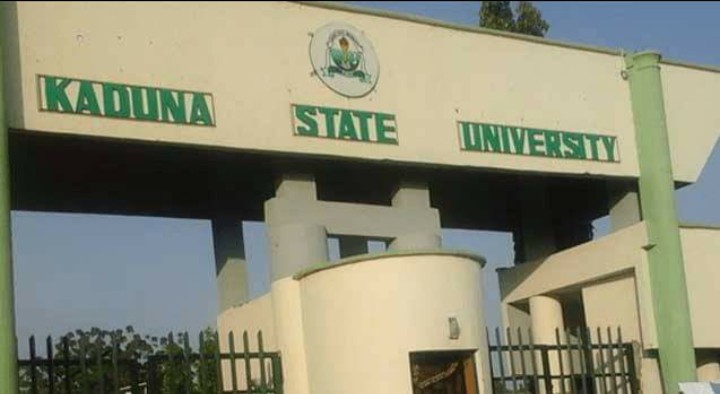
The management of Kaduna State University (KASU), Kaduna, has decided to back out of the ongoing strike embarked upon by the Association of Staff of Universities Union (ASUU) as the resumption date for academic activities is announced.
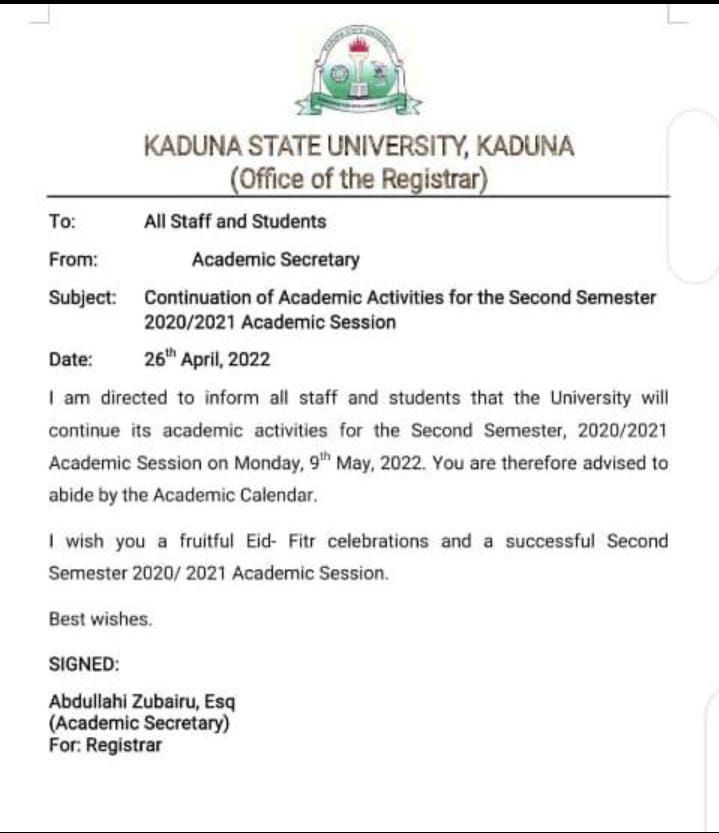
The resumption notice, which is contained in a statement by the institution’s Academic Secretary, Barrister Abdullahi Zubairu, said that “the University will continue its academic activities for the Second Semester, 2020/2021 Academic Session on Monday 9th May 2022”.
The Daily Reality learnt that the management has decided to resume in order to avoid stoppage of salary from the Kaduna State Government. The ASUU Chapter in KASU may likely clash with the management about the new development in the institution.
Recall that ASUU has condemned the Federal Government’s handling of the negotiation on its demands and nonchalant attitude towards the ongoing strike.
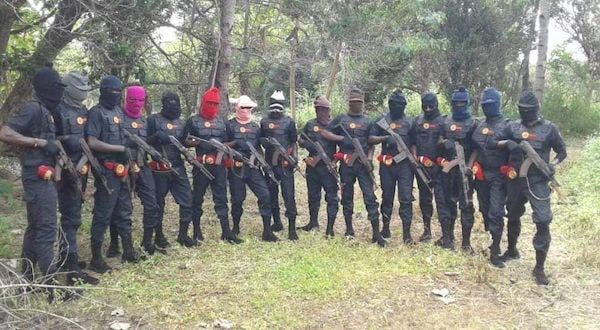
Imo: Nigerian military eliminate IPOB fighters, recover weapons
By Muhammad Sabiu
In a vicious fire battle along Orlu – Orsu Road on April 25, 2022, troops of the Nigerian Army’s 34 Artillery Brigade eliminated two gunmen and apprehended four other members of the proscribed Indigenous People of Biafra (IPOB) and its armed affiliate, Eastern Security Network (ESN).
This is contained in a Facebook statement signed by Onyema Nwachu (Brigadier General), the Director of Army Public Relations, via the verified handle of the Nigerian Army.
The statement read, “The troops, while on routine patrol, made contact with elements of IPOB/ESN around the general area of Aluminium Company and All Saints Church. On sighting the patrol team, the criminal elements opened fire and launched [a] grenade attack on the troops. The vigilant troops responded with superior firepower neutralizing two of the criminal elements, compelling others to flee in disarray.
“In a hot pursuit that followed the encounter, troops arrested four of the fleeing gunmen and recovered one AK 47 rifle, two magazines, one Police grenade launcher, two Baofeng communication radios, five mobile phones, one IPOB Beret, two Motorcycles, four SIM cards, five wallets containing different ID cards, afrodisiac [sic], charms and the sum of Sixteen Thousand Four Hundred and Sixty Naira only.”
The southeastern part of the country, which houses the secessionist Indigenous People of Biafra (IPOB), has been experiencing the violent activities of the Biafran agitators over the years.

Counting the cost: Comparing British Monarch and Prime Minister with Nigerian President and Traditional Rulers
By Aliyu Nuhu
The British Queen does not need to steal public funds. She was born rich and will never need to work or hold public office for her to live a comfortable life. This includes generations of her family, including the unborn.
The Queen had inherited private income that includes money from private estates, such as Sandringham and Balmoral Castle, and her personal investment portfolio. She even pays personal income tax to the British government running into millions of Pounds.
She also has 18,000 hectares of property, land and other assets in England and Wales. The income from the assets is called the Privy Purse and is used for the upkeep of the Queen’s private and official expenditure. In 2013, the profit from the Duchy was 19 million pounds.
Way back in 1760, King George III cut a deal with parliament to hand over the Crown Estate — a large portfolio of land and property now worth $15 billion, which includes most of the U.K.’s seabed, Regent Street in London and Buckingham Palace – to the Treasury. As part of this deal, the Monarch is entitled to a share of the profits of the Crown Estate. The Queen now receives the Sovereign Grant from the Treasury, which consists of 15% of the profits from the Crown Estate. In 2019, the Queen received $61 million, which goes to paying for royal travels, investitures, garden parties and the upkeep of official residences like Buckingham Palace.
Technically speaking the British Government does not spend a penny from taxpayers money on the Queen.
Moreover, the British Prime minister earns a salary of roughly 151,451 pounds annually, an equivalent of about 71m naira per annum. The PM takes care of himselt from the salaries including food except during state banquet where such bills are paid by the government.
On the other hand, the Nigerian president goes home with roughly 8m as salary. But President Buhari has “”magnanimously” slashed his salary by over 50% which brings down his take home to about 3m roughly. But that is not the end of the story.
The Nigerian president does not feed himself. Billions of Naira are budgeted for his food, drinks, clothes, electronics, furniture, cooking utensils and fuels. It is safe to say the salaries of a Nigerian leader is vague and unspecified. Only God knows how much is spent to maintain the president.
Similarly, the Nigerian traditional rulers on the other hand gave zero wealth to the states. The monies they squandered on luxurious lifestyles belong to LGs and State governments which by effect makes them lazy and economic parasites.
There is no need in going into the salaries of legislature at federal and state levels. We all know our bureaucracy is the costliest in the world with overhead that will never allow Nigeria grow. Unless we reduce the evil cost of governance and use the money for critical infrastructure, this nation will continue to run in circles.
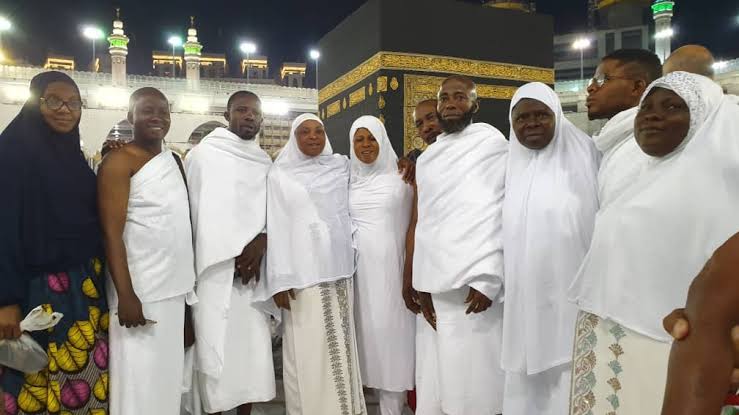
Too many people at Umrah this year: why?
By Ibrahim El-Caleel
I can’t understand this obsession with the population at Umrah this year. Some people are taking it too far. Asking why should people be going for Umrah when poverty is biting harder.
The Haramain have been under restricted access since the global Covid-19 blues in 2020. Extremely few people accessed the Haramain throughout the year 2020; just a little above that accessed it in 2021.
In 2022, the Haramain have resumed operations in full swing. The world has moved on Covid, becoming more attentive to Putin’s war.
If the Haramain has remained under restricted access for two consecutive years, commonsense should tell you that a lot of people will troop in immediately everything is back to normal. You have a ‘merger’ sort of attendees from three years – 2020, 2021 and 2022. Also, it is something of joy and divine praises that finally, we can visit the sacred sites to their fullest capacities.
This is only a fair idea on why it is this full. It could have even been fuller than this had it been its affordable.
You come across writings that “recommend” or “advise” Umrah attendees on a ‘better use’ of their money, towards feeding than lesser pilgrimage. We do so with all dictatorial might as if going to the Ramadan Umrah is a misplacement of priority. Social media has helped show how some of us can be more dictatorial than Hitler himself.
Why do we feel this sense of always telling rich people what to do with their money, especially in religious matters? The entitlement is beyond me.
Umrah is not a mere tourism. It is an act of worship. Umrah in Ramadan is even a more serious act of worship, lucratively rewarding with the sincere intentions.
In a hadith, Prophet Muhammad (Peace Be Upon Him) said, “an Umrah made in Ramadan is equivalent (in reward) with performing Hajj with me (the Prophet)”. This hadith is authentic, and has been transmitted by both Imamul Bukhari and Imām Muslim. At least.
This is why apart from Dhul Hijjah, Ramadan is the next month you see Muslims traveling to the Haramain Al-Shareefain. It is with purpose. They have the money to go after a specific huge reward, that’s why. In most cases those of us who don’t have money don’t even pay attention to ahādith like these. I remember the late Shaikh Albaniy Zaria in his Saheehul Bukhari lessons in Kitabuz Zakah. The Shaikh saw a lot of people sleepy, dozing off. So he said, one of the reasons why some people sleep off during Zakah lessons is because they don’t even have the wealth which qualifies for Zakah. They are not rich. This is why they find it hard to pay attention to understand the topic. Rahimahullah.
Therefore, Umrah and Umrah in Ramadan are not tourisms please. Rich people have their reasons for embarking on them. Good, valid reasons. Do not be talking as if they are misplacing priorities. Saying they should use the wealth to feed the poor, instead of doing Umrah. Do you know whether they are already doing so? Or since when did you become the divine regulatory directorate where people must come and confess their acts of deeds so that you are aware?
I think it is important we get down from this moral horse. You have an iPhone, a Redmi Note, an expensive Versace shoe, a Toyota Corolla. You buy 10gb mobile data monthly. Have you ever considered down-tiering from these things to cheaper things so as to use the differentials to feed the poor? Why don’t you sell off your Toyota and buy a Lifan motorbike, and use the balance to feed the needy in this Ramadan? After all, all you need is a transporting automobile. It doesn’t have to be a car, talk less of being a Toyota!
If you haven’t been doing this, do not get obsessed with ‘advising’ people on how to rank their Nawafil acts of deeds based on your perceived scale and degree of importance. It ain’t your place. It ain’t my place either.

Malaria: ‘Kano recorded over 2m hospital visits in 2021’ says commissioner
By Uzair Adam Imam
Kano State has recorded more than 2.8 million hospital visits due to the menace of malaria in 2021, the Commissioner for Health, Aminu Tsanyawa, said.
Tsanyawa spoke yesterday at a press briefing to commemorate 2022 World Malaria Day.
This, according to Tsanyawa, made the disease the single most common reason for about 60 per cent of outpatient visitations and consultations in Kano state.
However, Tsanyawa recalled that the Kano state government, in collaboration with its partners, did its best to mitigate the menace.
He said, “between July and October 202, the state government, in collaboration with its partners, administered more than 13,110,365 doses of malaria prevention drugs (sulfadoxine-pyrimethamine and Amodiaquine SP+AQ) with a view to preventing malaria and deaths in children under the age of five.”
Furthermore, Tsanyawa sounded a clarion call on residents to avail their children aged 3-59 months for the forthcoming 4-day cycles of mass distribution of malaria prevention drugs.
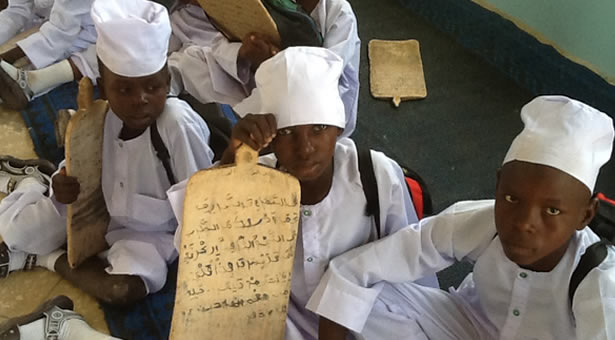
Islamiyya System: A perfect replacement for the archaic Almajiri system
By Muhammad Dattijo Kabir
Islamiyya system has been proven to be an alternative to the Almajiri system. In the Islamiyya system, it is easier to commit the Qur’an to memory within the shortest period with decency. And it also allows the children to seek other knowledge that will aid them in confronting the present challenges. Almajiri system can only be insisted to be reformed when it is proven that that is the only way to learn the Qur’an. The system poses a lot of danger to the children, such as health challenges, inferiority and, of course, most of them become morally debased in the end.
Reforming this system alternatively means rewarding irresponsible parents for their irresponsibility, creating unsustainable programs which cannot see the light of the day. Instead, the government should ban and criminalise the system and absorb all the already enrolled Almajiri into formal schools. Then any other parent that wants his child to learn the Qur’an by traditional means must first provide shelter, food, and health facilities for the welfare of the child and must ensure that the child goes to school to at least get primary education.
No one is saying karatun allo should be banned. Karatun allo differs in content and operation from the Almajiri system. While the former entails learning Qur’an by the traditional design by all and sundry, the latter entails recruiting young persons to learn Qur’an by traditional means without provision for food, shelter and medical facility for children recruited. The said recruited army of children relies only on begging leftover food and tattered clothes for subsistence.
It requires no second thought to believe that this system of taking young children away from their parents at the ages they need their parents the most should be stopped and criminalised. No child under the age of 12 should be taken away from his parents’ house in whatever guise. There is nothing good in the Almajiri system as practised today. The system has served and outlived its usefulness. It became archaic and, to some extent, barbaric considering the conditions of the children involved in the system.
There are more decent systems which are alternatives to the already abused system. The system indirectly supports irresponsible parents to breed bundles of children they know they cannot cater for. The parents use the system to abdicate their parental responsibility of feeding, clothing, educating and sheltering their children.
Also, the half-baked Malllams use the system as a means of income. The activists are using it to get themselves employment from international NGOs. The nagging question is, can Qur’an be learned through a more decent system than this child molesting system? The answer is yes. Thousands of children have committed the entire Qur’an to memory through the modern Islamiyya system.
Let’s move on; the system is not viable in the present era. The era of dogma has passed. Let every child be supported by his father and take Quranic education before his parents while attending school. Any system that encourages parents to take their children to the street is barbaric and should not be encouraged.
Muhammad Dattijo Kabir. Muhammad is a lawyer, a human rights activist and a public affairs commentator. He lives in Kaduna and can be reached via jibrilmuhammad27@gmail.com.

Nafisat Abdullahi, Naziru Sarkin Waka and our attack-the-messenger-to-discredit-the-message syndrome
By Ishaq Habeeb
I’ve met Nafisa twice, first at Zoo Road, Kano, hanging out with a friend who’s in business with many Kannywood industry people. Second, when I escorted a friend who visited Kano, Nigeria, from Niamey, Niger Republic. He had been pen pals with Nafisa for some time. So they agreed to meet whenever she’s in Kano.
After my initial attempts to dodge being part of making this meeting happen, I grudgingly agreed to link them up. But, aside from that, I don’t know Nafisa enough as an actress to know whether I like her or her movies.
I mostly remember her from the one-time popular song, “Bankwana sai watarana“, sang by Nazifi Asnanic. But following this Almajiranci debate, I already like her as an activist and looking forward to liking her as – hopefully – a good actress.
As for Naziru, I’ve met him several times. Besides being best friends with his childhood friend Rabiu Uba, I’ve had business reasons to visit his T/Fulani residence last year with Usman G. Abubakar and spent time with the singer in his living room. That aside, I am no fan of his mostly-political music. Nothing personal, just not my genre.
Now back to the original reason behind this write-up; the Almajiranci debate. My stand; Nafisat Abdullahi is right, so is Naziru Sarkin Waka. For those of us that know people in the Kannywood industry and have lived in Kano (the headquarters of Almajiranci in the world) long enough to see the horror of Almajiranci at its peak, we are in a better position to say they’re both right.
Victims of inadequate parenting primarily dominate both Kannywood and Almajiranci systems. Therefore, inadequate parenting is the monster we need to kill. Given that, bearing more children than one can adequately cater for is hugely responsible for bad parenting. This fact proves Nafisa and Naziru right.
Conclusively, the major problem lies with the people that make it their life’s calling always to attack messengers to discredit a message that often serves the good of all – however factual and tangible the facts in the message may be.
First, it was Digital Imam, speaking truth to Presidency on the escalating level of insecurity. Then Nafisat, for speaking out against Almajiranci, a menace we all agree needs urgent addressing. Then almost concurrently, Naziru, for speaking out against the prevalent immoralities in Kannywood, which is being perpetrated chiefly by victims of inadequate parenting.
Now, one can only pray, as a people, may we learn to hate our problems more than we love judging who’s reminding us of their presence for us to FIX them.
Ishaq Habeeb wrote from Kano via simplyishaqhabeeb@gmail.com.

Ronaldo could leave Man United this Summer—Danny Mills
By Muhammad Sabiu
Cristiano Ronaldo is one of eight Manchester United stars who could depart this summer, Danny Mills, a former Manchester City right-back, claimed.
According to Mills, Ronaldo, Paul Pogba, Eric Bailly, Victor Lindelof, Phil Jones, Jesse Lingard, Juan Mata, and Nemanja Matic might depart United at the end of the season.
Ronaldo has struggled since joining Manchester United from Juventus last summer, despite scoring 22 goals in all competitions for the Premier League giants.
Mills told Football Insider that making Ronaldo a part of the rebuilding process at Man United is pointless because Erik Ten Hag will take over from Ralf Rangnick.
“Ronaldo might be a difficult one, but I am sure somebody would take him. Remember, they didn’t pay too much for him. It’s not like they are going to take a huge hit in terms of a transfer fee.”
“Ronaldo still has something to offer, but if you are talking about a rebuilding process, and he’s only going to be there for one season, what’s the point? He becomes more of a hindrance than a help. Every time you lose, it is ‘Why is Ronaldo not playing?’ That is the difficulty that you have. If you’re going to start afresh, give yourself that opportunity to start fresh,” Mills was quoted as saying.

Almajiri and the road to Armageddon: Nafisa Abdullahi is right
By Aminu Mohammed
I have observed the raging debate over the Almajiri debacle in the last few days, especially the antagonism against a Kannywood actress Nafisa Abdullahi. The actress voiced out against parents who send their children to urban centres to memorise the Quran under the guise of an Almajiri system.
This issue resonates with me because I was once an “Almajiri”, though in a modernised form of learning. I was a product of Arabic and Islamic education. I am still grateful to my late father for seeing the wisdom in sending me to the College of Islamic Studies Afikpo, a boarding secondary school in Southeastern Nigeria funded by a Saudi Arabia-based International Islamic organisation Rabita Alamul Islam (the Muslim World League). Unlike some of my schoolmates who later studied Islamic studies at Islamic University Madina and Azhar University Cairo, Egypt, I decided to study International Studies at the Ahmadu Bello University, Zaria, against my father’s wish, whose dream was for me to be an Islamic scholar.
I am still at a loss wondering why the actress is being pilloried for telling the truth. If you ask these intellectual lilliputians and Nafisa’s traducers whether they will be comfortable sending their children out to beg on the streets under the guise of Quranic education, they will never say yes.
Before you call me “Karen farautar yahudawa”, an agent of Jews, which our people are fond of calling those who seek societal change and are in tune with modern realities, let me clarify that I did not attend a conventional secondary school. I advocate an integrated education system involving the acquisition of both western and Islamic education.
I will never advocate against memorising the Quran or acquiring Islamic knowledge because I was a beneficiary of that. At the boarding secondary school in Afikpo, Ebonyi state, we were taught Hadith, Fiqh, Balaga, Tafsir, Tajwid, Saqafa, Sirat, Ulumul Falsaf, Sarf and Nahw, among other subjects, by some Islamic scholars mainly from Pakistan, Egypt and India. I was able to speak Arabic with confidence on completing my secondary education. I even took some Arabic courses as an elective throughout my studies in Zaria. Even here in Germany, I still communicate with my neighbours from the Middle East in Arabic.
I am not worried that this article will generate antagonism in some quarters or be pilloried for triggering anger in some folks. But the truth of the matter is that we cannot continue on this trajectory. This system can no longer continue the way it is; otherwise, we may be heading towards the precipice.
The word Almajiri is derived from the Arabic word “Almuhajirun”, meaning a person who migrates from his locality to other places in the quest for Islamic knowledge. During the colonial era and a few years after that, the schools were maintained by the state, communities, the parents, ‘Zakkah’, ‘Waqf’ and augmented by the teachers and students through farming. “Bara”, begging as it is known today, was completely unheard of.
Mallams and their pupils, in return, provide the community with Islamic education, reading and writing of the Qur’an, in addition, to the development of Ajami, i.e. writing and reading of the Hausa language using Arabic Alphabets. Based on this system, which is founded upon the teachings of the Qur’an and Hadith, the then Northern Nigeria was broadly educated with a whole way of life, governance, customs, traditional craft, trade and even the mode of dressing.
However, the system was corrupted in the past few decades, with teachers sending the children to beg for food on the streets. Similarly, many irresponsible parents were unwilling to cater to their children. Thus, they send them away to cities to purportedly acquire quranic education.
The current Almajiri system is not only archaic but atavistic. We must tell ourselves the truth that society is drifting. What we are facing today regarding security challenges in the North will be child’s play if our people refuse to change their ways. There is no gainsaying that the future is bleak if what we can boast of is an armada of malnourished and unkempt children who are roaming the streets under the guise of Islamic education. Eventually, the children may not acquire any meaningful skills to become useful members of society.
I am not a prophet of doom and derive no joy in pessimism. But, I do not see a bright future for a region struggling with a depleted human resource, coupled with millions of underage children clad in tattered clothes with bowls roaming the streets begging for food. I do not foresee any meaningful progress and development in such a society.
I still recall, in 2012, when former President Goodluck Jonathan visited Sokoto to inaugurate the Almajiri Integrated Model School in the Gagi area of the Sokoto metropolis. This boarding school was equipped with modern facilities. As a journalist working with THISDAY Newspaper then, I was there at the commissioning and even interviewed the school’s principal Malam Ubaidullah, a few months after the inauguration. I was excited that there would be a gradual process of taking Almajiris off the streets, as was promised by former Sokoto governor Senator Aliyu Magatakarda Wamakko. However, the euphoria was short-lived as governments in the region neglected the programme while the school buildings rotted away.
I wonder why our people antagonise those who want the system to be reformed or outrightly banned in the North. Are we comfortable seeing underage children roaming the streets under such dehumanising conditions? Have we pondered over the looming famine in the Sahel as forecasted by global development organisations, of which Northern Nigeria is part due to climate change worsened by overpopulation? Are we not witnessing the level of insecurity pervading the region because of societal neglect and marginalisation caused by a rapacious elite?. Do we sit down and pray and wait for a miracle to happen while expecting that our problems will go away?
Already we are battling with banditry in the Northwest due to societal neglect of a segment of the society that we use to mock because of their ignorance. And things will even get worse in future unless drastic action is taken to reform the system to enable children to memorise Quran in a friendly atmosphere devoid of hunger and deprivation. The current Almajiri system is a pathway to perdition.
Parents should stop sending children to cities if they are not ready to cater for them. These children should stay in their localities and learn under a school system presided by their Islamic teacher or Malam. The state governments must engage those Quranic teachers and pay them a stipend. I know this is doable because the government has the means to do that.
Unfortunately, much resource has been wasted on frivolities instead of channelling it towards revitalising the Almajiri system. We must wake up from our slumber and direct our energies toward finding a way to tackle problems in our society. Taking action is the key, and I believe that is the only way we can expect to have stability and peace in the polity.
Aminu Mohammed is at the school of Sustainability, Christian- Albrechts- Universität zu Kiel, Schleswig Holstein, Germany. He can be reached via gravity23n@gmail.com or stu219013@mail.uni-kiel.de.

Zainul Abideen: An examplary charity giver
By Ibrahim A. El-Caleel
Zainul Abideen was the nickname of Imām Aliyyu bnul Husain (Rahimahullah). He was son to Sayyidna Al-Husain (R.A), and a grandson to the 4th Rightly Guided Caliph, Aliyyu bn Abi Talib (Radiyallahu Anhu) and the daughter of the Prophet ﷺ, Sayyidah Fatimah (R.A). Therefore, he was a great-grandson of Prophet Muhammad ﷺ. Thus, Zainul Abideen is a member of the Ahlul Bayt (Household of the Prophetﷺ). Twelver Shi’ites count him as their 4th Imam, even though he neither believed in nor endorsed their Rafidhi creed and methods, just as indicated by Abu Nu’aim in his ‘Hilyatul Awliya’ (3/136).
The above is a quick biography of this exemplary personality whose history we all deserve to read. He has a rich biography, owing to his religious devotion and Islamic scholarship.
In this brief note, I intend to highlight his mode of giving charity, hoping that we use it as a template or we benchmark it versus how some of us give charity today.
Al-Imamul Dhahabi narrated in his book, ‘Siyaru A’alamin Nubala’ that, Zainul Abideen used to take bread during the dark part of the night, and he would drop it at the doors of the poor and needy while people were asleep.
Nobody knew who was doing this generous act. But after his death, the generous act stopped immediately. This was how it was discovered that Zainul Abideen was indeed the person who used to give out charity at night. He hid his face from people because his ultimate goal was to be rewarded by Allah. He was neither interested in the gratitude of the beneficiaries, nor the validation of the public, nor was he expecting anything in return from this material world.
Meanwhile, during his lifetime, he was known with a famous saying that:
إن الصدقة في سواد الليل تطفئ غضب الرب
“Verily, the charity given out in the darkness of the night extinguishes the anger of the Lord (with his servant)”.
For his rich biography, read Al-Imamul Dhahabi in ‘Siyaru A’alamin Nubala‘, 4/387
What Zainul Abideen was doing was in congruence with what Islam recommends about concealing charity. Allah says in Qur’an 2, Verse 271:
إِن تُبْدُواْ الصَّدَقَاتِ فَنِعِمَّا هِيَ وَإِن تُخْفُوهَا وَتُؤْتُوهَا الْفُقَرَاء فَهُوَ خَيْرٌ لُّكُمْ وَيُكَفِّرُ عَنكُم مِّن سَيِّئَاتِكُمْ وَاللّه
بِمَا تَعْمَلُونَ خَبِير
“If you give charity openly, it is well. But if you hide it and give it to the poor, that is better for you. (Allah) will forgive you some of your sins. And Allah is Well-Acquainted with what you do.”
This explains that there is no problem with you making your charity publicly known, especially if you hope to encourage people to imitate you in righteousness. However, the verse is admonishing you that concealing the charity, hiding it from the public glare is better for you. This is because it helps protect you from riya (show-off) which can make you lose your reward in the sight of Allah. Whatever the case, beware that Allah is well-acquainted with what you are doing. He knows both your intentions and your actions.
Today, some people are fond of exposing their charities which takes them close to riya, if not already it is. After giving the charity in public, you will see them snapping and uploading pictures of the charity session they had on social media platforms. Only Allah knows which charity is submitted for His sake and which isn’t. However, you should be careful because Iblees (Satan) is crafty. He can easily spoil your acts of good deeds by leveraging certain loopholes. Your intention could be pure from the onset, but upon uploading the pictures on social media, Satan would put in whispers to you to corrupt your initial intention and now look forward to trend; to gather ‘likes’, ‘retweets’ and ‘shares’ on Facebook, Twitter and Instagram. This is where riya might set in and destroy a noble cause.
For Allah and His Messenger (Peace Be Upon Him) to recommend concealment of charity, then there is a deep wisdom in such. Perhaps this is why predecessors like Zainul Abideen, for example, resorted to completely hide their faces from their charity. They sought to protect themselves from the whispers of Satan who has sworn to lead the humankind astray.
If you are coordinating a charity program on-behalf of an organization, or a group of people, and there are trust concerns, then it is better you create a small medium through email or social media messengers to send them proof of execution of the project. They are the people whom you might owe a proof of execution of the project. Secondly, in the course of mobilizing for funds through adverts, you may want to hide the faces of the beneficiaries because it appears improper to use someone’s predicament to publicize your financial aid program.
May Allah protect our good deeds from the corruption of riya, ameen
May Allah accept our good deeds and forgive our shortcomings, ameen.
El-Caleel writes from Zaria, Kaduna State.