Donald Trump

Major US TV Networks Suspend Trump Coverage After CNN Ban

By Sabiu Abdullahi

Five major United States television networks have suspended their pooled coverage of President Donald Trump after the White House barred CNN from carrying out its scheduled role as the television pool provider.

ABC News, CBS News, NBC News, Fox News and CNN jointly announced the decision on Monday, September 21, 2026, following the Trump administration’s move to prevent CNN from participating in the rotating pool system.

The decision means that the major networks will not provide the usual shared television footage of Trump’s presidential events for the time being, including his engagements at the White House and his trip to New York for the United Nations General Assembly.

The five networks defended the importance of independent media coverage in a joint statement.

“The public has a vital interest in receiving accurate, independent information about its government,” they said.

“No administration should restrict a news organisation because it objects to its reporting.”

The action came after the White House removed CNN from its scheduled pool assignment for Monday. CNN had been due to provide the rotating television coverage, under an arrangement through which the five networks take turns recording presidential events and distributing the footage to other broadcasters.

Bryan Boughton, Fox News’ Washington bureau chief and chair of the television pool, notified other members of the arrangement that no replacement would be provided for CNN.

“This is to advise that, effective today, the TV pool will not be covering events designated as pool coverage of the President. This follows the White House’s position preventing CNN from fulfilling its duties,” Boughton wrote in an email.

The television pool is designed to allow one designated network to cover presidential events with cameras and share the resulting footage with other news organisations. The arrangement is particularly important for events where physical space limits the number of journalists and camera crews that can participate.

The dispute follows the Trump administration’s decision to bar CNN, MS NOW and Politico from the White House.

The three media organisations subsequently filed a lawsuit against Trump and senior White House officials in a federal court in Washington, alleging that their exclusion violated constitutional protections for freedom of speech and the press.

The outlets are seeking a temporary restraining order that would restore their access to the White House while the legal challenge proceeds.

Trump has defended his administration’s action, accusing the affected organisations of publishing what he described as “fake news” and arguing that the White House has the right to restrict access.

Vice President JD Vance also defended the administration’s position, saying the White House was not banning media organisations but was declining to provide special access to outlets it believed were engaging in propaganda.

However, the networks’ decision to suspend the television pool has created an unusual situation in which the five broadcasters that normally share responsibility for filming Trump’s presidential engagements have declined to provide a replacement crew.

The suspension could limit the availability of pooled television footage of Trump’s public engagements, including his activities surrounding the UN General Assembly in New York. Other journalists may still cover the events, but the normal shared television feed will not be available through the five-network pool.

The latest confrontation is part of a wider dispute between the Trump administration and several US media organisations over press access to the White House.

The legal challenge by CNN, MS NOW and Politico now places the dispute before the courts, while the decision by the five major television networks has intensified the standoff over media access and presidential coverage.
Trump Bans CNN, MS NOW And Politico From White House Over Critical Coverage

By Sabiu Abdullahi

US President Donald Trump’s administration has announced an immediate ban on CNN, MS NOW and Politico from the White House, Al-Jazeera reports.

The decision followed Trump’s criticism of the three media organisations over their coverage of his administration.

Trump expressed his displeasure in a social media post on Friday, accusing the outlets of publishing what he described as false reports about him, his government and the United States.

He wrote that the organisations were “‘reporting’ FAKE NEWS!” before adding, “Other Fake News Media Outlets to follow,” suggesting that further media restrictions could follow.

The White House announcement has raised questions about press freedom and the constitutional rights of journalists to cover the US government.

Reporting from Washington, Al Jazeera correspondent Alan Fisher said the decision would likely face a legal challenge.

“This will be challenged, probably before the end of the day,” Fisher reported. “The United States has the First Amendment [of its Constitution] that says the government cannot restrict access to this sort of thing.”

Fisher noted that previous US presidents had also expressed anger over unfavourable media coverage and considered restricting access to the White House.

“Other presidents have been angry at the press coverage before. Linden B Johnson used to rail about it. Richard Nixon wondered whether or not he could ban certain people from the White House as well,” he said. “At every point they were told it’s not a good look.”

The development is expected to generate further debate over the relationship between the Trump administration and the American media, particularly concerning the limits of presidential authority and the First Amendment’s protection of press freedom.

Trump Threatens To Cut Trade Ties With Countries Running US Deficits

By Sabiu Abdullahi

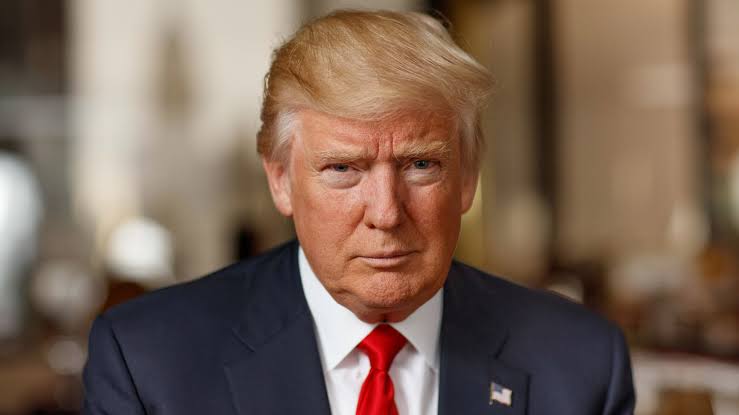
US President Donald Trump has threatened to sever trade relations with some countries that maintain trade surpluses against the United States, signalling the possibility of another escalation in global trade tensions.

Trump disclosed the plan on Sunday while speaking to journalists before departing Ireland, where he said the US must take tougher measures to address trade imbalances with other nations.

The president said his administration would consider ending trade with countries that consistently export more to the US than they import.

“I’m going to do that (cut off trade) with some nations,” he affirmed. “We don’t want to have deficits with nations. We want to have surpluses, or at least break even.”

Trump’s latest position follows heightened trade tensions with Canada in recent weeks. The dispute has involved increased tariffs, tighter trade restrictions and retaliatory measures.

The US president also addressed questions about the 2028 presidential election and Vice President JD Vance’s possible candidacy.

Trump described Vance as “terrific” but said it was premature to indicate whether he would support him for the presidency.

“It’s too early,” Trump said, adding, “We have so many terrific people.”

On his political standing, Trump dismissed recent opinion polls that have shown varying levels of public support for his administration.

He described the polls as “fake” and insisted that his approval rating remained strong based on what he called “only the legitimate pollsters.”

Trump also announced that the United States would remove the 15 per cent tariff imposed on Irish whiskey.

During his remarks, he renewed his support for the reunification of Ireland, arguing that, “it is natural to put north and south together.”

However, when asked whether Scotland should become independent from the United Kingdom, Trump declined to take a position.

“I won’t talk about that one, I’ll save that for another day.”

Trump Renames Lake Ontario ‘Lake America’ Amid Tensions With Canada

By Sabiu Abdullahi

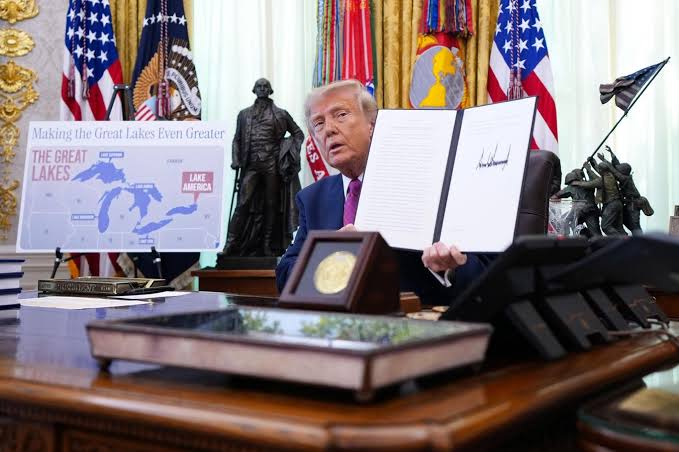
US President Donald Trump has signed an executive order changing the name of Lake Ontario to “Lake America”, in a move that has added a new dimension to the growing tensions between the United States and Canada.

Trump announced the change on Thursday after signing the order at the Oval Office.

“This is official, effective immediately,” Trump said.

The president also said he had completed the required procedures for the renaming.

Trump said he had “filed all the necessary papers, documents, everything else” for the name change and “notified all of the various people that we have to notify”.

Lake Ontario is one of North America’s five Great Lakes. It lies along the Canada-US border, with the Canadian province of Ontario located to its north and New York State in the United States to its south.

The other Great Lakes are Huron, Michigan, Erie and Superior. Together, the five freshwater bodies contain about one-fifth of the world’s surface freshwater.

The lake has been known as Lake Ontario for centuries. Its first known appearance under that name on a map dates to 1656, although historians believe the name was already in local use before then.

Trump’s executive order justified the new name on the grounds that most of the lake’s volume lies within US territory.

The order stated that “the deepest parts of the Lake’s waters lying within United States territory, the United States claims most of the Lake’s volume” and that the lake has “long been an integral asset to American exploration, settlement, commerce, and defense”.

However, it remains unclear whether the name change will be recognised outside the United States because geographical names are not governed by a single international authority.

Canada Rejects New Name

Canada has already indicated that it will continue to use the traditional name.

Earlier in the week, before Trump signed the order, Canadian Industry Minister Mélanie Joly said: “We’ll always call it Lake Ontario”.

Lake Ontario was formed after the last Ice Age from the earlier Lake Iroquois about 11,400 years ago.

By the mid-18th century, before the American Revolution and the eventual establishment of Canada and the United States, Lake Ontario had become the established name.

The name “Ontario” is believed to have Iroquoian origins. The Canadian Encyclopaedia says it may mean “beautiful lake” or “sparkling water”, while some historians interpret it as “vast body of water”.

French missionary records from around 1641 also referred to the body of water as Lake Ontario. The Canadian province of Ontario later adopted the name when it was created at Confederation in 1867.

Trump Links Move To Previous Renaming

The decision follows Trump’s earlier attempt to rename the Gulf of Mexico as the “Gulf of America”.

Trump referred to the two renaming decisions while speaking about Lake Ontario.

“We have a gulf and we have a lake. Now all we need is an ocean so maybe we’ll have to change the name of the Atlantic and/or the Pacific,” Trump said, referring to the bodies of water on either side of the US coastline.

The latest move comes amid renewed tensions between Washington and Ottawa after trade negotiations between the two countries broke down late Friday.

The United States subsequently imposed 50 percent tariffs on billions of dollars’ worth of Canadian exports, further straining relations between the neighbouring countries.

Trump Says US ‘Not in A Hurry’ as Iran War Negotiations Continue

By Sabiu Abdullahi

US President Donald Trump has said Washington is not under pressure to reach an immediate agreement with Tehran as efforts continue to end the US-Israel war on Iran.

According to Al Jazeera, Trump said both economic and military pressure remained effective, adding that he was “not in a hurry” to conclude negotiations with Iran.

Meanwhile, Iran says it has made considerable progress in restoring infrastructure damaged during the conflict and has strengthened its military capabilities.

Iranian army spokesperson Mohammad Akraminia said the country had rebuilt significant parts of the infrastructure destroyed during the war. He also said Iran had received new military equipment as part of efforts to reinforce its defence capacity.

On the diplomatic front, Iran’s deputy foreign minister for legal and international affairs, Kazem Gharibabadi, said the Strait of Hormuz remained closed despite a temporary transit arrangement reached with Oman.

Gharibabadi said the waterway would not be fully reopened until the United States returned to its obligations under a June 17 memorandum of understanding.

The Strait of Hormuz is a major international shipping route through which a substantial portion of the world’s oil supplies passes, making its continued closure a major concern for global energy markets.

The US State Department, meanwhile, told Al Jazeera that Washington was taking “concrete action to end” what it described as a long-standing threat from Iran.

According to the department, the US is targeting Tehran’s remaining sources of funding and preparing additional measures after imposing recent sanctions.

The developments come as tensions remain high across the region, with Israel also accused of continuing attacks in Gaza despite a ceasefire that was implemented last October.

At least seven Palestinians were killed in Israeli attacks across Gaza on Tuesday, according to reports, raising fresh concerns over the durability of the ceasefire and the humanitarian situation in the territory.

Canada to Impose Retaliatory Tariffs on US Goods From September 8

By Sabiu Abdullahi

Canada has announced plans to impose fresh tariffs on selected goods from the United States after Washington introduced a 50 per cent levy on about $20 billion worth of Canadian products.

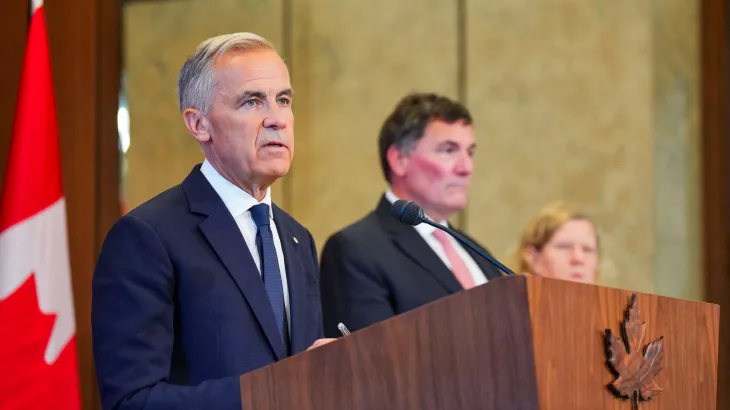
Canadian Prime Minister Mark Carney announced the decision in Ottawa on Saturday, saying the new measures would affect US steel, dairy products, appliances, agricultural equipment, pulp and paper, electronics and other goods.

The tariffs are expected to take effect on September 8.

“Canada will match Washington’s new tariffs dollar for dollar in order to protect Canadian workers, farmers, families, and businesses,” Carney told reporters.

The decision followed the collapse of trade negotiations between the two countries after several days of discussions. Carney said the United States had presented conditions that Canada could not accept.

“In recent days, the United States proposed new terms that were uneconomic, unfair and undermined the net benefits for Canada, and called into question the reliability of any deal,” Carney said, adding these demands included curtailing Canada’s ability to forge new trade deals.

“We cannot accept what they’ve offered, and we will not give what they’ve asked.”

Carney also accused US negotiators of making unacceptable “threats” concerning the French language and “Quebec culture”.

The latest US tariffs affect several Canadian exports, including wine, furniture, dairy products, cement, clothing, fishing rods and hockey equipment. The affected goods represent about 5.5 per cent of Canada’s exports to the US.

Reacting to Carney’s announcement, US President Donald Trump wrote on Truth Social, “Canada wants the benefits of being a State, without being one!!!”

Trump also claimed that Canada had imposed “massive amounts” of tariffs on US farmers for years and added, “No more!!!”

Carney said Canada would also introduce support measures for industries affected by the new US duties. He said the government would provide more details on the retaliatory measures in the coming days.

The trade dispute is expected to put additional pressure on the Canadian economy. Al Jazeera correspondent David Mercer said the tariffs could lead to higher costs, increased prices and rising unemployment.

“Costs are going to go up, prices are going to go up, unemployment is going to go up as well,” Mercer said. “And it’s been warned that business owners – small [and] medium-sized businesses – some of those will have to declare bankruptcy.”

Mercer said Carney was also using the dispute as an opportunity to expand Canada’s economic links with countries outside the United States.

“He’s been around the world, he’s been talking to countries in Asia, in Europe, shoring up new trade relationships, wanting to diversify Canada’s economy and Canada’s trade relationships with other countries around the world just to get away from that dependency that Canada has traditionally had on the United States,” he said.

Ontario Premier Doug Ford supported the Canadian government’s decision to retaliate against the US tariffs.

“I’m glad he didn’t sign that deal because it was a bad deal. It was a bad deal for Ontario. It was a bad deal for the auto sector, the steel sector, and manufacturing sector,” Ford told reporters on Saturday.

Some Canadians have expressed concern about the possible impact of the trade dispute on household expenses.

“I think probably the gas will go up even more, and all products, from food to, I don’t know, wood, everything else,” said Pamela Coulis, a resident of Fort Erie.

Another resident, Stuart Edwards of Port Colborne, said the trade dispute would “hurt everybody” and described the situation as “just sad”.

“We have a bully in Washington, and he’s just hitting us all with the big stick all the time,” he said. “And we’re not going to put up with it; Canada isn’t. We’ll fight back.”

Diamond Isinger, a former special adviser to ex-Canadian Prime Minister Justin Trudeau, said both countries would face economic difficulties as the dispute continues.

“It’s going to cause pain and challenge for Canadians and Americans alike – in terms of the actions that, unfortunately, the US has taken as well as Canada’s retaliation. But ultimately this was the way forward; this was the only realistic next step,” she said.

“Because the US administration responds best, of all the responses that they could have, to all the actions that a government like Canada could take, to strength,” Isinger added.

“So, we could not simply accept 50 percent tariffs going forward. We had to move forward with our own retaliatory package.”

US Trade Representative Jamieson Greer said no fresh negotiations had been scheduled with Canada.

“We’re moving forward with measures that respond to Canadian retaliation,” Greer said. “They’ve always had the best deal, and they still would have an even better deal, but they didn’t want that.”

The escalating dispute has also drawn criticism from some US Democratic lawmakers and governors, who accused Trump of increasing economic pressure on American businesses and families.

“Needlessly picking fights with our allies and raising prices here at home. That’s Trump’s economic policy in a nutshell,” New York Governor Kathy Hochul posted on X.

The Business Roundtable, which represents about 200 chief executives of major US companies, also warned that the new tariffs “risk raising costs for American businesses and families” and called on Canada and the United States to return to negotiations.

Trump Secretly Flown From Turkey To UK Amid Alleged Iran Assassination Threat

By Sabiu Abdullahi

US President Donald Trump was reportedly moved from Turkey to Britain aboard a smaller military aircraft last month after US authorities received what they considered a credible threat from Iran, The Washington Post and The New York Times reported on Tuesday.

The reported security operation occurred during Trump’s visit to Ankara for a NATO summit attended by several world leaders.

According to The Washington Post, Trump initially boarded the former Air Force One in front of television cameras. He was later transferred to another aircraft through an airport catering truck that is normally used to deliver meals and supplies to planes before departure.

A US official told the newspaper that the move was prompted by a credible threat linked to Iran.

The New York Times separately reported that the White House concealed Trump’s actual location from journalists and some members of his travelling staff.

The White House had earlier stated that Trump left Turkey on July 8 aboard the former Air Force One. Trump had also said on Truth Social that he intended to use the older Boeing 747 instead of the newer Boeing 747-8 aircraft donated by Qatar, which had taken him to Turkey.

The Qatar-donated aircraft was on its first international trip during the NATO visit. Its security features and planned modifications had previously attracted public attention.

Before departing Ankara, Trump said he would use the older blue-and-white presidential aircraft “for old time’s sake” to travel to RAF Mildenhall in Britain. He said the newer aircraft would also stop at the British airbase so US military personnel stationed there could inspect it.

However, The Washington Post reported that Trump was first taken aboard a third aircraft before being transferred to the older Air Force One shortly before departure.

The reported operation allowed Trump to enter the older presidential aircraft through a different entrance before later appearing on its stairs in public, creating the impression that he had travelled aboard the plane throughout the journey.

Members of the travelling press pool were reportedly told to keep the window shades in their section closed during the flight.

Some White House personnel travelling with Trump were also reportedly unaware that he was not aboard the aircraft they believed was carrying him.

Reporters later asked Trump why they had been instructed to keep the window shades closed. He responded jokingly that they were “probably on a dangerous flight.”

“But if I go, you go. Right?” Trump added.

The C-32A aircraft reportedly carrying Trump landed in Britain at about 10:20pm local time. The former Air Force One and the media aircraft arrived separately several minutes later.

Trump’s travelling press pool said he came out of the older Air Force One at about 10:56pm. He reportedly gave reporters a peace sign, greeted US service members and proceeded towards the aircraft donated by Qatar.

The reported security manoeuvre was similar to an operation carried out during former US President Bill Clinton’s 2000 visit to Pakistan. Clinton reportedly used an unmarked executive aircraft to enter the country while Air Force One served as a decoy.

White House Communications Director Steve Cheung, in response to questions about the reported operation, said the Qatar-donated aircraft had been fitted with high-level security measures to protect Trump and his staff.

“As the president has said recently, there are many enemies of America who have their sights on him, and we use every tool at our disposal to address those threats,” Cheung said.

Iran Dismisses Trump’s Claim, Says It Never Asked US To Halt Strikes

By Sabiu Abdullahi

Iran has dismissed United States President Donald Trump’s claim that Tehran asked Washington to refrain from launching fresh military strikes, describing the allegation as false.

According to Iran’s Mehr News Agency, which cited military officials, Trump’s statement “was nothing but a new lie.” The officials also said the country’s armed forces were “on high alert and ready for any eventuality.”

Trump had stated on Saturday that the United States was “ready to go against the Islamic Republic.” He also claimed that Iran and other Middle Eastern countries had urged him not to carry out additional attacks. He added that he agreed to delay any fresh military action on the condition that a deal could be reached with Tehran.

In a post on his Truth Social platform, Trump wrote, “This would include the Immediate, Complete and Total OPENING OF THE HORMUZ STRAIT, and an end to Iran’s nuclear threat.”

Meanwhile, Iran’s Fars News Agency quoted a source close to the country’s negotiating team as saying “as long as the United States maintains its hostile actions, the Strait of Hormuz will remain closed.”

Iran has maintained restrictions in the Strait of Hormuz since the conflict began. Ships are now required to obtain permission and pay transit fees before passing through the strategic waterway.

Trump Cancels Planned Iran Strikes, Says Deal Is Within Reach

By Sabiu Abdullahi

US President Donald Trump has announced that he has cancelled planned military strikes against Iran, saying the decision depends on the swift conclusion of an agreement.

In a statement, Trump said he called off the attacks “subject to being able to rapidly make a deal”.

He also claimed that Iran and other Middle Eastern countries had urged him to suspend the planned operation because “the perimeters of a deal has been agreed to”, including the reopening of the Strait of Hormuz.

Trump’s announcement followed fresh warnings from Iran over the possibility of military action.

Iranian Foreign Minister Abbas Araghchi told the foreign ministers of Turkiye, Pakistan and Saudi Arabia in separate telephone conversations that any “aggression” by the United States and Israel would be met with a “decisive ⁠and proportionate response”.

Meanwhile, the conflict in Gaza continued as Israeli forces reportedly killed at least eight Palestinians across the territory.

Reports also said Israeli attacks destroyed a medical warehouse in Deir el-Balah. The strike left a crater measuring about 20 metres (66 feet) wide and 10 metres (33 feet) deep.

Trump Warns UK’s New PM on Immigration Crisis

By Abdullahi Mukhtar Algasgaini

United States President Donald Trump has urged new British Prime Minister Andy Burnham to take immediate action against illegal migration, warning that the issue is “killing” the United Kingdom.

In an interview with GB News on Wednesday, Trump said Burnham would eventually be forced to address immigration despite initially avoiding the subject after taking office.

“He’s going to have to mention it because it’s killing your country,” Trump told the broadcaster.

The US president claimed migrants were arriving from multiple regions, including Africa, South America, and parts of Asia.

“They’re invading Europe,” Trump warned, adding that “the UK is a prime suspect.”

Trump’s comments came on the same day that more than 500 migrants crossed the English Channel into Britain, with people smugglers launching 11 small boats from various points along the French and Belgian coastline.

The remarks also come as Burnham’s government continues to face scrutiny over its plans for handling asylum seekers.

When asked earlier this week whether the Prime Minister wanted asylum hotels to be closed, a Downing Street spokesman said: “The work on that continues,” adding there was “no change in that work being carried out by the Home Secretary in her department.”

According to Home Office figures, 172 people crossed the Channel on the Wednesday of Burnham’s first week in office, followed by 366 on Thursday and another 103 on Friday.

Trump reflected on his early interactions with the British leader, saying Burnham had a “big job ahead of him” on his first day in Downing Street.

Describing a recent telephone conversation between them, Trump said it was “interesting, and went very well,” adding that he wished the Prime Minister “GOOD LUCK AND GODSPEED.”

While the two leaders have maintained relatively stable relations during Burnham’s opening weeks, North Sea oil drilling has emerged as a potential point of disagreement.

The day before Burnham succeeded former Prime Minister Sir Keir Starmer, Trump urged him to expand North Sea oil drilling, claiming it would transform the UK “from a poverty stricken disaster, to one of the richest countries anywhere in the world.”

Sources in Washington have reportedly expressed concern over Burnham’s appointment of Ed Miliband as Foreign Secretary, citing his previous criticisms of Trump.

Behind the scenes, efforts to strengthen UK-US relations are continuing, while Burnham has maintained Britain’s policy of allowing US forces to use British military bases for what the government describes as “defensive” strikes linked to the conflict involving Iran.