By Sabiu Abdullahi
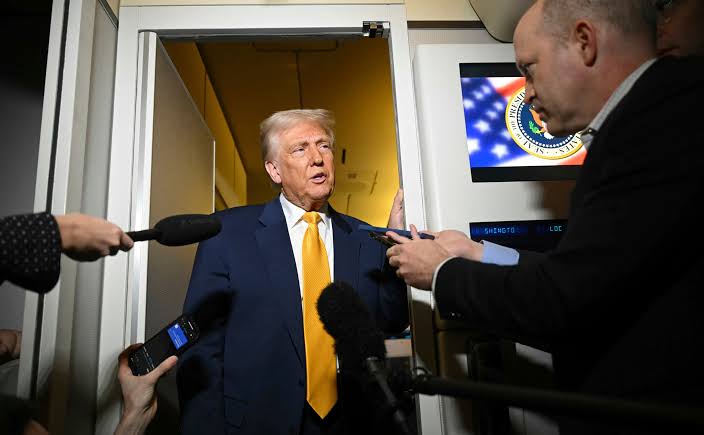
United States President Donald Trump has declared that he is “not open” to granting concessions to Iran as diplomatic efforts continue over the ongoing conflict involving Washington, Tehran and Israel.
Trump’s remarks came after Iranian authorities confirmed that they had sent a response to the latest American proposal through Pakistan, which is serving as a mediator in the talks.
The latest developments emerged amid growing international concern over security, energy supplies and humanitarian conditions across the Middle East.
Russia’s Foreign Minister Sergey Lavrov defended Iran’s right to pursue uranium enrichment for civilian purposes. Speaking at a news conference in Moscow, Lavrov said, “Iran, like any other member of the Non-Proliferation Agreement, has the full right to enrich uranium for peaceful purposes.”
He also stressed that Russia would not obstruct ongoing diplomatic efforts between Washington and Tehran.
“We will support any resolutions agreed upon and accepted by the negotiating parties themselves. In this case, the United States and the Islamic Republic of Iran,” Lavrov said, according to Russia’s Interfax news agency.
Meanwhile, Iran announced plans to tighten its oversight of the Strait of Hormuz through the creation of a new body known as the Persian Gulf Strait Authority. Iranian officials said the authority would provide real-time operational updates concerning the strategic waterway, which handles a large share of global oil and gas shipments.
Reports also indicated that Tehran plans to introduce an insurance scheme for vessels operating through the Strait of Hormuz and nearby Gulf waters. According to Iran’s semi-official Fars news agency, transactions linked to the insurance arrangement would be settled through cryptocurrency payments.
Iranian Foreign Minister Abbas Araghchi also held discussions with Saudi Foreign Minister Faisal bin Farhan Al Saud. Iranian state media said both officials discussed regional developments and diplomatic contacts between Tehran and Washington.
Germany joined calls for restraint after fresh attacks in the Gulf region. German Chancellor Friedrich Merz condemned attacks targeting the United Arab Emirates and other regional allies.
“Attacks on nuclear facilities pose a threat to the safety of people throughout the entire region. There must be no further escalation of violence,” Merz wrote on social media.
He further urged Iran to resume negotiations with the United States, halt threats against neighbouring countries and ensure unrestricted access through the Strait of Hormuz.
In the occupied Palestinian territories, the Palestinian Foreign Ministry criticised Israel’s reported decision to seize the headquarters of the United Nations Relief and Works Agency (UNRWA) in East Jerusalem’s Sheikh Jarrah area.
Palestinian officials warned that the move represented a “dangerous precedent” that could undermine international law. They said Israeli authorities planned to construct army and security facilities on the site, reportedly under the cover of establishing a museum.
Elsewhere, the Gaza Health Ministry said the territory’s medical system had suffered severe damage during the war. Officials stated that more than 76 percent of medical imaging equipment had been destroyed.
According to the ministry, all MRI services in Gaza have stopped after the destruction of nine machines. Only five of the enclave’s 18 CT scanners remain operational, while many X-ray machines are reportedly worn out and frequently malfunctioning.
The United Arab Emirates also condemned a recent drone strike targeting the Barakah nuclear power plant. UAE Minister of Industry and Advanced Technology Sultan Al Jaber described the attack as “a terrorist attack on a peaceful project, built to the highest safety standards, that powers homes, hospitals, and industries across the UAE.”
Authorities in the UAE said investigations were ongoing to determine the origin of the drones, which reportedly entered the country’s airspace through the western border.
In Europe, Polish Prime Minister Donald Tusk called for stronger cooperation between Europe and North America amid tensions between the United States and NATO allies over the conflict involving Iran.
“It is the task of all of us here in Poland, in Europe, across the Atlantic, in the US, in Canada, to ensure that transatlantic cooperation regardless of various political variables survives this difficult period,” Tusk said.
Tensions also escalated after organisers of the Gaza-bound Global Sumud Flotilla announced that Israeli authorities detained several participants, including Dr Margaret Connolly, sister of Irish President Catherine Connolly.
In a pre-recorded message released by organisers, Connolly stated: “If you are watching this video, it means I have been kidnapped from my boat in the flotilla by the Israeli occupying forces, and I’m now being held illegally in an Israeli prison.
“I am so proud to be taking part in this flotilla – it is the largest to date.”