Month: May 2026

Upending Unanswered Prayers, Unlike Ye

By Ugochukwu Ugwuanyi

Kanye West, better known as Ye, is an American songwriter and rapper with 24 Grammy Awards under his belt. Some comments he made several months ago have resurfaced on social media when his daughter disclosed her ambition to be a pastor. The convenient coincidence seemed more like a ploy by dark forces to dampen the impact of the piercing message delivered by Northwest, the child of Kanye and Kim Kardashian. 

Joined by her mother in an interview with Entreview Magazine last week, North said it is her passion to learn more about God and sharing the Gospel to help others. The teenager expressed her resolve to “tell people about God, and how problems get solved if they follow His word and His ways”. Indeed, North’s words are didactic enough to strengthen the backsliding believer. It even goes to the heart of her dad’s exasperation when he said the following: “I am a Christian, but I have my issues with Jesus. There’s a lot of stuff I went through, and I prayed but I didn’t see Jesus show up… We’re so into the belief that prayer is all we need to solve our problems. But we ain’t praying our way out of prison. These prayers ain’t working. We have to apply actual physical work.” 

If that were the way to go, Luke 18:1 wouldn’t have demanded that “Men ought always to pray and not faint.” With North asserting that people’s problems get solved when they follow God’s word and His ways, isn’t it wondrous how God has used the daughter to correct her father? From God’s Word, you will know His ways, the application of which is the solution to our problems. Let’s hope that Ye has repented of his issues with Jesus. If only he had sought to know God better, as his daughter recommended, he would have realised that nothing is as effective as prayer. That’s what the Word of God says. Let God be true and every man a liar. 

Now, many a Christian must have at one point, or another found themselves in Kanye’s quandary, thinking that this faith thing isn’t working. They must have cried their hearts out to God for intervention without answers, as if it isn’t the same God about whom Matthew 7:11 testified: “If you then, being evil, know how to give good gifts to your children, how much more will your Father who is in heaven give good things to those who ask Him!” 

Whenever there is no proof of prayer, the supplicant should, before giving up on God, check how they went about praying. With Jesus declaring in Matthew 6:7 that “when you pray, do not use vain repetitions as the heathen do,” how then do you expect God to answer prayers made as animists would to their god? If He does, won’t those gods take the glory? 

The concluding part of the scripture pointedly says, “For they think that they will be heard for their many words.” To be clear, repetition of a prayer request isn’t what is being condemned here. After all, Jesus, in the Garden of Gethsemane, prayed three times, “O My Father, if it is possible, let this cup pass from Me; nevertheless, not as I will, but as You will” (Matthew 26:39). The unacceptable “vain repetitions” in reference is rendered in other translations as “babble,” “empty phrases,” “ramble”. The Contemporary English Version defines it as: “talk on and on as people do who don’t know God.” In other words, the phrase means saying many things of nothing! 

The point must be made that too much talking isn’t necessary for effective praying. Christians only betray ignorance of their identity in Christ and shallow confidence in God when they babble at the prayer altar. When they pray as if they need to convince God, it’s because they don’t see Him as their Father. This makes them beat about the bush (pardon the cliche) when they should go straight to the point. Duration doesn’t determine the potency of prayers because much of that time is usually spent blabbing.

Why use too many words to convey your plight to the God who Matthew 6:8 says already knows what’s in our hearts before we ask Him?  We shouldn’t be praying to inform God since He is more informed about our predicament and needs than we will ever know. We can barely present our causes to Him because our language of expression is deficient, hence our need for the Holy Spirit to intercede on our behalf (Romans 8:26). 

The saints’ approach to prayers must show their conviction that they are asking of the Lord with the capacity to meet all their needs according to the riches of His glory in Christ Jesus (Philippians 4:19). We don’t have to pray to convince God because He is liberal and gives liberally. James 1:5 says, “God gives generously to all without finding fault.” He is therefore kind enough to give without us asking, as has been the case with our basic needs. 

Here is something else that seems rather simplistic yet is a proven route to receiving answers to prayers: the lifting up of holy hands while praying. The same way that the stretching of arms skyward exercises the body, especially while standing, that is how it exercises your faith when done in the place of prayer, praise and worship of the Lord. Lifting holy hands isn’t merely a gesture but a spiritual signal of triumph. Since faith requires a corresponding action to deliver, outstretched arms can be the catalyst for victory.

This calls to mind what happened during Israel’s battle with Amalek as documented in Exodus 17. Israel prevailed as long as Moses’s hands were lifted, but when his hands grew weary and came down; their opponents dominated the war front. The hands of Moses were so instrumental that Aaron and Hur cleverly devised a means for Moses’s hands to be perpetually lifted. That way, the Israelites carried the day. What a winning strategy the stretching of hands towards Heaven is! 

It is the Eagle that stretches its wings that gets to soar above stormy clouds. There is a sense in Apostle Paul recommending the lifting of hands while praying (1 Timothy 2:8). The psalmist even likened the posture to evening sacrifice, which is very pleasing to the Lord (Psalm 141:2). So, before concluding like Ye that prayers don’t work, also try lifting holy hands every so often and behold the turnaround that follows! Suffice to add that this throwing up of hands also symbolises total surrender unto the Lord Almighty as admittance that one has hit their wits’ end. It is at such a point of desperation and humility that God usually steps in to save the day.

VIS Ugochukwu is a Sage, Narrative Architect and Branding Strategist who responds to feedback via X @sylvesugwuanyi.

CGC Adeniyi Moves To Strengthen Nigeria-UAE Trade, Customs Ties

By Sabiu Abdullahi


The Comptroller-General of Customs, Bashir Adewale Adeniyi, has held talks with officials of the United Arab Emirates (UAE) Embassy in Abuja to boost trade relations and deepen customs cooperation between both countries.

The meeting took place on April 29, 2026. Both sides restated their commitment to improving bilateral trade and enhancing collaboration between the Nigeria Customs Service and its UAE counterpart.

During the engagement, the UAE Ambassador to Nigeria, His Excellency Salem Saeed, congratulated Adeniyi on his emergence as Chairman of the World Customs Organization (WCO). He described the development as a major achievement for Nigeria and the African continent.

The ambassador commended the leadership of the Customs boss and his team. He said their efforts have strengthened ties between both nations, especially in the area of non-oil trade.

“We have achieved a substantial increase in non-oil trade from the year 2023 to 2025. Despite the challenges over the years, this remains one of the best relationships we have had,” the Ambassador said.

He revealed that a Memorandum of Understanding has already been forwarded. He explained that the agreement is meant to improve cooperation in trade facilitation and customs administration.

The envoy also described Adeniyi as one of the most valued guests received by the embassy. He added that the Customs management team has played a key role in sustaining Nigeria’s trade growth.

In his response, Adeniyi appreciated the reception and expressed confidence in the future of the partnership. He said the meeting would open a new phase in the relationship between Nigeria and the UAE.

“We are happy to work with the UAE to show the true nature of trade. We also want to make trade easier, especially for SMEs, and use your embassy to bring Customs administrations together,” Adeniyi stated.

The Customs boss noted that trade between both countries has improved in the past two years. He assured that the Nigeria Customs Service will continue to engage stakeholders to improve efficiency and support legitimate trade.

He also called for closer cooperation to address activities that harm Nigeria’s image abroad. He said such collaboration would strengthen security, build trust, and support economic growth.

BREAKING: Bauchi Governor Bala Mohammed Dumps PDP, Joins APM

By Sabiu Abdullahi

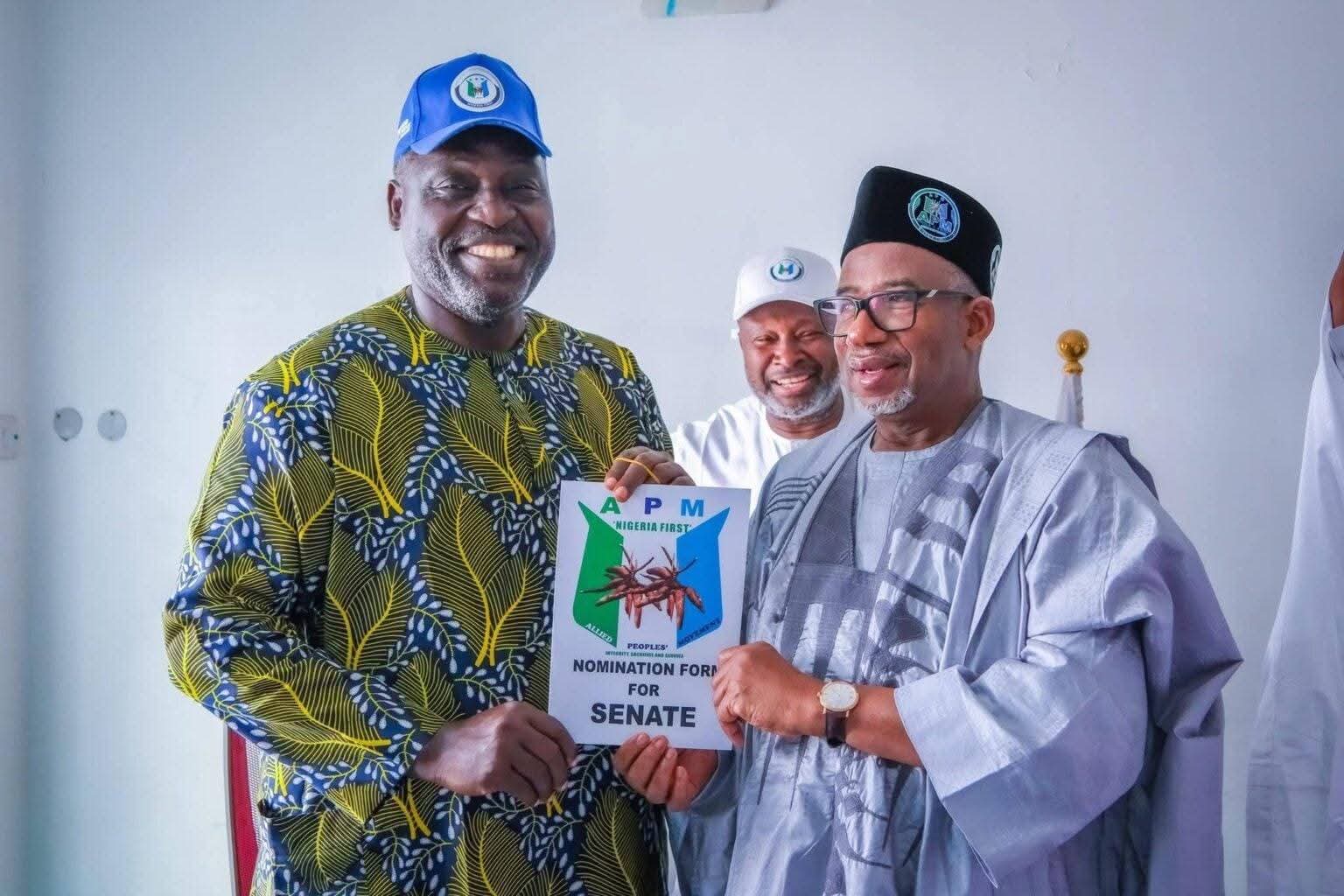
Bauchi State Governor, Bala Abdulkadir Mohammed, has officially left the Peoples Democratic Party (PDP) and joined the Allied Peoples Movement (APM) after weeks of consultations.

He made the announcement on Saturday at the Government House. His decision comes after prolonged uncertainty about his political direction. The uncertainty followed the internal crisis within the PDP.

The governor had earlier described the party as “headless”. He also showed readiness to consider other political platforms. Observers believe his exit could weaken the PDP and affect its grassroots strength.

Speaking on the recent Supreme Court ruling on the PDP leadership dispute, Mohammed said the judgement stopped any group from taking total control of the party. He explained that neither his faction, led by Kabiru Tanimu Turaki (SAN), nor the group loyal to the Minister of the Federal Capital Territory, Nyesom Wike, achieved full victory.

“We have succeeded in ensuring that no single individual hijacks the party,” he said.

In an interview with BBC Hausa Service, the governor stated, “As democrats who respect the rule of law, we accept the judgement. But it is not a victory for anyone.”

He added that the party’s Board of Trustees would manage its affairs for now. He said this arrangement would remain until a caretaker committee is formed in line with the party’s constitution.

Mohammed also accused Wike of acting against the interests of the PDP. He alleged that the FCT minister and his allies maintain links with the ruling All Progressives Congress (APC).

The governor said his defection aims to provide a stable political platform for his supporters ahead of the 2027 general elections.

“Our hearts remain with the PDP, but politically we must move forward,” he said.

He also confirmed plans to contest the Bauchi South Senatorial seat in 2027. He noted that his move to the APM followed consultations with other political parties.

Trump Says US Hostilities in Iran Have Ended, Floats Possible Action in Cuba


By Sabiu Abdullahi

President Donald Trump has notified the United States Congress that military hostilities against Iran have come to an end, while also raising the possibility of military action against Cuba.

In a letter sent on Friday, the president said the campaign, which started on February 28, had reached its conclusion after a ceasefire that began on April 7, 2026, remained intact. The development coincides with the 60-day limit set by the War Powers Act for unauthorised military engagements.

“The hostilities that began on February 28, 2026, have terminated,” Trump wrote. He added that the US military would keep a strong presence in the region to counter what he described as an ongoing threat from Iran.

Despite the formal tone of the letter, Trump struck a different note during an event in West Palm Beach, Florida. Speaking to supporters, he suggested that US naval forces deployed in the Persian Gulf could be redirected toward Cuba.

“We’ll do it on the way back from Iran,” Trump told the audience, referring to the USS Abraham Lincoln aircraft carrier as monitored in CNN. “We’ll have that come in, stop about 100 yards offshore, and they’ll say, ‘thank you very much, we give up.'”

The remarks have drawn concern from international observers. Many see them as a sign that the administration may still be open to pursuing regime change, especially after the February 28 strikes that reportedly killed senior Iranian officials, including the country’s Supreme Leader.

At the same event, Trump praised the US Navy’s operations in the Strait of Hormuz. He spoke about the seizure of an Iranian cargo vessel and likened the operation to a lucrative venture.

“We took over the cargo, took over the oil. It’s a very profitable business,” he said, after explaining how forces used tugboats and boarded the ship.

Since April 13, the United States has maintained a maritime blockade around Iranian ports. Washington says foreign vessels can pass through, as long as they do not make payments to Iranian authorities. Analysts say the measure has severely affected Iran’s shipping activities.

Although active fighting has stopped, efforts to reach a lasting agreement have not succeeded. Talks held in Islamabad, Pakistan, ended without progress. Trump expressed dissatisfaction with Iran’s latest proposal.

“Frankly, maybe we’re better off not making a deal at all,” he said, indicating that the US could continue its pressure tactics, including the naval blockade.

The operation, known as Operation Epic Fury, has caused widespread damage across the Middle East. Reports indicate that thousands of people have been affected since the initial strikes in February.

Even with the official end of hostilities, tensions remain high. US authorities continue to monitor the situation closely, especially regarding Iranian-aligned groups in the region.

Is Africa Poor?

By Haroon Aremu,

In a vox pop, when they asked a simple question on the streets of Europe and America: “Which country is the poorest in the world?” The answers came quickly, confidently, and shockingly wrong.

“Africa.” “Africa is the poorest.” “Africa.” Not one voice hesitated. Not one voice paused to rethink. And therein lies the tragedy not of Africa, but of global ignorance because Africa is not a country. Africa is a continent. And more dangerously, Africa is not poor.

The birth of lies of how Africa became a Global stereotype. For decades, Africa has been reduced to a single, distorted image: poverty, hunger, conflict, corruption, and helplessness.

In global media narratives, Africa is often portrayed as a land of endless crises children with distended bellies, dusty villages, and hopeless economies. These images have travelled faster than facts, shaping how the world perceives the continent.

But stereotypes are not truths. They are shortcuts of ignorance. The reality is far more complex and far more powerful. Nigeria, Africa’s most populous nation and largest economy, is often caricatured as a land of scams, insecurity, and chaos.

Yet Nigeria is also one of Africa’s biggest economy by GDP, global hub of music, film, and tech innovation, home to billion-dollar startups and Africa’s largest film industry (Nollywood), and one of the world’s leading producers of oil and gas. Nigeria’s problem is not poverty of resources it is poverty of governance.

Ghana is frequently portrayed as a quiet, underdeveloped state. But Ghana is one of Africa’s most stable democracies, a major producer of gold and cocoa, a growing tech and fintech hub, and a country with rising middle-class influence and strong diaspora impact. Ghana is not poor. It is strategically under-recognised.

South Africa is often stereotyped as a crime-ridden society haunted by racial inequality. But in reality South Africa is also Africa’s most industrialised economy. It is a home to advanced infrastructure and global corporations and also one of the world’s largest producers of platinum, gold, and diamonds. Its challenge is inequality, not lack of wealth.

Kenya is a “Tech Savannah Ignored”. Kenya is often reduced to safaris and wildlife documentaries. But Kenya is East Africa’s innovation capital, home to M-Pesa, one of the world’s most revolutionary digital payment systems. Kenya is a regional hub for startups, logistics, and global investment. Kenya is not backward. It is digitally ahead of many Western economies.

Countries like Sierra Leone and Benin Republic are often dismissed as “poor African states.” But Sierra Leone has rich mineral resources, including diamonds and iron ore. It is a growing post-war economy and youthful innovation sector.

Benin Republic has strategic trade routes and ports with a vibrant informal economy and cultural influence across West Africa. Their struggles are historical and structural—not natural. 

Here is the irony the world refuses to confront, Africa holds an enormous share of the world’s natural wealth. The continent possesses about 30% of the world’s mineral resources, including gold, diamonds, cobalt, platinum, and uranium. Africa is home to vast reserves of oil, gas, rare earth minerals, and agricultural land that the world depends on. 

One of the most persistent and misleading stereotypes about African countries is the belief that Africans are largely uneducated, technologically backward, and incapable of innovation without foreign intervention. This narrative suggests that modern ideas, digital skills, and scientific breakthroughs are imported into Africa rather than created within it.

Yet this claim collapses under reality: African youths are building global tech startups, engineers are designing fintech systems used by millions, filmmakers are reshaping global entertainment, and researchers are contributing to science and medicine across continents. 

The problem has never been a lack of intelligence or creativity; it has been the lack of global recognition and supportive systems to amplify Africa’s homegrown brilliance. 

If wealth were measured by resources alone, Africa would not be poor. It would be unbeatable. So why does the world think Africa is poor? Because poverty is not just economic, it is political.

Africa is not poor in resources. Africa is poor in systems, leadership accountability, and equitable distribution of wealth. And that is not the fault of ordinary Africans.

The truth is painful, Africa is rich, but Africans are made poor by mismanagement. Africa is powerful, but its power is fragmented by borders and politics. Africa is wealthy, but its wealth is exported cheaply and imported expensively.

The vox pop passers-by responded to is a classic case of when ignorance meets reality. When people on Western streets say, “Africa is the poorest country,” they are not entirely guilty. They are victims of narratives created by western media framing, historical colonial distortions, and Africa’s own failure to tell its story convincingly.

The real question is not why foreigners think Africa is poor. The real question is why has Africa allowed the world to believe a lie? Imagine if Africa were one country. What if Africa was not divided into 54 countries? What if Africa spoke with one voice, traded with one currency, and defended its interests collectively?

Even in its current fragmented state, Africa remains the world’s most resource-rich continent. If united, it would not beg. It would dictate.

Africa is not poor, Africa is plundered. Africa is not the poorest place on earth. Africa is the most misunderstood. Africa is not lacking in wealth. Africa is lacking in systems that protect its wealth. Africa is not a burden to the world. Africa is the world’s hidden backbone.  

Until African governments rise to prove this reality, not with speeches, but with structures, the lie will continue to travel faster than the truth.

But history has a way of correcting lies. And when Africa finally tells its story in its own voice, the world will discover a shocking truth: The poorest continent was never Africa. The poorest thing about Africa was how the world chose to see it.

Haroon Aremu Abiodun is a Nigerian writer and wrote in via exponentumera@gmail.com.

China Removes Import Tariffs For Most African Countries, Excludes Eswatini


By Sabiu Abdullahi

China has lifted import tariffs on goods from 53 African countries. The new policy grants duty-free access to almost all nations on the continent, except Eswatini.

The measure took effect on Friday. It applies to African countries that maintain diplomatic relations with Beijing. Eswatini remains the only country left out because it has formal ties with Taiwan, which China considers part of its territory.

China had earlier removed tariffs on products from 33 least-developed African countries in December 2024. The latest move adds 20 more countries to the arrangement. According to Global Times, these nations will enjoy preferential duty-free access until 30 April 2028.

The Chinese Ministry of Commerce said the decision would boost the competitiveness of African exports in its market. Products expected to benefit include cocoa from Côte d’Ivoire and Ghana, citrus and wine from South Africa, as well as coffee and avocados from Kenya.

Officials also said the policy could support the growth of processing industries across Africa and attract more investment into the sector.

Lin Jian, a spokesperson for China’s foreign ministry, described the move as an “expression of China’s willingness to voluntarily expand openness and assume more international responsibilities”.

“It aims to share opportunities with Africa and achieve common development,” he said.

China remains Africa’s largest trading partner. In 2025, it imported goods worth more than £90 billion from the continent. This represents an increase of 5.4 per cent compared to the previous year. Total trade between both sides reached £255 billion.

The chairperson of the African Union Commission, Mahmoud Ali Youssouf, welcomed the development. He said the policy was “very timely” as African economies face global economic challenges and rising protectionist measures.

“I would like to express, on behalf of the African Union Commission, our sincere gratitude for this very brotherly gesture that all Africans appreciate,” he said.

The tariff removal forms part of China’s broader economic plan under its 15th Five-Year Plan covering 2026 to 2030. The plan focuses on expanding market access and strengthening trade and investment ties.

Lauren Johnston, a research fellow at the AustChina Institute, said the expanded access could increase agricultural exports. She noted it may also “help elevate rural incomes, improve rural productivity, and ultimately reduce hunger and poverty”.

However, some experts believe tariff cuts alone may not solve Africa’s trade challenges. Jervin Naidoo, a political analyst at Oxford Economics Africa, said that “many African economies still face structural constraints such as limited industrial capacity, weak logistics, and reliance on raw commodity exports, which tariff reductions alone cannot address”.

Trump Orders Withdrawal Of US Troops From Germany Amid Rift Over Iran War

By Sabiu Abdullahi

The United States has announced plans to withdraw about 5,000 troops from Germany, a key Nato ally, as tensions deepen between Washington and European leaders over the ongoing war with Iran.

The Pentagon confirmed the decision on Friday. The move follows a dispute between former President Donald Trump and German Chancellor Friedrich Merz. The disagreement centres on comments made by the German leader about the conflict.

A senior Pentagon official, who spoke on condition of anonymity, criticised Germany’s recent statements. The official said they had been “inappropriate and unhelpful”.

“The president is rightly reacting to these counterproductive remarks,” the official said.

Germany remains the largest base for US military operations in Europe. More than 35,000 American troops are currently stationed in the country. The location serves as a major hub for training and logistics.

Earlier in the week, Mr Trump warned that he could reduce troop levels after exchanging words with Mr Merz. The German chancellor had said Iran was embarrassing the United States during negotiations aimed at ending the war.

“An entire nation is being humiliated by the Iranian leadership, especially by these so-called Revolutionary Guards. And so I hope that this ends as quickly as possible,” he said.

“The Iranians are obviously very skilled at negotiating, or rather, very skillful at not negotiating, letting the Americans travel to Islamabad and then leave again without any result.”

Mr Merz also questioned Washington’s approach to the war. He said he could not identify a clear exit strategy. His remarks highlighted growing divisions between the US and its European allies. The disagreements also extend to issues such as Ukraine and trade policies.

In response, Mr Trump criticised the German leader in a post on Truth Social. He wrote:

“The Chancellor of Germany should spend more time on ending the war with Russia/Ukraine (Where ‌he has been totally ineffective!), and ⁠fixing his broken Country, especially Immigration and Energy, and ⁠less time on interfering with those that are getting rid of the Iran ‌Nuclear threat, thereby making the World, including Germany, a ‌safer place!”

The Pentagon said the troop withdrawal would take place over six to twelve months. Officials expect the move to return US troop levels in Europe to what they were before 2022, prior to Russia’s invasion of Ukraine.

As part of the plan, a brigade combat team will leave Germany. A long-range fires battalion that had been scheduled for deployment will no longer be sent.

The decision comes as the US increases pressure on its allies over the Iran conflict. Washington has urged Nato members to support efforts to reopen the Strait of Hormuz, which has been largely closed since late February. The disruption has affected global energy supplies.

In a related move, Mr Trump also announced plans to raise tariffs on vehicles imported from the European Union to 25 per cent starting next week. The policy is expected to have a significant impact on Germany’s auto industry.

Kaduna Gov Uba Sani Claims No President Has Backed the North Like Tinubu

By Sabiu Abdullahi

Kaduna State Governor, Senator Uba Sani, has said President Bola Ahmed Tinubu has honoured his commitments to Kaduna State and the wider northern region.

The governor spoke on Thursday when he received a presidential delegation touring the North-West. He credited the administration with improving security and boosting infrastructure across the state.

Sani said these efforts have strengthened public support for the president. He expressed confidence that such support would translate into votes in the 2027 general elections.

He also claimed that the impact of the projects has weakened opposition parties in Kaduna, which he described as existing only in name.

“He has done a lot for us and I could remember when he visited Birnin Gwari, on the 12th of December, 2022, we went there with some of our friends here. It was a journey of about less than two hours. But it took us five hours.

“So there were two major problems we faced. Number one problem is security, because at that time, in 2022, you could travel from Kaduna to Birnin Gwari without military escort. But today, you can go there without police escort.

“Also, look at infrastructure. Today, he has fulfilled his promises. That is the reason why the good people of Kaduna will forever be grateful to President Tinubu.

“When you go to Birnin Gwari, you will see hundreds of vehicles passing to Lagos. It has improved the economic prosperity of our people who are farmers. It has improved the business of our people who are small business owners particularly those that are into farming, trading.

“All of them are making a lot of money because of what the president has done for us. Again, we are talking about the north.

“So for me, no president has supported northern Nigeria as much as President Tinubu would have done in less than three years now. And that is also why I cannot see any zone, not even the southwest, coming down to vote for him.”

The governor dismissed suggestions that Tinubu could lose the 2027 election. He said such opinions are largely driven by social media narratives.

Sani further argued that the president played an active role during Nigeria’s pro-democracy struggle, at a time he said some critics remained silent.

“Some of us were approached by then Head of State, Abdulsalam Abubakar, for a meeting, and he made it clear to all of us there will be only three recognised parties.

“But we didn’t threaten to burn down the country like the current opposition are doing. We went to the street; through the court that decision was rescinded.”

However, some northern leaders have disagreed with the governor’s position. They argue that the region has not received fair treatment under the current administration. They pointed to what they described as an imbalance in the distribution of projects between the North and the South.

At a citizens’ engagement forum organised by the Sir Ahmadu Bello Memorial Foundation in Kaduna in June 2025, Chairman of the Arewa Consultative Forum Board of Trustees, Alhaji Bashir M. Dalhatu, criticised the administration’s approach to governance.

Dalhatu said, “Two years into President Tinubu’s four-year tenure, the feeling among the people of the North is, to put it mildly, completely mixed.

“To our surprise, those who did not support him, did not vote for him, and hardly wished him well have emerged from nowhere and are now attempting to drive a wedge between him and the North.”

The Northern Elders Forum also expressed dissatisfaction with the region’s earlier support for Tinubu. In an interview published by The Guardian in April 2025, the forum’s spokesman, Abdul-Azeez Suleiman, said the North would take a different approach ahead of future elections.

Suleiman said, “The North made a mistake in voting Bola Tinubu to the presidency in 2023, and it is unlikely that they will repeat the same error in the future.”

“They have learned from their past misstep and will strive to select a candidate who can unite the country and govern in the best interests of all Nigerians.

“Moving forward, the North will be more cautious in selecting a candidate for the presidency. They will prioritize someone who is seen as more inclusive, less controversial, and more aligned with the interests of all regions of the country.

“The mistake of supporting Tinubu in 2023 has taught them the importance of unity and consensus in selecting a candidate for the highest office in the land.” he added.

Pee Penalty: Italian City to Fine Dog Owners Up to €500 for Unwashed Pet Urine

By Maryam Ahmad

Dog owners in the coastal Tuscan city of Livorno will need to start carrying more than just plastic waste bags on their daily walks. Under a strict municipal ordinance, failing to wash away pet urine from public spaces can now land owners with a fine of up to €500.

The local council introduced the aggressive measure after a surge in complaints from local residents regarding foul odours and mounting hygiene issues, particularly in areas where adults and children congregate. Officials pointed to a booming pet population in the city as a major driver behind the deteriorating conditions.

According to the new rules, anyone walking a dog must carry a bottle of water to immediately rinse away any piddle left on pavements, benches, or the wheels of parked vehicles.

The ordinance carves out exemptions for on-duty police dogs and guide dogs assisting visually impaired individuals. Handlers are also exempt from the rinsing requirement during periods of icy weather, when adding water to the streets would create a safety hazard for pedestrians.

The story, which highlights the growing tension between expanding pet ownership and urban sanitation, was originally reported by The Guardian (UK).

Livorno joins a growing list of Italian municipalities that have turned to strict penalties to enforce public cleanliness among pet owners.

[2] https://www.theguardian.com

Kwankwaso, Peter Obi Set to Dump ADC as Obasanjo Brokers New Alliance

By Abdullahi Mukhtar Algasgaini

Former Kano State Governor, Rabiu Musa Kwankwaso, and former presidential candidate, Peter Obi, are reportedly planning to exit the African Democratic Congress (ADC), according to sources close to the matter.

Political insiders revealed that former President Olusegun Obasanjo is spearheading efforts to forge a political alliance between the two prominent opposition figures. The move is seen as part of a broader realignment strategy ahead of the 2027 presidential election.

Tensions rose earlier today when some of Kwankwaso’s key political associates, known as the Kwankwasiyya movement, were seen defecting from the ADC in the morning.

This development comes at a critical time as the country edges closer to the 2027 general elections, with top politicians scrambling to reposition themselves for maximum political leverage.