Christians

Allow senate presidency to go to Southern Christians – MURIC

  • NewsDesk

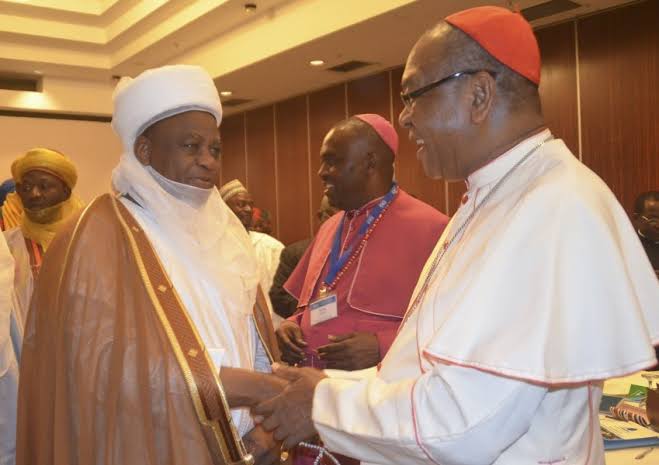
As Nigeria approaches May 29, the inauguration date of a new administration, newly elected lawmakers and politicians have intensified the lobby game. The Muslim Rights Concern (MURIC), an Islamic human rights group, has also joined the debate. Though a Muslim group, MURIC wants the Senate presidency to go to a Christian from the South. The group has therefore called on all Muslims vying for the post to withdraw.

This was made known in a statement issued on Thursday, May 18, 2023, by the Executive Director of the group, Professor Ishaq Akintola.

The statement reads:

“As the clock ticks away for the 29th May inauguration date of the Bola Tinubu administration, elected lawmakers and politicians have intensified the lobby game. We have seen how the different geo-political zones, as well as individual politicians and stakeholders, have demanded key positions in the National Assembly.

“Chief among those positions is the Senate presidency as it is the Number 3 position in the country after the president and vice president. As a major stakeholder in the affairs of Nigeria, we have followed with keen interest the imbroglio, which greeted the Muslim-Muslim ticket and how it ended in Nigeria having a Muslim President-Elect and a Muslim Vice President-Elect.

“In view of this outcome and considering the multi-religious character of our dear country, Nigeria, it is our considered opinion that the post of senate president should go to a Southern Christian. Nigeria needs the cooperation of both Muslims and Christians because only such collaboration can engender peace and development.

“Although we are a Muslim group, we believe very strongly that Muslims should not take all the top posts despite being the undisputed majority group in the country. Muslims must be ready to share power with their Christian compatriots. Politics is a game of give and take, and Nigerian Muslims must play it right.

“We must all be ready to demonstrate a willingness to work together as a people in spite of our religious differences. Afterall, there is no Muslim electricity supply, no Christian roads, no Muslim public transport system and no Christian naira. Our problems are identical, and whatever affects our country affects both Muslims and Christians together.

“A good example is COVID-19. Hunger knows no Muslim, and malaria knows no Christian. Poverty is common among the adherents of both faiths. Let us, therefore, share what belongs to all with love and find solutions to our common problems together.

“MURIC, therefore, calls on all Muslim candidates vying for the position of the senate president to withdraw in order to allow Christian candidates from the South to have a free hand in the competition (preferably the South-South because the South East has occupied the post on several occasions).

“In addition, MURIC tips any suitable candidate from the North West for the post of deputy senate president in view of the fact that the zone gave the largest number of votes to the party and the candidate that won the election.” 

40 worshippers reportedly abducted in Kaduna

By Muhammadu Sabiu 
 
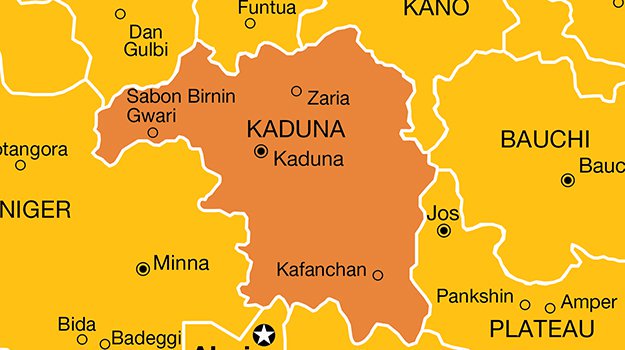
At least 40 worshipers were on Sunday reportedly abducted by bandits while on congression at Bege Baptist Church, Madala, Chikun Local Government Area of Kaduna State.
 
The incident was reported on Monday by Rev. John Hayab, leader of the Christian Association of Nigeria’s Kaduna State branch.
 
According to Hayab, the incident took place at 9:30 a.m., during the worship time.
 
He was quoted as saying, “The worshippers were in the Sunday service in the Church when around 9:30 am they heard gunshots very close to the Church. The gunmen attacked the Church and went away with 40 worshippers.”
 
However, he added that 15 of the kidnapped worshippers managed to escape, leaving 25 others in the kidnappers’ hideout.

Why Nigerians should thank Peter Obi

By Prof. Abdussamad Umar Jibia

The 2023 general elections have come and gone, and like every set of elections, there are winners and losers. Typical of Africans, those who lost alleged rigging and those who won hailed the process.

In addition to winners and losers, there are other people we should cheer for their roles in the elections. First, we should give credit to President Muhammadu Buhari for being true to his promise of organizing free, fair and credible elections. The President himself has observed that Nigerian voters have become more sophisticated. One manifestation of this is that voters no longer vote along party lines. It doesn’t matter if he is a card-carrying member of a political party; once a Nigerian voter sees a better candidate in another party, they go for them. That is the new normal if you like, and it is a good lesson for our politicians.

We must also hail the INEC Chairman. Just like his colleague Prof. Attahiru Jega, Prof. Mahmoud Yakubu has shown an uncommon tolerance in dealing with politicians, even in extreme cases in which an ordinary person would lose control.

My man of the day is His Excellency Peter Obi, a former Governor of Anambra State. I have never met Peter Obi, and he did not attract my attention until he began to claim that he wanted to become Nigeria’s president. From the way he started up to the time he crashed, I knew that Obi didn’t have a good understanding of the country he wanted to govern.

First, Obi wanted it under the PDP. Despite being a failed party, a PDP ticket would have earned Peter Obi a distant second regardless of the part of the country he is coming from. When he could not clinch its ticket, he jumped to the Labour Party. Then he started his campaign, the method of which we all saw.

The part of his political activity that we should thank Peter Obi for is his ability to solve one of the greatest puzzles of the Nigerian census. I mean the question of religion.

Nigeria is a big country with a Muslim majority and a minority that includes a good number of Christians and some pagans. Nigeria’s last census that collected data on religious affiliations was in 1963. According to the 1963 census results, there were 47.2 % Muslims, 34.3% Christians and 18.5% others. In the North, the ratio was 71.7% Muslims, 9.7% Christians and 18.6% others.

Talking about South West, the 1963 census figures identified the present-day Oyo, Lagos, Ogun and Osun as Muslim-majority states, with only Ondo and Ekiti as Christian-majority states.

Subsequent censuses either did not capture religion like the case of the 1991 and 2006 censuses or were cancelled due to controversies surrounding their conduct which was the case with the 1973 census.

Demographic experts make projections based on past trends, fertility and mortality rates and in the case of religious proselytization, migration, etc. The Ibrahim Badamasi Babangida administration decided to remove religion in the 1991 census due to bogus claims of being majority especially made by the church, and since then, the Nigerian Population Commission has avoided conducting standard projections involving religious affiliations.

Without a head count and/or unbiased, professionally made projections, Nigerians are continuously bombarded with unrealistic population figures. At one point in time, Christians claimed that they constituted more than 45% of the Northern Nigerian population, a claim ignored by Muslims for being ridiculous.

While ordinary Nigerians can be misled by propaganda, politicians looking for votes have always been calculative in their determination of who constitutes the majority and should attract their campaign and who is a liar.

And it is not difficult to figure out. Political affiliation in Nigeria is a good pointer to religious affiliation. For example, it is well known that Northern Christians do not vote for Muslims, whereas the former are in the majority. The examples are many and well-known. Thus, the number of Christian elected politicians in a particular state would approximately tell you the percentage of Christians in that state. In addition, the number of predominantly Muslim states with large populations like Kano and Katsina makes the population of the two Christian-majority states of Plateau and Benue a joke.

As a politician who needs votes of the majority to win a national election, Obi should have known all these figures and used them to gauge his level of preparedness. Unfortunately, he lost it and was going from one Church to another, vividly falling into the propaganda trap of the Church. He was carried away by the belief that the Middle Belt is Christian. But where is the Middle Belt? Is it North Central? Who, among the Governors of Niger, Kwara, Nasarawa, and Kogi, is a Christian? Obi was simply too naïve.

However, it is not bad at all. The clergy campaigned for him. Christians were mobilized nationwide. The outcome is what the NPC could not achieve in its censuses. Christians overwhelmingly voted for Obi. The number of Muslims who voted for him was simply insignificant, just like the number of Christians who voted for the Muslim-Muslim ticket of Tinubu-Shettima. The few Christians who did not vote for Obi were seen campaigning for PDP. Overall, more than 14 million voted for either Tinubu or Atiku, both of whom are Muslims. Even if we take 10% of that and add it to Obi, Christians are still a small minority.

As Muslims, we have avoided these arguments as we consider them unhealthy since, after all, our eternal prosperity in Islam is not dependent on whether or not Muslims are in the majority at a particular time or location. But we have been boxed into it, and it is helpful.

Professor Abdussamad Umar Jibia wrote from Kano. He can be reached via aujibia@gmail.com.

The consequences of religious politics in Nigeria

By Usman Muhammad Salihu.

Religion has been a part of Nigeria’s political landscape for decades. The country has a diverse population with multiple religions, such as Christianity, Islam, and traditional faiths.

The influence of religion on Nigerian politics cannot be overemphasised, as it plays a significant role in shaping political decisions and outcomes. However, the involvement of religion in politics in Nigeria has come with both positive and negative consequences.

One of the positive consequences of involving religion in Nigeria’s politics is the promotion of moral values. Religion teaches moral values such as honesty, integrity, and justice, which are crucial for a stable and just society. Religious leaders can use their platforms to advocate for these values and hold politicians accountable for their actions. Additionally, religion can inspire people to participate in politics and contribute to the development of their communities.

On the other hand, the involvement of religion in Nigeria’s politics has also led to negative consequences. One of the most significant adverse consequences is the proliferation of religious extremism and intolerance. The politicisation of religion has fuelled religious conflicts and violence, leading to the loss of lives and property. The Boko Haram insurgency, which began in 2009, is an example of the consequences of religious extremism in Nigeria.

Another negative consequence of involving religion in Nigeria’s politics is the erosion of the country’s secularism. Nigeria is a secular state, but the involvement of religion in politics has led to the blurring of lines between religion and state. This has resulted in the adoption of policies that favour one religion over the other and the exclusion of minorities from political processes.

Furthermore, the involvement of religion in politics has also resulted in the emergence of religious leaders as political power brokers. This has led to the entrenchment of corruption in the political system, as religious leaders often use their positions to secure political appointments and contracts for their followers.

In conclusion, the involvement of religion in Nigeria’s politics has both positive and negative consequences. While religion can promote moral values and inspire people to participate in politics, it can also fuel religious conflicts and lead to the erosion of secularism.

Therefore, it is essential to strike a balance between religion and politics to ensure that the positive consequences of faith are maximised while minimising the negative effects. This can be achieved by promoting interfaith dialogue, adopting policies that promote equality and inclusivity, and establishing effective mechanisms to hold politicians accountable for their actions.

Usman Muhammad Salihu writes from Mass Communication Department, Abubakar Tatari Ali Polytechnic, Bauchi, Bauchi state. He can be reached via muhammadu5363@gmail.com.

Short-term gain, long-term pain

By Dr Raji Bello

Nigerians are not known for their ability to figure out the long-term consequences of their actions. This is a major national handicap since some choices which produce short-term gain could lead to long-term pain. For instance, in 1999, the governor of Zamfara state introduced a new social order in the state in defiance of the authority of the Federal Government of Nigeria. The new order spread across the northern states along with a strong wave of triumphalism. 

In the years that followed, groups of non-state actors across the country learnt something from what happened in Zamfara – that a group of determined people within a defined geographical area could defy the Federal Government and impose their will without any consequences. Inspired by this knowledge, a new Islamic militant group soon appeared somewhere in Yobe state, which later grew into Boko Haram – and the rest is now history.

Militants in the Niger Delta, who were also observing developments in the North, concluded that the Federal Government was indeed weak and its authority could be challenged without consequences. An insurgency soon took firm roots in the area. Many years later, young herdsmen around the country and secessionists in the Southeast also decided that it was time to take on the government and Nigerian society. Over 20 years later, long after the triumph of 1999/2000 has faded, we are still living with the pain of the chain of developments that it had sparked.

Once again, there is palpable triumphalism in the land. Our newly-elected Muslim-Muslim presidency has elicited exuberance in the Muslim community and foreboding on the Christian side. Prominent Muslims are already lining up to claim ownership of the president-elect and his religious identity. The Muslims are glad that the apparent consolidated Christian vote for Mr Obi has failed to achieve its aim. Christians, on the other hand, see their voting preference as justified because of the sheer brazenness of the APC in coming up with a Muslim-Muslim ticket right at the end of the two terms of a Muslim president who was not even known for respecting diversity in his appointments.

The 2023 elections will mark the time when the religious cleavage in Nigeria deepened to dangerous levels. In fact, the frontlines of the religious battle have already shifted to some upcoming gubernatorial contests. In Taraba state, the CAN has allegedly circulated a statement alerting Christians in the state of the impending battle while Muslim clerics all over the North have united in charging Taraba Muslims for the solemn task ahead.

Also, in Nasarawa state, there is a fear that the Labour Party could repeat its earlier presidential election feat and elect a Christian governor for the state. Other states like Plateau, Gombe, Adamawa, Kaduna, Niger etc, may also witness more hardening of intercommunal attitudes going forward. 

There will be even more foreboding on the Christian side when the practical elements of the Muslim-Muslim presidency begin to manifest. For example, media coverage will show both the president and vice-president of Nigeria at Eid prayer grounds while only the SGF or senate president will be left to lead the celebrations of Christmas and Easter.

The other multiplier effects of this new paradigm can’t even be fully imagined now. I expect that in the fullness of time when all the predictable consequences are playing out, the few discerning ones among us will ask, was Bola Tinubu’s Muslim-Muslim ticket really worth it in the long run?

Raji Bello writes from Yola, Adamawa State.

Religion and the 2023 presidential election: A quick take

By Muhsin Ibrahim

Religion was central to Bola Tinubu’s emergence as the APC’s candidate for the 2023 presidential election. We discussed the issue as if it would not end. Since the 1993 annulled election of Abiola/Kingibe (both Muslims), no major candidate and his running mate have ever come from the same religion until now: Tinubu/Shettima (both Muslims). But, as the election approaches (we are, in fact, counting hours), only a few people talk about that. However, religion will play a significant role in the voting pattern.

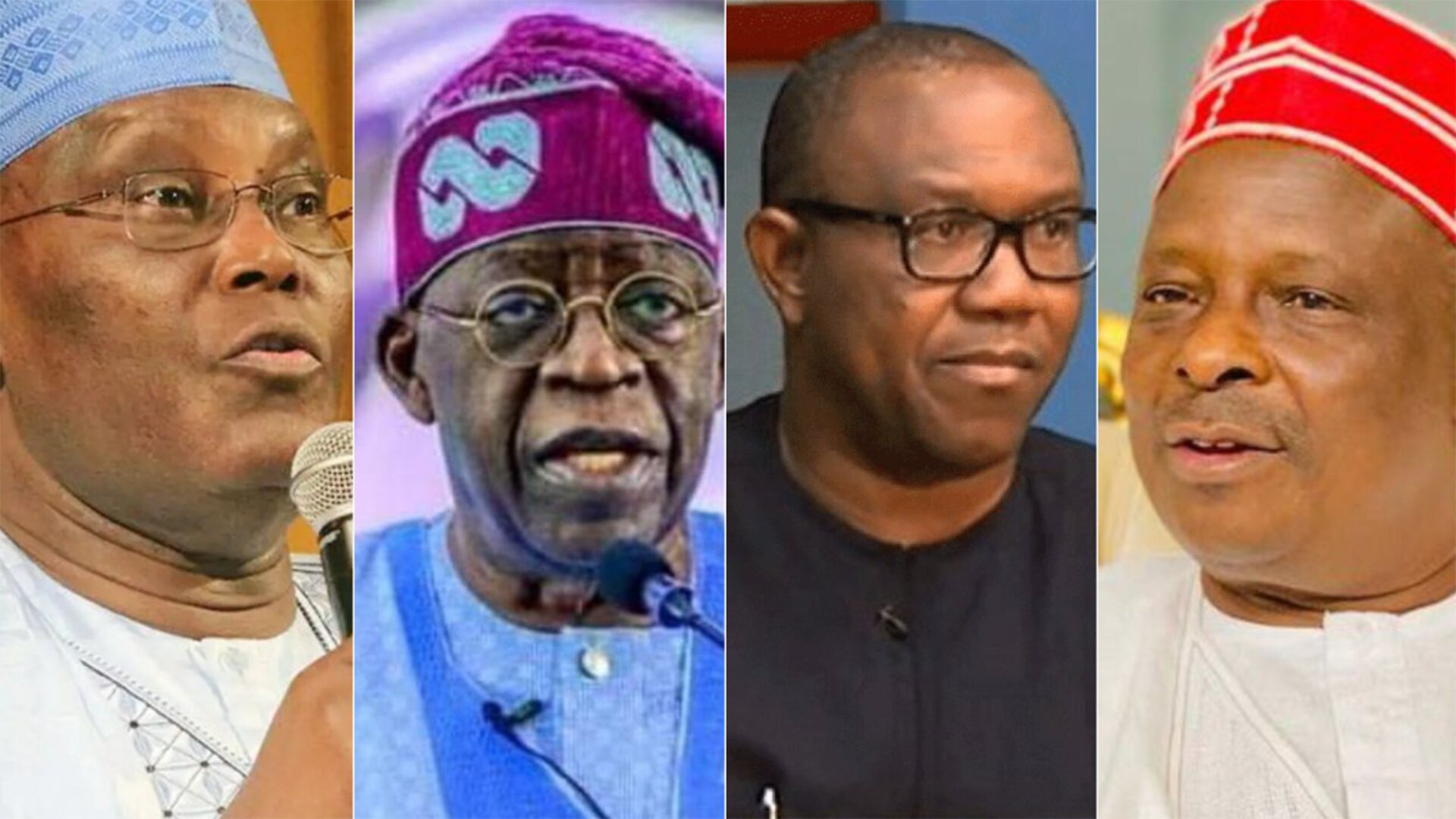
The wild popularity of Labour Party’s Peter Obi on social media and his appeal to foreign media has something to do with his religion. I know this may sound controversial, but it is so. The three other front candidates are Muslims, while Obi is Christian. Besides this, I can’t see a glaring difference between him and NNPP’s Engr. Rabiu Musa Kwankwaso per se.

Tinubu and PDP’s Atiku Abubakar are in their 70s, while Kwankwaso and Obi are in their 60s. The four leading candidates are stinking rich and belong to 1% of the Nigerian elite. Interestingly, the candidates represent Nigeria’s so-called major ethnolinguistic groups of Yoruba, Hausa and Igbo, alias WAZOBIA.

Though, there is a parallel between Obi and Tinubu. Many people will vote for them because of their religious identities. I learned that many churches, especially in the North, had ordered their members to vote for Obi. Likewise, the faith-based civil liberties organisation Muslim Rights Concern (MURIC) recently “reminded Northern Muslims of their promise to support a Southern Muslim [i.e. Tinubu] in the 2023 presidential election”.

Given the above, I agree with some observers and analysts that Obi may surprise his critics, such as myself, in the upcoming election. The votes from his Christian brethren and others supporting him for other reasons will make a difference. However, Tinubu has many more advantages – being APC the ruling party and his decades-old political footprints, among others.

Anyway, we hope for the best and pray for peaceful elections. But, please, stay away from violence. Your safety should be your most treasured possession. No politician or political party is worth dying for.

With love from a disenfranchised Nigerian citizen.

Muhsin Ibrahim works and lives in Cologne, Germany and can be reached via muhsin2008@gmail.com.

Pastor faces backlash for bringing AK-47 to church

By Ahmad Deedat Zakari

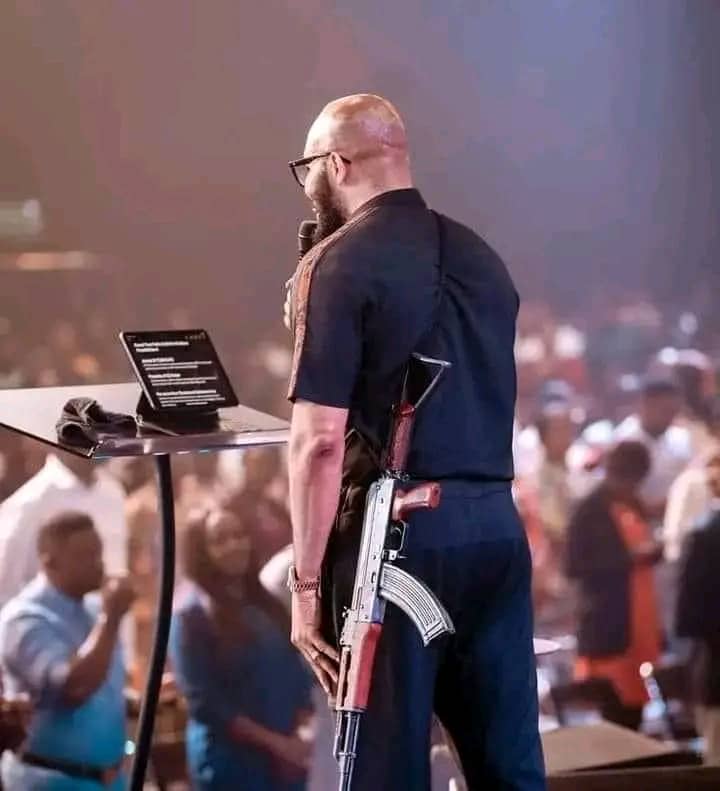
The presiding pastor of an Abuja church, Pastor Uche Ugbe, has brought himself to great disrepute and backlash after he took gun to the church on Sunday.

Pastor Ugbe, while on the altar addressing christian faithfuls, had an AK-47 dangling from his shoulder.

He was reported to have said he came to church prepared because some people are looking for his trouble

However, his action do not sit well with many Nigerians and they have taken to different social media platforms to lambast him.

Abdullahi O. Haruna, a journalist and public affairs analyst, described his action as insensitive.

Haruna said, “Yes, he is not a security guy,
He is a pastor wielding unabashedly this weapon of death, to a congregation that had children, exuberant youths, not minding the sensitivity. He reigns with such impunity. Don’t worry, this is Nigeria. Anything goes…”

Another Facebook user, Nasir Muhammad Salis, said, “I can’t fathom the high level of panic or tension some people will ignite in the country if this was Sheikh Gumi or Sheikh Pantami. But now, they are ignoring it. I don’t see, in my view, any justification for this childish dramatic action!”

Other persons have described him as silly, childish and attention-seeking.

As at the time of writing this report, the Christian Association of Nigeria (CAN), is yet to comment on the illegal possession of firearm by the pastor.

Interestingly, the Nigerian Police Force has also been conspicuously silent on the issue.

Bingham University bans students from using phones

By Ahmad Deedat Zakari

Bingham University Nassarawa has banned the use of smartphones in the institution. 

The Registrar, Dr Esther J Dyaji, disclosed the development in an internal memoir on Wednesday. 

According to Dr Gyaji, the phones of defaulters of the ban would be confiscated while they face appropriate sanctions. 

The memoir reads, “Following repeated abuse in the use of smartphones in contravention of section 5.14 subsection i, ii and iii of the students’ handbook, the use of smartphones is hereby prohibited with immediate effect. Violators of this would have their phones confiscated and face appropriate sanctions.”

Bingham University is a private missionary university owned by the Evangelical Church Winning All (ECWA). It was founded in 2005.

CPS condemns Christian leaders for criticising Muslim-Muslim ticket

By Uzair Adam Imam

The Centre for Promotion of Shari’ah (CPS) expressed worries over the utterances of some prominent Christian political and religious leaders concerning the Muslim-Muslim ticket.

The centre was also dismayed by the numerous social, political and economic challenges bedevilling the Muslim Ummah in the country.

This was contained in a communiqué signed by Aminu Inuwa Muhammad, the centre National Coodinator, at the end of a one-day stakeholders meeting in Abuja.

It said, “Current developments in the political landscape of Nigeria have become a source of serious concern to CPS and the general Muslim Ummah in the country.

“The decision of some parties in the choice of presidential candidates and their respective running mates has attracted unguarded statements from some religious and political leaders, a development that has worsened the already tense political situation,” it added.

The centre also called on the Muslims to vote for the political parties and candidates who will ensure justice and protection of their rights and interests.

“Muslims in Nigeria need to properly organise themselves in order to take full advantage of their obvious demographic strength during the 2023 elections.

“Muslims need to pursue proactive measures towards countering the negative profiling in the media as well as the moral drift and mischief prevalent in the social media.”

Dangers of entrusting religious leaders with sex education responsibility

By Aishat M. Abisola

A few weeks ago, I read that the federal government ordered the Nigerian Education Research and Development Council (NERDC) to remove sex education from the basic school curriculum. This decision was made by the Minister of Education, Mallam Adamu Adamu.

This followed the call by experts that sex education should be placed in the hands of parents and religious institutions so that it would not be taught in schools in ways that would not further “corrupt” young children with phones and access to technology.

Adamu stated that since Nigeria is a religious country, morals and values should be taught in Mosques and Churches, adding that it would bring up children with strong morals and reduce the rate of out-of-school children.

When I read this, I was shocked for many reasons. First of all, the introduction of sex education into the basic education curriculum is still recent, and most schools are not even implementing it.

When I was in secondary school, my classmates and I were mainly taught about the biological and chemical aspects of reproduction, not the elements concerning sex and sexuality.

Secondly, how are they sure that sex education has not benefited the youths who are barely taught about it in schools?

Sex education can be defined as teaching and learning about a myriad of topics related to sex and sexuality. It dives into the values and beliefs regarding these topics. It helps people gain skills they will need to navigate their relationships with themselves, their partners, and their community and helps them manage their sexual health.

Sex education can be taught anywhere, in one’s house, school, community setting with trusted individuals, or online. As I stated earlier, I was not taught much about sex education in secondary school.

Luckily, my parents were there to answer my questions on sexual education and even imparted helpful knowledge that has helped me a lot in many ways.

When I learnt more about sex education and focused on what my parents taught me, I learned more about myself, my body, and how I could improve in terms of mental and physical health.

Despite common misconceptions that sex education corrupts children when taught about it at school, sex education can be more beneficial than you might expect. The full description of what sex education entails is as follows:

Human Development

This involves human anatomy, puberty and how it will affect them both physically and mentally, sexual orientation (the different types of sexual orientations), and gender identity (what it means to be male or female).

Relationships

Relationships consist of Interpersonal relationships such as family, friendships, romantic relationships, and relationships with healthcare practitioners.

Personal Skills

This involves areas surrounding communication, boundaries, negotiations, and decision-making.

Sexual Health

Sexual education covers the areas that deal with sexual health, like sexually transmitted diseases, Birth Control, and pregnancy.

Society and Culture

This involves Media Literacy, Shame, and stigmatisation associated with sex and sexual education, the way that power, identity, and oppression can affect sexual wellness and reproductive freedom.

But besides all this, my main concern is how sex education is so callously put in the hands of religious leaders and institutions.

Most parents can be trusted to impart their knowledge about sex education to their children so they are more aware and careful.

On the other hand, religious leaders and institutions cannot be trusted in the same way.

Historically and in recent times, both religious leaders and religious institutions have been known to use children’s lack of sexual knowledge against them in ways most foul.

Priests, pastors, and Imams have preyed on young children entrusted to them by unsuspecting parents.

The more commonly known religious institution to do so are the Catholics, but other religious institutions and their leaders have done the same.

In some Islamiyah (Islamic religious learning academies), Imams have inappropriately touched young children they were supposed to care for.

Some examples would be a French Catholic church that was reported after discovering that its clergy and lay members had sexually abused at least 330,000 children over the past 70 years.

Another example would be a young girl from Lagos whom a Friar sexually abused at her parish church. In 2020, an Imam had taped himself raping a five-year-old girl, and earlier this year, in July, another Imam was arrested for the sexual abuse of seven children.

In October this year, another Imam was arrested for sexually assaulting an 11-year-old. Men (Women as well) who are placed into positions of power are more often than not predators who seek to prey on those weaker than them.

These days, anyone can become an Imam or a pastor. Because of the relaxed nature in discerning whether someone is an actual man/woman of god or whether they can be trustworthy in a position of power, many people get hurt.

Young children should not be placed in their care, nor should they be allowed to discuss sex education with them.
For all we know, they could teach these young and highly impressionable children wrong things and could hurt them badly in the long run.

Statistics have shown that when children have been sexually abused, there is a high likelihood that they will go on to commit the same injustices that were performed on them.

Ultimately, it will perpetuate a cycle of pain and torment.

Appropriately trained sexual education professionals should be tasked with training children on what they need to know about sex education from a young age. This way, they will learn more about their bodies and the best way to know if what is being done to them is right or wrong.

Along with this, their community should also take care of children.

If more than one eye is trained on a child, then any odd behaviour will be noted and told to their parents so that they can take the proper actions necessary.

With these two in hand, parents won’t need to rely on religious leaders or religious institutions to teach children about sex education when children are more likely to be abused by them.

Perhaps then, the government will have more trust in the education system instead of leaving such a delicate and complicated matter in the hands of people who would instead make matters worse than fix anything.

Children are blank canvasses, and teaching them the right things will make lovely and ethereal colours glow on their canvas, but teaching them in the wrong manner will damage it.

Children are the hopes and future of their parents and forefathers; It is with them that a legacy of peace, faith, and kindness is ensured.

I hope whoever reads this takes my words to heart and acts righteously for these children who might be led astray due to improperly placed trust.

Aishat M. Abisola is a member of the Society for Health Communication, Wuye District, Abuja, via Aishatmohd02@gmail.com.