Christians

Massacre of Muslim Travellers in Jos: the inside story

Barrister Lawal Ishaq is a resident of the area where Irigwe militias massacred scores of Muslim travellers. The Daily Reality (TDR) newspaper had an interview with him, thus:

TDR: Nigerian newspapers, blogs and so on have reported different figures as numbers of Muslim travellers massacre while passing through Jos, Plateau State. Can you tell us how many people were actually killed?

Barrister:  So far, the actual number is 26, and security operatives and good Samaritans rescued about 34 people.

TDR: Jos is known as a volatile state where religious crises have become a norm. Was this a sort of reprisal attack or what?

Barrister: Recently, there had been some misunderstanding and skirmishes between Fulani and Miyango tribe in Bassa Local Government. There have been attacks and counter-attacks between them for ages.  Recently, it was said that four people were killed, and their corpses were deposited at Plateau Special Hospital. They planned their funerals on Saturday. After they picked the bodies from the hospital, instead of conveying their corpses in the vehicle, they opted to come in large numbers and carried them on foot and were heard chanting war songs in their language. They were over two thousand. They trekked from Plateau hospital, passing “Operation Safe Haven” headquarter, but nobody said anything to them. Their large number was a warning signal, but fortunately, nobody cares.

As they were passing through Rukba Road, unfortunately, their victims were coming back from their annual Zikr event in Bauchi under the leadership of Sheikh Dahiru Usman Bauchi. The event takes place on the first Friday of every new year of the Islamic calendar. So, most of the people killed came from Ondo State. Most of them are Fulani, but they speak Yoruba more than even Fulfulde, and they were followers of the Tijjaniyya sect. They spent a night in Bauchi and left Bauchi early morning. The typical road for them to follow through Jos. They were in five buses, each containing eighteen passengers. So imagine the number.

TDR: You mean they attacked all those five buses?

Yes. All buses were attacked, killing 25 people instantly. One died later in the hospital.

TDR: How did they identify them?

Barrister: Unfortunately, their buses were all carrying the pictures of Sheikh Ibrahim Inyas to indicate that they were on a religious trip. And some of them were chanting Zikr. But there was nothing suspicious about them. It was apparent that they were only passing through Jos. And according to what they have told us, ordinarily, they would have passed Inuwa Nsunde (name of the street) peacefully. But because of the traffic gridlock caused by those people, that was how they met their death.

TDR How long did the attack last?

Barrister: It didn’t last long because already there was tension in that area. So the security operatives are always on high alert. And in this social media era, before you know it, some people were able to record and share images and videos on Facebook and WhatsApp groups.

TDR: Was there any gunshot in their bodies?

Barrister: No! No, any gunshot at all. They used machetes, knives and anything that can kill.

TDR: Any action from the state government?

Barrister:  The State Government had reacted promptly. The secretary to the state government came to the place immediately. The police commissioner was there, the director department of security service was there, and the Commandant of the Nigeria Security and Civil Defence Corps was also there. So we were together when they dispatched the security personnel team to the area. They retrieved the dead bodies and the injured, who were soon conveyed to the general hospital.

TDR: Was there any arrest?

Barrister: We stayed at the hospital until we were told to go and bury the bodies at 04:30 pm or thereabout. The burial took us more than an hour because we had to put them into a mass grave. We, later on, received information from the police command that about seven people were arrested. But the most important thing is that the resident of that area did not carry out the killing. Those people from Miyango village did this massacre.

TDR: What is the name of their tribe?

Barrister: Irigwe Tribe. They are predominantly Christians. That gives the whole thing a religious colouration because their victims were all Muslims. It took us a great deal to control the situation because some people were so agitated. That is why instead of burying them at the central burial ground, we took them to Dadin Kowa cemetery. That is about fifty kilometres from Jos.

TDR: Thank you, sir.

Barrister: You are welcome.

Plateau Massacre: Survivor recounts how Irigwe youths slain his 26 Muslim co-travelers

By Misbahu El-Hamza

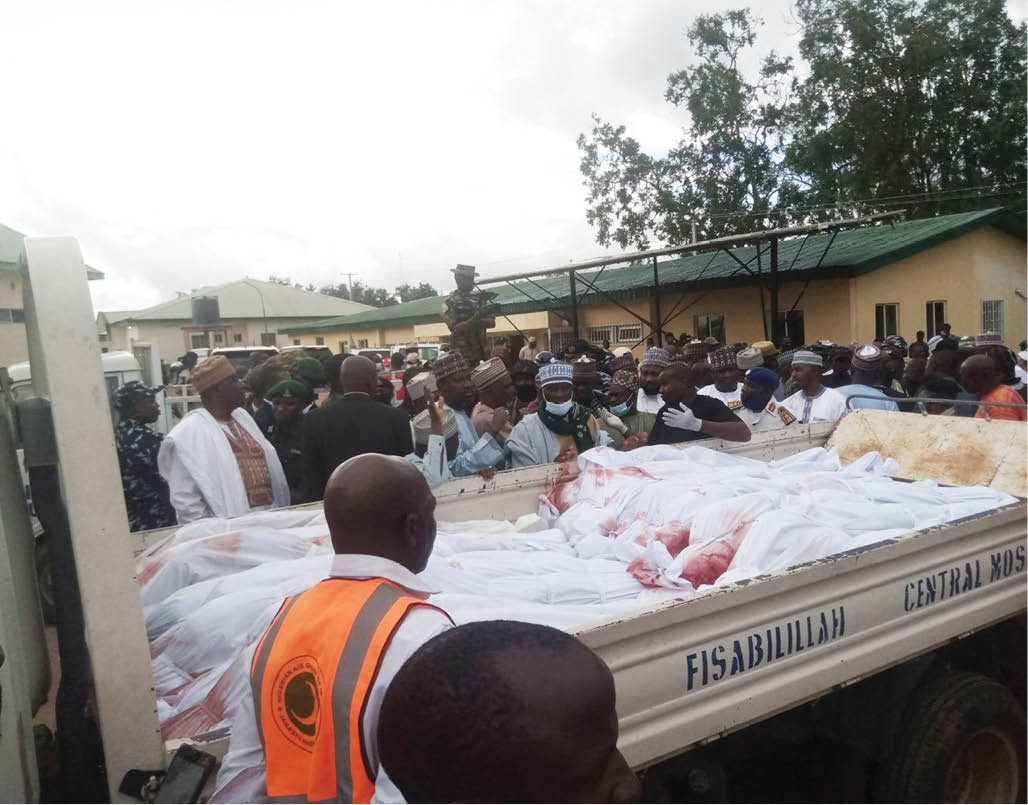
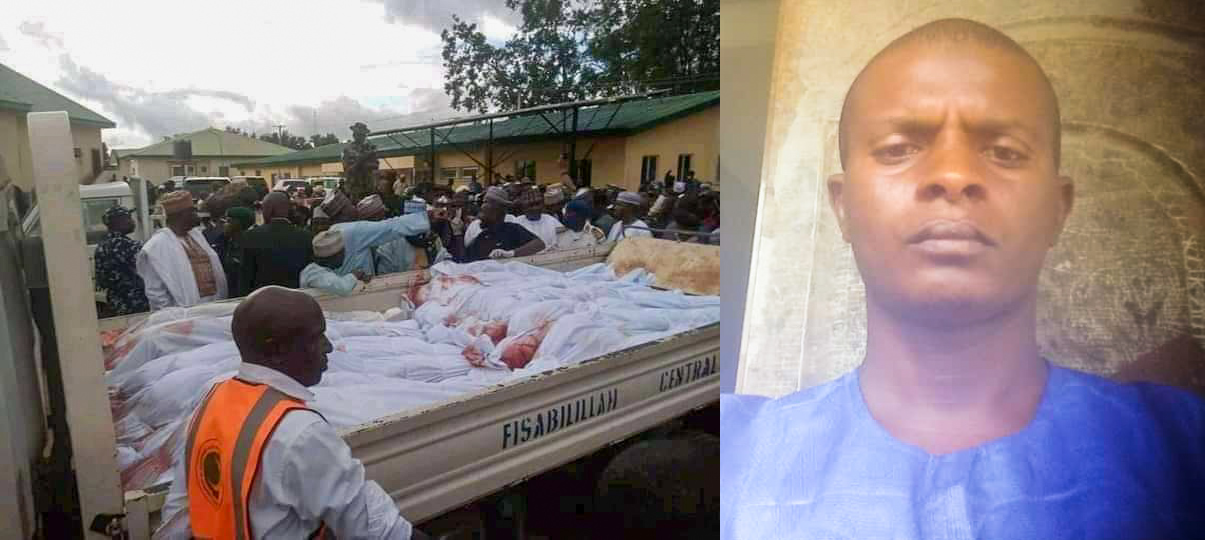
When I was listening to the Annual Muhammadu Sanusi II Colloquium online at around noon on Saturday, a call from a Jos-based friend interrupted my network. His heart was panting as he told me about an attack on travellers in Jos. However, he said he had no additional information; he only added that corpses, drenched in blood, had been brought to the Jos Central Mosque.

I immediately began to make calls, hoping I could speak directly with some survivors if there were any. But, unfortunately, I could not get any until the early hours of Sunday when I received an SMS from my source in Jos with the phone number of one survivor named Haruna Muhammad.

Haruna, 36, was the only man from Ogun state who joined other 53 Ondo and Kogi states based Muslims to travel to Shaikh Dahiru Usman Bauchi, a renowned Islamic scholar of the Tijjaniya Sufi Order in his home in Bauchi state. The 54 Muslim faithful travelled in a convoy of 5 hummer busses from Ondo state through Jos and arrived at Bauchi in the early hours of Friday “for a Friday litany with the Shaikh,” said Haruna.

“We left Bauchi for Ondo at around 7 am through Jos.” The journey was peaceful until around 10 am when “we arrived at a place blocked by some youths searching every car passing by. And when it came to our turn, we were asked to all step down of the cars.”

The youths began asking the drivers questions about where the convoy was coming from and where they were heading. “It was obvious they didn’t trust us,” Haruna said, but above all, the youths were angry. Before Haruna or any of his brothers speaks, the youth began shouting, hitting them with sticks, and suddenly, all the convoy dispersed into the nooks of Rukuba for their lives. “None of us has any idea where he’s running to, but we had to try and save our lives,” Haruna recounted.

While in hiding, Haruna watched in dread how the youth used sticks and stones to massacre some of his co-travellers. A viral video shared online by an unknown perpetrator shows how they used to smash and shatter the victims’ heads on the road. Haruna also heard a gunshot but could not identify who was shot at the moment. Twenty-five people were butchered at the spot before the military came to rescue those in hiding, like Haruna and 25 others. One other sustained severe injuries and died later at Plateau Hospital, according to Haruna.

The State Director, Fityanul Islam of Nigeria, Mallam Adam Hamza, who supervised the preparation and burial of the deceased, confirmed that they buried 26 bodies at Dadin Kowa Cemetery of Jos South. The graveyard is a 19-minute drive from the Jos North Central Mosque. The other injured victims are still at the hospital receiving treatment.

I asked Haruna why they chose to follow Rukuba Road since that wasn’t the road they followed to Bauchi. “One of us proposed that Rukuba Road would be better,” he said, “and then one of the drivers said he too knows the road. So, he led the convoy.” None of the five drivers, however, sustained an injury. All 5 were non-Muslim Yorubas from Ondo state. Before the military arrived at the scene, Haruna confirmed that one of the cars was set on fire, and another driver luckily drove off his car to safety. As of this morning, that driver set off for Ondo. Haruna and other survivors are still in Plateau State, kept at a hotel under the protection of the state government. He assured me they are well taken care of under the supervision of Fityanul Islam of Nigeria.

All this appeared to come to the authorities with shock, according to Mallam Adam. Some government officials who attended the burial include Secretary to the state government, who was said to have represented the state governor, Simon Bako Lalong. Others include the state police commissioner, CP Edward Egbuka, and General Officer Commanding (GOC) of the Jos 3-Division, General Ibrahim Ali. The CP and GOC also visited the scene of the massacre on Saturday.

All efforts to speak with one of the government officials were not successful. However, in a press statement, the Plateau State Government, in response to the massacre and avoidance of counter-reprisal, imposed dusk-to-dawn (6 pm – 6 am) curfew in Bassa, Jos South and Jos North local governments at 3 am on Sunday. But unconfirmed reports coming from Jos North this morning indicate that the atmosphere is intense.

It’s no wonder that through its Director of Press, Dr Makut Simon Machan, the state government released another statement at exactly 11:02 am today that imposing a 24-hour curfew in Jos North “to contain further security threats”.

It could be recalled that on Wednesday, August 4, 2021, an attack on travellers was recorded where a truck full of animals was set ablaze at Gada Biyu, a trekking distance from Rukuba Road. That attack was said to be a reprisal as Fulanis were said to have attacked Irigwe houses and destroyed farms in other state villages.

Yesterday’s attack could also be a continuation of the previous reprisal. Survivors and locals call on the Plateau state government to look into the root cause of these killings as a matter of urgency and ensure justice is served. Any delay could return Jos North to its dark days when people get killed sporadically if they (mistakenly) entered territory belonging to another ethnicity or religion other than theirs.

Haruna Muhammad further urged the Federal and State government to ensure the arrest of all who were responsible for the merciless killings of his innocent brothers on August 14 2021. He said whatever misunderstanding is going on between the tribes in Plateau state, his brothers know nothing about it, and their killings shouldn’t be unchecked. The massacre yesterday left 26 people dead and 33 survivors, including the drivers.

Apex Muslim body, NSCIA, condemns butcher of Muslim travellers in Plateau, appeals for calm

By Muhammad Sabiu

The Nigerian Supreme Council for Islamic Affairs (NSCIA) on Sunday “unequivocally condemns” the attack and killing of over 22 Muslim travellers by a suspected Christian militia in Plateau State.

On Saturday, the Daily Reality newspaper reported the killing of the travellers who were returning from Bauchi to Ondo after attending a religious event.

In a statement, the NSCIA said, “The Nigerian Supreme Council for Islamic Affairs (NSCIA) under the leadership of its President-General Muhammad Sa’ad Abubakar, CFR, mni, unequivocally condemns the massacre of a group of innocent Muslims who were returning from Bauchi to Akure. Ondo State, on Saturday.”

The Muslim body appeals for calm and warns against reprisals, saying, “…the Council appeals to all Muslims to be calm and nobody should take laws into his or her hands. The Council re-emphasises that no human life deserves to be wasted on any ground, be it religious or ethnic.”

The Presidency also condemned the killing in a statement signed by the presidential spokesperson, Malam Garba Shehu.

Again, social media users took to their accounts to protest the killing by sharing photo and video content of the victims’ bodies and their funerals.

President Buhari condemns attack on Muslim travellers in Plateau, vows to fish out perpetrators

By Muhammadu Sabiu

The presidency has “strongly condemned” the attack on about ninety Muslim travellers, among whom over twenty-two were killed on Saturday Gada Biyu and Rukuba Road along the Jos-Zaria road in Jos North Local Government Area of Plateau State.

The condemnation is contained in a statement released Saturday by a presidential spokesperson, Malam Garba Shehu, via his Facebook account.

“The Presidency condemns the attack earlier Saturday on travellers from a religious event in Bauchi, passing through Jos, the Plateau State Capital and regrets the reported deaths of at least twenty-two persons with several others injured in that ambush on their travelling party.

“It is widely known that Plateau State has been one of the states affected by herder-farmer clashes, which have, in a significant way, been curtailed following the intense peace-building efforts of the administration of Governor Simon Lalong,” Garba Shehu said.

President Buhari has ordered security agencies to fish out the perpetrators of the attack.

Giving the order, Buhari was quoted as saying, “Make no mistake about it: in line with my commitment to protect all Nigerians, I have ordered our security agencies to fish out the perpetrators of this gruesome massacre of innocent travellers and bring them to justice.”

Recall that The Daily Reality newspaper has reported that police have confirmed the killing of at least twenty-two Muslim travellers.

However, reports coming from Plateau State afterwards have indicated that the death toll had risen from twenty-two to thirty as more corpses were recovered.

Police confirm killing of 22 Muslim travellers in Plateau

By Muhammad Sabiu

At least twenty two Muslim travellers have been confirmed dead after an attack on a convoy of their buses on Saturday in Rukuba Road along the Jos-Zaria road in Jos North Local Government Area of Plateau State.

Confirming the attack, Plateau State police spokesman, Ubah Ogaba, said, “At about 0928hrs (08:28 GMT) the Plateau State Police Command received a distress call that a group of attackers suspected to be Irigwe youths (predominantly Christian)… attacked a convoy of five buses with Muslim faithful.”

“Twenty-two persons were killed and 14 injured in the attack,” he added

However, according to Channels TV, “a local government representative said the toll was higher.”

“Twenty-five people are now confirmed killed,” said the state government representative Danladi Atu, who visited a hospital where victims have been admitted.

In a statement released by Governor Lalong’s spokesperson, Makut Simon Macham, the governor condemned the attack and said, “security has been beefed up around the area.”

Plateau State is known for ethno-religious violence, which leaves people in large numbers dead and injured.

What Nigerian government should do about blasphemy

By Abdul-Hamid Abubakar Zubair

The ungovernability, which is crystal clear, toward the act of showing contempt and lack of reverence to sacred religious deity/deities is imminent and very alarming. If not seriously challenged and tackled by the constituted authorities, especially at the federal level, that may, unfortunately, aggravate severe tension even to the dogmatical secular democratic doctrine, believed to be a workable formula that has an answer to all national issues. 

It holds true, you like it or not, the fact that religion matters in Nigeria. Most people are firmly bound to one of the two major faiths, Islam or Christianity, and thus, it is a duty call for any person in power to uphold, respect, and support people’s various beliefs. The people have the right to practice their religion. Blasphemy is unacceptable and is punishable even according to national laws in the criminal codes as enshrined by both customary and Shariah laws. You can’t shift secularism to this place – at least, it is not yet the time.

Observing closely how cascades of blasphemous thoughtlessness and rashness have been unravelling in recent times, you can sense new dimensions and order of hidden treacherous agenda, purportedly insinuated by servile demonic elements. It is not by mere serendipity but a carefully thought out and planned memorandum.

In the North, there are more than four blasphemy suits filed in courts. The two trending cases include Yahaya Shariff Aminu, 22, a musician, and Umar Faruk, 16, both in Kano. The latter has been overturned and acquitted, and the former has been sent for a retrial by the Court of Appeal.

Another classic take-away example was the just concluded dialogue that features the controversial Shiite scholar, Abdul-Jabbar Nasiru Kabara, following his deliberate inciteful utterances and wrong interpretation and exegesis of Sunnatic traditions (Hadith), and after his request to the Kano State government to do justice and convene a physical dialogue with other Kano Islamic Clerics from the Salaf, Tijjaniya and Qadiriyya Sects. The aftermath of the conversation proved the bitter truth that was heavy and unfavourable to the eccentric Shiite cleric. 

I heard of a similar ordeal from Sokoto. A man allegedly made similar blasphemous utterances against the Prophet Muhammad (PBUH). However, we were supposed to be brainwashed by the excuse that he was suffering from temporal madness. Meanwhile, dementia was his alibi.

Taking a close look at these, one may ruminate over some questions and conclude that all these are not coincidental but planned.

Insecurity is a current social issue at hand. It has perturbed the entire nation. A lot of societal menaces are happening.  This trending problem of blasphemy coupled with insecurity will produce a severe stale. If it finds a place to stay, it will add salt to an injury, and the pain will be intolerably excruciating. 

There should be no room for apology for a deliberate blasphemous act. Anyone found guilty must be seriously punished and his actions thoroughly condemned. The same thing goes for all media outfits. Through that only, peace can prevail. 

Some personalities and deities are insurmountable, untouchable in major religions that should be demarcated by the power authorities and declared as a “no-go” zone. In strong terms, it should be stipulated that anything the Christians, Muslims, or any other religion recognised by the authority; within the Nigerian Province, which is considered alien or goes against the standard teachings – especially blasphemous utterances must be punishable. The government should get a grip on these with a strong and clenched fist.

The government should seize the day while it’s still dawn and make hay while the sun shines before things turned out of hand.

Abdul-Hamid Abubakar Zubair
Federal University Gashua, Nigeria.
E-mail: ibntaimiyya@fugashua.edu.ng
Phone no.: +2348138171001

Afenifere Article: Sahara Reporters’ editors are to blame

By Salisu Uba Kofar-Wambai

Though conflicts, for the most part, originate in the social world beyond the media, it is through the different media of journalism and circulation of news that many of them become publicly known and, often, pursued. Moreover, it is through many media lenses that the conflicts are variously defined, framed and visualized. Hence, media must always be socially responsible in its reportage not to stir up violence through its operations.

Journalism is a serious business in a multi-ethnic country like Nigeria, a country with over 400 ethnic groups, two major religious groups belonging to several sects, among other diversities. The media, especially the online newspapers, which serve as a watchdog and mirror of the society, cannot afford to be biased, lopsided and insensitive in the way they report such ethno-religious issues in the country.

Nigeria is a unique country on earth. You can hardly get a country that’s almost equally divided along two religious lines as Nigeria. Unfortunately, many studies conducted have shown the dirty hands of media in fanning the embers of hatred, animosity and conflicts they ought to have resolved among the followers of the two faiths.

The demonization of Fulani, the reportage of Sharia issues in the early 2000s, Boko Haram coverage, Niger Delta militancy reports, recent secessionists uprisings were all given oxygen by the media to survive, which seriously poses a threat to the unity and integration of the country.

However, irresponsible newspapers and so-called professionals working in the industry are to blame. The recent derogatory reportage of the unguarded utterances of the Afenifere, a Yoruba social-cultural organization, by Sahara Reporters is a textbook example of media complicity in causing violence in the country.

It looks like the Sahara Reporters had underrated and underestimated the profession’s ethics regarding such a sensitive and slippery issue. The editors haven’t done their onus professionally. Editing is a process of preparing language, images, or sound for presentation through correction, condensation, organization and other modifications. So, given the complex configuration of Nigerian society, an editor ought to be versatile and very knowledgeable of religious sensitivities. Newsroom desks must be given their cause to do their works. For instance, should the editor-in-chief be busy, the subeditors in the religious desk should handle it.

An editor is a gatekeeper who controls and sifts what will be disseminated to the enormous and varied readers, who have emanated from different social backgrounds, religious beliefs, and ethnic nuances. Therefore, an editor in a Nigerian newspaper ought to be someone with deep comparative religious knowledge who knows the sensitivities of every belief and faith. 

In a heterogeneous society like Nigeria, an editor must be Mr Know-All to escape falling into a ditch and trap of such violence invocation.

He should be aware that If Christians can compare every dimwit, imbecile character with Jesus (PBUH), Muslims don’t do it this way. In Islam, Prophet Muhammad (SAW) is sacrosanct, inviolate. Thus, no one should compare the Prophet with any being, let alone Sunday Igboho, a run-away character the Nigerian government sees as a criminal and murderer.

I thought these so-called editors would take a lesson from what Isioma Daniel did, who tried to align Prophet Muhammad SAW with the dirty beauty pageants in the early 2000s. It turned out to be the worst professional blunder by Thisday newspapers. That single act that could be corrected by almighty editing led to gigantic violence that claimed more than 200 innocent souls in Kaduna.

 I also wonder that Afenifere apologists have more Muslims than Christians in their membership; they ought to know this. Therefore, that’s why many were suspecting that what transpired was deliberately done to instigate war.

Sahara Reporters is the only newspaper that reported such an incident as such. Most media outfits have abandoned the reports for their editors knew the consequences. They look at the news items and the society at large.

No matter what, the professional interest must not be mortgaged to religious and ethnic ties. We must allow competence and expertise to overshadow those personal interests.

Salisu Uba Kofar-Wambai is a PhD student at the Department of Mass Communication, Bayero University, Kano. He can be reached via salisunews@gmail.com.