APC

Tinubu Receives APC Certificate of Return, Party Flag for 2027 Presidential Race


By Abdullahi Mukhtar Algasgaini

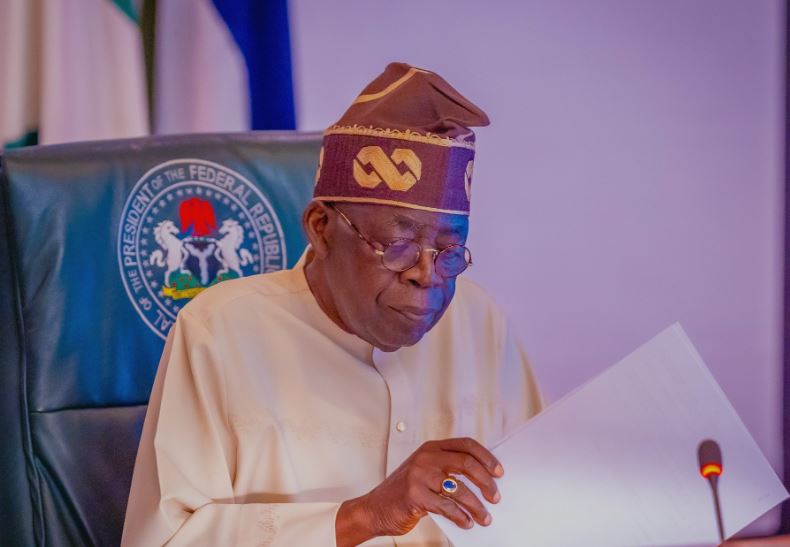
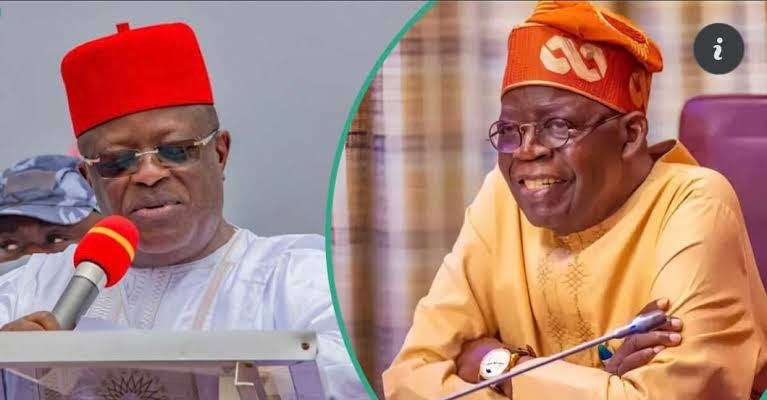
President Bola Ahmed Tinubu is set to officially receive the certificate of return and the party flag as the All Progressives Congress (APC) presidential candidate for the 2027 elections on Sunday.

The Presidential Primary Elections Committee will present the items at the Bola Ahmed Tinubu International Conference Centre in Abuja following the nationwide collation of primary election results.

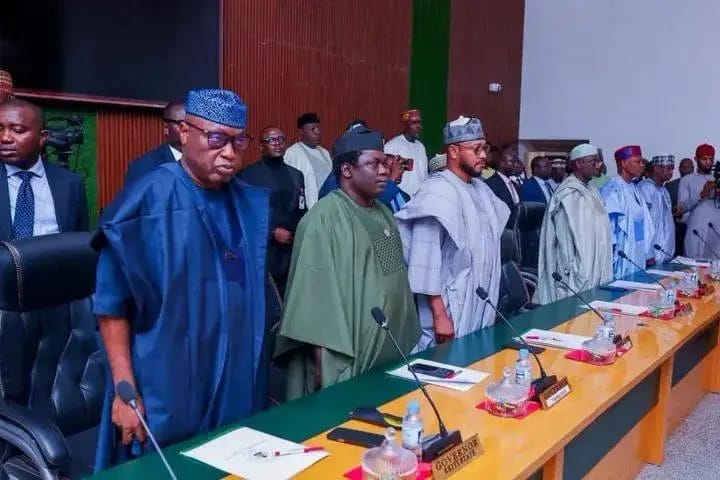
The ceremony will be attended by APC governors, members of the National Executive Committee, the National Working Committee, and the National Assembly, as well as party stalwarts.

In a statement released on Saturday, Bayo Onanuga, Special Adviser to the President on Information and Strategy, confirmed the event.

The presentation marks a formal step in the APC’s preparation for the 2027 general elections, with President Tinubu expected to lead the party’s campaign for a second term.

Kano Lawmaker Dumps APC for NDC After Losing Re-Election Ticket

By Uzair Adam

The member representing Gwale Constituency in the Kano State House of Assembly, Hon. Abdulmajid Isa Umar Mai Rigar Fata, has defected from the All Progressives Congress (APC) to the Nigeria Democratic Congress (NDC).

Mai Rigar Fata represents Gwale Local Government Area, the hometown of Kano State Governor Abba Kabir Yusuf.

The lawmaker was officially received into the NDC on Thursday by former Kano State governor and party leader, Senator Rabiu Musa Kwankwaso, at his residence in Maitama, Abuja.

Kwankwaso described the defection as a major boost for the party’s grassroots structure in Kano State, saying the new entrants would strengthen the NDC ahead of future political activities.

Mai Rigar Fata was first elected into the Assembly in 2023 under the platform of the New Nigeria People’s Party (NNPP) before later moving to the APC alongside Governor Yusuf.

His latest defection followed his failure to secure the APC ticket to contest for another term in the Assembly.

Others who also joined the NDC include former Gwale Local Government Vice Chairman, Hon. Kabiru Sani Auwal Obi, and Malam Mahadi Isa Umar.

The development came shortly after a Federal High Court ruling on Thursday which reportedly created fresh openings for political defections previously restricted by the Independent National Electoral Commission (INEC).

Reacting to the court decision, the spokesman of the opposition African Democratic Congress (ADC), Malam Bolaji Abdullahi, said the ruling could trigger mass defections from the APC.

Pantami Withdraws From APC Governorship Primary in Gombe

By Sabiu Abdullahi


Former Minister of Communications and Digital Economy, Prof. Isa Ali Ibrahim Pantami, has pulled out of the All Progressives Congress (APC) governorship primary election in Gombe State.

Pantami announced his withdrawal on Tuesday through a statement issued by Barrister Ibrahim M. Attahir on behalf of the Pantamiyya Movement.

The former minister said his decision followed alleged violations of the Electoral Act 2026 and what he described as the APC leadership’s failure to provide information needed for a transparent and credible primary election.

According to the statement, Pantami joined the race after pressure from political leaders, women, youths and other stakeholders in the state. It added that he complied with the party’s guidelines and fulfilled all requirements expected of aspirants.

The statement also noted that Pantami was the only APC governorship aspirant who sent a representative to the Peace Accord meeting organised by the Nigeria Police Force, Gombe State Command, on May 14, 2026. It said his representative was also the only one who signed the agreement during the meeting.

Pantami, however, accused the party of denying him access to important details concerning the conduct of the direct primaries.

The statement said letters written by his solicitors to party officials over concerns surrounding the exercise were neither acknowledged nor answered.

“In a democracy, the law must guide the process. Non-compliance with the Electoral Act 2026 and the party guidelines renders the exercise unsafe and illegitimate,” the statement said.

It further alleged that irregularities marred the APC National Assembly direct primaries conducted in the state on May 16 and 18.

“The people of Gombe State witnessed what transpired during the direct primary ‘elections’ for the National Assembly held on 16 and 18 May 2026,” the statement added.

Pantami maintained that many grassroots party members, especially women and youths who form the bulk of his support base, were excluded from the process.

The statement said the former minister decided to withdraw after consultations with stakeholders across the state.

“After extensive consultations with stakeholders and careful reflection on the developments in Gombe State, Prof. Pantami has taken the difficult decision to withdraw from the APC governorship primary election scheduled for 21 May 2026, under protest. Peaceful protest is a fundamental pillar of democracy,” it stated.

The movement also accused party leaders of ignoring directives by President Bola Ahmed Tinubu on the need for free and credible direct primaries.

According to the statement, details relating to accreditation of agents and observers, voting procedures and collation centres were not provided to aspirants before the exercise.

“Even though President Bola Ahmed Tinubu insisted on the necessity of free, fair, and credible direct primaries, his directives were, unfortunately, not implemented,” the statement said.

Pantami also expressed appreciation to supporters who contributed money for the purchase of his nomination and expression of interest forms through crowdfunding.

The statement disclosed that donations ranged from ₦5,000 to ₦4 million and were publicly acknowledged online.

He thanked youths, women, campaign coordinators, elders and members of his media and campaign teams for their support.

Pantami urged his supporters to remain peaceful and law-abiding despite the development.

“Democracy rests on the rule of law, peace, and security,” the statement added.

The Pantamiyya Movement said it would announce its next political steps in due course.

Plateau APC Primary: Lawmaker Gagdi Loses Re-Election Ticket

By Anwar Usman

Mr. Yusuf Gagdi, a two-term lawmaker representing Pankshin/Kanke/Kanam Federal Constituency of Plateau State has failed to secure ticket of All Progressives Congress, APC, to return to the National Assembly for the third time.

Mr Gagdi is currently the Chairman, House of Representatives Standing Committee on Navy.

Gagdi lost the primaries of his party conducted across the three Local Government Area, LGAs, that make up his constituency.

NAN reports that, the Chairman of the Electoral Committee, Daspan Ishaya, announced the results of the polls on Sunday in Pankshin.

Mr Ishaya said that Dr John Tongshinen scored 29,968 to defeat Gagdi, his closest opponent, who polled 5,849 votes.

“By the powers conferred on me as the Chairman of this committee, I hereby declare Mr John Tongshinen as winner of the APC primaries for Pankshin/Kanke/Kanam federal constituency,”he said.

Ishaya explained that the primaries was observed by officials of the Independent National Electoral Commission, INEC.

APC Aspirant Mahmud Buba Withdraws From House Of Reps Race Amid Age Controversy


By Sabiu Abdullahi

Mahmud Sadis Buba, widely known as Al-Ajabin Zazzau, has stepped down from the contest to represent Sabon Gari Federal Constituency in the House of Representatives under the platform of the All Progressives Congress (APC).

His withdrawal followed weeks of controversy over allegations of age falsification and inconsistencies in documents linked to his candidacy.

Buba disclosed his decision in a letter addressed to the Kaduna State APC chairman. He also shared the letter on his verified Facebook page on Saturday.

“Please accept this letter as formal notification that I am withdrawing from the race for Sabon Gari Federal Constituency, House of Representatives, effective immediately,” he wrote.

He explained that the decision came after consultations with party leaders, family members and political associates. According to him, ongoing reconciliation efforts within the APC also influenced his action.

“This was not an easy decision. But it was hastened by the reconciliation efforts initiated by stakeholders and leaders of our party. Consequently, after extensive consultations with my family, political associates, and stakeholders within our great party, I have decided that this decision is in the best interest of the All Progressives Congress (APC),” he added.

Buba said party unity remained important ahead of the general elections. He noted that supporting a consensus candidate would strengthen the APC’s chances in the constituency.

“I believe that uniting behind a single candidate is paramount to our victory in the general election and for the continued progress of our constituency and state,” he stated.

The former aspirant also thanked Kaduna State Governor Uba Sani and the APC leadership for giving him the opportunity to participate in the party’s primaries. He described the experience as valuable and rewarding.

He maintained that his withdrawal should not be interpreted as a sign of weakness. He said the move reflected his commitment to unity within the party. Buba also pledged support for whoever eventually emerges as the APC candidate for the constituency.

He further appealed to his supporters to remain peaceful and support the party’s flagbearer.

Before his withdrawal, Buba had faced criticism over claims that he altered his age to satisfy the constitutional requirement for election into the House of Representatives.

The issue gained attention after his appearance before the APC screening committee in Abuja. Several social media users circulated documents that questioned his age and identity details.

Buba had earlier stated in interviews that he was born on August 2, 1995, and was qualified to contest the election. However, critics continued to challenge the claim, alleging discrepancies in some of his records.

Although he did not address the allegations directly in his withdrawal letter, political observers linked his exit to the controversy that surrounded his ambition.

As of the time of filing this report, APC stakeholders in Kaduna State had not issued an official statement on whether the withdrawal was connected to the allegations or part of wider reconciliation efforts within the party.

Buba Rejects ‘Consensus’ Endorsement of Sadiq Ango, Vows to Go for Direct Primary


By Abdullahi Mukhtar Algasgaini

A major crack has emerged within the All Progressives Congress (APC) in Sabon Gari Federal Constituency as aspirant Mahmud Sadis Buba has publicly rejected the endorsement of incumbent lawmaker Sadiq Ango Abdullahi as the party’s consensus candidate.

Buba, a 30-year-old popular politician in Zaria also known as Abin Al-Aljabin Zazzau, dismissed the arrangement as an “endorsement,” not a consensus, insisting that he was not consulted as a fellow aspirant.

The controversy began on Wednesday when the chairman of Sabon Gari local government area and ALGON chairman in Kaduna State, Hon. Jamilu Abubakar Albani, issued a statement claiming that APC stakeholders had met and endorsed Sadiq Ango as the constituency’s consensus candidate.

But in a reaction on Thursday night, speaking through his personal assistant and secretary, Alhassan Sani, Buba said: “Consensus is where all contestants or aspirants step down for one person. There was nothing like that. There was no consensus in the Sabon Gari federal constituency seat. It was an endorsement, not a consensus.”

Buba, who has already purchased his nomination forms, declared that he is fully prepared for the APC direct primary scheduled for Friday.

“We are fully prepared to go into direct primaries on Friday, and the people of Sabon Gari will vote for us massively,” he said.

As both factions stand their ground, tensions are mounting in the constituency ahead of the party’s primary election.

Atiku Condemns Death of Former Jigawa Lawmaker in Bandits’ Captivity

By Sabiu Abdullahi

Former Vice-President Atiku Abubakar has reacted to the death of former House of Representatives member, Hon. Abba Anas Adamu, who reportedly died while in the custody of bandits after his abduction along the Kaduna-Abuja highway.

Reports indicated that the former lawmaker was kidnapped on May 3, 2026, and died nine days later despite efforts by his family to secure his freedom.

Reacting to the incident, Atiku described the development as another sign of the growing security challenges facing the country under the current administration.

“His death is yet another grim reminder of the worsening collapse of security under the Tinubu administration,” he said.

The former vice-president spoke through a statement issued by his Senior Special Assistant on Public Communication, Phrank Shaibu.

According to Atiku, the death of a former federal lawmaker in the hands of kidnappers reflects what he described as the government’s inability to fulfil its constitutional responsibility of protecting lives and property.

“Let us be brutally honest: Nigeria is under siege, and the Tinubu administration appears either overwhelmed, indifferent, or dangerously incompetent in the face of this national emergency.

“When a former member of the National Assembly can be abducted on one of the country’s most strategic highways and die in captivity, what hope remains for the ordinary Nigerian who lacks visibility, influence, or protection?

“This is no longer about isolated incidents. It is now a horrifying pattern. Nigerians are being kidnapped from highways, farms, communities, and even their homes, while the government continues to issue sterile statements and recycled assurances that bear no resemblance to the lived reality of our people.

“Under this administration, insecurity has evolved from a crisis into a cruel national routine. Citizens now travel with prayers instead of protection. Families sleep with one eye open. Businesses are shutting down, farmers are abandoning their land, and entire communities are being surrendered to criminals.

“A government that cannot secure its highways cannot claim to govern. A government that watches citizens get hunted like prey has failed the most elementary test of leadership.

“It is particularly tragic that the Abuja-Kaduna corridor and surrounding routes have remained notorious theatres of terror despite repeated promises, security budgets running into trillions, and endless propaganda about progress.

“Nigerians deserve answers. What exactly is the security strategy of this administration? Where is the urgency? Where is the accountability? How many more deaths must be recorded before this government realises that press releases do not defeat bandits?

“No amount of political spin can deodorise this failure. A nation where former lawmakers die in captivity while criminals operate with audacity is a nation in distress.

“At this point, what Nigerians need is not another hollow condolence message. They need decisive leadership, coherent action, and measurable results.”

Atiku also sympathised with the family of the deceased, the people of Jigawa State and Nigerians affected by insecurity across the country.

He urged the Federal Government to address the worsening security situation with urgency and take stronger measures to protect citizens.

ADC Coalition: Rescue Mission or Market of Ambition?

By Aremu Haroon Abiodun

Let me begin with clarity and sincerity. I write this not as a partisan actor, not as a loyalist of any political party, and certainly not as a hired megaphone for any candidate. I write from the standpoint of an analyst, a student of democratic behaviour, and a public relations strategist who understands that politics is not only about power; it is also about perception, timing, trust, and structure.

This piece is not designed to insult President Bola Ahmed Tinubu, attack the ruling APC, mock the opposition, or discredit any politician. Rather, it is an honest attempt to interrogate one of the most defining questions of Nigeria’s approaching democratic race: Is the new coalition a movement of salvation or merely a market of ambition?

In every democracy, coalitions can either rescue nations or ruin trust. In Africa, where democracy is still battling poverty, elite capture, and personality politics, the answer matters deeply. Across the continent, from Kenya to South Africa, Senegal to Zimbabwe, fragmented opposition groups often unite to challenge incumbents. Sometimes they succeed; sometimes they collapse under the weight of ego and suspicion.

Coalitions are usually built on five promises: to rescue the nation, restore democracy, defeat bad governance, unite the opposition vote, and provide a better alternative. But behind these promises often lie hidden motives: personal ambition, ticket negotiation, political survival, revenge against former allies, and access to state power. This is why many coalitions look holy in public but bleed distrust in private.

Nigeria may now be entering that exact season. The African Democratic Congress (ADC), once a relatively minor platform, is suddenly being discussed as a possible shelter for heavyweight politicians dissatisfied with their former homes. But before Nigerians clap, they must ask a dangerous question: Do the coalition members even trust themselves? 

Parties are not built by logos; they are built by loyalty, and loyalty cannot be photocopied overnight.

Nigeria’s politics has become a railway station where leaders keep changing platforms while asking voters to stay loyal.

President Bola Ahmed Tinubu did not emerge by accident. His journey moved through the AD, AC, ACN, and finally the APC. He mastered a core truth that many others underestimated: structure beats noise.

While others chased headlines, Tinubu built networks, state influence, and grassroots machinery. Whether loved or criticised, he represents a masterclass in long-term political engineering.

Atiku’s route has been equally dramatic, moving from the PDP to the APC, back to the PDP, and now toward discussions with ADC. No politician in modern Nigeria has contested the presidency with as much persistence. 

Supporters call it resilience; critics call it endless ambition. But as time moves on, the ADC coalition may represent strategic urgency rather than just ideology, a final gamble in a house where the inheritance is uncertain.

Peter Obi’s path from APGA to the PDP, the Labour Party, and now ADC tells the story of a reformer searching for a machine. Obi proved in 2023 that popularity can shake systems, but popularity without nationwide structure has limits. 

If Obi brings credibility and a coalition brings machinery, the equation is powerful. However, can a reformist brand coexist with old political warlords? Movements are powered by hope, but coalitions are powered by compromise.

Moving from the PDP to the APC, the NNPP, and now the ADC, Kwankwaso commands a loyal bloc in the North. He has what every coalition needs—a dedicated voter base—but he also has what coalitions fear: independent ambition. The success of any merger will depend on whether arithmetic can overcome ego.

The urgency for a coalition is often driven by the stark reality of election data. In Nigeria’s 2023 presidential election, the opposition’s fragmentation was clear. President Bola Ahmed Tinubu won with 8,794,726 votes (36.6%), while the combined votes of the three main opposition candidates, Atiku Abubakar (6,984,520), Peter Obi (6,101,533), and Rabiu Kwankwaso (1,496,687), totalled 14,582,740.

Mathematically, the opposition held over 60% of the total vote, but their inability to unite resulted in a win for the incumbent’s structure. This “voter math” is the primary engine behind the current migration toward the ADC; politicians realise that without a unified front, sentiment rarely defeats a settled structure.

Having that in mind, can Atiku trust Obi? Can Obi trust establishment figures? Can Kwankwaso trust a ticket arrangement? Coalitions often fail not because they lack votes, but because they lack trust.

Sooner or later, the “Ticket War” arrives. If Atiku wants one last shot, Obi believes his momentum was stolen, and Kwankwaso believes northern arithmetic favours him, the smiles will disappear. A coalition before a primary is romance; a coalition after a primary is war.

Furthermore, many underestimate the “Tinubu Factor.” Hatred of an incumbent is not a development plan. Tinubu remains a formidable strategist because he controls incumbency power and understands coalition management better than many of his rivals. To defeat a strategist, anger is insufficient, but superior organisation could be the way out.

From a strategic communication perspective, the narratives are already forming. APC’s narrative centres on stability, continuity, and ongoing reforms. ADC represents a force for “Rescue Nigeria,” unites the opposition, and restores hope.

Both parties face a risk. The ADC risks being seen as a shelter for serial defectors, while the APC risks seeming disconnected from economic pain.

Lastline 

Nigeria does not merely need a coalition of politicians; it needs a coalition of ideas, competence, and national healing. If the ADC becomes a real reform movement, it can change history. If it becomes only a marketplace of ambition, it will prove that parties change names faster than systems change realities.

The real contest of 2027 may not be APC vs. ADC. It will be structure vs sentiment, trust vs suspicion, and nationhood vs ambition. On that day, Nigerians, not politicians, will deliver the final verdict on who rules in the next four years.

Haroon Aremu is a public relations strategist and wrote in via exponentumera@gmail.com.

Gombe Senator Dumps APC Over Consensus Arrangement


By Anas Abbas

Siyako Anthony Yaro, a Senator Representing Gombe South Senatorial District has resigned from the All Progressives Congress (APC) to Peoples Democratic party ( PDP)  after rejecting the party’s reported consensus arrangement ahead of the 2027 political activities.

The senator, announced his resignation in a letter addressed to party officials, citing dissatisfaction with internal decisions and the alleged imposition of candidates through a consensus process.

He maintained that the arrangement was contrary to democratic principles within the party.

The senator stressed that his return to the PDP should not be viewed as political desperation or inconsistency, but as a demonstration of responsibility and commitment to the people he represents.

“To my supporters and constituents, I ask that you see this return not as a sign of confusion, but as an act of courage and accountability. My loyalty has always been, and will always be, to the people first,” he stated

The senator expressed concern over what he described as a lack of transparency and inclusiveness in the party’s internal affairs, stressing that members should be allowed to participate freely in competitive contests rather than adopting imposed agreements.

Sources within the party said the development has generated fresh political tension in Gombe State, especially as consultations and alignments ahead of future elections continue to intensify.

The resignation is seen as another setback for the APC in the state, with political observers suggesting that the move could influence emerging alliances and future political calculations in the region.

Bauchi Governor Bala Mohammed Picks APM Senate Nomination Form After Defecting From PDP

By Sabiu Abdullahi


Bauchi State Governor, Bala Mohammed, has picked the senate nomination form of the Allied Peoples Movement (APM) five days after formally joining the party.

Mohammed resigned from the Peoples Democratic Party (PDP) on May 2 and moved to the APM, citing prolonged court cases and internal disputes within the PDP as reasons for his departure.

In his statement issued on Thursday, the governor confirmed that he picked the nomination form during the APM National Executive Committee (NEC) meeting held at the party’s national headquarters.

“During the meeting, I officially picked up my nomination form to contest for the senate seat representing Bauchi south senatorial district under the platform of the APM ahead of the forthcoming elections,” he said.

The NEC meeting was presided over by Yusuf Mamman Dantalle, the party’s national chairman, and focused on key national and internal party issues. The session also provided an opportunity for Mohammed to formally engage with the party’s leadership structure.

He noted that Nigeria’s political environment has become increasingly difficult due to “undemocratic practices and political intimidation”, which he said have limited genuine participation for progressive leaders and movements.

Following consultations with political associates, stakeholders, and supporters across the country, Mohammed said the APM emerged as the most suitable platform for his political direction.

He explained that the party aligns with his political values, especially in the areas of good governance, internal democracy, justice, inclusiveness, and respect for the rule of law.

“I further emphasised that our decision to join the party was driven by conviction and the desire to contribute meaningfully to building a stronger democratic culture in Nigeria,” he said.

Mohammed also disclosed that several political office holders and stakeholders who were previously aligned with the PDP structure in Bauchi have followed him into the APM.

These include members of the National Assembly, the Bauchi State House of Assembly, local government chairmen, commissioners, ward executives, party officials, and other supporters at the grassroots level.

The governor assured the party leadership of his commitment to contribute resources, experience, and political support toward strengthening the APM ahead of future elections.