Hausa Films

Kannywood movie review: Ruwan Dare

By Muhammad Abubakar

Having watched this movie and seeing its lessons, I decided to review it. Doing so will, by God‘s will, will wake up those graduates—who are unknowingly killing, or more correctly, misleading themselves into believing that it’s shameful for graduates to get themselves engaged in a low-income business, let alone being a labourer.

The movie was released in 2018. It‘s directed by a veteran Kannywood director, Yaseen Auwal. The film is about the situation and the kind of life our nowadays students, particularly graduates, live.

Kamalu (Sadiq Sani Sadiq), the son of the lowest-income businessman (Rabi’u Rikadawa), happened to be a close friend to Bashir (Aminu Sharif Momoh), a brother to the husband of Jamila Nagudu. Their respectable, reasonable, deep-thinking friend, Lawal (Baballe Hayatu), always tries his best to advise not only Kamalu and Lawal but anyone too ambitious not to rely on the government job entirely. At least they should find something to do to improve their lives.

However—unfortunately for them, they always don’t see his advice as something important. One fateful day, Kamalu and Bashir came to the cafe where they almost every day buy stuff without payment. They lie to the tea seller (Ahmad Aliyu Tage) that when they become billionaires in the future, they will pay back everything he now gives them and give him more.

Unfortunately, the tea seller, Ahmad Aliyu Tage, rejected their request, complaining that he was tired of their ‘when-we-become-billionaires’. Luckily for them, Lawal came to buy something at the same cafe too. Although they undermined his sense recently, he surprised them by assigning the tea seller, Ahmad Aliyu Tage, to cook one packet of noodles alongside a whole roasted chicken for each of them. Sadly, this has not served them as a lesson.

One thing that inspired me is: Lawan never worried himself about a government job. He, in the end, made it, leaving them still suffering from poverty as usual.

The film is fascinating, indeed. We see how Lawal and Bashir suffer due to their laziness in going and refusing to hustle. As a result, they end up pushing a truck and teaching at primary school. In addition, the movie passes the message that: Whoever is not content with what God gives him will end up missing a lot in life.

The camera work and sound are up to the mark. And the subtitler has perfectly played his role. Even though he mixed with Hausa in some scenes, this is not an issue. Since the message is precisely delivered – this film was purposely made to call on the attention of graduates like Kamalu and Bashir.

It’s a must-watch film.

Kannywood movie review: AISHA

  • Director: Hafizu Bello
  • Producer: Abubakar Bashir Mai-Shadda
  • Screenplay: Naziru Alkanawiy
  • Language: Hausa
  • Company: Mai-Shadda Global Resources Limited
  • Release Date: 9/7/2022
  • Cast: Amal Umar, Nura Hussaini, Adam A. Zango, Sani Danja, Shamsu Dan Iya, Sani Mu’azu, Kanayo O. Kanayo, Sadiya Umar, Abdurrazak Sultan, etc.

You can hardly see a ‘thriller’ or a ‘crime mystery film’ in Kannywood’s archive. Recently, however, the trend has begun to change, as the rare genre is being explored by the veteran director Hafizu Bello. After presenting the murder mystery film HIKIMA in 2021, he came again with another one entitled AISHA. It revolves around the eponymous character, a rape victim who eventually dies, and her parents’ struggle for justice.

Aisha (Amal Umar) is a university student from a low-income family. Her father, Malam Balarabe (Nura Hussaini), tries his best to see her success. However, one fateful day, she is found lying, raped and wounded on campus. The police soon arrive and take her to the hospital. Meanwhile, the university management is more concerned about the school’s reputation. They, therefore, conspire with the police officer in charge of the case, SP Audu Makera (Adam A. Zango) and the doctor (Abba El- Mustapha) to hide the embarrassing incident.

Aisha’s parents are upset and anxious to know the cause of their daughter’s critical condition, but the doctor refuses to tell them. Therefore, her father questions the official report issued after she dies and files a petition to get justice. The audience is then taken to the courtroom, where everything is unmasked at the end.

Typical of mystery films, the plot is uncommonly twisted. Many sequences are cut before they end and later continued as flashbacks, particularly when the suspects are interrogated. There are more flashbacks as the defendants and witnesses talk during the court sessions. But all are flawlessly pieced together. The credit should go to the director, Hafizu Bello, who handles the film with the finesse of a devoted artist. Other crew members also did remarkably well. The cinematography is top-notch, and the locations are beautiful. There is also good use of costumes and props.

The film exposes the grim reality in some higher institutions where the students commit serious misconduct. It can also be a wake-up call for parents to be extra cautious about their female children. We see how Aisha duped her father into believing she would spend her night in the hostel but ended up in her boyfriend’s room, where the tragedy later befalls her. The film also highlights how the elite plot against the masses to protect their selfish interests.

Indeed, Aisha is a decent, well-crafted movie with a strong message and realistic narrative. However, the University setting and courtroom dramas make it somewhat formulaic, resembling the director’s previous film Hikima. It would’ve also been more intriguing if it had begun from the scene where Aisha is shown lying on the ground.

The film has an all-star cast, and the actors fit their respective roles. But some of them, like Yakubu Muhammad and Baballe Hayatu, are wasted as minor characters. The eponymous heroine (Amal Umar), the prime suspect (Shamsu Dan Iya) and the security personnel (Sani Danja and Adam A. Zango) all try to pull off good performances. However, it’s Nura Hussaini that steals every scene he features. The courage and anguish he communicates as Aisha’s hapless father seem extremely real. The lawyers (Sani Mu’azu and Sadiya Umar) and the judge (Kanayo O. Kanayo) also play their part with remarkable capacity.

Although Aisha is not a masterpiece, it’s better than the fluffs Kannywood churn out regularly. I, therefore, strongly recommend it—rating 3.5/5.

Reviewed by:

Habibu Maaruf Abdu

Kano, Nigeria

habibumaaruf11@gmail.com

Kannywood Film Review: ” There is a way”

By Anna Mohr

The movie, There is a way, directed by Falalu A. Dorayi and produced by Abba El-Mustapha, is a simple but effective feel-good movie retelling popular tropes and stories in a predictable but heartwarming way. Following the recipe of Shakespearean dramatics and clichéd Disney movies in the 2000s, such as Cinderella Story or High School Musical, it easily can stand on its own while also covering issues of the Hausa society and giving insights into its culture – an entertaining and so sweet movie you can taste the sugar on your lips.

Isham is a middle-class university student with a pure heart who wants to get his degree through hard work. He falls high over heels for Fadilla, the daughter of a wealthy businessman. The two desperately want to be together but must face several problems threatening to destroy their relationship.

There is a Way was the first Hausa movie I watched, and although the story has already been told a thousand times, I easily became invested with it. Even though I rarely watch romantic movies, I have a soft spot for them. The quality of the film is fitting to the story itself: simple but refreshing. Please, do not expect finesse camerawork or outstanding dialogues – you will surely be disappointed. But the blunt storytelling is made up of dramatics that can easily compete with those of the Bollywood film industry.

The movie itself is certainly no piece of art. It is amateurishly made: the camera is wiggling, and the lighter colours in the scenes are sometimes glaring and unnatural. At the same time, the movie uses effects such as slow-motion, certain scenes are muted to create tension and dramatic music is played in between.

The story itself is predictable as typical for a romantic movie and has similarities to our Western fairy tales and Elizabethan or ancient love stories: Man meets a woman and falls in love at first sight, but their love is doomed, and they have to face challenges before being together. Also, the poor protagonist and his rich-born love interest are no rarity in this genre. Another aspect I recognized in the film is the flat characters: We have a pure-hearted hero who cannot do wrong. But instead, tragedy happens to him, and his pureness is challenged. I found that quite wasted because characters are made to make mistakes. They can only grow when they do wrong and when they fail. There is a sense of relatedness that I miss.

The characters themselves are introduced in simplicity. When Fadilla’s parents appear on screen, they are introduced with “Hello Mum” and “Hello Dad”, which is blunt and unimaginative to share the family ties with the viewer. The dialogues are just as direct. The movie is in English, and there is no dubbing involved, meaning that Hausa people speak a language that is not their own. That includes that the dialogues are often wooden and lacking finesse. “I will tell you the secret of …” is just one example of the movie’s very direct way of communication, and I daresay that it would have been more natural if the characters had spoken in their own language. The English script has some sentences that are generally not used, leading to many exaggerated dialogues. For example, “you harbour a criminal” when Isham is accused of cheating in an exam.

So, why do I like this movie?

Easy: Because it has charm. It is charming how Isham and Fadilla are swooning about each other. How they tell each other Shakespearean confessions of undyeable love as if they just teleported into one of his sonnets; how they are the embodiment of a Greek tragedy, a Hausa variant of Romeo and Juliet; how the world is joined against them, but they are still standing side by side.

Viewing the Hausa society and culture in the movie is also fascinating. When watching it, you may recognize that male and female characters are never touching each other – not mother and son, not father and daughter, nor the lovers. In addition, women are wearing scarves – hijabs – around their heads, so you cannot see their hair.

Another interesting fact is the mention of Allah instead of God, which I needed some time to get used to the first time I watched the movie. Also, certain issues are discussed: For example, the gap between poor and rich, the importance of education and the problem of corruption and blackmailing at university. These aspects convey the information I would not find out otherwise and give more insights than any textbook in school.

To put it all together, the movie is a people pleaser. You can easily be invested in the plot and follow the relationship between Isham and Fadilla, although the story itself is simple and predictable. At the same time, there are interesting aspects of culture and society. So, I recommend watching it!

Anna Mohr studies at the University of Cologne, Germany. She can be reached via amohr9@smail.uni-koeln.de.

OBITUARY: Nura Mustapha Waye, the genius behind ‘Izzar So’

By Habibu Maaruf Abdu

On Sunday, July 3, 2022, Kannywood lost a colossus and a rare talent, Nura Mustapha Waye. Thousands of condolences started pouring from all angles as soon as the news of his death broke. Waye was the director of Izzar So and many other series and feature films. His sudden death came as a tremendous shock and left the Kannywood members and millions of their audience with tears in their eyes.

“Waye’s death is a significant loss to Kannywood, for he’s, I believe, the most prolific director today.” So says the Kannywood leading scholar-cum-critic, Dr Muhsin Ibrahim, in his short tribute to the late director.

Nura Waye, or Malam Nura, as he was respectfully called, proved unique among his peers in the Hausa film industry. He neglected its favourite musical love stories to make topical Islamic compliant productions. His dream of educating the audience prompted him to incorporate Qur’anic verses and prophetical sayings into the dialogues of his most of his films.

“In filmmaking, there are messages you could send and get a divine reward from the Almighty Allah… I take film as a medium for propagating a particular policy or ideology. This is what primarily inspired me to venture into it,” he once told VOA Hausa in an interview.

Waye began his Kannywood journey in the late 1990s. He was an actor throughout his first five years in the industry. He, afterwards, switched to director to realize his ambition of making films with a didactic tone. His early films left no mark, and he remained unnoticed for over a decade. Kuru-Kuru (2018) was, perhaps, his first movie to get critical attention.

The movie, which deals with the issue of ‘incest’, revolves around a new bride whose husband finds to be pregnant. After a lengthy investigation, it’s discovered that her uncle is responsible for the pregnancy. The movie received positive reviews and was generally praised for its theme and steady plot. But Waye would never rest there.

He reached the pinnacle of his career in 2020 after creating the YouTube series IZZAR SO. It was a sensational hit, and it went on to become the most-watched Kannywood series on YouTube. Its remarkable success dictated the migration of the Hausa film business to the online platform. Muhsin describes it as a ‘game-changer’ and opines thus:

“There might be a few YouTube series before Izzar So, but many more emerged following its unprecedented success. This has inspired many filmmakers, both struggling and established, to resort to making series, serials and feature films for YouTube.”

For Waye, however, Izzar So was not just a success but a fulfilment. This is because it catapulted him to the top of his career, which was his ultimate goal. “I want Allah to elevate me to its top,” he said when asked about his dream in the filmmaking business.

Nonetheless, Waye’s films are only one aspect of his legacy. He, on another side, had a reputation for being a very gentle, peaceful man. He was also so decent that he hardly features an actress wearing a tight-fitting dress in his movies. These, together with his vivid love for the Prophet (S.A.W), endeared him to the Hausa-Muslim populace despite their hostility towards Kannywood members.

Finally, as a Kannywood movie reviewer, I affirm Nura Mustapha Waye’s rare creativity. I believe he will always be remembered as a socioreligiously-committed filmmaker who led to Kannywood’s migration to online space and, above all, ‘the genius behind Izzar So’.

Habibu Maaruf Abdu wrote from Kano, Nigeria, via habibumaaruf11@gmail.com.

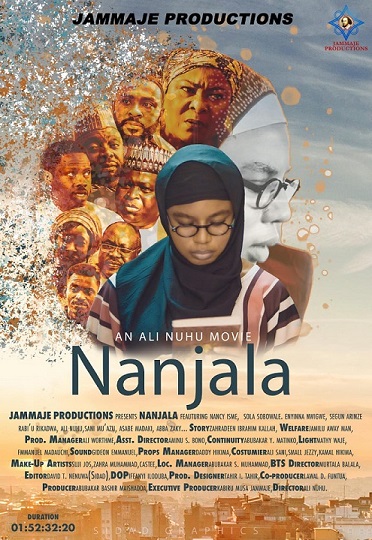
Kannywood/Nollywood film preview: Nanjala

The “Hausa films in English” have, since their debut, been as much praised as they have been criticised. However, while a large section of spectators welcomes the films, many others regard them as a threat to the development of the indigenous language. Others go further to describe them as “non-Kannywood” productions.

However, their initiator and promoter, Malam Kabiru Musa Jammaje, remains undaunted. He is all set to enthral the audience with another Kannywood film in English after the remarkable success of There is a way (2016), This is the way (2017), Light and darkness (2018) and In search of the king (2019).

The soon-to-be-released movie, entitled Nanjala, is the first of its kind in Kannywood. It features the industry’s heavyweights alongside top Nollywood actors like Enyinna Nwigwe, Nancy Isime, Segun Arinze, Sola Sabowale, among others. Moreover, it’s reportedly the most expensive Kannywood movie with a budget worth over N35 million.

The movie was directed by “whizkid” Ali Nuhu, co-produced by Abubakar Bashir Mai-Shadda and titled after its main character, Nanjala. I have only watched its two-minute-long teaser, but I could grasp that the eponymous heroine, Nanjala, is a journalist whose investigative reports would lead to the main conflicts. The film’s themes may include corruption, honesty, women empowerment, the menace of drug abuse, moral decadence, etc. The cinematography is terrific, and the cast seems to give an outstanding performance.

To be right is to describe the film as ‘pan-Nigerian’ due to its production quality, cast, English medium, and the resonance of its message in the country. It’s, of course, promising and will surely appeal to moviegoers from a wide range of backgrounds.

I, therefore, commend the trio of Jammaje, Ali Nuhu and Mai-Shadda for making a Kannywood film with the potential to catapult the overlooked film industry to the international stage. I do hope that it will not disappoint.

Habibu Maaruf Abdu

Kano, Nigeria

habibumaaruf11@gmail.com

27.5.2022

Kannywood movies review: NADEEYA

Director: Yaseen Auwal

Producer: Rahama Sadau and Abubakar Bashir Maishadda

Screenplay: Yakubu M. Kumo

Language: Hausa

Company: Sadau Pictures

Release Date: 18/02/2022

Cast: Rahama Sadau, Umar M. Shareef, Rab’u Rikadawa, Asma’u Sani etc.

After a brief hiatus in Kannywood, superstar Rahama Sadau is back with an eponymous movie NADEEYA. There have been high expectations of the film because of the good reputation of its director, Yaseen Auwal, and the female lead, Rahama Sadau, who also doubled as the producer. It, however, failed to open with a bang due to little publicity as it wasn’t initially made for the big screen.

The film is an issue-based drama about ‘upbringing’. It depicts how some parents spoil their kids, specifically daughters, and the practical difficulties such children face in life. The story revolves around a pampered daughter, Nadeeya (acted by Rahama Sadau), who faces similar challenges after her marriage.

Plot:

On their first day as newlyweds, Nadeeya’s husband (Umar M. Shareef) begins to discover mysterious things about her. She prays badly and can’t correctly perform even a simple ablution, not to speak of the ritual bath. The husband learns further that his bride doesn’t master domestic chores like cooking and housework. She once cooked a pretty heinous meal that nobody could eat. He is, thus, obliged to question her past. Viewers are then shown a series of flashbacks as she recounts her story.

Nadeeya is, since childhood, spoiled rotten by her father (Rabi’u Rikadawa). The father tried hard to get rid of anything that could cause discomfort to his favourite daughter. He had once fought an Islamic school teacher for punishing her and eventually pulled her out of the school. He also divorced her mum for disciplining her. Therefore, she was brought up single-handedly by the impious father with a maid doing everything for her. Nadeeya is now extremely remorseful and ready to change for the better. The story continues…

Critique:

The film is, indeed, hard-hitting and very meaningful. Through the eponymous character, it shows that children’s first learning begins at home, and their personality and morals depend largely on how they are raised. It also reminds of the responsibility of protecting one’s family from the hellfire, as contained in Qur’an (66:6). It reiterates that the responsibility is on both parents and husbands — this is seen in the portrayal of Nadeeya’s husband (Umar M. Shareef).

Nonetheless, despite some scenes being highly overdramatized, the director, Yaseen Auwal, succeeded in handling the serious theme with the utmost gravity. He deserves an accolade for making this topical movie that not only slams indulgent parents but also underlines the need for religious knowledge. Additionally, the film’s locales are beautiful, except for the bride’s room, where we see cracks in the painting. It was also well shot with an audible sound.

Again, the actors all did well. The lead, Rahama Sadau, is no slouch at acting. She melded every action with a fitting gesture, making a brilliant performance throughout the movie. M. Shareef tried to deliver his dialogue. He impressed in the scenes where he recites the Qur’an and where he teaches Nadeeya about Islam—although his chemistry with her didn’t take. However, Rabi’u Rikadawa did excellently as usual.

On the whole, Nadeeya is a well-made movie. I recommend it for those who are tired of Kannywood’s overblown romantic melodramas. Rating 3.5/5.

Habibu Maaruf Abdu wrote from Kano via habibumaaruf11@gmail.com.

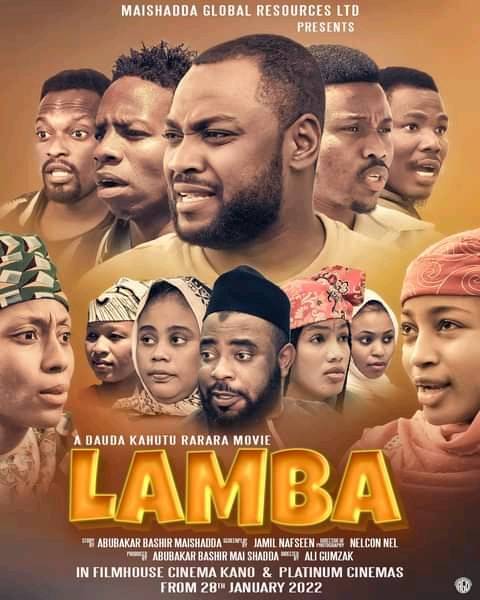
Kannywood Movies Review: “Lamba”

  • Director: Ali Gumzak
  • Producer: Abubakar Bashir Maishadda
  • Screenplay: Jameel Nafseen
  • Language: Hausa
  • Company: Mai-Shadda Global Resources Limited
  • Release Date: 28/01/2022

Mai Shadda Global Resources Limited, a film production company that recently emerged as Kannywood’s powerhouse, has produced many blockbusting comedies with the veteran director, Ali Gumzak. Their last release, Kayi Nayi, was the biggest hit of the previous year. However, as the new year arrived, they came in with another comedy entitled LAMBA.

The film is a social satire set against the backdrop of ‘Audio money’ (a slang term for the fake display of wealth). It tells how some three young men (Adam A. Zango, Umar M. Sharif and Ado Gwanja) flaunt false riches to impress the classy girls they meet on social media. They look for the girls who post their filtered, stylishly snapped pictures on the platforms.

Quite incidentally, the girls, too, are living under false pretences. They rent all the trendy clothes and latest phones they use. They hire everything from a dubious merchant, Salo (Aminu Shareef Momo), at any price. The unveiling of their true identity and what transpired later is shown in brilliantly executed hilarious scenes that get the audience laughing throughout.

The film bears some striking similarities to Makaryaci and Kalen Dangi (both directed by Ali Gumzak in 2017), but this doesn’t make it a clichéd one. It’s, in fact, somewhat of an unconventional comedy for having up to three choreographed song and dance routines. The songs are pretty melodious and well shot. But Zango’s dance in the last one, which has thumping music, impresses the most.

Also, due to the film’s need for multiple actors, the producer (Mai Shadda) didn’t cast his favourites (M. Shareef and Maryam Yahaya) alone. He, this time, featured Adam Zango alongside many others. This is particularly interesting for, until this film, the star (Zango) has not appeared in any big production since Karamin Sani (Dir. Falalu Dorayi, 2020).

Moreover, Ado Gwanja, Aminu Sharif (momo), Maryam Booth, Amal Umar and Aisha Najamu acted in pivotal roles. Dubbing artist-cum-actor, Sultan Abdurrazak and rising starlet Ummi Rahab also play supporting roles along with many new faces.

All the leading cast show great comic timing. Zango is larger than life, and Gwanja amuses with great gusto. M. Shareef shows a vast improvement as an actor. Aisha Najamu shines with her signature look, and the new faces seem promising. The credit should go to the director (Ali Gumzak), who handles them effectively.

In sum, though LAMBA lacks an innovative script, it’s an excellent comedy that succeeds in tickling the funny bone. It will surely entrance you and leave a long-lasting smile on your face. Watch it!

Habibu Ma’aruf Abdu wrote from Kano via habibumaaruf11@gmail.com.

Kannywood Movie Review: Gari Guda

Director: Sufyan Lawal Kabo

Language: Hausa

Release date: 26-11-2021

Company: Islamic Film Empire

Cast: Musa Lawal, Ibrahim Hassan, Mahmoud Mukhtar, Fatima Lawal, Binta Miko, etc.

Most of the criticisms around Kannywood are rooted in its personnels’ attitude towards filmmaking. They seem to focus on irrelevant, modern love stories, neglecting serious topics. Their films are therefore accused of cultural aberration and promoting moral decadence. However, as the criticisms became louder, a production company, Islamic Film Empire, came to change the narrative with its movie titled Gari Guda.

Set in Northwestern Nigeria, Gari Guda explores social vices like banditry and kidnappings that bedevil the region. It commences with a scene of a bandit attack on a village, where they kidnap many people, including its Chief Imam, and take them to their hideout in Dunguru Forest.

There is Abdul (played by Musa Lawal) on another side. He is a family man who, after losing his job, becomes bankrupt and cannot cater for them. His fruitless search for another job gets him increasingly frustrated with life, and he decides to end it all. He goes far away to Dunguru for the execution but eventually finds himself in the bandits’ camp. However, after hearing his story, their kingpin, Jalo (played by Ibrahim Hassan), asks him to work as their cyber-man.

Would Abdul accept the offer or turn it down? Find out in the cinemas!

Gari Guda is, indeed, a powerful film, not only for dealing with a pressing issue but for doing that effectively. It is shot in suitable locations that perfectly capture Northern Nigeria’s ecology. This makes it a realistic portrayal of the region and its current condition.

The film is a socio-political critique of the Northern political elites. It depicts their abuse of power as the posits that as the primary cause of the terrible mess the region faces. This is suggested when Jalo tells Abdul that he holds an LL.B degree, and his inability to afford “Law School” makes him resort to kidnapping. The intention of Abdul to commit suicide also reiterates the misconducts unemployed citizens could engage in.

The film is, in addition, overtly didactic. Its portrayal of Abdul, who encounters troubles for throwing his parents away, clearly symbolizes the consequence of parental disobedience. There are also many instances where the director incorporates moral teaching into the dialogue. I salute him for the job well done, together with all the cast and crew members.

Nonetheless, the film’s plot progresses too slowly. And while some scenes are lengthy with unnecessary details, some important points are missed. For example, what transpired with the people kidnapped at the beginning remains unknown. The director also fails to strike a balance between education and entertainment. Except for Abdul’s comical father character, there is no comic relief – something to allow the audience to recover from the tensions and excessive gunshots – in the film.

In conclusion, Gari Guda enlightens and educates. It is typical of what you would expect from the “Islamic Film Empire”. Therefore, I recommend it for the serious-minded—rating 3/5.


Reviewer:

Habib Ma’aruf

habibumaaruf11@gmail.com

Kannywood producer apes Davido, appeals for donation on social media

By Muhammad Sabiu

In style similar to that of the popular Nigerian musician Davido, a Kannywood producer Lawal Ahmad also took to his Instagram and Facebook pages to announce his appeal for donations from his fans.

He said, “Today, I also want to be honoured by my fans courtesy of Prophet Muhammad (SAW),” He afterwards stated his account details, comprising the account number, account name and bank.

You may recall that Davido on Monday was able to raise more than one hundred million naira in less than 24 hours after asking, jovially, those whom he had given a “hit song” to send him money. As of the time of filing this report, money still hits his account.

The famous musician has been sharing his bank account dashboard screenshots, displaying his name and account balance, which significantly increases whenever he uploads a new screenshot.

This has become a new trend as many other social media users follow suit to appeal for money—though sometimes jokingly.

Lawan Ahmad could be the first person to have made such an appeal in the Kano-based Hausa film industry history.

Checks on the timeline of the producer carried out by the Daily Reality show that he has started receiving money, albeit much smaller amounts compared to Davido’s.

Kannywood star laments rejection of Hausa films by southern cinemas

By Muhammad Sabiu

A famous Kannywood producer and former actress, Mansurah Isah, took to her social media accounts to lament how some southern Nigerian cinemas rejected the Hausa films.

She further complained about the government’s reluctance to support the films produced by the Kano-based Hausa film industry, Kannywood, and the inability to make the films as popular as those produced in other film industries in Nigeria.

Speaking in a 56-second video, she strongly questioned why Hausa movies are not popular all over Nigeria, except in just a section of the country, which, according to her, should not be like this.

“What did we Hausa producers do in Nigeria that our Hausa movies cannot be shown in cinemas all over Nigeria? But Yoruba movies will be all over; Igbo movies all over. Nigerian movies, too, are all over. So why is that we Hausa producers all left behind,” she questioned.

Though she didn’t mention anybody’s or agency’s name, Mansurah further solicited assistance, which she said should be by patronising films produced by the Kannywood film industry.

“Let us be assisted. You should make regulations. Display your language. Display your culture. You should love us. Make our films to be watched all over Nigeria. An English movie would be brought and shown in Kano, but a Hausa film wouldn’t be taken to Lagos and be displayed there. What is the reason?

Tacitly addressing people in power, she said, “We are the ones who support you. We neither insult nor defame you but we are still not developed. So what do you want us to do?

“I beg you in the name of God to help us and come up with regulations that will make Hausa films to be consumed everywhere in Nigeria.”

Kannywood is embattled with many tough challenges relating to cultural and religious issues, clichéd film content, monopoly of megastars, internal crises, among other problems critics and experts point out.

Masurah produced Fanan, a film whose songs have been trending on social media for several months. It recently showed in cinemas in Kano.