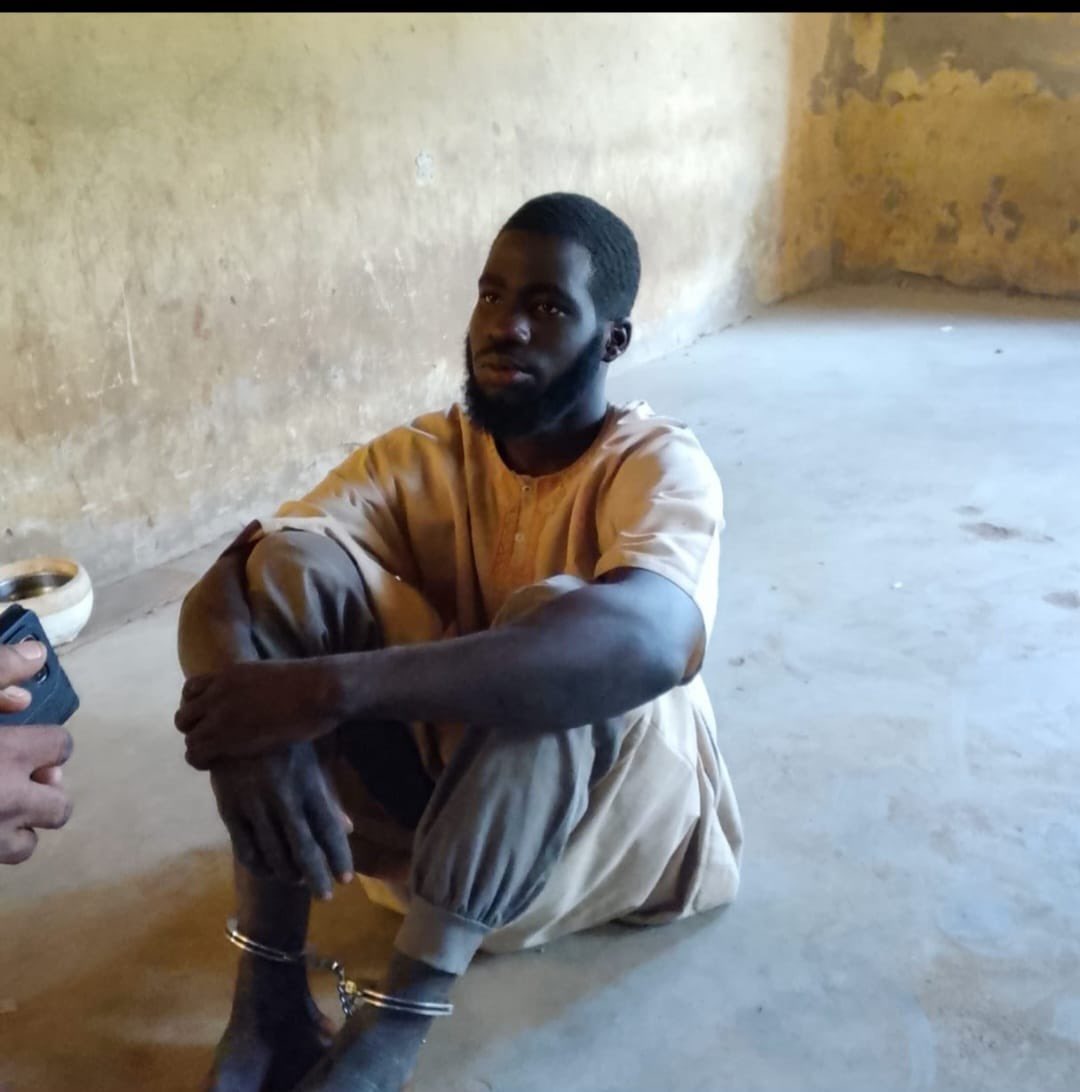
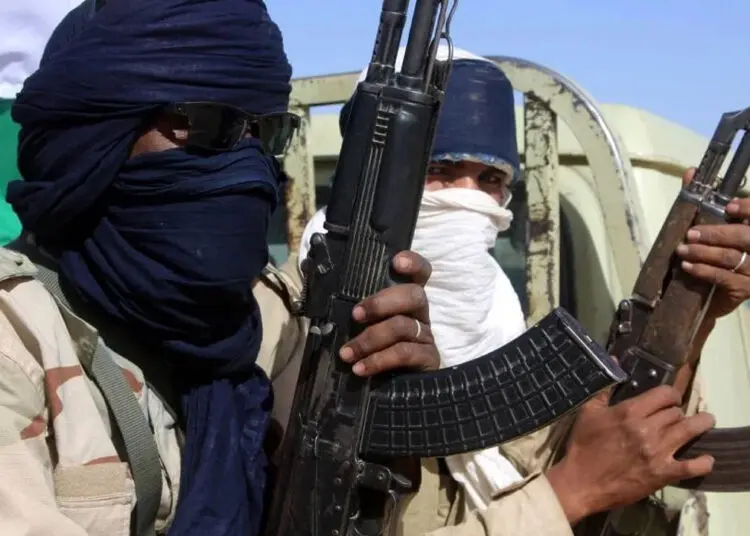
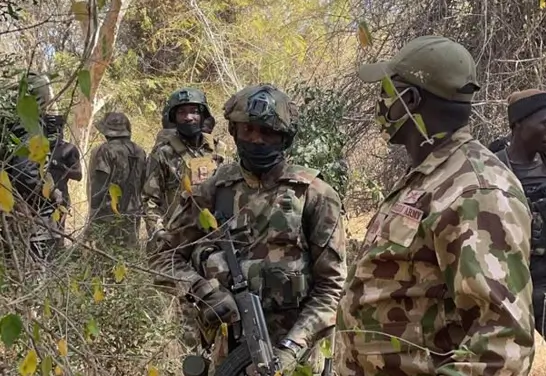
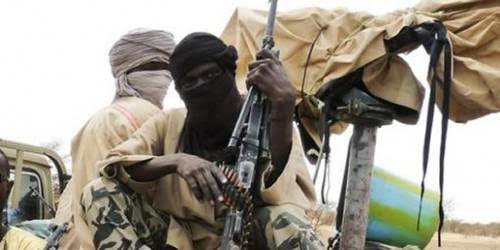
Troops of the Joint Task Force (JTF) under Operation Hadin Kai, working with civilian hunters and the Vigilante Group of Nigeria (VGN), have arrested a suspected informant linked to the Islamic State West Africa Province (ISWAP) and Boko Haram terrorists in Gombi Local Government Area of Adamawa State.
The suspect, identified as Abdullahi Umar, 25, a native of Gwoza in neighboring Borno State, was apprehended on March 23 after security operatives received credible intelligence about suspected ISWAP elements within the 232 Battalion’s Tactical Area of Responsibility.
SaharaReporters gathered that Umar was arrested during a coordinated operation involving troops and local security volunteers in the area.
A security expert and counter-insurgency analyst, Zagazola Makama, confirmed the arrest and revealed that preliminary investigations showed the suspect had been assigned by insurgents to carry out reconnaissance around military formations.
According to the findings, Umar was allegedly tasked with surveying routes leading to the 232 Battalion and other military structures to identify potential entry points for future attacks by insurgents.
During interrogation, the suspect reportedly confessed to participating in a recent attack on troops in Ngoshe, a community in Gwoza Local Government Area of Borno State.
Military authorities are conducting further investigations while Umar remains in custody for possible prosecution and additional intelligence gathering.
Suspected Boko Haram/ISWAP terrorists have abducted more than 100 women and children after attacking Ngoshe community in Gwoza Local Government Area of Borno State, as opposed to an earlier report that stated only 9 people and an imam were abducted.
Sources said the attackers also killed several soldiers, the chief imam of the town and some community elders during the assault. The incident happened shortly after Muslims broke their fast on Wednesday.
Security and community sources told reporters that the terrorists first targeted a military base operated by the 82 Division Task Force Battalion. After confronting the troops, they moved into the community and later stormed an Internally Displaced Persons (IDPs) camp.
One of the sources said the attackers outnumbered the soldiers, which enabled them to overpower the troops before advancing into the town where the mass abduction occurred.
“The militants invaded a military base of 82 Division of TF Battalion. They also launched an assault on the internally displaced persons (IDPs) camp in the community,” the source said.
He added that the attackers pursued fleeing soldiers and later searched houses and nearby bushes.
“We cannot ascertain the actual number of soldiers and civilians killed but nine bodies of soldiers have been recovered so far,” he said.
The source also alleged that the assailants destroyed military assets during the raid.
“Residents have fled Ngoshe town to the adjoining town, Pulka. The attack is very devastating considering that refugees have started returning from Cameroon,’ one other source said.
He also suggested that internal informants might have aided the attackers.
“It’s not possible to carry out such an attack without information from within us.
“The chief imam and some elders were slaughtered by the terrorists, and over 100 women and children were abducted or missing”, he said.
Residents who escaped the attack have reportedly moved to Pulka town in search of safety.
A resident, Malam Umar, described the emotional situation among survivors.
“You will see a mother crying, searching for her children and husband or children looking for their parents.
“The trauma of losing their homes and loved ones during this difficult time is quite devastating.” he said.
Meanwhile, reports indicate that the Nigerian military launched air strikes against the fleeing terrorists after the attack.
According to the security platform Zagazola Makama, surveillance aircraft tracked the insurgents along their escape routes. The Nigerian Air Force then carried out targeted strikes which reportedly killed more than 50 of the fighters.
Security analysts have linked the renewed attacks on military facilities to ongoing operations by troops in Sambisa Forest, the Mandara Mountains and areas around Lake Chad.
Senator Ali Ndume, who represents Borno South, condemned the attack and called for stronger military operations in the affected areas.
“I strongly condemn the attack. Let me commiserate with families of those killed and wish the injured quick recovery.
“Unfortunately, soldiers, the chief imam of Ngoshe and some elders of the community were among those slaughtered or killed during the attack.
“The military base was dislodged with some major equipment destroyed, including residential houses and property worth millions of naira set ablaze. I was informed that the General Officer Commanding 7Div, Brigadier-General Ugochukwu Unachukwu and the Brigade Commander of Gwoza are right now in Ngoshe to ensure civil authority is restored.
“We are liaising with Borno State Emergency Management Agency (SEMA) and the Chairman of Gwoza LGA to immediately provide relief items to the displaced persons in Pulka community,” he said.
The lawmaker also noted that the absence of stationed attack helicopters or fighter jets in the Northeast has continued to limit the military’s ability to respond swiftly to attacks.
Following the incident, the Gwoza Youth Forum appealed for humanitarian support for displaced residents who fled to Pulka.
The group’s chairman, Malam Idrissa Hamman, made the appeal in a statement.
“We humbly write to seek your urgent support for our brothers and sisters who have been displaced from Ngoshe and are currently taking refuge in Pulka.
“Many of them are living under extremely difficult conditions and lack basic necessities for daily survival.
“In view of this humanitarian situation, we are earnestly appealing for your kind support, either in cash or in kind to assist these vulnerable families.
“As a matter of urgency, we are particularly soliciting the following items: clothes, shoes, blankets, buckets, food items and other essential household items.
“This humanitarian initiative is being coordinated under the platform of the Gwoza Youths Forum.
“The chairman of the committee for this initiative is Mal. Idirisa Hamman, while the secretary is Engr. Aliyu Shehu & BK Glavda as Member,” he said.
The attack adds to a series of deadly assaults carried out by terrorists and bandits across several Nigerian states since the beginning of Ramadan. Security incidents have been reported in Borno, Zamfara, Kebbi, Adamawa, Niger and Kaduna states in recent weeks.
Islamic scholars have also condemned the killings.
A Kano-based cleric, Dr Ibrahim Siraj, said Islam strongly forbids the taking of human life.
Quoting from the Qur’an, he said: “Whoever kills a believer intentionally, his recompense is Hell, to abide therein forever; and the wrath and curse of Allah are upon him, and a dreadful punishment is prepared for him.”
He said the offence becomes even more serious when it occurs during Ramadan.
“In addition to violating the sanctity of life, it also violates the sanctity of the month itself. Ramadan is a time when Muslims are encouraged to do good, refrain from bad behaviour, and draw closer to Allah. To take a life in this holy month is to show contempt and disrespect for its sacredness,” he said.
Another cleric, Sheikh Halliru Maraya of Kaduna, also stressed that the attacks contradict Islamic teachings.
“One of the reasons these criminal gunmen step up their atrocities against Nigerians during the holy month of Ramadan is that they are not acting in the name of Islam or based on its teachings. They are simply acting on their own whims and caprices.
“These atrocities clearly contradict the faith. Islam does not condone violence, let alone the taking of human life without a just cause. According to the Qur’an, taking a human life unjustly is like killing all of mankind. Whoever kills a soul unless for a soul or for corruption in the land – it is as if he had slain all mankind,” he said.
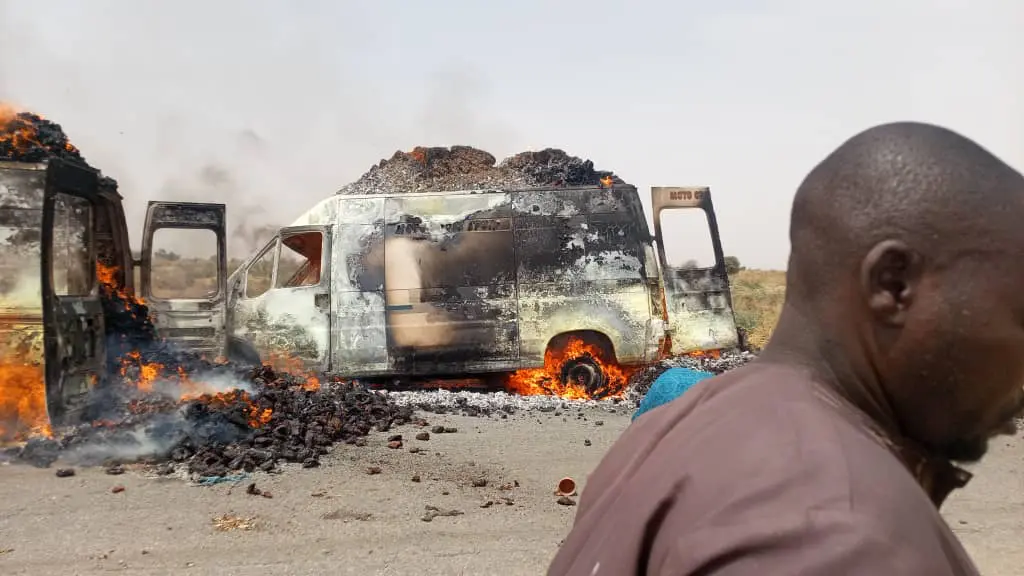
Suspected Boko Haram/ISWAP insurgents have attacked and destroyed three trucks loaded with fish in Borno State.
Daily Trust reported that the incident occurred at Mile-forty in Magumeri Local Government Area on Thursday afternoon. Sources said the drivers were heading to Maiduguri when the assailants intercepted them at about 1:00pm.
A security source confirmed that the drivers escaped unharmed, but the vehicles were completely burnt.
“Thank God that all the drivers escaped but the three vehicles: two Peugeot J5 and a school bus loaded with fish were burnt down,” the source said.
One of the affected drivers, who asked not to be identified, described the ordeal. He said they abandoned their vehicles and fled into nearby bushes when the attackers struck.
“We parked the vehicles and ran into the bush. Thank God we all made it alive but I watched helplessly as the only means of my livelihood got burnt to ashes. Tell the government to do something on that road.
“Before, they used to abduct people and demand ransom from families, but they frequently intercept vehicles these days to loot and burn them down,” he said.
The driver appealed to the federal government and security agencies to deploy more personnel along the route in order to safeguard travellers and their property.
This latest attack follows a similar pattern of assaults along the Maiduguri–Monguno axis. On February 10, 2026, insurgents reportedly stopped four trailers conveying cattle from Monguno to Maiduguri. They carted away over 100 cows and set the vehicles on fire.
Four days earlier, gunmen blocked four trucks carrying beans to Maiduguri from Monguno at Garin Kashim in Guzamala LGA. The trucks were also burnt.
Several drivers who ply the road blamed the repeated incidents on the absence of adequate security presence.
“It has become a daily occurrence now and no action has been taken. From Maiduguri, one can only find a military checkpoint at Gajaganna, Gajiram, and the new one in Mairari, then Monguno.
“Unless the government takes this seriously, livestock and grain businesses that begin to thrive in those areas would soon collapse. Because, we can no longer risk our lives and vehicles on thatk road,” he said.
The driver further urged authorities to strengthen security on the road. He cited the Gwoza axis, where soldiers have been strategically stationed to prevent attacks.
“Many truck owners have now withdrawn their vehicles from this road. These things kept happening and no action has been taken so far,“ he said.
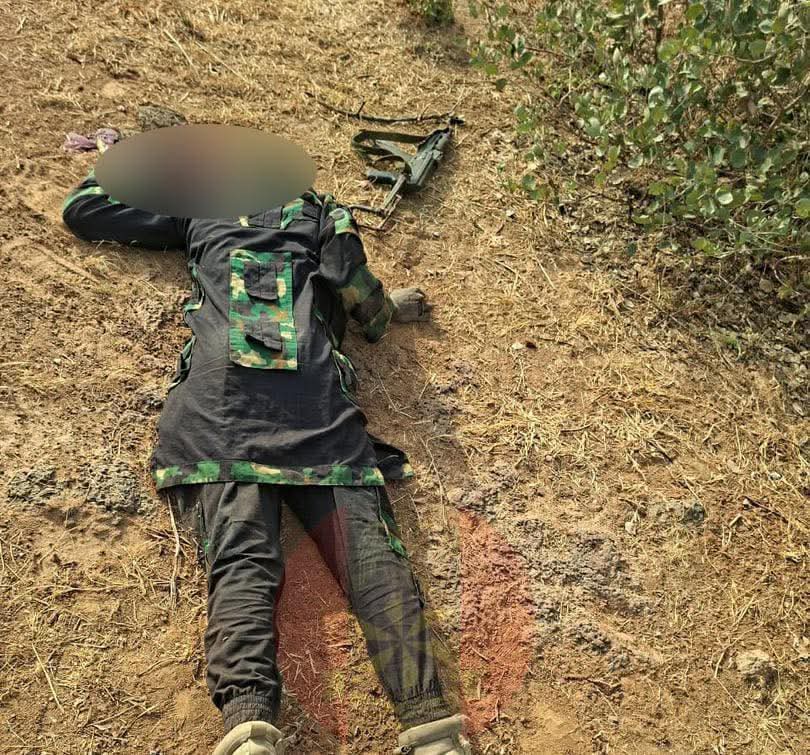
Troops of Operation HADIN KAI, working alongside local vigilantes and hunters, have neutralised a senior Boko Haram figure identified as Abdullahi Mafa in the Madagali axis of Zamfara State.
Security sources disclosed that Mafa, described as a former hybrid commander of the terrorist group, was killed during a coordinated operation in the area.
In a separate development, troops also apprehended a suspected logistics and drone supplier to the insurgents, Dauda Usman Gubula, during another mission in Madagali Local Government Area.
According to security analyst, Zagazola Makama, the encounter took place on Thursday. He said troops came in contact with suspected Boko Haram fighters during an ambush along the Visik River corridor.
The confrontation led to the death of the terrorist commander after an exchange of fire.
Makama further revealed that the alleged collaborator was arrested in a different operation. He said the suspect was picked up during a raid carried out at Madagali Motor Park.
Quoting officials, he stated that security operatives recovered several items from the suspect. These included two aerial drones and 20 solar power banks believed to be meant for terrorist operations.
The suspect remains in custody as investigations continue.
Meanwhile, troops have sustained offensive actions across the region. The ongoing operations are targeted at dismantling Boko Haram cells and restoring normalcy in affected communities.
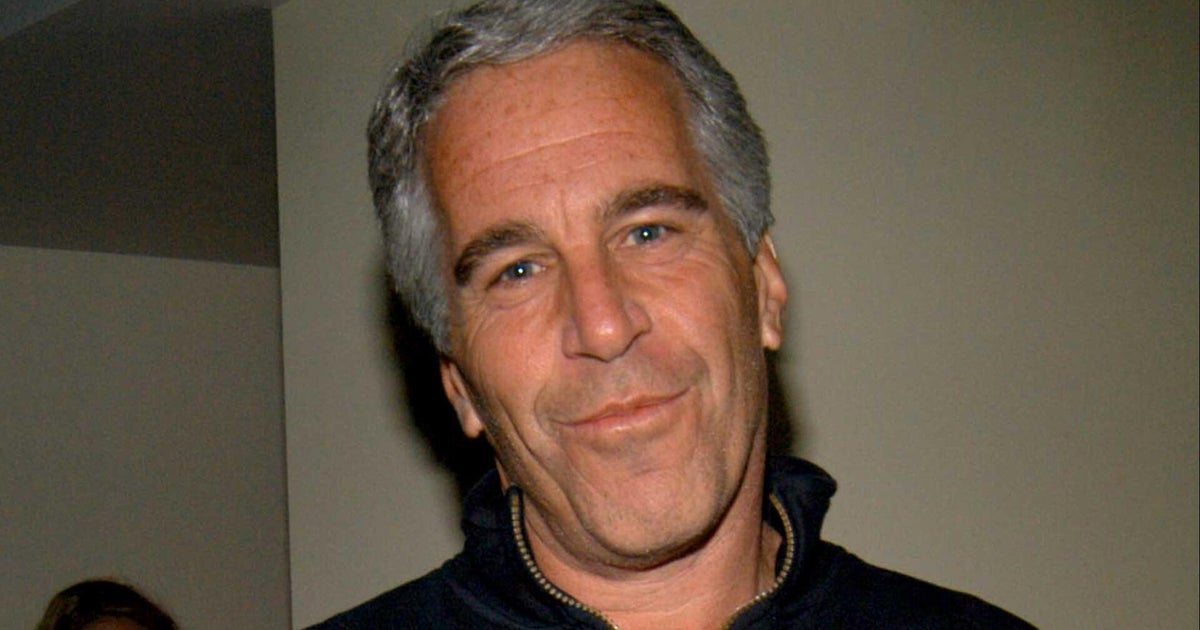
New details have surfaced alleging that convicted American sex offender Jeffrey Epstein and former Israeli Prime Minister Ehud Barak exploited Nigeria’s Boko Haram insurgency to promote surveillance technology and gain entry into key economic sectors.
The claims are contained in an investigation by Drop Site News (DSN). The outlet relied on emails released by the United States Department of Justice. The report alleged that both men saw Nigeria’s worsening insecurity as a commercial opening rather than a humanitarian concern.
Al Jazeera also cited the investigation. It reported that while Nigeria battled Boko Haram, Epstein and Barak marketed Israeli “field-proven” security systems to Nigerian authorities. The term refers to technologies tested in conflict zones, particularly in Palestinian territories.
One 2014 email referenced unrest across the Middle East and Africa, including Nigeria. Epstein wrote to Barak, saying, “isn’t this perfect for you.” Barak reportedly responded, “You’re right in a way. But not simple to transform it into a cash flow.”
Biometric Technology Promoted As Counterterrorism Measure
The investigation linked Barak to Israeli intelligence-connected technology firms whose products later reached Nigeria.
In 2015, Barak and a partner invested $15 million in FST Biometrics. The company was founded by former Israeli military intelligence chief Aharon Ze’evi Farkash. It developed a biometric platform known as Basel. The system was first tested at the Beit Hanoon (Erez) crossing between Israel and Gaza to monitor movement.
As Boko Haram violence intensified, Barak allegedly helped facilitate the sale of similar biometric systems to Babcock University in Nigeria. The initiative was framed as a counterterrorism project. Promotional materials at the time said the system would “filter away all unwanted persons.”
The report added that such deals opened doors for wider Israeli cyber-security involvement in Nigeria. By 2020, DSN stated that the World Bank had engaged the Israel National Cyber Directorate and a startup linked to Barak to support Nigeria’s national cyber infrastructure planning.
Security Deals Linked To Oil, Maritime Interests
Documents cited in the investigation suggested that security partnerships also created business pathways into Nigeria’s oil and port sectors.
Epstein allegedly arranged high-level meetings on behalf of DP World, the Dubai logistics firm. The talks focused on potential acquisition of strategic port assets in Lagos and Badagry.
In 2018, he reportedly connected Jide Zeitlin, then chairman of Nigeria’s sovereign investment authority, with DP World chairman Sultan Ahmed bin Sulayem. Emails indicated that Epstein tried to manage U.S. sanctions concerns involving figures in Nigeria’s mining industry to advance negotiations.
One September 2018 message quoted Zeitlin as telling Epstein: “I hope your pal’s sojourn in Tel Aviv … was more effective than his efforts on the African continent.”
According to the investigation, Bin Sulayem stepped down as DP World chairman on February 13 amid renewed scrutiny over his relationship with Epstein.
Political Access In Nigeria
The emails also pointed to high-level political access secured by Epstein and Barak in Nigeria.
In 2013, Barak attended a cybersecurity conference in Abuja. Organisers privately described the event as an opportunity to arrange meetings with then-President Goodluck Jonathan.
Correspondence cited in the report quoted an organiser saying, “The dinner is one other excellent way … to meet with good Friends of Israel and make new friends for Israel as well.”
Following those contacts, Israeli defence contractor Elbit Systems went ahead with an internet surveillance project in Nigeria despite objections from some lawmakers.
The documents also showed Epstein advising Barak on business strategy. After Barak shared information about a proposed oil transaction, Epstein cautioned him: “I told you on the phone before sending or asking anyone about it you should do your own homework.”
Wider Document Release
The revelations form part of a broader disclosure of millions of files detailing Epstein’s global relationships with political figures, financiers and intelligence-linked actors.
The investigation reported that Epstein funded Israeli groups such as Friends of the Israeli Army and the Jewish National Fund. It also alleged links with individuals connected to Israeli intelligence circles.
Barak, who served as Israel’s prime minister from 1999 to 2001, has previously expressed regret over his association with Epstein. Epstein was convicted in 2008 for procuring a minor for prostitution and served about a year in prison. Barak maintained ties with him for years afterward. He later said he did not know the full extent of Epstein’s crimes until 2019.
Suspected Boko Haram fighters carried out fresh assaults in parts of Borgu and Agwara Local Government Areas of Niger State late Friday night.
The attacks were disclosed by security reporter and analyst, Comrade Zakari Y. Adamu Kontogora, through a post on his Facebook page where he detailed the incident.
He reported that the armed men moved across several communities. They opened fire on residents and set houses ablaze during the raids.
Quoting security operatives who spoke with his newspaper, he said no fewer than 21 people lost their lives after the gunmen invaded Konkoso community.
The sources also revealed that the assailants extended their attacks to nearby settlements such as Pissa, Zango and Tungan Maƙeri. Casualties were recorded in the affected villages. Properties were destroyed as homes and shops were burnt.
Residents were said to be gripped by fear as the attackers reportedly remained within the general area as of the time this report was filed.
There has been no official statement yet from security authorities regarding the incident or the number of casualties recorded.
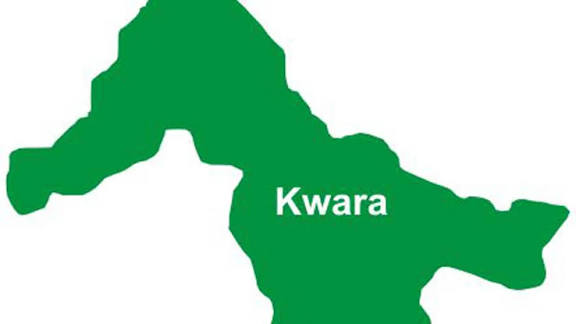
Suspected Boko Haram insurgents have circulated a video showing a large number of women and children said to have been abducted from Kaiama Local Government Area of Kwara State.
The footage, which lasts one minute and 17 seconds, was published by Sahara Reporters. It shows dozens of female captives and minors assembled in an open location while an unidentified speaker questions them. The face of the speaker was not shown in the clip.
During the exchange, the speaker asked the victims, “Where were you abducted?”
They responded, “From Woro.”
He followed up with another question, “Which local government?” and they replied, “Kaiama.”
“Which state?” he pressed.
“Kwara,” the captives answered in unison.
The speaker then asked, “How many are you?” Two women answered, “176.”
After the responses, the unidentified speaker accused the Federal Government of downplaying the number of abductees.
“You can see that your infidel government lied to people that you are not more than 30,” he said.
The video ended shortly after the remark.
As at the time this report was filed, neither the Federal Government nor the Kwara State Government had confirmed the authenticity of the footage or the number of victims mentioned by the insurgents.
Security agencies have also not released any official statement in reaction to the claims.
The incident has sparked renewed anxiety over insecurity in Kwara State. The North-Central state has not been widely known as a major centre of Boko Haram operations when compared with states in the North-East.
Troops of the Joint Task Force, North East, under Operation HADIN KAI (OPHK), have achieved notable operational successes across the North-East, following sustained intelligence-led military actions against terrorist groups and criminal elements in the region.
This is contained in a statement signed by Sani Uba, Lieutenant Colonel, Media Information Officer, Headquarters Joint Task Force (North East), Operation HADIN KAI, on January 31, 2026.
According to the statement, intelligence sources confirmed the killing of JULAIBIB, a senior ISWAP commander operating along the Gujba axis of the Timbuktu Triangle. The terrorist leader was killed during a clash with troops around Kimba in Damboa Local Government Area of Borno State on January 30, 2026.
Further intelligence reports indicated that the development threw ISWAP fighters in the area into confusion, as several of them were also eliminated during the encounter. The development dealt a significant blow to the group’s command and control structure in the area.
In another operation, OPHK troops, working alongside members of the Civilian Joint Task Force, neutralised three terrorists during a carefully planned ambush between Ngazalgana and Lamusheri communities in Borno State. The operation followed credible intelligence on the movement of insurgents within the area. Troops positioned themselves along the identified route and engaged the terrorists with effective firepower. Three insurgents were killed, while others escaped with gunshot wounds. Two AK-47 rifles were recovered from the scene. The military said the operation formed part of ongoing efforts to restrict terrorist movement and weaken their operational capacity across the theatre.
Similarly, on January 29, 2026, troops deployed on an ambush at Tsokorok in Gwoza Local Government Area of Borno State encountered Boko Haram and ISWAP elements. The troops engaged the terrorists, which forced them to retreat. One terrorist was neutralised during the encounter, while no casualty was recorded among the troops. Two motorcycles were recovered at the scene.
Troops also recorded several successes in Adamawa State. On January 29, 2026, soldiers responded to a distress call from Barama community in Mubi North Local Government Area, where they foiled an armed robbery attempt. Two suspects who attempted to attack a student of the Federal Polytechnic, Mubi, were arrested. One of the suspects sustained a gunshot wound on the thigh while attempting to confront the troops and was taken to the Federal Medical Centre, Mubi, for medical treatment. The suspects were later handed over to the Nigeria Police for further investigation. Items recovered from them included three cutlasses, two laptops, four mobile phones, and one power bank.
Earlier, on January 28, 2026, troops, in collaboration with local vigilantes, carried out a fighting patrol along the Amtasa–Washim axis in Hong Local Government Area of Adamawa State. During the patrol, the troops encountered terrorists and engaged them with heavy fire, which forced the attackers to flee in confusion. The troops also rescued a woman who had been abducted by the terrorists. Weapons recovered during the operation included one AK-47 rifle with registration number 2056792, two rounds of 7.62mm special ammunition, one SMG rifle, and 42 rounds of assorted ammunition.
According to the military, the overall security situation across the theatre remains stable. Operation HADIN KAI reaffirmed its commitment to protecting lives and property, dismantling terrorist networks, and working closely with local communities and relevant security stakeholders to restore lasting peace and economic stability across the North-East.
Channels Television has come under intense criticism following its headline on the Christmas Eve bomb blast in Maiduguri, Borno State, which many Nigerians have described as biased and insensitive.
The television station had reported the incident with the headline: “Many Feared Dead As Bomb Blast Rocks Maiduguri On Christmas Eve.”
The blast, however, occurred inside a mosque, with Muslim worshippers as the primary victims.
Critics argue that the omission of both the mosque and the victims’ religious identity from the headline distorted the gravity and context of the tragedy.
A journalism expert and Facebook user, Aisar Fagge, accused the station of deliberately reframing the narrative in a manner that downplayed the victims and their place of worship.
“The bomb blast occurred in a mosque but Channels TV chose to remove the mosque from the headline of the story and replaced it with ‘Christmas,’ showing a lack of sympathy for the people (Muslims) who were killed,” Fagge wrote.
He further alleged that such editorial decisions reflect deeper problems within sections of the Nigerian media.
“In Nigeria, we do not only fight Boko Haram; we also fight what I call ‘Truth Haram’ media outlets — the likes of Channels,” he added.
Another Facebook user, Abubakar Suleiman, also criticised the station, stating that the headline exemplified what he described as “the politics of headline framing.”
According to Suleiman, the editorial choice influenced how the public processed the information by shifting attention from the actual victims and location of the attack.
“The bomb blast happened in a mosque, and the victims were Muslims. However, Channels TV chose to headline the story by removing the place and the victims of the heinous attack, replacing them with ‘Christmas Eve,’” he stated.
He added that although the incident occurred on Christmas Eve, the wording of the headline effectively erased the victims’ identity and dignity.
“Yes, it is true that the bomb blast happened on Christmas Eve, but the presentation of the headline controlled the perception of the targeted audience and eroded the victims of any mention, identity, or dignity,” Suleiman wrote.
Suleiman further alleged that the omission of the mosque was linked to a broader narrative that does not align with the interests of certain ideological groups.
“The exact place where the bomb blast happened — a mosque — also does not matter, because it does not fit into the narrative of Reverend Dachomo, which advances the ‘Christian genocide’ propaganda,” he stated.
Drawing parallels with global media practices, Suleiman said skewed narratives in international media had forced other regions to establish their own independent broadcast platforms.
“When the Arab world grew tired of skewed and silenced narratives, massive propaganda, double standards, and hypocrisy from the likes of Fox News, the BBC, and CNN, they did not stop at complaining; they established competent and reliable broadcast media and employed credible journalists to present their stories,” he wrote.
Quoting Chinua Achebe, he added: “Until the goats learn to write their own history, the history of the hunt will always glorify the hunter.”
Suleiman also warned that sensational reporting encourages division in a multi-religious society such as Nigeria.
“Even if Nigerians choose to live in peace with one another regardless of religion, region, or ethnicity, the Nigerian media will always find a way to sow the seeds of hatred and discord. You know why? Because fear sells much faster and more easily than hope, or than the effort required to deliver a nuanced message,” he stated.
He concluded with a call for responsible journalism and urged Channels Television to exercise greater sensitivity in future reporting.
“Anyway, I hope Channels TV will do better next time because all we wanted is, to quote Ben Affleck: ‘We just want to eat our sandwiches, go about our lives, mind our own business, without being targeted, demonized, or expected to condemn things that have nothing to do with us,’” he said.
Right now, I am deeply pained and genuinely confused, perhaps like many other well-meaning Nigerians who still believe this country can rise above its failures. If all I have to offer is my voice and my pen, then I will continue writing about Nigeria’s lingering security crisis until my last strength fades. Silence is no longer an option when the nation is bleeding this profusely.
This country is bruised. Every week, the news reminds us that Nigeria is fighting for its own life, not in theory but in blood and dust. Yet we move on too quickly, as if these tragedies belong to someone else.
The death of Brigadier General M. Uba should stop us in our tracks.
Not just because he was a senior officer. Not because his story is more important than the stories of countless others who fell before him. But because his final hours reveal both the extraordinary courage of the men defending this country and the painful weaknesses of the institutions meant to protect them.
Two days ago, Nigerians were told he was alive and safe. Today, the truth arrived from insurgent propaganda channels rather than from the State he served. That alone should trouble every citizen who still believes this country can be redeemed.
But beyond the misinformation, beyond the chaos of battle and the failures of communication, there was a man. A man who fought through one ambush, shielded his men, and kept talking on the radio even as danger closed in from every direction. A man who understood the terrain, the risks, and the meaning of service in a way many of us never will.
His killers did not find him by magic. They found him because insurgent groups in the North-East have evolved into highly adaptive, intelligence-driven networks. They have spotters, informants, trackers, and a familiarity with the terrain that gives them dangerous advantages. Our troops face that reality every day with limited resources and uneven institutional support. Yet they still go out, still patrol, still hold their ground.
Brigadier General Uba died in uniform, under a harsh Borno sky, in the service of a country that has not yet learned how to protect its defenders fully. His death is not just a battlefield loss. It is a national failure.
But this is where our story must change.
Nigeria cannot survive if we continue pretending that insecurity is a Northern problem, or a Christian problem, or a Muslim problem, or a regional competition in suffering. Nigeria is bleeding in too many places for that false comfort.
This is a Nigerian problem. All of us are inside this fire.
If we want to save this country, we must begin by admitting the truth.
We have an overburdened military fighting a war that politicians treat like background noise. We have intelligence agencies that do not always speak to each other. We have a society more invested in ethnic debates than national survival. We have families quietly burying soldiers while the rest of us argue online. We have institutions that hide failures rather than learn from them.
But we also have something else. We have citizens who still believe in Nigeria. We have communities ready to cooperate when trust is restored. We have young officers and men who refuse to give up on this country, even when this country sometimes gives up on them. We have people like Brigadier General Uba, whose courage reminds us of the Nigeria that is still possible.
If his death is to mean anything, it must push us toward a national rebuilding rooted in truth, accountability, and collective responsibility. It must force us to demand better communication protocols, better extraction procedures, better intelligence coordination, and better welfare for every man and woman who carries a rifle for this country.
Saving Nigeria is not a slogan. It is a long, disciplined, painful process that requires leadership, honesty, citizen cooperation, and institutional courage.
Brigadier General Uba has paid his share in full. The account is now with us.
Suleiman Usman Yusuf, a Governance, Security, and Development Consultant, AI Policy and Governance Advocate, and a Shaper of Africa’s Tech Future, wrote via suleimanusmanbac@gmail.com.