
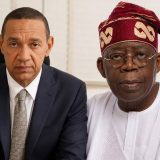




Rift with Kwankwaso: NNPP lawmakers in talks with Ganduje on defection plan
By Uzair Adam
The National Chairman of the All Progressives Congress (APC), Dr. Abdullahi Umar Ganduje, on Tuesday held a closed-door meeting in Abuja with Senator Abdurrahman Kawu Sumaila and House of Representatives members Kabiru Alhassan Rurum and Aliyu Sani Madaki — all currently of the New Nigeria Peoples Party (NNPP).
According to a post by Aminu Dahiru, the Senior Special Assistant to the APC National Chairman on Visual Communication & Events, the meeting was confirmed via his verified social media handle.
It was gathered that the meeting is part of ongoing preparations for the lawmakers’ anticipated defection from the NNPP to the APC ahead of the 2027 general elections.
The opposition lawmakers have had a long-standing disagreement with the leader of the NNPP and Kwankwasiyya movement, Dr. Rabi’u Musa Kwankwaso.

Court reserves ruling in Ganduje’s bribery, misappropriation case
By Uzair Adam
A Kano State High Court has reserved ruling in the case involving former governor of Kano State, Dr Abdullahi Ganduje, who is facing an eight-count charge of alleged bribery, misappropriation, and diversion of public funds running into billions of naira.
The charges were filed by the Kano State Government against Ganduje and seven others, including his wife, Hafsat Umar.
Others listed in the suit are Abubakar Bawuro, Umar Abdullahi Umar, Jibrilla Muhammad, Lamash Properties Limited, Safari Textiles Limited, and Lasage General Enterprises Limited.
During Tuesday’s proceedings, the court entertained several applications from counsels representing the defendants.
Counsel to Ganduje and his wife, Offiong Offiong, SAN, sought an extension of time and filed a preliminary objection dated November 18, 2024, challenging the jurisdiction of the court.
He also submitted a 28-paragraph affidavit, a written address, and a reply on point of law dated April 4, 2025.
Responding, state counsel Ayodeji Adedipe, SAN, urged the court to dismiss the objections, describing them as lacking merit.
His response, dated October 22, 2024, was supported by a seven-paragraph counter-affidavit and a written address filed on December 13, 2024, along with attached exhibits.
Other defence counsels, including Mr Adekunle Taiye-Falola (3rd and 7th defendants), Mr Sunusi Musa, SAN (5th defendant), Mr Ashafa Yusuf (6th respondent), and Mr Faruk Asekone (8th defendant), filed separate preliminary objections supported by affidavits, written addresses, and further affidavits in response to the prosecution’s submissions.
All urged the court to grant their respective applications.
Presiding judge, Justice Amina Adamu-Aliyu, granted the application for an extension of time and adjourned the matter for ruling on the preliminary objections.
A new date will be communicated to the parties.

IGP visits Plateau, vows justice after deadly attacks
By Abdullahi Mukhtar Algasgaini
Following a series of violent attacks in Bassa Local Government Area of Plateau State that left scores dead, the Inspector-General of Police (IGP), Kayode Adeolu Egbetokun, has visited the state to assess security measures and pledge justice for the victims.
The IGP was accompanied by senior police officers, including the Assistant Inspector-General in charge of the Police Mobile Force, AIG Funsho Adegboye, and other top commanders.
During his visit, he met with Governor Caleb Mutfwang at the State Government House, where he condemned the attacks and assured residents that the police would intensify efforts to restore peace and apprehend the perpetrators.
Egbetokun also held a strategy session with tactical commanders to review security deployments in the state.
He directed the Deputy Inspector-General of Police in charge of Operations, DIG Kwazhi Dali Yakubu, to oversee ongoing efforts to stabilize the region.
The Nigeria Police Force reaffirmed its commitment to ensuring justice for the victims and restoring lasting peace to Plateau State.

No need to travel outside registration state for 2025 UTME, says JAMB
By Anas Abbas
The Joint Admissions and Matriculation Board (JAMB) has assured candidates that they will not be required to take the upcoming examination outside their registered states.
Dr. Fabian Benjamin, JAMB’s Public Communication Advisor, provided this assurance during a recent telephone interview with the News Agency of Nigeria in Abuja.
He clarified that while some candidates for the 2025 Unified Tertiary Matriculation Examination (UTME) were assigned to mock examination centers outside their states due to limited availability, this will not be the case for the main examination.
Benjamin explained that if mock examination centers in a state, such as Abuja, are fully booked, candidates may be redirected to nearby centers in other states, like Nassarawa.
However, he noted that the main UTME will have a wider array of centers available, ensuring that all candidates can take the exam within their state of residence.
He added that early registration plays a crucial role in determining the proximity of a candidate’s examination center. If a closer center is filled, candidates may be assigned to any available center within the same state.
In a statement released on Sunday, Benjamin acknowledged the delays and challenges faced by some candidates during the mock examinations and expressed regret for any inconvenience caused.
He attributed these issues to new features being tested to improve the overall conduct of the UTME.
“The mock examination serves as a trial run for the UTME, allowing us to implement innovations while helping candidates acclimate to the Computer-Based Test (CBT) environment,” he stated.
“This initiative has consistently met its goals over the years, addressing identified shortcomings and providing candidates with essential experience for the main examination.”
JAMB encourages all candidates to continue making necessary preparations to ensure a smooth examination experience that meets their needs.
The 2025 UTME is set to commence on April 25.

Northern youths council seek immediate action on Plateau killings
By Anwar Usman
The Northern Youth Council of Nigeria has condemned the recent killings of innocent people in Plateau State, urging the federal government to take immediate and decisive action to thwart the crisis.
The council, in a statement released on Tuesday in Kaduna, expressed deep alarm and distress over the tragic pattern of bloodshed that has devastated communities and robbed families of loved ones in Plateau State.
“We call on the federal government to take immediate and decisive action to halt this crisis. It is imperative that the authorities prioritize the safety of citizens by not only condemning these heinous acts but also by ensuring that the perpetrators are swiftly brought to justice,” said Isah Abubakar, National President of the Northern Youth Council of Nigeria.
The Daily Reality reports that, the council’s demand for action comes after President Bola Tinubu’s condemnation of the killings in Plateau State, which claimed the lives of over 40 citizens.
Tinubu urged Governor Caleb Mutfwang to summon the necessary political will to resolve the crisis and establish enduring peace.
The council further reiterated the need for unity and solidarity among northern youths to advocate for peace and demand accountability from those in power.
“We urge Northern Nigeria to unite against these menacing forces that threaten our peace, stability, and future. It is crucial that we come together, regardless of our backgrounds, to stand firm against the evil that seeks to divide and destroy our communities,” the president revealed

Two Kano men die in Niger mining pit collapse
By Uzair Adam
The police in Niger State have confirmed the death of two individuals following the collapse of a mining pit in the Farin-Doki area of Shiroro Local Government.
Police Public Relations Officer, SP Wasiu Abiodun, told journalists in Minna on Monday that the tragic incident occurred on Sunday night, trapping two miners later identified as Buhari Kano and Mallam Tasiu, both natives of Kano State.
He explained that officers from the Erena Division, alongside local residents, rushed to the scene and began rescue efforts.
However, the victims were eventually found dead and their remains were taken to the Zumba hospital for further examination.
Preliminary investigations revealed that the miners were operating illegally at the site at the time of the collapse.
Abiodun stated that a full investigation is currently underway to determine the exact cause of the incident.

Praise strengths, hide weaknesses in marriage and beyond
By Aisha Musa Auyo
I will begin my write-up with this Hadith: Prophet Muhammad (peace be upon him) said, “Nothing is heavier on the believer’s scale on the Day of Judgment than good character.” (Sunan al-Tirmidh).
If we pay attention and are fair to ourselves, I bet you will realise that none of us is perfect. We all have areas in our lives where we excel, and we all have areas where we do not excel – or even fail. This will be true in your marital life as well. So, let us try to upgrade our character based on this fact.
Marriages collapse for many reasons. Some marriages and relationships go wrong because people fail to praise each other’s strengths and tend to criticise each other’s weaknesses.
Let me tell you from experience. I love getting praise when I do something good, but if I totally blow something, I am already critical and upset enough with myself that I do not need my mate coming in and twisting the knife, so to speak. I am pretty sure everyone out there would agree with me on this.
If you want to approach marriage the right way, you must generously praise each other, particularly when one excels at something, and use criticism sparingly when one flounders. Pray about the challenges and allow Allah, the Most High, to handle the work.
Crushing your spouse’s soul will only push them away and never pull them toward you. When you see your spouse has messed something up, this is a time to draw them into your arms, hug them tight, and assure them everything will be okay.
Marriage is teamwork, not competition, so learn to support and encourage each other. If you discover that you have strengths in areas where your spouse is weaker, take the lead in those aspects of the relationship and allow your partner to excel in what they do best. This synergy is achievable only in a healthy, selfless, progressive marriage.
If you both struggle in an area, agree to collaborate to address it. Learning to use this key effectively will create tremendous harmony in your relationship.
This formula can be applied beyond marital relationships. Any type of relationship can benefit from it, including those between parents and children, teachers and students, siblings, coworkers, or employers.
In a world where you can be anything…. choose positivity, compassion, empathy, and kindness. Remember, people may forget how you look, but they may never forget how you made them feel.
One more reason to be kind, encouraging, and compassionate is the hadith that the Prophet Muhammad (peace be upon him) said: “The best among you are those who have the best manners and character” (Sahih al-Bukhari).
Aisha Musa Auyo is a Doctorate researcher in Educational Psychology. A wife, a mother, a homemaker, caterer, parenting, and relationship coach. She can be reached via aishamuauyo@live.co.uk.

Trending at any cost: TikTok fame and the rise of Kabeer 2Pack
By Hadiza Abdulkadir
In a striking example of how far young people are willing to go for online fame, a TikTok content creator known as Kabeer 2Pack has taken social media by storm with bizarre, often repulsive stunts—drawing the attention not only of millions of followers but also of serious academic inquiry.
Kabeer, dubbed the “April 2025 sensation,” has garnered over 5.2 million likes and 618,300 followers on TikTok by performing antics such as bathing himself in filthy gutter water and covering himself in dust and charcoal. His goal, he insists, is not madness but “glory”: “Ba hauka ba ne, ɗaukaka na ke nema,” he says—“I’m not mad, I seek glory.”
While his popularity soars—one of his videos reached 30.3 million views—critics question why such extreme behaviour overshadows respected Islamic scholars like Sheikh Aminu Daurawa, whose most viewed video stands at 2.4 million. In comparison, controversial influencer Murja Ibrahim Kunya boasts 3.1 million followers and 59.4 million likes.
Professor Abdalla Uba Adamu of Bayero University, Kano, argues that these influencers, despite their antics, are crucial subjects for academic study. “Influencers, trenders, even sickos and weirdos are all part of the data to harvest in order to fully understand contemporary society,” he wrote in a recent commentary.
According to Adamu, the phenomenon reflects what scholars now term the “Attention Economy,” where digital content, no matter how outrageous, is exchanged for social capital, influence, and often money. He compares this with global TikTok stars like Khaby Lame, who silently mocks life hacks and has amassed over 162 million followers—earning $20 million in 2024 alone.
“Even the most ridiculous trends can be read as resistance, escapism, or social commentary,” Adamu notes, urging researchers to see past the surface and explore the deeper meanings behind online behaviour.
In a digital age where clout is currency, young people like Kabeer 2Pack are not just chasing fame—they’re reshaping the culture, one like at a time.

State Department memo reveals lack of evidence against detained student
By Hadiza Abdulkadir
Rumeysa Öztürk, a 30-year-old Turkish doctoral student at Tufts University, was detained by U.S. Immigration and Customs Enforcement (ICE) agents on March 25 near her home in Somerville, Massachusetts. The arrest, captured on security footage, showed masked agents taking her into an unmarked vehicle without identifying themselves, leaving her screaming for help.
Öztürk, a Fulbright scholar pursuing a Ph.D. in Child Study and Human Development, had co-authored a 2024 op-ed in The Tufts Daily criticizing the university’s response to the Gaza conflict and calling for divestment from companies linked to Israel. Following the publication, her name and photo appeared on Canary Mission, a controversial website that profiles individuals accused of anti-Israel activism.
The Department of Homeland Security (DHS) accused Öztürk of supporting Hamas, though no public evidence has been provided. Her student visa was revoked, and she was transferred to a detention center in Louisiana, despite a court order requiring 48 hours’ notice before moving her out of Massachusetts.
Öztürk’s detention has sparked widespread protests and condemnation. More than 2,000 students rallied at Tufts University, and demonstrations have taken place in Boston and Washington, D.C. A coalition of 27 Jewish organizations filed a legal brief in her support, arguing that her arrest threatens free speech and academic freedom.
Tufts University President Sunil Kumar stated that the university has no information supporting the allegations against Öztürk and emphasized the importance of due process. Öztürk’s legal team, including the ACLU, is seeking her immediate release, citing violations of her constitutional rights.
A federal court hearing is scheduled to determine the jurisdiction of her case. Öztürk remains in ICE custody, facing possible deportation to Turkey.

The super bookseller; Tribute to Alaji Garba Mai Littafi.
By Muhammad Ahmad Iliasu
When Barr. Ammani recommended Hillary Clinton’s Autobiography ‘Living History’ to me back in 2018, I said to myself where could I find it? Because, among others, one thing was certain; books that are authored across the ocean are not easy to find. And if, in the rare case, they are available, a young student like me was most likely priced out of contention.
Then one day, during one of my trekking braggadocios between Kantin Kwari, Bata to Sabon Gari, I stumbled upon an intensely greying old man of modest stature, smiley and incredibly alert and mobile for a man of his age. What pulled my attention to his makeshift shop wasn’t him, but rather the large book carrying the face of Herbert Hoover – USA’s 31st President.
At that time, there were a lot of debates in our Macro class in BUK on Buhari’s Protectionist policy. And with Yanis Varoufakis’s dominance on my bookshelf, how protectionism backfired against Hoover as stated in his ‘Global Minotaur’ became of great interest to me. I didn’t only want to know all about protectionism in the 1930s but the whole lifetime of President Hoover and his administration.
Therefore I stepped to the old man, pointed at the book and asked ‘how much is that one, Baba?’ ‘It’s price is two-thousand five-hundred Naira, boy’ – he replied. I responded ‘what?’ – almost terrified by its incredible cheapness, even though I didn’t have that amount at the time. To which he incredibly remarked ‘if you are truly serious, I will leave it to you at one-thousand seven-hundred Naira’. I laughed and borrowed the money from my boss’s change to settle the payment. I asked him once again ‘do you by any chance have Living History?’ The old man smiled and said ‘That will be Hillary Clinton’s Autobiography. I sold it two days ago. But I have ‘Women in Charge’. He put my curiosity into perspective with that response. Because I didn’t think he would know that instantly. And from then my relationship with him became very close. I admired his familiarity with books, genres and authors. And he became fond of how much I was willing to spend on books.
Interestingly, we never exchanged contacts. I usually stopped by his place anytime my boss sent me to Sabon Gari. And whenever he had a book he knew I’d like, he would keep asking his customers if they knew one big lad from the core metropolis who is crazy about books – I knew that because he asked three people who knew me and passed the message.
Beyond the unbelievable cheapness of his books, what made Alaji Garba special wasn’t his eagerness to sell, but knowing what his customers wanted to buy. He had a way of profiling people’s interest perfectly. For example, anytime he had an autobiography of a famous leader or historical figure he would try his best to see me acquire it. I recall how he kept the biography of Joseph Stalin waiting for weeks even though many wanted to get it ahead of me. Funny enough, I didn’t know who Stalin was at that time. He just believed I would like it. And he was right.
From him I acquired more than 20 biographies of US presidents including those of Washington, Maddison, Jefferson, Lincoln, FDR and Reagan. I first heard about The Bourbons, House of Windsor and The Bolsheviks from him. Better yet, he supplied deep readings on them. I got classics authored by Rousseau, Locke, Homer, Byron, Marx, Calder, Orwell, Dante and Dumas from Alaji Garba.
He introduced me to the artistic savagery of Mario Puzo’s Mafia and the boiling horror of Stephen King. I know Jenni Calder and her father Angus Calder because of Alaji Garba, and thanks to that I know Thomas Carlyle and whoever he mentioned in his analysis of Heroes. I’ve forgotten to mention the book “Heroes” by Jenni which Alaji Garba gave me almost for free, the very book whose analytical dexterity formed the earliest foundation of my ability to conflate history with literature, personality with reality, and what an author seeks to achieve with every detail of his book.
On the afternoon I bought Eisenhower’s biography, Alaji Garba gave me ‘Thirty Centuries of Command’ for free. And beyond acquiring familiarity with the military-industrial complex, the misinformations in the Thirty Centuries of Command on Sultan Muhammad al-Fatih rattled me into reading the history of the Ottoman Empire since Sulayman Shah and Ertugrul up to Lawrence of Arabia and Mustafa Kemal Attaturk.
Indeed, I am nothing without my bookshelf, and my bookshelf would be nothing without Alaji Garba’s heavenly supply. There are five times more books on my shelf that were supplied by Alaji Garba than any other bookseller. And he’s probably only edged by Jakara City on the quantity of my readings supplied. The poor man, whom I truly loved, probably had no idea what he was doing jumping from one shadow to another under a bridge with those small sacks of old treatises. He was probably just trying to put food on his table, unsure of who next will buy, and whether that will be enough to pay the fare home. But he was more than that. And I wish he knew it. I wish he knew how many lives he changed with that materially unrewarding trade. I wish he can get recognition for the volume of knowledge he worked very hard to put into the hands of people who otherwise would never have gotten the chance to get.
I wish he knew how much I loved him and how much I understood his efforts and how much I admired him and his trade. I wish he knew how people like him inspire me to be great despite having no independent ambition to be so, just so that when I tell their story to the people who should’ve known them it will bear some weight. I write, partially, so I could tell the stories that may never be told. And Alaji Garba’s is truly one of a kind. May Allah rest him in His eternal peace. May ‘Iqra’a’ rescues him from the wrath on the day of judgement. For certainly very few have dedicated more to the love of reading.
Muhammad Ahmad Iliyasu is Strategic Communications Officer at the Center for Fiscal Transparency and Public Integrity. He can be reached via his email: Muhada102@gmail.com