International

UK To Ban Social Media Access For Children Under 16

By Sabiu Abdullahi

The United Kingdom government has announced plans to prohibit children under the age of 16 from accessing major social media platforms, citing concerns about online safety and the impact of digital content on young people.

Prime Minister Keir Starmer unveiled the proposal on Monday. He argued that social media platforms are harming children’s wellbeing and exposing them to inappropriate material.

According to Starmer, the government “will ban access to social media for all children under the age of 16”. He also warned that these platforms are “exposing them to content that is dangerous” and “designed to be addictive”.

The proposed restriction will cover platforms such as Snapchat, TikTok, YouTube, Instagram, Facebook and X. Messaging services, including WhatsApp, will not be affected.

Starmer said he expects the legislation to be approved by the end of December, with implementation scheduled for the spring of next year.

The British leader also disclosed that the government intends to take “world-leading action on gaming services and live streaming platforms”. Officials are considering additional measures, including overnight restrictions and limits on endless scrolling features for users under 18. More details are expected in July.

The proposal follows a government consultation that allowed British teenagers to test social media restrictions and app time limits. Authorities said the initiative drew about 116,000 responses, making it one of the largest consultations ever conducted by the government.

The plan was influenced by Australia’s decision to ban social media use for people under 16. Australia became the first country to adopt such a policy in December.

Not everyone supports the move. A YouTube spokesperson cautioned that a blanket ban could push children toward “less safe services”.

Starmer also addressed concerns about gaming and live-streaming platforms that allow contact between children and strangers.

“Is there a situation in the offline world where you would just let your child pair up with a stranger? An adult that you don’t know about? No. So we’re taking action on that,” he said.

The UK announcement comes shortly after the government directed major technology firms, including Apple and Google, to introduce safety tools that prevent children from creating, sending or receiving nude images on mobile devices.

Authorities warned that legislation would be introduced if the companies fail to implement the required protections within three months.

The Labour government stated that technology firms have a “moral responsibility” to “protect children from coercion, abuse and sextortion”.

Meanwhile, several countries have introduced or proposed similar measures. Canada recently proposed legislation that would prevent children under 16 from opening social media accounts, while Indonesia began enforcing a comparable restriction in March. A number of European governments have also indicated interest in adopting similar policies.

According to figures cited by the UK government from the Internet Watch Foundation, 91 percent of online child sexual abuse reports recorded in 2024 involved self-generated content created by children.

Finally, Trump Announces US–Iran Ceasefire As Strait Of Hormuz Reopens in Landmark Deal

By Sabiu Abdullahi

United States President Donald Trump has declared that a ceasefire agreement has been reached with Iran, alongside a decision to reopen the Strait of Hormuz for international shipping, marking a major shift in relations after months of tension.

Trump made the announcement from the White House and later expanded on it in a series of posts on Truth Social, where he confirmed the deal and outlined immediate steps linked to its implementation.

“The Deal with the Islamic Republic of Iran is now complete,” Trump wrote on Truth Social.

He further stated:
“Congratulations to all! I hereby fully authorize the toll free opening of the Strait of Hormuz, and, simultaneously herewith, authorize the immediate removal of the United States Naval blockade. Ships of the World, start your engines. Let the oil flow!”

In a separate message, he added:
“This Great Deal will bring Peace and Security to the whole Region”

Trump also suggested that the agreement could reshape regional relations going forward.

“Many presidents have tried to make Peace with Iran, and all have failed before me. The Leaders of the Region have, for the first time, found a President who can help them achieve real Peace. With the opening of the Strait upon the signing of the Deal on Friday, for purposes of mine removal, oil will flow on both ends again for the Region, and the World!”

The announcement came shortly after Pakistan’s Prime Minister Shehbaz Sharif confirmed that both parties had reached a comprehensive understanding to end hostilities.

“Following intensive talks, we are pleased to announce that the Peace Deal between the United States of America and the Islamic Republic of Iran has been REACHED. Both sides have declared the immediate and permanent termination of military operations on all fronts, including in Lebanon,” Sharif wrote.

He also disclosed that an official signing ceremony is scheduled to take place in Switzerland on Friday, June 19, following a series of preparatory diplomatic meetings.

The agreement, according to mediating parties, followed intensive negotiations involving several regional actors. Qatar welcomed the outcome, describing it as a step toward wider stability.

“The State of Qatar welcomes the agreement reached on the Memorandum of Understanding between the United States of America and the Islamic Republic of Iran on addressing the outstanding issues between them, including ensuring freedom of navigation in the Strait of Hormuz, and considers it an important step towards consolidating sustainable peace and promoting economic growth regionally and internationally,” Qatar’s Ministry of Foreign Affairs stated.

In the United Kingdom, Prime Minister Keir Starmer expressed support for continued technical discussions aimed at ensuring full implementation of the agreement.

“Attention must now turn to fully implementing the memorandum of understanding to ensure the Strait reopens and remains fully and permanently open, and that the detailed elements of the nuclear agreement are finalised,” Starmer said.

He added:
“We are clear that toll-free freedom of navigation must now be restored,”

French President Emmanuel Macron also welcomed the deal, urging swift implementation while confirming France’s readiness to support maritime stability efforts.

“I welcome the agreement reached between the United States and Iran, the result of a diplomatic effort to which several partners contributed. I call for its swift and full implementation by all parties to the conflict,” Macron said.

“This agreement must allow for the urgent and unconditional reopening of the Strait of Hormuz, which the international mission established with the United Kingdom is ready to support. The resources are in place and ready to be deployed,” he added.

“The resumption of maritime traffic, without restrictions or tolls, is essential for regional stability and the global economy.”

France “will also continue to provide its full support to the determined efforts of the Lebanese authorities to restore the sovereignty of the State, which alone can ensure Lebanon’s stability and territorial integrity and meet the needs of its populations”, he added.

US Vice President JD Vance described the agreement as a turning point for the region and expressed optimism about its wider impact.

“What the president has done is create the real space to transform that region. And now, hopefully a new era with the Iranians,” Vance said.

“I think we can safely say, with confidence, that Iran will never have a nuclear weapon… This is just a great thing for the American people.”

The ceasefire announcement comes as international observers watch closely for signs of long-term stability in the region, with attention now turning to the upcoming signing ceremony in Switzerland and the practical implementation of the agreement.

Tension Rises in Ghana as Protesters Storm MTN Headquarters, Demand Exit of South African Businesses


By Sabiu Abdullahi

Fresh tensions emerged in Ghana on Thursday after demonstrators under the banner of the “South Africa Must Go” campaign marched to the headquarters of MTN Ghana in Accra, demanding the departure of South African businesses from the country.

The protesters gathered in large numbers and moved to the telecommunications company’s head office amid growing anger over recent xenophobic attacks against African migrants in South Africa.

Videos shared on social media showed demonstrators carrying placards and chanting slogans as they approached the MTN Ghana premises in the Ghanaian capital.

The protest forms part of the wider “South Africa Must Go” campaign, which has gained momentum in recent days. Organisers say the movement is a response to reports of xenophobic attacks and killings targeting African migrants in South Africa.

The development comes weeks after Ghana began evacuating some of its citizens from South Africa following renewed tensions linked to anti-foreigner violence.

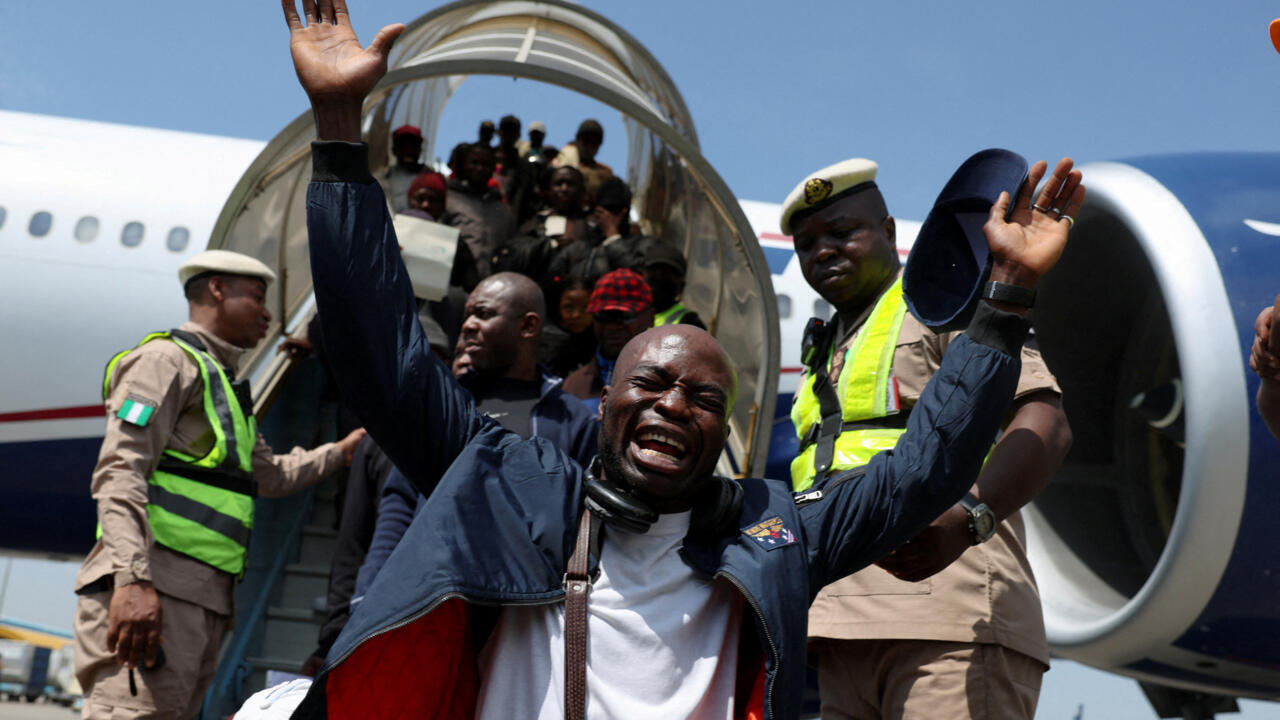
On May 27, 2026, the first batch of Ghanaian nationals evacuated from South Africa arrived in Accra. The Ghanaian government assured the returnees that they would receive support and would not be treated as refugees.

While welcoming about 300 evacuees, Ghana’s Foreign Affairs Minister, Samuel Okudzeto Ablakwa, said the government had put measures in place to assist those returning home.

“You are not going to arrive in Ghana as if you are orphans,” Ablakwa said. “You arrive, you are a hero’s welcome. The Chief of Staff himself has called me to say that he would love to join me to receive you.”

He also disclosed that senior government officials would be present to receive the returnees.

“And he will be there leading a high-powered government delegation to receive all of you,” he said.

The minister further stated, “You have seen the arrangements that the President has made. We have met and discussed a five-item package that everybody will be entitled to.”

Although he did not provide details of the package, Ablakwa said the government’s response reflected its commitment to protecting and supporting Ghanaian citizens abroad.

“We want to show the world that we cherish our nationals. Our citizens matter to us,” he said.

He also dismissed suggestions that the evacuees should be regarded as displaced persons.

“You are not refugees. You are not some destitutes. Ghana is not some war zone where we cannot take care of our own. Ghana is a place to be,” he added.

The minister praised Ghana’s reputation as a peaceful and welcoming country, noting that many foreigners continue to choose the country as a destination.

“And that’s why many, many foreigners are trooping to Ghana… they always feel at home,” he said.

He assured the returnees that they would continue to be treated with dignity upon their arrival.

“We will accept you as royals,” Ablakwa said.

Omar Artan to Officiate UEFA Super Cup Clash Between PSG and Aston Villa

By Muhammad Abubakar

Somali referee Omar Artan has been appointed to officiate the 2026 UEFA Super Cup between Paris Saint-Germain (PSG) and Aston Villa, UEFA announced on Thursday.

The prestigious fixture, scheduled to take place in Salzburg, will see the Champions League winners PSG face Europa League champions Aston Villa in the traditional curtain-raiser to the European club season.

Artan’s appointment marks another milestone in a refereeing career that has earned widespread recognition across Africa and beyond. The Somali official is regarded by many football observers as one of the continent’s finest referees, having handled high-profile matches in both African and international competitions.

His selection for the UEFA Super Cup comes days after he was controversially excluded from the 2026 FIFA World Cup in the United States. Reports indicated that Artan was denied entry into the country, preventing him from participating in the tournament despite being considered among Africa’s top referees.

UEFA’s decision to entrust him with one of Europe’s most prestigious club matches is likely to be seen as a strong endorsement of his abilities and standing in world football.

The UEFA Super Cup annually brings together the winners of the UEFA Champions League and the UEFA Europa League, making it one of the most anticipated fixtures on the European football calendar.

Critics Allege ‘Hypocrisy’ as Media, European Football Bodies Face Scrutiny Over Silence Ahead of 2026 World Cup

By Muhammad Abubakar

A debate over perceived double standards in international football has resurfaced on social media, with critics accusing some Western media organisations and European football associations of hypocrisy in their responses to the 2022 and 2026 FIFA World Cups.

The discussion was sparked by an X post from user Yan Goi (@GongR1ight), who contrasted the strong criticism directed at host nation Qatar before the 2022 World Cup with what he described as a muted response to the 2026 tournament, which will be co-hosted by the United States, Canada, and Mexico.

The post cited Norway’s calls for a boycott of the Qatar tournament, Denmark’s public criticism of Qatar’s human rights record, and political gestures by Germany’s national team during the 2022 competition. It also pointed to the BBC’s decision to focus on controversies surrounding Qatar rather than broadcasting the full opening ceremony, a move that drew both praise and criticism at the time.

Critics argue that many of the organisations and commentators who were vocal about labour rights, governance, and social issues in Qatar have been comparatively quiet about concerns linked to the 2026 World Cup, including immigration policies, border enforcement, and other political controversies in the host countries.

Others reject the comparison, arguing that the circumstances surrounding the two tournaments differ significantly and that media outlets have continued to report on issues related to the 2026 World Cup, albeit with less intensity than the coverage seen ahead of Qatar 2022.

The debate has renewed broader questions about consistency in sports journalism and international football governance, with supporters and critics divided over whether similar standards are being applied to different World Cup hosts.

Addressing the Root Causes of Xenophobia

By Blessing Omolola

I hope you find this helpful

A recent report that Nigerians are seeking to return from South Africa has once again brought a painful, long-standing issue to the forefront. This is the recurring cycle of xenophobia in South Africa.

The Federal Government’s concerns regarding Nigerians seeking evacuation highlight more than just immediate safety risks; they expose deep-seated, unresolved tensions surrounding migration, unemployment, and economic frustration across the continent.

For those who have read the history books, the relationship between Nigeria and South Africa is historically complex. During the apartheid era, Nigeria was a primary supporter of South Africa’s liberation struggle, providing significant political, economic, and moral aid.

Consequently, many Nigerians view these recurring attacks as a fundamental betrayal of continental unity. Following the end of apartheid, South Africa emerged as one of the continent’s most robust economies, naturally attracting migrants seeking better prospects. However, this movement has frequently met with local resistance.

Xenophobic violence in South Africa is a systemic issue affecting various African nationals through repeated waves of unrest. In 2008, widespread attacks in various townships resulted in over 60 deaths and the displacement of thousands of immigrants.

This was followed by another surge in 2015, when violence erupted in Durban and spread across the country. Foreign-owned shops were looted, and several migrants, including Nigerians, Mozambicans, and Zimbabweans, were killed, leading to diplomatic friction.

Most recently, in 2019, attacks resurfaced in Johannesburg and Pretoria, sparking renewed outrage and firm responses from the Nigerian government. These incidents demonstrate that the violence is driven by economic desperation and social tension rather than isolated hostility toward one specific nationality.

As tensions rise, the Nigerians in Diaspora Commission (NiDCOM) has reported that many citizens expressed a desire to return home due to safety fears. However, the Federal Government’s stance that those wishing to return must cover their own transportation costs has sparked significant debate.

Critics argue that citizens in crisis deserve more robust state support, while others point to the logistical and financial strain on the government. This situation emphasises the vulnerability of African migrants during social unrest and the pressing need for stronger diplomatic cooperation to protect citizens living abroad.

But beyond statistics, xenophobia has devastating personal consequences. Consider the story of a young Nigerian entrepreneur in Johannesburg who spent years building a small electronics business to fund her education and support her family.

When violence flared, she was forced to abandon her shop and inventory to save her life. Years of hard work vanished in days. She returned to Nigeria with no capital and significant psychological trauma. This narrative is common among those who face sudden displacement and financial ruin.

The roots of xenophobia in South Africa are firmly planted in socio-economic struggles such as high unemployment, inequality, and poverty. In this environment, immigrants are often scapegoated as competitors for limited jobs and resources. This perspective ignores the reality that many immigrants contribute to the economy by creating small businesses and filling labour gaps.

So, the problem is not the presence of foreigners, but rather unresolved structural economic failures. Violence and collective punishment do not solve unemployment or poverty; instead, they damage diplomatic ties and tarnish Africa’s global image.

Africa is at its strongest when its nations cooperate. The repeated cycles of xenophobic violence undermine the spirit of the “United Africa” that leaders have long championed. The true cost of xenophobia is paid by displaced migrants, South Africa’s international reputation, and the concept of continental unity.

Long-term solutions require emergency evacuations, structural economic reform, better policy action, and public education to foster tolerance. Only by addressing these core issues can Africa achieve true peaceful coexistence.

Oladapo Blessing Omolola a student at Yakubu Gowon University in the Department of Strategic Communication. I can be reached at: blessingomolola0565@gmail.com.

Iran Launches Missile Attack on Israel as Tensions Escalate

By Sabiu Abdullahi

Iran on Sunday night fired missiles toward Israel in a move that has heightened tensions in the Middle East and raised concerns about the future of ongoing diplomatic efforts in the region.

According to the Israeli military, about 10 ballistic missiles were launched toward northern Israel. Authorities said the missiles were either intercepted by air defence systems or landed in open areas. There were no immediate reports of casualties or significant damage.

The attack marked Iran’s first direct strike against Israel since a ceasefire between Iran, Israel and the United States took effect in early April.

Iran said the missile launch was a response to Israeli air strikes on Beirut earlier in the day. Tehran accused Israel of violating the ceasefire in Lebanon and warned of further action if such attacks continue.

In a statement reported by Iran’s Tasnim news agency, the Islamic Revolutionary Guard Corps (IRGC) described the operation as a warning.

“Tonight’s operation was a warning declaration, and in the event of repeated aggressions, the responses will be more extensive and will encompass all American-Zionist targets in the region,” the IRGC said.

Iran’s military leadership also cautioned Israel against further military action in Lebanon, warning that the country could face “more devastating and regretful blows”.

Israel responded by promising a strong reaction to the missile barrage. Military spokesman Brigadier General Effie Defrin said Iran was attempting to create a new security equation through direct attacks on Israeli territory.

“The (Iranian) regime is attempting to establish a new equation through direct attacks on Israeli territory in response to IDF operations in Dahiyeh,” Defrin said.

“We struck in Dahiyeh in response to Hezbollah’s relentless attacks on the communities of northern Israel. The IDF will continue to operate throughout Lebanon and will intensify its actions against the Hezbollah terrorist organisation.”

He added: “The Iranian terrorist regime has made a grave mistake by once again choosing the path of terror.”

Meanwhile, US President Donald Trump urged restraint and called on both sides to avoid further escalation.

Speaking to Israel’s Channel 12, Trump said: “The Iranian strikes didn’t hurt anybody. Hopefully Israel is not going to retaliate. If Bibi [Netanyahu] strikes them back, it’s just gonna keep going like the last 47 years, or the last 3000 years.”

He also expressed optimism about ongoing diplomatic contacts with Tehran.

“We are very close to a final deal with Iran. It is going to be a good deal. I don’t want it to blow up because of what is happening now,” Trump said.

“I am going to call Bibi right now and tell him not to retaliate,” Mr Trump added. “Each of them had their fun. Israel had its strike and Iran had its strike. We don’t need another one.”

“I don’t want to see an additional attack tonight,” he added.

Trump also criticized Israel’s earlier strikes on Beirut, telling Fox News that Washington had not been informed in advance.

“I’m not happy about it,” he said.

Regarding Iran’s response, Trump stated: “It’s certainly not going to help negotiations.”

Elsewhere, Iraq temporarily closed its airspace and suspended air navigation following the missile launches, citing safety concerns. Iraqi aviation authorities said the restriction would remain in place for 72 hours.

Iranian Foreign Minister Abbas Araghchi also held discussions with officials from Britain, Turkey and Pakistani mediators on Sunday evening. According to Iran’s foreign ministry, the talks focused on the latest regional developments and Israel’s “repeated violations of the ceasefire in Lebanon”.

In Israel, Clalit, the country’s largest healthcare network, began relocating operations at its hospitals to underground facilities as a precaution following the attack.

Pro-government supporters in Tehran later gathered in the streets to celebrate the missile strike, waving Iranian and Hezbollah flags.

The latest exchange has increased fears of a broader regional conflict despite ongoing diplomatic efforts aimed at preventing a new escalation.

Trump Grants Pardon To Former Congressman Stephen Buyer in Insider Trading Case

By Sabiu Abdullahi

United States President Donald Trump has granted a presidential pardon to former Republican Congressman Stephen Buyer, who was convicted of insider trading and served nearly two years in prison.

The pardon, dated Thursday, was made public by the White House late on Friday.

Buyer, a former representative from Indiana, received a 22-month prison sentence in 2023 after a federal court found him guilty of making illegal stock trades based on confidential information obtained while he worked as a consultant and lobbyist after leaving Congress. The court also ordered him to surrender more than $350,000 in profits linked to the trades and pay a $10,000 fine. He was released from prison in 2025.

The US Supreme Court declined to hear Buyer’s appeal in May, issuing its decision without comment.

In the pardon document, Trump granted “a full, complete, and unconditional pardon” to Buyer. The president pointed to Buyer’s service as a judge advocate general in the US Army and his years in Congress, describing his public record as “distinguished and highly productive”.

Responding to the decision, Buyer said the pardon “corrects a politically motivated prosecution” and that it was “horrific to be imprisoned for a crime that I did not commit”. He has consistently denied any wrongdoing.

Trump had previously signaled support for Buyer’s pardon request. On May 31, he shared two letters on his Truth Social platform that urged him to grant clemency to the former lawmaker, who is also a Gulf War veteran.

Buyer served as a House prosecutor during the impeachment trial of former President Bill Clinton in 1998. He also worked on Trump’s presidential transition team in 2016, where he focused on veterans’ affairs.

One of the letters, signed by more than 40 former Republican members of Congress, argued that Buyer was “targeted by the deep state” because of his role in Clinton’s impeachment proceedings.

“Like you, Mr President, Steve has been the victim of lawfare conducted by the Biden Administration,” the former lawmakers wrote in an April 2025 letter.

A separate letter from five current Republican members of the House of Representatives stated that a pardon would help deliver justice in Buyer’s case. The June 2025 letter was signed by Tom Cole of Oklahoma, Ken Calvert of California, Marlin Stutzman of Indiana, Jack Bergman of Michigan and Pete Sessions of Texas.

Buyer, 67, was convicted over trades connected to the $26.5 billion merger between T-Mobile and Sprint, which was announced in 2018. Prosecutors also linked him to illegal trading involving consulting firm Navigant before its planned acquisition by Guidehouse became public.

Under the US Constitution, the president has broad authority to grant pardons for federal offences. While a pardon does not remove a criminal conviction from a person’s record, it is often viewed as an act of mercy or a remedy for perceived injustice.

Israeli Strike Kills Lebanese General as Pakistan Calls For End to Iran War

By Sabiu Abdullahi

An Israeli air strike in southern Lebanon has killed Brigadier General Wissam Sabra and two other senior Lebanese military personnel, amid growing regional tensions linked to the ongoing conflict involving Israel, the United States and Iran.

According to the Lebanese military, Sabra was travelling in a convoy on a road between Kfar Tebnit and Khardali when the strike occurred. The two other victims were identified as Captain Elie Khoury and soldier Hussein Ghozal.

The Lebanese presidency condemned the attack, describing it as “a blatant violation” of the country’s sovereignty. President Joseph Aoun said the strike was “aimed at thwarting all efforts to reach a solution”, while Prime Minister Nawaf Salam called it “a heinous crime and an attack on Lebanon and all Lebanese people”.

The Israeli military later acknowledged carrying out the attack and said the vehicle involved was “moving suspiciously”. It added that the incident remains under review.

The killing of Sabra, a 54-year-old father of three, is one of the deadliest incidents involving the Lebanese army in recent years. The attack comes at a sensitive time as diplomatic efforts continue to seek an agreement involving the United States, Iran, Hezbollah, Lebanon and Israel.

Jordan also condemned the strike and called for an immediate halt to Israeli military operations in Lebanon. A spokesperson for Jordan’s Foreign Ministry, Fouad Majali, described the attack on the Lebanese military convoy as “a blatant violation of the sovereignty, security, and stability” of Lebanon.

Majali extended condolences to the Lebanese government and the families of those killed. He also reaffirmed Amman’s “unwavering support” for Lebanon.

According to Jordan’s official Petra news agency, Majali “also stressed Jordan’s support for the Lebanese government’s efforts to assert its sovereignty over all Lebanese territory, reactivate its national institutions, and ensure that weapons are solely in the hands of the state”.

Meanwhile, Pakistan’s Interior Minister Mohsin Naqvi reportedly delivered what was described as an “important message” from Islamabad to Iran’s Supreme Leader Mojtaba Khomeini. He also urged an end to the war involving Iran, Israel and the United States.

Elsewhere, demonstrations in support of Palestinians took place in several countries. Hundreds of people marched through Manchester in the United Kingdom carrying Palestinian flags and demanding that the British government withdraw support for Israel. Protesters displayed a banner reading “End the Israeli Occupation”.

The march coincided with the 59th anniversary of the 1967 Naksa, when Israel occupied the West Bank, East Jerusalem and the Gaza Strip.

In Tunisia, demonstrators gathered in the city of Bizerte to protest Israel’s military campaign in Gaza. Participants placed symbolic coffins marked with red paint in a public square to highlight the humanitarian situation in the territory.

In Scotland, activists from the group Red Card Glasgow held a vigil outside Hampden Park Stadium to honour Palestinian footballers killed during the conflict. Participants placed wreaths, football shirts and Palestinian scarves at the venue.

The latest developments highlight continuing instability across the region as diplomatic efforts to ease tensions face significant challenges.

Trump Claims Israel Would Not Exist Without His Intervention

By Sabiu Abdullahi


United States President Donald Trump has said Israel would not exist today if he had not taken action against Iran, while rejecting claims that Israeli Prime Minister Benjamin Netanyahu persuaded him to confront Tehran.

Trump made the remarks during an appearance on the Pod Force One podcast, where he responded to suggestions that Netanyahu had influenced his decision to take a hard line against Iran.

“He tricked me? No. I’m the one that started it,” Trump said.

The US president stated that his actions were motivated by concerns over Iran’s nuclear programme.

“I started it because we can’t let them have a nuclear weapon. If there wasn’t me, there would be no Israel right now,” he said.

His comments came amid reports of strained relations between Trump and Netanyahu following a recent telephone conversation about Israel’s military operations in the region.

Trump also confirmed that he had a tense exchange with the Israeli leader over the continuing conflict involving Lebanon.

In an interview published by the New York Post, Trump was asked about reports that he used strong language during a phone call with Netanyahu.

“You said, ‘Are you f-ing crazy? What are you f-ing doing? I helped you stay out of jail.’ Is that true? Did you speak to him in those terms?” the interviewer asked.

“I did,” Trump responded. “I was a little bit perturbed at his constantly fighting with Lebanon.”

Trump said he urged Netanyahu to halt the hostilities.

“I said, ‘Bibi, we gotta stop this.’”

The comments highlight reported disagreements between the two leaders over Israel’s military actions, despite their long-standing political relationship. They also come at a time of heightened tensions in the Middle East, where conflicts involving Israel, Iran and regional armed groups continue to draw international attention.