
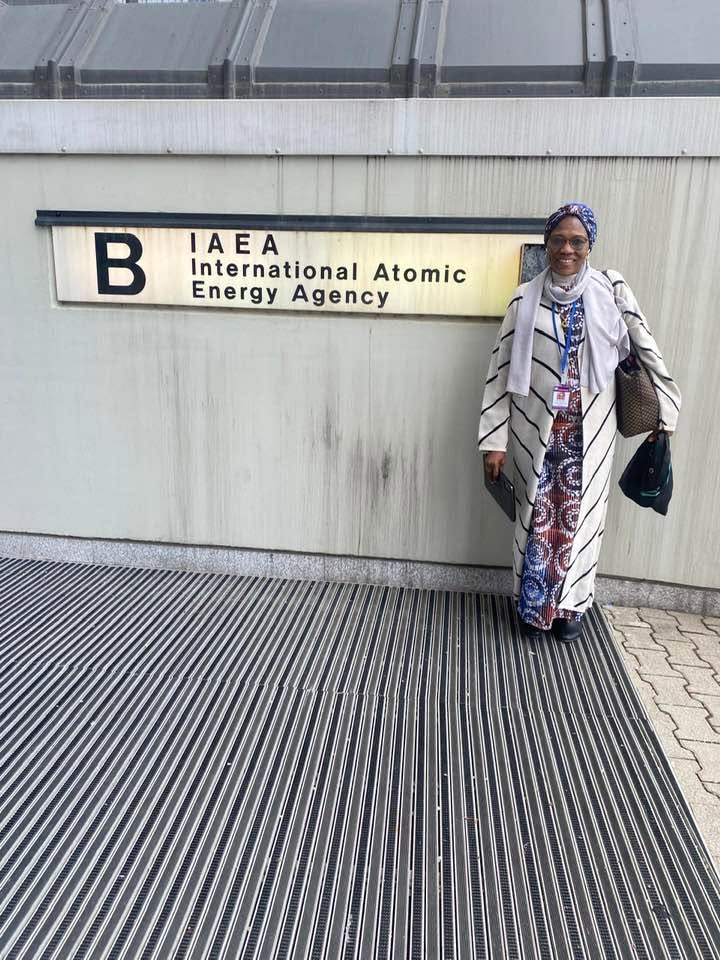
By Hadiza Abdulkadir
Professor Rabia Salihu Sa’id, a renowned atmospheric and space-weather physicist at Bayero University, Kano (BUK), has been appointed by United Nations Secretary-General António Guterres to a prestigious 21-member Independent Scientific Panel on the Effects of Nuclear War.
The newly formed global panel, established following UN General Assembly Resolution 79/238, brings together leading international experts to assess the physical, environmental, climatic, radiological, and socioeconomic consequences of a potential nuclear conflict.
Professor Sa’id holds a Bachelor of Science, Master of Science, and PhD in Physics from Bayero University, Kano, alongside an additional M.Sc. in Environment and Development from the University of Reading in the United Kingdom.
Professor Sa’id’s academic career began at BUK in 1999 as a Graduate Assistant, eventually leading to prestigious international research fellowships, including work at the Institute of Applied Physics at the University of Bern in Switzerland as well as recognition from the Ford Foundation and the Elsevier Foundation.
Professor Sa’id’s appointment underscores Nigeria’s growing prominence in high-level scientific diplomacy and global policy formulation. The panel’s work marks the first comprehensive, UN-backed synthesis of nuclear war impacts in over three decades, leveraging modern climate modelling and technological advances to update global risk assessments.
Speaking on the scope of the initiative, UN officials noted that the panel will examine local, regional, and global ramifications of nuclear detonation, providing crucial data to inform international security policies.
The group’s findings will be compiled into major reports ahead of key international security summits, offering updated science to aid in nuclear risk reduction and disarmament strategies.
Professor Sa’id, widely recognised for her contributions to physics education, environmental research, and advocacy for women in STEM, joins a diverse international team tasked with delivering these critical scientific evaluations over the next two years.