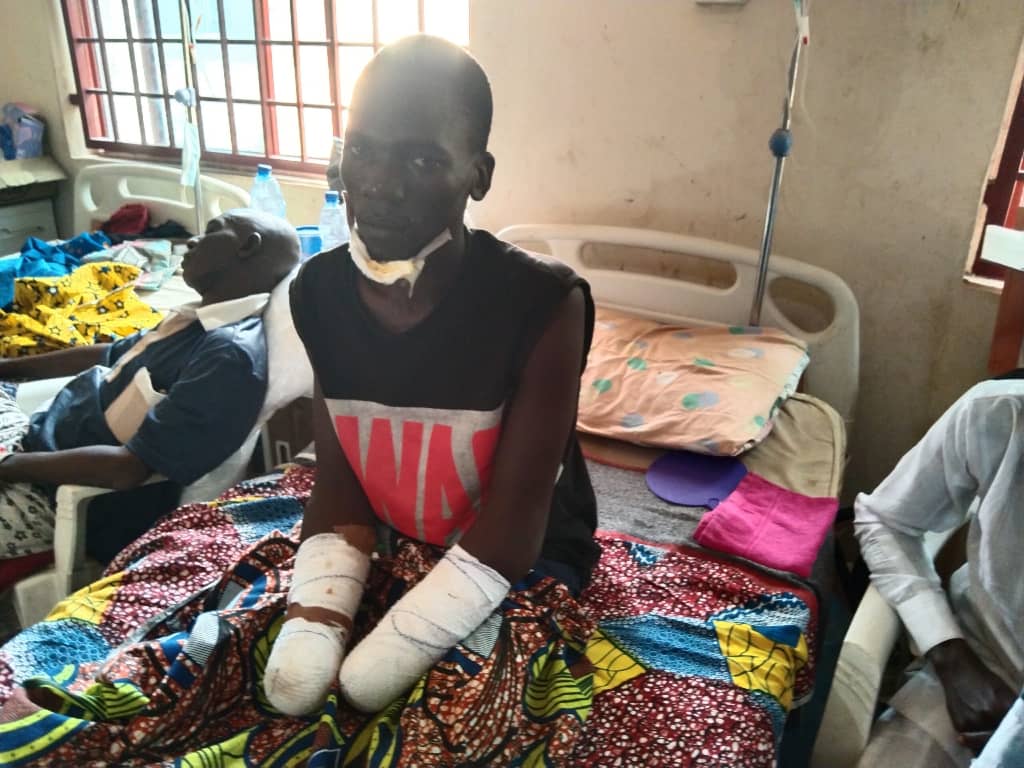
Abductors of Zaria council workers demand 100M ransom
By Hussaina Sufyan Ahmad
The new development by Katsina State Internal Revenue Service (KIRS) has been an immediate stoppage of all cash payments and collection of revenues, taxes and other levies due.
The Executive Chairman of KIRS, Mustapha Muhammad Sirajo, on Sunday in a statement issued to journalists added:
“The stoppage of the cash payments takes effective from Monday, November 8, 2021. As part of the modernization project of its service, Katsina State Internal Revenue Service (KIRS) is reviewing the process of collection of revenues, taxes and levies due to Katsina State’s Developments.”
“The commercial banks are First Bank, Access Bank, Eco Bank, First City Monument Bank, Fidelity Bank, Guaranty Trust Bank, Keystone Bank, Polaris Bank, Stannic Bank, Sterling Bank, Union Bank, United Bank of Africa and Zenith Bank.”
“The public is hereby informed that all cash payments and transactions have been halted and e-payment effective from Monday 8th Nove mber 2021.”
By Aminu Mohammed
“Aminu! I cannot travel to Afghanistan. I am afraid that the Taliban will kill me. I am not going anywhere and will rather die in Germany”.
These are the exact words by my friend and neighbour, Suroosh, who incidentally is from Afghanistan. According to him, going to Afghanistan is akin to signing his death warrant. Suroosh also narrated a gory tale about how a relative was hacked to death a few weeks ago by the Taliban just because he worked as a translator for the United States Embassy in Kabul.
This issue got me perplexed, and I became curious about why the Taliban wanted Surrosh dead. My neighbour revealed that he previously worked for an international non-governmental organisation in Kabul before moving to Germany for further studies. This alone puts him on target for elimination by the Taliban if he decides to visit Afghanistan.
I usually perform my Friday prayer at the Afghan mosque in my city here in Kiel. However, from my interaction with some Afghan nationals, I observed that feeling of hopelessness and agony. These people cannot go back to their country for fear of the unknown. Most of those I engaged in conversation with are afraid to go home for fear of being killed by religious zealots.
This article is not about the Taliban or Afghanistan; I want to draw our attention to the negative trend and how lack of proper understanding of Islamic tenets can lead to chaos and anarchy, resulting in mass suffering among the citizens. It should be noted that this discussion with my neighbour took place shortly after the Taliban took over the mantle of leadership in Afghanistan.
I have always refrained from engaging in any discussion about the myriad of challenges bedevilling Northern Nigeria. However, I realised that one could not continue to maintain silence when it comes to issues about one’s homeland. I am compelled to write this because I am worried about the current security situation in the North, especially kidnapping and banditry. The issue at home has become critical that we need to do whatever it takes in one way or the other to change the narrative.
I have observed with keen interest and dismay the incessant verbal attacks and altercation among our people, particularly our youths, over religious issues in various social media platforms and offline. We attack one another and show hatred and bitterness to our fellow Muslims just because of sectarian differences. This has degenerated to the extent that people within a particular sect will be tagging others who do not believe in their doctrine as infidels.
The Islamic scholars from various sects are not left out in this altercation and dangerous trend. Some make uncomplimentary remarks against other scholars and sects during their preaching and sermon, which always elicit amusement rather than condemnation from their audience. This has become constant and worrisome that we must try as much as possible to propagate against this; otherwise, it will not augur well for our society if we all keep quiet and refuse to act.
Let me, first of all, clarify some issues. First, I am not an Islamic scholar, and I do not claim to have a vast knowledge of Islam. However, having been taught by Sunni Islamic scholars from Pakistan, India, and Egypt at the College of Arabic and Islamic Studies, Afikpo, Ebonyi State, I can distinguish between right and wrong in Islam. Our teachers (at Markaz) never taught us to discriminate against other sects or abuse people that do not believe in our doctrine. I still don’t understand why our people dissipate energy on religious arguments and trivial issues to the extent of cursing one another.
Today, the North is no longer secure and safe. People are being hacked to death in large numbers. Religious intolerance has become a significant challenge in our society. We derive joy in casting aspersion on people and mocking those who do not believe in our ideology. This got me wondering whether there is something wrong with us. Why should we be fighting one another over different doctrines and sects? Is Islam in Nigeria different from the one being practised in other saner climes and countries?
Are we not concerned with the number of out-of-school children, illiteracy, industrial stagnation, high unemployment and the raging inflation in the North? Are the incessant killings of hapless villagers perpetrated by marauders and bandits in our rural communities not enough to wake us up from our slumber? I am afraid that if we continue on this trajectory, we will wake up one day and discover that we have no place to call home because of what we have done to ourselves.
Afghanistan is in chaos and ruins today because of this religious rascality, and I am afraid the North is heading in that direction. Prayer alone without action cannot stop the calamity that may happen if we fail to take action. Therefore, it behoves us as individuals and groups to start a conversation and see how we can live in unity and harmony with our fellow Muslim brothers irrespective of their sect and ideology.
We should learn to accommodate people in our midst irrespective of the sect they belong to or the religion they practice. We should endeavour to voice out against Islamic preachers who abuse other sects or do not share their ideology. Tolerance should be our watchword and the only key to our progress and prosperity as a people. We need peace and security for us to grow as a nation. Silence is no longer a virtue. We cannot remain silent and continue to watch as spectators while our region degenerates into anarchy.
Aminu Mohammed is at the School of Sustainability, Christian-Albrechts-Universität zu Kiel, Schleswig Holstein, Germany. He can be reached via gravity23n@gmail.com.
By Abdullahi A. Lamido
The renowned Muslim human rights activist and Director of the Muslim Rights Concern (MURIC), Prof. Ishaq Lakin Akintola, has called for exempting the Sultan of Sokoto from the “Deposition Clause” in the Nigerian laws.
Speaking as the keynote presenter at the formal opening ceremony of the 15th Anniversary of the 20th Sultan of Sokoto, His Eminence, Alhaji Muhammad Sa’ad Abubakar CFR mni, Akintola noted that Sultan Sa’ad as the head of the Nigeria Supreme Council for Islamic Affairs (NSCIA) means well for Nigeria and his council has the potentials of solving several problems that Nigerian Muslims are bedevilling with.
“By the nature and composite of the NSCIA, anyone who occupies the position of governor in Sokoto State has the power to depose the Sultan. Unfortunately, the removal of the Sultan has the bandwagon effect of removing the President General of the NSCIA. This is because, Section 6 Cap 26 of the Laws of Northern Nigeria empowers state governors to depose the Emirs and this includes the Sultan”, he said.
Akintola stressed that in addition, Article 7 of the NSCIA constitution stipulates that the Sultan of Sokoto shall be the President General of the NSCIA. “Here lays the dilemma facing the Ummah. The governor of a single state can depose the Sultan and leader of all Nigerian Muslims. This situation is capable of causing unmitigated embarrassment. It also has the capacity to trigger a religious crisis of unimaginable dimension”.
He pointed to the fact that: “Whereas even the president of Nigeria cannot interfere in the affairs of the Christian Association of Nigeria (CAN), [but unfortunately] a state governor can interfere and even depose the Sultan and President General of the NSCIA. This has far reaching comparative disadvantage vis-a-vis the bargaining power as well as pressure group influence of Christians and Muslims in Nigeria.”
The solution to this dilemma according to Akintola is to secure immunity from deposing the Sultan. “The onus is therefore on the Sokoto State House of Assembly to set the machinery in motion for the repeal of Section 6 Cap 26 of the Laws of Northern Nigeria in such a way that it will exclude the Sultan from the governor’s exercise of the power of deposition. It is a simple exercise which may not go beyond a motion in the House seeking to insert the phrase ‘except the Sultan of Sokoto’ in the dethronement clause.”
He reiterated that this is not about the present Sultan but about the progress of the Ummah and the freedom from undue executive influence.
Commenting after the speech, the Chairman of the Occasion, His Highness, the Emir of Argungu Alhaji Samaila Muhammadu Mera, stressed that this matter raised by Akintola is a serious one and Nigerian Muslims should give it utmost attention. The Sultan is the leader of the Muslims not of Sokoto. He is not the Sultan of Sokoto State but of the Sokoto Caliphate. As the leader of the entire Nigerian Muslims, the office of the Sultan deserves special provision in a manner that safeguards the overall interest of Muslim leadership.
Muhammadu Sunusi (II) was the recent emir in Northern Nigeria to be deposed by the Kano State Governor, Dr. Abdullahi Umar Ganduje by alleging that the deposed emir interfered into the state’s political matters that almost caused him to lose his second election in 2019.
By Abdurrahman Muhammad
His Eminence, Sultan Muhammad Sa’ad Abubakar MNI, has honoured a Keke Napep rider, Malam Akilu Gangare in Jos, with the sum of NGN500,000, for returning NGN500,000 left in his Keke Napep to its rightful owner.
A passenger boarded Malam Akilu’s Napep to a particular place. After reaching his destination, the passenger hurriedly alighted leaving his back behind. A little while longer, Malam Akilu sighted the bag in his Napep after his passenger has disappeared. He opened the the bag out of curiosity only to see a large sum of money NGN500,000 inside.
Malam Akilu quickly turned back in search of the passenger. After he located him, he handed him back the bag with his money intact.
On receiving the news, His Eminence the Sultan made the necessary investigation and the information turned out to be true.
Yesterday, Saturday, 23-10-2021, His Eminence rewarded Malam Akilu in Jos with the sum of NGN500,000. The exact amount he honestly returned to the owner.
For His Eminence, this is not the first time of doing this kind of great gesture. He has done it several times before. It is his way of rewarding honesty and encouraging people to be good citizens.
By Muhammad Sabiu
By Mohammed Zayyad
The debate that the presidency moves to the South in 2023 has gained momentum. Also, presidential hopefuls from the North, like Atiku Abukar, Sule Lamido, Senator Bala Mohammed, Senator Rabiu Musa Kwankwaso, are also effectively playing their games.
The calls for power to shift to the South have further triggered permutations and realignments in the polity. Both the Peoples Democratic Party (PDP) and the All Progressive Congress (APC) have strong candidates from the South. But these candidates have their respective baggage, and the parties have internal squabbles that must be resolved.
The APC has its stronghold in the Northwest, Southwest, Northeast and Northcentral – four of the nation’s six geopolitical zones. The PDP has strong structures in the six zones with a stronghold in the Southeast and Southsouth. However, the APC has moved into the Southeast in full force. Before the 2015 elections, nobody had ever thought that the APC would someday have even a ward councillor in the Southeast. But, today, the party has two state governors, senators, House of Representatives members, state house of assembly members, local council chairmen, councillors and formidable party structures in all the five southeastern states.
Come 2023, the APC has no reasons to retain power in the North, but there is strong politicking by some governors and other bigwigs to maintain power. This will mean the APC contravening the unwritten agreement between the North and the South on power rotation. In any case, the APC does not have a strong presidential candidate from the North. This is a big plus to the presidential hopefuls from the South, or Southeast, in particular. Furthermore, the Southeast has a strong case to present based on a plank that the Southeast is the only geopolitical zone in the South that has not produced a President or vice president on any political party platform since 1999.
If APC picks its presidential candidate from the South, especially Southwest, the PDP may attempt to outwit this by looking to the North for its presidential candidate. This, as well, will put the PDP in a catch-22 situation on how to explain this to the South, especially the Southeast and the South-South, why the North again, after eight years of the North being in power.
PDP has good candidates in their own ‘rights’ from the Southeast and South-South. Enugu State Governor Ifeanyi Ugwuanyi, Peter Obi from Southeast and Governor Nyesom Wike from the South-South. Obi does not have friends in the North and has never tried to pull an appeal from the region, directly or by proxy. His deportation of other Nigerians to their states when he was governor of Anambra state was used against him in the North during the 2019 campaign, and it worked.
For Wike, his words, ‘Rivers is a Christian state’ will be used against him in the North like Governor El-Rufai’s Muslim-Muslim ticket in Kaduna can be used against him (El-Rufai). This is how local politics impact a candidate’s wider political opportunities. Some young people in the north are also campaigning for Enugu State Governor Ifeanyi Ugwuanyi. Still, the IPOB issue will be a significant hindrance in the North, but it is not insurmountable. Advocates of secession appear not to understand Nigeria. There are massive inter-marriage, friendships, business links and political alliances, among other ties, between many northerners and many Igbos.
Some nationalistic politicians from the Southeast have started to convince other Nigerians to support the region to produce the Nigeria president of Southeast extraction in 2023. The bigwigs’ forefront presidential hopefuls are Governor David Umahi, Orji Uzor Kalu, Governor Ifeanyi Ugwuanyi, Rochas Okorocha, Chris Baywood Ibe, Ken Nnamani, Minister of State for Education, Dr Chinedu Nwajiuba, Sen Osita Izunaso and many others. Of course, these politicians have their political baggage and controversies. However, people like Chris Baywood Ibe are new faces without any political baggage and controversy-free.
A thorough understanding of how Nigerian politics works is paramount in achieving the political goals of a group, a region, or individuals. There are so many conflicting interests in Nigeria. Still, there are always windows for alliances, give-and-take, a hand of friendship, and convincing others to support a particular political cause or an individual’s.
For the 2023 presidency, the Southeast should present a candidate with a new face, no controversies, no political baggage and who has friends and is well-known across the Niger. For both the APC and the PDP, it will be an opportunity to reunite Nigeria and rekindle the historical political alliance between the north and the southeast while maintaining the partys’ current national. The Igbo presidency is possible through the spirit of one Nigeria.
Zayyad I. Muhammad writes from Abuja. He can be reached via zaymohd@yahoo.com.
By Abdulrazak Iliyasu Sansani
By Abdulhaleem Ishaq Ringim
By Adamu Umar Kumo
Gombe Geographic Information Systems (GOGIS) is an agency under Gombe State Ministry of Lands and Survey saddled with the responsibility of modernizing land administration in Gombe State in accordance with international urban planning standards and practices to pave the way for infrastructural development in Gombe State.
To ensure a solid foundation has been laid for successful takeoff and smooth running of the agency, His Excellency, Governor Muhammadu Inuwa Yahaya appointed a competent personality and Contemporary Town Planner with more than a decade of experience in the profession, Dr Kabiru Usman Hassan to pilot the affairs of the Agency.
GOGIS, under the leadership of Dr Kabiru Usman Hassan, has modernised the process of issuing land titles and other related documents using state-of-the-art facilities. The transition and integration of land information into a unified geographic database has given the agency easy access to information about any piece of land or landed property with a click of a finger. This has drastically reduced duplication and other forms of malpractices and corruption in land administration.
With the approval of adequate funds for aerial mapping that will cover the whole Gombe State (both inhabited and uninhabited areas) using high resolution remote sensing facilities, GOGIS will soon be partaking in the exploration of resources in the state. This will go a long way in wooing investors to Gombe state and eventually boost our economy.
As GOGIS continue to undertake “Operation Show Your Land Title Documents”, the operation aimed at sensitizing people on their duty as law-abiding citizens to pay their ground rent and other related taxes, the agency has succeeded in many fronts by mobilizing industries, banks, fuel stations and other commercial institutions to pay their dues. To lead by example, most at times this kind of operation is done by a team of professionals under the leadership of the DG himself. This singular task has helped Gombe State Government in broadening its revenue base to cope with the current economic realities.
The establishment of the Gombe State Special Development Zone has been one of the focal projects of Governor Inuwa Yahaya’s administration aimed at providing a well-planned layout with adequate social amenities for the establishment of institutions to consolidate investments in the state. GOGIS has been at the forefront in carrying out this task. From mapping, census of the existing structures to sensitization, the agency has been playing a pivotal role in making the project a reality.
Settling disputes is another aspect where GOGIS deserves recommendation. GOGIS corporate office receives numerous complaints on a daily basis regarding distortions of layouts and indiscriminate erection of structures. With prompt intervention from GOGIS, many community clashes and individual disputes have been averted.
With GOGIS under this workaholic Director-General, Dr Kabiru Usman Hassan, Gombe State is in sha Allah set to be the most convenient state to live in the country.
Adamu Umar Kumo writes from Gombe State.