Nigeria

Self-styled investigative journalist Hundeyin under fire over anti-Arewa tweet

By Muhammad Sabiu


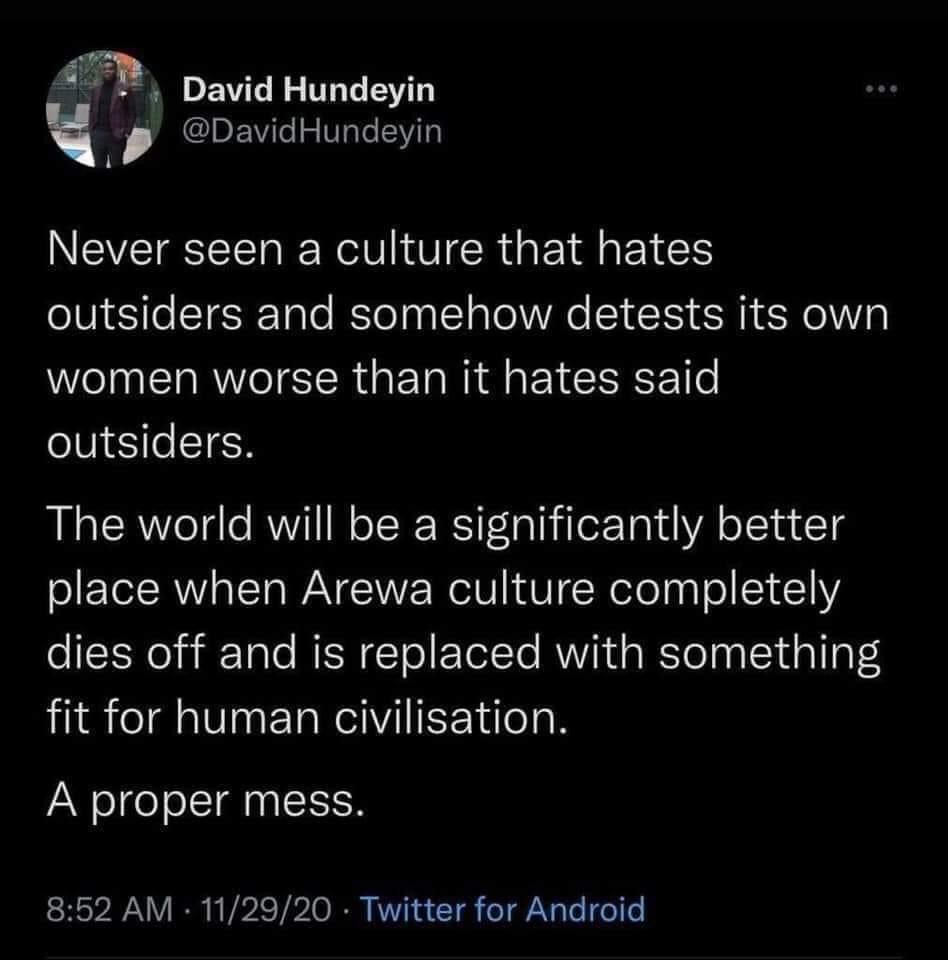
David Hundeyin, a self-styled investigative journalist who has in recent months become popular on social media, has come under fire over his about-a-year-old tweet condemning “Arewa” and its culture.


According to Mr. Hundeyin, the world would be a better place to live in without the “uncivilised” Arewa culture because he has“[n]ever seen a culture that hates outsiders and somehow detests its own women worse than it hates [the] said outsiders.”

“The world will be a significantly better place when Arewa culture completely dies off and is replaced with something fit for human civilisation,” he added.


The digging up of the tweet could not be unconnected with a recent, viral, controversial article he wrote titled “Cornflakes for Jihad: The Boko Haram Origin Story”, in which he tried to give the history of Boko Haram in Nigeria and presented what many described as “conspiracy theories” and “hasty conclusions.”


Airing their grievances against Mr. Hundeyin’s derogatory tweet, many Facebook users from the North took the issue to their timelines.


For instance, Dr. Ahmad Shehu suggested that legal action should be taken against people making such negative stereotyping.


“The north should make an example of these idiots. I hate it when we seem passive against these kinds of bigots. I enjoin our legal activists to take these kinds of people to court for stereotyping,”Dr. Shehu wrote.


Similarly, another user, who goes by the name Abubakar Sulaiman, sees him as somebody with a dangerous mindset. “The question that crosses my mind is simply why do they hate us? This is the dangerous kind of mindset David Hundeyin and his ilks use to delve into archives.


“So what was made to look like an investigative journalistic endeavour by the likes of David Hundeyin was simply a pre-conceived idea supported by witty though foolish biased selection of data while ignoring a significant portion of related data that may contradict that pre-conceived idea. A clear case of cherry picking,” he said.


Also, according to Adam Baba Yamani, Hundeyin is nothing but a bigot and hater of anything that has to do with the North and Muslims.


He wrote,“Hello my people of the North (Arewa), if you think David Hundeyin is not a bigot and a hater of anything North and Muslims, take your time and glance at what he wrote on his Twitter handle, don’t be deceived by the cloak of journalism he is wearing, his intent is to replace you, your culture and Way of life with the one of his choice, for those among us that are applauding David Hundeyin for his “Conflakes..”, please read, research and cogitate.”

World Teacher’s Day: Nigerian students send wishes, prayers to their teachers

Compiled by Aisar Fagge

Today, October 5, is designated as World Teacher’s Day. Students across the globe are celebrating the day with their teachers by sending them flowers, cards, taking them out for dinner and writing goodwill messages on various social media platforms.

The Daily Reality collects some opinions of Nigerian students about this day. Here are some:

Umar Haruna Tami

“Teachers are the nearest alchemists within our reach. The good students they produce are the result of patience, perseverance and dedication to the service. They don’t prioritize what’s in it for them. May their spirits never lose shape.”

Adamu Kazaure

“Without the hard work of Nigerian teachers, the level of illiteracy will have been unmeasurable. We are ever grateful to all the Nigerian teachers. You all deserve to be celebrated.”

Hafeez Kiido

“Uncle Ishaq, who taught me in my elementary school, Maitama Yousuf. He was the first person who had inspired me to read and be courageous when giving it back(public speaking in debates). Malam Sanusi was the second person who usually exempted me out of many applauding my doings. That motivates me, though.

Prof. Tijjani M Naniya of BUK (well-known historian), from whom I retrieve raw knowledge of history. I also emulate some of his positive and solid character. For example, he once told us to be self—defendants and not to part in sectarianism, as sectarianism was solely built upon politics, not religion.

Late Malam Sanee taught me Quran in my early childhood stage (Allah ya gafarta masa).

Last and not least was Malam Abdullahi Abba, who was my Project Supervisor at Kano state Informatics. I will never forget his kindness and guidance towards our studies. May the brim of blessings of Allah flood them all.”

Sohaib Infinity

“Teachers are the reason for what am I today; I always respect them, and my love for them is immeasurable.”

Abdullahi Idris Tikau

“We know we don’t have a Kobo, Naira, or Dollars to pay you. So your (teachers) reward is in heaven. May Allah be your helper and protect you from the trials of this Dunya. May Allah bless your excellent work for humanity. Long live Nigerian teachers. Your good work will not be in vain.”

Jamila Umar

“Teachers are community builders. I can recall when a teacher in primary six once told me about vision 2020 (2005) that all the academic, health challenges etc., we are facing in Nigeria will become history. Since then, I have been dreaming of this dreamland. He speaks sincerely with hope for our future, but upon reaching 2020 now, the result is ‘irony.’ I still have hope for the future generations to come. May Allah reward our teachers.”

Harun Muhammad Yakasai

“Teachers are the angels who enlighten our lives with the light of knowledge and wisdom. Wishing you immense joy, happiness and prosperity because teachers like you deserve the best. Happy teacher’s day to you all.”

Sani Muhammad

“My best regards to both my Islamic and western education teachers as they have really impacted on me in relations to honesty, dedication and many more.”

Dan Ladi Hausawa 

“I don’t have enough words to express my gratitude to my humble teachers who guided me on how to become a useful person among the people. God bless our teachers.”

Auwal Mukhtar

“Today is the teacher’s day. Teachers are the bedrock of any sane and progressive society without which any society can only live in room and gloom. They perform lofty and noble acts which go unnoticed and adequately compensated. My utmost regards to my teachers, who helped to shape and mould my thinking. Who always taught me the act of self-sacrifice and selfless living. My sincere appreciation to Mrs Beatrice Okoro, Mr Yemi Odedokun, Mr Nkuma, Late Atemken Achanga, Mal Abdullahi Musa, Mal Yusufu, Mal Nura Khalid ( digital Imam), Ass. Prof Bappa M Abubakar, Ass. Prof Manir Kamba, Prof Lukman Diso, Dr  Abdulkadir Idris Ahmed and many others too numerous to mention.”

Karama Jamila Sani Yaro

I will forever be grateful to my teachers. My parents were my first teachers. Both Islamic and Western School teachers I attended. And the entire teaching staff of Al-Manaahil Academy. You all are much appreciated.”

Yahanasu Ibrahim Isah

“Dear teachers, it is because of you I became a good student. Thank you, all, that you have done for me. I wish you a delighted teachers day. If knowledge is the light, then you are the guiding stars that give us this light. I celebrate you all. Happy teachers day. Proud to be one. I celebrate us all.”

Hassan Mujtaba
“I was inspired by many teachers, and you are included. The way teachers inspired me is to be a hard-working student. Alhamdulillah. I took their advice. I always work hard. I rather fail and fail than cheat in any exam. I believe deep down in me that this is a very good thing and am proud of it. Above all am proud to be among your students, sir. Am still seeing it as a favour. May God bless all our teachers.”

90,000 malaria related deaths are recorded every year in Nigeria – NMEP

By Hussaina Sufyan Ahmad

MEP Advocacy Communication and Social Mobilisation (ACSM) Officer, Eunice Subair, disclose that 90,000 malaria deaths are recorded yearly in Nigeria at the quarterly meeting of the Civil Society in Malaria Control, Immunisation and Nutrition (ACOMIN), held in Abuja on October 3, 2021.

Subair noted that progress is being made to control malaria, with prevalence going down from 42% in 2010 to 27% in 2015, and 23% in 2018 (MIS 2010 and NDHS 2018).

She said malaria was still a significant burden in Nigeria, and that the Seasonal Malaria Chemoprevention (SMC), was ongoing in all the eligible states.

She also requested the media to help in achieving the malaria elimination goal by making the disease a topmost topic of discourse to the public by including malaria issues in their programmes. And educating the public on the importance of sleeping inside ITNs every night to protect themselves against mosquito bites, among others.

Subair stressed the need for pregnant women to visit clinics at the earliest stage of pregnancy, to undergo antenatal care and admonished Nigerians to always go to the hospital whenever they suspect their systems to have malaria symptoms.

The Coordinator of the Civil Society in Malaria Control, Immunisation and Nutrition (ACOMIN), Ayo Ipinmoye, said more than three billion people, about half of the world’s population, are at risk of malaria, which is treatable and preventable.

He noted that the recently upgraded customised management information system would save the Federal Government about N293,700,000 in logistics cost, out of the N890m budgeted for the implementation of the malaria Intervention programme.

He further explained that the deployment of technology in data collection would help check malaria commodities, such as the ACT and insecticide-treated net.

He said with the latest upgrade of ACOMIS, data could be collected from the field on a real-time basis across all implementing states.

Are we the leaders of tomorrow?

By MA Iliasu


This question has grown into a full-blown critical question among Nigerian youths. And from the way it exudes the aura of anger and despair, it’s evident that generational frustration and offence seem to take over at the mere mention of the question. The anger and grief are mainly directed at the core of the established ruling class, who aren’t growing any younger, whose incompetence also seem to grow with their age.

“We were scammed. I don’t believe we’ll be the leaders of tomorrow. Obasanjo was the president when I was born. Today it’s Buhari. Both are older than my grandfather. And tomorrow it’ll be another older man in the villa. How does that show any trustworthy sequential line of succession?” a very vibrant, 22-year-old young man who loves to discuss national politics tod me. Clear as the sun, he was angry.

I murmured. To an extent, the young man had a valid point – after all, who doesn’t want positive, fresh energy and change in the leadership capacity. Meanwhile, if there’s another thing to be exploited from the frustration of our youths that often warrants utterances, such as that is the plentiful poverty of imagination and painful obsession with literalism. And that alone can explain why young blood is absent in the establishment of the highest political echelon.

“Is the definition of leadership really that narrow?” – I asked the young man.

Indeed, if what is leadership and who is a leader is restricted to presidential, gubernatorial or representative chairs and who gets to sit on them, then it’s only expected that we don’t care to responsibly fulfil the vacuums of class captains and school prefects, students union governments and community initiatives, let alone develop the ambition of leading the pack in trillion-dollar conglomerates, become the CEO’s of medium and small enterprises and head of profit and nonprofit organizations. That, too, is leadership and perhaps even a more fulfilling one. But, sadly, it’s so vivid that in the mind of Nigerian youths, politics is the only method of the ladder to, and only acceptable definition of, leadership.

Meanwhile, if leadership is really that narrow, in any country of a hundred million population, only less than 0.01% would be leaders over the course of a century. Did the person who first said that never knew this? Far from that. The issue is on us and us alone. Today, in Nigeria, we develop the habits of taking phenomena out of context and converting positivity into negativity. Overwhelming positivity does indeed cause a crushing crisis. But one thing history teaches us is that prosperity has never blossomed in a negative mindset.

With over a billion population, the Chinese wake up every day to tell their children they’re the leaders of tomorrow. Do you know how many people led China in its 76 years of official declaration? The US, the arena of blockbuster politics and democracy, with a population of over three hundred million, was ruled by less than fifty people of its official existence. And any other person outside of the presidential list was once told they would be the leader of tomorrow. The Soviet had significantly lower, as does Russia and Saudi Arabia and Japan and any muscly country.

So maybe the frustration isn’t in the saying but in our interpretation of it. Perhaps we simply lack imagination. Perhaps we’re just lazy. Because if we think as the forward-thinking do, we may have enough to realize leadership begins by being a good husband to your wife, excellent father to your child, a kind friend to your neighbours, a just leader to your community, an empathetic and responsible Godfather to your employees, an excellent teacher to your students, a good HOD to your department, a good dean to your faculty, good examination officer to your school and even a trustworthy representative to the wealthy man who assigns you to distribute occasional stimulus.

That your grandmother called you a leader so that you’ll make the name proud and raise children who’ll change the world. That one day, you may become influential and inspire lives forever and not necessarily a political leader if you become that too brilliant. But there are other prerequisites. And if alive, every sane and healthy human must pass through. If you reach there, you’ve fulfilled your inevitable destiny of becoming a leader. And how you exercise the right defines you even in the sight of your Lord (SWT). It’s not a consolation, neither a justification of a rotten system—only consolidation of reality and highlighting the fallacies engraved in our sorry definition of leadership.

So again, one may ask, “are we the leaders of tomorrow?”. We must “yes” to that question even with an overwhelming affirmation. It’s a natural order that we were all born to be leaders. We were, we are, and we’ll be. The best wish is to ask Allah to make us the best our generation will ever see.

MA Iliasu writes from Kano. He can be reached via his email muhada102@gmail.com.

If there was Biafra

By Ahmadu Shehu, PhD.

It is no longer debatable that Nigeria, despite its crippling challenges, may never disintegrate, at least geographically. Of course, the animosities, hatred and distrust between the ethnic and regional nationalities might worsen, but Nigeria’s elasticity is exemplary and uncommon. However, I still do not accept the convenient folktale deployed by politicians that our country’s unity is non-negotiable. By now, our experience as a nation should have liberated our minds to begin a conversation on any topic of national interest, no matter the controversy or emotional delicacy.

As we approach the 61st birthday of our beloved country, I find it imperative to discuss this controversial but important issue. From the outset, let me clarify that this article is not about the Igbo as an ethnic group or the southeast as a region. Given the rise in pro-Biafra sentiments and agitations at the moment, this article is only meant to provide an outsider view of some arguments espoused by the secessionists in their attempt to generate sympathy and popularity.

When you think of Nigeria’s disintegration, the first thing that comes to mind is Biafra – a defunct Igbo separatist nation in the country’s southeastern part. The attempt to curve this region from Nigeria in 1967 remains one of the most gruelling experiences of our country. A barely six-year-old nation was thrown into chaos by a set of greedy politicians and unscrupulous military officers who wanted power at the centre. Within those thirty months, millions of innocent citizens lost their lives, got injured or lost their possessions. In addition, Nigeria lost a large chunk of its national treasury meant to set the country on the right footing. The rest, as they say, is history.

Instead of learning from our past mistakes to avoid the recurrence of this destructive, reckless and unnecessary event, Nigerians of this generation seem to be oblivious of the necessary truth. As with most factual historical events in the Nigerian psyche, this painful experience, its true causes, and damning consequences are not well-known to the younger generations. The biased narratives in various country sections ensure that our population only hear the stories that suit their mindsets without alternative facts that would open their minds to self-criticism.

In the case of Biafra, most of the young Igbo folks have a pretty false image of their fate as a people if Biafra had happened. This skewed imagination is not unconnected with the biased, often imaginative stories these young Nigerians were told about their defunct “nation”. The Igbo popular culture and the intelligentsia depict a fictional image of Biafra as a dream-nation where the Igbos shall live in peace and prosperity devoid of challenges.

They imagine, albeit naively, that Biafra will be unlike Nigeria and that their lot would have been better than it is today. These unsuspecting chaps are led into believing a mirage of living in a nation flowing with honey and milk. They are also told that other ethnic and geopolitical sections of Nigeria are responsible for all their woes. They argue, albeit ignorantly, that if not for the North, the West, Hausa, Fulani, Yoruba, etc., theirs would have been a heaven on earth. These ignorant tales conclude that a united Nigeria does not help their course as a people.

Well, I think that these views are simplistic. I also believe that it is our responsibility to tell our brethren the truth that they need to hear. Firstly, the creation, proclamation of Biafra was not in the interest of the ordinary Igbo people. It was the last-ditch by Igbo politicians to hide their faces from problems they caused and ensure they stayed in power. Secondly, our brethren are mischievously told that the Igbo were so rich that the Igboland was the largest economic contributor to the federation. Unfortunately, the falsity of this assertion is not far-fetched, as the southeast was and is still the least contributor to the Nigerian GDP. Moreover, during the attempted secession, Nigeria’s GDP was mainly from the agricultural sector, predominantly from the North.

Thirdly, it seems that many people are misled into believing that Biafra would be an oil-rich country even though none of the Southeastern states is truly oil-producing. The Niger Delta, Nigeria’s oil pot, was not and will never be part of Biafra.

Fourthly, young Igbo people tend to believe that the southeast was Nigeria’s cash-cow at independence. The bitter truth is that even in the ’60s, the perceived strong Igbo economy depended entirely on other regions. This scenario is worse today as there are probably more Igbo people and Igbo businesses in other parts of the country than in Igboland. Worse still, the Igboland is closed and unfriendly to Nigerians, making external investments impossible.

The most supposedly intelligent argument advanced by the secessionists hinges on the current centralized federal system. They claim that the centre is too powerful and that Igbo states are marginalized. This is an argument of convenience, at best. Nigerians are not oblivious that the current unitary system was the handwork of Igbo politicians who saw a unitary arrangement as the answer to their political agenda. Today, the tides have turned, and these very people are calling for the system they abolished. Restructuring this country – whatever that means – might be a good idea, but only after a genuine debate that will ensure we do not return to the same vicious circle.

People with secessionist tendencies have used the challenges in northern Nigeria as reasons for disintegration. However, Biafra will by no means be a safer or better place. Currently, some of the most terrible crimes bedevilling this country are not unconnected with the southeast. From drugs to internet fraud, armed robbery and kidnapping to arms smuggling, if not worse, the southeast is not holier than other parts of this country.

Another commonplace argument is that the industrious nature of the Igbo people is enough evidence that Biafra will be a great country. But this argument, too, has failed to account for the fact that the wealthiest and most successful Igbo people and their businesses owe their success significantly to Nigeria and not Igboland. The Igbo people are traders, and the economic success of trading lies in the customer market, not the number of sellers. What do the Igbo people actually produce or sell that does not rely on the larger Nigerian population?

On the one hand, there is nothing that the southeast offers that cannot be produced or sold by other Nigerians. But, on the other hand, everything from food to livestock, energy, and the market for everything sold depend on the other regions. The southeast is asking to leave under this situation is the most absurd strategic blunder of the century.

Similarly, Igbo politicians and administrators have not distinguished themselves from the rotten Nigerian public servants. We do not see a difference between southeastern institutions or southeasterners in Nigerian public offices and their counterparts in other regions or ethnic groups. The same crop of people will lead Biafra. So, nobody should be enthusiastic.

Therefore, it is evident from the preceding that the viability of Biafra as an independent state is not assured. For one, it will be a landlocked, forty-one thousand kilometres square piece of land, which is just a half of Niger state and less than the size of Kaduna state. Worse still, it will be circled on all four corners by its biggest adversary, the Nigerian state. Secondly, it will depend on its biggest adversary for nearly everything except air, including waterways, food, and labour. Third, it would be one of the most overpopulated countries vis-à-vis its landmass and population.

The bitter truth is that these ecological, geographical, demographic and economic factors do not support the presupposition that the Igboland is better off as a separate entity than it is within the Nigerian federation. Therefore, it is safe to conclude that even if Biafra was to happen on a platter of gold, it is not going to be the rose garden these populists have configured our brothers to believe. Thus, we should all look before we leap!


Dr Ahmadu Shehu is a nomad cum herdsman, an Assistant Professor at the American University of Nigeria, Yola, and is passionate about the Nigerian project. You can reach him at ahmadsheehu@yahoo.com.

Making Waqf a serious business in Nigeria

By Abdullahi Abubakar Lamido


Waqf, translated as Islamic endowment, simply means a perpetual charity. As a strategic Islamic socio-economic institution, it entails dedicating a benefit-creating or revenue-generating asset for the sustainable provision of free public services to the society – especially for the less privileged. It can be created by an individual, a group of individuals, a corporate body or even a governmental institution. Waqfable asset is that which is legally owned by the endower and is cable of perpetually creating benefit or generating revenues which would be channelled to defined religious or charitable purposes.

From the dawn of Islam passing through the periods of the companions, Umayyads, Abbasids, Ayyubis and the Ottomans, waqf was maximally utilized as a unique instrument for addressing virtually all aspects of societal religious, economic, educational, healthcare and environmental development needs. In fact, what “substantial historical evidence” suggests, as established by Islamic economic historians like Murat Cizakca and before him, Marshall G.S. Hodgson, is that, “waqf, not zakah was the most important institution for redistribution of wealth” in Muslim history.

Historically, waqf has sufficiently financed virtually all aspects of public welfare and developmental needs, especially education and healthcare. To wit, in the area of education, it was used for building schools, libraries, laboratories, student hostels and lodgings for teachers, scholars and researchers. It also funded scholarships, payment of teachers’ salaries and the provision of food, clothing, learning and instruction materials as well as creating conducive teaching-learning atmospheres. Great Muslim Universities were built as waqfs and have continued to be substantially financed from waqf proceeds. It grew so ubiquitous that “A person can be born in a house belonging to a waqf, sleep in a cradle provided by that waqf, be educated in the school of the waqf and read the books provided by it, become a teacher in the waqf school, earn a waqf-financed salary and at his death be placed in a waqf-provided coffin for burial in a waqf cemetery”.

Relating to health, waqf has been used to build hospitals, clinics and medical laboratories which provide a wide range of free medical services, including surgery. It is documented that it was due to the advancement in service provision through waqf that the need was not even felt for governmental ministries or departments for education and health, as these were fully financed by waqfs.

Education and health were not the only areas of waqf interventions. Waqfs sustainably financed all forms of social, economic and community development services including transportation, environmental protection and beautification among others. At some historical epochs, various Muslim nations relied on waqf sources for a substantial portion of their national income.  Waqfs were used to finance the building and maintenance of mosques, traveller’s lodgings, orphanages, bridges, water-wells, public conveniences, soup kitchens, roads, street lights and gardens.  In fact, in many Muslim communities, waqfs were created for the sustainable provision of all conceivable public welfare services. Until the colonization of Muslim societies, waqf remained a significant contributor to socio-economic development in many Muslim countries. It was colonialism that changed the subject of the formula.

Having realized how waqf provided social, cultural and economic independence to especially Muslim scholars and intellectuals, who incidentally were usually the most resilient class against selfish imperial policies; the colonial “monsters”, implemented well-orchestrated policies that saw to the hibernation of the waqf sector. They syphoned many waqf assets, weakened many, deliberately rendered many irrelevant, and calculatingly destroyed the functioning and autonomy of waqfs by subjecting them to government control. They created governmental ministries that coordinate waqfs, with all the negative consequences of that.

Worth stressing is the fact that western imperialists destroyed the waqf system in Muslim lands only after they had already copied the concept from the Muslim Middle East through the crusaders, and then developed it as an instrument for financing developmental services. In her celebrated 1988 study titled “The Influence of the Islamic Law of Waqf on the Development of the Trust in England: The Case of Merton College”, Monica Gaudiosi established that it was actually the waqf institution that gave birth to the concept of Trusts and Foundations in the West.  Modified and enhanced waqf was used to establish great western institutions such as the Merton College which still shares clear similarities with the waqf institution. And except for a few changes in the English law of Trust, most features of waqf have remained unchanged in the western practice of Trusts till date.

Interestingly, for more than two decades now there has been a growing global waqf reawakening. From the Middle East to Africa, and from the West to the East, waqf consciousness has continued to balloon. Despite the big blow that colonialism did to the waqf sector, making it reduced to merely an atomized institution concerned with financing some aspects of the spiritualties, the global Muslim communities have now rejuvenated their commitment to reposition waqf as a dynamic Islamic, third sector socio-economic institution. Waqf is seen and promoted as an engine of poverty reduction, wealth creation and distribution, employment generation and socio-economic development. In 2016, the World Bank noted that if properly harnessed “even if partly”, waqf, alongside zakah, can eradicate poverty in Africa, the Middle East and Southeast Asia. For a long time, combine global assets are estimated to be close to USD 1 trillion and growing.

Conversely, the story of waqf in Nigeria is largely different from other Muslim communities like Turkey, Morocco, Egypt, Saudi Arabia, and even others like Malaysia, Indonesia and Singapore. Yes, waqf knowledge and practice have existed in Nigeria for well over a millennium. But for several reasons, including historical, it was not comprehensively institutionalized in Nigeria’s pre-colonial history as a holistic, comprehensive socio-economic institution that provides a wide range of public welfare and developmental services. Its knowledge and practice have largely been reduced to the religious waqf, mostly mosques, cemeteries and religious schools. Even these waqfs, hardly had other revenue-generating waqfs for their sustainable funding as obtained in other climes.

But why should waqf be of great significance to Nigerian Muslims? It is of course factual that poverty is largely a Muslim phenomenon in Nigeria. All official statistics show that the states with the highest poverty rate are the Muslim dominated states. The majority of the Muslim population live in sorry conditions of socio-economic deprivations; poverty, hunger, squalor, illiteracy and poor healthcare. Muslims account for the highest number of out of formal schools and vulnerable children. These – combined with other factors – have resulted in rising insecurity and underdevelopment. For long, the solution to this has been largely viewed by many as the sole responsibility of the government. Only a few have realized that while governments have a great responsibility, Muslims can only alleviate their sufferings if they explore, among other things, Islamic socio-economic institutions in addition to agitating for good governance.

One important instrument that can significantly reduce the poverty and socio-economic backwardness of the Nigerian Muslims is no doubt the waqf institution. The flexibility and dynamism of the waqf institution provide for the mobilization of diverse resources in the forms of cash, landed properties, real estate, and other resources, which would be developed and invested, such that their revenues and fruits would be channelled to developmental services.

Nigerian Muslims already have the potentials for this. The long history of Islamic belief and practice, the enthusiasm of the population towards anything connected to Islam, the high spirit of giving that exist within the rich, middle class and even the masses, the availability of Islamic intuitions such as mosques, Islamic schools and media channels, the prevalence of governmental and non-governmental zakah and waqf institutions, among others, all provide a handy infrastructure that can be explored and utilized in the campaign for a new holistic waqf regime in Nigeria.

Particularly, the growing atmosphere of waqf consciousness among the elites and Islamic scholars, as exemplified in the increased awareness creation and establishment of Islamic charitable foundations in especially the last five to seven years, all point to existing opportunities for making waqf a veritable instrument for socio-economic empowerment. All this can also be added to the vast arable land an array of professionals and intellectuals that the Muslim community is blessed with.  It is our opinion that with these and several other potentials, if philanthropic waqf were to be well studied, promoted, institutionalized and maximally harnessed and utilized, poverty would be largely reduced and socio-economic empowerment would be greatly triggered in Nigeria.

In this regard, there is the need to utilize several platforms for waqf discourse such that its potentials would be unearthed, its dimensions analyzed, its impediments examined; goals defined, priorities set and methods of actualizing the dream well spelt out. These platforms should bring together the Islamic scholars, business persons, professionals, community leaders and all important stakeholders to common thinking tables. In the light of this, the AZAWON Newsletter presents itself as a primary platform for debating, dialoguing and analyzing waqf matters (alongside other Islamic social finance instruments).

Scholars, intellectuals, professionals and other concerned citizens are therefore invited to continue contributing articles, reports (written, pictorial or otherwise), opinions, comments and all valuable information that can enrich and smoothen the journey to making waqf a serious business in Nigeria.

Malam Abdullahi Lamido is the Chairman, Zakah and Waqf Foundation, Gombe, Nigeria. He can be reached via lamidomabudi@gmail.com.

October 1: IPOB declares sit-at-home, urges removal of Nigerian flags in region

By Muhammad Sabiu

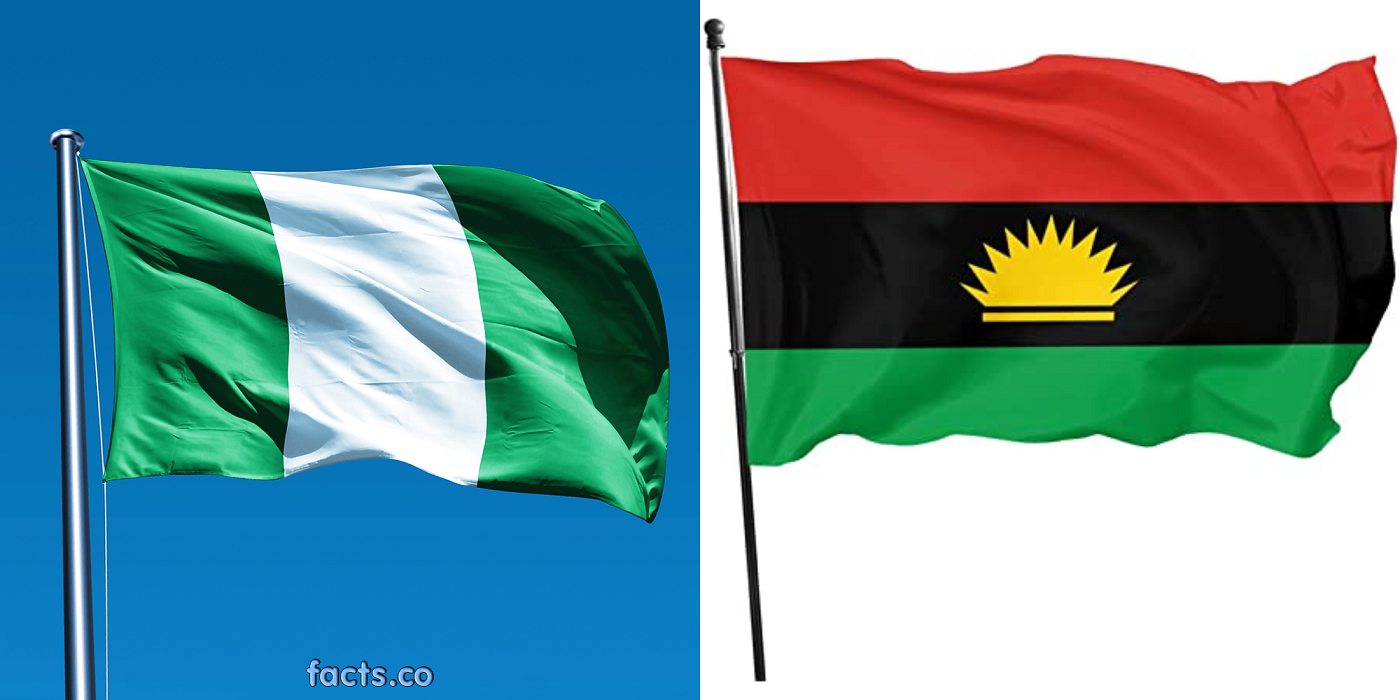
The Indigenous People of Biafra (IPOB), a proscribed secessionist organisation agitating for the breakaway of Nigeria’s southeast, has declared that the 1st of October would be a sit-at-home day.


The group has also ordered all Nigerian flags in the region to be removed.


The proscribed organisation, in a statement by its spokesman on Saturday, Emma Powerful, stressed that it had commenced its “no Nigerian flag in Southeast” campaign.


“IPOB has declared 1st of October 2021 total shutdown in Biafra land as a sign of our rejection of the evil construct called Nigeria and there shall be no movement in Biafra land on this day.


“Also, IPOB has declared from today 25th September 2021 that all Nigerian flag mounted anywhere in Biafra land must be brought down, Banks exceptional, IPOB leadership will communicate to Banks directly and give them reason they must peacefully bring down Nigeria flag in their banking premises before we do it ourselves in our own way.


“Every body must strictly adhere to this directives from IPOB leadership, we want to let the world know you that Biafraland is not Nigeria and shall not be. Don’t say I don’t know, a word is enough for the wise,” the statement reads.


Recall that IPOB leader, Nnamdi Kanu, is currently awaiting trial on charges relating to treason, illegal possession of firearms.


He was in recent months reportedly arrested in Kenya and later repatriated to Nigeria after spending years in the United Kingdom as what could be described as an “asylum seeker.”

Towards achieving food security in Nigeria

By Abdulrahman Yunusa

Perhaps, this current administration has come with the solid whims of making an agricultural revolution, but they failed to understand that it’s one of the most challenging plans to achieve. It’s most demanding because it’s beyond paperwork, lip service or even baseless table talk. Instead, it requires tireless effort and viable policies to realise.

Likewise, it’s really a sacrificial movement that needs to go beyond the border of border closure tactics. Modern farming techniques are required, well and learned agriculturists versatile in modern farming should be hired to do the job efficiently.

Contrary to the above, the government brought poor hands couple with the introduction of outdated personalities to do the job. It is a clear indicator that we are not ready to achieve our goals.

 I think all these failed tried politicians have been used by the father of mediocrity and ineptitude to prove how vast and expert this administration is when it comes to the game of political deceit. So can we keep channelling our traps into the wrong portion and be anticipating a rattling result? But, of course, things never work out in such a fraudulent way.

Imagine putting the wrong panel in a position and expecting it to work perfectly. Is this not a self-deceit at its truest form? If it happens to be true, then malfunction within their administrative circle would forever prevail since meritocracy has become a key factor to be sidelined by the change charlatans. As they move to change the seemingly poor narratives here, today, the incapacitated hands are making the job uglier than it was.

Therefore, as a country dancing in between the edge of capitalism, socialism and liberal economic system as a guiding economic instrument, they should promptly take off the fruitless idea of border closure and let food float into our country. Say this because for one to develop, he must underdevelop someone, and that could be made possible only when we have a shoulder to lean upon while trying to make the dream reality.

Also, technology should be the leading figure in this journey. All these outdated farming tactics and machines should be utterly dispelled and be substituted with modern ones.

On no reasonable ground, one will expect people to produce the enormous quantity of food that will suffice a big country like Nigeria and even have a surplus that could export to neighbouring countries using the 1908s farming system. Meanwhile, at the moment where they are battling with their stomach, and annoyingly the price of fertiliser and other farming equipment couple with chemicals are at a high price.

Most importantly, people need to be fed well before heading to the farming ground, where most of their energy is utilised. Failure to provide them food at an affordable price will drastically reduce the outcome of their farming during the harvesting season, yet the desired goals will never be achieved that way.

Our govt needs to work on its farming system mechanism to fill the existing gap in the realm of agriculture and food security. 

Abdulrahman Yunusa is a political and public affairs analyst. He writes from Bauchi and can be reached through abdulrahmanyunusa@gmail.com.

The unlived legacies of Alhaji Ahmed Joda

By Ahmadu Shehu, PhD.

To continue our conversation on a better northern Nigeria, let me bring you three unlived legacies of Alhaji Ahmed Joda, one of the most accomplished civil servants in this country. These are fantastic ideas capable of turning around the socioeconomic situation of this region and the entire country for good.

For the benefit of those who do not know him, Ahmed Joda OFR, CON, CFR was born on February 13, 1930, in Girei, a village located a few kilometres from Yola, the capital of Adamawa state. His basic education started at Yola Elementary School, from where he proceeded to Barewa College Zaria, before graduating from Pitsman College, London, in 1956. Before delving into journalism, Baba Joda started his career in agriculture and later became one of the longest-serving permanent secretaries of various federal ministries, including education, information and industry.  

Sometimes in 2019, former minister of Federal Capital Territory Dr Aliyu Umar Modibbo invited us to a meeting with Alh. Ahmed Joda. At the age of 90, Baba Joda, as we fondly called him, had assembled younger minds to think about the way forward for Nigeria and rethink the approach northern Nigeria has taken in negotiating its state, status and privileges within the Nigerian state. Baba Joda was very particular about the unity of this country, just as he was deeply concerned about the socioeconomic problems bedevilling the north. I, particularly, was astonished to see that despite his age, Baba Joda was chairing a four-hour meeting, perusing through documents and making amendments where necessary. After several meetings, recruitments, and deliberations, that meeting resulted in the “Nigerian Platform”, a collection of thinkers, excelled public servants, professionals, and academics, helping to chart a way forward for this country. The rest, as they say, is history.

Having noticed our contributions at the meeting, Baba Joda ensured my friend Dr MD Aminu and I stayed close to him and learned about this country as much as possible. We, indeed, kept in touch, learned, benefitted and enjoyed our relationship with this seasoned civil servant, experienced administrator, excellent intellectual and a special breed of the Nigerian elites.

One of Baba Joda’s agendas behind mentoring young Nigerians is to develop what he envisaged as the Nigeria Unity Forum (or any name that might suit the cause at the later stage of its development). Under this cause, Baba intended to develop a genuinely Pan-Nigerian national platform where citizens of this country will come together to discuss their grievances without hindrance, fear or hesitation. This was (to be) the first platform under which Nigerians from all walks of life, backgrounds and social status would have a free space to discuss, analyse and subject any topic of national interest without limits or limitations. The aim was to start a citizen-driven healing process among Nigerians to guarantee the true unity of our country. In the beginning, Baba had sacrificed his farmland and the facilities therein for weekly/monthly meetings of the groups. He was also to provide funding and feeding for the takeoff meetings. 

Another concept Baba Joda nurtured was a Sustainable Agricultural Model in which he invested so much time and resources in its conceptualisation and trial. Noting the waning natural resources, especially land and water, and the ever-growing population, vis-à-vis climate change and the attendant crises we are already witnessing, Baba had commissioned research into various models adopted by other countries such as India and Botswana. These countries have faced or are facing similar socioeconomic and environmental challenges. After thorough comparative studies, Baba proposed an agro-livestock model that, in my opinion, will forever change our society for good. The most fascinating and novel aspect of his proposal is its capability to deal with land and water resources, and at the same time, create a sustainable economic model that will undoubtedly work for the majority.     

The third and most important to him was the creation of the National Livestock Development Authority. Again, looking at the proposal of this agency, one cannot help but see the extraordinary visions and foresight in the manner in which it was to be designed, administered and supervised. This would not be another government-funded agency that would serve as a conduit for financial embezzlement and docility. Instead, it was meant to be a self-funding, self-sufficient and revenue-generating government agency responsible for making money for the country via our large, prosperous, but abandoned livestock sector. It was going to be a multibillion-dollar government company, richer than the NNPC and most of our aviation agencies. It would have led to vast foreign investments into our livestock sector, building companies for our manure, beef, leather, blood and born, etc., all expensive raw materials that go untapped in this part of the world. It would have been a major regional investor in this part of Africa, as it will not have had competitors for many years to come.   

While all of these and many more programs were coming up slowly but steadily, we sadly lost Baba Joda on August 13, 2021, at the age of 91. While I pray to Allah for his forgiveness and mercy upon his soul, I equally pray that those of us who are alive and are lucky to have drunk from his ocean of wisdom and patriotism will continue the struggle for a better future. I also pray that Allah will lead many more people to this cause and that these dreams, these ideas, will see the light of the day. Since Baba Joda is no longer around to pursue these ideas, I invite you to join his disciples and those who genuinely love this country to vigorously pursue and patiently work towards realising these ideas and their possible implementation.  

Dr Ahmadu Shehu is a nomad cum herdsman, an Assistant Professor at the American University of Nigeria, Yola, and is passionate about the Nigerian project. You can reach him at ahmadsheehu@yahoo.com.

Rethinking Nigeria’s healthcare financing

By Dr Abdulkareem Kabir Masokano

The announcement of a high profile committee by President Muhammadu Buhari on September 6,  2021, to be headed by his Vice President, Prof. Yemi Osinbajo, to oversee reforms in Nigeria’s health sector, is a laudable and timely one. However, like most sectors in Nigeria, the health sector is, to put it mildly, in a state of stagnation that, with the existing structure and organisation, is practically impossible to make any headway despite the enormous potentials abound in the sector to the economy.

There are numerous angles to the problem bedevilling Nigeria’s fragile health sector. They include the collapse of the primary health care system, poor infrastructure, inter-professional rivalry, poor accountability, inefficient, limited health insurance coverage, etc. However, the single most important factor causing the apparent none progress of the sector is the absence of a robust, patient-centred health financing model. Every single one of the problems can be directly attributable to this.

Contrary to what many think, modern healthcare is too expensive to be offered for free anywhere in the world. Nigerians think other countries provide healthcare services almost free of charge to their citizens. Actually, these are products of either heavy government subsidies, strict universal taxation regimes, or compulsory insurance programs. Over the years, governments in Nigeria have gotten caught up with this delusion that they can offer free healthcare to their citizens from the little they generate of their internal and external revenues without any sustainable framework to ensure steady financing of such an important yet expensive sector.

The result of this thinking is the current problem of underutilisation of highly trained healthcare professionals across various tertiary hospitals in the country because of the unavailability of modern diagnostics and therapeutic equipment – all of which are very expensive to use and manage. For example, we have specialists across various surgical specialities with the necessary skills to perform highly technical surgical procedures like kidney transplants, open heart surgery and complex brain surgeries. However, the system is so designed that it cannot accommodate their expertise due to the unavailability of resources to sustain such programs. This leaves many Nigerian patients cumulatively spending billions on such medical procedures abroad, and Nigeria loses money tremendously.

Primary healthcare, the essential segment of any serious health system, is virtually non-existent in the country. This is not due to the absence of the structures. It’s because of the ‘internal’ brain drain within the levels of the existing health system. The primary healthcare centres are primarily under the care of the local governments in the country. Unfortunately, most of them cannot afford to employ the minimum required number of qualified doctors, nurses and other health workers who, by extension, are pulled by better-paying jobs available at the higher levels of the system. As a result, most of Nigeria’s primary health centres are manned by Community Health Extension Workers with minimal skills and expertise.

The National Health Insurance Scheme (NHIS), which is supposed to be the primary driver of universal health coverage in the country, is essentially running far below par due to the poorly regulated profit-driven model it is structured. According to various statistical sources, the NHIS covers less than 5% of all Nigerians (out of over 200 million people!). As a result, the vast majority of Nigerians resort to paying out-of-pocket to access specialised healthcare. With that proportion, the insurance pool can only generate a meagre sum of money.

Coupled with the profit-only motive that drives the Health Management Organisations (HMOs), one can only expect that the system cannot cover the comprehensive health needs of its enrollees, not to mention driving any meaningful growth in the sector. The state-run contributory health systems are even worse! They are fraught with inefficiencies, lack of transparency and corruption. And as far as I am concerned, they ought not to have been created as their creation only serves to decrease the pool and reach of the National Scheme.

From the preceding, it is evident that sustainable financing is the critical element missing in our health sector; the focal point of any meaningful health sector reform in the country should include improving it. The current model whereby health financing largely depends on what the governments generate from their dwindling revenue or generous donor agencies is not sustainable and cannot move the sector even an inch from its current state. Therefore, it is about time Nigeria’s policymakers look for other alternatives to fund our increasing healthcare needs, given our explosive population growth rate.

Accordingly, this high profile committee set up by Mr President should look into developing a comprehensive, sustainable, and transparent healthcare financing model that would cover every Nigerian’s most basic health needs. It should consider a complete overhaul of the country’s healthcare financing by the development of a hybrid health financing system at various levels of the healthcare system with varying blends of public, private and public-private partnership, through the creation of a compulsory basic healthcare taxation system to cover for a comprehensive healthcare financing at the primary level for all Nigerians regardless of socioeconomic class.

A comprehensive reform of the NHIS should supplement this to enforce the enrolment of all workers in the formal sector of the economy (public and private), cooperative organisations of the various non-formal entities of the economy like farmers, artisans, transport workers, among others. This will cover specialised healthcare across our tertiary and specialist hospitals, both public and private and broadening the insurance industry to include ethical health insurance systems like the Takaful system to increase inclusivity across the various demographics of the country.

The committee should also encourage creating windows for community-based contributory health safety nets to tap into the national health insurance pool to enable citizens from lower socioeconomic access to specialised healthcare at our tertiary health institutions.

Special funds can be set aside annually from the NHIS fund pool for research and development in our tertiary health institutions regarding funding for specialised healthcare services and preventive health. This should be enough to cover all the available infrastructure needed to procure, support and maintain modern diagnostic and therapeutic equipment.

The committee has qualified, world-class technocrats as members. It also has the Bill and Melinda Gates Foundation, Vesta healthcare partners, and WHO as observers. Thus, we are optimistic that it will develop a sustainable blueprint for health financing as the bedrock of their essential task. May the government implement the committee’s recommendation for the needed reforms in Nigeria’s fragile health sector.

Dr Abdulkareem Kabir Masokano is a resident Surgeon, ABUTH, Zaria. He can be reached via abdulkareemmsk@gmail.com.