Nigeria

El-Rufai Family Announces Janazah for Hajiya Umma El-Rufai

By Abdullahi Mukhtar Algasgaini

The family of former Kaduna State Governor, Mallam Nasir El-Rufai, has announced the passing of their matriarch, Hajiya Umma El-Rufai, who died on Friday, March 27, 2026.

In a statement released on Saturday, Hon. Mohammed Bello El-Rufai, representing Kaduna North Federal Constituency, confirmed that the funeral (Janazah) prayer will be held today at the National Mosque in Central Area, Abuja, commencing at 1:00 pm. The burial is scheduled to follow immediately at Gudu Cemetery in Apo.

The announcement described the deceased as a beloved grandmother, requesting prayers from the public. The family expressed gratitude for the visits, well-wishes, and condolences received during their time of grief.

Hon. Bello El-Rufai, who also serves as the Chairman of the House Committee on Banking Regulations, signed the statement on behalf of the family elders, praying for Allah’s mercy upon the departed.

“May Allah SWT bless her soul and grant her the highest level of Aljannatul Firdausi,” the statement read.

Report Shows How Hundreds Of Pupils Study In ‘Death Trap School’ In Jigawa Amid Prolonged Neglect

By Sabiu Abdullahi

More than 300 pupils at Community Primary School in Ayama, located in Auyo Local Government Area of Jigawa State, are reportedly learning under hazardous conditions due to years of neglect.

The situation came to light after a recent inspection by Tracka, a civic accountability organisation, which described the state of the school as alarming and unsafe for both pupils and teachers.

The report highlighted the poor condition of the school facilities. It blamed the situation on prolonged neglect and what it described as a failure of the education system under the administration of Governor Umar Namadi, despite repeated appeals from the host community.

“During a recent field visit by the Tracka team to Community Primary School in Ayama, Auyo LGA of Jigawa State, the reality on ground was both shocking and heartbreaking,” the report read.

Further details in the report painted a grim picture of the learning environment.

“This single primary school, which serves more than 300 pupils from the community, is in a deplorable and dangerous condition that should never be associated with a place of learning.

“Many of the classrooms are severely dilapidated, with cracked walls, weak and damaged floors, and roofs that have partially collapsed.

“Ventilation is extremely poor, and some structures are so unsafe that they can only be described as death traps.

“Yet, these are the spaces where innocent children are expected to sit every day in pursuit of an education and a better future.”

Findings from the visit showed that several classroom structures have lost their strength. This has exposed both pupils and teachers to danger, especially during periods of harsh weather.

The report stated that the condition of the school has remained unchanged for years. It added that government response has been minimal despite several appeals.

“For more than three years, the community and school authorities have made repeated appeals for help.

“With little or no government response, residents have tried to carry out minor repairs using their limited resources just to keep the school functioning.

“Unfortunately, these temporary efforts have not been enough to address the scale of the problem,” the report added.

Residents of Ayama community have attempted to fix parts of the school by contributing what they can. They repaired leaking roofs and supported weak structures. However, these efforts have not solved the larger problem of decay.

The report also pointed to overcrowding as a major concern. It noted that the shortage of desks and chairs has forced many pupils to sit on bare floors during lessons.

“Overcrowding has also become a major challenge. With very few desks and chairs available, many pupils are forced to sit directly on the bare floor during lessons,” the report noted.

Education stakeholders have warned that such conditions can harm pupils physically and also affect their learning ability over time.

The situation has raised fresh concerns about the state of public education infrastructure, especially in rural communities across Nigeria.

Reacting to the findings, civic technology group MonITNG expressed worry over the development. The organisation linked the poor learning conditions to declining school attendance and increasing dropout rates in the state.

“Unsurprisingly, this terrible learning environment has contributed to declining attendance, with some children eventually dropping out of school altogether,” the organisation said.

It also questioned the gap between government spending on education and the reality in schools like the one in Ayama.

“This situation is particularly troubling considering that billions of naira are allocated to education annually.

“The contrast between budget figures and the conditions seen in schools like this raises serious concerns that must be addressed.”

MonITNG called for urgent intervention to address the situation. It urged authorities to rebuild damaged classrooms and provide essential facilities.

“We call on the relevant authorities to urgently intervene by reconstructing the damaged classrooms, providing adequate furniture, and ensuring access to clean water and proper sanitation facilities.

“Every child deserves a safe and dignified place to learn.

“Our children’s education should never be a gamble with their lives. It is time to fix our schools and secure their future.”

The situation in Ayama reflects wider challenges facing many public schools in rural parts of the country. Poor infrastructure, inadequate funding, and weak oversight continue to affect the quality of education, leaving many children at risk.

Nigerian Soldiers Foil Diesel Theft

By Sabiu Abdullahi

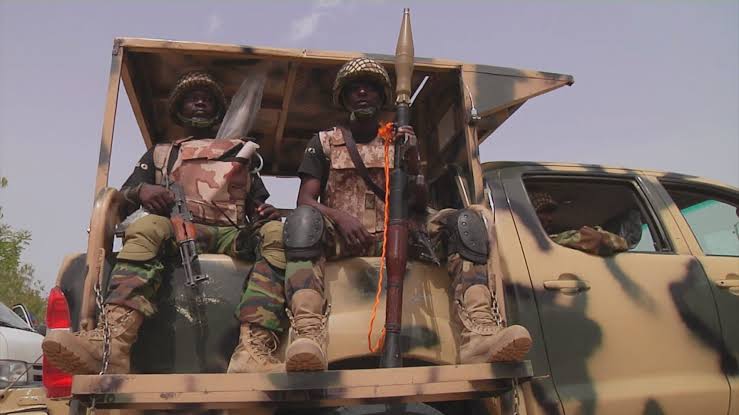
Troops of the 2 Brigade of the Nigerian Army have disrupted an attempt by suspected criminals to siphon diesel from equipment belonging to Sterling Petroleum and Fertilizer Limited in Akwa Ibom State.

This is contained in a statement signed by Lawal Bala Muhammad, a Captain and Assistant Director of Army Public Relations at the Headquarters of 2 Brigade in Akwa Ibom, on March 27, 2026.

The incident occurred at Ukpe Ete in Ikot Abasi Local Government Area after soldiers acted on intelligence about illegal activities around the company’s facility. The troops moved to the location and carried out an operation that led to the arrest of a driver who was transporting the stolen products.

Sources said the situation took a dramatic turn when the troops attempted to return the suspect and recovered items to the company for further questioning. Some youths in the area blocked the road in a bid to free the suspect. They attacked the soldiers with stones and bottles despite efforts by the troops to maintain calm.

The army personnel fired warning shots to disperse the crowd. The action did not bring the situation under control. The confrontation intensified and forced the troops to identify and neutralise the ringleader, who was shot in the leg. He was later taken to a hospital for treatment.

The unrest escalated as the youths reportedly vandalised vehicles, harassed commuters, and attacked trucks belonging to the company along the route.

Reinforcements were later deployed from the Brigade to restore order. After the crowd was dispersed, troops carried out further checks in the area. During the operation, they discovered an unidentified corpse placed beside a coffin. Security personnel moved the body to a mortuary with support from the Nigeria Police Force.

The army said troops have remained in the area to secure the company’s assets and prevent further breakdown of law and order.

In the statement, the military authorities appreciated members of the public for their cooperation. They also assured residents of their resolve to protect lives and property across the state. The public was urged to share useful information with security agencies as investigations continue.

Yilwatda Leads as APC Releases Full National Executive Committee List

By Abdullahi Mukhtar Algasgaini

The All Progressives Congress (APC) has officially released the full list of its National Executive Committee members, with Prof. Nentawe Goshwe Yilwatda confirmed as the National Chairman. The detailed roster, which outlines the party’s leadership structure across various offices, was made public in a recent announcement.

Yilwatda heads a comprehensive team of national officers, supported by Ali Bukar Dalori as Deputy National Chairman (North) and Dr. Benjamin Obi Nwoye as Deputy National Chairman (South). Senator Surajudeen Ajibola Basiru serves as the National Secretary, while Prof. AbdulKarim Abubakar Kana takes on the role of Deputy National Secretary.

The list also includes key appointments across critical portfolios: Murtala Aliyu Kankia as National Legal Adviser, Uguru Mathew Ofoke as National Treasurer, and Amb. Haruna Ginsau as National Financial Secretary. Muhammad Sulaiman Argunu OFR was named National Organising Secretary, while Donatus Enyinnah Nwankpa was appointed National Welfare Secretary.

Felix Morka will continue as National Publicity Secretary, with Sen. Abubakar Maikafi as National Auditor. The party’s demographic representation is led by Dr. Mary A. Idele (National Women Leader), Dayo Isreal Abdulai (National Youth Leader), and Aare Durotolu Oyebode Bankole as National Leader for Persons with Disabilities.

The party also announced deputies for several positions, including Hamman Adamu Ali Kumoo (Deputy National Financial Secretary), Barr. Emeka Okafor (Deputy National Organising Secretary), and Zainab Abubakar Ibrahim (Deputy National Women Leader). Other deputy roles were filled by Hon. Meseko Durosinni Josiah (Publicity), Dr. Christopher Michael Akpan (Welfare), Mr. Olugbenga Olayemi (Auditor), Barr. Ibrahim Salawu (Legal Adviser), Engr. Ben Akak (Treasurer), and Jamaludeen Kabiru (Youth Leader).

Rounding out the executive committee are six National Ex-officio members representing the geopolitical zones: Dr. Opawoye Oluwatoyin Bunmi (North Central), Adamu Jallah (North East), KanoMuhammed Jamu Yusuf (North West), Hon. Ikechukwu Umeh (South East), Mr. Francis Kolokolo (South South), and Hon. Bunmi Orinowo (South West).

The announcement underscores the party’s efforts to solidify its leadership structure ahead of upcoming political activities.

A Wake-up Call to Our Youth

By K.H.M Haladu Muhammad 

As I wrote this article from my point of view on leadership, or what leadership is all about, we already know that leadership is a collective responsibility, not a one-person business. Some may think leadership is only one person’s business or responsibility, that’s the one people elected or chosen to be in the mantle of leadership.

A leader is a servant of the people, meaning that leaders serve the interests and affairs of the state, not their personal interests. Some people think that if a leader is done with some developmental projects or programmes, my fellow youth and citizens think that the government or the leader is privileged; they forget that anything the government has done is our right, not a privilege.

In these points, I would like to call our attention to what values and self-leadership are. Let us take a look at what values are: beliefs and principles that guide someone on how they think, how they act, how they treat others, and how they make decisions.

Values enable leaders to earn respect and trust, make the right decisions, stay consistent under pressure, and lead without fear.

My question is whether there are some core values that we all have, these are: Accountability, commitment, discipline, fearlessness, integrity, respect for others, tolerance, hardworking and timeless.

Please, are you accountable, committed, disciplined, hardworking, and respectful of others? I just selected five of the nine to see whether any of us are practising the core values.

Let us take a look at self-leadership, a process of intentional self-influence that fosters motivation, direction, and continuous personal growth. It’s taking ownership of your thoughts, actions, and development without waiting for external directions. Why I say self-leadership matters as a young person: it allows you to build confidence, enhances autonomy, increases adaptability, and sharpens decision-making.

Are we all practising self-leadership? Please, if we are not, let us start not tomorrow or later, the time is ticking, we should start now.

We should start taking care of our little problems, because leadership starts from our home, school, office, and even up to where you think the so-called leaders are based. Because change starts with you, not others, if we do not change ourselves, we can’t have the leaders we aspire to.

And lastly, who are those leaders? Their people, like me, you, and us, are from the society and community; they’re like you, so if we don’t change our values and practice self-leadership. We should start making nonsense all over social media or at gatherings because we’re the ones producing the leaders we have.

Please let us look at these core values and reflect on some of them. Thank you  

K.H.M Haladu Muhammad wrote from Maru LG, Zamfara State.

Outrage As DSS Detains Taraba Pastor For Weeks Without Charges

Tension is rising in Taraba State following the prolonged detention of a cleric of the Global Methodist Church, Reverend Beziel, who was reportedly arrested by operatives of the Department of State Services (DSS).

Sources within the church said the cleric was taken from his residence in the early hours of February 22, 2026. The arrest reportedly occurred around 2am under conditions described as “shocking and unlawful.”

Concern has continued to grow among church members and residents over the development, especially as no official explanation has been given for the arrest.

According to a report by a Nigerian online newspaper SaharaReporters, a church member, Ruhania Idris, expressed worry over the situation. He stated that efforts to secure the pastor’s release have not been successful.

“Our pastor, Reverend Beziel, was taken from his home in the dead of night by DSS operatives without prior notice or explanation. Since then, he has been held for weeks without any clear charges brought against him,” Idris said.

He also alleged that a payment was made in an attempt to facilitate the cleric’s freedom, but the situation remains unchanged.

“We were made to believe that paying N15 million would secure his freedom, but even after raising and paying the money, he is still in detention. This has left us confused, distressed and feeling completely helpless,” he added.

Idris further revealed that the pastor is no longer in DSS custody. He said the cleric has been moved to a correctional facility in Jalingo, the Taraba State capital. He noted that the transfer has raised fresh concerns about due process.

“He is no longer even in DSS custody; he has been moved to the correctional centre in Jalingo, yet no one has told us what offence he committed. We are in the dark,” Idris said.

The situation has become more troubling after claims that a top state government official distanced the administration from the matter.

“The Secretary to the State Government allegedly told us plainly that he does not know anyone who can facilitate the pastor’s release. That statement has deepened our fears that justice may not be served,” Idris stated.

The development has triggered reactions from religious groups and residents. Many are demanding transparency and accountability from the authorities. They are also calling for clarity on the legal basis of the arrest and continued detention.

Family members and church leaders have appealed to civil society organisations, human rights advocates, and the public to intervene. They want either the immediate release of Reverend Beziel or his appearance in court without further delay.

Kano Deputy Governor Resigns Amid Impeachment Move

By Uzair Adam

The Deputy Governor of Kano State, Comrade Aminu Abdussalam, has resigned from office following recent political developments in the state.

His resignation was announced on Friday in a statement issued by the spokesperson of the Kwankwasiyya Movement, Dr. Habibu Sale Mohammed.

The development comes after the Kano State House of Assembly initiated impeachment proceedings against Abdussalam earlier in the week.

In a related development, a Federal High Court sitting in Kano on Wednesday dismissed an application filed by the deputy governor seeking to stop the impeachment process.

According to the statement, the Kwankwasiyya Movement formally informed the public, the people of Kano State, and the nation about Abdussalam’s decision to step down from his position.

It explained that the resignation, although difficult, was taken in the interest of the people and to ensure stability in the governance of the state.

The statement noted that recent circumstances had limited the deputy governor’s ability to fully discharge the duties and responsibilities attached to his office, making it necessary to allow the position to function effectively for the benefit of the public.

It, however, stressed that the decision to resign should not be interpreted as an admission of the allegations levelled against him by the Kano State House of Assembly.

According to the movement, Abdussalam maintains his innocence and believes that his record in office and public service reflects his integrity and commitment to the people.

The statement further described the resignation as an act of statesmanship intended to preserve peace and prevent political tension that could affect governance and development in the state.

It added that Abdussalam would now focus on strengthening the Kwankwasiyya Movement, particularly by consolidating its structures and strategies ahead of the 2027 general elections.

The movement also urged its supporters and residents of Kano State to remain calm, law-abiding, and committed to democratic values while assuring that further details would be communicated in due course.

WAEC Releases 2026 First Series Results, Reveals 32 Per Cent Pass Rate

Ishaka Mohammed

The West African Examinations Council (WAEC) has released the results of the Computer-Based West African Senior School Certificate Examination (CB-WASSCE) 2026 — first series.

In a statement released on Friday, March 27, 2026, the Council asked the candidates who sat the examination to check their results within a few hoursʼ time.

“The result of CB-WASSCE for Private Candidates, 2026–First Series has been released. Candidates can access their results within the next 12 hours,” part of the statement reads.

The Council also revealed that out of the ten thousand, four hundred and eighty (10,480) candidates that sat the examination, three thousand four hundred and twenty-nine (3,429) candidates (32.72%) obtained credit and above in a minimum of five (5) subjects, including English Language and Mathematics.

However, two thousand and sixty-two (2,062) candidates (19.68%) have a few of their subjects still being processed due to some errors traceable to them. In addition, seventy-five (75) candidates’ results, representing 0.72% of 

The total number of candidates who sat the examination is being held in connection with various reported cases of examination malpractice, which are still being investigated.

The examination, which was held from January 28 to February 14, 2026, was in a hybrid format. All the questions were displayed on the computer, but while the multiple-choice questions were answered thereon, the essay questions required paper-and-pencil responses.

Bandits Raid Katsina Community, Cart Away Valuables Worth Millions

By Sabiu Abdullahi

Residents of Jeri community in Kusada Local Government Area of Katsina State have been thrown into distress after bandits launched a prolonged attack on the area.

The incident, which occurred on March 27, 2026, involved armed men moving from one house to another and looting valuables without interruption for nearly two hours.

Security analyst Bakatsine disclosed the development in a post shared on X on Friday, where he gave details of the attack.

“Bandits carried out a house-to-house raid in Jeri community, Kusada LGA of Katsina State, operating for nearly two hours,” he stated.

During the operation, the attackers reportedly made away with mobile phones, cash, and cattle belonging to residents.

“Phones, cash and cattle worth millions were taken,” Bakatsine added.

Despite the scale of the attack, there were no reported deaths or abductions.

The incident has, however, sparked fresh concerns over security in the area. This comes amid recent efforts by authorities to restore peace in parts of Katsina State.

Bakatsine also pointed out that the attack occurred only weeks after a peace agreement was said to have been reached with bandits in Kankia Local Government Area.

“This incident raises fresh concerns about the effectiveness of the peace deal struck with bandits in Kankia LGA just weeks ago,” he said.

Detained Zaria Cleric Reportedly in Protective Custody Over ₦2m ‘Prayer Money’ from Coup Suspect Amidst Death Rumour

By Abdullahi Mukhtar Algasgaini

Contrary to widespread speculation that he had been killed or had gone missing, Kaduna-based Islamic scholar Sheikh Khalifa Sani Abdulkadir, also known as Sheikh Khalifa Zaria, is alive and being held in protective custody by Nigerian security agencies, PR Nigeria reported.

The cleric, who disappeared earlier in 2026 after traveling to Abuja and having his bank account frozen, is currently being investigated by a joint team of the Nigerian Military and the Department of State Services (DSS). The investigation centers on a transfer of approximately ₦2 million from a military officer implicated as a key suspect in a foiled coup plot against the administration of President Bola Ahmed Tinubu.

According to intelligence sources quoted by the news platform, Sheikh Khalifa’s detention followed the discovery of the funds in his account.

“Sheikh Khalifa is alive and healthy in protective custody. His arrest followed the discovery of funds in his bank account transferred from one of the suspected military officers involved in the attempted coup,” a source disclosed.

However, sources close to the cleric’s family offered a different narrative, describing the transaction as a routine spiritual offering. They claimed the soldier obtained the Sheikh’s account number through a student and sent the money with a request for prayers and blessings , a common practice among religious followers in Northern Nigeria.

“There was no political discussion, no criminal intention, and nothing beyond a request for prayers,” a family source maintained.

Concerns over the wellbeing of Sheikh AbdulKadir have intensified in recent days amid mounting public speculation. A fundamental rights suit filed to demand his release was heard at the Federal High Court in Abuja on February 18 and March 13, 2026. The presiding judge has adjourned the matter to April 10, 2026, for final judgment.

Former Vice President Atiku Abubakar weighed in on Wednesday, calling for the cleric’s immediate release or prosecution. In a statement issued by the Atiku Media Office, he described the prolonged detention as a “grave violation” of fundamental rights and a threat to Nigeria’s democratic principles.

“The continued detention of Sheikh Khalifa without due process poses a significant threat to the rule of law and risks eroding the fundamental rights guaranteed to all citizens,” Atiku said.

He also raised concerns over the authorities’ silence regarding the cleric’s condition, adding that “Nigeria cannot continue to claim the status of a democracy while the rights of its citizens are routinely and brazenly violated.”

Despite the legal and public pressure, intelligence sources insisted that the cleric would remain in custody until the investigation is concluded. “He would soon be arraigned in court for prosecution after the completion of the investigation alongside others,” the official added.