Lagos State

Mohbad: Police declare Primeboy wanted, offer ₦1m for helpful info 

By Abdurrahman Muhammad

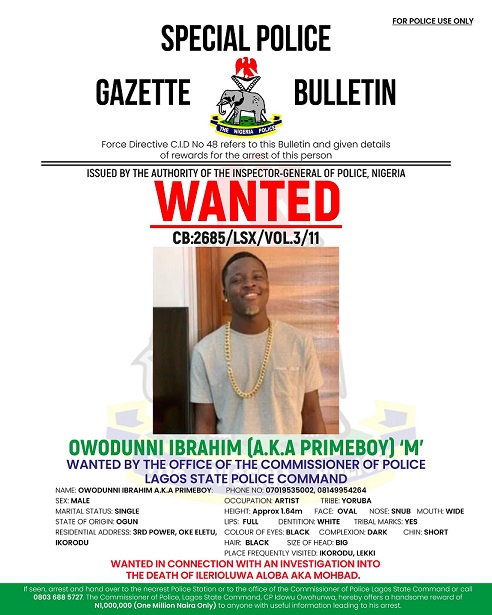
Following his failure to honour the police invitation successfully sent to him since the commencement of investigation into the circumstances leading to the death of Mr Ilerioluwa Aloba, aka Mohbad, the Lagos State Police Command, via its PRO, SP Benjamin Hundeyin, now declares wanted Owodunni Ibrahim aka Primeboy.

Ibrahim is approximately 1.64-m tall, dark-complexioned, with tribal marks and Yoruba by tribe. His last known address is 3rd Power, Oke Eletu, Ikorodu.

If seen, contact the nearest police station or call 0803 688 5727. The Commissioner of Police, Lagos State Command, CP Idowu Owohunwa, hereby offers a handsome reward of N1,000,000 (One Million Naira Only) to anyone with useful information leading to his arrest.

Who is watering the Nigerian grass?

By Bello Hussein Adoto

A few days after someone glibly told me that the grass was greener in Nigeria, a young medical doctor Dr Diaso Vwaere was crushed to death in an elevator accident at the General Hospital in Odan, Lagos State.

Netizens and other persons who have worked at the hospital said they complained about the malfunctioning elevator for years, but the management did nothing tangible to address it. So the young female doctor, with two weeks to complete her housemanship, took the elevator to retrieve a dispatch—a food package—on the ground floor. She never made it.

I imagine her in the elevator anticipating the food she ordered, salivating, getting ready to devour her food, and returning to her busy schedule as a house officer. I imagine her standing on the elevator, weightless, as it moves.

Then it snapped. Suddenly, the metal box is crashing down from the 10th floor all the way to the ground. Imagine her now in the elevator, weightless, as it falls freely. Imagine her grasp at everything and anything, something to break her fall. Then, bam, it crashed. Imagine her now.

What do you think she would have felt? She was trapped in the rubble. The package she was going to retrieve was less of a worry. Her call can wait. The world can wait. Now, she needed freedom, a way out of the rubble. She needed air. The wreckage is choking.

While in the rubble, time trickled. Seconds must have felt like a decade, minutes like forever. Time trickled. One, two, three… 40 minutes. She was there for 40 minutes before help came. She was out, finally. Ahhh, some relief.

Anyone could have been in that elevator. It could have been a patient, doctor, nurse, relative, or even you, my reader. It could have been a visitor, like the state governor or the CMD. Would this incident have made any difference? I wonder.

A consultant once said it’s better to have a heart attack on the streets of London than in the corridors of a teaching hospital in Nigeria, and I thought that was ridiculous. From what I have seen in recent times, he was not wrong. It is not impossible. We are all at our own’s risk.

Those who should provide the basic oversight at the hospital, from government officials to the hospital management and staff, seem to have other businesses than their jobs. That’s why the elevator could be so bad as to take a life before they consider fixing it. Do we need the president, governor, or minister of health to come and fix it too? What happened to the hospital management?

The elevator accident happened at a hospital big enough to have house officers, ten floors, and elevators. It is a big hospital, indeed, by every standard. Yet there was no blood to rescue Dr Diaso. Some said there was no morphine, emergency supplies, or cotton wool. The last part could have been a stretch, but I have seen resident doctors protest that there was no normal saline, which should be as common as sachet water. Yet…

When patients come to hospitals, and these supplies are not available, and they cannot afford them, they turn on the doctors and nurses that are equally helpless. A soldier beat my friend’s wife, a nurse at Sobi Specialist Hospital, some time ago because she asked him to get delivery packs for his wife’s delivery. Last December, patient relatives at the University of Ilorin Teaching Hospital pinned a doctor to the wall. They beat him because they thought their father was dying and he wasn’t helping. Meanwhile, they were asked to do a test they had yet to do.

These incidents happened in tertiary hospitals where we should expect—sorry, hope—that things are better, where supplies were available for patients to use and pay later. But they aren’t. What is the hope of someone in a rural area?

I wonder what would happen if someone fell off a storey building in Obehira, where I grew up, or Ikuehi, my hometown. What would be their fates? They may have to be referred to the recently built Reference Hospital in Okene. Will they fare any better there?

Back to Dr Diaso, the doctor in the elevator accident. She survived the crash but not the injuries she sustained. She was severely injured and needed blood. “There was no blood available for resuscitation,” wrote the Lagos branch of the Nigerian Medical Association. There she was in the hospital. She had spent 11 months and two weeks on calls, attending to patients, saving lives, unable to be resuscitated because there was no blood. She died. She died in the institution where she served.

They say the grass is greener here. Who is watering the grass?

Bello Hussein sent this piece via bellohussein210@gmail.com.

Police arrest man over attempt to use son for money ritual in Lagos

By Uzair Adam Imam

The Nigeria Police Force (NPF) in Lagos State have arrested a fifty-one year-old man, Mr. Poni Bada, for attempting to use his son for ritual.

The man recounted how he lured his 9-year-old child and took him before a habalist to be sacrificed for money rituals because of the rising inflation which resulted to a bitting economic hardship in the country.

The man said he had ten children from three wives but he can not feed himself, let alone feeding them.

He stated that looking at the way things kept changing from bad to worse, he decided to use the 9-year-old kid, Agbe, who is his last child for a money ritual so that he could train the other children and have better living conditions.

However, the child was rescued when a team of policemen from the Zone 2 Command, Onikan Lagos, who acted on intelligence, stormed the herbalist’s shrine and arrested the man and other suspects.

Explaining how he came up with the idea of using his son for money rituals, the father of the boy, Bada, said: “I have 10 children from three wives.

“The situation of things kept going from bad to worse. I could not feed my children. I then decided to use my last child, Agbe, for a money ritual, so that I could train the other children and have better living conditions.

“In May 2023, I left my home town in Jakotome, Benin Republic for Nigeria, to visit my brother, Benjamin Balobi, at Ilaro, Ogun State, who earlier told me he was doing well as a farmer and that the owner of a farmland was looking for labourers.

“That was how I brought Agbe to Nigeria to work. But the thought of using him for a money ritual came up when I realized that the money paid as salary to my son was very poor.

“I told Balobi to help me get a herbalist that would help me with the money rituals; he said he knew no one but promised to help me find a herbalist who might have information on it.

“He informed Ige Koshelu (one of the suspects) who found someone that promised to take us to the herbalist’s place in Sango.

“But we were taken to another herbalist’s place in Owode, where we were arrested,” he stated.

Buhari launches Dangote Refinery in Lagos

By Ahmad Deedat Zakari

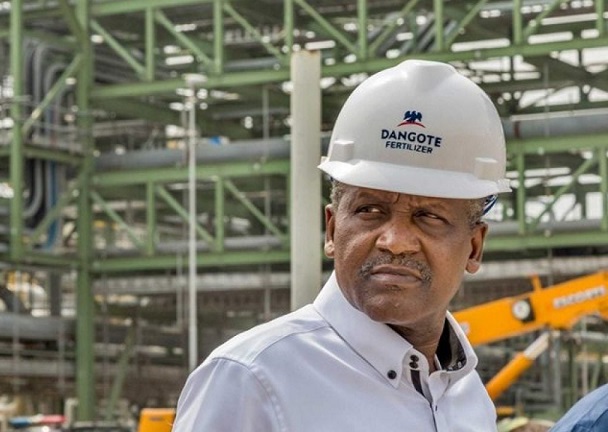
Barely seven days before the expiration of his final tenure, President Muhammadu Buhari launched the long-awaited Dangote Refinery in Lagos. The newly commissioned refinery is the first private-owned oil refinery in Nigeria. 

The President was flanked by many dignitaries from within and outside Nigeria during the unveiling. He described the refinery as a ‘game changer’ for the country’s economy. 

“This clearly makes this event a notable milestone for our economy and a game changer for the downstream petroleum product market not only in Nigeria but the entire African continent,” He said.

The accomplished businessman and owner of the refinery, Alhaji Aliko Dangote, gave the welcome remark at the unveiling ceremony.

He thanked President Muhammadu Buhari for his support and said he was his source of inspiration at times he felt like giving up. 

He also appreciated the Governor of the Central Bank of Nigeria, Godwin Emefiele, for ‘moving mountains’ in the course of the project. 

The billionaire also revealed that the first product of the $12 billion facility “will be in the market before the end of July, beginning of August this year”.

“Beyond today’s ceremony, our first goal is to ramp up production of the various products to ensure that within this year, we’re able to fully satisfy our nation’s demand for higher quality products,” he said.

The Dangote Petroleum Refinery and Petrochemical is the largest single-train refinery in the world and has a capacity of 650,0000 capacity a day.

Lagos: Gun battle erupts as NDLEA chases suspected drug traffickers

By Uzair Adam Imam

There was a gun battle between the National Drug Law Enforcement Agency (NDLEA) and drug traffickers in Lagos that lasted for about thirty minutes on Thursday.

The NDLEA spokesperson, Mr Femi Babafemi, stated this in a statement he issued to journalists on Sunday.

Babafemi added that acting on credible intelligence, NDLEA operatives had laid an ambush on the traffickers along the Eleko Beach road in Lekki and at 4:51 am on Thursday.

He further stated that two long trucks conveying the illicit consignments were flagged down, but rather than stopped, the trucks escorted by armed men sped off, as a result of which there was an exchange of gunfire that lasted 30 minutes

He stated that “After they were overpowered by the NDLEA operatives, the truck drivers and their armed escorts escaped into the bush, abandoning the trucks and the drug consignments.

“While one of the trucks painted red has 149 jumbo bags weighing 6,548kgs, the second one with blue colour has 53 big bags with a weight of 2,304kgd, bringing the total number of bags to 202 and gross weight of both to 8,852kgs.

“Meanwhile, operatives are already on the trail of the drug lord who shipped the illicit consignment into the country,” Babafemi said.

Defiled Muslim minor: MURIC demands justice

  • News Desk

The fourteen (14) year old daughter of an Igbo Muslim, Mallam Tahir Akpan, has been reportedly defiled. The suspect, Emeka Emmanuel, 29, has been remanded in Kirikiri Correction Centre.

But an Islamic human rights organisation, the Muslim Rights Concern (MURIC), has raised the alarm concerning attempts being made by certain people to sweep the matter under the carpet. MURIC has insisted on justice for the family of the defiled Muslim girl.

This was disclosed in a statement issued on Wednesday, April 26, 2023, by the Executive Director of MURIC, Professor Ishaq Akintola.

The statement reads :

“A fourteen (14) year old Muslim girl has been allegedly defiled by one Emeka Emmanuel, 29 of No. 2, Sam Onwudinjo Street, Igbo Elerin, Lagos State. The victim is the daughter of an Igbo Muslim, Mallam Tahir Akpan.  

“Although the suspect has been remanded in Kirikiri Correction Centre by the Family Magistrate Court, Agbo Malu, Ajegunle since 13th April, 2023, we are raising the alarm today because of attempts being made by certain people to sweep the matter under the carpet.

“According to the victim’s father, Mallam Tahir Akpan, from Ini Local Government of Akwa Ibom State, a highly placed individual in Igbo Elerin, Lagos State, has threatened to deal with him for refusing to soft-pedal on the matter. The father also alleged that the culprit’s lawyer also threatened to write a petition against him alleging child abuse.

“MURIC rejects this attempt to arm-twist Mr Tahir Akpan. He is a well-educated, highly enlightened, disciplined and fearless man. The threat to deal with him and to charge him for child abuse is sheer blackmail. How can a sexual abuse complainant be turned into an accused? What kind of justice is that?

“We suspect foul play. We warn that officials involved in this case should not allow themselves to be used in circumventing the law. Any attempt to turn the case upside down will be resisted with every legitimate means available. We want those involved to know that Akpan is not alone. MURIC and all conscious and freedom-loving Nigerians are with him.

“MURIC demands justice for the Akpan family on this case of sexual assault on their underaged daughter. Also, in view of threats issued against the victim’s father, Mr. Tahir Akpan, we warn that nothing should happen to him or any member of his family.

“MURIC is in possession of the medical report which confirms a case of penetration and defilement against the culprit. We therefore warn all those who are making attempts to interfere with the course of justice in this case to steer clear. The Akpan family is fully aware of their Allah-given and fundamental human rights and any attempt to encroach on any aspect of their rights will be rebuffed with the full force of the law.

“Finally, we commend the police in Iba for playing their role professionally and fearlessly. By taking the case to court, the police have proved that they have no skeleton in their cupboard.

“However, it is not over until it is over. There is one more thing the police need to do. We demand full protection for the family, and the onus falls on the Divisional Police Officer (DPO) of Iba Police Station, Iba, to ensure this for Mr Tahir Akpan and all members of his family. MURIC will continue to monitor the situation until justice prevails.”

#JusticeForAkpanFamily

Tinubu: Savouring the triumph of an ageless political colossus 

By Lawan Bukar Maigana

It is now an open secret that the former Governor of Lagos State, Bola Ahmed Tinubu, is now Nigeria’s president-elect. For many who may not know, the erstwhile Lagos Chief Executive is not the typical run-of-the-mill Nigerian politician. 

A master political strategist of no mean repute, Tinubu has never lost an election since he started appearing on the ballot. The lessons in his political journey are enormous and worth studying by contemporary politicians, especially young people who aspire to be leaders of tomorrow. 

Tinubu’s political trajectory depicts the importance of building people regardless of any differences. He built builders, and the builders built him. 

Most people, including some members of his party, had thought that he was not going to win the February 25th presidential election because of some varying factors.

But Tinubu, for a minute, never lost hope. He consistently told people that he was going to win. He candidly said, “it is my turn, and I will win.” These were the songs he sang until he won. 

It is a fact known that most politicians fear the “enemies within”, but the reverse is the case with Tinubu as the Aso Rock cabals in President Muhammadu Buhari’s government fear him. He tackled them and moved on. 

The contribution of the people he built in politics to his emergence as president-elect cannot be overemphasized. 

Hours after he was announced as the winner of the keenly-contested election, he first extended his heartfelt appreciation to the Vice President-elect, Senator Kashim Shettima, and the entire northern governors who gave their best to his ascension to the presidency. 

One of the qualities of a resounding leader is his ability to unite people and carry everybody along. That is what Tinubu started with. He called on all presidential contestants to join him in building a new Nigeria for the betterment of all and sundry. Who has ever done that in the history of our nascent democracy? 

Tinubu’s track record as governor of Lagos is a testimony of his effort for the unity and development of Nigeria. He brought capacity hands outside Lagos for the betterment of his people. He has national spread, unlike his Labor Party rival, Peter Obi, who was largely voted by people of the east and a few from the west. 

Obi, being the governor of Anambra, does not take his state as his permanent residence. He lives in Lagos—a state developed by Asiwaju Bola Ahmed Tinubu. I expect him to calm down his supporters, conceit defeat and join hands with the president-elect to steer the Nigerian project. 

One of the best ways to advocate peaceful coexistence and give people a sense of belonging is by giving protection to the people you govern, regardless of any differences. Tinubu’s house is a good example. He’s a Muslim. His wife and children are Christians. 

Teeming Nigerians have joined Tinubu to savour his electoral victory in the penultimate Saturday’s presidential election. But the President-Elect knows, more than anyone else, that the journey ahead will be rough, bumpy tortuous. 

He, however, should do all that it takes to actualize the visions of his ‘Renewed Hope’ campaign slogan. It is not for anything that many, including his armchair critics, regard him as a political colossus who has greatly paid his dues in helping to entrench democratic governance in Africa’s Giant.

Lawan Bukar Maigana writes from Abuja and can be reached via email: lawanbukarmaigana@gmail.com.

Lagos: Tinubu appeals for peace as hoodlums attack traders over APC’s loss

By Uzair Adam Imam

Bola Ahmed Tinubu, the Presidential Candidate of the All Progressives Congress (APC), has urged the Lagos State people to avoid violence against his loss to Peter Obi, the Presidential Candidate of the Labour Party (LP), in Lagos State.

In Saturday’s presidential elections, Obi defeated Tinubu in Lagos with a total vote of 582,454, whereas Tinubu got 572,606 votes.

Different reports from the state indicated violence in some parts of the state as hoodlums attacked some traders.

However, reacting to the incident in a statement by his Director, Media and Publicity of the APC Presidential Campaign Council, Bayo Onanuga, Tinubu said the defeat should not be a source of violence in Lagos State.

He added, “The fact that the APC narrowly lost Lagos State to another party should not be the reason for violence.

“As a democrat, you win some; you lose some. We must allow the process to continue unhindered across the country while we maintain peace and decorum,” the former governor of Lagos State said.

EFCC to inaugurate Integrity Club in Lagos college

By Ahmad Deedat Zakari

The Economic Financial Crimes Commission (EFCC) is set to inaugurate the Commission’s Integrity Club in a Lagos secondary school.

On Wednesday, the Lagos Command of the EFCC said the inauguration of its Integrity Club in Crescent College, Lagos, is in line with its strategic objectives to continuously enlighten and reorientate the youth about the menace of economic and final crimes commission.

The EFCC made the promise to the students during the former’s visit to the Lagos Command of the EFCC. 

Addressing the students, the Deputy Zonal Commander, Lagos Zonal Command, Emeka Okonjo, urged the students to join the EFCC Integrity Club. He said joining the Club affords them an opportunity to become ambassadors of the Commission in the anti-graft campaign.

He said,  “We want you, the leaders of tomorrow, to join in the campaign against economic and financial crimes and become change agents in your environment, schools, churches and mosques.

“We want you to join hands with us to tell everyone that integrity, honesty and hard work are the sure routes to living a successful life”.

A representative of the school, Shukrah Odunola, expressed profound gratitude to the EFCC for honouring the school invitation, adding that the lunch of the integrity club in the school would go a long way in ensuring that the students “are enlightened on the consequences of corruption in the society and Nigerian as a whole.”

The Harvard University Professor who worked as a bus ‘conductor’ in Lagos

By Muhammad Jameel Yusha’u, PhD

At 2:45 am every day, the first email at HKS comes to your inbox. HKS Daily is a catalogue of information about activities at Harvard Kennedy School. If you miss it for a day, you could miss countless opportunities about conferences, breakfast with guests, working groups, and lectures by presidents, governors, mayors and other leading policymakers from different parts of the world.

When I checked this morning, I saw an event posted by the Building State Capability Project. It was a book talk entitled “They eat our sweat: Transport labour, corruption and survival in urban Nigeria.” The theme was from the title of a book by Daniel Agbiboa, an Assistant Professor of African and African American Studies at Harvard University Center for African Studies. I registered immediately.

I love original research. Daniel’s work is an excellent example of that. The book, which I look forward to reading, was based on his research work at the University of Oxford, where he worked with the late pan-African scholar, Professor Abdulra’uf Mustapha. It was a research project that used participant observation to study the informal transport sector in #Lagos. As a student of public policy, this attracted my attention even more. Many policies are designed without an in-depth understanding of the social, cultural and even political implications of such policies.

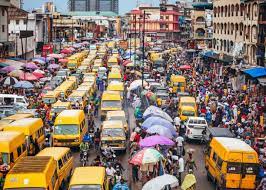
A governor or minister might see the informal transport sector as a nuisance to a modern city. He might bring consultants to hurriedly analyse the problem and come up with a solution. Every person would like to see his city looking like San Francisco, Paris or Dubai. What we tend to forget is that there are thousands of lives that could suffer in our attempt to look modern. Where do we put those people who work as drivers and ‘conductors’ if we don’t have an alternative industry that will absorb them?

To understand this, Professor Daniel went to the field. He became a bus ‘conductor’ for two months, working with a driver, starting early in the morning and absorbing the difficulty that comes with such endeavour. He used his research to understand the difficulty of survival within the informal transportation sector.

He provided a critique to those who use CPI to evaluate countries as corrupt when ordinary people in those countries have completely different realities. “Informal transport not only provides a sector for examining corruption, but also a prism through which to interrogate the binary framing of formality/informality and understandings of the borders (or lack thereof) between the two.” Says Daniela Schofield in a review of the book published on the blog of The London School of Economics and Political Science (LSE).

Takeaway: Developing public policy needs in-depth thinking and proper planning. Building infrastructure is only one part of the story. Managing the effect of policies on people is a much harder task.

Muhammad Jameel Yusha’u, PhD, is a candidate for a Mid-Career Master’s in Public Administration at Harvard University, John F Kennedy School of Government. He can be reached via mjyushau@yahoo.com.