Germany

Japa: Addressing misconceptions on helping young Northerners craving to move abroad

By Dr. Muhsin Ibrahim

Some people accused us (Hausa/Fulani folks living in the West) of not doing enough to bring our own here – as our counterparts from the South do. This is not the first time and will not be the last I heard such accusations. In short, they are baseless.

Years ago, we spent hours giving a webinar on how to get scholarships and jobs in Germany under the Arewa Youth Mentorship Program (AYMP) platform. AYMP has been organising such events for years. I have shared it here and with many people personally. One of them complained that it was too long!

I went to bed last night thinking about the accusation. I almost slept when I felt the need to share a website about working, studying, and living in Germany, which I did. However, see how many people reacted to it (30 as I type this; the one before it has almost 1500). One of the three people who commented on the post asked, “How can I apply”? Click on the darn web link!

Folks, it is not easy to come to Europe or any other part of the world via legitimate means for a gainful job. First, you need to have the required skills or qualifications. Second, you must have either an admission, scholarship, or job contract. Third, you must have a visa.

I swear some of those people we praise for ‘helping’ their own follow dubious means. I know several people working with others’ documents and identities. I have heard of people charging astonishing amounts of money to be others’ guarantors (to come here). I cannot do any of these.

I have shared scholarship and job opportunities countless times and have been mentoring people—directly or indirectly—for years. Some of these folks have made it—Alhamdulillah. However, others haven’t. I cannot satisfy everyone.

Others have disappointed me, thinking I should do everything for them. I cannot recall how often I asked some so-called mentees to collect their academic transcripts or write proposals for applications to do their postgraduate studies abroad. Come on! I have other essential engagements myself.

Upon waking up, seek God’s help and avoid falling for scams out of desperation (the topic I discussed yesterday, though in Hausa).

May Allah help us all, amin.

Dr. Muhsin Ibrahim teaches Hausa Studies at the Institute of African Studies, University of Cologne, Germany. He can be reached via muhsin2008@gmail.com.

Germany partially legalizes cannabis, sparking debate

By Uzair Adam Imam

Adults in Germany will have more freedom regarding cannabis possession and cultivation starting April 1st as the country implements a partial legalization program.

However, the new law comes with limitations and has drawn mixed reactions.

The legislation allows adults over 18 to carry up to 25 grams of dried cannabis for personal use. 

Home cultivation of up to three cannabis plants per person is also permitted, with a maximum storage allowance of 50 grams of dried cannabis at home.

Public consumption is restricted, with smoking banned within 100 meters of schools, playgrounds, and sports facilities and in pedestrian zones between 7:00 a.m. and 8:00 p.m.

Starting in July, Germany plans to introduce a system of regulated cannabis clubs. 

These non-profit organizations will have a maximum of 500 members and can sell a limited amount (50 grams per month) of dried cannabis to each member.

Adults under 21 will face additional restrictions on both monthly amounts and THC content.

Notably, meeting and consuming cannabis within the clubs is not allowed, and membership is restricted to one club at a time.

The government hopes this reform will tackle the black market and associated health risks. 

However, the law has been criticized by medical groups and regional authorities, who worry about public health consequences and implementation challenges.

A second law is planned to test shop or pharmacy sales in specific regions, but the European Union initially opposed this proposal. 

Opposition parties have already voiced disapproval and threatened to overturn the law if they win the 2025 elections.

Germany’s cannabis reform is a work in progress, sparking debate while offering a more regulated approach to the drug. 

Muhabbat to represent Nigeria in international language festival in Germany

By Sabiu Abdullahi 

Muhabbat Yakubu, a student in SS2 at Nigerian Tulip International Colleges (NTIC), has received the prestigious honour of representing Nigeria at the upcoming International Festival of Language and Culture (IFLC) in Germany on May 31st, 2024. 

IFLC, an annual celebration of linguistic diversity and cultural exchange, serves as a beacon of unity, fostering understanding and inclusivity through the universal languages of art, dance, and music.

Originating in Turkey in 2003, the event has since blossomed into a global phenomenon, with participation from 160 countries and over 2000 talented individuals in 2015.

Its mission of promoting peace, love, and friendship resonates deeply in today’s interconnected world. Muhabbat’s selection displays her exceptional cultural awareness, linguistic talents, and dedication to promoting harmony through language and culture.

Under the guidance of NTIC, she will showcase Nigeria’s rich heritage on the international stage, embodying the spirit of unity and cooperation that defines IFLC. 

Mr. Fayzullah Bilgin, the Managing Director of NTIC, expressed pride in Muhabbat’s achievement, noting the school’s commitment to nurturing global citizens who embrace diversity and champion inclusivity.

As Muhabbat prepares to represent Nigeria with distinction, she carries the hopes and aspirations of her nation, symbolising the power of youth to build bridges of peace and understanding. 

According to a report by the National Television Authority (NTA), the NTIC community extends its heartfelt congratulations to Muhabbat Yakubu and wishes her every success as she prepares to shine on the global stage at the International Festival of Language and Culture in Germany.

German government rejects “genocide” allegations against Israel at UN court

By Uzair Adam Imam 

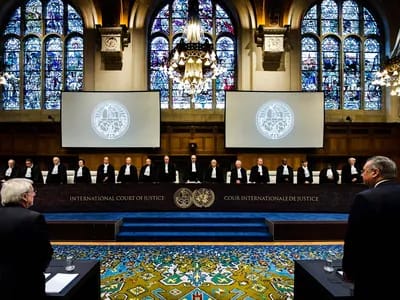
The German government strongly dismissed accusations of Israel committing “genocide” in Gaza during a statement on Friday at the UN’s top court. 

Government spokesman Steffen Hebestreit stated that Israel was “defending itself” in response to “inhuman” attacks by Hamas on October 7. 

Hebestreit highlighted Germany’s commitment to the UN Genocide Convention, showing its significance in preventing another Holocaust. 

He firmly rejected any “political instrumentalization” of the Convention and acknowledged varying international opinions on Israel’s military operation in Gaza. 

The statement clarified Germany’s position, decisively rejecting the accusation of genocide against Israel brought before the International Court of Justice (ICJ). 

Hebestreit announced Germany’s intention to intervene as a third party under an article allowing states to seek clarification on the use of a multilateral convention. 

South Africa initiated an emergency case at the ICJ, alleging Israel’s breach of the UN Genocide Convention and urging an immediate halt to the Gaza campaign.

Israel and the United States have dismissed the case, promising a robust defence. 

While Germany maintains its historical responsibility for the Holocaust and supports the state of Israel, recent criticism has emerged regarding the Israeli campaign’s impact on civilians. 

Foreign Minister Annalena Baerbock stressed the need for “less intensive” combat and increased aid flows.

The hidden reality of life in Europe

By Aminu Mohammed

This article was inspired by a recent post by Dr Muhsin Ibrahim on Facebook regarding money belonging to someone named “Hassan Idris” sent through his PayPal account. Muhsin made the post asking the person to identify himself by sending him a message. However, soon after, he was inundated with messages from people seeking help in various forms. Some even asked him for money, assuming he had won a lottery or had ample cash stocked somewhere.

This issue not only worried me but also made me sad about the attitude of our youths. So that you know, I also live in Germany. I am yet to fathom the reason for the sudden influx of requests based on a Facebook post. Is it desperation, greed, ignorance, or the belief that money grows on trees in Europe?

I have thought about this issue and wondered why this behaviour occurred. Is it that the economic situation in the country has impoverished a large segment of society, making people desperate and in dire need of free money? What could be the reason behind this attitude?

I want to make it clear that I am aware of the difficult economic situation in Nigeria due to inflation and other factors. I also understand that there are genuine people who are in dire need of help and who reach out to Muhsin for support. However, I want people to know that just because Muhsin lives and works in Germany, it does not mean he is rich.

The Untold Story About Europe

Europe is often seen as a paradise with streets paved with gold and abundant wealth. However, the reality is different. Life in Europe is not as easy as it seems. Homelessness and begging are common in countries such as France, Italy, the Netherlands and the United Kingdom. In London alone, at least 167,000 people are homeless due to the high cost of living. Comparably, a great number of immigrants, among them Africans, are stuck in Europe and unable to return home because they are afraid of what is ahead.

 Although the standard of living is high in Germany and the government provides stipends for jobless citizens, there are still poor people, beggars and homeless people in the country. In my former city, Kiel, I have seen people sleeping in public buildings and bank corridors, even during the harsh winter months. I recently saw a naked woman amongst the homeless folks at the Hamburg Central Station, probably suffering from mental illness. It was heartbreaking.

Despite these challenges, there are still opportunities for people with relevant skills to excel and succeed in Europe. Even without a university education, one can live a good life in Germany by being disciplined and hardworking.

Rising Living Expenses

The ongoing war between Russia and Ukraine has brought about significant economic changes in Europe, particularly in Germany. As a result of Germany’s reliance on Russia for affordable energy, particularly gas, to power its numerous industries, the country has been severely impacted. Germany had to look for alternative gas sources, mainly from Norway and the Middle East. This has led to an increment in energy costs and subsequently affected the cost of living and production.

The high cost of living has affected many families, with numerous individuals struggling to pay their bills monthly. The rat race has worsened, and many people live paycheck to paycheck. Groceries and the prices of other goods have doubled or, in some cases, even more. This is in addition to an increase in rent, energy, water bills, etc.

2024 Goals

It is an incredible experience to step out of your comfort zone and explore new places in life. However, before travelling to any country, please conduct thorough research and set reasonable expectations. Life is not always easy, but you can succeed with diligence, perseverance, and hard work.

Set your goals for this year, and take concrete steps to achieve them. Additionally, aim to acquire new digital skills to increase your earning potential. I wish you the best as you enter the New Year with renewed energy and determination.

Aminu Mohammed wrote this article from Ingolstadt, Germany. He can be reached at gravity23n@gmail.com.

Man accused of murdering own 100-year-old grandmother in Hamburg

By Muhammadu Sabiu 

A shocking case of alleged homicide unfolded in Hamburg, Germany, as a 37-year-old man faced trial for the brutal murder of his 100-year-old grandmother. 

The accused, a German native born in Estonia, appeared in court on Thursday to answer the grave charges against him. 

The prosecution’s case revolves around the accused’s inability to care for his elderly grandmother, who was 100 years old and suffered from dementia.

The prosecuting lawyer emphasised this point in court, stating, “He could not cope with looking after her.” The horrifying incident took place in the early hours of March 6, when the accused reportedly launched a vicious attack on his defenceless grandmother inside her Hamburg home. 

The elderly woman, struggling to fend off her assailant while sitting in a wheelchair, endured a harrowing assault. 

According to the prosecution, the victim suffered at least 16 blows to her head and neck during the violent encounter. The brutal attack resulted in her falling to the ground, sustaining a broken shoulder, and ultimately succumbing to spinal injuries. 

The accused, in a chilling turn of events, took it upon himself to alert emergency services to the grisly act he had committed. When the police arrived at the scene, they discovered the lifeless body of the 100-year-old woman.

Remarkably, the man offered no resistance and surrendered himself to the authorities without incident. 

As the trial unfolds in the northern German city of Hamburg, the court will delve further into the circumstances surrounding this tragic incident.

The accused faces a charge of homicide, and the legal proceedings will determine his guilt or innocence in the murder of his own grandmother.

Return to Forever: African Studies in Europe

By Prof. Abdalla Uba Adamu

Frankfurt, Germany. 3rd July 2013

The German immigration officer looked at me and gave the usual clenched-mouth smile. I did the same. I am used to it. He flipped through my passport and then looked up.

“How many days are you staying THIS time.” Emphasis on THIS.

“Two days in Cologne”, I replied. “Today, tomorrow, and the day after that, I am off.”

He stamped the passport without asking for the usual – return ticket, invitation, hotel booking – all of which I had. He wished me a pleasant say and waved to the next person behind me.

I was then in Cologne to attend the valedictory retirement conference held in honour of the woman who mentored me and virtually adopted me as her son – Heike Behrend, who was retiring from the Institute of African Studies, University of Cologne, Germany, where she was the Director. She created the research category of “Media and Cultural Communication”, and I was the first African to be invited to deliver a lecture at the cluster. The Immigration Officer’s reference to the length of my stay was in response to the numerous times I had been to Germany – and never stayed beyond the time necessary for whatever it was that brought me.

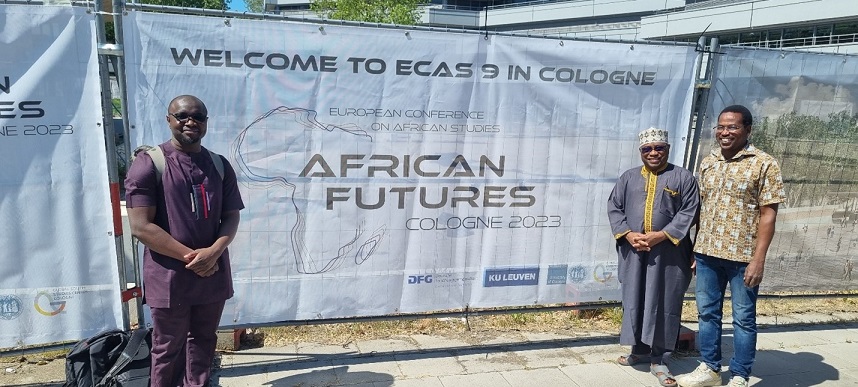
The week from Tuesday, 30th May to Sunday, 4th June 2023, I returned after ten years. This time, the occasion was to attend ECAS2023: 9th European Conference on African Studies, with the theme of “African Futures.” It was hosted by the University of Cologne. “African Futures” explores the continent’s critical engagements with the past, present, and future of Africa’s global entanglements. ECAS is the largest and most visible single event under the AEGIS umbrella. AEGIS is an expression of a much wider and dynamic set of African Studies connections, collaborations, activities and opportunities within and beyond Europe. The conference, lasting four days, had over 70 panels involving hundreds of papers and speakers. All were efficiently coordinated through the various classes at the University of Cologne.

Earlier in the year, I and colleagues from Germany and US had submitted a panel, “Digital/social media and Afrophone literature”, for consideration at ECAS 9. It was accepted.  The conveners were me (BUK), Uta Reuster-Jahn, Umma Aliyu (Hamburg) and Stephanie Bosch Santana (UCLA). Before submitting our panel to ECAS, we first held an online symposium which was preceded by a call for papers. Despite sending the CfP to various universities and the Nigerian Academy of Letters (NAL), the response was pretty poor. The symposium was titled Social Media as New Canvas, Space and Channel for Afrophone Literatures. It was eventually held online at the University of Hamburg, Germany, on 22-23 February 2023. The participants then were from Germany (Uta Reuster-Jahn, Umma Aliyu Musa), Nigeria (Abdalla Uba Adamu, Zaynab Ango, Ado Ahmad Gidan Dabino, Nura Ibrahim, Asabe Kabir Usman, Isyaku Bala Ibrahim), Tanzania (Hussein Issa Tuwa, Zamda Geuza), Ghana (Nikitta Dede Adjirakor), Stephen Ney (Canada), US (Stephanie Bosch Santana).

After the symposium, we submitted a panel for the ECAS 9th edition. Our panel was accepted, and all the participants of the online seminar were issued official letters of invitation to process their funding for the conference in Cologne in June 2023. As a panelist, I was fully funded to attend by Deutsche Forschungsgemeinschaft (German Research Foundation, DFG). Umma and Uta were able to sponsor themselves from Hamburg. Unfortunately, only Nikita from Ghana was able to come from the others who could not get any funding. As a result, our panel, held on Wednesday, 31st May 2023, had only four speakers. It was déjà vu all over again – after almost 24 hours of flying and waiting at airports (Kano, Abuja, Doha), I was given only 20 minutes for the presentation.

My paper was “From Kano Market Literature to Kano Social Media Literature: The Reincarnation of an Afrophone Literary Genre.” The paper traces the trajectory of the genre from print media to its liberation in online media, with a specific focus on Facebook, Wattpad and APK files on Google Play. The paper uses netnographic methodology to harvest the dominance of and reaction to the newly reincarnated genre, which, far from being dead and buried, is more than ever before, alive and kicking in other spaces – beyond censorship or any form of criticism. In the process, the paper explores the freedom gained by the authors in unrestricted storylines that cross boundaries of identity, gender and alternative sexualities.  The Journal of African Literature Association (curated by Taylor and Francis Group) has agreed to publish the papers of the Symposium in 2024. We will have to ask for more contributors.

Another dividend for me was that I was approached by a representative of Lexington Books in the US for the possibility of publishing my paper as part of a book on Hausa media cultures if I have something like that. As it happened, I have almost completed such a project titled “Hausa Cinema” (to complement Jonathan Haynes’s book, “Nollywood”) which was to be published by the Ohio University Press in 2010, but things went southwards! Now Lexington Books is providing an opportunity, and I am excited about it.  

Our panel was lively, though, and I even met a fan! He was Jos Damen, Head of the Library and ICT Department of the African Studies Centre at the University of Leiden. While I was making my presentation, he took my picture with his phone and uploaded it to my Wikipedia page (itself created by another fan)! Later he told me I needed to have a picture there, and he took that responsibility. So it was kind of him!

The conference attendance was a fantastic homecoming for me because although Heike Behrend had retired back to Berlin, where she came from (and where I visited her in 2015 had a wonderful dinner when I was a guest of the Haus der Kulturen der Welt, Berlin), Muhsin Ibrahim is now in the same institute. Both Muhsin and I were from Bayero University Kano. Muhsin was teaching Hausa at the Institute.

I first came to Cologne in 2004 – at the invitation of Heike Behrend when I met her in Kenya. At that time, I had an invitation to participate in an African Literatures project at Johannes Gutenberg University, Mainz. Heike asked me to reroute my itinerary to stop at Cologne, teach a Postgraduate class and give a public lecture. I did both on Monday 15th November 2004. Since then, I have almost lost count of the times I visited Germany – Berlin, Freiburg, Hamburg, Leipzig, and the wonderful Cologne with its incredible, massive and stupendous cathedral – the largest Gothic church in Northern Europe. It was in Cologne in 2004 that the foundation of my ethnographic foray into critical media studies was laid. Unlike in Nigeria, where many saw me as an ‘interloper’ (as they murmur, ‘After all, he is a Biologist, isn’t he?’), here it is not what you study but what you can contribute to any discipline. I have been to Colone four times and other cities several times – all on the same mission of promoting Hausa media studies.

ECAS 2023 started wonderfully with Muhsin meeting me at the Koln Hauptbahnhof and helping me drag my luggage through various concourses to the trains that would take us to his flat: a very lovely well-furnished, and very spacious space. Upon arriving and freshening up, a massive mountain of uncharacteristically fat masa was waiting for me. Even the masa looks like a ‘Bajamushiya’! The soup alone could feed a family for a week! It was a truly delicious welcome. Once I got rid of the hunger, he took me to my hotel, IBIS Centrum.

Breakfast in the morning at the hotel saw a meeting of Who-is-Who in African studies – both diasporic Africans, home-based Africans and European and American researchers. It was indeed a wonderful gathering. In addition, I had a chance to reconnect with one of the most promising diasporic Hausa African Studies experts – Musa Ibrahim.

Musa is based in Ghana. He travelled there through South Africa and Japan, ending up in Bayreuth, Germany, where he obtained his doctorate. We met at Leipzig in 2018, and I collected his CV with the hope of getting him employed in our Information and Media Studies department, Bayero University Kano. However, the university was not interested. Before you knew it, he was grabbed by the University of Florida, Gainesville, where he spent about three years before getting another appointment at the University of Ghana. Such rich and varied experience would have been valuable to us in Kano, but the parochialism of our university system did not factor in multidisciplinarity.

The following day saw dinner at Muhsin’s house, and this time, Umma Aliyu, originally from Bauchi, joined us. Umma now lives and teaches in Germany at the University of Hamburg (after her studies at Leipzig). Like Muhsin, she also teaches Hausa at Hamburg, where she took over from Joe McIntyre (Malam Gambo), who retired some time ago. During dinner, we brainstormed the idea of two book projects – which, for me, was one of the significant takeaways from ECAS9.

Muhsin, Abdalla and Musa at ECAS9, Cologne

The first book project would be tentatively titled “Hausa Studies in European Diaspora: Experiences and Perspectives.” This will be a collection of chapters written by Hausawa living and working permanently in various European universities, either teaching Hausa or other disciplines.  The objective is to demonstrate how internationalised Hausa scholarship is. We started with about five in Germany alone.

The second book project would be a post-Boko Haram narrative. So far, the Boko Haram literature has focused on the human disaster of the insurgency – virtually all books written were from the governance, security and disaster perspectives. Yet, much success has been and is being recorded in the war against terror in the form of surrenders, deradicalisation and reintegration. Yet, no one is looking at this. Using ethnographic field data, the book project will provide another side of the war on terror in Nigeria. We were excited and promised to work on various draft proposals before embarking on the works, which we hope will be completed by 2025.

The Conference’s overwhelming focus on the multidisciplinarity of African Studies was an eye-opener—no room or time for a narrow perspective on scholarship. No one cares about what your degrees are in – what matters is what you are bringing to the table NOW and how it impacts the knowledge economy of African societies and contribute to the decolonisation narrative.

For me, Cologne is a Return to Forever – the beginning of an endless loop of research and investigation.

My deepest thanks to Muhsin for being such an excellent, graceful host.

Thomas Tuchel set to replace sacked Bayern Munich Manager

By Muhammadu Sabiu 

Thomas Tuchel, a former manager of Chelsea and PSG, is about to be named the new Bayern Munich head coach.

Football transfer guru Fabrizio Romano made this known on Thursday night.

He reports that a complete deal is in place and that Tuchel has already accepted the position.

Romano wrote in a tweet: “Exclusive news confirmed: Thomas Tuchel becomes new FC Bayern head coach, full agreement in place. He has already accepted the job.

“Contract agreed, documents are being prepared tonight.”

German man sued for having too many barbecues

By Abi Carter

A 75-year-old man from the town of Bad Tölz in Bavaria has successfully sued his neighbour for causing a bit of a stink by lighting his barbecue with unusual irregularity. As RTL reports, the two men live in the same apartment building in the small town, and the one in the upstairs flat began to get frustrated with his neighbour, who apparently took to grilling food on an electric barbecue on his terrace almost every single day. 

The smoke and rising smell became “unbearable” for the upstairs pensioner, who was named by RTL as Heinz J. Together with his wife, he reported his neighbour to the local authorities, and the case ended up in court. 

While the first court threw out the complaint, the plaintiffs appealed and a second district court in Munich – after hearing testimony from around a dozen witnesses about the smell and smoke caused by the grill – eventually sided with the couple. 

The court has ruled that the downstairs neighbour is only allowed to light up his barbecue four times per month and added that he is not allowed to grill two days in a row on the weekend. If he does not comply, he risks being slapped with a 250.000-euro fine. 

Source: iamexpat

My Journey to Kassel (Documenta Fifteen): Lessons for Nigeria’s waste management

By Ibrahim Uba Yusuf

Since I arrived in Germany to complete the last lap of my PhD studies, I intended to start a travelogue on cultural shock. Unfortunately, my quest suffered a setback for two reasons. Firstly, I have a tight working schedule for writing my thesis on the Culture Industry (Hausa home videos) and their contribution to peacebuilding in northern Nigeria. Therefore, dealing with various raw data, literature, doctoral colloquium, and conferences was overwhelming. Secondly and sadly, I lost my stepmother Hajja Aishatu (may Allah have mercy on her soul), who has cared for us, including our aged father, since my mother died in 2002. Her death threw me into a state of confusion and thus compelled me to suspend it.

Now to the issue: the journey to Kassel. It was Eid-el Adha globally. Since it is not the first time I am experiencing Sallah outside Nigeria, I envisaged it would be dry. So, after observing the two voluntary Eid Prayers at about 6:10 am (German time), I proceeded to Hauptbahnhof (the central train station). The journey is about an hour on the ICE train (the fastest train in Germany) and about three hours on regional trains (which are slow but relatively cheaper) from Hildesheim. The journey to Kassel marks the end of a week-long UNESCO Symposium on Artistic Interventions in educational and social contexts organised by the UNESCO Chair, Professor Julius, who doubles as my German Supervisor.  

Documenta is one of the largest art exhibitions in Germany, which started in Kassel in 1955 with the sole aim of displaying a variety of contemporary artworks such as sculpture, film, photography and painting, among others. Held every five years, this is the fifteenth edition of the International engagement for arts. During the walk to various exhibition stands, I became interested in the open cinema in Karlswiese. This is due to my bias in broadcasting and film studies. The open cinema, a work by The Nest Collective, is tagged ‘Return to Sender—Delivery Details 2022’. It was locally constructed from dystopian waste to mimic the Global North. The dystopian waste was carefully packaged to serve as acoustic panels for the cinema walls to control external noise and echo.

In all honesty, this is my first time seeing such an amazing innovation. Scraps of electronic devices imported to the Global South were packaged and displayed for exhibition. The message embedded in this tag, ‘Return to Sender’, of course, suggests the frustration by the Global North and the radical position taken to mitigate not only importation but waste management. This dystopian waste introduces a new alternative to the existing acoustic panels in our television and radio studios, which is economical and easy to construct. In contrast to other acoustic panels, the installations offer a better aesthetic and sound control. I strongly recommend this innovation to our local cinemas (viewing centres), public and private broadcast stations, and Departments of Mass Communication and Performing Arts. I am not unmindful of the digitisation drive. While we continue the digitisation plan, I believe this can serve as an alternative that may be attuned to the sustainability discourse.

Unfortunately, Nigeria is among the countries with poor waste management. The Environment Performance Index (EPI) 2022 ranked Nigeria 168 out of 180 countries. Also, a United Nations Industrial Development Organization report shows that Nigeria produces 32 million tonnes of waste annually. With this record, Nigeria stands a chance of changing the negative discourse on environmental health, hygiene and sustainability.

Nigerians must change their nonchalant attitude toward indiscriminate waste disposal. As I write this article, one of my greatest challenges living in Germany is separating the waste into the appropriate trash cans. In Germany, paper, plastic and organic bio-waste are separated. Waste separation is comprehensive and taken seriously by both Germans and the government.

 While there is no Recycling Plant in the country, all those Baban Bola (scavengers) can be utilised and strengthened to ensure a clean environment. The services rendered by those people deserve special recognition. We must begin this campaign from our homes, schools, worship places, media and markets. Nigeria deserves to be clean.

Ibrahim Uba Yusuf wrote from Germany and can be reached at itsibrahimsite@gmail.com.