Genocide

Matthew Miller: Israel has ‘without doubt’ committed war crimes in Gaza

By Muhammad Abubakar

Matthew Miller, former spokesperson for the U.S. State Department under President Joe Biden, has said Israel has “without doubt” committed war crimes in Gaza.

In a recent interview, Miller pointed to the targeting of civilian infrastructure, the high civilian death toll, and the ongoing blockade as clear violations of international law. His remarks mark a significant departure from the official U.S. position, which has largely avoided directly accusing Israel of war crimes.

Miller’s comments come as independent investigations into alleged violations by Israeli forces continue. He also criticized the Biden administration’s support for Israel, warning it risks enabling serious breaches of humanitarian law.

Spain urges sanctions against Israel amid Gaza humanitarian crisis

By Muhammad Abubakar

Spain has called for international sanctions against Israel following its ongoing military campaign in Gaza, which has led to heavy civilian casualties and a worsening humanitarian situation.

At a high-level summit in Madrid, Spanish Foreign Minister José Manuel Albares proposed suspending the EU’s cooperation agreement with Israel, imposing an arms embargo, and targeting top Israeli officials with sanctions. 

Mr Albares also called on world powers to recognise the State of Palestine as a step toward peace.

Spain has joined South Africa’s case at the International Court of Justice, accusing Israel of genocide, further escalating diplomatic pressure. 

Meanwhile, public protests across major Spanish cities have amplified demands for an end to arms sales and more decisive action against Israel.

UK, France, and Canada condemn Israeli military escalation in Gaza, threaten sanctions

By Muhammad Abubakar

The leaders of the United Kingdom, France, and Canada issued a joint statement today strongly condemning the Israeli government’s continued military operations in Gaza and its denial of humanitarian aid to the besieged population.

In the statement, the three nations called the humanitarian situation in Gaza “intolerable” and labelled Israel’s limited allowance of food into the territory as grossly inadequate. They urged the Israeli government to halt its military offensive immediately and allow unimpeded delivery of humanitarian aid, in cooperation with the United Nations.

The leaders also called on Hamas to release the remaining hostages held since the October 7, 2023, attack on Israel, while affirming Israel’s right to self-defence. However, they described the ongoing Israeli response as “wholly disproportionate.”

The statement strongly criticised the Israeli government’s use of inflammatory rhetoric and warned that permanent forced displacement of Gaza’s population would constitute a breach of international humanitarian law.

The three countries also voiced strong opposition to the expansion of illegal Israeli settlements in the West Bank, stating such actions undermine prospects for a viable Palestinian state and threaten regional security. They pledged to take further actions, including potential targeted sanctions, if the situation does not improve.

The joint statement expressed support for current ceasefire efforts led by the United States, Qatar, and Egypt, and emphasised the need for a long-term political solution. The leaders stressed their commitment to a two-state solution. They highlighted the upcoming June 18 international conference in New York, co-chaired by Saudi Arabia and France, as a key moment for advancing peace.

“We are committed to recognising a Palestinian state as a contribution to achieving a two-state solution,” the statement concluded, reaffirming their readiness to work with international partners to bring stability to the region.

Smotrich: Gaza aid meant to avoid war crimes charges, not alleviate suffering

By Muhammad Abubakar

In a controversial address on Monday, Israeli Finance Minister Bezalel Smotrich openly acknowledged that the limited humanitarian aid allowed into the Gaza Strip is intended not to alleviate civilian suffering but to shield Israel from international war crimes accusations.

Smotrich declared that Israel is “annihilating everything that remains in the Strip,” describing Gaza as “one big city of terror.” He said the provision of minimal aid — such as “a few bakeries distributing pitas” and “a daily portion of cooked food” — serves a strategic purpose: maintaining global political cover. “It allows the world to continue providing us with international protection,” he asserted.

Smotrich defended Israel’s ongoing campaign of widespread devastation, describing it as a shift from targeted raids to full-scale occupation. “No more raids with ins and outs… we are conquering, clearing, and staying until Hamas is destroyed,” he said.

The minister praised the military’s intensified focus on Gaza’s civil infrastructure, noting that the Israel Defence Forces (IDF) is now targeting the administrative apparatus of Hamas, including ministers, civil servants, and the economic networks.

Boasting of the level of destruction inflicted on the enclave, Smotrich said, “We are dismantling Gaza, leaving it in ruins with unprecedented destruction, and the world still hasn’t stopped us.” He went further, expressing support for a complete blockade of essential services: “Until the last of the hostages returns, we should also not let water into the Gaza Strip.”

Perhaps most alarmingly, Smotrich appeared to endorse forced displacement, stating: “The population will reach the south of the Strip, and from there, God willing, to third countries, as part of President Trump’s plan.”

His remarks have sparked renewed concern over the humanitarian situation in Gaza and raised serious questions about the legality and morality of Israel’s ongoing military strategy.

Pro-Palestine activist Momodou Taal leaves U.S. amid deportation threats

By Muhammad Abubakar

Momodou Taal, a British Gambian pro-Palestine activist and former Cornell PhD student, has left the United States due to deportation threats. Following his lawsuit against the Trump administration over executive orders targeting pro-Palestinian activism, Taal faced mounting pressure, including visits from ICE agents and visa revocation.

In a statement on social media, Taal expressed gratitude to his supporters but voiced his loss of faith in the U.S. legal system, stating, “I have lost faith I could walk the streets without being abducted.” He criticized both the government’s actions and the silence surrounding the situation in Palestine.

Taal remains committed to the cause, declaring, “As sad as I feel right now, I do not despair. History will absolve us.” He is confident that the fight for justice will lead to the liberation of Palestine.

Israeli soldier reveals he was ordered to use Palestinians as human shields in Gaza

By Muhammad Sulaiman

An Israeli soldier has told CBS News that he was ordered to use Palestinian civilians as human shields during military operations in Gaza. 

The soldier, identified by CBS as “Tommy” (not his real name), detailed how his unit was instructed to force civilians into dangerous situations to protect Israeli troops.

“We’ve burned down buildings for no reasons, which is violating the international law, of course,” he told CBS News. “…And we used human shields as protection.”

Tommy said his commander ordered his unit to use Gazan civilians to search buildings for explosives instead of dogs.

“They were Palestinian,” he said. “We sent them in first to see if the building was clear and check for booby traps…They were trembling and shaking.”

The allegations add to growing concerns over Israel’s conduct in its ongoing military campaign in Gaza. Human rights organizations have long accused the Israeli military of violating international law, including the use of civilians in combat zones.

The Israeli Defense Forces (IDF) have denied such practices, insisting that they operate within legal and ethical guidelines. However, Tommy’s testimony raises serious questions about Israel’s adherence to international humanitarian law.

Al Jazeera journalist Hossam Shabat killed in Israeli airstrike in Gaza

By Muhammad Sulaiman

Al Jazeera journalist Hossam Shabat was killed in an Israeli airstrike in northern Gaza shortly after reporting on the death of his colleague, Mohammed Mansour.

Shabat’s car was bombed on Sunday, marking yet another fatal attack on media workers in the besieged Palestinian territory.

Shabat had just posted about Mansour’s killing when he himself became a victim of Israeli bombardment. His death adds to the growing toll on journalists in Gaza, where at least 208 media workers have been killed since Israel launched its military offensive on October 7, 2023.

The targeting of journalists has drawn widespread condemnation, with press freedom organizations calling for accountability and urgent protection for reporters covering the war.

Al Jazeera has repeatedly accused Israel of deliberately targeting its journalists, a charge Israel denies.

The ongoing war in Gaza has led to unprecedented casualties among civilians and media professionals, raising concerns over press freedom and the safety of journalists in conflict zones.

BREAKING: Israel launches new ground offensive in Gaza

By Hadiza Abdulkadir

Israel has launched a fresh ground offensive in Gaza, targeting key areas amid escalating violence. The Israeli military described the operation as a “limited ground offensive” aimed at securing strategic zones.

The assault follows intense airstrikes that have killed hundreds of Palestinians, including women and children, and damaged civilian infrastructure. The renewed fighting has shattered a fragile ceasefire, with Prime Minister Benjamin Netanyahu vowing to continue until Hamas is dismantled.

International leaders have expressed concern over the growing humanitarian crisis, urging restraint to prevent further civilian casualties and displacement.

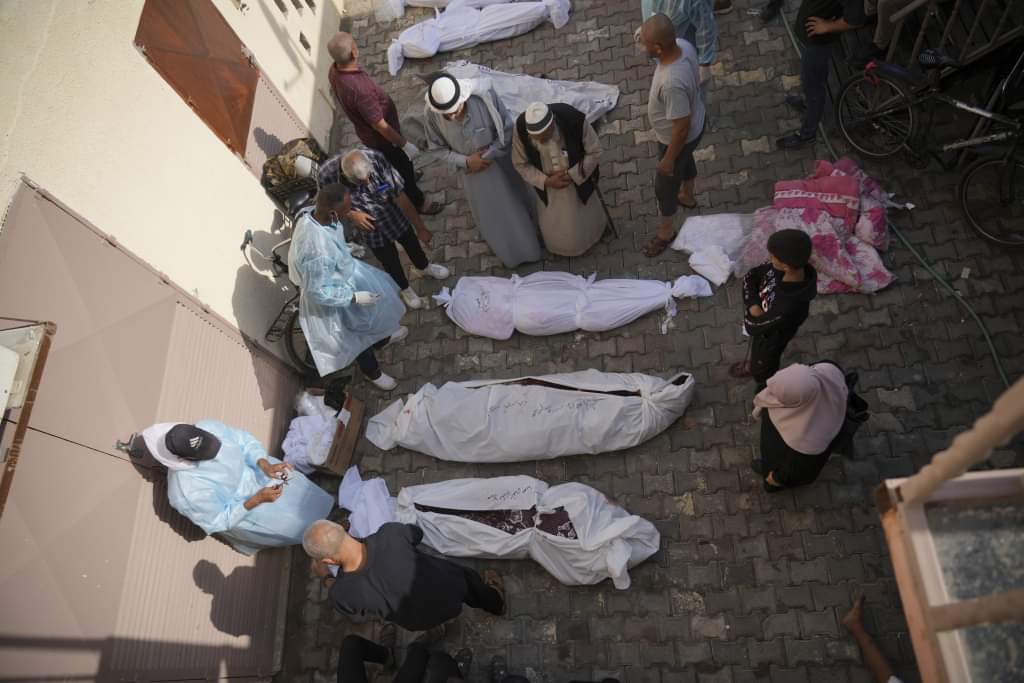
Israeli authorities withholding over 665 Palestinian bodies, some for decades

By Maryam Ahmad

Israeli authorities are reportedly holding at least 665 Palestinian bodies, many of which have been buried or stored in refrigerators since the 1960s, according to the National Campaign for Retrieval of Bodies. 

The campaign reveals that the bodies include individuals who were killed in past decades, as well as those who lost their lives as recently as last week.

The practice of withholding bodies has sparked widespread condemnation from Palestinian families and human rights groups. 

Relatives demand the return of their loved ones for proper burial, while critics argue the act is a violation of fundamental humanitarian rights.

Israeli authorities have not publicly addressed the full scope of the issue. Still, it is believed the bodies are kept for security or political reasons, with some allegedly buried in unmarked graves or stored in cold storage.

Human rights organisations have called for the immediate return of the bodies and demanded accountability for what they describe as an ongoing violation of human dignity.

Israel-Hamas war: Has diplomacy failed?

By Hajara Abdullahi

The long reoccurring war between Israel and Palestine spans decades which can be traced to the Balfour Declaration of 1917  that led to the creation of a national home in Palestine for the Jewish people fleeing the Nazi Holocaust in Europe. After the creation of the zionist state in 1948, the Arab states went to war with Israel, which led to the first Nakba (Catastrophe) that led to the killing of hundreds of Palestinians and thousands of others fled their homes. Israel won the war, and the reality surfaced that the Zionist state had come to stay, especially with unwavering support from allies like the US, France, Germany and other European countries.

Since the creation of Israel, Palestinians have been subjected to the worst form of apartheid and dehumanisation, as well as the forceful annexation of their lands to establish Jewish settlements, which the U.N. have described as illegal under international law. Peace accords and diplomatic efforts have done little to address this decade-long conflict from Camp David to Oslo.

On October 7 2023, Hamas launched an unprecedented attack on Israel that led to the loss of about 1,139 lives, while about 250 were kidnapped, according to the BBC. This attack sparked rage worldwide, considering the strong support Israel enjoys from powerful allies like the U S and the U.K. This attack had led to the launch of a full-scale wall on the besieged Gaza Strip that has claimed the lives of at least 45,000 people, and almost 100,000 have been injured. It has also led to the displacement of nearly the entire population of 2.3 million, a hunger crisis and a genocide case at the World Court. Even the occupied West Bank is not spared, as IDF have carried out airstrikes and shellings that have killed civilians and displaced thousands. The U.N. has described 2024 as the deadliest year for Palestinians in Gaza, with the IDF offensive reducing the enclave to rubble.

Since the outbreak of the conflict, The U.N., E.U., U.S. and other world leaders have condemned the Hamas act and called for restraint to avoid escalation. Diplomatic efforts have been put in place after months of fighting with Iran-backed resistant groups Hezbollah and Houthi launching solidarity attacks against Israel. On October 18 2023, U.S. President Joe Biden visited Tel Aviv to make a peace deal between the warring parties. Similarly, the G7 leaders also met in Tokyo in June to push forward for a ceasefire to avoid a wider regional conflict.

On May 31, U.S. President Joe Biden announced a three-phase proposal to the U.N. Security Council to end the war in the Gaza Strip. He called, first, for a temporary ceasefire tied to partial withdrawals of Israeli forces, limited hostage exchanges, and an influx of aid. Negotiations would then begin and, if successful, lead to the second phase, involving a permanent cessation of hostilities tied to total withdrawals and complete hostage exchanges. The final phase would see reconstruction efforts being set up, but Israel’s refusal to accept the conditions witnessing the withdrawal of Israeli troops from Gaza a total setback amidst protests by families whose relatives are held as hostages in Gaza. However, the ceasefire plan was short-lived when Israel, with the assistance of intelligence support from the U.S., launched a deadly attack that led to the killing of at least 200 Palestinians while  4 Israeli captives held in Nuseirat camp in Central Gaza were rescued, according to the BBC.

Hopes were lit when U.S. Secretary of State Anthony Blinken, in his 11th trip to the Middle East on August 15 to avert a wider conflict after the killing of top Hamas leader by Israel, told a gathering of reporters while departing Tel Aviv that the ball is in the court of Hamas to accept the conditions as Israel has accepted the bridging proposal for the ceasefire to work. Unfortunately, Hamas said it won’t be part of a new proposal, saying it will only accept the initial proposal put forward by President Biden.

While Israeli Prime Minister Benjamin Netanyahu vehemently opposes the release of Palestinian prisoners held in Israel in exchange for captives held in Gaza, the withdrawal of IDF from Gaza while Hamas has not been dismantled, as well as leaving the strategic Philadelphi corridor  ditched the last hope of the ceasefire which two key mediators Egypt and Qatar have been working on.

Marwan Bishara, a senior political analyst with Aljazeera, said, “Both parties understand that they cannot achieve in diplomacy what they couldn’t achieve in war” This implies that the Israelis won’t get the captives back on a platter of gold, neither would Hamas get Gaza free of Israeli soldiers free of charge.

The  Wall Street Journal, in an exclusive article it published on September 20 2024, said it’s unlikely for a ceasefire to be reached in Gaza, citing top-level officials in the White House, State Department and Pentagon without naming them while explaining two obstacles will make it difficult: Israel’s demand to keep forces in the Philadelphi corridor between Gaza and Egypt and the specifics of an exchange of Israeli hostages for Palestinian prisoners held by Israel. In the recently concluded 79th session of the UNGA, world leaders called for restraint in Lebanon as tension heightened.

In the end, diplomatic efforts may produce little or no results because, as Tim Marshall explained in his book Prisoners of Geography, the map of the region is being redrawn in blood, and the current fault lines emerged from the artificial lines drawn by Europe. Therefore, the U.N., U.S, Arab League and other world leaders must work hand in hand for a two-state solution agreed upon in the Oslo Accord of 1993, as well as press Israel and Hamas to accept the conditions laid down for the ceasefire to work which will ensure a peaceful coexistence in the Middle East region as well as prevent a wider regional conflict the region risk facing with the recent clash between Hezbollah and Israel on the Lebanese southern border.

Hajara Abdullahi wrote from the Dept of Mass Communication, Bayero University Kano.