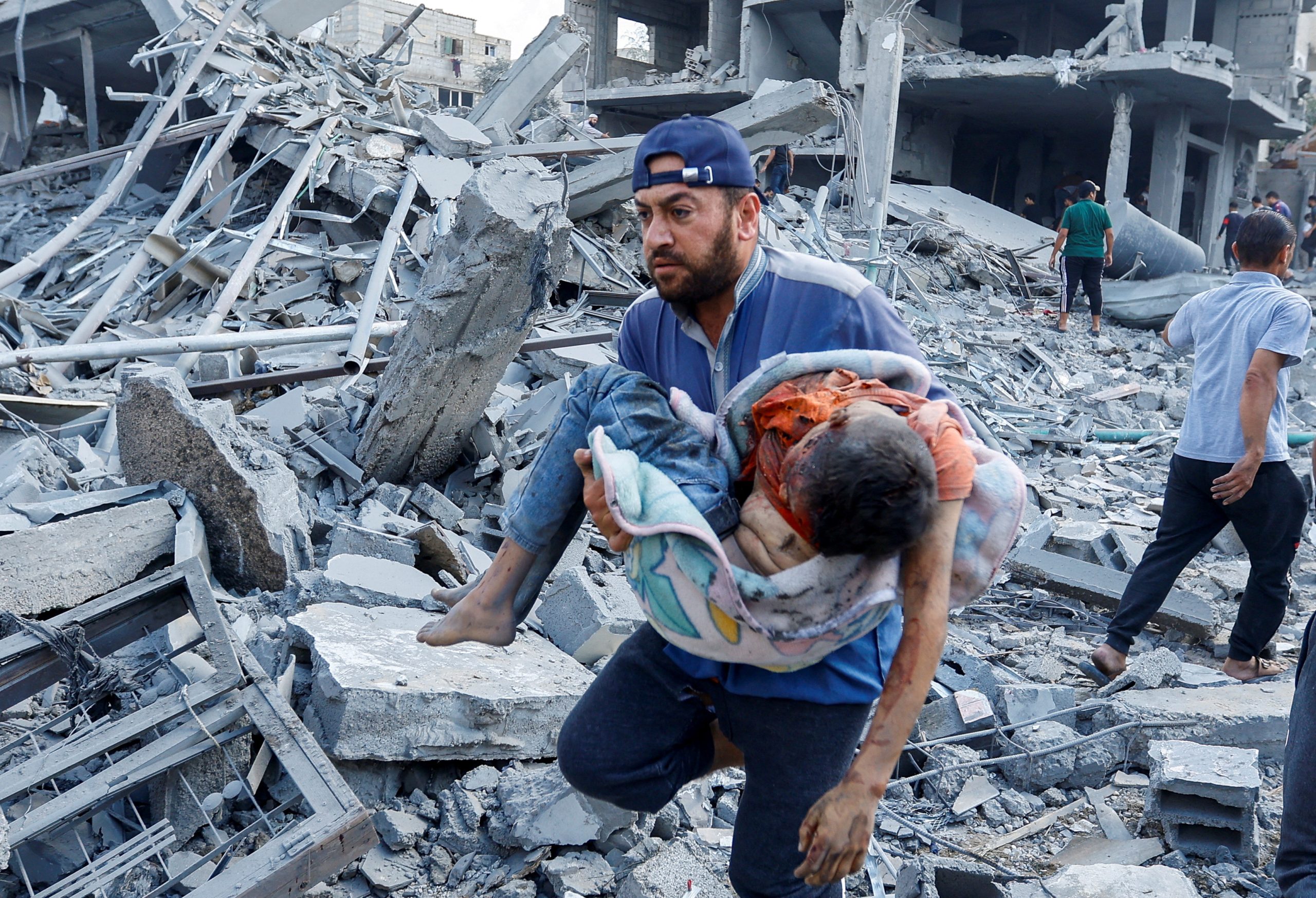
Genocide

Rethinking the “Christian Genocide” narrative: Reflections from Wilton Park

By Dr Samaila Suleiman Yandaki

Nigeria is once again in the global spotlight in the wake of its redesignation as a Country of Particular Concern and the accompanying threat of U.S. military action by the Trump administration to save Nigerian Christians from “genocide”. This narrative is as dangerous as it is familiar, evoking the old imperial logic that simplifies and distorts our complex realities to justify external intervention. As a student of the politics of history and identity conflict, I find this portrayal beyond perturbing and perilous. 

I witnessed firsthand how such perilous narratives were debated in international policy circles when I joined other Nigerian and British stakeholders at a high-level summit at Wilton Park in February 2020 for a dialogue on “Fostering Social Cohesion in Nigeria”. Situated in the serene estate of Wiston House, Steyning, West Sussex, Wilton Park is an Executive Agency of the UK Foreign, Commonwealth and Development Office, widely recognised as a global space for peace dialogues and post-conflict reflection. The meeting was part of the UK government’s follow-up to the Bishop of Truro’s Independent Review on the persecution of Christians worldwide, in which Nigeria was identified as a major flashpoint of “religious violence.” The Truro Report asserted that Nigerian Christians are facing systematic persecution and called upon Western governments to do more to protect them. 

At Wilton Park, we were offered more than an interfaith forum to dialogue; we were given the opportunity to deconstruct the dangerous oversimplifications that have come to characterise Western discourses on Nigeria. Unlike the imperialist gimmicks and threats emerging from Washington today, the British government, through the Foreign and Commonwealth Office, convened diverse stakeholders from Nigeria and the UK – religious leaders, politicians, diplomats, academics, and civil society representatives – to deliberate on the multifaceted security challenges confronting Nigeria and explore ways of building social cohesion. I am not permitted by the Wilton Park Protocol to name participants or cite their specific interventions, but suffice it to say that, with few exceptions, those present were individuals who matter in Nigerian and British policy circles.

The participants spent three days discussing the farmer-herder crisis, the Boko Haram insurgency, and the persistent communal conflicts in the Middle Belt. What struck me most was the consensus among Nigerian participants — Muslims and Christians alike — that the “Christian persecution” framing was profoundly misleading. We emphasised that the reality was far more complex than the narrative of religious persecution suggests. The problem, as several participants observed, is not that Christians do not suffer violence, but that violence in Nigeria is indiscriminate, affecting all communities. To single out one group as uniquely persecuted is to misread the nature of the crisis. 

The Wilton Park approach reflected a subtle but significant shift– the need to appreciate the broader social, political, and environmental dynamics of violence in Nigeria. While the Truro Report relegated these factors to the background, we strongly highlighted them, showing that Nigeria’s crisis is a shared national tragedy rather than a targeted religious war. The goal was to nurture a more nuanced understanding, one that resists the reductive opposition between Muslim perpetrator and Christian victim. 

The meeting concluded on a high note with consensus around the “sensitivity and diversity of conflict narratives,” recognising that every victim’s voice deserves to be heard. It was agreed that shifting the narrative from “Muslims against Christians” and other binary categories must therefore be a priority if we are to avoid deepening existing divisions. The meeting recommended that the Nigerian government should “commission and fund independent, credible research on climate change, number of attacks, crime victims, cattle routes and patterns; develop strategy on how to use data to proactively educate, myth-bust and shape narratives for both sides of the argument; justice and peace training to be included in schools; Government of Nigeria to appoint a National Reconciliation Adviser; establish a Joint Religious Coalition to ensure accountability of government for insecurity and politicisation of conflict; develop religious engagement strategy; and commence dialogue to facilitate creating ‘Code of Conduct’ for religious leaders,” among other actionable recommendations. This later became the groundwork for further peacebuilding engagements between Nigerian and British stakeholders. The Wilton Park dialogue is a model of thoughtful engagement, the kind of thoughtful diplomacy the world requires in times of conflict, not the militarised moralism coming from Washington. 

The question is, what are the true intentions of Trump? Is he genuinely motivated by a humanitarian desire to protect Nigerian Christians, or is this another exercise in the US geopolitical and imperial crusade? History offers little reason for optimism. We know that humanitarian and messianic pretexts always precede Imperial interventions. In the 19th and 20th centuries, colonial logic was a “civilising mission”; today it is “defence of persecuted Christians”. The language changes, but the logic remains the same —define and rule, borrowing from Mahmood Mamdani. The Palestinian literary critic Edward Said describes this imperial habit of defining how others are perceived and how their suffering is interpreted. Therefore, classifying Nigeria—a complex, plural, and Muslim-majority nation—as a persecutor of Christians is a convenient casus belli for Trump, masquerading as a humanitarian concern. 

Meanwhile, I congratulate the proponents of the “Christian genocide” narrative in Nigeria and beyond. We are now officially a Country of Particular Concern, polarised and divided. As the advocates of the narrative await, with self-righteous anticipation, an American-led “rescue mission”, I want to remind them of the devastation that American invasion has brought to nations in the name of salvation: Libya, Iraq, Afghanistan, Syria, Vietnam, Somalia. Each intervention was couched in the language of freedom, yet each left behind broken societies and deepened resentment.

The “Christian genocide” narrative is doubly dangerous: while deepening domestic divisions, it legitimises foreign intervention. This is not to deny the suffering of Christians in parts of Nigeria. Their pain is real and deserves acknowledgement. But this is equally true of Muslims and others who have suffered the same fate. The question is not who suffers most, but how that suffering is framed. 

Ultimately, the Nigerian state bears the greatest responsibility for its failure to protect all its citizens. Endemic corruption, elite impunity, and the persistent inability to provide security for Nigerians have created fertile ground for such divisive narratives to thrive. Unfortunately, the citizens themselves have collectively failed to hold the government accountable for these failures. Instead, they are busying themselves competing for victimhood, thereby creating the conditions for external powers to intervene discursively and politically. It is this vacuum that the Trump administration is filling.  

The task before Nigerian scholars, faith leaders, and policymakers is to reclaim the narrative, not through denial, but through a more honest, inclusive, diplomatic and historically grounded understanding and framing of its own complex realities. The federal government must strengthen its security institutions and reassert the primacy of equal citizenship. All lives matter in Nigeria—Christian, Muslim, and traditionalist alike.

Dr Samaila Suleiman writes from the Department of History, Bayero University, Kano.

How the “Christian Genocide” narrative could cost Tinubu his 2027 re-election

By Misbahu El-Hamza

President Bola Tinubu has finally responded to the false accusation of a “Christian genocide” in Nigeria, a narrative that surfaced in late September. Yet as this claim gains traction in U.S. conservative circles, he should be more worried about his political prospects. The narrative—and U.S. President Donald Trump’s recent call to redesignate Nigeria as a Country of Particular Concern (CPC)—could give Washington both motive and cover to oppose Tinubu’s re-election in 2027, just as former President Goodluck Jonathan alleged of the Obama administration in 2015.

Former President Jonathan publicly claimed that he lost the 2015 election because of U.S. interference. Two issues broadly defined the diplomatic rift between the two governments. The first was Boko Haram’s insurgency and the abduction of the Chibok girls. In a 2018 BBC interview, Jonathan lamented that Nigerians in the U.S. joined public protests there, one of which famously featured Michelle Obama holding a placard with the slogan #BringBackOurGirls.

At the October 2025 launch of ‘SCARS: Nigeria’s Journey and the Boko Haram Conundrum,’ by former Chief of Defence Staff Gen. Lucky Irabor (retd.), Jonathan recalled: “When I was in office, one of the major scars on my government, and one I will retire with, is the issue of the Chibok girls. As Bishop Kukah said, no plastic or cosmetic surgeon will remove it.” The then-opposition under Muhammadu Buhari, which included Tinubu, exploited insecurity for political advantage, a factor that clearly contributed to Jonathan’s loss.

The second, and in my opinion, more damaging rift was Jonathan’s stance against same-sex marriage, reflecting the convictions of most Nigerians. In 2014, he signed the Same-Sex Marriage Prohibition Act, shortly after the Obama administration’s 2011 pledge to “use all the tools of American diplomacy” to promote gay rights globally. Washington’s reaction was swift. The White House warned of possible cuts to HIV/AIDS and anti-malaria funding, while Jonathan’s government held firm. Nigerians applauded him for that. But during the 2015 campaign, the Obama administration’s outreach, including direct appeals to Nigerian voters and a high-profile visit by Secretary of State John Kerry, was widely viewed as tacit support for Buhari, which many Nigerians, including Jonathan himself, believe shaped the election’s outcome.

Insecurity also played a domestic role in Jonathan’s downfall. Nigerians were increasingly alarmed by unrelenting violence—beyond Boko Haram, currently compounded by communal, ethnic, and religious clashes and by banditry mostly in northern Nigeria—that claimed hundreds of innocent lives. Regardless of how the world described it, the reality was and is still tragic. It eroded public trust and patriotism. Yet successive governments, rather than restoring security, have often appeared more concerned with foreign perceptions than with rebuilding national confidence and truly working to end the bloodshed of innocent Nigerians.

So, while Jonathan’s administration angered the Obama White House over the same-sex marriage law, many believe that Tinubu’s has irritated Washington for another reason.

In early September, U.S. Senator Ted Cruz introduced the Nigeria Religious Freedom Accountability Act of 2025 (S.2747) to the U.S. Senate. The bill seeks to sanction Nigerian officials allegedly complicit in “Islamist jihadist violence against Christians and other minorities” and those “enforcing blasphemy laws”. Blasphemy remains an offence under Nigeria’s criminal code and in the twelve northern states operating shari’a law. Yet, the Cruz bill’s language raises serious questions: how would the former officials be identified, and on what evidence? If Washington possesses proof, it has not presented any. Within Nigeria, such accusations often surface in political rhetoric but rarely withstand scrutiny.

Still, Nigeria’s greater “offence” under Tinubu—at least to American conservatives like Bill Maher, Mike Arnold, Ted Cruz, Riley Moore, and now Donald Trump—is its unwavering support for the Palestinian people. Successive Nigerian governments, whether Christian- or Muslim-led, have consistently condemned Israel’s occupation and called for a two-state solution as the only path to peace. This position, long-standing and bipartisan in Nigeria, clashes directly with Washington’s pro-Israel consensus.

After Nigeria’s firm statement at the 80th UN General Assembly in September, Maher went on his HBO show and declared, “I’m not a Christian, but they are systematically killing the Christians in Nigeria,” comparing it to Gaza and calling it “a more serious genocide.” Such claims, amplified by Trump’s rhetoric about “defending Christians,” serve U.S. political optics more than global justice. Recall Trump’s 2020 CPC designation for Nigeria. It was largely symbolic and carried no enforcement before he left office. His renewed posturing appears equally opportunistic.

Tinubu may believe U.S. pressure arises from concern for Christian victims of Islamist violence and that this aligns with Nigeria’s large Christian population. Yet the U.S. record tells a different story. The same establishment that condemns persecution in Nigeria supports Israel’s war in Gaza, where many casualties are both Muslim and Christian Palestinians.

If Nigeria accuses Washington of selective advocacy, it may find sympathy at home, but not in Washington, where lobbying interests dominate the narrative. Assuming that the “Christian genocide” argument will shield Nigeria from criticism would be a miscalculation.

Tinubu is not yet where Jonathan stood in 2015, but the parallels are unmistakable. The Obama administration’s posture during Jonathan’s re-election bid showed how U.S. influence can shape Nigerian politics. A sustained clash with U.S. policy on religious freedom and Palestine, coupled with insecurity and governance failures, could become a tipping point. Avoiding that outcome will require strategic diplomacy (which we have no doubt our president possesses), credible reform, and a domestic agenda rooted in accountability. Nigerians must see real action towards ending Boko Haram and banditry.

This moment demands political acumen and the disciplined management of both security and foreign relations. Tinubu cannot afford to repeat Jonathan’s missteps. In global politics, misreading Washington’s signals has previously cost Nigerian presidents, and history may not be kind to those who fail to learn from it.

Misbahu writes from Kano and can be reached via email: misbahulhamza@gmail.com

Over 100 killed in Israeli strikes on Gaza amid ceasefire dispute

By Maryam Ahmad

More than 100 people were killed in a series of Israeli airstrikes across Gaza on Tuesday, according to health officials in the enclave. The strikes came shortly after Israel accused Hamas of violating a fragile ceasefire agreement — an allegation Hamas has denied.

Palestinian health authorities said the attacks targeted several densely populated areas, leaving scores of civilians among the dead and many others injured. Rescue teams continued to search through the rubble for survivors late into the night.

In a statement, Hamas rejected Israel’s claims of ceasefire breaches and accused Israel of deliberately escalating the conflict. The group also said Israeli authorities had prevented the return of the bodies of Israeli hostages who were killed during earlier clashes.

The renewed violence has raised fears of a broader breakdown in the ceasefire, which had offered a brief respite after months of devastating fighting. International calls for restraint have grown as humanitarian conditions in Gaza continue to worsen.

CAN rejects claims of Christian genocide in Nigeria

By Muhammad Abubakar

The Christian Association of Nigeria (CAN) has denied claims of a Christian genocide in Nigeria, calling such reports misleading and lacking a consistent pattern, as reported by The Guardian (Nigeria).

The claims gained attention after U.S. comedian Bill Maher and Senator Ted Cruz accused Islamist groups and Nigerian officials of persecuting Christians. Cruz even proposed sanctions through the Nigeria Religious Freedom Accountability Act. 

At the same time, U.S. lawmaker Riley Moore urged the U.S. government to halt arms sales and label Nigeria a “Country of Particular Concern.”

In response, Nigeria’s Presidency denied any religious war, stressing that the violence affects all citizens regardless of faith.

CAN’s Director of National Issues and Social Welfare, Abimbola Ayuba, acknowledged widespread killings but said they were not targeted solely at Christians. He noted that both Christians and Muslims have fallen victim to terrorist attacks, adding that bullets “don’t look for a Christian or spare a Muslim.”

Ayuba cautioned against foreign interference and urged Nigerians to work collectively to end the insurgency through local institutions rather than seeking sympathy abroad.

Ulama Forum refutes claims of 500,000 Christian deaths in Nigeria

By Hadiza Abdulkadir

The Ulama Forum in Nigeria has condemned what it describes as false and inflammatory allegations by some international media outlets, including Fox News, Radio Genoa and American talk show host Bill Maher, claiming that 500,000 Christians were killed in Nigeria last year.

In a statement signed by Convener Aminu Inuwa Muhammad and Secretary Engr. Basheer Adamu Aliyu, the Forum described the claims as “entirely unfounded, reckless, and designed to misinform the international community.” 

It added that Nigeria’s security challenges—terrorism, banditry, and farmer-herder clashes—affect both Muslims and Christians, not any single religious group.

The Forum noted that Muslim communities, particularly in the Northwest, have “suffered disproportionately,” with thousands killed in repeated attacks ignored by international coverage. It warned that spreading false genocide narratives could inflame tensions and undermine peace efforts.

Quoting the Qur’an, the Forum reaffirmed Islam’s prohibition of killing innocents and called for unity among Nigerians “to resist attempts by foreign actors to manipulate false narratives.” 

It also urged the government to intensify security measures and advised international media to report responsibly and respect Nigeria’s diversity.

Italy gripped by strikes over weapon shipments to Israel

By Muhammad Abubakar

Italy is witnessing widespread labour unrest as dockworkers, unions, and students have launched strikes and demonstrations to protest the shipment of weapons to Israel amid the Gaza conflict.

In Ravenna, Mayor Alessandro Barattoni and local authorities stopped two trucks carrying explosives meant for Haifa, citing solidarity with Palestinians and concerns over loopholes allowing arms transit through Italy.

In Genova, dockworkers participating in a strike have blocked access roads to the port and rallied under the banner of preventing Italian ports from facilitating arms transfers. Similar protests are underway in Livorno. Public transportation services have been disrupted in cities such as Rome and Milan, and several schools have been closed.

Unions are demanding that the Italian government suspend both commercial and military cooperation with Israel, close legal loopholes related to transit of arms, lift any humanitarian blockade on Gaza, and formally recognise the State of Palestine.

The protests highlight increasing internal tensions in Italy’s politics, especially under Prime Minister Giorgia Meloni’s government, which has traditionally aligned more with Israel diplomatically. Observers suggest the strike actions test if citizen and labour moral pressure can influence the government to curb arms exports and transit.

Canada, Australia and UK formally recognise Palestinian state

By Muhammad Abubakar

In a historic diplomatic shift, the governments of Canada, Australia, and the United Kingdom have formally recognised the State of Palestine. The announcement, made in a joint statement on Sunday, marks a significant moment in international support for Palestinian statehood.

Leaders of the three countries said the recognition was aimed at advancing a just and lasting peace in the Middle East, reaffirming their commitment to a two-state solution. They urged both Israel and Palestine to return to negotiations and called for an immediate halt to violence in the region.

The move has been welcomed by Palestinian officials, who described it as a “courageous step towards justice and self-determination.” However, Israel has expressed strong opposition, warning that such recognition could undermine peace efforts.

The decision by three of the world’s most influential Western nations is expected to increase pressure on other countries to follow suit, potentially reshaping the dynamics of the Israeli-Palestinian conflict on the global stage.

Eric Cantona calls for UEFA and FIFA to ban Israel as Spain proposes a World Cup boycott

By Muhammad Abubakar

Former Manchester United legend Eric Cantona has called on football’s governing bodies, UEFA and FIFA, to impose an immediate ban on Israel over its ongoing military actions in Gaza. Cantona, known for his outspoken views, said football cannot remain silent while civilians continue to suffer.

His statement comes amid growing international pressure on Israel, with Spain reportedly considering a boycott of the upcoming World Cup should the situation persist. 

Spanish officials have hinted that participation in global tournaments could be reconsidered if FIFA does not take more decisive action.

The calls echo previous instances where sporting sanctions were used as leverage against states accused of human rights violations, most notably the bans imposed on apartheid-era South Africa and, more recently, Russia following its invasion of Ukraine.

Neither UEFA nor FIFA has officially responded to Cantona’s demand or Spain’s potential boycott threat, but the developments add further weight to the debate over the role of football in addressing global conflicts.

The United Nations and eight decades of impotence

By Amir Abdulazeez

The United Nations is currently holding its 80th General Assembly sessions in New York. Some days earlier, the U.S. State Department, under the pretext of national security and anti-terrorism laws, revoked visas for dozens of Palestinian officials, including President Mahmoud Abbas slated to participate, at the General Assembly and a high-level two-state conference. This move drew criticism from the UN itself, EU and some human rights groups, with calls to relocate Palestinian-related meetings outside New York. This echoes historical precedents, notably the 1988 visa denial to Late Yasser Arafat, which forced the UN to shift one of its sessions to Geneva to allow him participate.

Although the 1947 ‘Headquarters Agreement’ obliges the United States to admit all UN participants, Washington occasionally and selectively invokes security and legal excuses to discriminate between entrants. Such practices explain how the UN’s operations remain vulnerable to U.S. control, thereby undermining its independence, authority and credibility. As the UN marks the 80th anniversary of the ratification of its charter on 24th October 2025, the organization which was founded on the ashes of World War II in 1945 faces an existential crisis of credibility and effectiveness.

While it has achieved notable successes in humanitarian aid, educational research and global environmental and health initiatives, its core mission of maintaining international peace and security has been repeatedly undermined by structural and diplomatic flaws. The organization’s inability to meaningfully respond to crises from Syria to Ukraine and most visibly in the Israeli-Palestinian conflict, has exposed fundamental weaknesses that warrant urgent reform. The UN’s record is one of profound paradox: a body designed for action but often defined by its inaction. Nowhere is this impotence more starkly illustrated than in its 70 years’ failure to resolve the Palestinian question or to hold Israel accountable for its international impunities.

From the outset of the Israeli-Palestinian conflict, the United Nations assumed a central role by proposing the 1947 Partition Plan, which sought to establish separate independent states for both parties. Although initially conceived as a potential path to peace, the plan was never enforced and the UN has since struggled to translate its own decisions into reality. Further failures are documented in a paper trail of unimplemented resolutions: Security Council Resolution 242 (1967) called for Israel’s withdrawal from territories occupied during the Six-Day War; Resolution 338 (1973) and countless subsequent resolutions reaffirmed this demand that was not only ignored but instead empowered Israel’s massive expansion of illegal settlements.

Beyond the unimplemented resolutions, a critical UN failure in this regard is that of narrative framing. It has been unable to consistently enforce a foundational principle: that the right to self-determination for one people (Israelis) cannot be predicated on the denial of that same right to another (Palestinians). The organization’s various bodies often treat the conflict as a symmetrical dispute between two equal parties, rather than an asymmetrical struggle between a nuclear-armed occupying power and a stateless, occupied population living under a brutal blockade.

The core of the UN’s ineffectiveness lies in the flawed decision-making structure of its Security Council, where the five permanent members (United States, Russia, China, France and United Kingdom) hold the autocratic privilege of veto power. This system of outdated World War II geopolitics has frequently paralyzed the organization in hours of need. Since 1946, the veto has been selfishly exercised about 300 times. Between 2011 and 2023, Russia and China blocked 16 resolutions on Syria, enabling the Assad regime’s brutal campaign against civilians. The United States, meanwhile, has used its veto more than 50 times to shield Israel from accountability, making Palestine the single most vetoed issue in UN history. Instead of serving as a platform for global security, the Council has become an arena for shameless and hypocritical power politics.

The General Assembly, despite representing all 193 member states equally, has been relegated to a largely ceremonial role in matters of international peace and security. While the Assembly can pass resolutions by majority vote, these carry no binding legal force and are routinely ignored by powerful nations. The 2012 resolution calling for an arms embargo on Syria passed with 133 votes but had no practical effect, as Russia continued supplying weapons to the Assad government. This has created a two-tiered system where the views of the international majority are systematically subordinated to the interests of Security Council Super Powers.

The selective enforcement of international law has become a defining hallmark of UN impotence. While the organization has at times demonstrated resolve such as coordinating global sanctions against apartheid South Africa in the 1980s or authorizing military intervention in Libya in 2011, its responses to other similar crises have been inconsistent and politically driven. Similarly, the International Criminal Court, often operating with UN support, swiftly indicted leaders of Liberia, Sudan and Libya, yet no Western or allied leaders like George W. Bush or Tony Blair have been held to account for baseless interventions in Iraq, Afghanistan or Yemen. These double standards have eroded the UN’s credibility and moral authority, particularly in the Global South, where it is increasingly viewed as an instrument of Western hegemony.

The UN’s peacekeeping apparatus, while successful in some contexts, has also demonstrated significant limitations when confronting determined state actors. The United Nations Disengagement Observer Force (UNDOF) on the Golan Heights and the United Nations Interim Force in Lebanon (UNIFIL) have maintained buffer zones during their operations, but have been powerless to prevent violations by all parties. During the 2006 Lebanon War and subsequent conflicts, these forces could only observe and report violations rather than enforce compliance.

Financial manipulation has emerged as another tool of selective pressure within the UN system. The United States, which contributes 22% of the UN’s regular budget, has repeatedly withheld or threatened to withhold funding to pressure the organization on specific issues. In 2018, the Trump administration cut $285 million from UN peacekeeping operations and reduced contributions to various UN agencies. The UN’s human rights mechanisms face similar challenges of selective application and political manipulation. The Human Rights Council, reformed in 2006 to address criticisms of its predecessor, continues to be influenced by bloc voting and political considerations rather than objective human rights assessments. Countries with questionable human rights records have served on the Council while using their positions to deflect criticism and protect allies.

Critics argue that the UN has become a stage for symbolic debates while real decisions and tangible actions are outsourced to global bullies like the US, less formal coalitions like the NATO and regional actors like the EU. For example, the U.S.-brokered Abraham Accords normalized relations between Israel and several Arab states without addressing core Palestinian concerns while side-lining the UN. Similarly, its response to Russia’s invasion of Ukraine in 2022 was limited to humanitarian aid and symbolic condemnation, as bodies like EU looked more relevant and assertive.

The rise of new global powers and changing geopolitical realities have rendered the UN’s 1945 structure increasingly obsolete. Reform proposals have circulated for decades but have consistently failed due to the resistance of existing power holders. Things have changed since World War II, nations have evolved, others have declined and hence the UN must be reformed to reflect current realities. The permanency of the Security council membership must be reviewed and the senseless veto authority must be abolished or modified along the lines of justice and accountability. As the United Nations approaches its 80th anniversary, the choice is clear: fundamental reform or continued irrelevance.

Maintaining the United Nations system costs about $50–55 billion per year, not counting military deployments and opportunity costs. Beyond money, states commit significant diplomatic, military, humanitarian and bureaucratic resources to maintain their participation. This makes the UN one of the most resource-intensive international organizations ever created. Without serious reforms to address structural inequalities, eliminate veto abuse and restore the primacy of international law over great power politics, the UN risks becoming a historical footnote rather than the cornerstone of the global governance its founders envisioned. The international community must decide whether it will tolerate continued dysfunction or demand the transformative changes necessary to address 21st century challenges.

Spain withdraws ambassador from Israel after genocide accusation

By Muhammad Sulaiman

Spain has pulled its ambassador from Israel in a dramatic escalation of tensions. Foreign Minister José Manuel Albares said the move came after “false and calumnious” accusations from Israel against Madrid.

The step follows Prime Minister Pedro Sánchez’s hard line on Gaza, including a permanent arms embargo and bans on Israeli-linked ships and aircraft. He has accused Israel of committing genocide, sparking Israeli claims of antisemitism and entry bans on Spanish ministers.

Madrid insists its stance is rooted in human rights and international law, marking its toughest diplomatic challenge to Israel yet.