Facebook

Man intoxicates, rapes Facebook friend, vows to release nude pictures 

By Uzair Adam Imam 

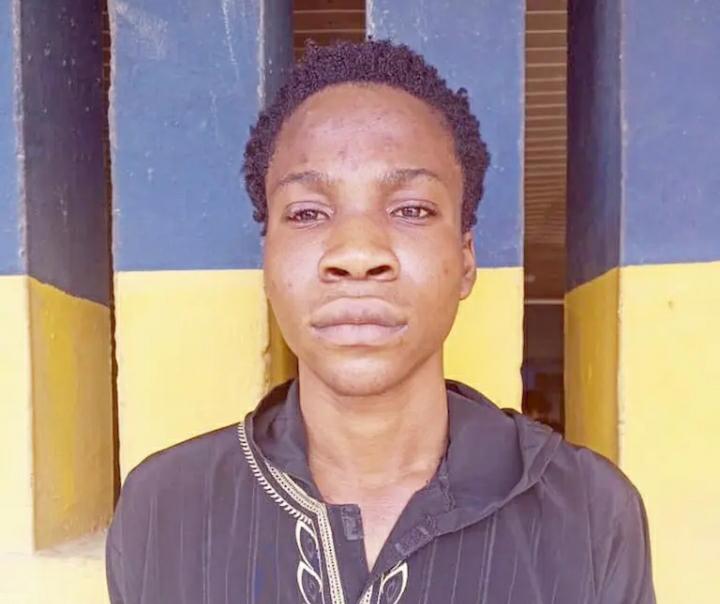
The police in Ogun State have arrested a 25-year-old man, Ebenezer Adeshina, for raping and intimidating a 16-year-old Facebook friend.

Adeshina allegedly invited the victim to his house, where he had intoxicated and raped her.

After having raped the girl, Adeshina also took the victim’s nude pictures and started threatening to make them public if the girl refused to give him the sum of N50,000.

The girl confided in the police that she met the guy on Facebook last year, and since then, they have been chatting with each other. 

She said because her phone got spoilt, the suspect called her with a promise to give her N30,000 for the phone’s repair.

However, no sooner had the girl arrived at his house than the suspect offered her a drugged drink which she took and became unconscious, after which the rape followed. 

The police spokesman in the state, Abimbola Oyeyemi, said Monday that the suspect was arrested following a report by the victim at Owode Egbado Division.

The statement read in part: “After having sex with her in the state of unconsciousness, the suspect took her nude pictures and started threatening to upload them on social media if she didn’t pay him the sum of N50,000.”

Social media is another world

By Musa Idris Panshekara

The first human being was created single. Then another creature was created from him. Later all generations were created from the two. Then they were all dispersed on the face of the earth. Some are black, some are yellow, some are tall, some are short while, some are medium, some are fat, and some are thin. All these differences were prescribed for us to contemplate God’s creatures and better interact with one another.

Allah said in the glorious Qur’an, “…the camels, mules and donkeys (were created) for travelling and luxury, and He creates (continuously) what you (companions of the prophet and we) would not know.”

Allah, the alpha and the omega, the omnipotent, the omniscience and the omnibenevolent, knows all that human beings need for their better survival on this globe. That is why He creates us and provides us with all we will rejoice in in our lives.

As a result of technological advancement, it makes life expedient. As a result, the world has become small, and what are remote are brought closer. However, the ubiquity of cell phones resulted in a constant increase in social media users, whereas social media helps get the world close to one another too. These platforms are; Facebook, WhatsApp, Instagram, Twitter and Tiktok.

Some social media users utilise it in a meaningful manner, while others misuse and abuse it. The constant increase of users increase social media abuse. As a result, cybercrimes such as cyber fraud, phishing, social engineering, etc., also increase. On the other hand, some use it in a beneficial and meaningful manner, such as teaching and learning, mentorship, digital marketing, etc.

Some people think social media brings, helps, and contributes to spreading some acts of immoralities. In contrast, some condemn the entirety of social media and label it a means of spreading numerous immoralities in our society. Nevertheless, I can neither deny nor accept all the claims.

Let us scrutinise the following analogies;

The producer produces cups and sells them in the market; consumers buy. Some will use them to drink water and tea, while some will use them to drink intoxicant drinks and other alcoholic beverages, and some will even use them to feed others with poisonous drinks. Therefore, how could the cups be blamed for the above mentioned positive and negative uses? You use your cup and drink cool water or juice. What if I use mine for drinking poison and committing suicide? Whose fault is that? The cup? Never!

Moreover, medicines are made to cure diseases and illnesses, but some people use them otherwise. If a hacker uses a computer and commits malicious acts like fraud, phishing, or hacking someone’s device, whose fault is it? The hacker or the computer? Allah created the world and its contents (social amenities) for human beings to enjoy and perform their prescribed worships (for them to be rewarded in the Hereafter). If humans did not utilise the opportunities and provisions provided to them righteously, who would be blamed?

Social media is no different from the physical world in so many instances. There are friends and acquaintances, family and relatives, teachers and students, mentors and mentees, just like the physical world. But, despite all these, it does not prevent someone from doing what they desire to do on social media. Similarly, all the personalities mentioned above do not prevent someone from misbehaving in the physical world.

We should not call social media terrible or obnoxious. On the contrary, social media is innocuous itself operated by humans. Therefore, it should be considered as another world. In this manner, you would find many people of your ilk (if you are good or otherwise), despite some users portraying their mirror side like a “hyena shrouded with a goat’s skin”.

If you want to benefit from social media, minimise using numerous platforms (you must not be on all platforms). Choose the most important ones and leave the rest. When you are on the selected ones, follow or befriend those whom you will benefit from their educative posts and speeches. Block and unfriend or do not follow those who spread immoralities, whose posts are devoid of knowledge and wisdom.

Avoid engagement in any controversial trending topics, and always remember that those who created the platform you are using are not illiterate or uneducated. They did not make it for charity rather than as a source of income. Therefore, do not let yourself be distracted from whatever you know is important to you. Finally, always remember God watches over you. Whatever you are doing, everywhere you are.

Musa Idris Panshekara wrote from Kano via pmusaidris@gmail.com.
Beware of Facebook, other hackers

By Abdulrahman Muhammad, PhD

A friend recently left Facebook after his friends were duped through his hacked Facebook account. The hacker took over the victim’s Facebook account and sent messages to the latter’s friends asking them to deposit money into an account and get double the amount deposited in two weeks!

Because of sheer trust and gullibility, they first transferred monies into the bank account given to them by the hackers before even contacting my friend via phone. A total of about 450000 naira was lost this way, one of the victims being a student.

Lessons:

1. A simple phone call to confirm the true source and authenticity of the message would have saved the victims the trauma of losing huge sums of money.

2. The susceptible can be found even among the educated. While working in New Bussa, a colleague excitedly showed me a text message from an ordinary number informing him that he had won a lottery in which he was a random passive participant. I warned him that it was fraudulent, but another colleague convinced him it was genuine. The most painful thing was that the fraudsters asked him to go to an ATM and called them from there so that they could instruct him on how to redeem his prize. He inserted his card into the machine and followed their instructions sheepishly, which led to the emptying of his bank account.

3. Even a smart person can be a victim if they are too trusting, careless and greedy. Nobody can double your money in two weeks. Haba! Be street-wise.

4. Some bankers seem to be collaborating with fraudsters. For example, when victims go to the bank and complain, the bankers say the bank account the victim transferred the money does not exist!

5. Some of us have not been duped only because we are too poor to be conned. Or, to put it more respectfully, we are not rich enough to be defrauded. Where is the money?

6. A simple test can expose hackers. Recently, a Facebook friend sent me a fraudulent solicitation message. I promptly suspected his account was hacked. Unfortunately, I didn’t have his mobile number, so I sent him a message via Facebook Messenger asking simple questions in Kanuri language. The hacker responded in English with wildly off-the-mark answers. I called his bluff, and he disappeared.

7. Any friend who wants to deposit money in my account is welcome, but they should get the correct account details directly from me through my mobile number. My bank account name is slightly different from my Facebook account name.

8. One can also use the Messenger voice call option to confirm the person’s identity soliciting for money.

God save us from fraudsters.

Dr Abdulrahman Muhammad wrote from Maiduguri, Borno State. He can be reached via abbakaka@yahoo.com.

Positive and negative influences of cyberspace amongst today’s generation

By Mai-Nasara Muawiya Uzairu

It’s crystal clear that everything that exists on the Earth has a reason(s) for its existence. This is the reason behind our being here. We are now in an age where everything is computerised. Without social media, people would have to continue to live like in the Stone Age without knowing how the world rolls and how things change interchangeably. In my opinion, social media has a vast number of both the positive impacts it creates and the negativity it causes. Although it depends on how one holds and utilises it, the choice solely depends on the social media person.

Many people have recorded successes and achieved their dreams via social media, while others’ remain unfulfilled and stagnant. Social media affects and changes people’s minds about destructive behaviours or otherwise. On the other hand, it sends countless lives to their graves unprepared. Congratulations to those folks for whom social media becomes the reason for their smiles and achievements. May they continue to benefit from the dividends of social media. Best wishes in advance to the future ones who may stir social media with goodness. May they, too, achieve more than today’s beneficiaries achieved, amin. Hard luck to those for whom the reverse is the case.

You are not too late to change the dice rolling with solid hope and unflinching determinations. Many people believe in social media and take it as a means of chatting only with family and friends (FAF) and a means of becoming a nuisance to other people. It is fascinating that whichever group one chooses to belong to will definitely meet people of his ilk or even those who are pretty better than them in that regard. It consists of and explores everything depending on which one decides to choose. I advise you not to be among those who take social media for granted.

Learn, relearn from those great minds, and share your knowledge, experience, and skills with your friends. I call your attention not to share fake news on social platforms. It would be best to share only genuine and beneficial info with your friends, as fake news spreads faster than today’s dreaded virus of todayCOVID-19. Ride your tongue with care; it has a potent venom far better than that of a snake. Mind yourself what you write, share, like, react and comment. Steer clear of unnecessary arguments. Above all, never be addicted to social media impulsively. Manage your time judiciously.

Social media plays a significant role in sharing the development and advancement of today’s generation. Through it, many people make investments and become business tycoons and academic experts, particularly smartly witty ones. Moreover, it helps many connect with their customers and clients from far and distant environments. Without social media, many amongst our business tycoons would not have become what they are today, let alone be known around the world. These include Bill Gates, Otedola Warren Buffet, and Aliko Dangote. All and sundry know these great minds in business circles through cyberspace and their products exclusively. In this regard, we can unanimously say that social media plays a vital role in marketing and economic buoyancy for many of our successful business moguls.

Social media eases and simplifies most things that seem complex. Many people from far distant places have become as familiar and intimate as those with blood consanguinities. We, the generation of social media users, need to use it wisely to avoid hatching rotten eggs among the future generation. We need guidance and parameters to set our activities straight by our great minds who scaled through in life. Our manners need to be replicated for better growth and attainment of better opportunities in this twenty-first, digital century loaded with brouhaha and challenges. Had social media been fully sanitised and sensitised, I am sure the future would have been productive. But, alas! All around us, one can see how the havoc wreaked by people is floating and sinking in a massive wave.

To say a naked and plain truth, children who are yet to reach puberty should be banned from using social media. It is usually the causative factor of their rudeness and moral decadence in society. It is better not to have a child at all than to give a community a notorious child that could threaten the good habits observed by people. Many under-aged children learn to watch pornographic pictures and videos via these platforms.

Fornication, homosexuality and lesbianism could only be eradicated or diminished among our youths by enforcing laws and orders on how social media shall be used. Most parents are lackadaisical in peeping the ins and outs of their children on social media; some are only good at giving birth but very poor in giving moral standards to their children. Children’s phones need to be checked up frequently and unceremoniously. Parents should check to know the children’s friends because bad companies produce harmful products. Friends are the central processors in changing the behaviours of today’s generation, particularly females whose lives are at a zenith than that of males. By so doing, most social vices could reduce to the barest minimum or even be completely wiped away. 

Mai-Nasara Muawiya Uzairu wrote via newmainasara016@gmail.com.

YouTube removes “dislike” count across its platform

By Muhammad Abdurrahman

YouTube, the world’s biggest online video sharing and social media platform, has hidden dislike count across its platform. While the button will remain, but the “dislike” numbers will be only visible to the channel’s owner.
 
The Google-owned company further states that the move is meant to “help better protect our creators from harassment, and reduce dislike attacks — where people work to drive up the number of dislikes on a creator’s videos.“
 
The statement clarifies that:
 
|As part of this experiment, viewers could still see and use the dislike button. But because the count was not visible to them, we found that they were less likely to target a video’s dislike button to drive up the count. In short, our experiment data showed a reduction in dislike attacking behavior.
 
We also heard directly from smaller creators and those just getting started that they are unfairly targeted by this behavior — and our experiment confirmed that this does occur at a higher proportion on smaller channels.”
 
This came when some social media users, particularly Facebook, were calling on their developers to introduce the “dislike” button on those platforms. Given this development, social media experts suggested that users may not see the “dislike” option on Facebook, Instagram or other networking sites.

Just in: Facebook just announces the change of its name to Meta

According to the Verge Media “the company announced the rebranding during Facebook Connect. Mark Zuckerberg announced that Facebook’s new name will be “Meta.”

Facebook CEO Mark Zuckerberg announced Thursday at his company’s Connect event that its new name will be Meta. “We are a company that builds technology to connect,” Zuckerberg said. “Together, we can finally put people at the center of our technology. And together, we can unlock a massively bigger creator economy.”

“To reflect who we are and what we hope to build,” he added. He said the name Facebook doesn’t fully encompass everything the company does now, and is still closely linked to one product. “But over time, I hope we are seen as a metaverse company.”

Zuckerberg owns the Twitter handle @meta (whose tweets are protected as of this writing) and meta.com, which now redirects to a welcome page on Facebook outlining the changes. The site previously redirected to meta.org, a biomedical research discovery tool that was a project of the Chan Zuckerberg Science Initiative. That’s part of the philanthropic arm Zuckerberg co-founded with his physician wife, Priscilla Chan, in 2015. In a Medium post on Thursday, the group says it’s sunsetting Meta.org on March 31st, 2022.

As The Verge first reported on October 19th, the rebrand is part of the company’s efforts to shift gears away from being known as just a social media company and focus on Zuckerberg’s plans for building the metaverse. In July, he told The Verge that over the next several years, Facebook would “effectively transition from people seeing us as primarily being a social media company to being a metaverse company.”

Zuckerberg wrote in a blog post Thursday that the company’s corporate structure would not be changing, but how it reports financial results will. “Starting with our results for the fourth quarter of 2021, we plan to report on two operating segments: Family of Apps and Reality Labs” he explained. “We also intend to start trading under the new stock ticker we have reserved, MVRS, on December 1. Today’s announcement does not affect how we use or share data.”


Merits of social media

By Habib Sani Galadima

I was one of the persons that took social media (SM) as a joke. I used to think that SM was only for chatting with family and friends. I thought that one could not build a career or improve oneself there except if they belong to a small group of people who obtained certificates and special skills abroad.

I was scrolling down my Facebook timeline on a particular Friday night in 2019 when I got a post by Ibrahyim Elcaleel. He was jokingly talking about LinkedIn. I did not know anything about the platform, so I hurriedly went to check it on Google. I read the information about it until I was convinced to create an account with them.

Honestly, I didn’t take the platform seriously, for I didn’t even put a profile picture, let alone my academic details there. Coincidentally, in the first quarter of 2020, I read three articles, in a row, of late Prof. Ali Muhammad Garba, Mal. Muhsin Ibrahim and Dr Adamu Tilde advising youths to learn skills. One of these articles attempted to convince people to add the skills to their SM profiles.

Before then, I thought that only people who go to the highest level in many aspects of life beautify their profiles. So, doing that by an average translator like me is an exaggeration. In my experience, the only things I know that I could beat my chest to reference are two translation projects from Amnesty International and Al-Qalam University, Katsina State, and a few more from some national companies that need not be mentioned.

Still, I know that I have some writing skills, mainly translation, but I do have not many certificates to create a pretty CV to be read like a journal. Nevertheless, the late Prof. Ali Muhammad Garba said something that rehabilitated my conscience to move forward, thus: “There is the difference – between knowledge and skill. The former says you are aware of it, while the latter says you can do it. Which one do employers seek or value? The former is evidenced by a certificate (of attendance. The latter is evidenced by ability (buried in the anecdotal stories and case examples). Both are valuable, but one (skill) even more so. One addresses the question of “What?”, the other addresses the question of “How?”

Reading those articles by the people mentioned above pushed me to go back to my LinkedIn profile to edit it —adding academic details and some skills that I didn’t think were worthy of review.

Surprisingly, in one year, from the time I edited the profile, I did three projects, two from Northern Nigeria and the other from the southern part of the country. And my profile was reviewed by Writers.Gig, which is a part of success as a friend who works with them said. They review few people among many.

The mighty problem is how we consider ourselves “local”. We learn a skill, but we keep it unpublicised, assuming our friends on Facebook, Twitter, and other platforms know it since they know us. Many people keep their heads low in terms of humility, while it is a lack of confidence. Understanding the difference between humility and lack of confidence will help a lot. People have the latter, thinking it is the former. You can humbly show your skills to the world.

Dr Marzuq Abubakar Ungogo says, “As demand for skills increases worldwide, one easy way to lose opportunities is to show that you have no skills. But you actually have so many skills than you think of, mainly coming from your education, unpaid labour, charity or voluntary work. What skills need is packaging and honing. You can start by having a deep reflection on possible skills you have, then present them in the most marketable way possible. There are specific terminologies that you should also use. Once you do that, you also start working on getting better at them. This is not meant to stop. Constantly update!”

Habib Sani Galadima writes from Kano. He can be reached via habibmsani46@gmail.com.

On the rise of social media catfishing

By Nazir Muhammad

Have you ever met someone online with a false identity or been in love with a total stranger, believing he’s real and found out otherwise? That’s a catfish!

As social media (SM) globalised the world, catfishing is scrambling like a bushfire. It happens daily on Facebook, Twitter, Instagram, TikTok and other social media platforms.

The word “catfish” refers to a person who set up an account with a false identity (Name, Photos, Address, Occupation) SM for fraudulent, deceptive and other malicious purposes.

Social media experts explain that catfishing varies in nature, depending on the target goals. Some pretend to be businessmen to rip off people’s money. Others are merely playing around, toying with people’s emotions for fun because they are lonely, bored or mentally sick. Then, of course, there are also sexual offenders, kidnappers, and rapists, among others.

The vast majority of catfish victims are youths and teenagers. Perhaps, their facileness to fall in love with online friends is the reason. For decades, there are bunches of girls and boys blindly dating people old enough to be their fathers or mothers. Consequently, millions of people are trapped in job scams – losing their hard-earned funds. Often, girls get kidnapped, raped or heartbroken the same way.

A report gathered by Reuters on March 22, 2021, reveals that Facebook took down 1.3 billion fake accounts. However, notwithstanding the efforts, catfishing remains incessant. According to a recent online survey conducted by an American website, one out of four women (23 per cent) admitted that they had catfished someone. In contrast, one out of three males (38 per cent) also fessed up similarly. In addition to these reports, another statistic said that about 73% of people online use photos of someone else rather than actual pictures of themselves. No less than 10% of all online dating profiles are scammers. 

Shocked? Alas, it is true and daily business for the culprits -the only way to shield yourself is to be circumspect with online friends.

It is not a one-day job, if not impossible, to get rid of all catfishes online, but you can cover up yourself by getting adequate cyber awareness. However, having eagle eyes to spot the doers will also help. 

Often, a catfish could be easily discerned whilst desperately trying to be too friendly and familiar to their target – denying the face-to-face meeting, or refusing a video call could be a significant clue.

Furthermore, to verify a person’s identity, meet in person or make a video call/Skype; monitor people they interact with online and unrelentingly download his photo and verify it via Google image search to confirm whether it appears somewhere else.

FYI: No matter how close you are with your online bae/fiancee, concede to meet only in the daytime and on busy places or streets. Shun hotels and uncrowded areas for your safety. 

Nazir Muhammad writes from Gombe, Gombe State. He can be reached via nazzhubby@gmail.com.