Coming to Europe—legally or otherwise—is not easy. Countries, including Germany, have tightened their immigration policies and continue to do so.
Of course, several European countries have a shortage of highly skilled workers. However, they follow due, often bureaucratic, processes to hire those workers.
I don’t know how to hire or influence anybody or any institution to hire anyone. If I knew, my immediate family and close friends would be the first I would bring here, not “random” social media contacts.
I appeal to some people who contact me via DM about job and scholarship opportunities in Germany. I share such openings here and, especially, on LinkedIn. Try your luck and pray. Muhsin may not be able to help you in the way you think.
Everything is available on the Internet. Explore sites and YouTube. But don’t fall for scammers. Your employers will not ask you for money; instead, they will pay you. Scholarships are not for sale. Your qualifications and competence will earn you one.
May the Almighty God make it easy for everyone, amin. May you secure your dream job or scholarship sooner than you anticipate, amin.
Dr. Muhsin Ibrahim teaches at the University of Cologne in Germany and he can be reached via muhsin2008@gmail.com.
Apart from hosting us in their house during the Thanksgiving holiday, Danielle Callaway Njama and her husband, Philip Njama, booked a ticket for us to visit the National Museum of African American History in Washington DC. It was another rich historical voyage. I strongly recommend visiting the museum if you happen to be in Washington DC.
The museum, formally launched by President Barack Obama in 2016, documents the history of slavery and the unspoken contribution of Africans to European and American economies.
Walking through the floors of the museum, an air of historical insecurity, goosebumps, and lamentation engulfs you. As you read through the stories of how the enslaved Africans were transported to Europe and North America in chains and other inhuman conditions, you feel the blood of sympathy circumambulating in your veins.
While these thoughts were going through my mind, there was sudden silence among my family. I turned back, and my eldest daughter was in tears, struggling to hold her emotions while reading through the stories of Africans like Ayoub Suleiman from The Gambia, who was enslaved in Maryland, and Mahommah Baquaqua from Benin, who was sold in Brazil and transported to New York.
Being a student of economic development, I couldn’t miss the section in the museum that estimated the value of cotton produced by African Americans to $250,000,000 in 1861; and the value assigned to enslaved African Americans at $3,059,000,000 in 1860. What is the value in today’s terms?
This is a difficult history, but as I have discussed many times with friends and colleagues, Africans shouldn’t allow themselves to be the psychological prisoners of the trauma caused by slavery. Yes, it is difficult, but Africans must move forward with zeal and unparalleled determination to write a glorious chapter of their story no matter the odds against them. Creating a path to development is the antibiotic to economic dependency.
Takeaway: Torturous lessons of history are difficult to ignore. It is the lessons from history that help determined communities to write a glittering chapter for future generations.
Muhammad Jameel Yusha’u, PhD, is a candidate for a Mid-Career Master’s in Public Administration at Harvard University, John F Kennedy School of Government.He can be reached via mjyushau@yahoo.com.
When Europeans came to Africa and said, You have no culture, no religion, no civilization, no history; Africa was bound sooner or later to reply by displaying her own accomplishments. To do this, her writers and intellectuals- stepped back into what you may call the purity before the coming of Europe. What they uncovered there they put into their books and poems, and this became known as their culture, their answer to Europe’s arrogance. – Chinua Achebe
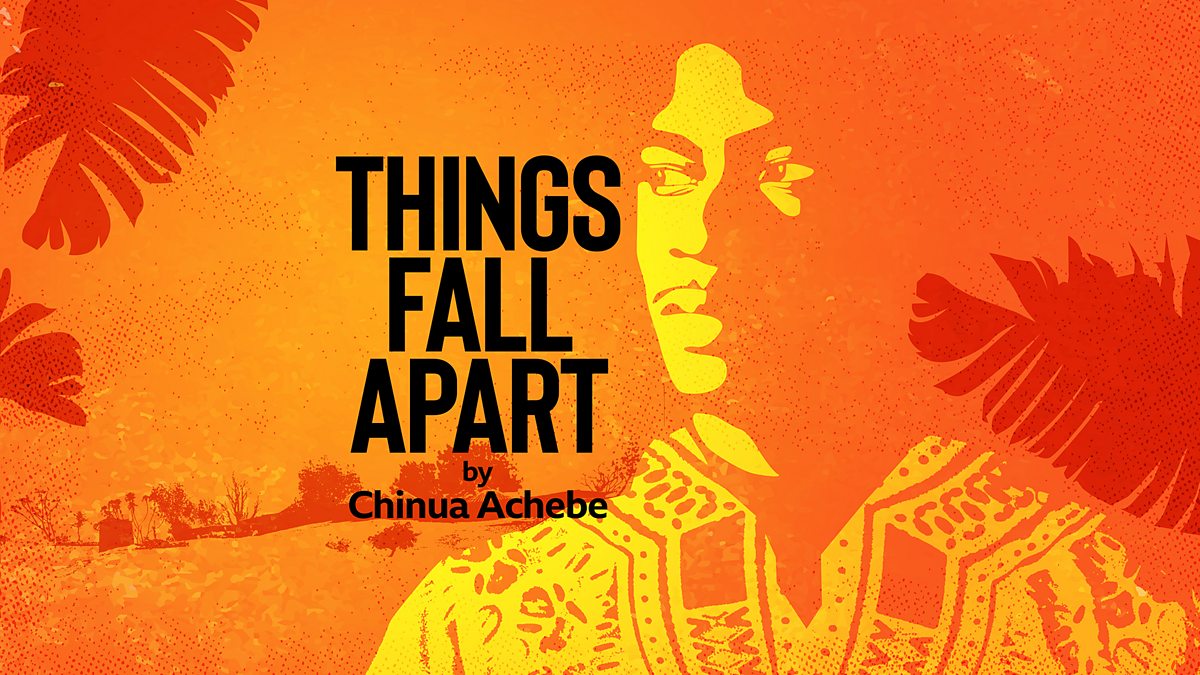
Things Fall Apart (1958) is a text on colonialism by Achebe. As Ngugi asserts, “There is no writing in a vacuum”. Equally, Stanley Fish, Raymond William, Edward Said, and Homi K. Bhaba, among others, strongly believe that writing consciously or unconsciously reflects political, historical or social issues at the time of its birth.
In response to Joseph Conrad’s Heart of Darkness and Joyce Carry’s Mister Johnson, Achebe came up with Things Fall Apart to rectify the distorted image of Africa popularised by the Europeans. As he was quoted, “My role as a writer is to help my society regain belief in itself and put away the complexities of years of denigration and self-abasement”.
Things Fall Apart is recognized as one of the 100 novels ever written in history. It has also been translated into more than 50 different languages. Achebe gets the title of the text from W.B Yeats, an Irish poet, in his poem, “The Second Coming.”
“Turning and turning in the widening gyre
The Falcon cannot hear the falconer
Things Fall Apart; the centre cannot hold
Mere anarchy is loosed upon the world.”
The text has 165 pages, twenty-five chapters, and three phases, each discussing a distinct matter. The first part talks about the culture, tradition, norms and values and political system of Igbo society. Meanwhile, the second part talks about the major character, Okonkwo’s exile to his mother’s kinsmen in Mbanta when he kills a boy during a funeral festival. Then, lastly, is the happenings that lead him to hang himself.
The first part of the text opens with Okonkwo, who gets renown by wiping the floor with Amalinze; his celebrity circulates far and wide. He’s also a man of action, industrious and works tirelessly to go contrary to his bone idle and workshy father. Ikemefuna is brought to Okonkwo’s household before his future is decided. Pronto, the boy, owns the love of Okonkwo.
We also glance at Okonkwo, who has four wives and children and run them with heavy hands because he wants them to shun being inactive. His strictness makes him break a week of peace by beating his wife in black and blue. He also cuts Ikemefuna down, which Ezeadu forewarns him, “That boy calls you father, do not bear a hand in his death” (P.45). He does this and takes the life of sixteen years inadvertently, which in their custom is exile for seven years.
Secondly, the second part opens in Mbaino, Okonkwo’s mother’s town, where he serves for seven years. He receives a helping hand from his boon companion, Obiereka, by looking after his remnants of farm and letting him know about the arrival of white men who wiped out Abame altogether, and oracles apprise them that;
“The strange man would break their
Clan spread destruction among them” (p.111)
He also accepts the worsened situation:
“… Now he has won our brothers and our clan
Can no longer act like one; he has put a knife
On the things that held us together and we have fallen apart” (p.141)
Thirdly, the last part of the text is on Okonkwo’s return from Mbaino, where he loses his celebrity and social prestige. He finds out that white missionaries take everything up. They erect churches, courts, government and schools. He stands up against missionaries, fighting back his fame, social prestige and customs. But, drearily, he fails by not getting any co-operation from his clan, and this frustrates him to the core, and he takes his own life.
Like a bolt of lightning, a key to open the freedom door dropped literally on my lap through the radio. In 1996 the government of Kano (Nigeria), where I live, was battling with Hausa creative fiction and public morals. One after the other, Islamic sheikhs came on the radio and condemned newly emerging Hausa creative fiction writers as being responsible for poor attention span in schools (and subsequent poor grades) and immorality. They did not indicate how many of the novels they had read, though. Their condemnations caught my attention, for it seems there was a reading culture among Hausa youth – something public culture kept lamenting as lacking among youth.
Reading culture is, of course, an environment where reading is championed, valued, respected, and encouraged. BUT it seems that the reading culture in Kano meant reading school textbooks (if available) and passing examinations. Reading culture? James Hadley Chase, Harold Robbins, Irvin Wallace, Agatha Christie, Denise Robbins, Nick Carter, Joan Collins, Wilbur Smith, et al., anyone? So why not Ado Ahmad, Balaraba Ramat, Ɗan Azumi Baba, Bilkisu Salisu Ahmed Funtuwa? All the objections against Hausa literature were based on the baseless Media Effects Theory, which believes that mass media influences the attitudes and perceptions of audiences.
I, therefore, decided to delve into this ‘problem’ further. It was to be a bridge between cultural studies (popular culture) and education (reading culture).
I eventually traced the production of Hausa novels to the City Business Center in the city of Kano under the proprietorship of Alhaji Abba Lawan Maiunguwa, a childhood friend. This led to Ado Ahmed Gidan Dabino, unarguably the most successful of Hausa novelists, and the forging of a life-long friendship based on respect. I spent about two years in the field, talking, recording, and unarchiving writers, critics and fans of the Hausa creative fiction.
The writers included Ahmad Mahmood Zaharadden Yakasai, Yusuf Muhammad Adamu, Ibrahim Saleh Gumel, Ɗan Azimi Babba Cheɗiyar Ƴan Gurasa, Aminu Abdu Na’inna, Badamasi Shu’aibu Burji, Hamisu Bature, Aminu Hassan Yakasai, Abdullahi Yahaya Mai Zare, Bala Muhammad Makosa, Bashir Sanda Gusau, Bala Anas Babinlata. Female authors of the period included Hauwa Aminu, Talatu Wada, Zuwaira Isa, Safiya A. Tijjani, Binta Bello Ɗanbatta, Binta Maiwada, Jummai Mohammed Argungu Karima Abdu D/Tofa, Bilkisu S. Ahmed, and the most outstanding of them all, Balaraba Ramat Yakubu.
Along the line, I developed the Hausa hooked glottal sound characters (Ƙ, ƙ, Ɗ, ɗ, Ɓ, ɓ) to help in proper Hausa writing on computer word processing programs using Fontographer software. But that is a story for another day. Next, I went to my dad, Muhammadu Uba Adamu (Kantoma), discussed with him my new-found direction and sought his blessings. He readily approved. Not surprising, considering he had always been a radical on his right. Further, my early contact with literature was from his library, as he studied Political History with English Literature as a minor. His approval, and even later, endorsement, gave me courage.
Finally, I summoned enough nerve (remember, it was not my field, and I was aware those ‘in the field’ jealously guard their turf) to write an article and send it to Ibrahim Sheme of the New Nigerian Weekly newspaper. It was titled “Hausa Literature in the 1990s”. It was published in their April 24 and May 1, 1999 issues. It created a tsunami of a reaction.
Unbeknownst to me, the debate about the merits (or lack of) of Hausa creative fiction had run its course in various Hausa language newspapers and magazines. Hawwa Ibrahim Sherif fired the first salvo in an interview with Ibrahim Sheme, published in Nasiha, on September 6 1991 (some eight years before my own article).
Following on from her views (and she was a writer herself), two camps emerged – those who did not see any merit in the novels, and those who believed in them, the latter, perhaps understandably, was made up of mainly authors themselves, such as Ado Ahmad Gidan Dabino, Yusuf Adamu, Kabiru Assada, etc. In 1998, Novian Whitsitt, an American student, even submitted a PhD thesis on Hausa creative fiction with a focus on Hajiya Balaraba Ramat Yakubu. His thesis was titled The Literature of Balaraba Ramat Yakubu and the Emerging Genre of Littattafai na Soyayya: A Prognostic of Change for Women in Hausa Society.” It was submitted to the African Studies Program University of Wisconsin-Madison.
You could therefore imagine the fire I came under; An Educationist was venturing into Hausa literary studies. Some accused me of being an ignoramus who knows nothing about Hausa literature (true), and others accused me of encouraging immorality (not true).
To get rid of my accused ignorance, I adopted two methods – both facilitated by my being a true believer in science and its methods. The first was rooted in the ethnology of Hausa cultural production. This approach was based on Victor Turner’s exposition of the ‘anthropology of experience’, itself based on Wilhelm Dilthey’s conception of ‘what has been lived through’. The approach enables the exploration of how people actually experience their culture and how those experiences are expressed in forms as varied as narrative, literary work, theatre, carnival, ritual, reminiscence, and life review. To get a closer look at the cultural production, it was necessary to be embedded in the process.
I started by identifying what was more or less a Bohemian cluster of Hausa fiction writers hanging out at City Business Center, Daneji, Kano city, along Sabon Titi. Then, I embedded myself into their cluster and observed what they were doing – inspiration for their stories, discussing plots for stories, typing, artwork, printing, marketing, etc. This went on for almost five years from 1998. As a result, I gained deep insights into their creativity and concerns. I also read quite a few of the fiction they produced to gain a more immersive experience.
In this process, I did not rely on secondary data but became a primary data gatherer myself. This came in good stead much later when I submitted a paper to a journal based in France. The editor wanted me to provide references for some of the narrative encounters. I pointed out that I was the reference and used Turner’s field study framework as a basis because I was there. The editor accepted, and eventually, the paper was published.
For the second method, I launched myself into a self-study of Critical Theory from the roots: to reflect on and critique society through literature. There were four varieties of such theory: new criticism, poststructuralism, psychoanalytic criticism, and Marxist theory. I delved into the first two, deeming that the other two do not apply to my data. I became a student of Jürgen Habermas and his “Structural Transformation of Public Sphere”, in which I see Islamicateness in expounding the boundaries of the public sphere. Stuart Hall and his critical works in cultural studies provided another roadmap to understanding the reception of media texts. Marshall Hodgson’s essay on the idea of “Islamicate” societies seemed to mesh perfectly well with my own sites of contestation of media production, distribution and consumption. Anthony Giddens and his Structuration provided an excellent introduction to Agency.
I thus refused to cage myself within Nigerian Hausaist (for which I am not one) delineation of Hausa studies into apparently mutually incompatible divisions of Literature (Adabi), Language (Harshe) and Culture (Al’ada). I said ‘apparently mutually incompatible’ because if you are versed or specialized in one, you are not expected to know much about the other. In other words, you should ‘stay behind the yellow line’!
And so, the battlelines were drawn, and for almost five years to 2004, New Nigerian Weekly and Weekly Trust pages were awash with what Ibrahim Sheme referred to as The Great Soyayya Debate. I was in the thick of it. But, since the debates were on pages of newspapers and therefore meant for the general readership, I focused on simply defending the right to write rather than the morals of the contents (for which, in my opinion, show cleanliness) or the grammatical sophistication of the writers. They have a right to write and thus write the rites to right the wrongs they perceive in society – after all, the genre is referred to as ‘adabi’ (reflection).
Only four people at Bayero University believed in what I was doing. Isma’ila Abubakar Tsiga, Sa’idu Ahmad Babura, Abubakar Adamu Rasheed and Ibrahim Bello-Kano – all from the Department of English and European Languages. Ibrahim Bello-Kano, or IBK as he is popularly referred to, was the Seminar coordinator in the Department of English and European Languages in 2001. He invited me to present a paper at their Departmental Seminar, which I agreed to and presented in January 2001. It was the first academic presentation of my research. I was understandably nervous because I was presenting something on new terrain to people fully trained and versed in it. However, the paper’s title, Tarbiyar Bahaushe, Mutumin Kirki and Hausa Prose Fiction: Towards an Analytical Framework, introduced something to the polemics besides just moral indignation.
However, soon enough, the massive success of Hausa fiction authors (despite scathing criticism from academic and public culture) emboldened them enough to migrate to the emergent Hausa video film industry. If there is one person to be credited with creating the Hausa film industry, it was a writer, the late Aminu Hassan Yakasai. He was both a novelist, a scriptwriter and a Hausa soap opera star. He and his collaborators, such as Bashir Mudi Yakasai and Salisu Galadanci, launched the first Hausa video film, Turmin Danya, in March 1990. This predated Nollywood’s Living in Bondage in 1992. Sunusi Burhan Shehu, a novelist, established a Hausa film magazine, Tauraruwa, and in a regular column in August 1999, created the term “Kanywood” to refer to the Hausa film industry. It is the first reference to a film industry in Africa and predated “Nollywood”, which was coined in 2002 by Norimitsu Onishi in a New York Times report.
In 1999 Sarauniya Films Kano released the catalytic video film that literally shaped the direction of the industry. It was Sangaya. It was, like most Hausa youth literature, mainly a love story. It was not the story that was significant about the film, however, but its soundtrack with catchy song and dance routines backed by synthesized sound samples of traditional Hausa instruments such as kalangu (talking drum), bandiri (frame drum) and sarewa (flute). The effect was electric on a youth audience seeking alternative and globalized—essentially modern—means of being entertained than the traditional music genre, which seemed aimed at either rural audiences or older urbanites. It became an instant hit. Indeed, the success of Sangaya was as momentous in the history of the Hausa video film industry as Living in Bondage was for the southern Nigerian video films. The Hausa video films that subsequently emerged were predominantly based on cloning Bollywood films and production characteristics – love triangles, gender rivalry, and choreographic song and dance routines. At least until 2007, when the system crashed after the leakage of a private steamy sex video of a popular actress. The entire entry was labelled bad, just like the literature industry. A new censorship regime was instituted that made film production difficult.
Internet became widely available late 1990s, and by 2000 it had become affordable. Before that, we had to rely on the National Universities Commission (NUC) switchbacks to access it. So when Nitel started offering it, we jumped on. Yahoo! Groups was launched in early 2001. A series of discussion boards formed the earliest reiteration of social networks, predating Facebook, which was created in 2004 but became available only in 2009 to us. Seizing the opportunity to create lively discussions, I formed three groups on the Yahoo! Groups platform: Finafinan Hausa, Littattafan Hausa, and Mawaƙan Hausa, from August 31 to November 15 2001. Finafinan Hausa was by far the liveliest.
By 2009 when the discussions whittled away, there were almost 25,000 postings on the board. Other boards did not fare too well. Further, between 2000 to 2009, I chaired thirteen Hausa video film award ceremonies, four of which were organized by Yahoo! Groups. The discussion board really popularized many of the Hausa video film stars. The University of Frankfurt in Germany even dedicated a Library Officer to join the groups and harvest all the comments as examples of public discourse on Hausa popular culture.
All these did not prevent me from participating in educational alphabet soup agency activities, so I was still rooted in Education. Criss-crossing the north, training education officials, writing reports no one read, and working out the next activity. Along the process, I became Head of the Department of Education – rather reluctantly, for I was enjoying fieldwork in cultural production and educational alphabet soup interventions (the latter helped to put additional plates on the table!).
In 1993 the late Prof. Mike Egbon of the Department of Mass Communication, Bayero University Kano, visited my office and asked me to help supervise his PhD student who was working on the transfer of communication education curriculum from the US to Nigeria. Between 1991 to 1992, I was a Fulbright Senior Research Scholar at the Center for Studies in Higher Education, University of California, Berkely. My work focused on the transnational transfer of education from the US to Nigeria, resulting in a book published in 1994 in New York. It was titled Living on a Credit Line: Reform and Adaptation in Nigerian University Curricula. It was my work in the US which I had been discussing at various places within the campus that attracted Mike Egbon, and he appointed me as co-supervisor and internal examiner to his student. Mike Egbon, then, was the one who opened the door for me to enter the Mass Communication department.
While all this was happening, a conference on Hausa video films was held in one of the northern Universities. The conference condemned the films, just as earlier on, the writers of Hausa fiction were also condemned. Many of these writers, using the cheap availability of video cameras, had transitioned from Hausa fiction to Hausa films and, in the process, attracted a lot of mainly non-indigenous Hausa into the industry. But because these elements use the Hausa language in their films and rely virtually exclusively on cloning Hindi cinema, all Hausa films were tarred with the same paintbrush. So the focus of the conference held somewhere in the north was to confirm how bad the films were from cultural perspectives.
However, in August 2002, a group of academicians and members of the Hausa entertainment industry in Kano got together to discuss the state of research on Hausa popular culture and media technologies, with particular reference to the Hausa films. It was meant to be a brainstorming session with various inputs from members overshadowed by the then-current crisis in the non-marketability of Hausa films due to condemnations from the public culture. Further, it was noted that there had been no systematic study of the phenomena from academic perspectives, at least by the practitioners themselves. A strong observation at this meeting was the increasing role of media technologies in popular culture and how Hausa urban communities are refining the concept of entertainment among the Hausa.
The group noted, with concern, a lack of local input into the systematized pieces of research showing the relationship between Hausa culture and popular media as a vehicle of cultural preservation and transmission. In this regard, it was noted some of the most significant advances in this area were made by our foreign Hausaist colleagues. All these researchers have published extensively on Hausa culture and language, and their works are heralded as authoritative accounts of Hausa popular media.
Thus, while the group acknowledged the immense contributions made by these foreign researchers, it saw these researches as challenges to stimulating local scholars into exploring other terrains of popular culture among the Hausa. As a result of these observations, the group suggested a series of activities aimed at creating collaborative opportunities for research between local researchers, practitioners of popular culture (literature, music, film, indigenous knowledge etc.) and international partners. A committee was formed to articulate all these into a conference, and I was made the Chairman of the Committee.
Eventually, on 3rd to 5th August 2003, we held the first-ever international conference on Hausa films in Kano, with the theme of Hausa Home Videos: Technology, Economy and Society. It was hugely successful, attracting presentations from US and Germany in addition to both local film practitioners and academicians. I, Yusuf Adamu and Umar Faruk Jibril edited the papers and a book with the same title as the conference was published in Kano in 2004. The resolution of the conference was to establish a Center for Hausa Cultural Studies. This was meant to be a think tank that would hold monthly events to promote Hausa cultural production in the internet age.
Later, tired of the constant criticisms against me from the film industry despite all my efforts (they believed that by focusing on culture, I was disparaging their art), I shifted my ethnographic focus to music, with a particular focus on the Rap genre which was trending at the time. This community of cultural producers – K-Boyz, Kano Riders, Lil’ TeAxy, BMERI, ClassiQ, Dr Pure, G-Fresh, Haddy, K-Arrowz, the late Lil’ Amir, etc. – proved more welcoming than filmmakers.
By 2004 I had attracted the attention of some colleagues overseas, particularly Brian Larkin in the US, Graham Furniss in the UK and Heike Behrend in Germany. I even wrote a visa approval letter for Heike Behrend, then Director, Institute of African Studies, University of Cologne, Germany, to come to Nigeria and conduct fieldwork on Hausa films. Heike Behrend was to later “adopt” me as her son. She is a brilliant ethnologist with a field experience in Kenya and Uganda, as detailed in her excellent book, Incarnation of an Ape. An autobiography of ethnographic research (2020), which itself is a textbook on the anthropology of experience. As she stated in a YouTube introduction to the book, “it was about reversing the perspective and showing how those I meant to ethnograph ethnographed me.”
Thus, when Graham Furniss was asked to nominate participants for a “Seminar on Media in Africa” in Nairobi, Kenya, organized by the International African Institute in August 2004, he nominated my name, and I was accepted. Again, in the same year, he was invited to Johannes Gutenberg University, Mainz, Germany (plainly referred to as the University of Mainz) to participate in the 8th International Janheinz Jahn Symposium “Creative Writing in African Languages: Production, Mediation, Reception”. It was to be held at the Centre for Research on African Literatures, Johannes Gutenberg University Mainz, 17-20 November 2004. Graham had too many engagements for the period and suggested to the organizers that I should be invited – something they accepted. I received an invitation to participate in the conference.
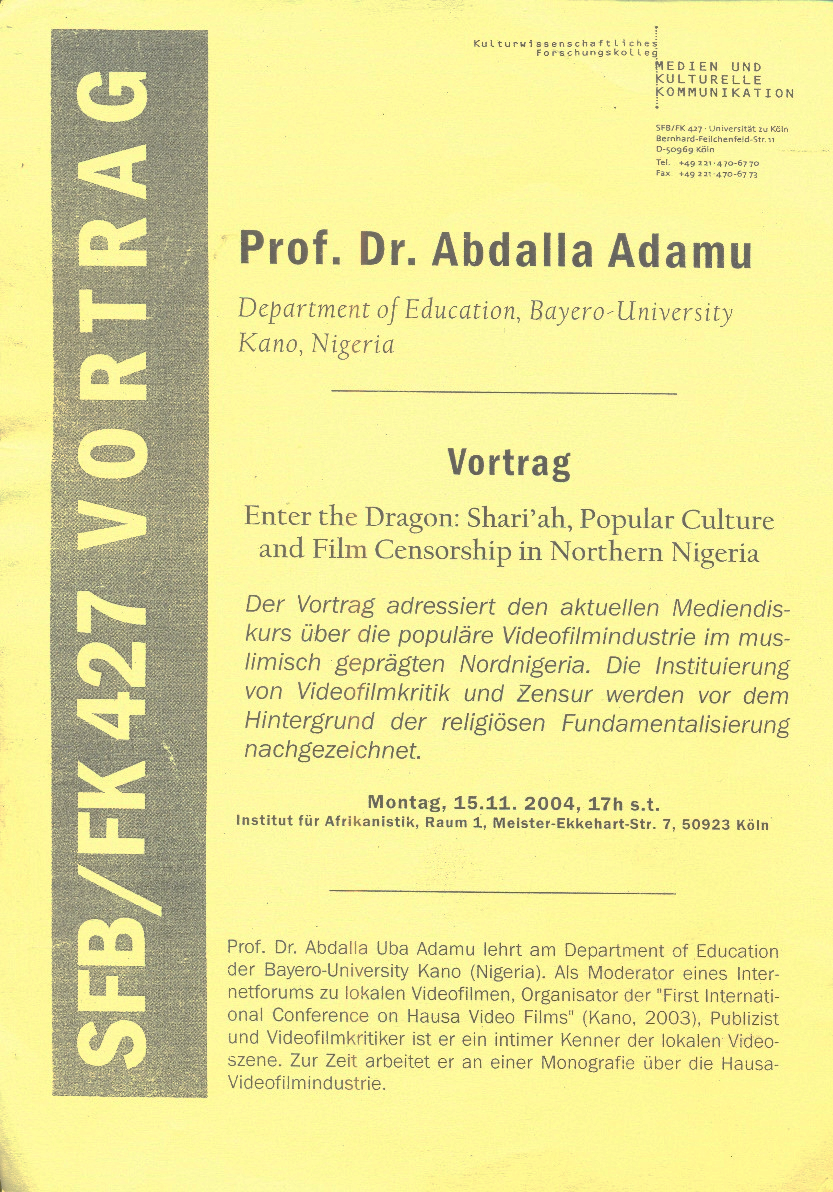
At the first event in Nairobi, I met Heike Behrend, who was also invited, and during an off-conference interaction over a cup of expresso (her favourite rendering of coffee!!) I informed her of my coming trip to Mainz for a conference. She immediately extended an invitation for me to come to the University of Cologne on my way to Mainz and present a seminar to doctoral students on any topic I like. This I did on November 15 2004 and presented a paper to the students. It was titled “Enter the Dragon: Sharī’ah, Popular Culture and Film Censorship in northern Nigeria.”
Vortrag
Note, from the poster, that I was still in the Department of Education. When I returned to Nigeria, I met Dr Gausu Ahmad, then Head of the Department of Mass Communication BUK, who insisted on the paper being presented at their own Departmental Seminar. Before that, I was already teaching Advanced Research Methods to postgraduate students and Online Journalism at all levels. Further, I was already working with a doctoral student in the Department. Unknown to me, Dr Gausu had already recommended my employment as a Part-Time lecturer in the Department of Mass Communication. A letter to that effect was eventually sent to me in November 2005. Earlier, the Department had requested my transfer from Education, but the Vice-Chancellor at the time refused.
The visit to Germany in 2004 was the beginning of a series of travels to various universities as a visiting lecturer/professor/guest speaker etc., in media and cultural production. These included the US (University of Florida, Gainesville; Rutgers State University of New Jersey; Barnard College, Columbia University), UK (School of African and Oriental Studies), Switzerland (University of Basel), Germany (Freie University, Berlin; University of Mainz; University of Freiburg; University of Cologne, University of Hamburg; Humboldt University), South Africa (University the Witwatersrand), and Cameroon (University of Yaoundé).
In November 2008, I was once more invited to Germany for an event. After my event at the University of Hamburg, one of the participants, Nina Pawlak from the Department of African Languages and Cultures, University of Warsaw, Poland, approached me and asked if I would like to visit Poland for three months as a Visiting Professor. I delightfully accepted. The funding was to come from the European Union under the program of The Modern University – a comprehensive support program for doctoral students and teaching staff of the University of Warsaw as part of Sub-measure 4.1.1 “Enhancing the educational capacity of a higher education institution” of the Human Capital Operational Programme, of the EU. After all the paperwork was done, I was eventually offered the Visiting Professor position at the Department of African Languages and Cultures, University of Warsaw, Poland, from March 1 to May 31 2012. I taught two courses: Transnationalism and Identity in African Popular Culture and Oral Traditions in Local and Global Contexts.
Prof. Abdalla Uba Adamu wrote from the Department of Information and Media Studies, Bayero University Kano, Nigeria. He is, among many other things, the former Vice-Chancellor of the National Open University of Nigeria (NOUN). He can be reached via auadamu@yahoo.com.
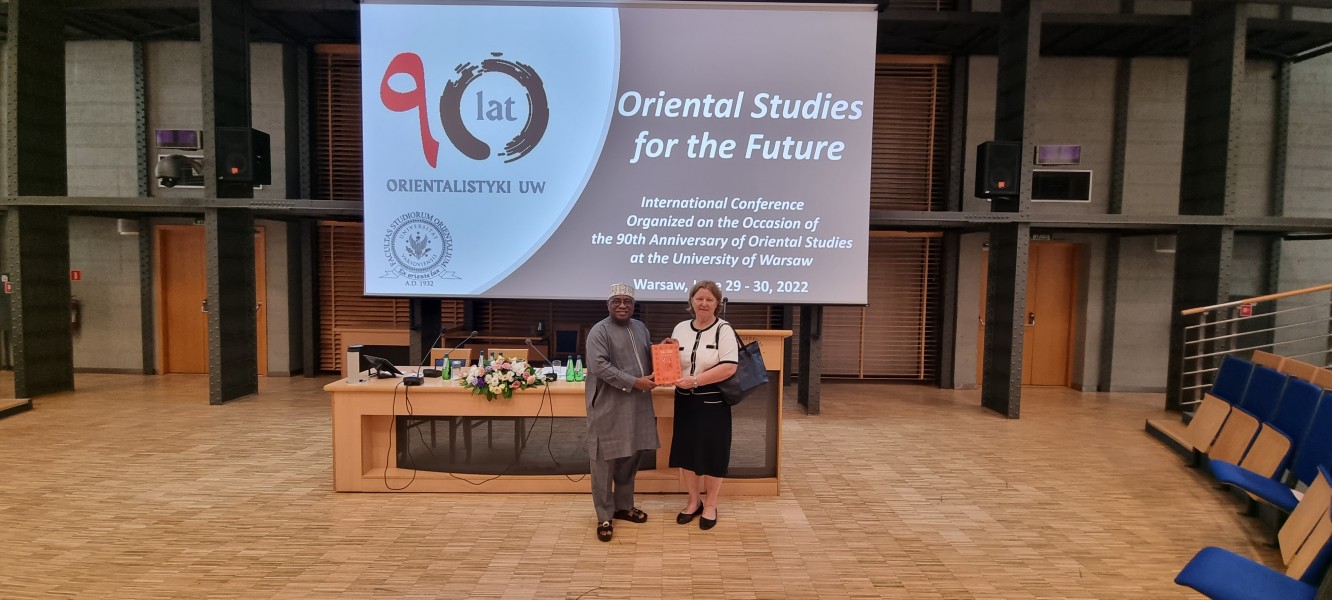
The academic world will never cease to amaze me. Let us look at just one example. Take an invitation to present a paper at an international event, as I was in June 2022. This particular event was the 90th commemoration of the establishment of Oriental Studies at the University of Warsaw, Poland. About 30 of us were invited, mainly from Europe and Asia, to share experiences on our various studies on orientalism from 29th to 30th June 2022.
The trip was daunting for me, to begin with. It started with an hour flight on Qatar Airways to Abuja from Kano (my base). I spent another hour or so on the ground at Abuja before taking off for the six-hour flight to Doha, Qatar. I spent over four hours meandering around the terminal at Doha, waiting for the connecting flight to Warsaw. Eventually boarded the five-hour flight from Doha to Warsaw. All told, about 17 hours journey time. Arrived at the hotel jetlagged, weary and disoriented.
Off the following day to the University of Warsaw for the two-day conference scheduled at 9.00 p.m. each day. And it was right on the dot, with welcoming remarks by Prof. Piotr Taracha, the Dean of the Faculty of Oriental Studies UW, followed by an address to the conference by Prof. Alojzy Z. Nowak, the Rector of UW. These were followed by two keynote addresses, then appreciation of retiring members of the university community who had been there for over 50 years, including my host, Prof. dr. hab. Nina Pawlak (that’s how distinguished academic titles are labelled in most Eastern European universities). Let’s see what the letters mean; prof stands for professor, while dr is the doctor. To be a hab, however, requires extra efforts.
To be awarded the academic degree of doktor habilitowany (habilitation), the candidate must have remarkable scientific or artistic achievements; submit a habilitation book which contributes to the development of a given scientific discipline; receive a favourable assessment of their output, pass a habilitation examination and deliver a favourably assessed habilitation lecture. It is after all this that they become professors.
Nina Pawlak received her PhD in 1983 (Constructions expressing spatial relations in the Hausa language), habilitation in 1995 (Syntactic Markers in Chadic) and professorship in 2007. Thus entitled to prof. dr. hab. status. The habilitation is a post-doctoral experience that is highly formalized, represented by a separate thesis or a compendium of outstanding work in the area that can be evaluated as making an original contribution to knowledge. It takes between four to ten years to complete. Its public presentation is something like an inaugural lecture before a professorship. In most cases, the habilitation is the qualification needed for someone to supervise doctoral students. So far, in Africa, only Al-Azhar University in Cairo seems to offer this route to university scholarship.
It is the habilitation qualification that will determine one’s path to professorship, but the publications required for skipping it to become a professor directly have to be more outstanding than the habilitation publication. This process shows rigorous respect for original contribution to knowledge in European scholarship. One can still be referred to as prof. dr. in recognition of their scholarship, without the hab. For instance, I was recognized as so by the European Union award of a grant to teach at the University of Warsaw in 2012. The prof. dr. title, used in mainland Europe and some Asian universities, acknowledges scholarship, even without the region-specific hab.
Now back to the Conference. No ‘Chairman of the Occasion’, or Lead Paper presenter, nor ‘Royal Father of the Day’, etc. Just presentations. Now that brings me to my wonderment about the academic process. After over 17 hours of flight time (and same hours returning back), like everyone else, I was given 20 minutes (which included being harassed five minutes to the end by the moderator) to present my paper titled The Trans-Oriental Express: Receptivity and Cinematic Contraflows in African Popular Culture, and 10 minutes allowed for discussions – and that’s it!
Thus, you spend weeks on fieldwork and data synthesis, spend hours being ferried from one location to another, and stay for days cooped up in a dingy hotel room (wistfully thinking about your own spacious personal living space!) eat some unusual and often very expensive food. All for 20 minutes of fame! This has been a recurring pattern in all the conferences I had attended.
So, what is it about, at least international scholarship, that people would rather read what you wrote than listen to you? In Nigeria, paper presenters tend to ramble way beyond their allocated time. Often, the moderator of your session is worried about stopping you because you are a ‘big’ man, even if you are talking out of point. I remember one case in which the ‘Guest Speaker’ was reminded that his time was up as per the ‘program of event’ (sic). He adamantly refused to heed the time and insisted that since he was the main ‘event’, he would only stop when he finished reading the booklet of his lecture, which was 32 pages! Thank God for Smartphones – people just ignored him and shifted their attention to their WhatsApp messenger and came back to earth only after someone started clapping to signal their relief at the conclusion of the presentation!
Perhaps it is time for us as Nigerian academics to move from this dense didactic approach to presenting papers – where you are often expected to give ‘theoretical framework’, ‘research questions’, ‘methodology’ (to appear ‘Scientific’ even if there is no Science in your conclusions) before you get to the actual data itself. And most annoying, you are also expected to give totally useless ‘recommendations.’ I had arguments with moderators and participants in Nigeria on the last point where I am asked about my ‘recommendations’ after my presentations. I often reply that I don’t have any recommendations – I present my data and my interpretation. How it goes is up to you. For instance, what can I recommend to a person who based their own narrative creativity on intertextual appropriation, thus creating a meta-narrative? That it has happened is fascinating enough. That I brought it to your attention is sufficient enough in knowledge discourses. In wider international scholarship, participants are more interested in exploring other aspects of your data.
I think our approach to conference presentations in Nigeria has vestiges of the didactic educational experiences we were grilled through. Under such an academic ecosystem, all research is geared toward policy and governance. It is time for a paradigm shift – cut down the number of minutes on presentation, and focus on the epistemological virtues of the presentation! Oh, and cut-off the prof’s microphone when he seems about to torture his audience beyond his allocated 15 to 20 minutes!
Prof. Abdalla Uba Adamu is the former Vice-Chancellor of the National Open University of Nigeria (NOUN). He can be reached via auadamu@yahoo.com.
This article was inspired by a post that I read on the Facebook page of Dr Muhsin Ibrahim, where he cautioned our youth against embarking on a perilous journey that may lead to their untimely death. However, while going through the comments, I was actually shocked by a statement made by someone who insisted on travelling to Europe through the Sahara Desert, despite warnings by the writer.
Of course, I know that life is tough in Nigeria, and many youths are jobless and hopeless. The high level of insecurity is worrisome in the North, as people are being hacked down to death daily without any concrete intervention from the security agencies. The deprivation is glaring on the streets all over the North, and people are looking for a way out. However, I will always advise people to travel legally anywhere or otherwise stay at home if they do not have the financial capacity to do so.
During my stint as a journalist in Sokoto a few years ago, I have written many articles about human trafficking and illegal migration. Unfortunately, this is a big business for many people in villages around the Illela local government area of Sokoto. Illela is a border town between Sokoto and Qoni in the Niger Republic. People are trafficked through these villages with the connivance of some youth in the villages. These nefarious people in the villages assist these illegal migrants by transporting them with motorcycles to the Niger Republic in order to evade immigration officers at the Illela border, who may likely prevent them from entering the Niger Republic en route to Libya and finally to Italy and other European countries.
Let me make it clear that life is not a bed of roses here, and the streets of Europe are not paved with gold. People don’t pick money on the streets. You have to work very hard to earn money. Although the government makes efforts to ensure a good life for the citizens, there are homeless people and beggars in Germany, the wealthiest European country. It is not a paradise as many of you may think or imagine in your dreams.
Life in Europe is akin to slavery for people without legal documents. First, life is tough here without legal documents. You cannot get accommodation, open a bank account, work, or visit the hospital without a resident permit. My first time at a clinic to see the doctor in my city, I was asked to present my residence permit and health insurance card; otherwise, I won’t be able to receive treatment. Thus, I presented my documents, which they quickly confirmed before treating me.
Many young men are being lured by the success stories of those who travelled illegally to Europe through the Sahara Desert in the past and believed they too could achieve success if they endure tribulation and go through pains. Although not all those who follow the pathway of illegal migration end up in agony, most live as enslaved people here.
Of course, I know and have met some of them who came to Europe through the Sahara Desert and Libya and are doing well here. For example, I know a Hausa guy from Kano State who lives in my city with his family and owns a clothing shop. He told me gory tales about his movement from Sokoto to Agadez in the Niger Republic and the perilous journey through the Sahara Desert to Libya, which lasted eight days. He spent about one year in Libya doing menial jobs before he summoned the courage to cross the Mediterranean with a boat carrying many people to the island of Lampedusa, Italy, 11 years ago.
According to this Kano guy, they took the boat early in the morning from Libya and were rescued at noon by coast guards who later ferried them in their boats to Lampedusa. He subsequently left Italy for Germany eight years ago and is now a legal resident here. He speaks fluent German and carries out his business diligently.
A few of them in my city came through that perilous route and are now established in Germany, doing meaningful jobs while contributing to the country’s economy. But their trajectory may not be the same as yours as everybody has his own destiny and luck. So many people have died in the Sahara Desert even before reaching Libya, while some have died trying to cross the Mediterranean Sea, yet our youth are still not deterred despite such deaths.
The fact of the matter is that many people who came through the illegal route are wallowing in misery and deprivation. Most of them are trapped in refugee camps scattered in most cities across Germany. I have been to the refugee camp in my city twice and witnessed how these people live. It is a kind of glorified prison, though they can still go out and even work illegally without the knowledge of the authorities. They do “black jobs”, which are very low-paid jobs that do not require documents and are usually paid directly after their labour but not through the banks.
I met a Ghanaian last year whose name is Idrissa. He left the refugee camp in Munich, the southern part of Germany and is now hiding in my city doing menial jobs. According to him, he feels terrified whenever he sees the police and usually gets scared of commuting by public bus or train for fear of being arrested. Unfortunately, this is the type of life those with illegal documents live here. In fact, at the peak of the Corona pandemic last year, this Ghanaian could not get vaccinated because no hospital would vaccinate him due to a lack of legal documents.
Some of these illegal immigrants, desperate to get legal documents for them to be able to work, get entangled with old German women that are old enough to be their grandparents under the guise of marriage and are treated as slaves. Of course, the German women are aware that they want them only because of their residence permit and make sure they go through excruciating pains.
I decided to write this article in order to alert our youths on the dangers of travelling to Europe through the Sahara Desert and the Mediterranean Sea. If your dream is to travel to Europe, then try to go through the legal way. You can go either through the study route, a scholarship or a job based on your skills. I know that many people get jobs with the skills they acquired in Nigeria, such as doctors, nurses, engineers, and those in data science and information technology, among others. Travelling legally is the only way to move freely without humiliation abroad due to a lack of legal documents. May Allah make things easy for all of us, amin.
Aminu Mohammed is at the School of Sustainability, Chrtistan Albrechts Universität zu Kiel, Schleswig Holstein, Germany. He can be reached via gravity23n@gmail.com or 219013@mail.uni-Kiel.de.
One could succumb to knowing why Europeans and Americans are so obsessed with photo-keeping culture. Every fragment of their life, whether small or insignificant, is captured in a photo collection that will be made available on display or neatly hidden in a safe for future use.
Although that is not part of my culture, I can reason that they keep a photo collection, contrary to what we think. The Europeans do that to keep memory down history lanes – pedigree, simply because, at times, that is one heck of a thing one can grow up to know about their family. For example, parents die leaving behind their children at much younger ages; the lost ones, the adopted ones, and those who find themselves in the orphanage may get to know and connect with their past from photos made available to them.
That’s their pop culture right before the present day when digital tools made photos even easy to capture and share with FAF, even on the go. But, unlike photo cards, digital images travel far away and faster than we can ever imagine. It also keeps memories longer than photo cards, free from any physical damage, such as loss, overuse, fire and water consumption, etc.
Despite the importance of keeping photos, I feel that we overdo it. Nowadays, we take unnecessary images that we could not even keep, and recently, it’s becoming like an addiction. We just found ourselves taking photos that are not only insignificant but smartly improper that sometimes pose threats to our peace of mind.
On many occasions, photos land us in big troubles: many people lost their jobs, some were convicted and tried; it broke marriages, shattered dreams, and made rich people poor. However, sometimes the photos we take belie our sense of humanity. For example, sharing pictures of victims of a ghastly accident is more horrible than sharing nudes.
Although photos motivate and make things extremely simple, sometimes they appear to be fallacious and discouraging, and when that happens, it does more harm than the purpose it was captured for. Thus I advocate for photos for a good cause.
It appals me to see the Muslim North divided on a trivial yet substantial religious issue like ‘interfaith’. I have for long heard Muslim clerics discrediting the whole idea of interfaith since the establishment of its centre in Bayero University Kano – one of North’s prestigious universities, something which was otherwise not their business. Still, thanks to this institution, interfaith is now localized enough to get such stimulating clerical attention in Northern Nigeria.
Having had the opportunity to study Islamophobia exploringly, I would say interfaith is significantly relevant where the identity of Islam is greatly contested. By definition, interfaith, whether as a dialogue in research or academic discourse, revolves around the peaceful, complaisant, and constructive interaction between people of different faiths for mutual benefit. It involves striking balance, a tolerable understanding of such interrelationships and beneficial engagements through dialogues, academic events, and activities aimed at peaceful coexistence. To say all these aren’t relevant for a Muslim community is a dismal misunderstanding of the whole concept and reasoning of interfaith.
The world witnessed an unprecedented rise in Islamophobia shortly after 9/11; statistics show that Islamophobia reached its peak in 2016. If you reside in the Western world in the decade after 9/11, you will understand the intricacy of the threat Islamophobia puts Muslims into. Especially for Muslim women who are more obviously identified than their male counterparts. Muslim women were subjected to hate speech, discrimination, and abuse, thanks to the incessant misrepresentation of Islam and Muslims in the Western media. Since the Muslims are a minority in such Western countries, their religious identity was at stake. As such, the results were provocative political discourses, foreign policies and the whole activities of the Islamophobia industry vigorously tarnished the image of Islam beyond doubt.
Islam was always portrayed as an intolerant and backward religion that advocates terrorism. Muslim men are seen as utter misogynists, violent, barbaric, and bloodthirsty fanatics, while Muslim women are said to be oppressed, voiceless, helpless, and subordinate in dire need of immediate liberation. Now, this has been the case centuries before 9/11, but the Orientalism surged after 9/11 because there was an agenda to create fear of Muslims and control the world using that purported fear—New World Order?
Consequently, 9/11, subjugation of women in Afghanistan, terrorist activities by ISIS, Boko Haram etc., were leveraged as justifications for those claims. The average Westerner believes every accusation about Islam and has little or no interest in discerning the images. One may ask, so what if they believed?
The consequences are bigotry against Muslims, vandalism of religious places, hate speeches, discrimination, loss of jobs (or other vital opportunities), rejection in the community they ought to belong to, and the worst is loss of lives. We have seen so many Islamophobic attacks on the Muslims, the New Zealand mosque shootings, for example. This misconception renders the Muslim communities in the West vulnerable. It puts them in constant fear of perceived danger and, consequently, loss of faith. Yes, look at it from the perspective of younger generations struggling to fit in.
Among many other factors, I acknowledge the efforts of Yaqeen Institute by Sheikh Omar Suleiman, a Palestinian American scholar. He has taken the lead in fighting Islamophobia through interfaith dialogues, among other methods. Why shouldn’t the Muslims engage in interfaith dialogue when it has been an avenue for discussing the Muslims’ predicaments? It has given Muslims a platform to talk about their real lives and share their religious practices contrary to the media’s narrative.
Interfaith dialogue has helped quell the flame of hate. It has given Muslims the room to openly operate as an inclusive religion – with lots of global moves to ascertain cultural harmony. It has opened laypeople’s minds about Islam which they would otherwise have remained unaware of. It has opened the door for discussion of religious differences politely and positively, which pushed many non-Muslims toward studying Islam.
Do you know the result of this increased curiosity about Islam? Acceptance of Islam, the Christian West has seen rapid growth in conversion to Islam. So, where is that extreme hate of Islam/Muslims today? Alhamdulillah, there is a significant improvement in the situation, thanks to interfaith dialogue, among other efforts taken by anti-Islamophobes.
So is interfaith precarious to Muslims in Nigeria? Why all the debates?
Would Nigerians understand the need for an interfaith dialogue without foreknowledge of Islamophobia, global diplomacy and religious inclusiveness? It’s a fact that Muslims aren’t a minority in Nigeria, but ethno-religious crises are still ravaging, in the North especially; crises in Jos and Kaduna would have been addressed amicably if the interfaith dialogue was well embraced. It is utterly disconcerting to say that, in this age, people are having religious disputes.
Similarly, Boko haram has been synonymous with Islam in Nigeria in that it is always referred to as an ‘Islamic terrorist group’. Don’t we need to dispel the myth of Islam advocating terror in Nigeria? Are Muslims too big to have a peaceful inter-religious conversation in Nigeria? Are we blind to the fact that Islam is under attack in Nigeria? When professor Farooq Kperogi wrote on Islamophobia in Yorubaland, I was bemused because I never expected that of all the tribes in Nigeria, Yorubas would discriminate against their tribespeople based on religion. The rapidity at which Islamophobia is manifesting in Nigeria is quite alarming. Nigerian Christain’s support for Donald Trump in the last election spells out their desperation for Muslims’ continued exclusion.
Religious harmony is still farfetched in most regions of Nigeria. We are just pretending to be harmonious and tolerant. Little wonder how minuscule events easily trigger provocation. We need to talk about our differences positively and engage in healthy interactions to progress as a nation. Colonialists already bond us together, so unity in diversity becomes a necessity. Or do we wait until our children begin to ask us questions before we get to talk about our differences nicely? If not for anything, interfaith in Nigeria will allow non-Muslims to learn about your faith – Islam. Isn’t that a form of da’awa?
My research acknowledges how interfaith dialogue in the US, Europe and other parts of the world contributed to the curbing of Islamophobia by promoting peaceful coexistence. So to use religion to relegate the whole idea is quite imprudent. To quote Shafiq, Muhammad, and Mohammed Abu-Nimer, the authors of Interfaith Dialogue: A Guide for Muslims, “although a relatively modern term, interfaith dialogue has, in fact, had a long and enduring history for Muslims, underscored by a spirit of genuine inquiry and respectful exchange. The primary role of interfaith dialogue is to remove misunderstanding and accept difference….”
Some Ulamas in Nigeria have taken a critical stance on this matter. I listened to one yesterday opening that interfaith is an extension of secularism. While I appreciate his disposition, I beg to disagree that ‘we don’t need interfaith’ due to his stated reasons. It should be at the participant’s discretion to know the aim of every dialogue before engaging in one. My focal point is that whoever participates in interfaith dialogue should be cognizant of their religious jurisdiction and wary of their intentions. I kindly advise our Ulama to focus on ways to religiously liberate the Northerners from the abject poverty that has infested this region instead of the debates surrounding the appropriateness of interfaith – which is long overdue.
Dr Sadiya Abubakar Isa is interested in research related to Islamophobia. She can be contacted via sadeeyaa@yahoo.com.
The invasion of Ukraine by Russia is a “catastrophe” for Europe, according to British Prime Minister Boris Johnson, who has asked for an emergency summit of the NATO military alliance led by the United States.
He was quoted as saying on Twitter: “This is a catastrophe for our continent.”
Mr. Johnson added that he would make a national address on the developments.
“I will also speak to fellow G7 leaders and I am calling for an urgent meeting of all NATO leaders as soon as possible,” he said.
President of Ukraine Volodymyr Zelenskyy calls on citizens to fight
Zelenskyy has appealed to all civilians who are willing to protect Ukraine against Russian soldiers to come forward, stressing that Kyiv will provide firearms to anyone who requests them.
Ukrainian President Petro Poroshenko also urged Russians to resist Moscow’s plan to invade their country’s neighbour.
Recall that Russian President Vladimir Putin has ordered the launch of attacks on parts of Ukraine as part of the move to support intending breakaway regions in the Eastern part of the country.
The attack has caused outrage and condemnations from world powers as citizens flee Kyiv, the Ukrainian capital city, although Putin stated that the attacks were not targeted at unarmed civilians.
Ukraine claimed that it had shot down fighter jets belonging to the Russian forces stationed in the unresting part of the country.
The worsening fuel scarcity that hit Kaduna State has forced several motorists to abandon their vehicles in queues at many filling stations when petrol was not available to go back home.
The Daily Reality visited some filling stations and observed that long queues have risen exponentially. Motorists were seen in the early hours, precisely, 6.30 am, queueing at Mobil Fuel Station, Independence Way, Kaduna, where PMS was dispensed via only one nozzle point with four orders inactive.
Also, at the filling stations on Constitution Road, Ali Akilu Road, Yakowa Way, among others, fuel attendants were seen turning back motorists.
The development came almost one week after the import of millions of dirty PMS from Europe into Nigeria disrupted the fuel supply system of the country, leading to long queues nationwide. The situation has resulted in total confusion and long lines of vehicles at various filling stations in the metropolis.