China

Kano: Chinese Business Community condemns murder of Ummita

By Ahmad Deedat Zakari

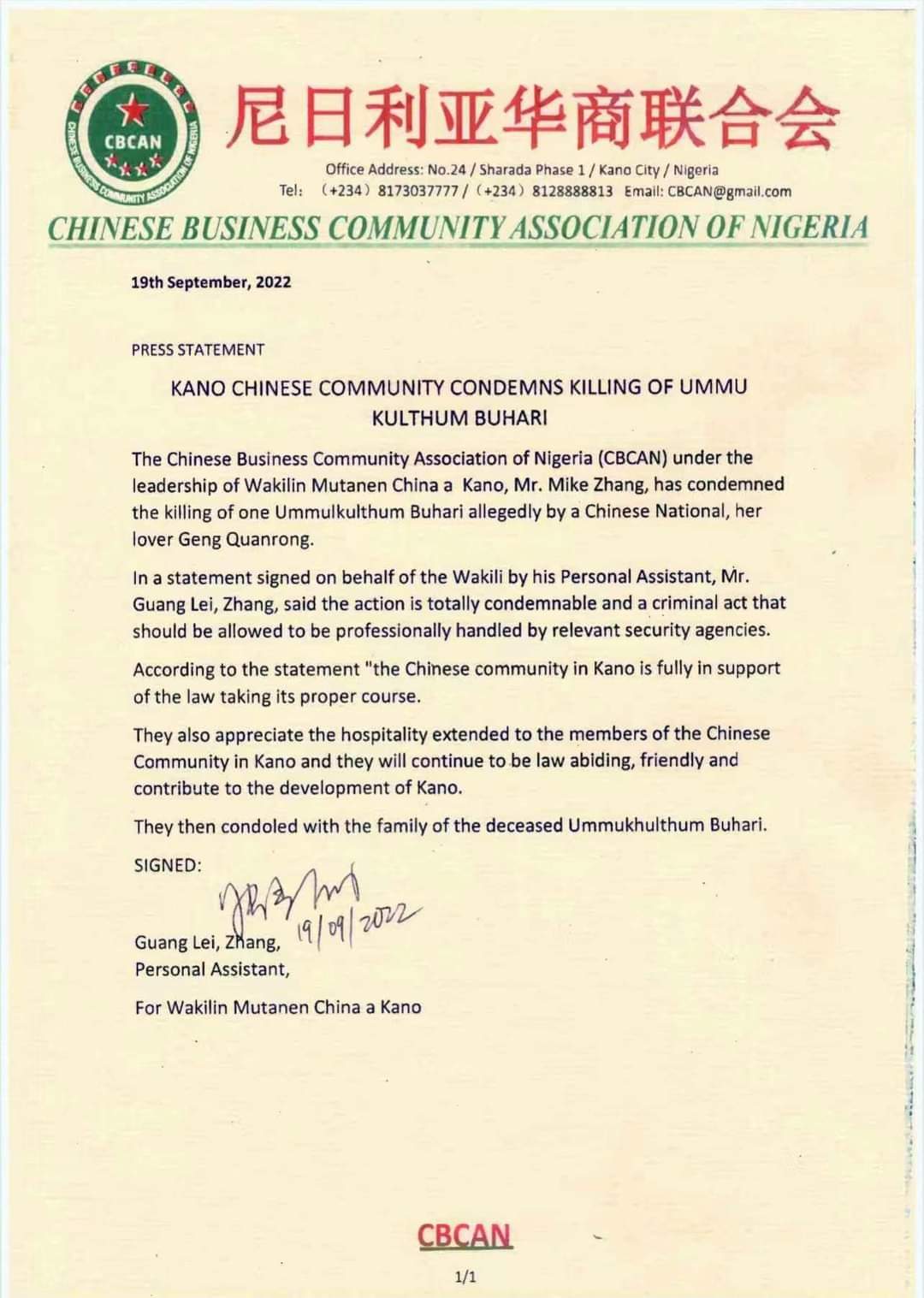
The Chinese Business Community Association of Nigeria, CBCAN, has condemned the murder of Ummu Khulthum Buhari, alias Ummita, in Kano.

This was made known through a statement released on behalf of the Wakilin Mutanen China a Kano by his personal assistant, Ghuan Lei Zhan on Monday.

“The Chinese Business Community Association of Nigeria (CBCAN) under the leadership of Wakilin Mutanen China a Kano, Mr Zike Zhang, has condemned the Killing of Ummukuthum Buhari allegedly by a Chinese National, her lover Geng Quarong” Part of the statement reads.

The Chinese Business Community also said it supports law to take its proper course.

Ummukuthum was allegedly murdered by her Chinese lover on Friday night. Her murder has generated outrage on social media. Many people expressed concern over crimes allegedly committed by Chinese nationals working in Nigeria.

Sadiq Baba Abubakar: A victorious political warrior

By Mukhtar Jarmajo 

Mao Zedong, the founder of the Peoples Republic of China, once said, “Politics is war without bloodshed while war is politics with bloodshed.” By inference, thus, there is so much correlation between politics and war, the only difference being that the former isn’t bloody while the latter is. Therefore, the art of politics is the same as that of war, where two or more opposing parties contest for supremacy either in terms of votes for political power as with politics or territorial control as with war. Additionally, politics and war involve strategies to subdue the opponent through deceptive techniques. 

Perhaps this is why Sun Tzu, the great Chinese writer, philosopher and war strategist, noted that while differentiating victorious warriors from defeated ones, “Victorious warriors win first and then go to war, while defeated warriors go to war first and then seek to win.” Aside from that, Sun Tzu emphasised the importance of strategy in war. He also meant that only warriors who adopt strategies in defining the means to conquer the enemy are victorious. The third import of Tzu’s quote is that strategists conquer their opponents well before the offensive is launched. 

So just as wars can be won and lost before the first Salvo is released, elections too can be won and lost even before any vote is cast. Meanwhile, it bears no repeating that only strategic politicians achieve such excellence. They study the prevailing political circumstance, analyse it based on the ambitions of the time, and then meticulously plan the best strategy to be used in conquering the opponents. Politicians such as the Bauchi state APC governorship standard bearer, Sadiq Baba Abubakar, are victorious political warriors simply because they understand the art of political warfare. 

During the governorship primary election in Bauchi state, the erstwhile Air Chief turned political czar and let his fellow contenders believe they were more political than him. Therefore only they knew what the road to winning the party’s ticket looked like. After the contest, Sadiq Abubakar won the day, with the runner-up placed at a distant 92 votes away. While they were reluctant that he was not a factor to count, Sadiq Abubakar campaigned vigorously and reached out to stakeholders and delegates to convince them of the substance and import of his ambition. 

In the end, they were convinced that aside from experience he would bring to the table, the erstwhile diplomat is one politician capable of giving the ruling PDP in Bauchi state a run for its money. Thus, he won the primary election before the first ballot was cast. And by Sun Tzu’s standard, Sadiq Baba Abubakar is a victorious political warrior. It raises no eyebrows that as a graduate of political science who also holds a master’s in strategic studies, the Bauchi APC governorship standard bearer can do even more than this. 

Jarmajo can be reached via dattuwamanga@gmail.com.

Drug abuse and illicit trafficking

By Tajuddeen Ahmad Tijjani

Every 26th day of June is the International Day against Drug Abuse and Illicit Trafficking as identified by the United Nations. This year is not unprecedented due to the menace that keeps rising, which sadly causes untold hardship to our communities and the world in general.

The date is to commemorate Lin Zexu’s dismantling of the opium trade in Humen, Guangdong, ending on June 25, 1839, just before the First Opium War in China. The observance was instituted by General Assembly Resolution 42/112 of 7th December 1987. The global observance of the day aims to raise awareness of the major dilemma that illicit drugs represent to society. Indeed, the aim is an expression of the United Nations’ determination to strengthen action and cooperation to achieve the goal of an international society free of drug abuse.

Justice and health are two sides of the same coin when it comes to addressing drug problems. The pertinent question is: what have we done in our immediate communities to address this situation that is posing a danger to our survival as a society and a nation? Are we to maintain silence while the future of our children and that of unborn children is on the brink? No! Most of the crimes committed were done after the criminals took drugs and illicit trafficking caused, according to sociological trumpets.

In Nigeria, the Boko Haram in the Northeast, ungodly bandits and kidnapping in the North West, and the IPOB terrorists in the southeast have something in common, which is criminality, havoc and destruction. However, the acts were mostly committed after taking unprescribed drugs, which are injurious to the health and well-being of the people.

Perhaps, those taking illicit drugs don’t know the dangers and injuries they create for their lives and, at the same time, for society. It’s the drug that impels them to commit crimes against humanity, which, of course, triggers instability in the world. However, there has never been a better time to convert this serious threat into a human cooperative existence than now. But, to achieve this, we must destabilise the sources of illicit drugs.

For one thing, you can’t discourage and combat illegal drugs and trafficking without addressing irresponsible parenting; how could God bless you with juveniles and then neglect their proper upbringing? In our society, you see someone with ten youngsters or more without taking care of their full responsibility. We must take the bold step and tell ourselves the truth. Never produce what you can’t take care of. Their moral upbringing is a primary responsibility of every parent. The association of pair groups in such a way trains your wards to be good ambassadors to society. for them to be productive citizens of the country and the world. 

The Nigerian drug law enforcement agencies must take their obligations with all seriousness. Indeed, perpetrators must be punished according to the law of the land. This is the only way that will serve as a deterrent to all with similar horrible intentions, and of course, at the same time, our justice system must be overhauled.

It’s clear in the northern part of the country, some hawkers go round selling illicit drugs, expired and villagers are taken with their hard-earned resources without doctors’ prescriptions, which post hazards to the health care system. This and similar illegal actions should be properly checked. Indeed, health is wealth. We should all play our part in spreading awareness to make our environment clean and live in a prosperous world.

Tajuddeen Ahmad Tijjani wrote from Galadima Mahmoud Street, kasuwar Kaji Azare, Bauchi State.

Why Kwankwaso deserves more accolades

By Najib Ahmad, PhD

We often hear people saying that ‘he [Sen. Rabiu Musa Kwankwaso] did it with the government funds.’ And so? Oh, you expect him to do it with his money; then, you will ponder whether he’s worthy of their gratitude. But, this is not how things have been done right from the inception.

If you read over the history of the previous great Muslim rulers like Umar Ibn Abdulaziz (61-101 AH), may Allah have mercy on him, you will realize the incredible impressions he left on people despite being a caliphate for a short period. But, it is known that all he had achieved and built weren’t from his funds. Still, he’s remembered and admired.

People often appreciate the history of how other nations developed, which primarily transpired through human development. But, for example, how do you think today’s China and Singapore got it right? Do you think they only wake up to all this in the morning? No, it was because some leaders decided to do it right and went on to create policies that enabled them to reach where they are today.

For instance, if you take China, they unconditionally relish Deng Xiaoping – the architect of modern China. While Singapore’s Lee Kuan Yew is also highly recognized as the founder of modern Singapore, they constantly appropriate him for its development. During their time as leaders of developing nations, all they have accomplished weren’t with their funds but with the government funds.

Those leaders’ priorities then were primarily policies on education and the industrial revolution transformation. Sending students, including the peasant farmers’ children, to universities worldwide via scholarships was part of Mr Xiaoping’s most significant policies that China benefited from. His initiatives have matured into a whole system, i.e., the China Scholarship Council (CSC) and China Postdoctoral Science Fund. This remarkable initiative alone helps them strengthen their universities and vocational colleges with a quality workforce and, in turn, enables them to become the world’s industrial powerhouse.

Today, check all your household belongings to verify the above. Those two leaders are still relevant in China’s and Singapore’s present days. You can’t underestimate their significance no matter how you try due to the enormous opportunities and equal advantages they created for their people.

I understand your frustrations, which is why one person out of more than 12 million people of Kano is receiving too many accolades. First of all, it is their choice to appreciate him, mind you. This is because he means so much to them. The good thing is, you can’t deny them this satisfaction even if you try. So, why the resentment? Allow those that prefer to do what suits them to continue thanking and re-thanking him till the end of time, if that is their wish. What’s your problem with their choice, fisabilillahi?

Above all, the main thing to look at is that appreciating Kwankwaso’s effort doesn’t physically hurt you or anyone else or destroy any of our fundamental values. In fact, it is teaching people to learn to recognize good deeds and be thankful to whoever is responsible or part of their progress in life. Isn’t this a harmless mannerism to learn, emulate, and propagate?

Dr Najib Ahmad is a Postdoctoral Researcher at Shandong University, China. He can be contacted via namuhammad03@gmail.com.

N/Assembly urges China to help Nigeria rescue abducted train passengers

By Uzair Adam Imam 

The National Assembly urged the Chinese government to help Nigeria rescue the Abuja-Kaduna abducted train passengers.

Today marks exactly 45 days since the 62 passengers were attacked and abducted while in transition on March 28, 2022.

The Daily Reality reported how bandits stormed the Abuja-Kaduna train, gunned down eight people and abducted over sixty people in March. 

The Chairman Senate Committee on Land Transportation, Senator Abdulfatai Buhari, expressed sadness over the failure to rescue the victims 45 days after.

Also, the people concerned have shown great sadness over the government’s failure to rescue their loved ones and threatened that the train service must not resume until those abducted have regained freedom. 

The lawmaker representing Oyo North in the National Assembly decried that the attack had created fear in the minds of Nigerians who had started embracing the railway.

He said, “The Chinese government makes money from the many rail projects that are being handled by CCECC in Nigeria, so asking them to help us is not out of place.

“Nigerians are no longer ready to listen to the number of passengers that have been carried by the trains since they were commissioned. Nigerians are not interested in what has been put in the various stations by the CCECC. What we want to hear now is the effort being put into rescuing those people in captivity.

“If a Chinese national was among those people abducted, we know that the Chinese government would have come to rescue him.

“I remember when an American was kidnapped, the Americans came and took him away from where he was held captive. We know that with the level of technology that the Chinese have, even without leaving Beijing, they can help us track where these people are, or even give us enough intelligence that would aid their rescue,” he added. 

TikTok and selling immorality to consumers on the internet

By Yahuza Abdulkadir

A source culled from Wikipedia says that TikTok, known in China as Douyin, is a video-focused social networking service owned by Chinese company ByteDance Ltd. It hosts a variety of short-form user videos, from genres like pranks, stunts, tricks, jokes, dance, and entertainment with durations from 15 seconds to three minutes. TikTok is an international version of Douyin, released initially in the Chinese market in September 2016.

However, I was not a user of TikTok until a few weeks back when a friend gave me the hint to start using the app to promote my art by creating short videos of spoken word poetry. And then, I came to learn young people use the platform to showcase their talents in comedy, singing, dancing and other forms of entertainment through creating short videos and sharing them across a community of users.

However, after launching my account, I felt it was boring for people like me to find comfort there. The only person I was able to follow was Alhan Islam because I am interested in what she does. After a few days, I could no longer log in to the app again.

As of January 2022, out of the 4.8 billion social media users globally, TikTok has 1 billion active users, earning a spot in the six most famous social media platforms. Cloudfare’s 2021 Year In Review puts TikTok as the most famous website in 2021, surpassing even Google. Tiktok net worth is $50 billion in 2020 and now nearly $75 billion in 2022. Despite the nature of content promoted on the platform, one may want to know that so many individuals earn huge amounts of money through their videos’ engagements.

According to Forbes Magazine, a 17-year-old American social media personality and dancer, Charli D’Amelio, the most followed video-creator on the platform, earned $17.5 million in 2021, making her the highest-paid TikToker of the year.

I read many articles on Facebook and other blogs where people lament the platform to be a weapon for killing the young women in this generation. They said most of the videos created by users promote indecency and immorality. But recently, I found out that it’s not only in Nigeria that such content is being promoted; it’s almost everywhere globally. This made some countries take legal action on the matter. Countries like Pakistan has imposed and lifted four bans on TikTok, tagging the platform to be responsible for promoting immoral, obscene and vulgar content.

Bangladesh government also involved itself in the war against pornography to save children and adults from moral and social degradation by blocking the platform’s internet access. TikTok was also temporarily banned in Indonesia in the year 2018. The Indonesian government said the platform has a lot of harmful content to children.

In 2020, the platform was also banned by the Indian government to protect the data and privacy of its citizens from threats that have to do with national security, and they tagged the platform responsible for promoting inappropriate content. As a result, the platform lost 167 million users in the country. What would surprise you is that even China has banned the use of this platform.

This shows that the Nigerian government can also ban TikTok if it wants to. Do you think it’s not possible? I think it’s possible if we look at the “Twitter ban saga.” Unless the government thinks the use of this platform has no consequence on their side. If that’s the case, we need to go back to our homes and solve the problem. As people would say, “Charity begins at home.”

We shall all know that social media platforms are there to serve a purpose, and if it turns out that we tend to lose our good morals and forget where we came from by joining the trends and “feel among syndrome” – showing the world how indecent we are, then we have deceived nobody but us. So I think good characters matters the most.

Furthermore, it’s disheartening to see the young women in the Arewa community selling their body parts on cyberspace, not only on TikTok. This occurs almost on every social media platform. It’s a massive disappointment to our cultures and values. Whatever one might engage in, they should know “the internet never forgets.”

Yahuza Abdulkadir wrote from yahuzaabdulkadir50@gmail.com.

Chinese-based company, Hikvision, certifies 14 Engausa apprentices

Hangzhou Hikvision Digital Technology Co., Ltd., often shortened to Hikvision, is a Chinese state-owned manufacturer and supplier of video surveillance equipment for civilian and military purposes, headquartered in Hangzhou, Zhejiang. The Chinese government owns its controlling shares. 

As part of the company’s mission to expand operations in northern Nigeria and Sub-Saharan Africa, Hikvision trained and rigorously assessed the theoretical and practical capabilities of 14 apprentices at the Engausa Global Tech Hub in Kano, Nigeria.

Impressed by the individual performance of the apprentice after the certification exams, the company has agreed to register Engausa Global Tech Hub as a Hikvision Training Academy, the very first training ever in northern Nigeria. 

We are joining the general public to congratulate these 14 Engausa apprentices that bagged Hikvision International Certification on CCTV tagged Hikvision Certificate Security Associate (HCSA-CCTV).

Recall that the founder/CEO of Engausa Global Tech Hub, Engr Mustapha Habu Ringim, has bagged a similar certification from Hikvision two years ago. And this makes a total number of 15 certified professionals in HCSA-CCTV. 

Nigeria’s education system: An incubator of job seekers or providers?

By Salisu Uba Kofar-Wambai  

Functional education is the key to solving most of the joblessness and unemployment predicament Nigerians face today. Therefore, the philosophy of education matters a lot. Moreover, the kind of philosophy under which a particular curriculum operates determines the quality of graduates a particular system of education breeds.  

The idealism philosophy, which Nigeria’s education system subscribes to, contributes grossly to the condition of our graduates. They frequently end up chasing shadows, seeking jobs when in reality, there’s none. This is because the idealism philosophy emphasizes and dwells so much on book knowledge. The students are made to jampack and cram all the knowledge and ideas in their heads, but practising the knowledge is ultimately zero.

In other words, the idealism philosophy thrives in theoretical aspects. And this British model has since been abandoned by many countries of the world, as it has no successful ends and doesn’t suit 21st-century challenges.  

However, more innovative countries like China, Germany, and Japan that adopt a pragmatic philosophy of education in their curriculum are getting it right regarding employment issues. Most of their graduates are fully equipped with the specific skills required to handle jobs effectively and efficiently. Moreover, even before graduation, their students are already into temporary employment. 

The functional education practised in such countries has made their graduates vibrant job-providers instead of perpetual job-seekers we see here in Nigeria.  

It is a mammoth challenge for our education policy formulators to do the needful. They should help us migrate from idealism to pragmatism as a system. Students will then have practical skills or functional education that will enable them to establish their businesses based on their acquired skills, not just memorizing books and blowing grammar all over.

When a mechanical engineering professor could not repair a simple technical fault on his car until he refers it to a local technician, you know there’s a massive challenge with such a system of education.

I think these entrepreneurial studies and industrial training introduced by our institutions of learning are equally astute and sagacious towards achieving the desired goal. But they’re not close to where we’re aiming at. So, we must change the philosophy in its entirety first to have enough roadmap on the ground.   

The sooner we migrate, the better for us.

Salisu Kofar-Wambai wrote from Kano. He can be reached via salisunews@gmail.com.

Who will save the Nigerian donkeys?

By Aliyu Nuhu

It is indeed a horrible time for the Nigerian donkeys. Each day about 5000 donkeys leave the Maigatari market in Jigawa State to the East, where they are consumed as meat by many households.

That is just one statistics from Jigawa State alone. Some 15000 donkeys also passed from North East and the Niger Republic to the South East, mostly Agbor, Anambra, Onitsha, Enugu and Abakalaki, to meet a similar fate.

Now it seems the donkeys are in for bigger trouble as the Chinese have also developed an appetite, particularly for their meat and skin. As a result, demand for donkeys has tripled over a short period. Meanwhile, the donkey is not bred in Nigeria on an industrial scale, and it is an animal that does not multiply with its very slow birth rate.

It is terrible enough to consume the gentle beast locally but worse to see it exported to China. Then who will save the donkey?

States in the North should legislate against the trading of donkeys for export to other parts of the federation. Already the price of a donkey that used to be between 8000-10000 naira has hit 35000 naira, making it well above the means of the local farmers who use it as rural means of transport.

The Federal Government must urgently place a ban on the exportation of donkeys and their by-products to the outside world, for now, China.

Aliyu Nuhu is a popular social commentator. He lives in Abuja, Nigeria.

Afghanistan: Superpowers’ invasion and history of resistance

By Aminu Rabiu Kano


The history of Afghanistan is one characterized by epic tragedy. The narrative of the “Afghan problem” has been diverse, with each actor telling their side of the story in a bid to justify their action or inaction as the case may be. A poor, landlocked Afghanistan is one of the few countries in the world which events happening in and around it have been dominating the headlines for decades. Both the mainstream and social media are obsessed with happenings in the country. Indeed, even the layman on the street is more or less interested in the Afghan problem to the extent that virtually everyone can say one or two things about it. The question that follows, therefore, is, why is the world interested in happenings in Afghanistan? In other words, why are developments in Afghanistan capable of generating reactions around the world? Also, why have the superpowers in history found it necessary to invade Afghanistan?


To answer the above questions, we must begin by establishing the geopolitical relevance of Afghanistan on the world map. Afghanistan is doubtlessly strategically located. It is at the crossroads of Central and South Asia. It borders Pakistan, China, Iran, Turkmenistan, Tajikistan and Uzbekistan. It is predominantly mountainous and inhabited by approximately 32 million people – nearly 45% of whom speak the Pashtun language. Moreover, the Afghan population is primarily Muslim. This reason, coupled with the fact that it borders Iran, Afghanistan is sometimes seen as a part of the “Wider Middle East.”


From the list of the countries bordering Afghanistan, one will realize the geographical importance of Afghanistan in the international political environment. Of the five countries that bordered it, Iran and China stand out. However, Uzbekistan, Tajikistan and Turkmenistan had been part of the former Soviet Union that fell apart in the 1990s. This implies that Afghanistan has been a neighbour to glorious powers both in the past and present.


Therefore, it was invaded severally by several empires across ages due to its essential, strategic location. For example, Alexander The Great of the Macedonian empire invaded Afghanistan in 330 BC as part of the war against Persia. Alexander saw that he could only get the Persian empire subdued by invading Afghanistan. Similarly, foreign powers such as the Persian Empires, the Mongol Empire led by Khan Ghengis, the Mughal Empire, the Timurid Empire, the Rashidun Caliphate, and the Sikh Empire conquered Afghanistan.


Little wonder, Afghanistan, even in the modern era, grappled with yet other rounds of invasions, but this time around by the “superpowers”. The superpowers being the USA and the USSR. During the cold war, these superpowers used Afghanistan, among other countries, to test their military, economic and political powers. It all started when, in April 1978, the People Democratic Party of Afghanistan overthrew the Afghanistan government. Nur Muhammad Taraki, secretary of the PDPA, became president of Afghanistan. But Taraki’s government was communist in orientation and enacted some policies that were not well received by the masses. Thus, the masses hated government, and, as a result, Taraki was overthrown by Hafizullah Amin in September 1979. Despite the change of government from Taraki to Amin, opposition to communist rule continued even under Amin. In December 1979, Amin was shot and replaced by Babrak Kamal, who was in exile in Moscow. Kamal’s government heavily relied on the Soviet military for support and protection against his vast opponents.


Opposition to the communist government continued, which prompted the USSR to invade Afghanistan, deploying more than 50,000 soldiers. This occupation was even met by fierce resistance by Afghans, who have joined the Mujahedeen – a guerilla movement that proclaimed to be fighting anti-Islamic forces in Muslim lands. The Mujahedeen would later be referred to as the “Taliban”. The Taliban was formed by Mullah Muhammad Umar, who recruited young Muslim students from Afghanistan and neighbouring Pakistan to fight the Soviet Military. Over the next ten years, hundreds of thousands of lives were lost. In the end, the Soviet military was forced to withdraw from Afghanistan.


However, the mujahedeen (or the Taliban, if you like) did not fight the war alone: they were heavily supported, armed and financed by the USA, Saudi Arabia and Pakistan. USA was mainly instrumental in its support to the Taliban because it feared that if the USSR succeeded in occupying Afghanistan, its national interests would be threatened. In fact, the US’s intervention was informed by the need to resist the advance of what former President Reagan called the “evil vampire”. Then, the two superpowers – the USA and USSR – were in the heat of the cold war. Therefore, the US saw that if the Soviet Union succeeded in implanting communist rule in Afghanistan, the domino theory would materialize. This means that the USSR would also succeed in spreading communist ideology into those countries neighbouring Afghanistan. Most Fundamentally, by gaining the control of the Middle East, the USSR would determine oil and gas supply to the US and its allies in the West. This meant that the Soviets could do great harm to the US economy and those of its allies by cutting off the oil supply since oil was a vital product so crucial that military and industrial operations heavily depended on it.


After the withdrawal of the Soviet military from Afghanistan, the Taliban formed an Islamic government. Osama Bin Laden – a Saudi citizen – was instrumental in fighting the Soviet army. As the son of a rich and influential citizen in Saudi Arabia, Osama contributed substantial financial resources to the Afghanistan war that lasted for ten years. He later formed Al-Qaeda, which was said to be a terrorist movement determined to liberate the Muslim land from Western influence. On 11 September 2001, 4 aeroplanes were hijacked by, allegedly, the Al-Qaeda. Two were flown to the Twin Towers housing the World Trade Centre, one flown to the Pentagon and the other to Pennsylvania. As a result, more than 5000 people lost their lives, and critical government infrastructures were destroyed.


The US was quick to blame Osama’s Al-Qaeda for the tragic 9/11 event. The US President George Bush soon declared war on terror. The war was first on Afghanistan, which led to the overthrow of the Taliban government. After that, the American forces established a democratic government with its foundation in and allegiance to American imperialism. However, after 20 years of occupation, the Taliban expediently returned to power when the US forces willingly decided to withdraw from Afghanistan.


From the foregoing, three lessons can be learned. One, Afghans have a genetic history of resistance to foreign domination. Second, Afghanistan is a strategic country that played an important part in the Great Game power struggles for centuries. Finally, it is evident from the above that Afghanistan’s series of invasions was no end in itself, but a means to an end. Put it more succinctly, Afghanistan is a gateway for foreign powers. Its invasion would allow the superpowers to dominate the Asian continent, including the oil-rich Arab world. Overall, Afghanistan, despite its myriad of aggression by foreign superpowers, is still in existence. It survives!


Aminu Rabiu Kano is a political and public affairs analyst. He can be reached via 08062669232.