


Nigerian leaders and the call to save our country
By Yusuf Yusuf
Sometimes, even the starry-eyed optimist must give up on Nigeria. The way things go from bad to worse in the country today is appalling. The great novelist Chinua Achebe had diagnosed our problem as a nation where he said, “The trouble with Nigeria is simply and squarely a failure of leadership.” The leadership of this country is not doing enough to save us from what experts call a “failed” to a “collapsed” state. We fervently pray for God’s intervention.
The recent revelation by an ace investigative journalist and maverick writer, Malam Jaafar Jaafar, is mindboggling! It highlights Nigerian leaders’ new joint venture in unrelenting efforts to run this country aground. It shows their insensitivity to the suffering of other Nigerians. How will a government that berates the payment subsidy of basic stuff for its citizenry and whose minimum wage is among the lowest approve such an unsubstantiated rise in the salary and allowances of only a “select group”?
I cannot unravel our leaders’ craze to undermine this nation’s progress. Sometimes, I feel like believing conspiracy theories about them being stooges of other groups with vested interests in our nation. Our leaders fail to grasp that when you cause your country to fail or collapse, you will spend the rest of your life a stranger, the life of a Black Hermit (apologies to the great Kenyan writer Ngugi wa Thiang’o).
White-collar crimes are threatening the existence of Nigeria. Once upon a Giant of Africa is now a baby learning to crawl. Ironically, a country blessed with human and natural resources will become a poverty capital. The way these resources are mismanaged points an accusing finger to its leadership.
The level of suffering in Naija these days is monumental. The dream of having a meaningful life is becoming a mirage. The hopes of the young people are being shattered by daily reality in the country. Hunger and poverty have become our co-tenants—businesses, whatever the scale, are crumbling. Young graduates with both certificates and functional skills are roaming about our streets. Sensible minds are afraid of what may happen next. You know, poverty always breeds crimes.
This trend needs to be reversed. More than anyone else, the Nigerian leader has a lot to do to reverse the rot and change the status quo. We can all borrow a leaf from other people’s books. Nigerian leaders are very good at making allusions to attitudes which promote development in other climes.
Charity, they say, begins at home. The best way the Nigerian leader can help his people catch up with progressive worlds is by renewing our hopes of the noble decision to cut the cost of governance, as leaders of these nations have done.
Cutting undeserved official allowances and estacodes, unnecessary long laundry lists of aides and stopping duplicity, inflating figures and collecting kickbacks when issuing contracts could help save now the slim chance of the survival of the nation.
The earlier the nation’s leadership makes the above noble decision, the better for our collective future. This has the potential to prevent the furtherance of the untold hardships that the majority of Nigerians are going through. These hardships, I am afraid, could make many citizens easy prey to international criminal syndicates, especially young and inexperienced minds, with mere food and money handouts. Nigerian leaders, individually and collectively, need to act swiftly to avert the arrival of our doomsday.
May God save Nigeria from Nigerians.
Yusuf Yusuf can be contacted via yusufyusufgamji@gmail.com.
Familiarity breeds contempt
By Abdurrazak Muktar Makarfi
In our daily lives, those closest to us often find it most challenging to appreciate or value us fully. Familiarity can breed contempt, as the saying goes. The people we interact with regularly, whether family members, close friends, or colleagues, can sometimes take us for granted or overlook our unique qualities and contributions.
When someone sees us daily, they become accustomed to our presence and may fail to recognise the depth of our character or the significance of our actions. They might overlook our strengths, talents, and achievements because they’re too focused on the routine aspects of our relationship. This familiarity can lead to a lack of appreciation and understanding of our true worth.
On the other hand, people farther away from us, whether geographically or emotionally, may have a clearer perspective on who we are and what we bring to the table. They might see us through a different lens that isn’t clouded by everyday interactions and expectations. They may be more likely to appreciate our unique qualities, offer genuine recognition for our accomplishments, and provide valuable feedback because they’re not as intimately familiar with us.
It is important to recognise this dynamic and strive to balance closeness and distance in our relationships. While it’s natural for those closest to us sometimes to struggle to appreciate us entirely, we can take steps to foster understanding and gratitude within those relationships.
Communication, expressing gratitude, and regularly reflecting on each other’s contributions can help bridge the gap between familiarity and appreciation. Additionally, seeking feedback and validation from various sources, including those farther away, can provide a more comprehensive perspective on our value and worth.
Abdurrazak Muktar Makarfi wrote from Kaduna via prof4true@gmail.com.

Tinubu condemns Kano mosque arson, condoles with victims
By Uzair Adam Imam
President Bola Tinubu has expressed his deepest condolences to the government and people of Kano State following a devastating fire incident at a mosque in Larabar Abasawa, Gezawa Local Government Area, which claimed the lives of several worshippers.
In a statement issued in Abuja on Tuesday, Special Adviser to the President on Media and Publicity, Ajuri Ngelale, condemned the “heinous act” and prayed for a speedy recovery for those injured.
According to reports, a family dispute over inheritance led to the tragic incident, which occurred during the early morning prayer session at around 5:30 am.
The suspect, Shafiu Abubakar, allegedly set the mosque ablaze by spraying petroleum and locking the door, trapping approximately 40 worshippers inside.
President Tinubu strongly denounced the act of arson, directing law enforcement agencies to conduct a thorough investigation and ensure the prosecution of those responsible.
He extended his sympathies to the bereaved families, all those affected, and prayed for the quick recovery of the wounded.
Governor Fintiri and market development
By Zayyad I. Muhammad
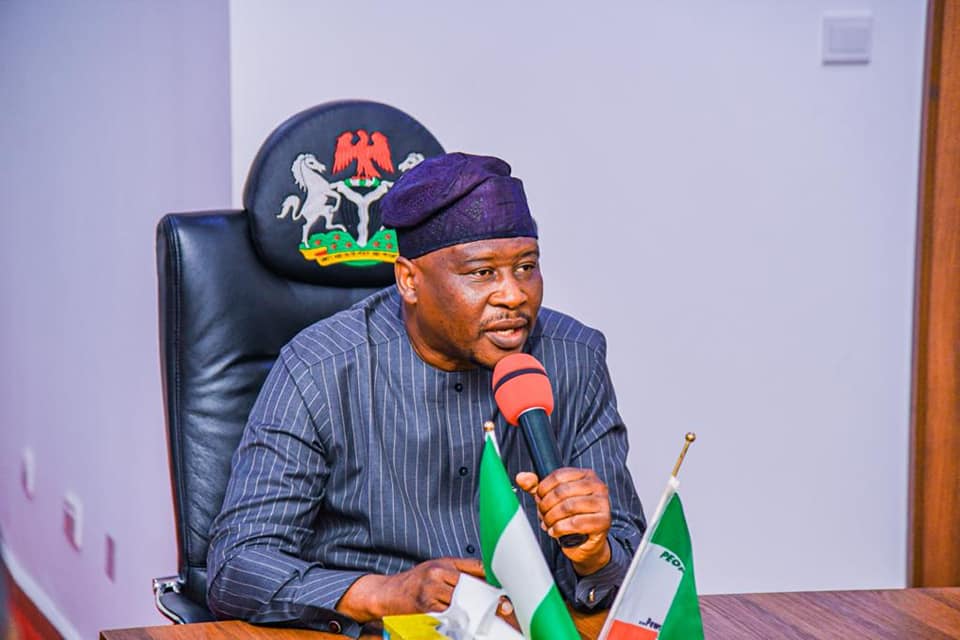
In systems thinking, infrastructure and social developments don’t occur in isolation; projects and programmes are built using a series of interconnected systems that complement each other’s purposes and functions. Governor Fintiri is applying this approach to his development programmes, projects, and policies.
A typical example is the modernization of the Jimeta Shopping Complex, which aims to connect its purpose and functions with those of the new flyover at the old Mubi Roundabout while also providing a befitting shopping complex at the centre of Jimeta City for economic and aesthetic development as part of the urban renewal programme.
The new flyover at the old Mubi Roundabout will connect travellers to Jimeta’s economic activities and natural beauty. At one end, it will lead to the Gerio Swamp and the historic Jimeta Bridge over the River Benue, offering a glimpse of the area’s natural charm. At the other end, it will provide access to the Jimeta Modern Shopping Complex and ease traffic within the city—economic and social development knit together.
The new Jimeta Shopping Complex will feature a world-class, 24-hour, one-stop shopping mall with high-rise buildings. The redevelopment plan of the complex includes a diverse range of shops, boutiques, arcades, food courts, cinemas, banks, smart parking facilities, Wi-Fi connectivity, interactive displays, and a customer service desk.
Adamawa’s three senatorial zones each boast important urban and rural markets. In the southern zone, spanning from the Ganye grain market to the historic Mayo Belwa market, there are connections to the central zone’s Ngurore cattle market, the Jimeta modern market, the new Jimeta shopping complex, the Jimeta old market, the Yola-town market, and the Hong agriculture market.
In the northern zone, notable markets include the Mubi International Cattle Market, Michika Market, and various weekly markets. Plans are underway to transform these markets into modern trading hubs catering to local, national, and international trade. The markets in the northern zone and the Fufore markets serve as crucial centres for traders from Cameroon, Chad, and several Central African countries.
The redevelopment of the Mubi International Market is already underway, with plans to rebuild and remodel the burned Yola Town Market. Additionally, other major markets across Adamawa State are slated for modernization. The markets will undergo systematic redevelopment following Governor Fintiri’s government’s series-system development process.
Governor Fintiri’s comprehensive plan for market development focuses on revitalising economic activities across the state by introducing modern markets and shopping centres. This initiative aims to create vibrant commercial hubs catering to diverse needs.
Central to the plan is a robust market redevelopment policy, streamlining bureaucratic processes and attracting local and international investors. Job creation is prioritised, with the goal of stimulating employment opportunities through market revitalization and new commercial spaces.
The policy also emphasises sustainability, promoting private sector participation to diversify revenue streams and reduce dependence on the dollar. Overall, Governor Fintiri’s vision for market development encompasses economic transformation, community empowerment, and a prosperous future for the state.
Zayyad I. Muhammad writes from Abuja via zaymohd@yahoo.com.

Kano Assembly to amend emirate council law
By Uzair Adam Imam
The Kano State House of Assembly has agreed to amend the State Emirate Council law 2019 and Kano State Emirate amendment law 2023.
This move follows an urgency and public importance motion moved by the majority leader, Alhaji Lawan Hussaini Chediyar ƴan Gurasa, and seconded by Shu’aibu Rabi’u, representing Dawakin Kudu Constituency.
The amendment seeks to revisit the changes made to the emirate structure in 2019, which led to the fragmentation of the Kano Emirate into five distinct emirates and the deposition of Emir Muhammadu Sanusi.
The recent electoral victory of Governor Abba Kabir Yusuf, who campaigned on restoring the traditional Kano Emirate system, has revived efforts to reinstate Emir Sanusi.
Senator Rabiu Musa Kwankwaso, leader of the New Nigerian Peoples Party (NNPP), has emphasized the party’s commitment to reviewing the changes made to the emirate structure.
He expressed confidence in Governor Yusuf’s ability to address the challenges effectively and resolve the issues planted in Kano state, ensuring peaceful coexistence among citizens.
As the legislative process progresses, the potential amendment of the Emir Appointment Law holds significant implications for the traditional emirate system and leadership structure in the region.

The raise and the rays of Prof Adamu Abubakar Gwarzo
By Murtala Sani
The story of Professor Adamu Abubakar Gwarzo cannot be narrated without weaving greatness with success and mixing niceness with kindness, for he is a character of dignity and simplicity. His life is a hub of imagination and determination, creativity and possibility, humanism and activism because he is a master of generosity and hospitality. Gwarzo’s life style is full of optimism, strength, zeal, courage, tolerance with no iota of hopelessness and laziness as seen in his commitments and achievements.
Adamu Abubakar Gwarzo is an origin of Gwarzo Local Government, Kano State, pursuance of knowledge took him to France where he obtained all his degrees. He held Bachelors degree in French, Masters of Arts in French, PhD in French Linguistics, and then PhD in High Education. This gave him a room to become a Professor of Modern European Languages and also a Professor of Leadership. Obtaining dual Professorship is a feat that only a genius can attain.
Gwarzo became a Professor in his early fourties, coincidentally; he was the President of Protection Rights of Journalists of Africa (PRJA) in his early thirties when he was active in the field of Journalism. At the young age he fought for the rights and freedom of Journalists across Africa.
His passion for business and entrepreneurship opened doors for him to get opportunities in France where he made a huge success. He was the first person that founded bilingual University in Niger Republic, Maryam Abacha American University, Niger (MAAUN) in 2013. Seven years later, Gwarzo founded Maryam Abacha American University, Nigeria, (MAAUN) at Kano in 2021 after two years he founded two more Universities in Nigeria, Franco-British international University, Kaduna and Canadian University of Nigeria, Abuja the former is the first Franco-British University in Nigeria.
Therefore, within ten years, Adamu Gwarzo founded four universities making him the first and youngest man that founded four universities in Africa.
Gwarzo is the pioneer President of the Association of African Private Universities due to his dedication to the development of education in Africa. Considering his outstanding contributions to education sector, International Union of Universities in collaboration with Association of African Private Universities gave him an award which serves as commendation to his tireless effort in uplifting education within the African continent.
Again, noticing Gwarzo’s impact on the education sector, International Academic and Management Association (IAMA) inducted him as the Member of its Advisory Board. For the same reason, World Education and Ed Tech 2 awarded him as Innovative Leader in New Delhi, India. These are few out of the numerous awards and honors Gwarzo received from various governmental and non-governmental organizations, national and international associations institutions, schools, communities and students.
The generosity of Adamu Gwarzo led him to establish a foundation with which he can easily touch the lives of many people that are in need of assistance, therefore, Adamu Abubakar Gwarzo Foundation was initiated. The philanthropic activities of the foundation revolve around education health, entrepreneurship, empowerment and provision of infrastructural facilities to communities.
For instance, the foundation donated 66 seater bus to Aliko Dangote University of Science and Technology, Wudil (ADUSTECH), 60 seater bus to Bayero University Kano (BUK) , 66 seater bus to Al-Istiqama University Sumaila, 60 seater bus to Kaduna State Polytechnic and 60 seater bus to Niger University. The foundation also constructed more than one hundred boreholes in Gwarzo Local Government area and some areas within Kano State that were in dire need of water. Again, the foundation undertakes the tasks of giving skills and capital to orphans and masses in order to make them self – reliable considering the economic hardship and the rate of unemployment within the country.
Adamu Gwarzo is an enigma. If you see him dining with the elites today, you may see him feasting with the masses tomorrow. His down-to-earth joyous interactions with the masses make him the hero of the commoners. His capacity gives him the opportunity in rubbing shoulders and shaking hands with African, Arabian and European Presidents despite his young age. No wonder Chinua Achebe said a boy that washes his hand well dine with the elders.
His fluency in Hausa and Yoruba languages, plus his mastery of French and English languages speaks volumes of his intelligence. He is peaceful and tolerant because he is he is neither a racist, nor a tribalist, nor a religious jingoist. Muslims, Christians and Jews have no problem with him as seen in his constant navigation to almost every continent of the world. In his entourage, there is no separation between Sunni and Shi’ite believers, therefore, Qadiriyya, Tijjaniyya, Shi’ites and Izala followers work closely with him without segregation. He embraces the actors, musicians, footballers and all sorts of celebrities or legends that swarm around him without stigma.
Adamu Gwarzo is heterogeneous, as a Pan- African, he named MAAUN’s Senate Building after Nelson Mandela, the former South African President and activist that fought against the subjugation of the black people under Apartheid system of government. He named MAAUN’s President Building after Thomas Sankara, that revolutionist that served as the President of Burkina Faso. He named MAAUN’s Deanry Block after Kwame Nkrumah, the first President of Ghana and nationalist who fought for the independence of the country. He named MAAUN’s Library after Murtala Ramat Muhammad, the patriotic Nigerian General who was assasinated on power.
Furthermore, as an advocate of girl-child education, he named MAAUN’s Social Centre after Magajiya Danbatta, the legendary female singer who promoted girl-child education in her songs. As a Philanthropist, he named MAAUN’s School of Health Sciences after Aminu Alhassan Dantata, a legendary business man and iconic philanthropist. As a non-partisan, he named MAAUN’s school of Social and Management Science after Atiku Abubakar, the former Vice president of Nigeria and former Nigerian Presidential candidate under PDP. He named the Association of African Private Universities (AAPU) Secretariat Building after Senator Rabiu Musa Kwakwaso, the former Governor of Kano state and former Nigerian presidential candidate under NNPP. He named MAAUN’s School of Law Building after Remi Tinubu, the First lady of the Nigerian President, Bola Tinubu, who became President under Apc. Reciprocally, streets, buildings and schools were named after him by the communities, institutions and schools that benefitted from his philanthropic gestures.
In appreciation of Adamu Gwarzo’s friendly and kinship relationship with people he interacts with, Sarkin Hausawan Turai, a leader of Hausa community living in Europe turbaned him as Wazirin Sarkin Hausawan Turai. A Hausa community living in Agege, Lagos, turbaned him as the Sarkin Zumunchi of Agege. In Niger Republic, African Aminci Cultural Association Niger crowned him as the Sarkin Yaki da Jahilci na Afrika. This is in tune with his ambition where he stated that his ambition is to sponsor the education of one million people.
Currently, Maryam Abacha Amercan University Nigeria (MAAUN) is the 4TH best private University in Nigeria, 17th in Africa and 854 in the world, according to the AD Scientific Regulatory Ranking Body for global Academic Institutions. The ranking is based on capacity in Research Inputs /Outputs, Quality Teaching Aids (Faculties and Facilities), Conductive Atmosphere of Learning, Internalization and Collaborations, Students /Staff (Academic and Non – Academic), Positive Interpersonal Relationships, Community Services and Support, Human and Infrastructural Developments that fit with global standard.
Murtala Sani writes from Gwarzo Local Government of Kano State. He is also an academic staff of Kano State Polytechnic, Department of Basic and Remedial Studies.

Funeral procession of Raisi, entourage begins
By Uzair Adam Imam
Thousands of Iranians gathered in the streets on Tuesday to bid a final farewell to President Ebrahim Raisi and seven members of his entourage who lost their lives in a tragic helicopter crash.
The mournful procession began at a central square in the northwestern city of Tabriz, the destination Raisi was headed to when the helicopter went down on Sunday.
With somber faces and waving Iranian flags, the crowd paid their respects to the late president and his companions, carrying portraits of Raisi as they marched through the streets.
The funeral procession was a poignant display of national grief and solidarity, as Iranians came together to honor the memory of their leader and the lives lost in the devastating crash.

International HR Day: Shaping the new future
By Imam-Malik Abdullahi Kaga (ACIHRM, CPM, PGD-HRM)
Today, Monday, May 20, 2024, marks International Human Resource Day, a celebration of the vital role HR professionals play in shaping the future of work. As a Certified Personnel Manager, I write to celebrate this special day in line with the theme: Shaping the New Future.
International HR Day was founded by the European Association for People Management (EAPM) and was first observed in 2019. Its aim is to recognise the momentous contributions of HR professionals globally. Prior to this day, the then-Jamaican Governor-General, Sir Patrick Allen, proposed the celebration in 2013 but was not successful in bringing the day to life. In 2018, the Jamaican government declared the day.
Since then, it has become an avenue for HR practitioners to come together, share best practices, and discuss the latest trends and challenges by organising webinars, workshops, et al in the industry.
This year’s HR Day is tagged with the theme: Shaping the New Future, and sub-themes of Championing Ethical Tech and AI Integration, Excellence in People Management, Continuous Investment in Skills and Education, Redefining the Future Workplace.
Championing Ethical Tech and AI Integration
The integration of technology and AI has revolutionised the way our department works. However, it also raises important ethical considerations. Despite the increasing reliance on technology and AIs, it’s very important that HR professionals champion ethical practices to ensure these technologies are used responsibly and for the betterment of organisations, companies, and society at large.
This includes implementing AI systems that are transparent, unbiased, and protect employee data privacy.
Excellence in People Management
MSF has this adage: “MSF is People.” HR professionals play a crucial role in attracting, retaining, and developing top talent. At the heart of any successful organisation is its people. This requires a deep understanding of the changing needs and expectations of employees.
By nurturing a culture of excellence in people management, HR can improve employee engagement and create a positive work environment. This involves adopting a holistic approach to talent management, spotting the diverse needs of global labourers, and providing opportunities for growth and development.
Continuous Investment in Skills and Education
The stride of technological change demands that employees continually update their skills to remain relevant. HR invest in education and training programs that arm workers with the skills needed to succeed in their roles.
This includes providing access to online learning platforms, workshops, and mentorship opportunities. For example, organisations like the MSF have a department called learning and development, where the staff’s KSA are developed. MSF also has a platform called Tembo for its staff to learn and develop. By prioritising continuous learning, HR can future-proof the workforce, initiate innovation, and stay ahead of the competitive world.
As we celebrate International HR Day, we urge all departments in every organisation, whether humanitarian, government, or profit-based, to adapt the culture of continuous learning for professional growth and excellent work outcomes.
Happy International HR Day to the “retention strategists”
Imam-Malik Abdullahi Kaga is a member of the Chartered Institute of Human Resources Management and a Certified Personnel Manager. He writes from Maiduguri and can be reached via imammalikabdullahikaga@gmail.com.
EFCC returns stolen assets to Kano, Enugu
By Uzair Adam Imam
The Economic and Financial Crimes Commission (EFCC) has made a significant breakthrough in the fight against corruption, returning 14 properties to the Enugu State government and 324 houses to Kano State pensioners.
The properties, valued at millions of naira, were recovered through diligent investigation and prosecution.
The Enugu State properties were formally handed over to the state government at the EFCC headquarters in Abuja, while the 324 houses were returned to Kano State pensioners who had been defrauded of their benefits.
EFCC Chairman, Ola Olukoyede, commended the Enugu State government and Kano State pensioners for their cooperation throughout the investigation and recovery process.
He assured that the EFCC would continue to work tirelessly to recover stolen assets and bring corrupt individuals to justice.
Enugu State Governor, Peter Mbah, expressed gratitude to the EFCC for its efforts in recovering the stolen assets and praised President Bola Tinubu for his prompt action in ceding the assets to the people and government of Enugu State.
This milestone marks a significant achievement in the fight against corruption and asset recovery, demonstrating the EFCC’s commitment to ensuring that corrupt individuals are held accountable and that stolen assets are returned to their rightful owners.

YSU irregularities: An open letter to Gov. Mai Mala Buni
By Kassim Isa Muhammad
I am writing to bring to your attention the concerning situation at Yobe State University, where various violations of the university’s regulations are taking place.
As the governor of Yobe State, I urge you to intervene and address these issues promptly to ensure the integrity and compliance of the institution.
Specifically, one of the major issues that require your immediate attention is the tenure situation of the university Registrar, Dr. Kalli Gazali.
It has come to light that Dr. Gazali has purportedly continued to occupy the office of the Registrar despite retiring in September 2023 after serving for 35 years, not 65. This contravenes the university (Miscellaneous) Act 2012 on the retirement of non-academic staff.
The violation of such regulations governing the university raises serious questions about the adherence to established procedures and laws.
Furthermore, six months ago, an interview was conducted for the position of Bursar at Yobe State University. However, despite the passage of time, the results of this interview have not been announced.
This delay has created a sense of uncertainty and unease among the candidates and the university community.
Subsequently, it has come to our attention that another interview is being called, allegedly to favor a candidate who is rumored to be related to you, specifically your brother.
This development is viewed as a clear violation of the university’s laws and regulations, which are designed to ensure a fair and transparent selection process based on merit and competence.
Moreover, this is a clear violation of the oath of office and the Constitution, which you swore to uphold.
You took an oath that: ‘I will not allow my personal interest to influence my official conduct or my official decisions; I will do right to all manner of people, according to law, without fear or favor, affection or ill will.’
If it is true that you are allowing your brother, who is already a Bursar in another institution in Yobe State, to be brought to the state university and staging another interview just to pave the way for him, it is rather disgusting.
For example, the favoritism can be seen from the advert for the post of the Bursar; in the first advert, the qualification required is that the candidate for the post must: ‘…be a practicing Deputy Bursar with at least one-year minimum experience on the post in a recognized University….’
In the second advert, that criteria was completely deleted because the anointed candidate has not been a deputy bursar in a recognized university but is presently a substantive Bursar.
The question is, why is a substantive Bursar interested in becoming a Bursar in another institution? Perhaps to serve as a conduit pipe for those who are doing everything possible to ensure he becomes the Bursar.
Again, under the Experience in the first advert, the criteria are: ‘candidate must have a minimum of fourteen (14) years of prudent university financial management and administrative experience,’ whereas in the second advert, the word ‘university’ was removed to mean 14 years of prudent financial management because the anointed candidate did not possess 14 years of university experience.
The university’s laws and regulations are in place to uphold the integrity of the institution and ensure that all appointments are made fairly, transparently, and without bias.
The actions taken so far appear to be in contravention of these laws, undermining the trust and confidence of the university community and the public at large.
I, therefore, call on you to investigate the delay, ensure transparency, prevent nepotism, and announce the result of the already conducted interview.
Also, instruct the university governing council to immediately advertise for suitable candidates to apply for the already vacant office of the university registrar and appoint, in the interim, the most senior deputy registrar in an acting capacity to oversee the affairs of the office.
These are misconduct or irregularities within the university that merit investigation and corrective action.It is pertinent to uphold the principles of transparency, accountability, and fairness in the administration of educational institutions to safeguard the interests of students, staff, and the reputation of the university.
We believe that addressing these concerns will reinforce the integrity of the appointment process and restore trust in the governance of our esteemed university.
We have full confidence in your commitment to justice and fairness, and we trust that you will take the necessary steps to rectify this situation.
Kasim Isa Muhammad wrote from Damaturu, Yobe State.