
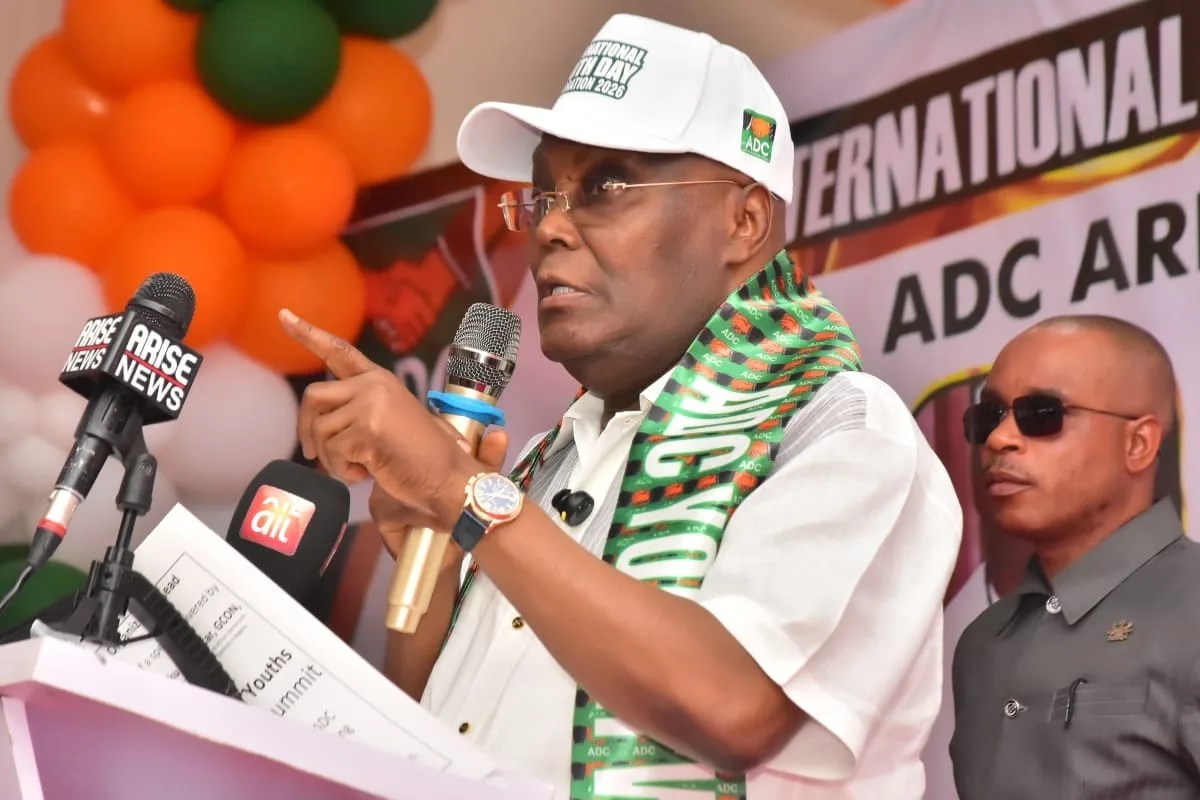
Atiku Abubakar Vows to Develop Southern Ports, Reopen Land Borders if Elected
By Sabiu Abdullahi
Former Vice-President Atiku Abubakar has pledged to reopen Nigeria’s land borders with neighbouring countries if elected president in 2027.
Atiku, the presidential candidate of the African Democratic Congress (ADC), made the promise in a video shared online by ADC chieftain Dele Momodu on Friday.
He argued that restrictions at the country’s land borders had harmed cross-border commerce and contributed to job losses, particularly among young Nigerians.
Atiku pointed out that several northern states share borders with neighbouring countries, where many Nigerians depend on cross-border trade for their livelihoods.
“The Northern states is bordering Cameroon, Chad, Niger, Benin Republic.
“And you close all those borders. All our young men who are doing trading between these countries, they carry goods across, they do this and that, all what we call transborder trade is a legitimate business,” Atiku said.
He said the border restrictions had pushed some young entrepreneurs out of business after their investments collapsed.
“All the upcoming young men and women who used to have a capital of 10 million, 20 million, and they were employing two, three other people, and then all of them went bankrupt and unemployed. How can there be security?” he asked.
“So I said I am going to reopen the borders and I will,” he added.
Atiku Plans Southern Port Expansion
The former vice-president also disclosed plans to improve port infrastructure in the southern part of the country if he wins the presidency.
He said he had previously held discussions with shipping companies and other stakeholders in Europe about expanding ports in the South and South-East.
“During the last campaign, I went across to Europe to discuss with shippers and ship development companies how we can together develop South and South-Eastern ports so that there is balance as far as importation of goods and transportation of goods are concerned,” he said.
According to Atiku, stronger port facilities in the southern region would make it easier and cheaper to move imported goods to northern parts of the country.
He used the transportation of containers from Lagos to Yola, Adamawa State, as an example, noting that he has a factory in the city.
“So when, if I drop my container in Calabar or in Uyo or in Port Harcourt, it will just take me 24 hours to take the container to Yola.
“But right now, it takes me not less than two months to take my container from Lagos because you have to cross over from South-West, you go to North-East, and then there is even no road,” Atiku said.
He said the proposal reflected concerns over the movement of goods and the need for balanced development of the country’s ports.
Background To Border Closures
Nigeria’s land borders were closed in August 2019 under the administration of former President Muhammadu Buhari.
The Federal Government at the time said the measure was aimed at tackling large-scale smuggling of rice, poultry products, petroleum products and other commodities. The government also cited concerns over the movement of weapons and drugs and sought to promote domestic agricultural production.
In December 2020, Buhari directed the reopening of four border posts: Seme in Lagos State, Illela in Sokoto State, Maigatari in Jigawa State and Mfun in Cross River State.
The administration of President Bola Tinubu later reopened the Tsamiya border with the Benin Republic in Kebbi State and the Kamba corridor linking Nigeria with Niger Republic in February 2026.
US to Withdraw 200 Troops From Nigeria
By Sabiu Abdullahi
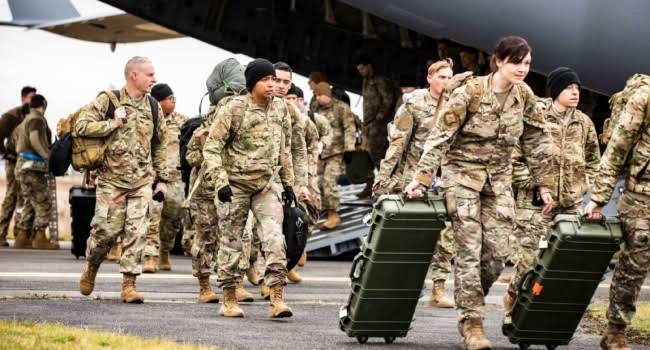
The United States is preparing to withdraw about 200 military personnel deployed to Nigeria earlier this year as part of efforts to combat Islamist militants, according to a report by The New York Times.
The report said American and Nigerian officials considered the deployment relatively small but credited it with producing significant results against militant groups.
Most of the troops are expected to leave Nigeria by the end of September. However, small teams of US military trainers and intelligence analysts are expected to remain in the country, according to the report published on Thursday.
US officials reportedly described the Nigerian deployment as a potential model for future American counterterrorism operations across Africa.
The planned withdrawal follows a May military operation that killed Abu-Bilal al-Minuki, identified as the second-in-command of ISIS, in the Lake Chad Basin.
Last month, Dagvin Anderson, commander of the US Africa Command (AFRICOM), said the United States had already withdrawn a significant number of its troops from Nigeria after the operation.
According to Anderson, the operation dealt a major blow to ISIS leadership in Nigeria and beyond.
He also said Nigeria had been “very active” since the May operation and was working to prevent terrorist groups from sustaining themselves.
Despite the reduction in troop numbers, Anderson said the US would maintain its intelligence-sharing partnership with Nigeria.
Amidst Fear of Losing Election, Tinubu Orders 500 More CNG Stations, Targets Cheaper Transport Fares From October
By Sabiu Abdullahi
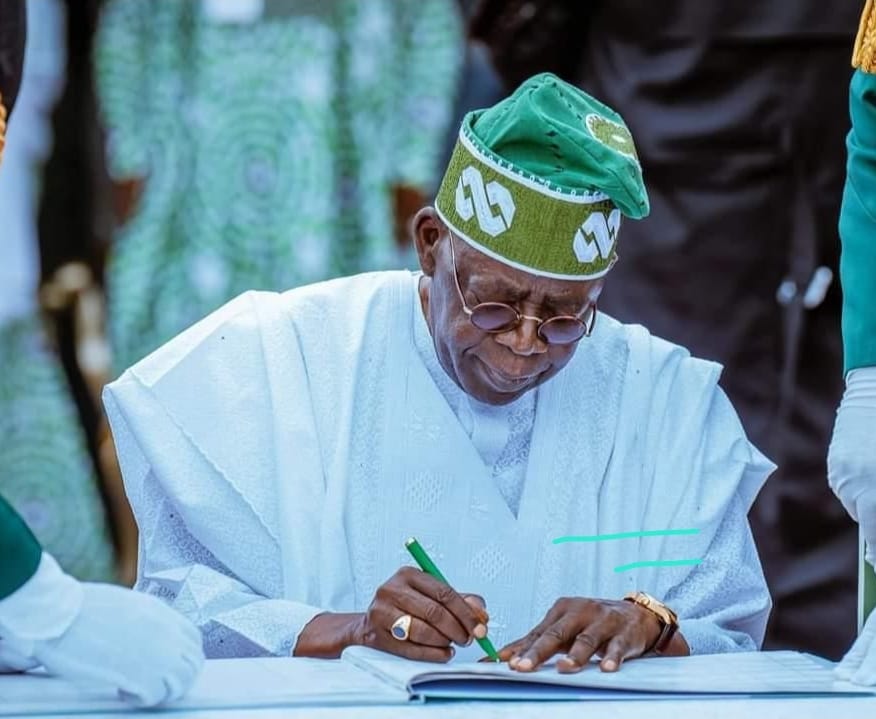
President Bola Tinubu has approved the establishment of 500 additional compressed natural gas (CNG) refuelling stations across Nigeria as part of efforts to reduce transportation costs, in what, according to many citizens, appears to be fear of losing 2027 election.
Tinubu disclosed this in a statement he personally signed on Thursday after discussions with members of the Nigeria Governors’ Forum (NGF) on measures to make transportation more affordable.
According to the President, the governors had agreed to pursue measures that would lower transport costs, with particular attention to the savings offered by CNG-powered and electric vehicles.
Tinubu said the Federal Government is already supporting more than 100 gas-related projects across the country. These include 15 CNG mother stations and 86 daughter stations.
He said the Federal Government and state governments had also agreed to establish a joint committee that would commence work on the agreed measures immediately.
“I have also directed the additional rollout of another 500 CNG refuelling stations nationwide in addition to the 500 stations ordered earlier in the year by the Fund, bringing the programme to 1,000 stations across the country,” the statement reads.
The President said state governments have an important role to play because intra-state transportation has a direct impact on Nigerians.
“Intra-state transport is where Nigerians feel the cost most directly, and it is where the states hold the levers.
“I am encouraged that our Governors are moving to bring these benefits closer to the people they serve.
“We have agreed to set up a joint Federal and State committee to begin implementing these measures immediately. A vehicle running on CNG spends 60 to 80 per cent less on fuel than one running on petrol.
“From October 1, our goal is that Nigerians begin to partake in those savings through lower transport fares. We have agreed that cheaper fuel should result in cheaper fares!”
The President urged all levels of government to coordinate their efforts to ensure that Nigerians benefit from the programme.
“Each tier of government must keep doing its part and work together for the benefit of every Nigerian.”
Governors Consider Nationwide Fare Reduction
The development follows a communiqué issued by the NGF after its meeting in Abuja on Wednesday.
The governors said they were considering a nationwide reduction in transportation fares under the proposed National Affordable CNG Transit Programme (NACTP).
The forum said the programme would take advantage of the lower operating costs associated with CNG to provide more affordable public transportation.
Tinubu approved the Presidential Compressed Natural Gas Initiative (PCNGI) in August 2023.
The Presidency said the initiative was designed to reduce the impact of petrol subsidy removal on Nigerians through lower energy costs.
With the latest directive, the number of CNG refuelling stations targeted under the programme is expected to rise to 1,000 nationwide.
Trump Renames Lake Ontario ‘Lake America’ Amid Tensions With Canada
By Sabiu Abdullahi
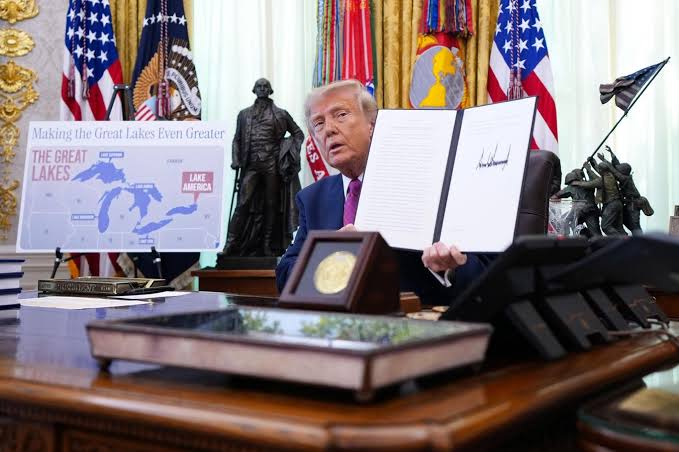
US President Donald Trump has signed an executive order changing the name of Lake Ontario to “Lake America”, in a move that has added a new dimension to the growing tensions between the United States and Canada.
Trump announced the change on Thursday after signing the order at the Oval Office.
“This is official, effective immediately,” Trump said.
The president also said he had completed the required procedures for the renaming.
Trump said he had “filed all the necessary papers, documents, everything else” for the name change and “notified all of the various people that we have to notify”.
Lake Ontario is one of North America’s five Great Lakes. It lies along the Canada-US border, with the Canadian province of Ontario located to its north and New York State in the United States to its south.
The other Great Lakes are Huron, Michigan, Erie and Superior. Together, the five freshwater bodies contain about one-fifth of the world’s surface freshwater.
The lake has been known as Lake Ontario for centuries. Its first known appearance under that name on a map dates to 1656, although historians believe the name was already in local use before then.
Trump’s executive order justified the new name on the grounds that most of the lake’s volume lies within US territory.
The order stated that “the deepest parts of the Lake’s waters lying within United States territory, the United States claims most of the Lake’s volume” and that the lake has “long been an integral asset to American exploration, settlement, commerce, and defense”.
However, it remains unclear whether the name change will be recognised outside the United States because geographical names are not governed by a single international authority.
Canada Rejects New Name
Canada has already indicated that it will continue to use the traditional name.
Earlier in the week, before Trump signed the order, Canadian Industry Minister Mélanie Joly said: “We’ll always call it Lake Ontario”.
Lake Ontario was formed after the last Ice Age from the earlier Lake Iroquois about 11,400 years ago.
By the mid-18th century, before the American Revolution and the eventual establishment of Canada and the United States, Lake Ontario had become the established name.
The name “Ontario” is believed to have Iroquoian origins. The Canadian Encyclopaedia says it may mean “beautiful lake” or “sparkling water”, while some historians interpret it as “vast body of water”.
French missionary records from around 1641 also referred to the body of water as Lake Ontario. The Canadian province of Ontario later adopted the name when it was created at Confederation in 1867.
Trump Links Move To Previous Renaming
The decision follows Trump’s earlier attempt to rename the Gulf of Mexico as the “Gulf of America”.
Trump referred to the two renaming decisions while speaking about Lake Ontario.
“We have a gulf and we have a lake. Now all we need is an ocean so maybe we’ll have to change the name of the Atlantic and/or the Pacific,” Trump said, referring to the bodies of water on either side of the US coastline.
The latest move comes amid renewed tensions between Washington and Ottawa after trade negotiations between the two countries broke down late Friday.
The United States subsequently imposed 50 percent tariffs on billions of dollars’ worth of Canadian exports, further straining relations between the neighbouring countries.
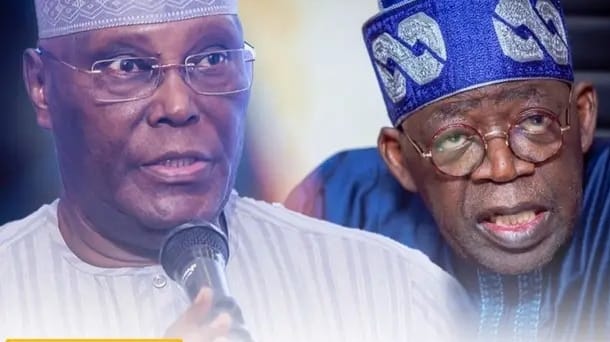
Atiku Questions N600bn Cash Transfer Spending, Demands Explanation From FG
By Sabiu Abdullahi
Former Vice-President Atiku Abubakar has asked the Federal Government to account for more than N600 billion reportedly disbursed under its cash transfer programme for vulnerable Nigerians.
Atiku, who is the presidential candidate of the African Democratic Congress (ADC), raised the concerns in a statement issued by his media aide, Phrank Shaibu, on Thursday.
He also questioned the difference between the number of households the government currently says have benefited from the programme and an earlier figure announced by the Presidency.
On July 16, President Bola Tinubu said the expanded cash transfer programme had reached 15 million vulnerable households and lifted an estimated 7.5 million Nigerians out of poverty.
However, Bernard Doro, Minister of Humanitarian Affairs and Poverty Reduction, said on Wednesday that more than N600 billion had been disbursed to slightly over 10 million households since Tinubu became president.
Doro made the disclosure during an appearance on Channels Television’s Politics Today, where he said the beneficiaries could amount to about 40 million people based on an average household size of four.
“We have done over N600 billion in cash transfers to be able to support vulnerable Nigerians within three years,” Doro said.
Atiku Questions Five-Million Household Difference
Atiku said the figures from the government did not correspond and called for clarification on the actual number of beneficiaries.
“On 16 July 2026, the Presidency officially declared that expanded cash transfers had reached 15 million vulnerable households,” the statement reads.
“It repeated essentially the same figure on 2 August 2026. Yet on 26 August 2026, the Minister of Humanitarian Affairs suddenly told Nigerians that only ‘slightly over 10 million households’ had been reached.
“So where did five million households go? These are not opposition figures. They are Tinubu’s figures contradicting Tinubu’s figures.”
The former vice-president also challenged the government’s expenditure figures based on the amount each qualifying household was expected to receive.
According to him, the government had indicated that eligible households would receive N25,000 monthly for three months, which amounted to N75,000 per household.
“If 10 million households received the full payment, that would be about N750 billion. If 15 million households did, it would exceed N1.1 trillion. Yet government says it spent just over N600 billion,” he said.
Atiku demanded information on the number of beneficiaries who received one, two or all three payments. He also sought details of failed and reversed transactions.
“A name on a social register is not a bank alert. Counting people in a database is not the same thing as proving money reached them,” Atiku said.
Atiku Demands Disbursement Records
The ADC presidential candidate urged the Federal Government to publish verifiable records showing how the funds were distributed.
“If N600 billion truly moved, then government must show the trail: unique verified households, payment tranches, state-by-state distribution, failed transactions, reversals and an independent audit,” he said.
Atiku also criticised the government’s wider poverty-reduction strategy. He argued that economic policies should tackle the factors that increase the cost of living rather than rely mainly on cash support after households become vulnerable.
He cited his proposed intervention in the domestic petroleum value chain as an approach aimed at reducing fuel and transportation costs.
“When petrol becomes cheaper, the bus driver spends less, the farmer moves produce more cheaply, the trader pays less for haulage, businesses face lower logistics costs and the savings travel through the economy to the family kitchen,” he said.
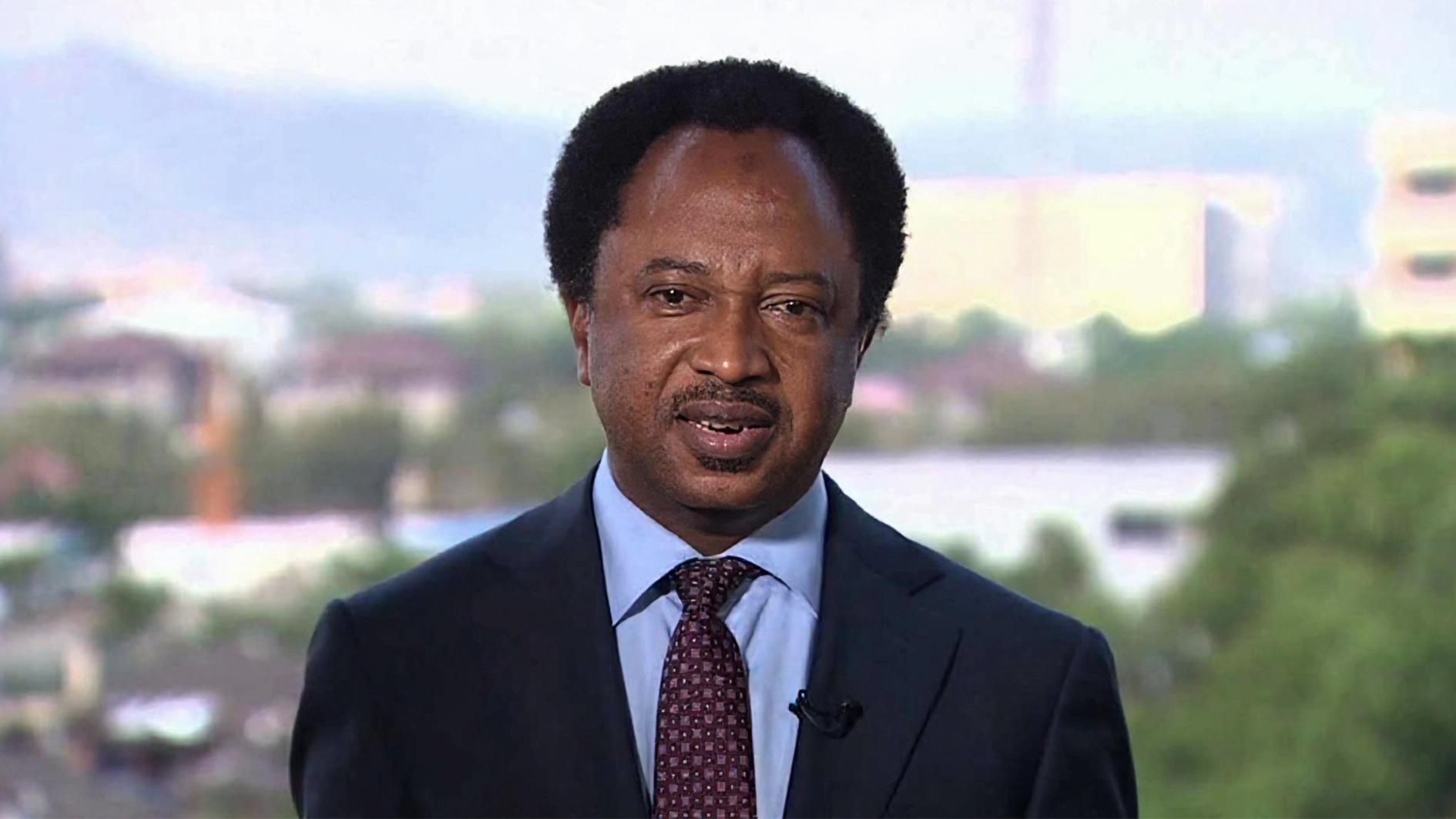
Shehu Sani Warns Against Return of Fuel Subsidy
By Sabiu Abdullahi
Former Kaduna Central Senator, Shehu Sani, has opposed former Vice President Atiku Abubakar’s proposal to restore fuel subsidy if elected president in 2027, describing the promise as “deception” and warning that it could further disrupt Nigeria’s economy.
Sani made the remarks at a press conference in Abuja, where he argued that Nigeria could not afford to return to a subsidy system that had cost the country trillions of naira and created opportunities for corruption and fuel smuggling.
He said the priority should instead be the rehabilitation of Nigeria’s refineries and the expansion of domestic crude oil refining capacity.
According to the former senator, Nigeria had spent between N3 trillion and N4 trillion on petroleum subsidy, a situation he described as unsustainable for an oil-producing nation.
“I don’t think any candidate that is worthy of leadership should pull us back to that era,” Sani said.
He alleged that the former subsidy system was exploited by some individuals who diverted public funds through questionable petroleum import arrangements.
Sani also said subsidised fuel was often smuggled into neighbouring countries, where it was sold at higher prices. He said such activities denied Nigerians the intended benefits of the subsidy programme.
He questioned the logic of exporting crude oil, importing refined petroleum products and then using the country’s scarce foreign exchange to subsidise those imports.
“If any politician makes pledges of revamping our refineries so that we can be able to refine our own crude oil, then he’s making sense,” he said.
“But a politician that has been in the economic field for a very long time telling us that the way forward for us as an oil-producing country is to continue to import all petroleum products and again use our own foreign currency to subsidise it for our people to consume, for how long can we continue to do that?”
Sani acknowledged that the removal of fuel subsidy had increased the economic pressure on Nigerians. However, he maintained that restoring the former arrangement would not provide a lasting solution.
“The return of subsidy will not bring down the prices of commodities. It will simply distort the economic stability of our country,” he said.
He called on the Federal Government to make the ongoing economic reforms more responsive to the difficulties faced by ordinary Nigerians.
Sani said Nigerians should not be left to bear the effects of economic reforms while political leaders continued to maintain extravagant lifestyles. He advocated a reduction in the size and cost of government, as well as sacrifices from both the executive and legislative arms of government.
The former senator also pointed to the Dangote Refinery as evidence of the opportunities available through local petroleum refining. He questioned why Nigeria should continue to import refined products despite the establishment of a major refinery through private investment.
“We should not just talk about importing petroleum products,” he said, stressing that Nigeria could not attain meaningful economic independence if it continued to export raw materials and import finished goods.
Sani Calls For Issue-Based 2027 Campaign
Sani also addressed the 2027 general elections, urging political parties and candidates to base their campaigns on policies, programmes and the issues that affect Nigerians.
He cautioned against the use of ethnic, religious and sectional sentiments as political weapons, warning that such tactics could weaken national unity and stability.
“At this time of our country’s life, we should assess, analyse, and elect leaders based on what they stand for and what they can deliver for us as a country,” he said.
The former senator criticised opposition politicians who seek foreign support or intervention in Nigeria’s political affairs. He said political parties should rely on Nigerian voters rather than seek endorsement from foreign governments and institutions.
Sani said Nigeria’s democracy had survived several periods of political crisis and expressed confidence that the 2027 elections could be transparent and credible.
He, however, raised concern over what he described as pessimistic predictions about Nigeria’s future ahead of the election. He urged political actors to place the country’s unity and stability above personal political ambitions.
On the presidential contest, Sani said he supported the emergence of a southern candidate, arguing that political power should rotate among the country’s various regions.
He said such an arrangement would reflect Nigeria’s diversity and promote political balance. However, he acknowledged that regional rotation was not a constitutional requirement but a political understanding that could contribute to national stability.
Sani also expressed support for President Bola Ahmed Tinubu’s re-election bid while urging opposition parties to consider fielding a southern candidate in the 2027 presidential election.
He warned politicians against viewing elections as a matter of survival and urged them to accept electoral outcomes without actions that could threaten the country’s unity.
“The country doesn’t have to fall because you lose elections. The country doesn’t have to scatter into pieces because you lose elections,” he said.
Sani said Nigeria’s large population and diverse ethnic and religious composition placed a responsibility on political leaders to manage disagreements with caution and avoid actions that could endanger peace and national stability.
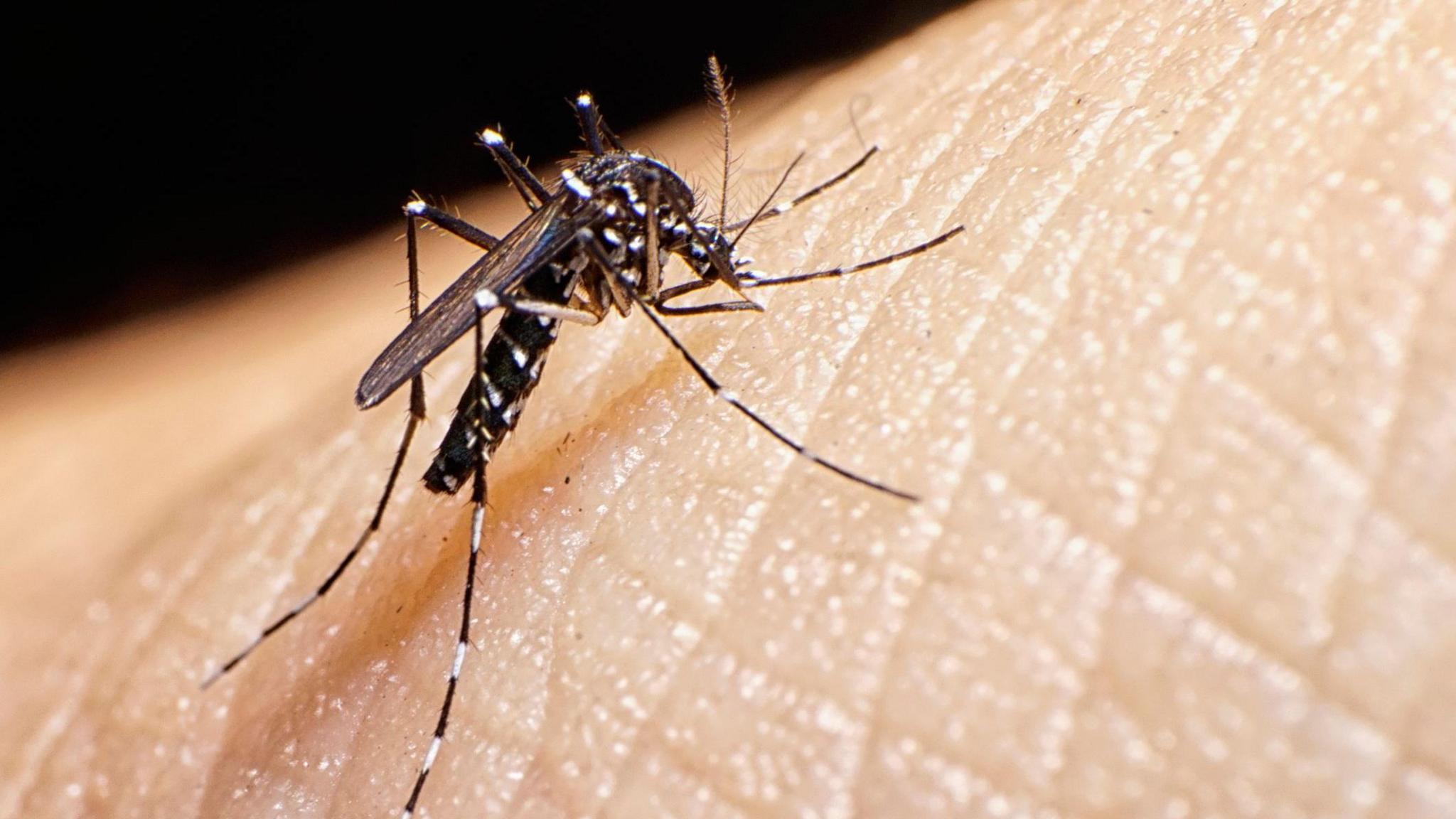
Two German Airport Workers Die From Malaria Linked to Mosquito on Plane
By Sabiu Abdullahi
Two workers at Frankfurt Airport in Germany have died after contracting malaria from a mosquito believed to have arrived on an incoming aircraft, according to health authorities in Frankfurt.
The number of deaths rose to two on Wednesday after airport officials initially confirmed that one of six infected employees had died.
Germany’s Robert Koch Institute (RKI) identified an imported Anopheles mosquito, which was likely transported into the country on an aircraft, as the most probable source of the infections.
The four other affected airport workers are receiving treatment in hospital, an airport spokesman said. Authorities have also placed mosquito traps around the airport as part of efforts to identify the insects responsible for the outbreak.
Mosquitoes captured through the traps will be sent to the Institute of Tropical Medicine in Antwerp, Belgium, where genetic testing will be conducted to establish more information about their origin.
Malaria is uncommon in Germany, and the RKI said the country last recorded an airport-related malaria outbreak in 2023.
However, the institute warned that the rarity of the disease in Germany can make diagnosis more difficult because doctors may not immediately consider malaria when assessing patients. Delayed diagnosis can increase the risk of severe illness.
Malaria is a potentially serious infectious disease caused by microscopic parasites and transmitted through the bites of Anopheles mosquitoes. Common symptoms include headaches, nausea, fever and intense chills.
The disease remains a major public health concern worldwide and causes hundreds of thousands of deaths each year, with sub-Saharan Africa carrying the greatest burden.
Medical treatment is available for malaria, and patients who receive appropriate care early can usually make a full recovery.
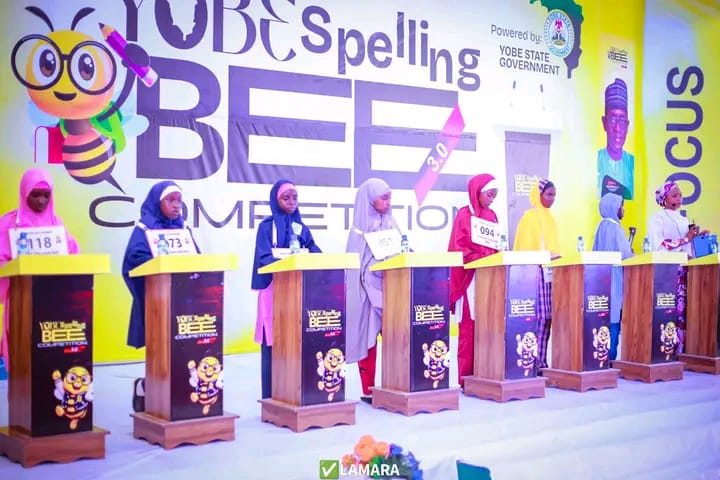
[OPINION]: The Confidence to Stand, By Maji Bappa Maina
By Maji Bappa Maina
There are moments in a child’s education that do not appear on a school report.
A child walks onto a stage.
Hundreds of eyes turn towards them.
A word is pronounced.
For a few seconds, everything becomes quiet.
Then the child speaks.
That moment may last only seconds, but the confidence gained from it can last for years.
This is one of the reasons the recently concluded 3rd Yobe Spelling Bee Competition deserves more attention than the applause surrounding the event.
Students from across Yobe’s 17 Local Government Areas were brought together to learn, compete and test themselves in an environment beyond the ordinary classroom.
They had to prepare.
They had to listen.
They had to think under pressure.
And, most importantly, they had to stand up and believe that they could do it.
That experience matters.
A good education system should produce students who can remember what they have been taught. But it should also produce young people who are prepared to stand before others, express themselves and face challenges without fear.
This is where programmes such as the Spelling Bee quietly contribute to educational development.
They create healthy competition among schools.
They encourage students to read beyond examinations.
They give teachers another platform to identify talent.
They expose young people to peers from different parts of the State.
And they create memories that can shape how students see their own abilities.
The wider significance is even more important for Yobe.
A state cannot build its future entirely through physical infrastructure. It must also build the confidence, knowledge and capacity of the generation that will eventually inherit those structures.
This is why the support of the Mai Mala Buni Administration for educational initiatives that bring young people forward deserves recognition.
I also commend Dr. Mohammed Goje, Secretary to the State Government, and the organisers, teachers, schools and partners whose efforts helped bring the competition together.
The real success of such a programme may not be measured only by the names of those who carried away prizes.
It may be found in the student who discovered a new confidence.
In the teacher who discovered a promising talent.
In the child who returned home believing that perhaps the world is larger than he or she had imagined.
Today, they are spelling words.
Tomorrow, some of them may be spelling out new possibilities for Yobe.
That is why supporting young minds is one of the quietest, and most consequential, ways of building a State.
Maji Bappa Maina is a Political Writer, PhD Researcher at Voice of Development, Leadership & Public Insight.
Presidency Accuses Former VP of Playing Politics With Economic Policy
By Abdullahi Mukhtar Algasgaini
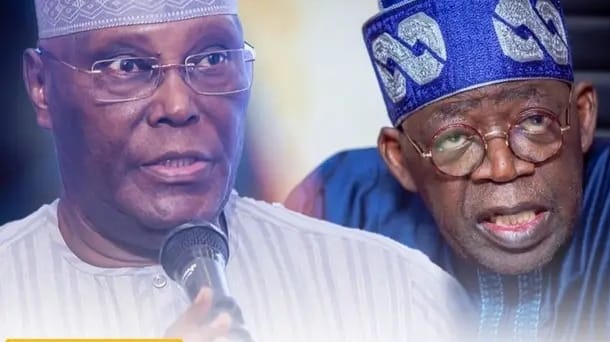
The presidency has accused former Vice-President Atiku Abubakar of policy confusion and political gamesmanship following what it described as three contradictory statements on petrol subsidy within a single week.
In a strongly worded statement, Special Adviser to the President on Information and Strategy, Bayo Onanuga, questioned whether the 2023 presidential candidate is proposing a serious economic policy or merely exploiting the temporary economic discomfort facing Nigerians.
The controversy began when Atiku’s spokesperson, Paul Ibe, announced that the former vice-president would restore petrol subsidy if elected president and later phase it out, describing it as a temporary intervention to give Nigerians and businesses room to recover.
However, another senior aide, Phrank Shaibu, quickly issued a clarification, describing Ibe’s statement as “unauthorised and misleading.” Shaibu insisted that Atiku would not set a predetermined date for ending the subsidy, but would maintain it until domestic refining expands and market conditions stabilise.
Hours later, Atiku himself intervened, effectively overruling the clarification and insisting his position “has not changed.” He reiterated that he would restore what he called a “targeted subsidy” if elected president, stating: “I will restore targeted subsidy and put purchasing power back in the hands of Nigerians.”
Presidency Questions Economic Understanding
Onanuga challenged the former vice-president’s understanding of petroleum market dynamics, pointing out that petrol prices are influenced by multiple factors including international crude oil prices, exchange rates, refining costs, transportation, and distribution.
“Petrol does not become cheap simply because government orders a subsidy or because competition is expected to emerge,” Onanuga stated.
The presidency also took issue with Atiku’s argument linking fuel prices to food inflation, noting that Nigerians experienced rising food prices even during years when petrol subsidy was in place.
“Agricultural productivity, insecurity, exchange rates, logistics, storage, flooding, input costs, money supply and supply constraints also matter,” the statement read.
Technical Questions on Subsidy Proposal
The presidency raised specific technical questions about Atiku’s proposal, asking whether he is aware that refined petrol constitutes only 45 per cent of the by-products of a refined barrel of crude oil.
Other products include aviation fuel, kerosene, and diesel – the latter deregulated during the Obasanjo-Atiku administration in 2004. The statement questioned whether Atiku would subsidise all these by-products as well.
Onanuga urged Atiku to explain precisely what he means by “targeted subsidy,” including its cost, beneficiaries, funding mechanism, and the objective economic conditions that would determine its eventual termination.
“The economy is too serious for policy somersaults, incoherence, destructive populism and election gimmicks,” the statement concluded.
Nepal Flood Death Toll Rises to 95 as Hundreds Remain Missing
By Sabiu Abdullahi
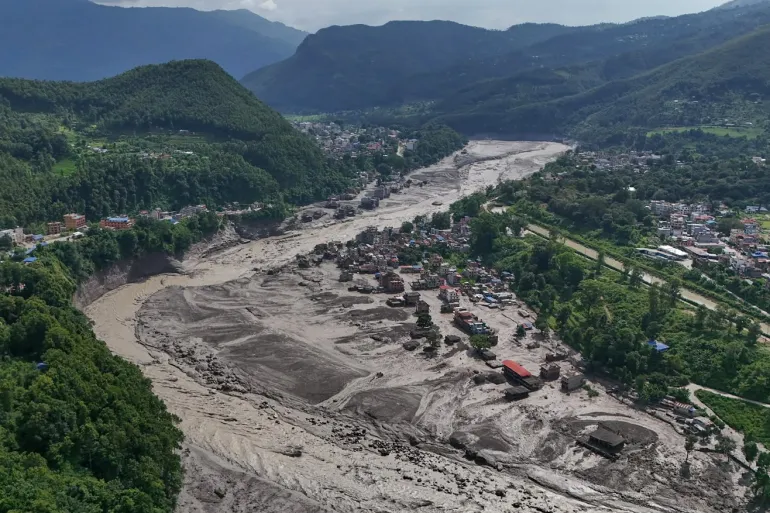
At least 95 people have died after a flash flood swept through parts of Nepal near the border with Tibet, destroying homes, roads, bridges and power infrastructure, according to Nepalese authorities.
Police spokesman Abi Narayan Kafle said 28 police officers were among those reported missing. Authorities also said 384 tourists, including 291 foreigners from countries such as the United Kingdom, United States, India and Malaysia, were missing after the disaster.
“So far 95 deaths have been reported,” Kafle said.
The disaster also affected areas across the border in Tibet, where Chinese authorities reported at least three deaths and 265 missing people in Gyirong county. State broadcaster CCTV said the figures were still being verified.
Nepalese Prime Minister Balendra Shah called for unity as rescue operations continued.
“Please be patient. The government takes full responsibility for your rescue, treatment, food and shelter. In times of such a disaster, we all need to stand together,” Shah said in a statement shared on social media.
Authorities said the floodwaters were too high for helicopters to land in Syapru Besi and Timure, in the mountainous Rasuwa district, which has a population of about 50,000.
District administrator Narendra Pariyar urged residents living along the Bhote Koshi River to move to higher ground after reports that villages and infrastructure project sites had been swept away.
“We have asked both India and China to help us with the rescue efforts,” said Sasmit Pokharel, a Nepali government spokesperson.
In Tibet, China’s official Xinhua news agency reported “major casualties” and missing people after a mudslide struck a border crossing between China and Nepal. The incident at Gyirong port disrupted roads, communications and electricity supplies in the Shigatse region.
Chinese President Xi Jinping ordered “all-out” efforts to locate missing people and called for stronger monitoring and early warning systems to reduce the risk of further disasters.
Prayash Adhikari, a climate justice activist in Nepal, described the flooding as “devastating” and said it had destroyed “whole villages”.
“Hundreds of people are missing,” Adhikari told Al Jazeera from Kathmandu, adding that buildings, schools, bridges and highways had also been destroyed.
The flooding also prompted authorities in India’s Bihar state to begin evacuations in six districts amid concerns that floodwaters could spread into the area.
Videos released by Nepal Police and other sources showed large volumes of muddy water rushing through mountain valleys. Kosh Raj Koirala, an editor of Republica Daily, said many residents were caught by surprise because there had been no heavy rainfall before the flash flood.
“[People] were at home … several houses have been washed away, swept away by the river,” Koirala told Al Jazeera.
Prime Minister Shah also held an emergency meeting with the National Disaster Risk Reduction and Management Authority to assess the impact of the disaster.
“Work has started to take necessary steps in coordination with the medical team, scouts, and Red Cross,” Shah said in a social media post.
The Nepal Army deployed helicopters and disaster response personnel to affected locations as rescue and assessment efforts continued.
“The work of collecting details of the damage is under way,” the army said in a statement.
The Nepal Electricity Authority said about 430 megawatts of electricity generation capacity from hydropower and solar facilities had been affected.
“The disaster has damaged the production, transmission and distribution facilities of the Authority … resulting in disruption of electricity supply,” it said.
Eight South Korean workers employed at a hydropower project were also reported missing, while another 10 were stranded, according to South Korea’s Ministry of Foreign Affairs.
The ministry said Nepal had sent a rescue team to the area. South Korea has also formed a task force led by its foreign minister and plans to send a rapid-response team made up of government officials, firefighters and police personnel.
Avalanche Suspected In Flood
The immediate cause of the flash flood remained unclear. Climate experts at the International Centre for Integrated Mountain Development in Nepal said an avalanche from a glacier was likely responsible.
According to the experts, the Lhende Khola River, a tributary of the Bhote Koshi River, experienced severe flooding on Wednesday.
“The Lhende Khola has flooded twice in 14 months, this time triggered by an ice-rock avalanche from a glacier on the Nepal side that blocked the river and released a sudden surge downstream,” said Saswata Sanyal, a disaster risk reduction specialist at the climate research group.
Adhikari said stronger early warning systems could help reduce the impact of such disasters.
“This can’t be completely turned around because we are on the verge of climate catastrophe, but still we can protect our communities,” he said.
The Bhote Koshi River begins in Tibet before flowing into Nepal’s Trishuli River, which later enters India as the Gandak River.
A similar flood in the Bhote Koshi River last year killed nine people and left 24 missing. It also destroyed the Friendship Bridge between Nepal and China, disrupting transportation and trade for several months.
The earlier flood was linked to the sudden release of water from a supraglacial lake in Tibet, according to a regional climate monitoring organisation.
Floods and landslides are common across South Asia during the June-to-September monsoon season. Scientists have warned that climate change is contributing to more frequent and severe extreme weather events in the region.