



The Pantami experiment: Morality in the politics of grime
By Ibrahiym A. El-Caleel
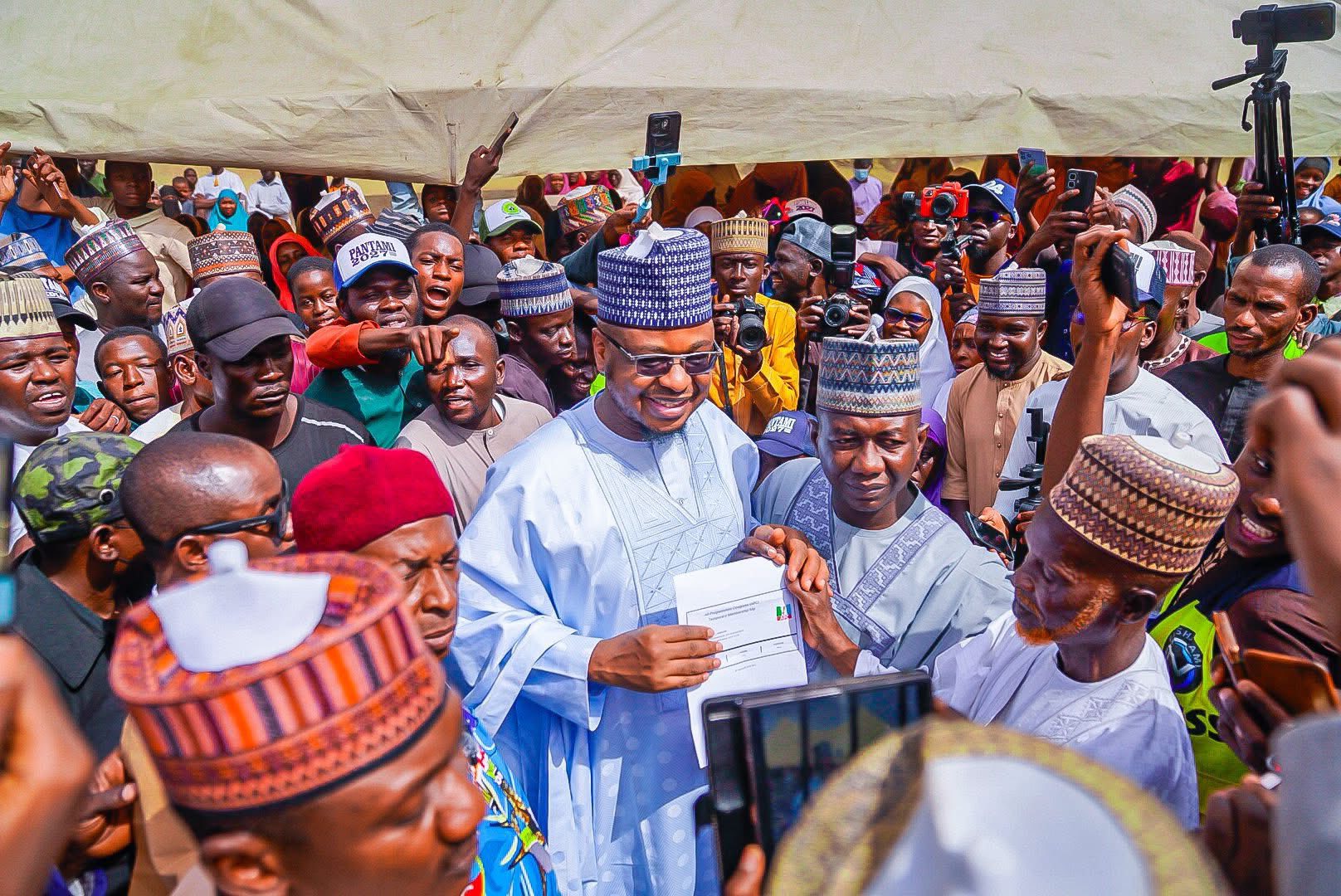
Given his profile as an Islamic scholar and public servant, Imam Dr Isa Pantami’s aspiration for the Gombe State governorship continues to attract attention from multiple quarters. What caught my attention yesterday were the closing lines of Jaafar Jaafar, the publisher and editor of Daily Nigerian, in a brief social media post on the candidature. Jaafar remarked:
“Nigerian politics is grimy. You cannot work in a sewer line and expect to come out clean. Mallam (Pantami) should prepare to mudsling, dip his paws in a cookie jar, dance to the tune of Rarara songs, shake hands with female foreign investors and diplomats, visit churches, steal some billions from security vote, divert public funds for political activities, hire thugs during rallies, lie during campaign, rig during election, take kickbacks after contract award, etc.”
Jaafar is clearly not endorsing these practices; he is only highlighting the grime and immorality that dominate Nigerian politics. Yet I disagree with the implicit suggestion that Mallam Pantami must get his hands dirty simply because he is now in frontline politics. No, he does not.
Pantami does not need to embrace corruption to win elections, nor must he compromise his morals to win or govern successfully after victory. These practices do not constitute the winning formula for elections even in Nigeria. Their dominance in our politics are symptoms that our political system has been hijacked by the morally bankrupt over the years.
Unfortunately, many Western philosophers and some Eastern philosophers have theorised a political thought that sidelines morality. They present it as if power must always be ruthless and corrupt. Niccolò Machiavelli, in his famous work The Prince, famously separated politics from conventional morality. He argued that the end justifies the means and that a ruler should be prepared to use deception, force, or cruelty to consolidate power. Better to be feared than loved, he asserted, if both cannot be achieved.
We see the same philosophy from the likes of Friedrich Nietzsche, Max Weber, Henry Kissinger and even the famous Robert Greene of our age. Their common premise is that politics is about power and domination; that stability and the balance of power matter more than moral ideals; that leaders may employ force, deception, and unethical means to maintain authority; and that some, like Nietzsche, even suggest that morality is a human invention of the weak.
The consequences are visible across the globe. Leaders who internalise these philosophies often govern through ruthlessness, corruption, and moral compromise. In so doing, they have soiled their hands in blood, sex scandals, human rights abuses, economic sabotage, and corruption. This is why, for example, several prominent world leaders have skeletons in Jeffrey Epstein’s wardrobe. They have abandoned morality in their pursuit of power. Today, they are prisoners of their actions.
In contrast, Islamic political philosophy teaches that a ruler must be powerful yet morally accountable, serving as a role model for society. Consider Umar ibn al-Khattab (Umar I), the rightly guided caliph, whose governance was a masterclass in combining justice, authority, and compassion. Umar I punished governors publicly, enforced the law even on the elites, maintained military discipline, and ensured state stability. Yet he was profoundly compassionate: during a famine, he refused to eat butter or meat until the people were fed, and he personally delivered food to the hungry. This was not a democracy; it was a caliphate, yet moral leadership reinforced his authority rather than undermined it.
Umar ibn Abdulaziz (Umar II), the Umayyad Caliph, provides another striking example. Before his ascension to power, the Khutbah (Friday sermons) were often laden with political propaganda, and some rulers ordered preachers to insult and curse Caliph Ali bn Abi Talib from the pulpit in political rivalry. They turned the khutbah into a tool for political rivalry rather than moral guidance. Umar II stopped this vile practice immediately he became the Caliph. He banned curses and political abuses from the revered pulpit of sermons and replaced them with Qur’anic verses. This was exemplary moral courage.
However, Umar II returned the stolen wealth of his predecessors and officials to the national treasury. He reformed corrupt systems gradually because he believes moral change is institutional, not emotional. He abolished oppressive taxes and unjust land confiscations, redistributed state wealth to reduce inequality, and institutionalised meritocracy. Under this meritocracy, he appointed governors and officials based on competence rather than family or tribal loyalty. He removed corrupt and incompetent officials even from his own Umayyad family. Therefore, he revived Islamic ethics in governance.
The last example I will cite here is the famous Abbasid Caliph Harun al-Rashid, who was cited by Chinua Achebe in his book, The Trouble with Nigeria. Harun al-Rashid is another classic example of a leader who combined political power with moral conscience. He was known to travel incognito at night among Baghdad’s citizens to hear complaints directly and make amends where needed. Despite his moral inclinations, the Abbasid dynasty reached its political and cultural peak under Harun al-Rashid. His reign kicked off what later became known as the “Islamic Golden Age”, which gave the world an intellectual gift, the Baytul Hikmah (House of Wisdom).
These examples make one point crystal clear: moral corruption is a choice, not a prerequisite for leadership. The more the world internalises Machiavellian philosophies, the more it empowers the ruthless and morally bankrupt. For Imam Dr Isa Pantami, his candidature is a litmus test. Should he compromise his ethical standards, he risks tarnishing decades of personal integrity. Yet he also has the opportunity to carve out a niche in Nigerian politics by leveraging his clean record, focus, and moral credibility. If he can win ethically and govern without succumbing to corrupt pressures, he could make history, embodying the same fusion of power and moral conscience exemplified by Umar ibn al-Khattab, Umar ibn Abdulaziz, and Harun al-Rashid.
I wish him success and look forward to observing whether he can translate his reputation into leadership that blends authority with moral responsibility, setting a new standard for governance in Nigeria. He is a specimen we should observe; let us see how morally upright people swim against the black tides of our politics. If he succeeds, more morally upright people need to enter politics and help us fix this broken country as early as possible, before it’s too late.
Ibrahiym A. El-Caleel wrote from Zaria, Kaduna State, via caleel2009@gmail.com.
IPOB rejects U.S. lawmaker’s claim that Nigeria’s unity ensures Christians’ safety
By Sabiu Abdullahi
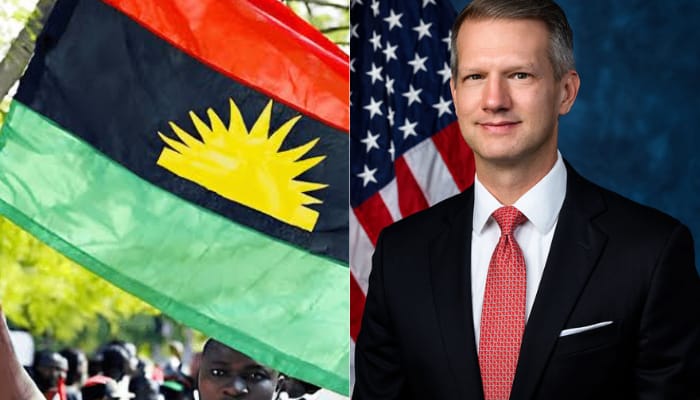
The Indigenous People of Biafra (IPOB) has criticised comments attributed to U.S. Representative Riley Moore concerning Nigeria’s unity, religious persecution, and the movement for Biafran self-determination.
In a statement released on Sunday, Comrade Emma Powerful, IPOB’s Spokesperson and Media/Publicity Secretary, challenged Moore’s view that maintaining Nigeria’s territorial integrity guarantees the protection of Christians.
Moore, who recently concluded a fact-finding visit across Nigeria, warned against the country’s potential balkanisation, arguing that supporting separatist movements could endanger Christians, particularly in the North and Middle Belt regions. According to Moore, his visit included meetings with government officials, church leaders, aid organisations, and Internally Displaced Persons (IDPs) to examine what he described as the “rampant persecution of Christians” in the country.
IPOB, however, described Moore’s position as flawed. “With utmost respect, the position attributed to Rep. Riley Moore reflects a familiar but deeply flawed assumption: that preserving the territorial integrity of Nigeria is synonymous with protecting Christians. History proves the opposite,” the statement said. Powerful highlighted that, over the past six decades, Christians in Northern Nigeria, the Middle Belt, and parts of Yorubaland have faced “cyclical massacres, mass displacement, church burnings, and a culture of impunity enabled by the state itself.”
The group also dismissed Moore’s claim that self-determination “emboldens terrorists,” calling it “a line of reasoning born out of 9 million dollars lobbying enterprise in Washington not reason.” Powerful argued, “terror movements are not triggered by oppressed peoples seeking safety; they flourish where centralized states suppress identity, deny autonomy, and reward violence with appeasement.” He cited Afghanistan as an example where decades of military cooperation and aid collapsed while radical ideology resurged.
Referring to history, IPOB’s statement noted that persecuted religious minorities often survived because independent states provided refuge. “The religiously persecuted Huguenots did not survive Catholic France because France became tolerant. They survived because an independent Protestant England already existed — a sovereign refuge with the political will, military capacity, and moral clarity to protect them. Without Protestant England, there would have been no sanctuary for European Protestants fleeing annihilation,” it read.
Powerful linked this historical context to the current Biafran movement led by Mazi Nnamdi Kanu, describing it as “not a call to violence, nor a scheme to destabilize West Africa as British/Nigerian lobbyists in Europe and USA would have us believe. It is a demand for a democratic referendum, the most peaceful conflict-resolution mechanism recognized in international law.”
The statement added that a restored Biafra “would function as a safe civilizational anchor — a homeland where Christians and people of other faiths from across Nigeria can live without fear, and from which persecuted Christians elsewhere could find refuge and protection.” IPOB also claimed that its emergence has helped reduce attacks on Igbos in Northern Nigeria, stating, “Since the emergence of the IPOB, the once-routine mass killings of Igbos in Northern Nigeria abruptly ceased. That outcome was not accidental. Collective self-assertion created deterrence where decades of appeasement failed.”
While acknowledging the value of security cooperation with the United States, IPOB argued that it addresses symptoms rather than the root causes. “Security cooperation between the United States and Nigeria may manage symptoms, but it has never cured the disease. Repeating a strategy that has failed for generations — while dismissing self-determination as dangerous — is not realism; it is historical amnesia,” the statement said.
Powerful concluded that advocacy for self-determination does not conflict with peace or countering violent extremism. “No serious advocate of peace opposes cooperation against violent extremism. But refusing to acknowledge peaceful constitutional exits, while insisting on the permanence of a demonstrably broken state, guarantees the continuation of persecution rather than its end,” he said.
The spokesperson further argued that an independent Biafra would enhance, not threaten, regional stability. “An independent Biafra, like an independent Protestant England or the State of Israel, would not threaten regional stability. It would create it — by giving persecuted peoples something they have never had within Nigeria: a sovereign place of safety.”
“True concern for Christians — and for all Nigerians — begins with intellectual honesty: forced unity has failed. Safety, dignity, and peace have always followed self-rule, not its denial,” Powerful concluded.
Army recovers 529 rustled animals after gun battle with terrorists in Katsina
By Uzair Adam
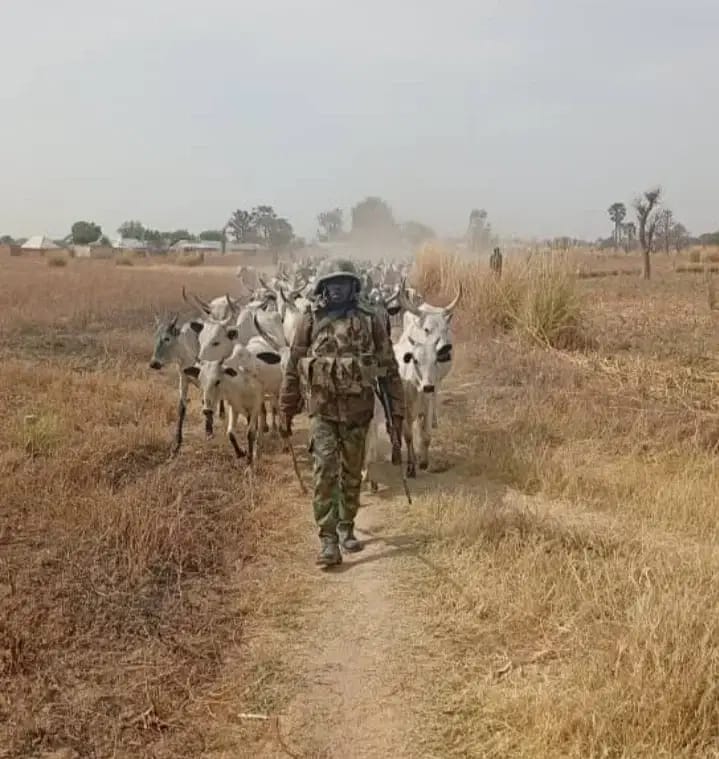
Troops of the Nigerian Army under the 17 Brigade, Katsina, have recovered 529 rustled livestock following a gun battle with suspected terrorists in Kafur Local Government Area of the state.
The Acting Assistant Director, Army Public Relations, 17 Brigade, Capt. Abayomi Adisa, disclosed this in a statement issued on Saturday.
According to him, the operation was carried out by troops of the Forward Operating Base, Malumfashi, after credible intelligence revealed terrorist activities around Kasuwan Sabo in Kafur LGA.
He said the operation, conducted on February 7, 2026, was led by the Commanding Officer of FOB Malumfashi, Lt. Col. M. M. Isa, and targeted terrorists believed to have infiltrated Katsina from neighbouring Zamfara State.
Adisa added that the criminals were allegedly led by Idi Abasu Aiki, said to be a younger brother of notorious bandit leader, Ado Aliero.
He explained that the terrorists opened fire upon sighting the advancing troops, leading to a fierce exchange of gunfire.
However, the soldiers responded with superior firepower, forcing the assailants to flee into nearby bushes while abandoning part of the stolen livestock.
“The troops immediately launched a hot pursuit and caught up with the fleeing terrorists between Burdugau and Unguwan Matau villages in Malumfashi LGA, where the criminals were forced to abandon all the remaining rustled animals,” he said.
After a thorough sweep of the area, the troops recovered 529 animals, comprising 290 cows, 238 sheep and one donkey, as well as one motorcycle.
Adisa noted that 14 cows were killed during the exchange of fire after the terrorists allegedly used them as shields.
He stressed that no casualty was recorded among the troops during the operation, describing their conduct as professional and effective.
The recovered animals, he said, were handed over to relevant authorities for identification and eventual return to their rightful owners, under the supervision of the Chairman of Kafur LGA, Suraju Nature, and the Divisional Police Officer, Superintendent of Police Aminu Salihu.
Adisa further disclosed that the General Officer Commanding 8 Division and Commander, Sector 2 Joint Task Force, Operation FANSAN YAMMA, Maj.-Gen.
Paul Koughna, commended the troops for their gallantry and professionalism, while reassuring residents of sustained military operations against criminal elements in the area.
He added that troops of FOB Malumfashi have continued aggressive patrols to deny terrorists freedom of action and ensure lasting security in the area.
Kano lawmakers deny alleged move to impeach deputy governor
By Uzair Adam
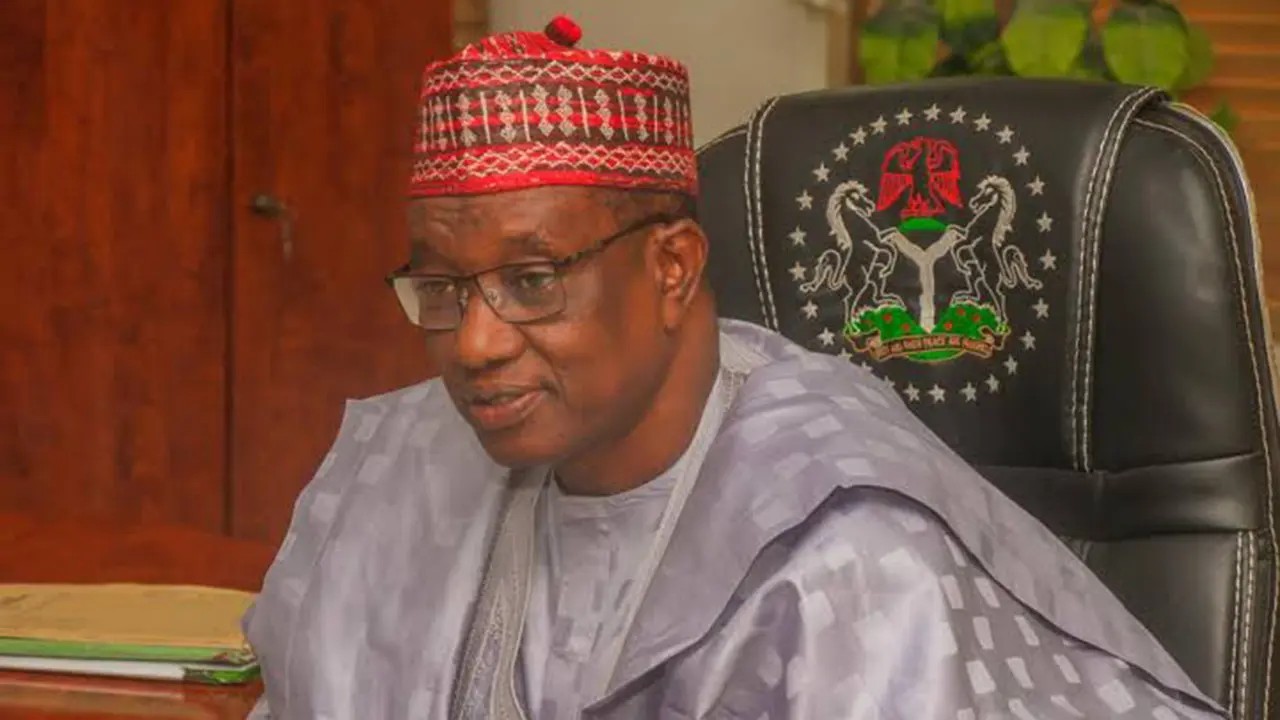
The Kano State House of Assembly has dismissed reports suggesting an alleged plan to impeach the Deputy Governor, Aminu Abdulsalam-Gwarzo, describing them as unfounded and misleading.
The Assembly said there was no such move before the House, stressing that the reports were intended to create unnecessary tension within the state.
Speaking to journalists in Kano on Saturday, the spokesperson to the Speaker of the House, Kamaluddeen Shawai, said there was “absolutely no motion or initiative” aimed at removing the Deputy Governor.
According to him, the circulating reports were false and should be disregarded by the public, adding that the Deputy Governor continued to enjoy the full support of the Assembly.
Shawai urged members of the media and the public to always verify information before dissemination, emphasising that accurate and responsible reporting is crucial to maintaining political stability in the state.
He further noted that the House remained focused on its legislative responsibilities and oversight functions, rather than engaging in speculative political manoeuvres.
“Our priority is good governance and serving the people of Kano, not the circulation of rumours,” he said.
Boko Haram’s letter to Kwara monarch promised ‘preaching and guidance’ weeks before massacre
By Sabiu Abdullahi
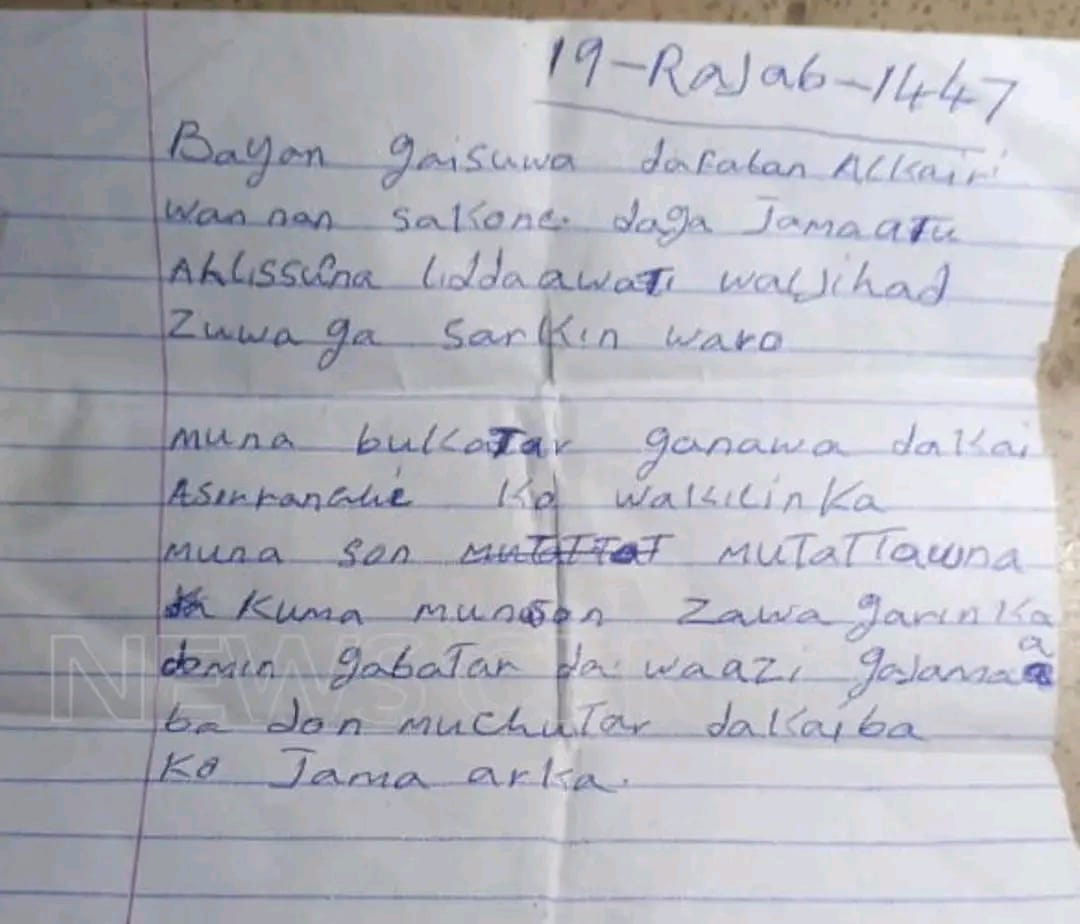
A handwritten letter allegedly sent by Boko Haram insurgents to the Sarkin Woro in Kaiama Local Government Area of Kwara State has surfaced, weeks after a deadly attack that left over 170 people dead.
The message, dated January 8, 2026 (19 Rajab 1447 AH), was written in Hausa and requested a meeting with the traditional ruler or his representative before the violence occurred.
According to a publication by a Nigerian online newspaper, SaharaReporters, the terrorists presented the proposed visit as peaceful religious engagement.
Part of the letter read: “After greetings and good wishes, this message is from Jama’atu Ahlis Sunna Lidda’awati wal Jihad to the Sarkin Waro. We are requesting a meeting with you personally, or alternatively with your representative.
“We wish to discuss matters with you and remind you, particularly concerning preaching and guidance among your people. This is not a threat or a declaration of war against you or your people,” they added.
Residents of Kaiama later accused authorities of ignoring repeated warnings before the massacre. Community members said they had reported suspicious movements of armed men in surrounding forests to traditional leaders, local officials, and the state government without response.
One resident said, “Before these attacks happened, our youths went to the traditional ruler many times to report that strange people were gathering inside the forest close to our villages.
“They did not only stop there. They also informed the local government council and the state government. Everybody knew, but nobody came to protect us.”
Another resident said the alerts were also sent directly to government authorities. “We reported to the state government and to the local government authorities that terrorists were around us. We begged them to deploy security operatives to clear the forests.
“They kept assuring us that something would be done, but nothing happened.”
Locals recalled that fear heightened around mid-2025 after unusual activities increased in nearby bushes. One source said, “There was a time the governor even promised that soldiers would be deployed to our area because of what we reported.
“He told some of our leaders that the Army would be sent to secure the community, but till today, no soldier came. We were abandoned.”
Survivors said the attackers later launched coordinated assaults on several villages. Casualties included men, women, and children, while homes were set ablaze. A resident stated, “What happened did not just start overnight.
“These people were around us for months. We warned the authorities. If they had listened, this massacre would not have happened.”
Another survivor described the scale of the raid. “They came in large numbers with guns. They were shouting and shooting. People were running in all directions.
“Our houses were burned. Many families were wiped out. We are still counting the dead.”
Kwara State Governor AbdulRahman AbdulRazaq, who visited the area with service chiefs and cabinet members, condemned the killings and sympathised with affected communities. He said, “Tonight, I arrived in Kaiama in company of service chiefs and cabinet members to commiserate with His Royal Highness Alhaji Omar Mu’azu (Bagidi Kiyaru IV), the Emir of Kaiama, and the entire community on the cowardly attack launched on our compatriots in Woro and Nuku yesterday. I also visited Woro to see things for myself.”
He stated that many victims were killed after rejecting extremist teachings imposed by the attackers. However, some residents faulted the government’s response and casualty figures. One of them said, “The government failed us.”
He continued. “We did our part by reporting early. If they had deployed army when we raised alarm, these terrorists would not have stayed here to plan and kill our people.”
Another resident added, “It is so sad; the governor came here after people died and they even lied that it was only 75 people that died. Anybody that believes those who were killed were not up to 100 should come here and count the corpses themselves. The government was just doing ‘eye-service’ by crying to the media. They knew these people would attack us and they did nothing.”
EFCC suspends prosecutor Samuel Chime over alleged bribery scandal
By Sabiu Abdullahi
The Economic and Financial Crimes Commission (EFCC) has suspended one of its senior prosecutors, Samuel Chime, over allegations of bribery linked to the sabotage of corruption cases.
The action followed the outcome of an internal investigative panel constituted by the EFCC Chairman, Ola Olukoyede, after multiple petitions were submitted by civil society organisations, non-governmental groups, and concerned individuals accusing Chime of misconduct and financial inducement.
Sources within the commission disclosed that the EFCC leadership expressed strong displeasure over the development, warning that such behaviour could damage the agency’s credibility.
One official said, “Chime was suspended after extensive internal probe revealed that he had compromised some cases due to financial inducements.” Another insider added that “the commission might end up dismissing him, but he has been begging the chairman, and pleading for clemency.”
Chime had served as lead prosecutor in several high-profile cases across different Federal High Courts, including matters involving former public officials and alleged fraud suspects in Abuja, Kano, and Port Harcourt.
Following his suspension, the EFCC has requested adjournments in the affected trials, informing courts that the prosecutor had “proceeded on a sick leave,” a move aimed at safeguarding the commission’s public image.
Further findings from petitions accused him of duplicating charges in separate courts to frustrate defendants, an act said to contradict established prosecutorial standards and EFCC policy.
Consequently, the commission has directed other prosecutors to review both pending and concluded cases previously handled by Chime as investigations continue.
Bandits kill three, abduct Catholic priest, 10 others in Kaduna
By Sabiu Abdullahi
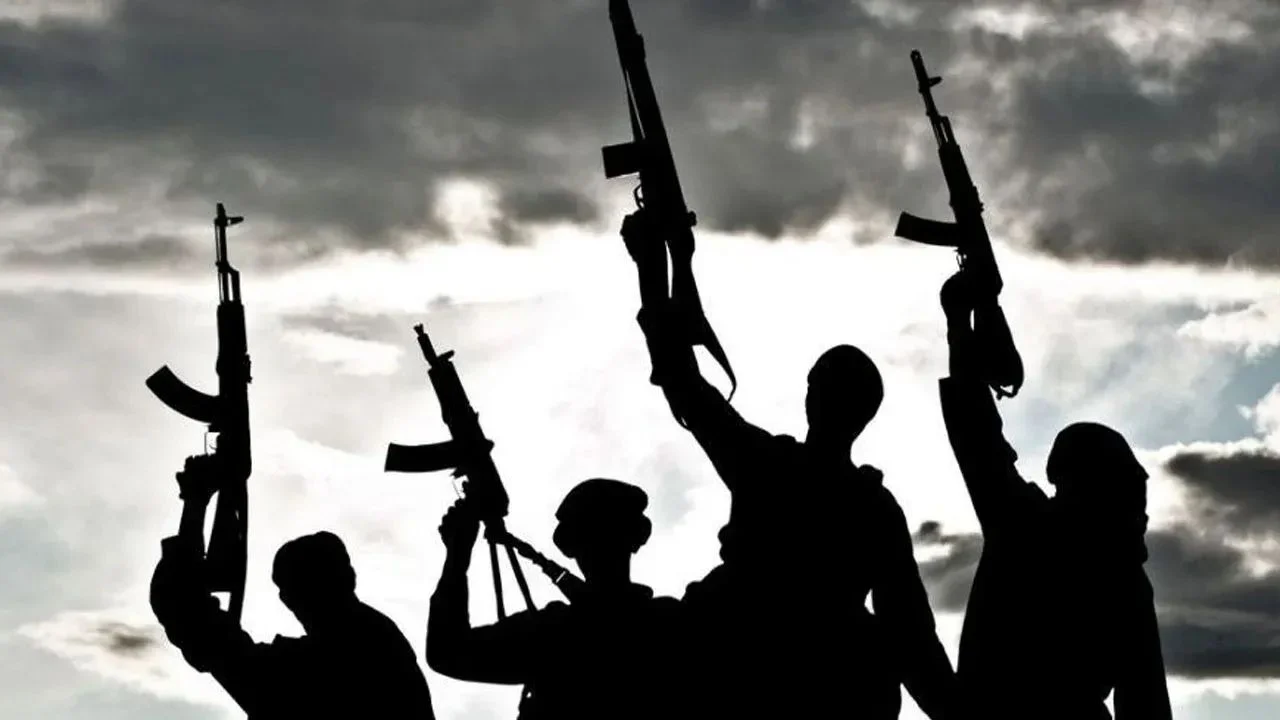
Gunmen suspected to be bandits have killed at least three residents and abducted several others, including a Catholic priest, during a predawn raid on Karku village in Kauru Local Government Area of Kaduna State.
The incident occurred in the early hours of Saturday and threw the community into grief amid growing concerns over insecurity in Southern Kaduna.
A family member of one of the victims, who spoke in a distress message from the village, said the attackers stormed the area suddenly and opened fire on residents. He stated, “The bandits entered our village around 3:20 a.m. and started shooting. People were running in different directions.”
He explained that local vigilantes mobilised and went after the assailants, which led to an exchange of gunfire. According to him, “When the vigilantes intercepted them, there was a gun battle. Six people were killed during the encounter, including two security personnel.” He added that some members of the vigilante group could not be accounted for after the clash. “As I am speaking to you now, three of our vigilantes have not returned. We don’t know their whereabouts,” he said.
The Catholic Diocese of Kafanchan confirmed the assault and the abduction of the Parish Priest of Holy Trinity Catholic Church, Karku, Reverend Father Nathaniel Asuwaye, alongside 10 parishioners. In a statement, the Diocesan Chancellor, Reverend Father Jacob Shanet, said, “It is with deep sorrow that we confirm the abduction of our priest, Reverend Father Nathaniel Asuwaye, the Parish Priest of Holy Trinity Catholic Church, Karku, and 10 other parishioners.”
The Diocese identified those killed as Mr. Jacob Dan’azumi, Mr. Maitala Kaura, and Alhaji Kusari. It added, “Among those killed in the attack are Mr. Jacob Dan’azumi, Mr. Maitala Kaura, and Alhaji Kusari. We condemn this act of violence in strong terms.”
The attack has heightened tension across Southern Kaduna, an area that has witnessed repeated assaults on rural settlements and places of worship. Residents have continued to decry what they describe as insufficient security deployment and slow response during emergencies.
As of the time of filing this report, neither the Kaduna State Government nor security agencies had released an official statement, while community members urged authorities to intensify rescue efforts and strengthen protection in the area.

The menace of Sara Suka and the effects of drug abuse : The way forward
By Isyaka Laminu Badamasi
Recently, an Imam at Kurmin Dorawa in Karofin Madaki, Bauchi state, led a joint Maghrib and Isha’i prayer due to credible fears of a possible attack by suspected thugs in the area. This decision, though unusual, was taken as a precautionary measure in response to rising insecurity—either as retaliation for earlier clashes involving local youths or as part of the resurging menace of ‘Yan Sara Suka’.
Ordinarily, the combining of prayers occurs during the rainy season, while travelling, during festivities, or for other lawful reasons as permitted in Islam. That such a step was taken purely for security reasons speaks volumes about the level of fear and uncertainty now confronting residents.
These mobs, largely composed of young people between the ages of 15 and 25, move around armed with dangerous weapons. Contrary to popular belief, they are not street children, nor are they sponsored by politicians, cult groups, or gang leaders. Rather, they are products of deeper structural failures: poor parental care, societal decay, government neglect, weak application of criminal justice, and, most critically, the widespread abuse of drugs and other narcotic substances openly sold in our neighbourhoods.
In recent years, decisive actions by security agencies, vigilante groups, and community committees have significantly reduced Sara Suka’s activities, creating a relatively safer environment. Unfortunately, the problem has resurfaced with renewed intensity, spreading across almost all parts of the state, including both old and newly established settlements. As a result, some neighbourhoods have become partially or completely inaccessible due to the violent activities of these groups.
This piece does not seek to introduce a new narrative. Rather, it aims to draw attention to existing academic research that examines the role of drug abuse in expanding the frontiers of thuggery. These studies consistently highlight how narcotics fuel aggression, lower inhibition, and sustain cycles of violence among vulnerable youths. More importantly, the literature proposes evidence-based policy frameworks and intervention strategies for addressing the menace through inclusive, humane, and logical approaches.
Only by grounding our responses in research, strengthening social institutions, enforcing the law fairly, and confronting the drug economy within our communities can we hope to stem the resurgence of ‘Yan Sara Suka’ and restore lasting peace.
Academic literature proposes several multidimensional strategies to address the drug abuse crisis in Nigeria, focusing on prevention, management, and systemic reform. These papers advocate the integration of compulsory drug education into secondary and tertiary institution curricula to enlighten students on the physiological and social dangers of substance misuse.
The literature also suggests establishing associations and clubs to promote healthy lifestyles at the community and family levels. Additionally, several studies highlight the critical role of effective family communication and proactive parental monitoring in reducing children’s exposure to drugs, as well as leveraging traditional and religious institutions for grassroots mobilisation and public sensitisation.
While these measures are critical in addressing the menace of drug abuse, the National Drug Law Enforcement Agency (NDLEA), as the regulatory body charged with combating this serious social problem, must be more proactive. For decades, the agency has engaged in efforts to curb drug abuse, including supply and distribution control; however, the situation continues to deteriorate. This reality calls for serious policy adjustments to enable a multisectoral approach involving relevant ministries, Departments, and Agencies (MDAs), such as the NDLEA, the Pharmacists Council of Nigeria (PCN), NAFDAC, security organisations, and host communities, alongside the honest and consistent application of criminal justice.
Governors, on the other hand, should, as a matter of public interest, establish platforms that complement the efforts of the NDLEA through innovative initiatives aimed at eradicating drug abuse in our communities. This can only be achieved through strong political will and sincerity of purpose.
Isyaka Laminu Badamasi is of No 555 Ajiya Adamu Road, Bauchi, Bauchi State.
The old playbook is broken: Emerging markets must navigate the new, polarised global economic disorder
By Ahmed Usman
The global economic order is no longer merely under strain; it is fragmenting in ways that are particularly costly for countries like Nigeria and much of the Global South. Across continents, economic anxiety is feeding political instability, geopolitics is reshaping markets, and institutions once designed to stabilise the world are struggling to remain relevant. What we are witnessing is not a temporary downturn or a cyclical adjustment, but a deeper structural breakdown, driven by forces once assumed to guarantee global stability. For many emerging and developing economies, this moment is not just about global disorder; it is about survival within it.
Global economic power is shifting rapidly. Liberal market-oriented democracies are facing unprecedented domestic turmoil, and the deep integration of trade and finance that defined recent decades is steadily unravelling. From supply-chain fragmentation to trade wars, sanctions, and tariff escalation, the global economy is retreating from openness toward fragmentation. The question is no longer whether the post–World War II economic order is weakening, but how it reached this point and what, if anything, can replace it.
Ironically, the very country long believed to anchor global stability is now fueling its destabilisation. Globalisation was supposed to spread prosperity, deepen interdependence, and reduce the likelihood of conflict. Instead, it has widened inequality within countries, eroded the middle class in developing economies, and concentrated gains among a narrow elite. These imbalances have stoked political backlash, empowered populist movements in developed economies, and turned trade into a political weapon rather than a shared economic good.
This shift became unmistakable during the Trump administration, when tariffs, once viewed as relics of a protectionist past, returned to the centre of global economic policy. The imposition of broad tariffs on China and other trading partners signalled a decisive break from the rules-based trade order. What began as “America First” protectionism quickly reshaped global behaviour, legitimising unilateral trade actions, encouraging retaliation, and accelerating the erosion of multilateral discipline. Trade policy, once anchored in cooperation, became openly confrontational, and the precedent has proven difficult to reverse.
Nowhere is this erosion more evident than in the weakening of trust in liberal democracies themselves. Economic dislocation has bred social resentment. In developing countries, repeated external shocks such as oil price shocks, global interest rate hikes, and pandemic disruptions have led to inflation, currency depreciation, and shrinking real incomes. Rising living costs, youth unemployment, and fiscal austerity have weakened trust in democratic institutions and fueled social unrest.
Domestic politics, in turn, have become more constrained, limiting the policy space needed to pursue long-term development strategies. Political polarisation has weakened governments’ ability to sustain coherent economic policies. As domestic politics grows more volatile, foreign economic policy becomes reactive and confrontational. Trade barriers rise, industrial policy replaces market openness, and economic nationalism becomes a political necessity rather than an exception in many Western countries.
At the same time, the global institutions meant to manage these tensions have failed to evolve. The International Monetary Fund, the World Bank, and the World Trade Organisation, the cornerstones of the post–World War II economic architecture, were designed for a world dominated by a small group of advanced economies. Today, they struggle to respond to capital-flow volatility, technological disruption, climate risk, and the growing power of emerging markets. Their rules remain largely intact, but their legitimacy and effectiveness are increasingly questioned. Their frameworks are still anchored in assumptions that often underestimate social costs in developing countries. Conditionality, delayed financing, and inadequate attention to inequality and structural transformation have weakened their credibility across the Global South. The World Trade Organisation, meanwhile, has struggled to prevent powerful economies from bending trade rules in their favour through subsidies, tariffs, and industrial policy practices that have become more entrenched since the normalisation of tariff-based trade conflict under Trump.
For a time, the rise of emerging markets such as India, Brazil, Nigeria, and Turkey seemed to promise a more balanced and stable multipolar world. These nations benefited from globalisation without fully aligning with any single power bloc, acting as bridges between North and South, East and West. But today, that space is narrowing. Intensifying rivalry between the United States and China has turned trade, technology, finance, development assistance, and even currency choices into tools of geopolitical competition, forcing emerging market economies to pick sides in a contest they did not create.
For countries like Nigeria, this strategic squeeze is especially critical. Dependence on imported technology, foreign capital, and external energy markets makes neutrality costly. Sanctions regimes, supply-chain fragmentation, tariff escalation, and financial market volatility now transmit geopolitical tensions directly into domestic inflation, exchange rates, and public finances. What appears as global disorder at the international level is experienced as household hardship at home.
What emerges from this landscape is a destructive feedback loop between economics, domestic politics, and geopolitics. Economic shocks fuel political instability; political instability drives inward-looking policies; those policies heighten geopolitical tensions; and geopolitical tensions, in turn, further destabilise the global economy. Each turn of the loop reinforces the next, making disorder self-perpetuating.
This is why familiar prescriptions no longer suffice. Calls for more trade liberalisation, fiscal discipline, or institutional reform are not wrong, but are no longer enough. The world has changed too profoundly. Technology is reshaping labour markets faster than institutions can respond. Climate change is imposing costs that markets alone cannot price. Capital moves instantly, while political accountability remains national. Old solutions were built for a slower, more predictable world.
Breaking out of this cycle requires abandoning the comforting illusion that existing global arrangements will eventually self-correct. Calls for more liberalisation, deeper financial integration, or stricter fiscal discipline ignore the lived realities of developing economies. The old playbook was written for a world of expanding trade, cheap capital, and geopolitical cooperation. That world no longer exists.
What is needed instead is a fundamentally new approach. For Nigeria and the Global South, this means redefining integration on terms that prioritise resilience over efficiency. It means reforming global financial institutions to provide faster, more flexible support during shocks. It means investing in domestic productive capacity, regional trade, and human capital rather than relying on volatile external demand. And it means recognising that economic policy must be politically sustainable to endure.
The global economy is spiralling into disorder, not because globalisation failed entirely, but because it evolved without fairness, adaptability, or legitimacy. For countries like Nigeria, the stakes could not be higher. Remaining trapped in the doom loop will deepen vulnerability. Escaping it demands new thinking, new institutions, and a development model rooted in resilience rather than dependency.
The future of the Global South will not be secured by waiting for the old order to return. It will be shaped by how boldly countries confront the reality that the old solutions can no longer solve today’s problems.
The world is not spiralling into disorder by accident. It is doing so because the systems governing it have failed to adapt. Recognising this is the first step. The harder task of building a new framework for global cooperation in an age of rivalry, inequality, and uncertainty is now unavoidable.
The choice ahead is unambiguous: continue circling the doom loop, or accept that the old economic order cannot save us and begin the difficult work of inventing something new.

Security: Kano rolls out smart transport tracking system for commercial vehicles
By Uzair Adam
The Kano State Government has rolled out a Smart Transport Solution aimed at enhancing security and improving efficiency within the state’s transport system through the use of modern tracking technology.
The Daily Reality reports that the programme was unveiled on Saturday at the Afficient Event Centre, where top government officials, transport stakeholders and security agencies gathered for the flag-off.
Speaking at the event, the Commissioner for Transport, Barrister Haruna Isa Dederi, said the initiative, although new to Kano, is a globally tested system already deployed in major cities around the world.
“This is a system which is new in Kano, but not new in the world and not new in major cities,” Dederi said, explaining that the technology enables authorities to monitor transport activities in real time using cameras and satellite-based tracking.
He noted that the system would capture the movement of commuters and vehicles entering the state from designated points, with relevant data transmitted to appropriate authorities for monitoring and response.
According to the commissioner, security agencies including the police, the Ministry of Transportation and the Cabinet Office will have access to dedicated dashboards to track activities across the transport network.
“Everybody will be monitoring what is happening,” he said, adding that the initiative was informed by the growing influx of people into Kano due to its relative peace and economic opportunities.
Dederi stressed that while Kano remains one of the most peaceful states in northern Nigeria, there is a need to adopt modern technology to sustain security.
“That is why we just have to employ a lot of technological innovation, which will help us ensure absolute security in Kano,” he said, while commending the cooperation of security agencies in the state.
On the scope of the programme, the commissioner explained that the tracking system would initially cover all commercial vehicles, including tricycles, taxis, buses, trailers and tankers, with plans to eventually extend it to private vehicle owners.
“For the start, we are focusing on all commercial vehicles,” he said. “Eventually, it will come down to everyone.”
He added that the initiative is in line with the state’s comprehensive transport policy, which provides a legal framework for public-private partnerships and encourages investment in road and rail infrastructure.
“The government cannot go it alone. Partnership through public-private collaboration is the global trend, and Kano will benefit from it,” Dederi said.
Also speaking, the Head of Operations of As&Aj Company, Dr. Aminu Umar Maigari, explained that the firm is the technical partner responsible for deploying and managing the tracking technology used for the Smart Transport Solution.
He said the system was introduced to address security challenges in the transport sector and protect both commuters and their property, noting that As&Aj Company is providing the software platform and tracking devices required for effective monitoring.
Maigari described the initiative as part of Kano State’s efforts to embrace information technology in governance, adding that it would improve transparency and accountability in transportation operations.
He explained that the application required to access the system is free to download and use, with operators only expected to complete a Know Your Customer (KYC) process and install the tracker.
“The good thing about it is that it’s free. You don’t need to pay anything to download and use the application,” he said, adding that the combined cost of the KYC and tracker is N28,000, with a 10 per cent government subsidy for the first one million subscribers.
He noted that the flag-off ceremony was intended to create awareness among transport unions and local government stakeholders, adding that full deployment of the system would commence the following Monday.
In a show of support, the Chairman of the Vehicle Owners and Transporters of Nigeria (VOTOR), Comrade Nazifi Gidan Kudi, commended the initiative, describing it as timely and necessary.
He said the Smart Transport Solution would help check excesses among commercial vehicle operators, address unsafe driving and riding practices, and enhance security across the state.
The Daily Reality gathered that the Smart Transport Solution is expected to mark a significant step in Kano State’s drive to modernise its transport sector and strengthen public safety through technology-driven governance.