



10 generals honoured in grand army farewell ceremony
By Abdullahi Mukhtar Algasgaini
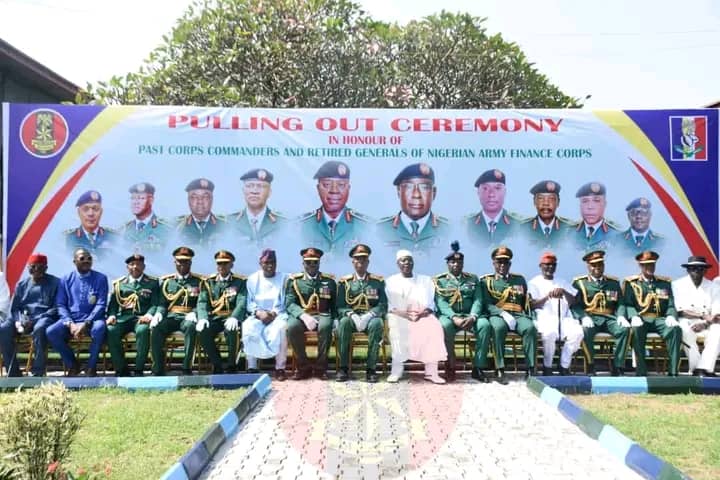
The Nigerian Army Finance Corps (NAFC) held a vibrant valedictory parade on Friday to honour ten of its retiring senior officers, marking the end of their distinguished service.
The event, held at the Nigerian Army School of Signals Parade Ground in Apapa, Lagos, was praised by the Special Guest of Honour, retired Major General Kamal Ishola Yusuf. He described it as “one of the most colourful and dignified” ceremonies of its kind, highlighting the military’s role in upholding tradition as the backbone of its discipline and identity.
The retirees honoured were Major Generals KI Yusuf, AA Fayemiwo, J Mohammed, RN Ochei, MO Ihanuwaze, M Galadima, SA Gumel, and Brigadier Generals EA Obona, AS Maikano, and MK Baba-Mallam.
In his speech, Major General Yusuf expressed thanks for divine protection during their service and commended the Chief of Army Staff, Lieutenant General Waidi Shaibu NAM, for his support. He also acknowledged the efforts of Major General TT Sidick, the Chief of Accounts and Budget (Army), in organizing the successful event.
The ceremony drew a wide array of guests, including serving and retired officers, former army chiefs, commanders, industry leaders, bankers, and the families of the retirees.
The programme featured a formal pulling-out parade, a march-past, and group photographs. Attendees were later hosted to a reception at the Command Finance Office, featuring music, comedy, cultural displays, and refreshments.

Israeli condemns Kwara massacre, pledges support for Nigeria
By Sabiu Abdullahi
The Embassy of Israel in Nigeria has strongly condemned the recent massacre in Kwara State, which claimed the lives of over 160 people, describing the attack as a “horrific massacre” against innocent civilians.
In a statement shared on its X handle on Friday, the Israeli mission expressed “deep sympathy with the families of the victims and all those affected by the deadly attack, which is considered one of the worst mass killings in Nigeria in recent times.”
“The Embassy of Israel in Nigeria condemns the horrific massacre in Kwara State, in which over 160 innocent people were brutally murdered,” the statement read. The mission called the deliberate targeting of civilians “an affront to humanity and can never be justified no matter when or where it takes place.”
Israel also affirmed its solidarity with Nigeria, pledging support for the country’s efforts to combat insecurity and safeguard its citizens. “Israel stands in solidarity with the people and Government of Nigeria in their efforts to confront violence and protect innocent lives,” the embassy added.
The condemnation comes amid national and international outrage over the attack, which occurred in a rural community on Tuesday when armed men reportedly invaded the area, killing residents and burning homes. Humanitarian organizations and local residents have placed the death toll at over 160, with additional people still missing.
The massacre has drawn renewed criticism of Nigeria’s security situation, particularly in rural regions that remain vulnerable to armed attacks. President Bola Tinubu condemned the killings, ordered the deployment of security forces to the area, and promised that the perpetrators would face justice. However, civil society groups and residents continue to accuse the government of failing to prevent repeated attacks despite early warnings.
Security analysts warn that unless immediate and coordinated measures are taken to protect rural communities, strengthen intelligence, and address the root causes of violence, mass attacks like the Kwara incident may continue. Survivors and grieving families are calling for justice, accountability, and sustained security presence to prevent further bloodshed.
Trump defends sharing racist video of Obamas, says ‘I didn’t make a mistake’ despite deleting clip
By Sabiu Abdullahi
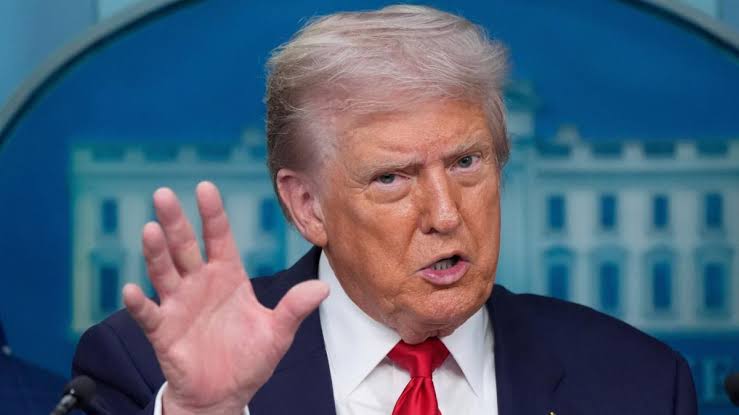
United States President Donald Trump has stated he did not err in sharing a video on his official Truth Social account that showed former President Barack Obama and former First Lady Michelle Obama depicted as apes.
Speaking to reporters aboard Air Force One on Friday, Trump insisted he “didn’t make a mistake” and said he does not need to apologize.
“I didn’t make a mistake,” he emphasized.
Trump acknowledged that he had not watched the entire video before it was posted. He explained:
“I didn’t see the whole thing. I looked at the first part, and it was really about voter fraud in the machines, how crooked it is, how disgusting it is. Then I gave it to the people. Generally, they look at the whole thing. But I guess somebody didn’t.”
When asked whether he condemned the video’s content, Trump replied, “Of course I do.”
The video, posted late Thursday, promoted a conspiracy theory about voting machines used during the 2020 election and included a racist portrayal of the Obamas. It remained on Trump’s account for about 12 hours before being deleted Friday morning after bipartisan calls for its removal.
Earlier, White House Press Secretary Karoline Leavitt defended the post in a statement, describing it as “from an internet meme video depicting President Trump as the King of the Jungle and Democrats as characters from The Lion King.”
She added, “Please stop the fake outrage and report on something today that actually matters to the American public.”
Hours after the statement, the video was removed from Trump’s Truth Social account.
Dear Donald Trump, we are not apes
By Muhsin Ibrahim
We could not sleep one night in 2008. Instead, we sat in front of the TV, watching and praying for ‘our’ favourite candidate to coast to power and be declared the winner of the election. We wanted to witness history, not of any relative winning any election in Nigeria, but of Barack Obama winning the United States presidential election.
Of course, we witnessed the history of the first non-white man becoming the president of the most powerful country in the world. We were delighted. We thought that, henceforth, black people would be more respected globally. Henceforth, our race would not be associated with backwardness. Henceforth, we would have more opportunities not only in the US but far beyond.
We also thought President Obama would do more for Africa (where his father came from) and for Muslims (his father’s ‘relatives’), especially in the Middle East. Again, his association with towering academics, such as Edward Said and Rashid Khalidi, gave us some extra hope. No, we got it all wrong. Obama was like the rest of them.
Obama’s role in destabilising Libya is still felt not only within the country but also far beyond, including in Nigeria. Obama authorised more drone strikes in the Middle East than any other US president. He did not bring peace anywhere, though he controversially won the Nobel Peace Prize.
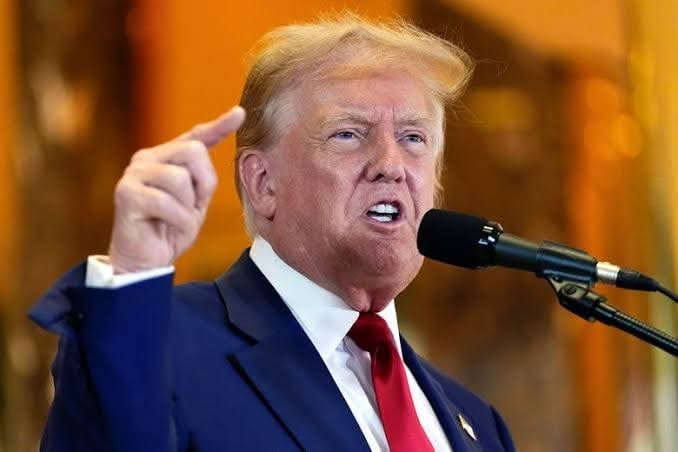
Despite the above and more, I was disturbed to see President Donald Trump sharing the infamous Obamas’ “meme”, depicting them as apes. This was Trump’s new low. Its implications are also broad, extending beyond the Obamas. It, among other things, risks normalising racism, especially in the West, towards black people.
Trump is unlike any leader anyone has ever seen in the White House. Yet, we should not overlook this brazen attack on us; we must call him out for this naked racism towards black people. We are not apes. We are human beings like him, if not better. We deserve respect. He owes us an apology.
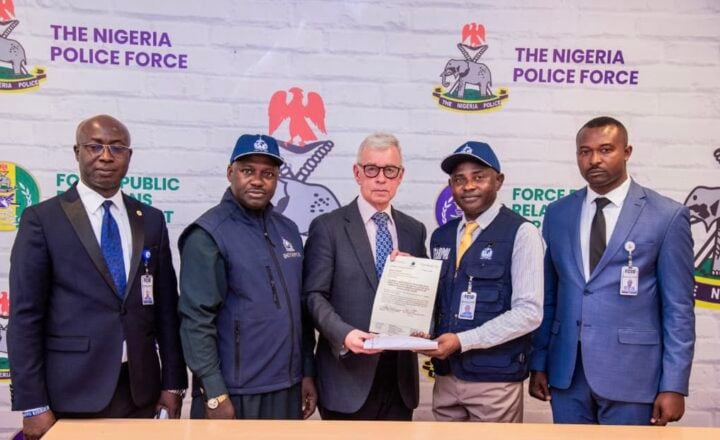
Police hand over $23,000 recovered from romance scam suspect Cayman Islands victim
By Sabiu Abdullahi
The Nigeria Police Force (NPF) has handed over the sum of $23,000 recovered from an alleged international romance fraud suspect to the British High Commission in Abuja for onward return to the victim in the Cayman Islands.
Police authorities said the money was retrieved from Achufusi Obioma, a Nigerian national who was under investigation for allegedly defrauding a resident of the Cayman Islands through an online romantic relationship scam.
In a statement issued on Friday, Force Public Relations Officer, Benjamin Hundeyin, disclosed that the complaint was first received by the INTERPOL National Central Bureau (NCB) Abuja from the Royal Cayman Islands Police Service.
He explained that the recovered funds were later transferred to the Royal Cayman Islands Police Service through Shaun McLeary, who represented the British High Commission in Abuja.
“The repatriation followed a request received from the Royal Cayman Islands Police Service seeking assistance of the INTERPOL NCB Abuja to investigate a Nigerian national, Achufusi Obioma Ikenna, who defrauded a resident of the Cayman Islands through an online romance scam,” the statement reads.
“Acting on the request, INTERPOL NCB Abuja conducted discreet, intelligence-led investigations which led to the arrest of the suspect and the recovery of the sum of $23,000.
“Following the completion of all necessary documentation and in collaboration with international partners, the recovered funds were formally handed over to the Royal Cayman Islands Police Service, through the British High Commission in Abuja, represented by Mr. Shaun McLeary, for secure delivery to the victim. Meanwhile the suspect will be arraigned at the conclusion of investigation.
“This successful repatriation underscores the Nigeria Police Force’s sustained commitment to intelligence-driven policing, effective international collaboration, and the disruption of transnational cybercrime networks.”
The Cayman Islands is a self-governing British Overseas Territory located in the western Caribbean.
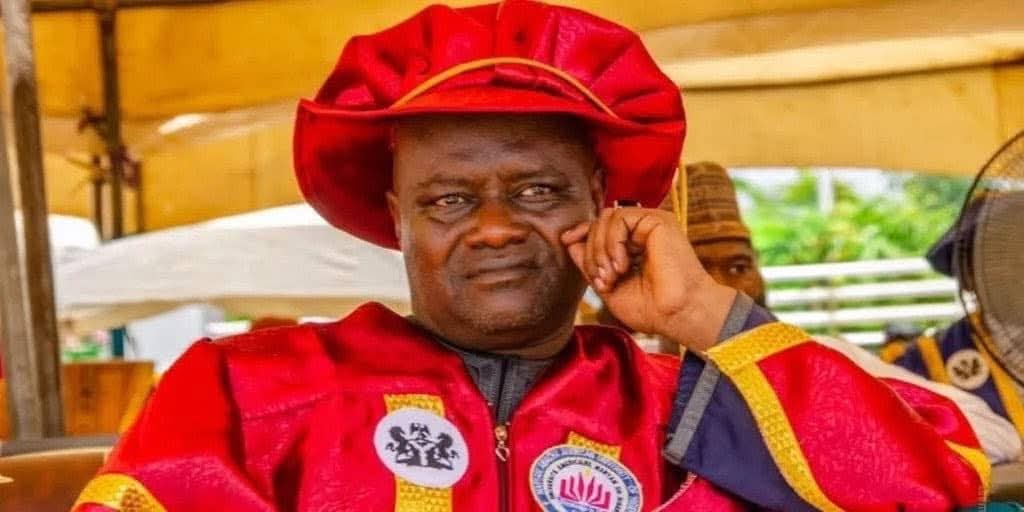
EFCC arraigns ex–FUDMA VC over alleged ₦19.7m bribery in Katsina
By Muhammad Sulaiman
The Economic and Financial Crimes Commission (EFCC), Kano Zonal Directorate, on Thursday, February 5, 2026, arraigned a former Vice-Chancellor of the Federal University Dutsinma (FUDMA), Professor Armaya’u Hamisu Bichi, before the Katsina State High Court over an alleged N19.7 million bribery scheme.
Bichi was docked before Justice Musa Danladi Abubakar alongside two others—Lawal Tukur Mani and Aliyu Lawal Jari—on a five-count charge bordering on bribery.
According to the EFCC, Bichi, while serving as Vice-Chancellor, allegedly received kickbacks from contractors through the two co-defendants in exchange for the award of contracts at the university. One of the charges alleged that he obtained N5 million in July 2023 from a contractor as gratification for contracts involving the supply of medical equipment and laboratory furnishing, with the funds paid into a bank account belonging to one of the co-defendants.
All three defendants pleaded not guilty to the charges.
Following their pleas, prosecuting counsel, Salihu Sani, requested a trial date, while defence counsel moved applications for bail. Justice Abubakar granted each defendant bail in the sum of N5 million with one surety in like sum and adjourned the case to March 12, 2026, for the commencement of trial.
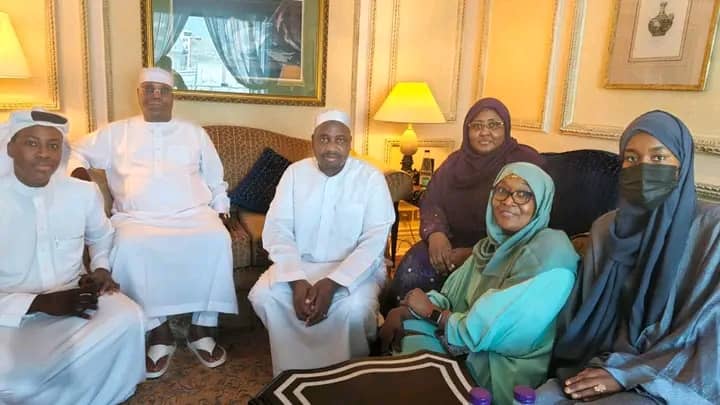
Former First Lady, Aisha Buhari, visits ex-VP Atiku in Saudi Arabia
By Abdullahi Mukhtar Algasgaini
Former vice President Alhaji Atiku Abubakar, on Friday in Saudi Arabia, received a courtesy visit from Hajiya Aisha Buhari, the wife of the former Nigerian President, Muhammadu Buhari.
The former First Lady was accompanied by her daughter, Hanan, and other family members during the meeting.
According to a statement from Atiku Abubakar, both he and the Buhari family are currently in the Kingdom of Saudi Arabia to perform the lesser Hajj, known as Umrah.
Alhaji Atiku Abubakar noted that he was honoured to host the visit, which underscores the continued cordial relationship between two the families.
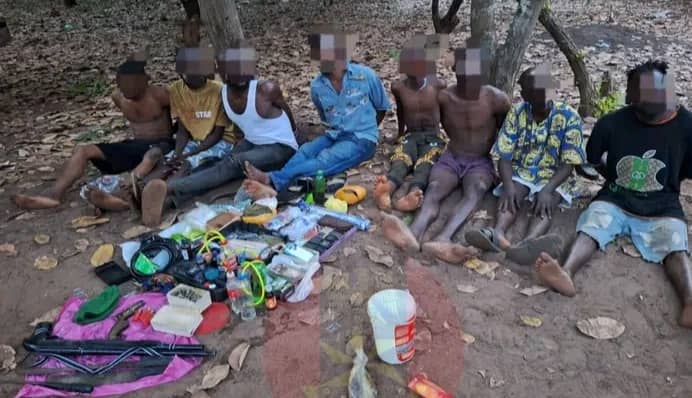
Joint security raid nets 13 kidnap suspects, drugs, weapons in Edo north
By Abdullahi Mukhtar Algasgaini
In a major coordinated operation, Nigerian Army troops from 4 Brigade, alongside Air Force, Police, Civil Defence, and Edo State Security personnel, have arrested thirteen suspected kidnappers and drug peddlers in Edo North Senatorial District.
The operation, codenamed “Operation IGBO DANU 1,” was carried out on February 4, 2026, across Osara, Auchi, and Okpella communities in Etsako West Local Government Area.
According to a military press release, eight suspects were initially apprehended in the clearance raid. Items recovered from them included a pump-action gun, a locally made pistol, live cartridges, a POS machine, illicit drugs suspected to be cannabis, tramadol, and codeine syrup, as well as phones, a camera, and ₦87,550 in cash.
In a follow-up operation the same day, troops combed the Aviele Forest, leading to the arrest of five more suspects. Two motorcycles, phones, and a power bank were seized.
All arrested individuals and recovered exhibits have been handed over to the Edo State Police Command for further investigation.
The Commander of 4 Brigade, Brigadier General Ahmed Balogun, praised the inter-agency collaboration and warned that Edo State will remain hostile to terrorists, kidnappers, and other criminals. He reaffirmed the commitment of security forces to protecting lives and property in the state.

Famous British rapper Central Cee announces conversion to Islam, sparks reactions online
By Sabiu Abdullahi
Popular British rapper, Central Cee, has stirred widespread reactions on social media after revealing that he has embraced Islam.
The announcement shifted attention from his music career to his personal faith journey. Shortly after the revelation surfaced online, thousands of fans and followers trooped to his social media pages to express their support and goodwill.
During a live appearance, the rapper disclosed that he had formally entered the Islamic faith. He said, “I declared the Shahada, I have a new name, I am now a Muslim.”
Following the declaration, congratulatory messages poured in from supporters across different platforms. Many welcomed him warmly into the religion. Some of the messages read, “Welcome to Islam, brother,” “You have been honored with Islam,” and “Welcome, Muslim brother.”
The development also triggered conversations about a possible new identity for the music star. This came after he hinted about adopting another name. He had stated, “I have a new name.”
Fans quickly began suggesting options they felt would suit him. Among the various proposals, one name appeared repeatedly in comment sections. Several followers wrote, “Yusuf suits him well,” while others added, “I am curious about the Muslim name, but let it be Yusuf.”
Despite the wave of speculation, the rapper has not released any official confirmation regarding a new name. He has also not provided further clarification on the matter.
Online engagement around the announcement continues to grow, with many admirers still awaiting additional details about his conversion and identity within the faith.
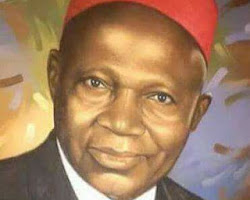
Zauren Mallam Aminu Kano as a Social Repair
By Abubakar Muhammad
Crime is a prominent feature of the city. The mitigation of crime and other social vices is a responsibility that falls not only on the government. The health of society is a responsibility that spans multiple dimensions, from authorities with direct power to families and residents of the community as a whole. The social health of the city is also the work of architects and planners.
Physical planning is an important factor in influencing the social health of society and its inhabitants. Respected voices in urban planning note how a great urban environment, in terms of design and social services, can enhance people’s quality of life and foster a sense of community. In this piece, I set out to use Zauren Mallam Aminu Kano as a social repair tool and a planning theory for combating crime and other social ills in our society.
We have recently heard the gruesome murder of an entire family in Kano, first in Tudun Yola and then in Ɗorayi, by the same alleged criminals. Cities are characterised by petty and violent crimes. The job of residents and governments is to implement policies that prevent crime to ensure the safety of inhabitants and the prosperity of the city. Sustainable urbanism involves governments at various levels, as well as city residents.
I was particularly happy weeks ago when I learned that communities around Dala have mobilised to construct a police station around Kuka Bulukiya cemetery to combat persistent phone snatching that has cost countless lives of innocent passersby. The idea of constructing security outposts in crime hotspots has been a productive strategy for combating crime. It is not only about fighting crime; it also replaces crime with security and constant human presence and activity. It not only prevents crime and protects lives but also brings life and economic activity to beleaguered areas.
My friend once took me to an area of the ancient city to pay my condolences. It was a long time ago I cannot remember the name of the neighbourhood. Those who know Kano intimately can piece together snippets from my narration to figure out the area. I can vaguely say that the area was around Mandawari, Yar Mai-Shinkafi, Gyaranya, Baƙin Ruwa, or Gwauran Dutse. We walked through the alleys after the condolence and appeared at the Aminu Kano Way.
The neighbourhood has a shelter christened Zauren Mallam Aminu Kano. It is an open pavilion in the heart of the neighbourhood. I was intrigued not only by the discovery but also by the place’s name and social function. This was the first time I had ever heard of the place, or any shelter named Zauren Mallam Aminu Kano in the city. I began to think about the connection between the place and the famed radical politician.
I did not ask the naming history behind the shelter, but my imagination wagered that this must be the spot where Mallam Aminu Kano hung out with friends and conducted his public life. It must be the local context where he started his political career, a gathering place for the nightly schooling and political organising. My guess was supported by my assumption that the place is located within the ancient city, and not far from his initial dwelling at the Aisami/Sani Mainagge axis. I was intrigued by the place for its great potential to build a community.
The Zauren Mallam Aminu Kano is a mini square and public space for the community. It enables the residents to perform social and religious functions. Residents of the neighbourhood, particularly the elderly and retirees, use the pavilion to hang out. The community uses the open space to perform the funeral salat for the deceased. The main street around the space serves as a collector road, receiving people from nearby alleys and neighbourhoods. Thus, the open space becomes vibrant with life. Residents and visitors use the space to park their vehicles. Around the square, activities sprang up: informal people, vendors, and small entrepreneurs set up stalls offering services, various wares, delicacies like tsire and awara, and other household items that cater to the neighbourhood’s hospitality and social needs. The shelter becomes a living room of the community. My reading is that Zauren Mallam Aminu Kano is an open space that allows residents to do things that they cannot perform in the narrow alleys of their neighbourhood.
Part II
For this reason, Zauren Mallam Aminu Kano stays with me. I want to suggest an expanded version of this space be built in as many places as possible in the ancient city, its suburbs and major towns across the state. This is based on key spatial ideas for sociability and security of communities and neighbourhoods.
Ancient cities like Kano had been built around their traditional institutions. The city spread out from the Emir’s Palace, surrounded by other civic buildings such as the court and the central mosque, which eventually formed the city centre. Spreading in a radial pattern, subsequent expansions and settlements of the city and major towns followed the same tradition. All roads lead to the city centre. And the civic centre, or city centre, is almost always located in the vicinity of the traditional ruler’s dwelling. Outside the city, the Maigari’s or Dagaci’s house sat at the centre of the settlements.
The best location for the Zauren Mallam Aminu Kano is to look for the ugliest and most dangerous part of the neighbourhood and tear it down to create a large enough open space to build the shelter. This place should be the heartbeat of the area by consolidating basic services in one building: a small local clinic, a school, a library, administrative offices for Mai-unguwa, Dagaci, and security agents, and a conference room for important community meetings and non-partisan civic engagements.
A strong civic component and social life are essential. The idea is to overwhelm crime, blight and unsightly facades. The building can serve as a venue for adult literacy classes, mass education and public orientation centres for social mobilisation and political awareness. As a multipurpose building, the place can host activities such as elections, immunisation campaigns, skills and personal development training for local youth.
A mosque can be located close to the shelter. Around the mosque, the elderly sit, dine, and eat. It is where they enjoy calm, festive hours by day and night. Zauren Mallam Aminu Kano should be the agora and living room of the community. Clusters of civic buildings, residential and commercial uses can create sociability. This is not new; it is something that needs to be consciously improved upon existing traditions. Several Hausa villages have a santa or tsakar gari, which serves mixed purposes and brings people together. Since the shelter is located near the mosque, it should also serve as an open space for conducting funeral prayers. Commercial activities can be encouraged around the area to provide a more vibrant economic life. In Kano city, many neighbourhoods have ƴar kasuwa within walking distance, allowing residents to make purchases for their daily needs.
The small clinic located in the centre should offer first-aid services and cater to the health needs of the most vulnerable. It should deliver basic drugs and inexpensive medications, medical advice and other services that might not require a trip to the hospital. Local people with training in medical fields can volunteer to operate the place. They can also request NYSC corps members to be posted there. Funding can come from donations from wealthy residents of the community. People who have retired from active service in various walks of life can participate. Skilled individuals can also ask to set up offices and contribute their services to the community. Community services can serve as a clear benchmark for future political leaders. People can see what potential representatives have contributed to their local communities before they enter politics – what they have done for the people before asking for their votes.
It would not be a bad idea to allow car owners to park their vehicles in and around the shelter. Community-owned assets, such as donated vehicles for transporting the deceased, a power transformer, and water sources like a borehole, can be sited there. The underlying assumption is that communities would actively work to protect their assets and improve their neighborhood. Their commitment or otherwise to safeguarding their assets is clear proof of their collective responsibility, leadership, accountability and readiness for sustainable development.
The idea is to use Zauren Mallam Aminu Kano to make the targeted area active and vibrant with human activity. The dwelling of the traditional ruler should be sited there to continue to facilitate administrative functions and liaison with various levels of governments for record-keeping, issuing birth certificates and documents, and other civic engagements. The closest idea to this is Ofishin Wakili, which can be upgraded where they already exist. If built with magnificent architecture, places like this can become historic sites that represent the community and its traditions.
The building should house an office for joint security agencies, including the police and Hisbah. This is where disputes will first be reported. It will enhance coordination and timely reporting of suspicious activities to support early crime prevention. Emphasis is placed on civil matters and on preventing violent crimes. The activities and involvement of the security should be largely civil and minimal. The point is to increase safety through informal supervision. Security agents, the elderly, and small business operators are public figures who keep an eye on the neighbourhood. Retirees and the elderly also fill the void and silence when others are at work or school. They can alert parents – and the security agents – to what is happening in the neighbourhood. Sustainable urbanism can be achieved by densifying social life in hitherto dark corners without militarising the neighbourhood. The refurbishment of the neighbourhood is a valued alternative to blight, providing security through communal social space. Services and buildings can be distributed according to the community’s needs and resources. The purpose is to chase away the thugs from the heart of the community and bring light to the dark corners and crevices. In the process, services are brought closer to the people. Traditional institutions are involved more closely and meaningfully in public service for their immediate communities.
Stakeholders – government, traditional institutions, and community members – should work together to realise the Zauren Mallam Aminu Kano as a state-supported, neighbourhood-funded civic infrastructure across Kano State. Zauren Mallam Aminu Kano should be conceived as a community and family resources centre for the neighbourhood’s residents. It should be designed as a crime-prevention tool through visibility, social life, and shared spaces that strengthen grassroots governance and access to basic services. It is also an embodiment of the spatial practice of good neighbourliness, the warmth, and the communal character of the Mutumin Kirki society.
Abubakar Muhammad is from Kano, Nigeria.