By Uzair Adam
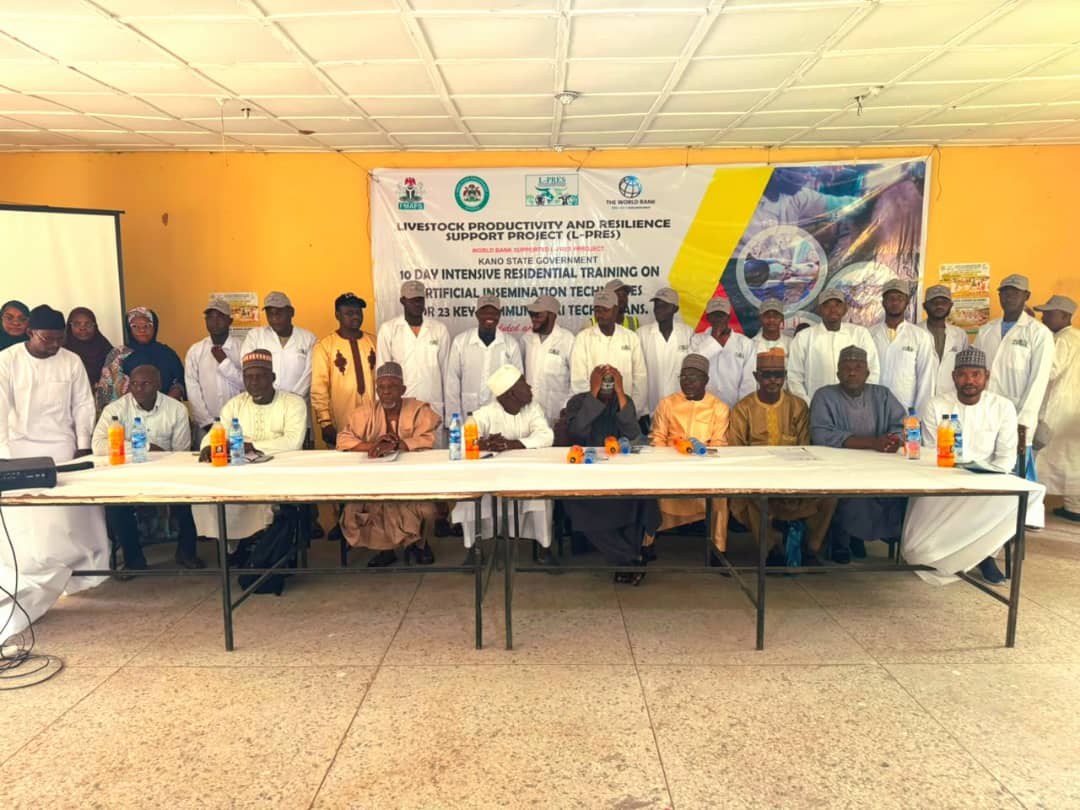
The Kano State Coordination Office of the Livestock Productivity and Resilience Support Project (L-PRES) has commenced a 10-day residential training for 23 community artificial insemination (AI) technicians as part of efforts to improve livestock productivity and increase milk and meat production across the state.
The training began on Monday, August 10, 2026, at the Artificial Insemination Centre and Farmer Field School, Kadawa, Kano State, and is scheduled to end on August 19.
The training, titled “Artificial Insemination Techniques for 23 Key Community Artificial Insemination Technicians,” is designed to equip participants with practical skills needed to support the project’s planned 5,000 artificial insemination exercises across the 44 local government areas and wards of Kano State.
The programme is expected to improve the genetic quality of livestock through crossbreeding, increase milk and meat production, and make artificial insemination services more accessible to livestock farmers and pastoral communities.
Speaking on the objectives of the training, Abubakar Muhammad Kabiru, an Animal Husbandry Officer with Kano L-PRES, said the 23 technicians were being prepared to participate in the planned artificial insemination programme across the state.
He said the technicians would play a key role in ensuring the successful implementation of the project’s target of 5,000 artificial insemination exercises.
“We are here today to train 23 key community artificial insemination technicians in order to enable them to participate in the forthcoming 5,000 artificial inseminations to be carried out across Kano State, covering the 44 local governments and all the wards,” Kabiru said.
According to him, the programme is aimed at achieving a high success rate while producing about 5,000 crossbred animals capable of increasing milk and meat production.
Kabiru added that the trainees would subsequently provide artificial insemination services to L-PRES beneficiaries across the state in accordance with approved technical standards.
He explained that 22 of the trained technicians would each be assigned to cover two local government areas, while he would supervise their activities.
He further said the technicians would work alongside a consultant who would visit communities to identify suitable animals based on factors such as age, health condition and pregnancy diagnosis before the insemination process.
Also speaking, Gambo Isa Garko, an Extension Officer with the L-PRES Project, described the training as a critical component of efforts to increase the number of cattle benefiting from artificial insemination.
Garko said the specialised nature of artificial insemination services made it necessary to have adequately trained personnel capable of providing the service at the community level.
“Training these 23 artificial insemination technicians will increase the number of targeted cows to be inseminated by the L-PRES Project and help us achieve our targets,” he said.
He explained that artificial insemination offered livestock farmers a relatively affordable method of improving the genetic quality of their animals compared with purchasing high-quality breeding animals, which can be costly.
“Instead of buying breeding cows, which are very costly, getting semen is relatively cheaper. With the semen and highly trained technicians, we can now carry out insemination,” Garko said.
He expressed optimism that the initiative would record a high success rate and contribute significantly to improved livestock productivity in Kano State.
The Director of Public Enlightenment at the Kano State Ministry of Agriculture and Natural Resources, Abba Dalha Soron-Dinki, also described the training as an important intervention capable of strengthening agricultural and livestock activities in the state.
Soron-Dinki said increased livestock production would improve the availability of milk and meat while contributing to economic growth and better livelihoods for residents.
“It is very important because it will increase and boost agricultural activities in the state. The milk and meat we are getting will become more available and will increase tremendously to the society,” he said.
He added that the Kano State Government was implementing various measures aimed at strengthening agriculture and livestock production.
Meanwhile, Auwalu Musa, a director at the Kano State Ministry of Livestock Development, said artificial insemination was essential to improving the genetic performance of livestock.
He noted that Kano’s large population made it necessary to increase livestock productivity to ensure adequate supplies of milk and meat for residents.
“With artificial insemination, the performance of our animals will be upgraded. Kano is a populated state, whereby there is a need to improve the genetic performance of the animals so that we get more milk and more meat for consumption,” Musa said.
Musa further noted that the training would help address challenges faced by livestock farmers in accessing artificial insemination services, particularly those living in pastoral communities.
He said the community-based technicians would be able to travel to various local government areas and communities to provide AI services, enabling pastoralists and other livestock farmers to access the service closer to their homes.
Musa added that the training would also equip the participants with specialised skills that could create livelihood opportunities for them while contributing to the development of Kano State’s livestock sector.