The fallacy behind free education in Kano
By Salisu Uba Kofar-Wambai
By Abdulahi Majeli, Esq., AICMC
By Zayyad I. Muhammad
The Federal University of Technology, Owerri chapter of the Academic Staff Union of Universities (ASUU) inaugurated a five-person probe panel on September 22, 2021, to assess the procedures used to appoint the Minister of Communication and Digital Economy, Dr Isa Ali Pantami, as a Professor of Cybersecurity. The panel said due process was followed by the governing council and the management of the university in the appointment. The report by the panel is an interesting one considering the heated public debates generated by the appointment.
Most of the people who criticized the appointment were academics. As expected, the majority of those who supported the critics were Pantami’s political adversaries. Pantami’s appointment supporters were either some academics, his political supporters, and those who sat on the fence.
The verdict by the five-person probe panel certainly gives Pantami and FUTO some respite. His political supporters will be delighted, while opponents of the appointment will fire more because the majority of them are academics. Tenacious criticism on issues that concern knowledge is an attitude of academics.
During the first debate, Pantami’s ‘friend’ Professor Farooq Kperogi said: “There are basically three legitimate ways to become a professor: by climbing the professional ladder in a university; by being appointed to the position from outside academia in recognition of vast and varied industry experience or artistic wizardly in a field; and through a courtesy appointment. Isa Ali Ibrahim Pantami’s record does not qualify him for any”.
However, Prof. Tukur Sa’ad, a former Vice-Chancellor, said, countering Kperogi, “A University can decide to appoint an individual to a position either through promotion or straight appointment based on the criteria they set up independent of the National University Commission (NUC).”
Pantami’s political allies and supporters are delighted with the report of the ASUU panel because they see Pantami as a potential vice presidential candidate with many advantages. To all Pantami’s supporters, his professorship is a big addition to his credentials which his potential rivals don’t have. They believe that Patnami is young, highly educated with a PhD. from the United Kingdom (UK) at Robert Gordon University, Aberdeen.
These supporters add that politically, Pantami is a good ‘material’ to balance a presidential ticket. He is from North-East Nigeria; he fits into the agitation for the northeast to present the vice-presidential candidate in 2023. Moreover, he is a household name in the North-west. They will feel at home with him – he is their cousin.
Additionally, he is an Islamic scholar with vast cult-like followership nationwide. Pantami is Buhari’s strong confidant and ally. The general belief among Pantami’s promoters is; Pantami from the northeast as vice-presidential candidate with any presidential candidate from the south, especially the southwest, will balance a presidential ticket and serve as a strategy for the APC to retain the presidency in 2023.
Nevertheless, academics and oppositions against Pantami’s professorship will continue to hit hard while his political rivals will clap for them. So Pantami and his supporters should be well-prepared for the game.
Zayyad I. Muhammad writes from Abuja. He can be contacted via zaymohd@yahoo.com.
By Mukhtar Ya’u Madobi
Subject to its wider ramifications, the burden of maintaining security is too cumbersome to be single-handedly by a solitary institution in a heterogeneous country like Nigeria.
Thus, the multi-stakeholders’ approach is often more necessary where there is a rise in security challenges. Therefore, security should be a collective effort of the government plus other state and non-state actors, including the private sectors.
The word ‘security’ simply implies the protection of the lives and properties of people from various forms of threat. It occupies the highest level of priority in the hierarchy of responsibility by the government as one of the core values that the state cherishes as non-negotiable and that does not admit compromise.
The contribution of private sectors in ensuring security can be rendered through various channels, including the construction of security facilities, donations of logistics to security services and providing equipment at their disposal during emergency response situations such as fire outbreaks, accidents, building collapse and natural disasters such as flooding, earthquake, etc.
Other alternatives include community participation in securing their locality in collaboration with police, i.e. the neighbourhood watch or vigilante group, involvement of religious and traditional leaders in disputes resolution among their followers and services provided by the business enterprises to their host communities through corporate social responsibility (CSR) initiatives.
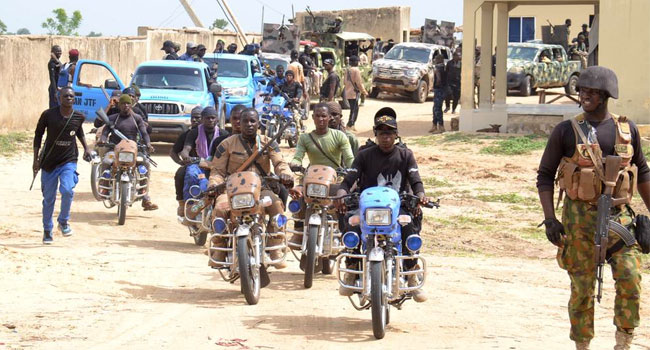
To that effect, the role being played by the famous Civilian Joint Task Forces (Civilian JTF), through collaboration with the security agencies in countering the violent extremism of Boko Haram terrorists in the North-East (Borno), is very commendable. Such volunteer groups provided invaluable intelligence that led to the uncovering of many deadly terrorist cells and their subsequent elimination.
Now that the terrorists are surrendering, community leaders, civil society groups and NGOs have a greater job to embark on sensitizing the mindsets of the public in de-radicalization, rehabilitation and reintegration of the repentant terrorists into society. This will go a long way in maintaining the security of lives and properties of people.
It is noteworthy that the CSR initiatives of the Aliko Dangote Foundation donated 150 operational vehicles to the Nigeria Police Force in 2018, which was described as the single most significant gift ever by a private sector operator to the police.
In the Niger Delta region, where the problem of insecurity is mainly attributed to the feeling of anger and frustration by host communities due to negligence of CSR initiatives, the oil companies have turned a good leaf by changing the narratives.
Multinational corporations are now actively involved in providing infrastructural facilities such as schools, hospitals, roads, and water supply to their host communities. In the long run, they also designed a special scholarship scheme for the indigenes. They are provided with tuition fees and reading and learning materials to further enhance their educational careers. This initiative has undoubtedly contributed immensely to reducing the militants’ activities and other security tensions in the oil-rich Niger Delta region.
Moreover, several societal figures and organizations were known for their efforts in constructing and rehabilitating security outfits across the country. Recall that, immediately after the #EndSARS protests in which several lives of both civilians and security personnel were lost, many properties were destroyed, police stations looted, their firearms carted away and subsequently destroyed.
The giant private sector-led Coalition Against COVID-19 (CACOVID) procured new equipment for police officers and pledged to rebuild the burnt police stations destroyed during the civil unrest to restore security to the affected locations across the country.
Even the traditional institutions were not left out as Oba (Alhaji) Dauda Ajolola Adebimpe Akinfolabi of Ayedade Local Government Area of Osun State built a divisional police headquarters and the office for the Nigeria Security and Civil Defence Corps (NSCDC) office. The monarch noted that the gesture was necessary to protect his people and ensure safety in his community, considering the rising insecurity in the country.
In addition, private security companies are also part and parcel of the security architecture of every country. The responsibility of a private security guard is ‘securing the lives and properties of the client’. The client may be an individual, organization, private institution, government, etc. However, experience has shown that guards can perform additional functions other than just protecting the lives and properties of the client.
Their large number and widespread presence make them a critical part of the security system of the nation. The NSCDC is the ultimate regulator of all private guard companies in Nigeria and has so far licensed over 1000 companies. Almost all residences, offices, schools, shopping malls, parks etc., especially in the city, are staffed by private guards securing their location. To that effect, their number has even exceeded that of the entire Police Force in the country.
Therefore, the government and the security agencies can take advantage of this opportunity to collaborate with private guard companies, especially in areas of intelligence gathering and sharing, training and joint task operations towards securing the country from the activities of criminal forces.
Sequel to that, Nigeria’s Policy Framework and National Action Plan for Prevention and Countering Violent Extremism, produced by the Office of the National Security Adviser (ONSA), retired Major General Babagana Monguno have succinctly acknowledged the role of the prominent private sector in national security.
As they say, Emergency Management is everyone’s business.
Mukhtar sent this piece from Kano. He can be contacted via ymukhtar944@gmail.com.
By Alhaja Adeola Agoro
I read Kperogi’s article with a smile playing around my lips. It brought back the contents of the second chapter of the first part of my (yet to be published) book, ‘Journey to Islam: The Journey So Far’.
While I wouldn’t say Kperogi was totally right in his submissions, I’ll say that I agree with a lot of what he said.
I was born a Christian. I converted to Islam in 2009. I have spent enough time in the Islamic religion to form an opinion about it. I can say what is right or wrong about the religion and those who practise it.
I started writing the book, ‘Journey to Islam in 2017. Then I paused. Life is a journey and you can never really capture it all until the last day, so I said, ‘Let’s see if something will change and I may have to change some things in the book’.
As Jon.Bellion said in one of his songs that I love so much, “Nothing has changed, he’s the same…” From the point of writing that book till now, let me say nothing has changed. So, let me share the second chapter of the first part of that book below:
2’Yerima and Other Influences
Long before my innocent mind began to get conscious of the fire religious strife and crisis caused by displacing people and rendering many homeless, fatherless and sending several to their early graves in Nigeria, I knew about religious marginalisation. I grew up to know about religious sentiments, influences and stigmas.
I grew up amongst a certain class of Christians who considered themselves holy. Going to church on Sunday, coming back to eat jollof rice and chicken and watching good family films like the ‘Sounds of Music’ was a way of life. In those days, we were made to believe that the Christian kids were the ones who wore crisply ironed clothes on Sunday. They were the ones who wore ‘ready-made’ clothes with socks and nice shoes to match. Looking back now, I must admit that it was the highpoint of Christianity to wear the kinds of beautiful dresses with hats to match that I wore on Sundays.
Looking that good meant I was a Christian. Or so I was made to believe. We were the sheltered ones who were not allowed to mix with just any other children in the neighbourhood. We were only heard from the confines of our homes and hardly seen. On the other hand, those who wore clothes sewed with ankara materials, who played outside, who went to Arabic schools or who chanted Arabic language as dictated by their teachers were regarded as considered to be a little lower than us.
The explanation was not really made; we just knew. I knew how the opinions of certain people about you became coloured the moment they found out your name was Mojeed or Shakirat or whatever Muslim name it was. Oh no! It just meant that you must be ill-bred. It meant that your upbringing was not all together complete. In cases where they couldn’t fault you for being half-baked because you were a Muslim, they assumed that you were aggressive and stubborn. In Ibadan where I spent my first sixteen years, Muslims were referred to as ‘Imale’ (followers of the hard religion).
To this day, there is an area in Ibadan known as ‘Imalefalafia’ literarily meaning the ‘followers of the hard religion want peace’.In the Christian family where I grew up, a Christian was more likely to be trusted for anything than an imale. By a stroke of fate, I discovered that most of the people hired for house chores and such other things in my family were Muslims. It went to show that the Muslims around us then were not educated and so had to take the lowest of jobs. I could remember that the woman who did our laundry till I grew up was called Iya Seki (Sekinat). It was just assumed that Muslim families didn’t care about educating their children beyond a certain level.
I can’t remember if anything was ever done to assist them in that regards. In a funny way, it didn’t matter if you were a Baptist or Anglican, if you came for a domestic work and it was discovered that you were a Christian, it used to elicit a level of surprise that you were not educated or that you chose to do some menial jobs. It was certain that your employer would ensure that you either went to school or learnt a vocation. All you to had to do worm your way into the minds of your employers or to get favours was to say you were a Christian. (It might matter though if you were a Celestian or aladura.
You were not quite different from a Muslim in the estimation of the holier-than-thou Christians). But things did not have that kind of colouration the moment I stepped out into the real world. From the moment I left home for my higher education till the moment I embraced Islam, it never mattered to the Muslims I met whether I was a Christian or Muslim or traditionalist before help came my way. All that mattered was the fact that I was a human being. And very much unlike what I grew up to know with somebody preaching to you that you must accept Christ to enter heaven and bearing heavily on your whether you wanted to talk religion or not, the Muslims I met NEVER tried to talk to me about their faith in a you-must-accept-it-by-force manner.
To this day, no Muslim that I met in those days condemned my religion.I would sit and dine with Muslims and we would be talking but the moment it was time for prayer, they would excuse themselves, do their ablution and quietly withdraw to pray without as much as invite you. If you visited them on Fridays, they would leave you in their house, go to mosque to pray and come back to meet you. Not only were they respectful of your religion, they trusted you with their possessions.
I wonder if there are Christians who would leave you in their house on a Sunday when going to church without pressurizing you to go to church with them – whatever your religion or sect.This was my unprejudiced observation until I met Yerima. Sen. Ahmed Sani popularly known as Yerima was the Governor of Zamfara State then.Yerima came into national prominence for the introduction of Sharia Law to Zamfara State. Under him, the Penal Code became more effective and whoever erred or contravened the law faced summary actions.
The name Yerima meant fear to non-Muslims outside his state. It was the general opinion that if you were not a Muslim, you couldn’t be safe near a fanatic like Yerima and in fact, you had no business being in Zamfara. I had started making a mark in journalism when one day, a friend I went to school with called to say she met Yerima’s ADC and discussed the prospects of me coming down to Zamfara to interview the governor. Without thinking about it for a moment, I turned down the opportunity.
Me, Yerima? No way!! As hungry as I was for good stories, I didn’t think Yerima was an area I could approach and I thought I was not the kind of journalist he would want near him for an interview. After all, I was a jean-wearing journalist with braids and totally un-Islamic in all ways.Little did I know that fate was bringing me in contact with Yerima and that was going to be an opportunity to see all Muslims in the same light – accommodating and not condemning of your religion. I met Yerima in the Summer of 2006. I was one of the panellists on a live broadcast of the breakfast show of Ben TV where Yerima was a guest. I had gone there dressed in jeans with my braids pulled up and complete with trainers and clanging bangles.
I looked a complete I-don’t-care type – a yuppy woman. After the television program, along with some other journalists, I went for more exclusive interview for my newspaper and despite Yerima’s stance on Sharia, he didn’t as much as look at me as a sinner for once.
The biggest part of it is that when I returned to Nigeria and applied to be one of his media consultants, he gave me the chance without delay. There I was, a Christian and a woman for that matter!I was treated with much respect and dignity and everybody around him respected me for what I had to offer – my brain.
Whenever I had a job to discuss with him or show him, he would attend to me but he never allowed us to be alone together. And when it was time for prayer, they would all go for prayers and come back to resume whatever I had to show him.
It was around that time that I began to feel naked by not covering my head and body. Something in me told me it wasn’t right. Yerima and those around him preached to me through their behaviours without saying a word. They accepted me the way I was. They worked with me without discrimination and they made me see what beauty there was in Islam.
In those days of surrendering to the silent and beautiful pull of Islam, I couldn’t stop asking myself if any of those I grew up with in my Christian background would be so accommodating. Would they give a Muslim woman a chance to work with them, dine with them, make money and not go to church with them?
Would they have a very attractive Muslim woman around them and not as much as make a pass at her?I doubt. Seriously, I doubt.
From Justice Babatunde Adejumo, President of the National Industrial Court to my mentor and father, Sen. Umaru Dahiru through whom I finally embraced Islam, through whom I went for Hadj, through whom I grew in faith and through whom I have learnt a lot, to Arch. Halima Tayo Alao, to Dr. Mahmuda Aliyu Shinkafi and so many others, I have been given opportunities by a lot of Muslims without any asking for anything in return.
These are all people of deep faith who never asked me to compromise my former religion till I was personally convinced. I am indeed lucky to have seen the light of Islam myself through the conducts of these Muslim people.
These people showed the way to Islam more through deep love and acceptance of everybody whatever your religion than through talks. May Allah continue to guide them in their faith and make them lead more to Him through their conducts, ameen.’
That’s that about the second chapter of the book.
I’ve not come here to say I agree or disagree with Kperogi, but I know that a Muslim will most likely accept you for a job or marriage or anything sooner than a Christian will.
Well…. I stand to be corrected after so many years of holding that belief.
Alhaja Adeola Agoro JP writes from Abuja
Indeed, the collapse of a 21-story building under construction in the Ikoyi area of Lagos State on Monday, November 1, 2021, is unfortunate. Unfortunately, this sad incident occurs in almost every region of Nigeria without proper investigation to determine the actual courses of action and adequate solutions to prevent future occurrences.
As FG is set to reverse the sale of DISCOs and GENCOs, it shows the highest form of corruption and mismanagement that continue to pester in their management. Go to their offices and see mismanagement and corruption personified, poor customer services and daylight bribery, before a meter is issued to a customer and so on.
There are 11 electricity distribution companies in Nigeria. Majority of them violated the agreement they entered with FG. There are over 20 electricity generating companies in Nigeria today but the top six GenCos providing the country with electricity are Egbin Power Limited, Transcorp Power, Shiroro, Kainji/Jebba, Sapele and Geregu. They have also failed to inject money into power generation and are begging government for funds.
Don’t get me wrong. I am not against privatisation of NEPA, but I am certainly not happy with the hurried way the government sold the utility corporation without putting it in good shape so that the private hands that will buy it will have a smooth and easy take up.
I was against selling the power corporation to former leaders, cronies and incompetent men by the Jonathan administration.
The past government didn’t rehabilitate the power plants before selling them. All money set aside were stolen by officials. The government refused to listen. We said they should take a cue from global trend. Almost all countries around the world began their power reforms from different starting points with a long history of handing over relatively well managed power corporations.
In contrast, Nigeria is privatising inherited pieces of the old NEPA systems, a derelict corporation where power generation was allowed to dip below 3500mw .
Nigeria will be the only nation in the world that sold its utility corporation at such an abysmal low power generation level, 3500MW to be precise.
Privatization of the Power and Natural Gas Industries around the world has a starting point which include: industry structure, wholesale market, labour and management relations, regulatory framework, privatization objectives and privatization methods.
Nigeria was so much in a hurry to sell out the entire system without taking a holistic appraisal of the likely consequences of the exercise to the nation.
And this explains why the country will remain in darkness for a very long time!
Aliyu Nuhu write from Abuja, Nigeria.
By Muhsin Ibrahim
By Abdulrazak Iliyasu Sansani
By Bilyamin Abdulmumin
After the ugly event between 1967 and 1970 in Nigeria that threatened to end the country’s years of coexistence, the then Federal Government sought to mend the fences by mandating one year of National Youth Service Corps (NYSC) for university and, later, polytechnic graduates.
The program was made effective by ruling that prospective Corps are deployed interchangeably across regions and states. This provides a platform to understand better the country’s cultural diversity and catalogue other differences among Nigerians.
To many, the NYSC scheme is a brainchild to later life achievements, building connections that lead to many things such as jobs, skills acquisitions, marriage or lifelong friendship.
However, out of not knowing, many prospective Corps members risk missing out from this one-lifetime experience in the name of redeployment or service in absentia.
At the tail ends of the NYSC three-week orientation camp, one thing that dominates the exercise is relocation application.
The NYSC commission has provided the options for relocation after completing the three weeks orientation camp from one state of service to another on the grounds of many reasons such as health, marriage, security and what have you.
Many Corp members would seek to outsmart this relocation window, intentionally citing health grounds, among many other reasons, for the relocation. Last Thursday, during the ongoing orientation camp, Gombe State chapter DG had echoed that: “There is no need to invite sickness you do not have upon yourself for the sake of relocation”
It doesn’t take careful observation to note that most applicants are typical northerners, aka Hausa-Fulani.
This leads to an intriguing conclusion; Hausa-Fulani folks are home loving-people. Therefore, they do not want to explore other regions apart from their familiar environment despite the enormous possibilities attached with that.
These home-loving youths would come home after redeployment only to continue from where they stopped; the circle of routine activities but little do they realize that the bet wasn’t worth it.
In education, unarguably where the NYSC scheme found its most important use, many secondary schools poised as Place of Primary Assignment (PPA), especially the public ones, would improve their teaching capacity with these agile youth (bubbling with fresh ideas) who came from different backgrounds. In addition, many students would get their inspiration for future careers from these Corp members. I’m a living witness, and I have come across many friends who testified to that.
Those Corps who came away from their PPAs have only the service to offer; therefore, they are the most dedicated to their service. Service at home is a deterrent to the prospective Corp members from giving their best; therefore, it makes redeployment to home non-recommendable. On the other hand, service in absentia deprives the host PPA; it will also come back hunting the Corp members involved.
Sometimes later, whenever there is a discussion on the NYSC memories period while those who served in absentia are sent into oblivion, the deployed youths will just be cut short with little to reminisce. However, many of them never hesitate to voice their regret for being deployed to their homes or even from rural to urban cities.
When it comes to having eventful memories, serving in the rural areas is the bomb. That is where NYSC youth Corps members are treated with glamour or grandeur, unlike in urban areas. Perhaps the lack of due recognition to NYSC in the urban areas is because of the high number of youths who were once members; the society became used to the scheme.
Initially, when deployed to a particular environment, primarily rural, it depends on how rural the area is; the writing will be all over the wall that a significant readjustment is necessary, the hopeless loom large on the horizon. Cortisol level overshoot, the less tough youth (female) breakdown crying. Yet, at the same time, men who are more practical with emotions keep it within them. This traumatic experience would soon make the relocation processes continue at an unprecedented rate or invoke planning ideas of serving in absentia either by showing up just during the monthly CDSs or abdicating completely with impunity.
However, the enigma of the arrival would naturally fade away; the cortisol level would come down and, after given sufficient time, the codes of living in the newfound environment begin to be deciphered. One can then manipulate the environment to his taste until at a point after settled. Then, one begins to imagine the wind-up is fast approaching or even fantasy for an extension of the programs.
Dear Corps members currently on the camps or those coming later, avoid plunging into remorse later and shortchange the PPA community. It would be best if you rethink the idea of redeployment or service in absentia.
Bilyamin Abdulmumin is a PhD candidate, Chemical Engineering, ABU Zaria. He can be reached via bilal4riid13@gmail.com.