Admin

Gunmen Kill Benue MACBAN Chairman After Peace Meeting

By Sabiu Abdullahi

Fresh tension has spread across parts of Benue State after unknown gunmen killed the Chairman of the Miyetti Allah Cattle Breeders Association of Nigeria in the state, Alhaji Risku Muhammad, alongside his associate, Yakubu Isah.

The attack reportedly took place on Friday at Okudu community in Otukpo Local Government Area shortly after the victims attended a peace meeting in neighbouring Ohinmini LGA.

Sources said the meeting was organised by the Divisional Police Officer of Ohinmini. Community leaders and Fulani herders attended the dialogue to discuss ways to restore peace in Ayunne Community, where a recent attack claimed several lives.

Residents said the victims were travelling home after the meeting when armed men intercepted their vehicle and opened fire on them.

The eldest son of the deceased, Idris Muhammad, confirmed the incident during a telephone conversation with journalists on Friday night. He said his father came under attack while returning from the peace meeting.

The Chairman of Otukpo Local Government Area, Maxwell Ogiri, also confirmed the killing and expressed concern over the development.

“It is true that the state chairman of MACBAN was killed within Otukpo Local Government Area this afternoon. The killing has raised tension in the community and neighbouring areas,” Ogiri said.

He appealed to residents to remain peaceful and assured them that security agencies were handling the situation.

The Chairman of Ohinmini Local Government Area, Adole Gabriel, said the deceased participated actively in the peace dialogue before the attack occurred.

“You know there was a crisis at Ayunne Community where some people were killed some time ago, and the DPO of Ohinmini convened a peace meeting involving Fulani herders and members of the community.

“I was told the meeting was fruitful and, at the end of it, the man (MACBAN chairman) left. Unfortunately, I learnt that some gunmen ambushed his vehicle at Okudu Community in Otukpo Local Government Area and killed him alongside one other person,” Gabriel said.

The Benue State Police Command confirmed that it received a report of the incident. The command’s spokesperson, Udeme Edet, said an investigation had started.

“I have received the report and investigation is ongoing,” Edet said.

Communities in Otukpo and Ohinmini local government areas have recorded repeated violent attacks in recent months. Several of the incidents were linked to suspected armed herders.

Meanwhile, the national leadership of MACBAN condemned the killing. The association described the incident as a “dastardly and deeply disturbing act.”

In a statement signed by its National President, Baba Othman-Ngelzarma, the group said the circumstances surrounding the murder had raised serious concerns.

MACBAN stated that it was troubling that a leader who attended a peace meeting became a victim shortly afterwards. The association also raised concerns over reports that one of the deceased’s children, who is a lawyer, was allegedly attacked in a village about a week earlier.

The group urged security agencies to conduct a thorough and transparent investigation into the matter.

“The killing of community leaders and peace advocates threatens efforts towards reconciliation, dialogue and peaceful coexistence among communities. Those who seek to destabilise society through violence must not be allowed to succeed,” the statement added.

The association also sympathised with the family of the deceased and members of MACBAN in Benue State. It reaffirmed its commitment to peace and cooperation with security agencies in addressing insecurity across the country.

Police Arrest Suspect With Severed Human Hand

By Sabiu Abdullahi

The Lagos State Police Command has arrested a 21-year-old suspect, Samson Onilewaji, after he was allegedly found with a suspected human hand, firearms, and other items during a stop-and-search operation along the Lekki-Epe Expressway.

Police spokesperson, Abimbola Adebisi, disclosed the development in a statement posted on the command’s official X account on Friday.

According to the statement, officers intercepted an unregistered commercial shuttle bus carrying six passengers during a routine security operation. A search of the vehicle and its occupants reportedly led to the recovery of several items from the suspect.

The statement read, “During a search of the vehicle and its occupants, the suspect, identified as Samson Onilewaji, male, aged 21 years, was found in possession of a suspected human right hand, two locally made pistols, one live cartridge, two axes, one POS terminal machine, and five ATM cards.

“The suspect confessed to have recently robbed three individuals of their personal belongings, including the recovered POS terminal machine and ATM cards. Efforts are ongoing to identify and contact the victims for the return of their recovered property.

“Investigation is also ongoing to ascertain the identity of the owner of the recovered suspected human hand, the circumstances surrounding its possession, and its intended use. Further efforts are being intensified to identify and apprehend other criminal associates connected with the suspect. The suspect will be charged to court upon the conclusion of the investigation.”

The police said investigations are continuing to determine the source of the severed hand and uncover possible links to other criminal activities.

Lagos State Commissioner of Police, Tijani Fatai, called on residents to remain alert and continue providing useful information to security agencies to support crime prevention efforts across the state.

The Genealogy That Does Not Inherit A Civilisational Verdict on Ochonu’s Boko Haram

By Ibraheem A. Waziri

Moses E. Ochonu, Boko Haram: The Past of the Present Upheaval, University of California Press, Oakland, 2026.

There are books that inform, books that provoke, and, rarer still, books that compel you to interrogate not merely their subject but the assumptions through which it has long been misread. Moses E. Ochonu’s Boko Haram: The Past of the Present Upheaval belongs, in large measure, to this last category. It is a serious, learned, and often illuminating work. It is also, at a foundational level, a work that mistakes genealogy for inheritance. In a region where the stakes of historical narrative are measured in mass graves rather than academic citations, that error deserves honest reckoning.

Let me be clear from the outset: Ochonu is no lightweight, and no serious reviewer should pretend otherwise. His central argument, that Boko Haram did not emerge in a historical vacuum but must be situated within a long tradition of Islamic reform, dissidence, and theological contestation in Northern Nigeria, is not only defensible but necessary. His four-phase map of postcolonial Muslim dissidence, from Sheikh Abubakar Gumi’s pragmatic shiga a gyara (enter to reform) politics, through the revolutionary “Islam Only” radicalism of the 1980s, to the Salafi fence-sitting of the 1990s, to the full-blown jihadism of Muhammad Yusuf, is genuinely useful. His insistence that Boko Haram be studied as a rational, calculating actor rather than dismissed as inexplicable barbarism reflects an intellectual courage sorely needed in the debate. All of this deserves acknowledgement. 

But respect for a scholar’s craft does not require silence about where it occasionally leads him astray. After sustained engagement with this book, I find that Ochonu’s historical genealogy – meticulous and intellectually compelling as it is – ultimately commits the cardinal error of confusing proximity with equivalence. That the Fodiawa jihad and Boko Haram invoke similar texts, deploy similar vocabulary, and emerge from overlapping cultural landscapes does not make them participants in the same civilisational project. Resemblance is not identity. And a genealogy is emphatically not a pedigree.

The fact that Boko Haram claims Dan Fodio does not mean Dan Fodio claims Boko Haram. Throughout history, movements of radically different character have invoked the same ancestors. Revolutionary France invoked Rome. Such invocation tells us about the claimant; it tells us nothing reliable about the legacy claimed.

The Missing Dimension: What the Genealogy Leaves Out

Ochonu’s framework operates almost entirely along the axis of theological and political dissidence, the reformist impulse, the grievance against corrupt rulers, and the appeal to textual authority. What it leaves almost entirely out of view is the civilisational dimension of Northern Nigerian history: the long, patient, and extraordinarily durable process by which the Hausa-speaking world built not only political orders but also moral architectures, shared systems of meaning, obligation, hierarchy, and dignity that survived dynasties, empires, conquest, and colonial transformation alike.

That moral architecture did not originate with Dan Fodio. It was already ancient when the Fodiawa arrived. The old Hausa city-states and the Kanem-Bornu, which Ochonu himself acknowledges as a sophisticated Islamic civilisation predating Sokoto by centuries, had already created the conditions for a complex society organised around recognisable concepts of hierarchy, obligation, and social responsibility. The Fodiawa did not create this order. They found it, deepened it, gave it sharper Islamic articulation, and codified it in law and administrative structures. This is the real achievement of the nineteenth-century jihad, not that it overthrew the existing order, but that it built upon and consolidated what was already there. The Caliphate succeeded because it was, in the deepest sense, continuous with the civilisation it reformed.

At the centre of that civilisation lies a concept absent from every reformist movement Ochonu analyses, whether in the Fodiawa corpus, the MSSN anthems, or a single Boko Haram sermon. It is the concept that the late Anthony H. M. Kirk-Greene famously described in his landmark essay, “Mutumin Kirki: The Concept of Good Person in Hausa.” Mutumin Kirki, The Good Person, is the civilisational ideal at the heart of Hausa moral order.

The Mutumin Kirki ideal captures something no purely theological analysis can adequately convey: that social legitimacy in Hausa society derives not from ideological purity or reformist credentials, but from kirki, the cluster of virtues encompassing mutunci (dignity), kunya (shame as a moral conscience), responsibility, restraint, and recognition of one’s obligations within the social order. The framework placed duties on Sarakuna and Malamai alike, gave meaning to the roles of Attajirai and ordinary farmers, and even extended its logic to those society defined as marginal. Everyone knew where they stood. Everyone knew what was expected. Dignity required discipline. Power required restraint. And knowledge without wisdom was understood to be incomplete, even dangerous.

Colonialism, for all its violence and extractive logic, largely preserved the structure within which this framework operated. Indirect rule in Northern Nigeria worked precisely because the existing institutions already possessed legitimacy. The Emirates, the Alkali courts, and the hierarchies of office were incorporated into, and in some respects reinforced within, the colonial administrative framework. The resulting order was imperfect, as every historical product is. But it remained broadly legible to the moral universe the Kirki framework had constructed over centuries. In this sense, each successive political order, from Kanem-Bornu to the Sokoto Caliphate to colonial administration, can be understood as a successive tenant of the same civilisational operating system, adapting it, straining it, but ultimately operating within its logic.

The Verdict: Why Boko Haram Is Different, Categorically

Against this backdrop, the comparison between Boko Haram and the Dan Fodio jihad does not merely strain; it collapses. The Fodiawa jihad, whatever its human costs, was oriented towards institution-building. It produced a legal system, an administrative hierarchy, an educational network, a scholarly tradition, a literary culture, and a deepened moral framework that placed obligations on rulers and ruled alike. It expanded the universe of the Mutumin Kirki ideal; it did not attack it.

Boko Haram has done the exact opposite, systematically. It has attacked schools, murdered scholars, destroyed markets, abducted children, and reduced entire communities to rubble. It has not built a single institution that a future generation will inherit with gratitude. It has not produced a single scholar whose work will outlast the insurgency. It has not deepened the social hierarchies in which dignity and obligation are mutually reinforcing; it has weaponised those on the margins of society and enslaved those it was supposed to protect. Whatever else this represents, it is a direct assault on the civilisational operating system that both Kanem-Bornu and the Sokoto Caliphate spent centuries constructing.

Ochonu acknowledges this divergence; he explicitly notes that Boko Haram’s positions “directly contradict major aspects of the Fodiawa reformist creed and statecraft.” Yet within his framework, these divergences occupy a subordinate position. Structurally and rhetorically, the main assertion is the connection. And it is that connection, Boko Haram as participant in Northern Nigeria’s reformist DNA, that lingers in the mind and provides precisely the legitimacy Boko Haram’s ideologues have always craved. This is not a small risk. It is the central vulnerability of an otherwise admirable intellectual project.

Those of us who have observed Northern Nigerian politics, society, and intellectual life across decades, including pundits and commentators who know this civilisation not only from the archive but from the inside, find this framing, however sophisticated its execution, essentially uninitiated. It reads like the work of someone who has mastered the grammar of Northern Nigerian Islamic history with enormous care but has not quite absorbed its spirit: the civilisational confidence, the deep institutional memory, and the quiet but unmistakable recognition shared by virtually every segment of Northern Nigerian society not affiliated with Boko Haram that this movement does not belong to the tradition it claims. It is not reform. It is rupture, a specifically anti-civilisational rupture that the region’s history has not witnessed in any comparable form.

A movement may quote the same texts as its predecessors and still negate them. The Dan Fodio movement built what endured. Boko Haram destroys what was built. That distinction is not a footnote to the history of Northern Nigeria. It is the history of Northern Nigeria.

Final Reckoning: The Question History Is Actually Asking

Ochonu’s book asks: Where did Boko Haram come from? It is a vital question, and the book answers it with real skill. But the deeper question, the one the civilisational history of this region most insistently raises, is: What does Boko Haram’s existence reveal about the resilience of the moral architecture it attacks?

The long view of Northern Nigerian history suggests this: the Kirki operating system has survived before. It survived the disorder preceding the Fodiawa jihad. It survived the internal rebellions of the post-jihadi Caliphate period. It survived British conquest and the dismantling of the Sokoto political order. It survived the postcolonial state’s repeated failures to honour the obligations the Caliphate tradition placed on rulers. It did so because it is not merely a political arrangement or a theological position. It is a civilisational inheritance, embedded in culture, language, social practice, and moral imagination, that no single insurgency, however violent, has yet to erase.

Moses Ochonu has given us an important, serious, and deeply researched book. He has expanded our understanding of the landscape in which Boko Haram emerged, and he has done so with intellectual integrity. But genealogy, to repeat, is not pedigree. The real story of Northern Nigeria is not the story of rebellion. It is the story of civilisation, the long, patient construction of a moral society anchored in dignity, responsibility, learning, and character. Measured against that standard, Boko Haram appears not as the culmination of Northern Nigerian history but as its most violent recent attempt at self-erasure.

And on that measure, the verdict of civilisation itself remains, as it has always been, clear: this is not our inheritance. This is our wound.

Mr Ibu’s family failed him

By Abdurrazak Mukhtar

The late John Okafor, popularly known as Mr Ibu, spent decades making Nigeria laugh. He gave his best years to Nollywood, entertaining millions across Africa with his unique comic genius and irreplaceable screen presence. He was more than an actor. He was a cultural institution. Yet today, the story surrounding his estate and his family’s welfare is anything but funny. It is a tragedy of greed, betrayal, and inexcusable injustice.

Mr Ibu rose from humble beginnings to become one of the most recognisable faces in Nigerian cinema. His comedy was not merely entertainment. It was a mirror held up to society, reflecting the struggles and absurdities of everyday Nigerian life with warmth and wit. When he fell ill, Nigerians did not hesitate. From all walks of life, fans, colleagues, and well-wishers contributed generously to his medical bills, demonstrating the depth of love this nation had for him. That outpouring of support was a testament to the kind of man he was and the joy he had brought to so many homes.

Reports indicate that Mr Ibu left behind significant assets, including properties in Lagos, Enugu, and Asaba, several cars, and substantial funds. Beyond his personal estate, generous Nigerians donated large sums during his illness to cover his medical treatment. Additional funds were raised at the time of his burial. By all reasonable accounts, there was more than enough to ensure that his widow and young children would be protected and provided for in the years ahead. But that is not what happened.

His son, Somotochukwu, came forward with a deeply troubling allegation. He claimed that his stepmother, Stella, sold a Lagos property for ₦60 million, an Enugu property for approximately ₦17 million, and another in Asaba for ₦11 million, yet he received only ₦40,000, presented not as his rightful share of his father’s estate, but as a personal gift. Furthermore, family members accused one another of embezzling the very donations that kind-hearted Nigerians had sacrificed to give during Mr Ibu’s illness.

The consequences of this alleged mismanagement are not abstract. They are visible and heartbreaking. Mr Ibu’s widow is reportedly fetching water from a well because she cannot afford her rent. Three young children, aged 10, 12, and 14, have been forced to drop out of school. The family’s electricity was disconnected for months, leaving them to depend on neighbours to charge their phones. These are the children of a Nollywood legend, reduced to conditions that no Nigerian child should endure.

This is not a private family matter to be quietly swept aside. It is a public failure with public consequences. The funds donated by ordinary Nigerians for Mr Ibu’s treatment were not gifts to any individual. They were acts of collective love for a man who belonged to the nation. Those who received and managed those funds bear a moral and legal responsibility to account for every naira. Silence in the face of such allegations is not neutrality. It is complicity.

The Actors Guild of Nigeria, Nollywood stakeholders, and relevant authorities must not look away. If funds donated publicly were misappropriated, the law provides remedies, and those remedies must be pursued. Transparency is not optional in matters such as these.

To the family of Mr Ibu, this moment calls for maturity, unity, and honesty. Whatever grievances exist between the widow and the children from other relationships, they must not be settled at the expense of the innocent. Those children did not choose the circumstances of their birth. They did not create the disputes dividing this family. They deserve access to education, shelter, and a dignified life, not as charity, but as their rightful inheritance from a father who worked hard all his life.

It is strongly advised that all parties submit to a transparent, legally supervised process for the distribution of Mr Ibu’s estate. A lawyer or court-appointed administrator should be engaged immediately to protect the interests of all dependents, especially the minor children. Settling this matter in the media through emotional appeals and counter-accusations serves no one, least of all the children.

The story of Mr Ibu’s family is not an isolated one. Too many Nigerian entertainers have died, leaving their families in poverty, not because they did not earn, but because there were no structures in place to protect what they built. The entertainment industry must begin to take the welfare of its members seriously, not only in death but in life. Wills, estate planning, life insurance, and welfare funds are not luxuries. They are necessities that every serious professional body must promote and facilitate.

The Actors Guild of Nigeria and similar bodies should establish a dedicated welfare framework that provides legal and financial guidance to members, ensuring that what happened to Mr Ibu’s family does not become a pattern.

Mr Ibu gave Nigeria laughter when it needed it most. He gave the film industry his talent, his energy, and ultimately his health. In return, the very least Nigeria owed him was the assurance that his children would be cared for and that his legacy would be honoured with integrity.

It is not too late to make it right. Mr Ibu’s children are still young. They still have futures ahead of them. Whoever holds the keys to their father’s estate must open that door with justice, fairness, and the fear of God. Because a man who made millions smile deserves far better than to be remembered as a cautionary tale about family greed.

He deserved better. His children deserve better. And Nigeria must do better.

Court Sentences 2 Men to Death Over Kidnap of NYSC Official


By Sabiu Abdullahi

An Ekiti State High Court has sentenced 2 men to death by hanging over the abduction of an official of the National Youth Service Corps (NYSC), Omoboade Adesina.

The incident happened on April 22, 2022.

The convicts, identified as Ibrahim Abubakar and Abdullahi Abubakar, were found guilty of kidnapping the NYSC staff member.

However, the court cleared a third defendant, Usman Abubakar, after ruling that prosecutors failed to prove his involvement in the crime.

The 3 suspects were earlier arrested by operatives of the Department of State Services (DSS) before they were arraigned in court.

Chief Judge of Ekiti State, Lekan Ogunmoye, delivered the judgment. He held that the prosecution successfully established its case beyond reasonable doubt.

The judge said evidence from the identification parade and call data analysis linked the 2 convicts to the kidnapping.

Ogunmoye thereafter sentenced Ibrahim Abubakar and Abdullahi Abubakar to death by hanging.

The court also discharged and acquitted Usman Abubakar due to lack of sufficient evidence connecting him to the offence.

Police to Arraign 4 Suspects Over Killing of 8 People in Kebbi Clash

By Sabiu Abdullahi

The Kebbi State Police Command has confirmed the arrest of 4 suspects linked to the violent farmers-herders clash in Gulma town, located in Argungu Local Government Area of the state.

The command said the suspects would soon face prosecution over the incident, which claimed the lives of 8 people.

Police Public Relations Officer, Bashir Usman, disclosed this in a statement issued on Thursday.

The clash reportedly started after a farmer was allegedly stabbed to death by a Fulani herder while working on his farmland. The incident later sparked a reprisal attack from members of the farming community, who allegedly invaded nearby Fulani settlements. Several casualties were recorded during the violence.

Usman identified the arrested suspects as Musa Makera, Saidu Adamu, Shafi’u Hamza and Adamu Madugu.

According to the police spokesman, investigations into the incident are still ongoing, while security operatives continue efforts to arrest other suspects connected to the violence.

He stated: “Further to the violent farmers-herders clash in Gulma Town, Argungu Local Government Area, the Kebbi State Police Command wishes to inform the public that four suspects have been arrested in connection with the incident, which resulted in the death of eight persons.

“The suspects, Adamu Madugu (male, Gulma), Musa Makera (male, Sauwa), Saidu Adamu (male, Sauwa), and Shafi’u Hamza (male, Gulma), are scheduled to be arraigned before a competent court on charges of criminal conspiracy, unlawful assembly, and culpable homicide.”

Usman added that the command had intensified efforts to apprehend other fleeing suspects.

“The command has intensified efforts to identify, arrest, and bring to justice all other persons linked to the incident who are currently at large.

“The Commissioner of Police, Umar Hadejia, assures the families of the victims and the general public that the command will pursue the matter to its logical conclusion and ensure that all persons found culpable face the full weight of the law. He further urges residents to remain calm and law-abiding and to desist from taking the law into their own hands.

“The command remains committed to maintaining peace, protecting lives and property, and ensuring justice for all affected persons. Further updates will be provided as the investigation continues,” Usman concluded.

Akpabio Says Only Wike’s Enemies Will Ignore Projects in FCT

By Sabiu Abdullahi

President of the Senate, Godswill Akpabio, has praised the Minister of the Federal Capital Territory (FCT), Nyesom Wike, over ongoing projects and administrative reforms in Abuja.

Akpabio stated that only people who dislike the minister would refuse to acknowledge the changes taking place in the nation’s capital.

He spoke on Thursday during the inauguration of the interchange at the Arterial Road N16–Ring Road III Junction, which connects Jahi District and Gwarimpa District in the FCT.

The road project forms part of activities lined up to celebrate President Bola Tinubu’s 3rd year in office.

President Tinubu was represented at the event by Akpabio.

While addressing guests at the ceremony, the Senate President commended Wike’s performance both as former governor of Rivers State and as FCT minister.

Akpabio said: “The honourable Minister of FCT, the performing Minister, the game changer, Mr deliver we are very proud of you, the country is proud of you.

“Only your enemies will not see what you are doing, no matter how you work they will not see.

“Nyesom Wike as governor of Rivers State you did a lot of miracles for the state and now as Minister of FCT I don’t know how to compare whether you are better as governor of Rivers State or as Minister of the FCT.

“Let me say that God would continue to guide you, you have turned the FCT around, even in terms of administration, the FCT is no longer the same.

“Today you have Permanent Secretaries in the FCT that previous administration never had, Today you have Head of Service of the Government of the FCT that previous administration never had, Today FCT staff know that they will not retire only as directors all because of your cooperation with President Tinubu.”

Gov. Yusuf Names Muhuyi To Head Kano Drug Abuse Task Force

By Uzair Adam

Governor Abba Kabir Yusuf has appointed the immediate past Executive Chairman of the Kano State Public Complaints and Anti-Corruption Commission, Muhuyi Magaji Rimingado, as chairman of a newly established Special Task Force on Drug Abuse and Illicit Trafficking in Kano State.

The appointment was announced in a statement issued on Thursday by the governor’s spokesperson, Sunusi Bature Dawakin Tofa, who said the task force was constituted as part of the administration’s renewed commitment to tackling substance abuse and drug-related crimes.

Muhuyi, who until recently headed the state anti-corruption commission, will lead a multi-agency committee that includes A.A. Zaura, the Commander of Narcotics of the National Drug Law Enforcement Agency (NDLEA), representatives of the Department of State Services (DSS), the Nigeria Police Force, the Nigeria Security and Civil Defence Corps (NSCDC), the Nigeria Customs Service, the Nigeria Immigration Service, the Ministry of Health, the Pharmaceutical Society of Nigeria, Kano State Hisbah Board, the Kano Emirate Council and the Council of Ulama.

Other members include Maryam Muhammad of Northwest University, Ambassador Yunusa Yusuf Hamza, retired DCI Abba Badamasi and Ambassador Maryam Hassan of LESPADA, while Dr. Ibrahim Garba Muhammad, Executive Secretary of the Consumer Protection Council, will serve as secretary and Aliyu Muhammad Sani, Director of Research and Evaluation at REPA, as co-secretary.

According to the statement, the task force is expected to strengthen intelligence gathering and information sharing among security agencies, identify and dismantle drug trafficking networks, facilitate targeted raids and arrests, and support the speedy prosecution of offenders.

The committee will also lead public enlightenment campaigns aimed at reducing drug demand, particularly among youths and other vulnerable groups, while promoting rehabilitation and support services for persons affected by substance abuse.

Governor Yusuf described drug abuse as one of the greatest threats facing the future of young people and reiterated his administration’s determination to tackle the challenge through enforcement, prevention and community participation.

He also charged members of the task force to discharge their responsibilities with commitment, professionalism and patriotism in order to safeguard the future of Kano State.

Kano L-PRES Equips Farmers with Skills in Crop Residue Processing, Silage Making

By Uzair Adam

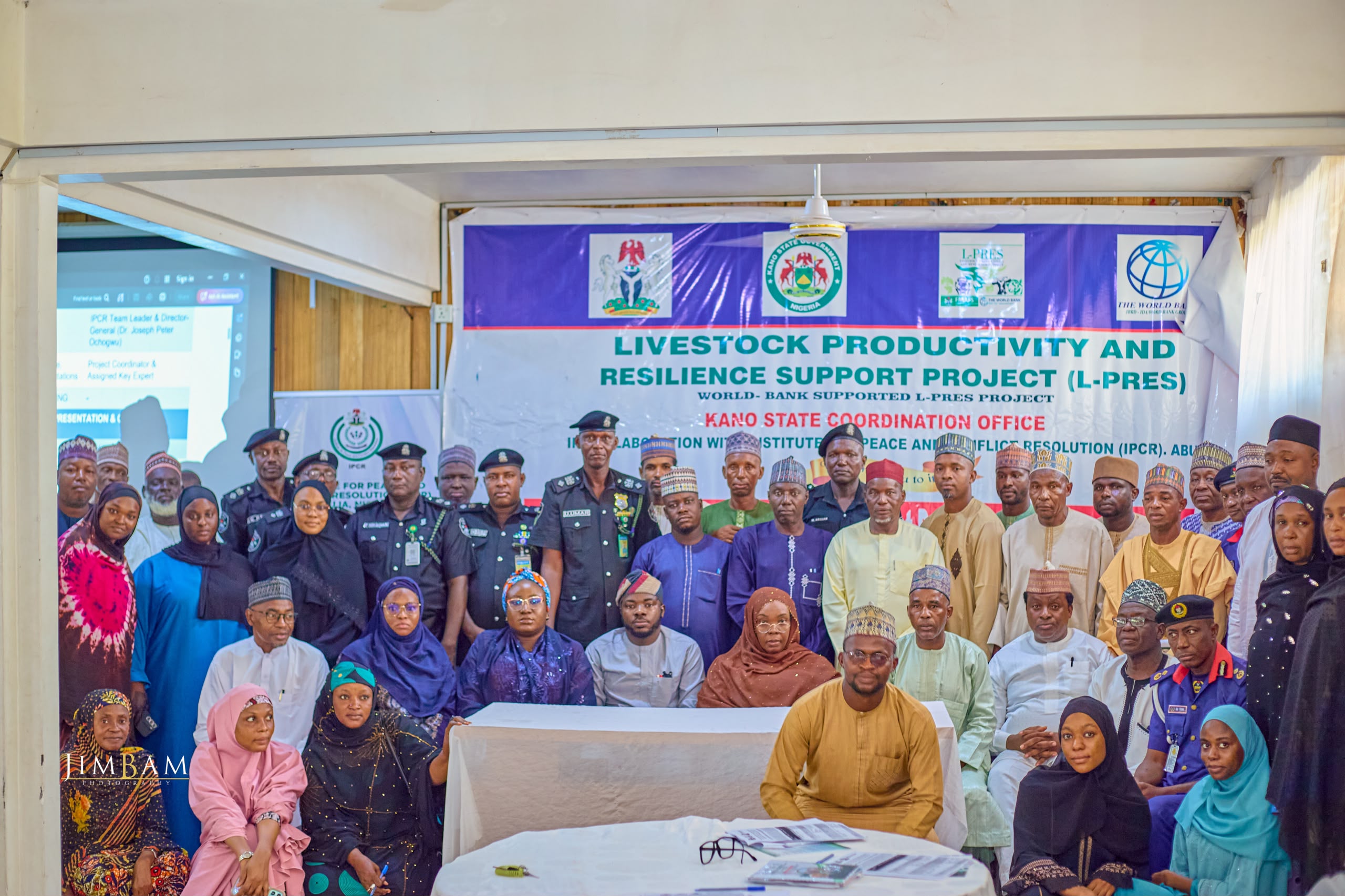
The Livestock Productivity and Resilience Support Project (L-PRES) has commenced a two-day training programme for livestock farmers and other stakeholders in Kano State on crop residue processing, fodder production, silage making and the utilisation of fabricated feed crushers aimed at reducing feeding costs and improving livestock productivity.

The programme, which began on Wednesday, is bringing together more than 200 participants representing over 100 livestock-related groups, including herders, poultry farmers, milk producers, butchers and private sector operators from across the state.

The training focuses on practical methods of converting crop residues and other agricultural waste into affordable and nutritious animal feed while fostering collaboration among stakeholders across the livestock value chain.

The initiative also serves as a platform for participants to exchange ideas, share experiences and explore partnerships that could enhance livestock production and strengthen resilience within the sector.

Explaining the rationale behind the programme on behalf of the Kano State Project Coordinator, Salisu Muhammad Inuwa, Gambo Isah Garko, an Extension Officer with L-PRES in Kano State, said livestock feeding remains one of the biggest challenges confronting producers, particularly during the dry season.

According to him, many livestock producers struggle to access affordable feed, making it necessary to train them on how to convert crop residues into valuable feed resources rather than allowing them to go to waste.

“Feeding has become very difficult. That is why we are giving them this training so they can utilise crop residues and other agricultural waste for livestock feeding,” he said.

Garko explained that participants were being taught how to improve the nutritional value of crop residues through the use of additives and appropriate processing methods.

He said the training would help farmers better understand livestock nutritional requirements and adopt feeding practices that improve animal growth and productivity.

Beyond improving feeding practices, Garko said the programme was designed to strengthen collaboration among stakeholders in the livestock sector.

“We have called major players across the value chain because this gives them an opportunity to interact and establish linkages that will benefit everyone,” he said.

He disclosed that about 200 participants attended the programme, representing 110 groups, including livestock breeders’ associations, poultry farmers, butchers, milk producers and private livestock operators.

Garko further noted that adopting the feed-processing techniques being taught could reduce livestock feeding costs by as much as 40 per cent.

According to him, farmers can significantly cut expenses by processing crop residues such as corn stalks and incorporating them into animal feed instead of depending entirely on commercial feed products.

“Using crop residues together with the crusher machines will drastically reduce production costs while maintaining or even improving the weight gain of animals,” he said.

He further revealed that L-PRES had distributed more than 210 feed crusher machines to livestock groups and farms across Kano State and was planning additional support for poultry feed production.

Garko urged participants to put the knowledge gained into practice and share it with other farmers in their communities.

“The purpose is not just to learn but to practice what has been learned and pass the knowledge to others,” he added.

The emphasis on practical application was echoed by Sule Saleh, Value Chain Officer of Enterprise Project Canada, who explained that the training was intended to ensure beneficiaries effectively utilise and maintain the feed crusher machines distributed under the project.

He said the machines were provided as common-user assets to cooperatives rather than individuals, enabling more farmers within each community to benefit from them.

“The project has distributed these machines across farmer groups, and this training is to show them the best way to operate and maintain them in an environmentally friendly manner,” Saleh said.

He noted that sustainability was a key component of the intervention, with beneficiary groups expected to establish committees responsible for overseeing repairs, maintenance and proper utilisation of the machines.

“We are confident that these arrangements will sustain the equipment and even encourage associations to acquire additional machines in the future,” he said.

Saleh advised participants to make proper use of the knowledge, equipment and other interventions provided under the project.

“Government is not providing these interventions for the sake of it. They are meant to improve your capacity, increase your income and enhance your livelihoods,” he said.

Beyond the technical aspects of feed production, the training also highlighted government efforts aimed at strengthening agriculture and livestock development in the state.

Speaking at the event, Abubakar Muhammad Kabiru, Animal Husbandry Officer with L-PRES, commended the Kano State Government for its continued support to the agricultural and livestock sectors.

He acknowledged the commitment of Governor Abba Kabir Yusuf to programmes aimed at improving agricultural productivity, strengthening livestock production and enhancing food security across the state.

Kabiru encouraged participants to actively engage in the training and apply the skills acquired in their farms and businesses.

“The success of this intervention depends largely on your commitment to applying the lessons learned in your farms, businesses and communities,” he said.

Participants, meanwhile, welcomed the initiative, describing it as a timely intervention for addressing the persistent challenge of livestock feeding.

Among them was Lawan Muhammad Alaramma, Chairman of the Fulani Union of Milk and Fura Sellers, who expressed appreciation to L-PRES for organising the training.

Alaramma said the scarcity of animal feed remained one of the biggest challenges confronting Fulani herders, often forcing them to travel long distances in search of pasture and exposing them to numerous hardships.

He noted that the training, coming after the distribution of feed crusher machines to livestock groups, would help farmers make better use of available resources and improve productivity.

“This is the kind of training we have been looking for over a long period. Feed is our major challenge, and this knowledge will help us overcome many of the difficulties we face,” he said.

When You Forget to Drink, Your Body Remembers

By Maimuna Katuka Aliyu

Imagine your body as a bustling city, an intricate network of systems powered by one indispensable element—water. Think of waking groggy, with a mouth as parched as desert sand. You might blame a late night or too much caffeine, but often it is your body’s quiet alarm bell, warning that its most vital fuel is running low.

Just as electricity keeps a city alive, water is the current that powers every cell. When it runs short, it is like a blackout in a metropolis, order gives way to chaos, systems slow down, and the risk of breakdown multiplies.

Dehydration rarely storms in with fanfare. It slips in unnoticed, first a dry mouth, then a slight headache, then a fog that blurs your thoughts. Even mild dehydration can dull your memory, weaken your focus, and pull down productivity.

The brain, that grand conductor of your daily rhythm, begins to miss its cues. For students, it may mean struggling to concentrate; for adults, the risk of poor decisions at work grows sharper.

In a hydrated body, blood flows like a gentle river. But when water is scarce, blood thickens into sludge, forcing the heart to labour harder. Soon, dizziness, weakness, and muscle cramps follow.

The skin, often dismissed as just a covering, loses its glow and elasticity, while the kidneys, the body’s tireless custodians, send out distress signals in the form of dark urine.

Our fast-paced lives only sharpen this risk. Long days under the burning sun, intense workouts, endless travels without a sip of water, each chips away at the body’s reserves.

And here lies the irony: by the time you feel thirsty, you may already be dehydrated. That is why hydration is not just a habit; it is preventive care, the quiet maintenance that keeps the “city” of your body humming, your mind sharp, your heart steady, and your skin radiant.

The symptoms of dehydration must never be taken lightly. It may begin with thirst and fatigue, but left ignored, it can escalate into confusion, rapid heartbeat, or even life-threatening complications.                                                  

Kidney stones, urinary tract infections, and heatstroke are some of its harsh penalties. The body’s cry for water is one alarm you cannot afford to silence.

Water is the simplest cure, but sometimes the body demands more, electrolytes to restore balance, oral solutions to replenish salts, or, in severe cases, intravenous fluids under medical care.

Hydration is not merely about pouring in water; it is about restoring the delicate balance that sustains life. Yet in the rush of daily living, hydration often takes the back seat. We forget that this basic elixir is both personal and societal.

In regions where clean drinking water is scarce, dehydration becomes a public health emergency, threatening the young and elderly most. Governments are pressed to act, building infrastructure, ensuring access, and educating citizens.

The cost of neglect is staggering. Health systems already stretched thin must spend resources treating preventable conditions, diverting funds from education and wellness.

Economies pay the price as productivity falters and budgets strain. Hydration, so simple and so often ignored, becomes not just a personal duty but a societal challenge.

Climate change sharpens the danger. Rising heat, shrinking water sources, and punishing droughts expose millions to the harsh reality of thirst. Water, once taken for granted, is now a policy priority, a sustainability crisis, and a public health concern rolled into one.

But the solutions lie within reach. Choosing water over sugary or caffeinated drinks. Carrying a bottle as a habit. Eating water-rich fruits like cucumbers and watermelon. Schools, offices, and public spaces can lead with hydration stations and campaigns.

When society makes water accessible, it empowers individuals to make the right choice. Ultimately, prevention remains the wisest cure. Sip steadily through the day, not just when thirst demands it.

Treat water not as a chore but as a daily act of self-care, a quiet gift that renews every cell. The next time you lift a glass to your lips, see it as more than hydration—it is your lifeline, your body’s power source, the fuel that keeps you thriving.

Hydration is not just a lifestyle tip. It is the foundation of health, the difference between fatigue and vitality, between a body faltering and a body flourishing. It is the lifeline every human being needs to live fully and thrive.

Maimuna Katuka Aliyu wrote via munat815@gmail.com.