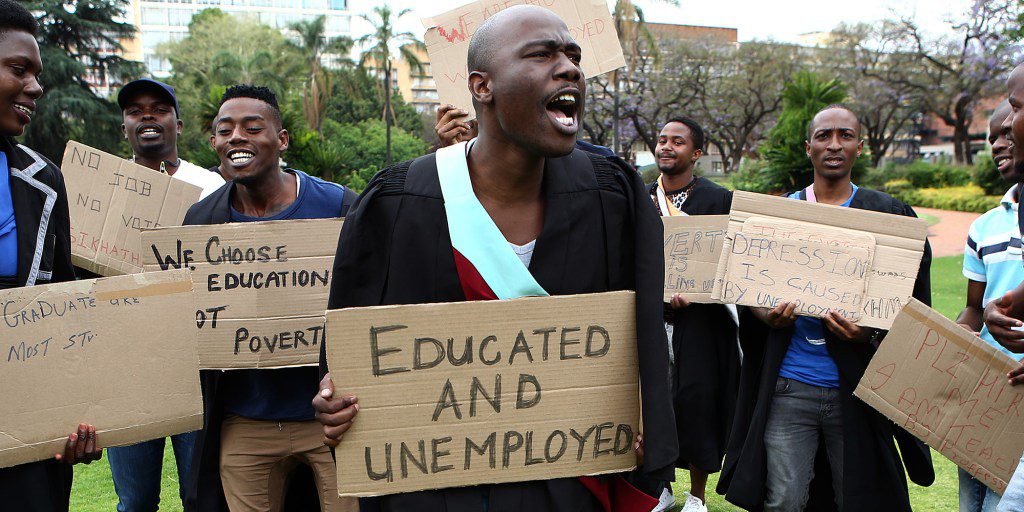
Unemployment

Unemployment: Nigerians shock firm with flurry of applications, force closure of vacancies

By Ishaka Mohamed

Edge Research Services Ltd has stopped accepting job applications just within 24 hours after advertising vacancies for data collectors across Nigeria.

The firm had called for applications on Thursday, January 2, 2025, and set January 20 as the deadline. However, an update by its LinkedIn handle in the early hours of January 4 declared the window closed after receiving over 2,000 applications.

Part of the statement reads: “WOW! We’re overwhelmed with gratitude! A huge thank you to everyone who commented, shared, and applied! We received over 2,000 applications in just 24 hours!”

After expressing gratitude and surprise, the firm stated its resolve to review only the applications received. “Due to this incredible response, we’re closing the job advert earlier than planned. Our recruitment team will now focus on reviewing applications and selecting the best fit…”

Edge Research Services Ltd, headquartered in Lagos and with a field office in Kano, Nigeria, is a data collection, research, and evaluation firm that offers qualitative and quantitative research services in sub-Saharan Africa.

It’s noteworthy that this is not the first time Nigerians’ interest in jobs has shocked an employer. A recent example was when the Nigerian National Petroleum Company Limited (NNPC Ltd) application portal glitched just a few hours after calling for applications. “Due to unprecedented traffic to the NNPC Ltd. career page from applicants applying for vacancies, the site is currently experiencing slow load times,” the company said in a statement.

45,689 jostle for NNPCL jobs as aptitude test kicks off

By Anwar Usman

Not less than 45,689 applicants are conducting the Computer-Based Aptitude Test on Saturday (today) as part of the recruitment process to secure employment at Nigerian National Petroleum Company Limited.

The aptitude test, currently taking place at the Ansar-Ud-Deen Society Centenary Resource Centre in Maitama, Abuja, and various other testing centres across Nigeria, marks the second stage of the rigorous recruitment process that began earlier this year.

Previously, on July 25, 2024, the company announced openings for new entrants.

In a statement, Olufemi Soneye, the NNPC spokesperson, said the recruitment would be for various positions across various departments within the energy company and interested applicants to visit the NNPC careers page for application instructions.

However, in a new post on its official Facebook handle on Saturday to update the public on the process, the national oil firm emphasized that only the most qualified candidates will be selected for employment at the end of the exercise.

The post read, “As the Computer-Based Aptitude Test for NNPC Ltd.’s recruitment begins today at various centres across the country, 45,689 applicants compete in a transparent and inclusive recruitment process.”

The NNPCL Group Chief Executive Officer, Mele Kyari, who visited the centres, promises a smooth, transparent, fair, and credible process.

“As an equal opportunity employer, NNPC Ltd. has made special provisions to ensure that applicants with disabilities can take the test without any hindrance.

“Kyari reiterated that only the most qualified candidates among the 45,689 applicants will be selected for employment”.

The daily reality gathered that this may be the major recruitment exercise since the NNPC fully transformed into a limited company in 2022.

Nigeria at 64: A country of possibilities still struggling

By Usman Muhammad Salihu and Muhammad Umar Shehu

As Nigeria celebrated its 64th independence anniversary a few weeks ago, it is essential to reflect on the nation’s potential and the persistent challenges that continue to hinder its progress. Despite being blessed with vast natural resources and a vibrant population of over 200 million people, Nigeria’s struggles have deepened rather than improved over the past year. From widespread poverty to increasing insecurity, the country’s path to growth remains uncertain unless urgent and substantial action is taken.

Poverty in Nigeria continues to be one of the most pressing challenges. A significant portion of the population, over 40%, still lives below the poverty line. As the cost of living soars and job opportunities remain scarce, millions of Nigerians find themselves trapped in cycles of deprivation. While government programs aimed at alleviating poverty have been implemented, the results have mainly been insufficient due to inefficiency, poor implementation, and corruption. 

The lack of job creation remains a critical concern. Despite having a young and dynamic population, many Nigerians face an uncertain future as there are not enough opportunities for them to contribute to the nation’s economic growth. The high unemployment rate, particularly among the youth, exacerbates feelings of hopelessness, contributing to social unrest.

Corruption continues to plague every sector of Nigerian society, from the public to the private sector. It has been described as a systemic problem deeply embedded in the fabric of governance, politics, and even business practices. Public funds for infrastructure development, healthcare, education, and poverty alleviation are often diverted for personal gain, leaving the masses to suffer.

Though active in many areas, the fight against corruption has proven ineffective in bringing about substantial reform. The long-standing lack of political will and the entrenchment of corrupt practices ensure that those in power remain immune from real accountability. Until corruption is thoroughly tackled, Nigeria’s progress will continue to be hampered.

One of the most alarming issues Nigeria faces today is the increasing insecurity. What began as localised conflicts in specific regions has evolved into nationwide terror. Terrorist groups, bandits, and separatist movements are now operating with impunity across the country. The rise in violent crimes, abductions, and ethnic clashes has not only resulted in loss of lives but has also displaced millions, further straining the nation’s resources.

Investors remain wary of Nigeria’s unstable environment, while everyday Nigerians are forced to live in fear. Insecurity has undoubtedly slowed economic activity, as businesses are reluctant to set up or expand in areas prone to violence. The government’s inability to secure the nation and protect its citizens is a glaring failure that demands urgent attention.

The educational sector, too, is still struggling. Though the government has made some efforts to reform education, such initiatives have not yielded the desired results. The country’s education system remains underfunded and ill-equipped to handle the growing demands of a population that values knowledge and skills as the gateway to prosperity.

A critical shortage of teachers, infrastructure, and learning materials leaves millions of children and young adults without access to quality education. Many Nigerian students are forced to attend overcrowded classrooms, while those in rural areas often lack basic educational resources. The result is a generation of young people who are ill-prepared to face the challenges of the modern world.

Unemployment remains at an all-time high. The nation’s reliance on oil as its primary source of revenue has left it vulnerable to global price fluctuations, causing economic instability. Additionally, the lack of diversification into other sectors, such as agriculture, manufacturing, and technology, limits job creation.

Without a comprehensive economic overhaul focusing on sustainable development and the growth of non-oil sectors, Nigeria’s economy will continue to stagnate. The country must invest in infrastructure, create an environment that nurtures entrepreneurship, and promote policies that stimulate job creation.

The question is not whether Nigeria has the potential to be great but whether its leaders can rise to the occasion and make the necessary changes to unlock that potential. There is no shortage of resources in the country—natural, human, or financial. What is lacking is effective governance, transparency, and leadership that prioritises the needs of the people over personal gain.

The Nigerian government must take decisive action to address poverty, reduce corruption, enhance security, and overhaul the education system. Citizens, civil society organisations, and the private sector must also play their part by demanding accountability, fostering innovation, and supporting initiatives that contribute to national development.

At 64, Nigeria remains a land of possibilities. However, unless these challenges are addressed, the country will continue to suffer, and the future will remain uncertain. It is time for bold steps and concrete reforms to secure the next generation’s prosperous and peaceful future.

Usman Muhammad Salihu was among the pioneer cohorts of the PRNigeria Young Communication Fellowship, along with Muhammad Umar Shehu. They can be reached at muhammadu5363@gmail.com.

Youth unemployment crisis in Nigeria: A ticking time bomb

By Sirajaddeen Mohammed Bello

In Nigeria’s many socioeconomic challenges, one issue stands out as the biggest threat, casting a gloomy shadow over the present and the nation’s future. Youth unemployment is a subject that elicits head shakes, furrowed brows, and a sense of impending doom. But beyond the sombre tone, let me unravel the implications of this predicament and infuse a touch of hope— and a pinch of ‘humour’ into this all-too-serious subject.

Youth unemployment in Nigeria isn’t just a problem; it’s an iceberg of colossal proportions. The National Bureau of Statistics (NBS) stated that Nigeria’s unemployment rate rose to 33.3% as it stood at the rate of 4.1% in the first quarter of2023, which translates to about 23.2 million people— youths, in particular. Let’s face it: numbers don’t always tell the whole story. Picture this: some hundreds of thousands, nay, millions of mostly educated, bright young minds stuck in a seemingly endless and almost fruitless game of job hunting— a game with fewer opportunities and a mammoth crowd of players. 

It’s a perplexing paradox, navigating through such a complicated realm that occasionally resembles a labyrinth of bureaucracy and nepotism. These players could either be overqualified or, in many cases, underqualified, creating a complex, ‘funny’ puzzle that baffles many— in a head-scratching manner.

Now, one might wonder why we care about this particular problem: youth unemployment. And even go on to declare it a “time bomb”? Too strict a term? Well, let me draw you a vivid picture. A sizeable chunk of our youths are left idle, grappling with feelings of inadequacy, financial crisis and frustration. Do you think all will end well? No! If not given the needed attention and channelled constructively, this sluggish energy can surely fester and lead to various social ills in unimaginably ugly ways. So, you see? It’s not just a ticking time Bomb: it’s an evil fuse that could ignite a powder keg of problems for this country.

It’s still not too late for the authorities to right this wrong. We’ve analysed the problem to an extent. Let’s talk solutions because dwelling on problems only, without drawing out remedies, is almost like writing a story with no plot. Nigeria’s youth is its greatest asset, with creativity and untapped potential. A serious country can’t afford to let this resource go to waste. More than ever. Now is the time to bridge the gap between the skills our youths (are assumed to) possess and the skills demanded by the labour market. 

Various vocational trainings (not the usual ‘crash’ workshops that hardly change a thing!) and education systems tailored to market needs can play a vital role. The government and the stakeholders in the private sector need to collaborate and determine what knowledge and skills young people should be taught to have rewarding jobs, considering how businesses are suffering from skills mismatch. Government should play a more active role in promoting appropriate education and Capacity-building for the youth.

Another equally important area to work on is entrepreneurship. Why not encourage more young entrepreneurs in a country where the labour market is fiercely competitive? Our youths are teeming with brilliant ideas waiting to be hatched. Government support, access to funds and mentorship programmes can nurture these promising— budding business moguls.

Technology and Innovation. Nigeria’s burgeoning tech ecosystem offers great hope. The digital world is undoubtedly a place where opportunities abound for a tech-savvy. The government should then invest in technology infrastructure and create an environment that supports innovation and startups and training and mentorship for young people. These and many other initiatives centred on progress and empowerment can go miles in addressing our plight.

The evil of unemployment in Nigeria is undoubtedly a ticking time Bomb, but it doesn’t have to detonate. By investing in skills development, nurturing entrepreneurship, promoting innovative empowerments and retaining our trademark diligence, we can defuse this albatross and unleash the incredible potential of our youths.

Sirajaddeen Mohammed Bello wrote from Yola, Adamawa State, via sirajaddeenm2019@gmail.com.

How I bade ‘welcome’ to the labour market

By Ibrahim Suleiman Ibrahim

The 7th of July marked exactly one year since I completed my NYSC, and so far, it has been an educative and worthwhile experience – Alhamdulillaah!

Let me tell you a story about my first experience in the labour market. The story goes thus;

A few days after the formal completion of my NYSC, I thought I should start job-hunting immediately. I said to myself then, “It’s better to strike while the iron is still hot”, what the Hausa people call “Da zafi zafi ake dukan ƙarfe“. I thought it was a prompt decision I made, forgetting that some of my colleagues with whom I completed NYSC had already secured lucrative jobs long before we completed NYSC. 

I didn’t let that discourage me anyway. “They are children of the elites, after all”—I said to myself. 

Another thing that motivated me to an immediate and unrelenting job-hunting was the fact that the Certificate of National Service, which used to be a barrier to so many opportunities I missed during my service year, had become handy at that time, and would no longer affect subsequent opportunities that might come.

So, to commence the job-hunting. I started following popular job sites and physical employers for job opportunities and ensured I did not let any job advert or link pass me by without applying. All these, I did with much confidence and hope to get a good job in no distant time.

One fateful evening, not up to a fortnight after the commencement of my job-hunting journey, while I was reclining on the sofa, I got a text message that reads thus;

“Congrats u have been shortlisted for our company Orientation on Monday 18/07/22 at 2nd floor, XX building Beside XXX Bank by XXXXX way Opposite XXXXX Road Kaduna, by 8:30 am.”(some information about the venue deserves confidentiality, hence the XXXX).

It was a text message from a random 11-digit phone number informing me that I had been shortlisted for a job and inviting me to an orientation exercise to mark the commencement of the job.

I was hellbent on getting a ‘better job’ that I didn’t even pay attention to the sheer informality and unprofessionalism in the text message I got. 

It is noteworthy that I already had a job I was managing then, but I was eager to get better opportunities since I was done with NYSC and expectations were very high.

So, I dressed my best on the scheduled morning for the orientation exercise and prepared for a possible interview that might come up during the orientation.

It will baffle you to know that I wasn’t even sure which of the jobs I got, but I was confident it would be better than the job I was managing then.

On reaching the venue, I saw a crowd of young people queuing in front of a desk officer for documentation and trooping into a large hall afterwards.

Long story short, I got into the hall after the tedious documentation process and later discovered that I was cheaply lured into attending a ‘Neolife’ lecture—Neolife is one of those tricky investment schemes claimed to be a foreign investment company, filled with a bunch of jobless people, where your income solely depends on the number of people you successfully convince into investing in the scheme. 

They indoctrinate the belief that you could become a multi-millionaire in a few months of investment if you successfully convince people to join the scheme. They tell you about how useless it is to seek salary jobs and how important it is to invest your whole savings into Neolife. They’ll tell you stories of one of their colleagues living in Europe, making millions of dollars due to investing in Neolife.

I felt disappointed and heartbroken to discover that I finally got lured into attending their lecture because of my naivety as a fresh graduate. I have spent my whole life avoiding the agents and promoters of such schemes.

That day I bade an official “Welcome” to the labour Market.

I have more stories about my labour market experience, but I’m indisposed to write about them now; perhaps, I’ll do that leisurely as time passes.

Ibrahim Suleiman Ibrahim wrote via suleimibrahim00@gmail.com.

Digital Bridge Institute: 5 years after, Kano-sponsored students can’t collect certificates

By Uzair Adam Imam

About a hundred students sponsored by the Kano State Government at Digital Bridge Institute have expressed their worries over the state government’s failure to pay for their certificates five years after graduation.

The students decried that the state government has not paid the designated fees to the institute to enable them to collect their results since 2019.

They complained that the development is delaying their education as they are left stranded for over five years.

The students said they need the certificate to further their education and apply for various job opportunities, saying their future would remain bleak if the government refused to intervene.

The Daily Reality gathered that the Kano State Governor, Dr Abdullahi Umar Ganduje, had sponsored 100 students, 40 males and 60 females, to study at the institute in 2017.

The students were sponsored to study various ICT programs such as Software Engineering, Multimedia Technology, Networking and System Security, Hardware Engineering and Telecommunications.

Our future is bleak students

The graduates said their educational careers were at risk, saying the years they spent at the institute would be wasted if the government refused to intervene.

One of the graduates, who pleaded anonymity, said he missed many opportunities, including admissions to study abroad because he has not collected his certificate.

He said, “I was offered three admissions to study in India, but I could not go because my certificate was not given to me.

“Some of my colleagues told me that they even got job offers. However, they could not go for an interview since they didn’t have the certificate.

“I would have scored admission and graduated had I the certificate. Probably got employed in an organisation.”

Muktar Ibrahim (not a real name) said he wanted to further his education but could not lay his hand on his diploma certificate after graduation in 2019.

He said, “I wanted to further my education. However, I have no certificate to seek direct entry into the university.”

Aisha Hussain (not a real name) said it was painful that she was yet to acquire a degree certificate while some of her sisters and friends were serving their one-year mandatory NYSC.

She said, “We have long been expecting the payment by the government for the release of our certificates. It is sad that some of my sisters and friends have completed their degrees even though I started schooling before them.

“I also got so many opportunities. However, I hopelessly saw them pass as I could not go for any of them,” she stated.

Government ignores our appeals

Since graduation, the students said they have been pleading with the government to settle the outstanding debt to enable them to collect their certificates.

The students went to various media stations pleading with the government to come to their aid and settle the debt.

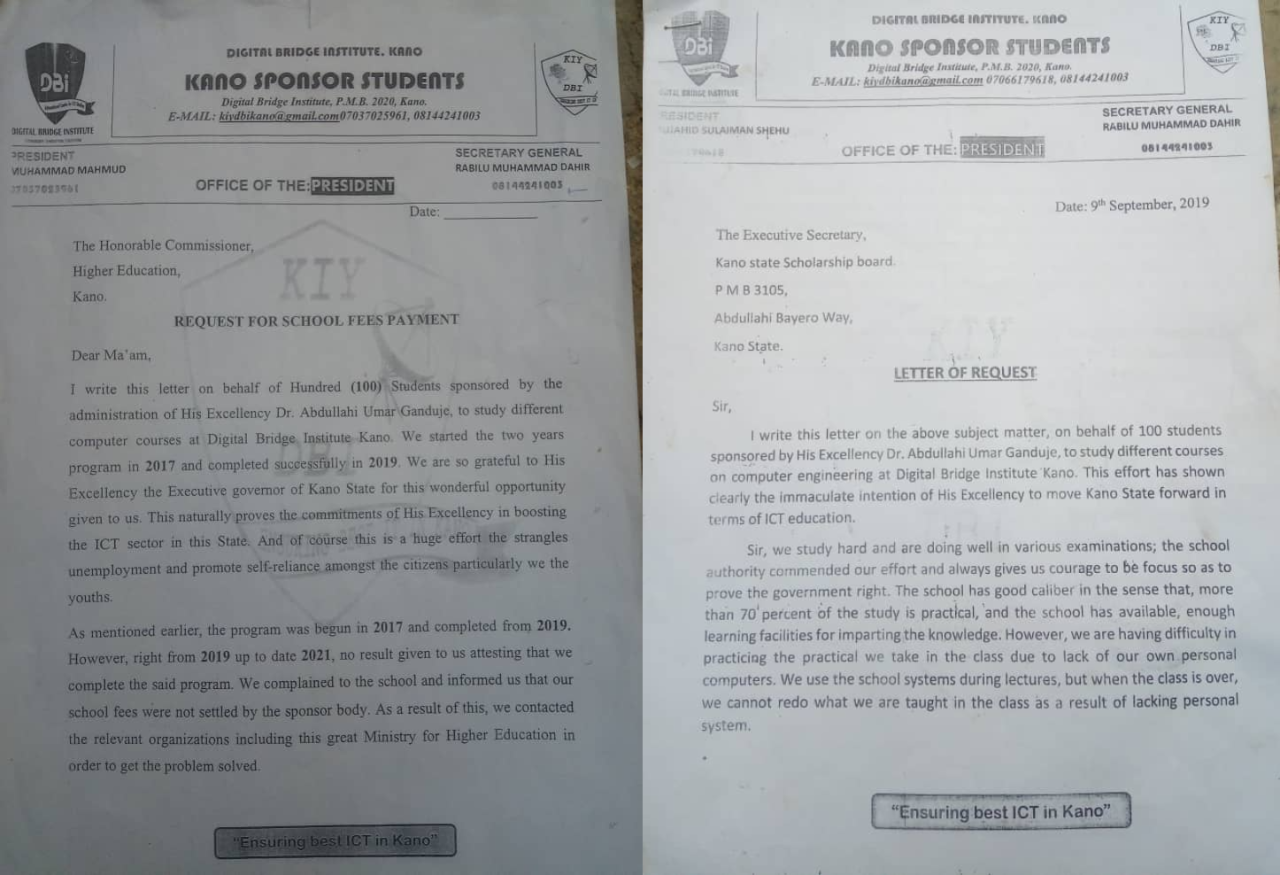
They said they also wrote letters to the Kano State Governor, Dr Abdullahi Umar Ganduje, through the Ministry of Higher Education and the Ministry of Education of the state.

However, all their efforts were in vain, as their plea did not yield any positive result from the government.

Some of these letters.

We are still not tired – students

The students who spoke to The Daily Reality said they are still not tired of sending their passionate appeals to the government to consider them.

They said they are still hopeful and pleading with Governor Ganduje to settle the debt before he leaves office this 2023.

Halima Ibrahim (not a real name) pleaded, “I urge his Excellency, Governor Abdullahi Umar Ganduje, to help us and pay for our certificates.

The lady said her parents are poor and therefore placed all their hopes on her certificate.

Another student who asked not to be named said, “Your Excellency, we know you are good and kind to the poor. We are your children. We are pleading with you to consider us.”

Maimuna Sunusi said, “Our parents cannot afford to settle this debt. Therefore, we are pleading with His Excellency to pay for our certificates and not to waste the years we spent at the institute.”

Kano State Government response

Our reporter has made several attempts to hear from the government, but all his efforts were in vain.

While the Public Relation Officer of the Kano State Ministry of Higher Education, Sunusi Abdullahi Kofar Na’isa, denied knowledge of the development, the Ministry’s Commissioner, Mariya Bunkure, could not be reached for comment.

Kannywood movie review: Ruwan Dare

By Muhammad Abubakar

Having watched this movie and seeing its lessons, I decided to review it. Doing so will, by God‘s will, will wake up those graduates—who are unknowingly killing, or more correctly, misleading themselves into believing that it’s shameful for graduates to get themselves engaged in a low-income business, let alone being a labourer.

The movie was released in 2018. It‘s directed by a veteran Kannywood director, Yaseen Auwal. The film is about the situation and the kind of life our nowadays students, particularly graduates, live.

Kamalu (Sadiq Sani Sadiq), the son of the lowest-income businessman (Rabi’u Rikadawa), happened to be a close friend to Bashir (Aminu Sharif Momoh), a brother to the husband of Jamila Nagudu. Their respectable, reasonable, deep-thinking friend, Lawal (Baballe Hayatu), always tries his best to advise not only Kamalu and Lawal but anyone too ambitious not to rely on the government job entirely. At least they should find something to do to improve their lives.

However—unfortunately for them, they always don’t see his advice as something important. One fateful day, Kamalu and Bashir came to the cafe where they almost every day buy stuff without payment. They lie to the tea seller (Ahmad Aliyu Tage) that when they become billionaires in the future, they will pay back everything he now gives them and give him more.

Unfortunately, the tea seller, Ahmad Aliyu Tage, rejected their request, complaining that he was tired of their ‘when-we-become-billionaires’. Luckily for them, Lawal came to buy something at the same cafe too. Although they undermined his sense recently, he surprised them by assigning the tea seller, Ahmad Aliyu Tage, to cook one packet of noodles alongside a whole roasted chicken for each of them. Sadly, this has not served them as a lesson.

One thing that inspired me is: Lawan never worried himself about a government job. He, in the end, made it, leaving them still suffering from poverty as usual.

The film is fascinating, indeed. We see how Lawal and Bashir suffer due to their laziness in going and refusing to hustle. As a result, they end up pushing a truck and teaching at primary school. In addition, the movie passes the message that: Whoever is not content with what God gives him will end up missing a lot in life.

The camera work and sound are up to the mark. And the subtitler has perfectly played his role. Even though he mixed with Hausa in some scenes, this is not an issue. Since the message is precisely delivered – this film was purposely made to call on the attention of graduates like Kamalu and Bashir.

It’s a must-watch film.

Robots and the future of human labour

By Kabir Musa Ringim

As a graduate of Computer Engineering and holder of MSc Information Technology, I’m sceptical to write about this topic which is quite controversial, because of the divergent views by two opposing groups of people about it. I will explain this later.

The world is currently in the information age, also known as the computer age. Although it began in the mid-20th century, characterized by a shift from a traditional industry established by the Industrial Revolution to an economy primarily based upon Information Technology, the biggest challenge now is how robots have started taking over many jobs previously meant for humans.

While the innovation of technology has dramatically improved our day-to-day activities, it has also proven that we no longer need actual human beings to help with many of today’s jobs soon, thanks to robotics.

A robot is a machine programmable by a computer capable of carrying out complex actions automatically. According to the Britannica dictionary, a robot is any automatically operated machine that replaces human effort. However, it may not resemble human beings in appearance or perform functions in a humanlike manner. By extension, robotics is the engineering discipline dealing with robot design, construction, and operation.

As the definitions above show, robots are here to replace humans in workplaces, markets, the army, etc. Though robots are still under development, the history of robots has its origins in the ancient world. During the industrial revolution, humans developed the structural engineering capability to control electricity so machines could be powered with small motors.

Already, machines and robots have started replacing humans in many workplaces like banks, industries, markets, and media houses in Nigeria. For example, automated Teller Machines (ATMs) allow banks to employ few tellers, while the internet enables them to have few customer care representatives. Nowadays, you don’t need a hardworking secretary to type your work when you can easily dictate to a computer what you want to write and get it printed.

Office workers in public and private institutions have already started feeling the heat. A robot can do a job that 20 persons can handle in a week in a day. Governments now give less priority to office workers and more priority to the health and education sectors when it comes to employment and recruitment. But it is just a matter of time before this status quo changes because the education and health sectors will soon start experiencing the tsunami of job loss.

Soon, schools don’t have to recruit many teachers when a single tutor from anywhere in the world can teach thousands of students online and have their exams and tests marked by a computer program or robot.

Health institutions will soon require the services of a few health workers, medical doctors, and consultants since a patient can get a prescription for himself by talking to a robot or chatting with a consultant that renders online services. Also, robots can soon perform surgeries. 

Security outfits will face massive job loss with the development of robot police and soldiers. A robot will be stronger, more loyal, more reliable, and more accurate than humans, in addition to it being a machine, as such, emotionless and immortal. Moreover, one robot can fight thousands of humans on a war front. Drones are now more preferred than having an air force officer flying a warplane to enemy camps.

Media houses like TV and radio stations don’t need to employ OAPs, presenters, newscasters, and language translators in a few decades to come, because machines and computer programs can handle their jobs. Instead, news editors and program managers will simply work on program contents and news and upload them into a special computer program (robot) for presentation, translation, and subsequent casting on air.

Same case with employing sales girls and sales boys at retail stores, shops, and supermarkets. Who will go shopping when people can easily order what they want to buy online and get it delivered to their doorstep? Likewise, cleaners, houseboys, office messengers, cooks, and labourers will all cease to exist because of robots.

Other jobs that robots will take away from humans include, but are not limited to, telemarketing, automated shipping services, sewer management, tax preparers, photograph processing, data entry work, librarians and library technicians, etc.

But with all that I mentioned above, I’m not trying to spell doom for the next generation of youth who will graduate from school and start looking for jobs in a few decades. As I have stated from the beginning, there’s a divergent view on the topic. Some people view robotics as a weapon to wipe out humans from industries, the military, offices, workplaces, etc. In contrast, others view it as a significant development that will improve lives, which is needed to be embraced by all.

For me, humans by nature, since time immemorial, have had survival instincts, and no technological development was able to render people jobless. If a job is no longer in existence, humans will always find themselves a better alternative. When industrial machines came into being in the 19th century and replaced millions of menial labourers, humans found a way to survive them; the same way robots will be integrated into our daily lives. By the way, remember that humans make these machines and robots, not the other way round.

Kabir Musa Ringim is HOD Computer Engineering, Binyaminu Usman Polytechnic, Hadejia, Jigawa State.
Unemployment: Hundreds jostle for WAEC jobs

By Uzair Adam Imam

Hundreds of job seekers from different parts of Nigeria trooped into Kano State Thursday to jostle for the West African Examinations Council (WEAC) jobs.

The examination body was hiring assistant registrar, accountant, quantity surveyor, registered builder and network administrator, among other posts.

The job seekers sat for a computer-based aptitude test organized by the examination body at a CBT centre along Gwarzo Raod in Kano.

Unemployment is one of the lingering issues currently flogging the Nigerian graduates, making it a serious challenge, especially to the government.

A recent Bloomberg report shows that unemployment in Nigeria has surged to the second-highest on the global list, jumping to 33.3%.

Unemployment alarming

Musa Musa Dangwangwani, surprised by the number of applicants who trooped into the state to sit for the CBT, said the unemployment rate in the country is alarming.

Dangwangwani, an applicant from Katsina State, said, “Despite the high unemployment rate, job opportunities are very scarce. I’m therefore pleading with the government to provide job opportunities in the country.

Another applicant from Kogi State told our reporter that the issue of unemployment in Nigeria is seriously killing graduates, urging the government to do the needful to mitigate the problem.

‘The future is bleak’

“We have a lot of graduates out there that already lost hope. If you speak to them about any job opportunity, they will tell you they don’t want to apply for any because they are rigged out.

“One has to have a godfather before he secures a job now. But I have been trying my best. Wherever I heard of any opportunity, I apply, believing that one day I will succeed,” Dangwangwani said.

A female applicant from Kaduna State, who did not want her name in print, said the gathering was suggestive of the country’s high unemployment rate.

She said, “The way people gathered here tells me about the high rate of unemployment in the country. The government needs to do something to end this issue.

“Government should revive the number of factories shut down over the years. I think that will really help.

I lost my job due to insecurity – Applicant

An applicant from Bauchi State told The Daily Reality how he lost his job to the security challenge in Nigeria.

He said that was the reason he was now seeking another job.

He said, “I had my business. I’m a network engineer. My job was to provide internet service to the people mining in the bushes, but because of the current insecurity in the country, we can’t risk our lives; thus, I am jobless now.”

The Daily Reality recalls that professionals have argued that there is a need for urgent intervention to save the country from an impending danger posed by the exponential increase in unemployment.

Should the Northern youth “Japa” too?

By Hassan Ahmad

The term “Japa” is slang used by Nigerians to refer to the continuous exodus of young Nigerians to the developed countries in search of greener pastures with the intent of not returning home. Japa is widely accepted in southern Nigeria, with many youths leaving Nigeria in the last decade. The justification for this mass departure is not farfetched. They include unemployment, insecurities, incessant strike actions by university teachers enabled by the government and other social problems cumulatively, among others. But on the other hand, the direct opposites of these push factors are the pull factors that also encourage it.  

The southern region of Nigeria housed the larger percentage of industries available in this country, with a better literacy rate and a better standard of living. 

However, in the North, the story is by far worse. Topping the list is insecurities from the Boko Haram ravaged northeast to the bandits’ taking over of northwestern villages and the ethno-religious conflicts in the north-central states. Don’t forget farmer-herders’ conflicts, too. 

Aside from insecurity, the poverty rate in the North is alarming – constituting 86 per cent as of 2021. In addition, illiteracy is prevalent, and there is high existence of unemployment as well as under-employment.  

From the above, we’ll understand that northern youths have more reasons to Japa and never look back, but that has not been the case. This can be understood to play out this way for obvious reasons: deep kinship relationship, lack of understanding of the evolving nature of the 21st century, fear of the unknown, ill contentment and others. 

The underlying issue is that it’ll no longer take long before the northern youths follow the footsteps of their southern counterparts and get fed up with Nigeria, and look beyond the seas and deserts to better their lives. Oh!  It has started already. Thousands of youths are already risking their lives through the Sahara desert with the hope of reaching Europe or the Middle East. Many others who were chanced to have acquired scholarships overseas ended up staying in those countries to pursue a living. This creates two scenarios.

While the educated northern youths get out of the country legally through scholarships and fellowship, the less educated and uneducated look for their ways illegally and, in most cases, lose their lives or ending as sex slaves. We lose our best brains to the developed world while losing our uneducated ones who can alternatively be a source of labour to the graves.  This means that the youths who are supposed to carry the northern and Nigerian dream (if there is any) are giving up already.

Where is the Northern Governors Forum? Have they provided a roadmap for the development of the North, how to tackle insecurity, unemployment, poverty or even improve education? 

Or the Forum is meant for negotiating power between the ruling elites? So why must it be far away Lagos that’ll have the foresight to partner with Kebbi in producing Lake-rice? Why not Kaduna, Kano or Nasarawa?  

Why is the same Forum quiet while their young people are out of school for an avoidable strike?  North is the most hit by the ASUU strike because 90% or more of her students depend on public universities for their education. Is this too hard for the governors to understand? Have they ever intervened? 

Northern leaders should rise to their responsibilities before it’s too late. The outside world is open to all but cannot afford to embrace us all. So it is either they make the North a home for the younger ones, or we look for another home. There is no sense in sticking to the parents that humiliate you all your life. 

As things are, if there is an opportunity, let’s Japa too, legally. 

Hassan Ahmad Usman writes from Lafia, Nasarawa State, Nigeria. He can be reached via basree177@gmail.com.