TETFund

Tax Reform: Presidency debunks claims of northern marginalization

By Uzair Adam

The Presidency has dismissed concerns that the proposed tax reform bills currently before the National Assembly will impoverish northern Nigeria or disproportionately favor Lagos and Rivers states.

In a statement issued on Monday, presidential spokesperson Bayo Onanuga emphasized that the reforms are designed to improve the quality of life for all Nigerians, particularly the disadvantaged, by simplifying tax administration and fostering a better business environment.

The statement addressed apprehensions raised by Borno State Governor Babagana Zulum, who had suggested that the proposed Value Added Tax (VAT) sharing formula could be skewed in favor of Lagos and Rivers states.

Onanuga, however, described these concerns as unfounded and based on misinformation.

“The tax reform bills will not make Lagos or Rivers states wealthier at the expense of other regions, nor will they lead to the economic marginalization of any part of the country,” Onanuga stated.

He urged Nigerians to reject any attempt to polarize the nation over the proposed legislation.

Onanuga also clarified that the bills do not seek to abolish key federal agencies such as the Tertiary Education Trust Fund (TETFUND), the National Agency for Science and Engineering Infrastructure (NASENI), or the National Information Technology Development Agency (NITDA), which will continue to receive funding through budgetary allocations.

The spokesperson reiterated that President Bola Tinubu’s fiscal policy reforms aim to ease the tax burden on businesses, streamline tax collection, and support national development.

Meanwhile, former Speaker of the House of Representatives Yakubu Dogara called on Northern leaders to approach the tax reform bills pragmatically rather than with ethnic or religious sentiments.

Speaking during a Channels Television town hall in Abuja on Monday, Dogara stressed the importance of prioritizing the region’s future development.

“We Northern leaders must set aside ethnicity and religious biases and focus on the realities these reforms will bring,” Dogara said.

He also criticized senators who claimed there was insufficient consultation on the bills, questioning their own legislative practices.

“How often do they consult the public when making laws? Some state laws are drafted in governors’ living rooms,” Dogara remarked, dismissing the argument that public opinion outweighs the potential impact of the reforms.

Taiwo Oyedele, Chairman of the Presidential Committee on Fiscal and Tax Reforms, explained that the bills aim to empower subnational governments to enhance revenue generation and achieve fiscal self-sufficiency.

Tinubu appoints new Tetfund board members 

By Anas Abbas President Bola Tinubu has appointed a new board for the Tertiary Education Trust Fund (TETFund), tasked with enhancing the quality and productivity of higher education. 

The seven-member board, chaired by Alhaji Aminu Masari, includes: 

– Senator Sani Danladi

– Mr. Sunday Adepoju

– Mr. Nurudeen Adeyemi

– Mrs. Esther Onyinyechukwu Ukachukwu

– Mr. Turaki Ibrahim

– Mr. Aboh Eduyok 

According to Chief Ajuri Ngelale, Special Adviser to the President (Media & Publicity), President Tinubu expects the new board members to be dedicated and committed to driving TETFund’s objectives. 

The TETFund plays a crucial role in supporting tertiary education, and the new board is expected to build on this mandate. 

The new board members are expected to bring their expertise and passion to the table, driving positive change in Nigeria’s higher education landscape.

TETFund charges institutions to comply with BPP processes

By Muhammad Aminu

The Tertiary Education Trust Fund (TETFund) has charged higher education institutions that benefit from its interventions to ensure strict compliance with the public procurement process to prevent corruption.

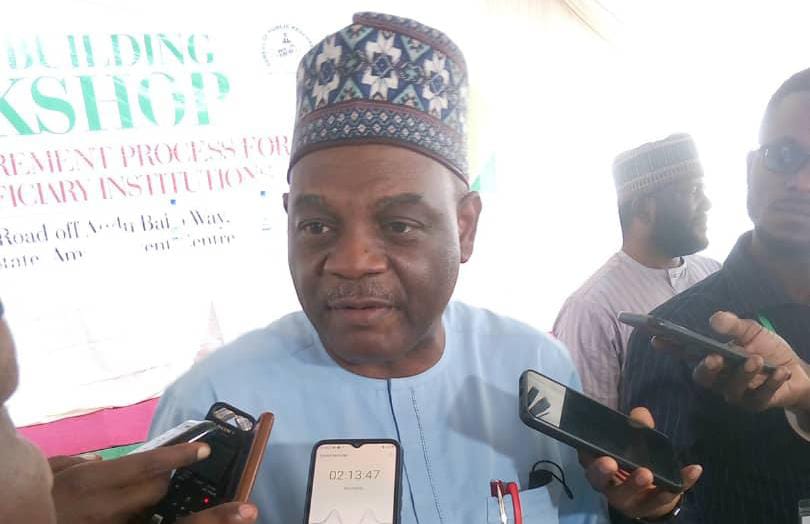
TETFund Executive Secretary, Architect Sonny Echono, disclosed this while opening a three-day capacity-building workshop on the public procurement process for TETFund beneficiary institutions organized by TETFund in collaboration with the public procurement Bureau (BPP) in Kano.

He said the training was for the institutions from the Northwest and Northeast subregions of the country to get equipped with the procurement processes to curtail corrupt practices in the agency’s projects.

He noted that the training would serve as a refresher training for desk officers of TETFund in the 246 enlisted beneficiary tertiary institutions across Nigeria.

Echono further called on the participants to utilise the opportunity and enhance their knowledge in public procurement law to achieve the desired objectives.

In his presentation, the Director General of the BPP, Mamman Ahmadu, said the workshop that intends to ensure attaining the provision of the public procurement Act came at the right moment.

”We are here today to build the capacity of accounting officers, principal officers, public officers and other key players in the procurement value chain.”

He said BPP would ensure that all provisions of the procurement act are strictly adhered in procurement in the Nigeria’s tertiary institutions.

TETfund unveils 10 books authored by Nigerian academics

By Muhammad Aminu

The Tertiary Education Trust Fund (TETFund) has unveiled ten textbooks authored by Nigerian scholars.

The books, which were TETFund-sponsored, were aimed at reducing over dominance of foreign publications in the nation’s higher education institutions.

Speaking at the event in Abuja, Minister of Education Adamu Adamu said the dependence on foreign academic publications portends great danger to the nation’s education sector, adding that boosting indigenous authorship would address the problem.

The minister, who was represented by the State minister of education, Goodluck Nana Opiah, said: “The paucity of indigenously authored and produced tertiary level textbooks and related academic publications in the nation’s tertiary education institutions is a known fact over time. Nigeria’s tertiary education institutions became dependent on books published outside the country with the attendant consequences of the pressure on the demand for foreign exchange.

“It is equally worrisome that the quality of most academic publications in our country leaves much to be desired. It is therefore expected that nurturing the culture of quality authorship and the production of indigenous books will not only ensure the availability of relevant books in the diverse subject areas that take cognisance of our local environment and sensitivities but will also safeguard national pride and reduce the demand for foreign exchange,” he said.

He commended TETFund for establishing the Higher Education Book Development project to tackle the scarcity of tertiary level textbooks which has before now reached a crisis proportion.

Adamu hailed the Fund for putting in place the Technical Advisory Group (TAG), whose mandate includes collaboratively working with the agency to ensure Nigerian authors churn out quality books.

“TETFund Book Development Fund intervenes in the three key areas of publication of academic books and the conversion of high-quality theses into books, support for Professional Association Journals, and the establishment and sustainability of Academic Publishing Centres (APCs).

“It is worthy of note that so far, seventy-seven manuscripts have passed through rigorous review processes by distinguished scholars and are ready for publication as books. I want to assure this gathering that an additional thirty books will be presented before the end of this year under the TETFund sponsorship programme.

“It will be of interest to note that over 60 per cent of these books are to be published by the Academic Publishing Centres (APCs) established by TETFund,” the minister said.

Executive Secretary of TETFund, Arc. Sonny Echono, who expressed delight over the quality of the ten books, said additional 30 books sponsored by the Fund would be unveiled before the end of the year.

He noted that the agency would sponsor the production of 50 textbooks in 2023.

“We have over 66 manuscripts; what we are unveiling today were published by only one publisher (one printing press) ….., by the time we unveil the remaining 30 in December, you are going to see all the authors cut across the three layers of our tertiary education institutions,” Echono said.

The TETFund boss also revealed that the Fund had provided support to ensure all the Academic Publishing Centres in the country become fully operational.

“There are seven of them across the country. When we came in March, only the University of Lagos academic publishing centre was fully functional and running, a few of them had little issues, some equipment, and other contractual issues, we have resolved all of them now.

“Four have been completed since the last few months, and the remaining we hope to finish by the end of September. The issue of operationalising them, making them self-sustaining is the debate we are having currently because we want them to run as a business enterprise and trying to create balance by focusing on academic publishing and being able to sustain themselves,” he said.

On his part, Chairman of TETFund TAG, Professor Charles Aworh, said 20 TETFund-sponsored textbooks were published in 2014 on different fields with wide acceptance from within and outside the country, adding that three of the ten new books unveiled today were from PhD theses.

He, however, called for more empowerment of the nation’s publishing centres.

“We are on course to publish 40 books before the end of the year, but the only challenge is the capacity of our universities to publish. Authors are ready to publish, manuscripts are ready,” Aworh said.

The high point of the event, which also attracted authors, academic staff unions and heads of education agencies, among others, was the public presentation of the TETFund-sponsored books, which include;1.Principles of Veterinary Surgery: A Concise Text for Veterinary Students 2. Fundamental of Chemistry 3. Fundamental of Public Finance 4.Java for Beginners and Web Design and 5. Programming for Beginners.

Others are 6. The Comparative Method and Civil-Military Relations 7. Fluid Mechanics and Hydraulics for Engineers 8. A Guide to Teacher Competence Evaluation 9. Financial Deepening and Economic Growth in Nigeria and 10. Motivational Factors and Teachers Efficiency in Secondary Schools.

Kano University establishes cervical cancer screening lab

By Muhammad Aminu

Yusuf Maitama Sule University, Kano (YUMSUK), has established a laboratory for screening cervical cancer in women, the first of its kind in northern Nigeria.

The Vice-Chancellor of the institution, Prof. Mukhtar Kurawa, said the Human Papilloma Virus (HPV) DNA Modular Research Laboratory would greatly help in the research and treatment of cervical cancer in women, especially in North-Western Nigeria.

The laboratory, situated on the Main Campus of the University, was funded by a grant from Tertiary Education Trust Fund (TetFund). Prof. Kurawa further explained that there is a rise in cervical cancer among women in the region hence the university’s efforts to address the problem.

The VC challenged researchers to take advantage of the centre by conducting scientific research to achieve the set objectives. The VC assured continuous support for the centre, saying that “researches are now conducted not only for academic progression but also for economic development”.

He expressed optimism that the centre would excel and achieve its objective due to its state-of-the-art facilities. The Lead Researcher and Dean, Faculty of Clinical Sciences of the university, Dr Iman Usman-Haruna, said, “the centre is established to provide free services to women with cancer problems.”

She said about 1,500 patients are expected to benefit during the first phase of its programme. “This research is a multi-centre study to be conducted in Kano, Katsina and Jigawa and is mainly on cervical cancer screening.

“We will be performing pap smear and HPV test for 1,500 women, samples will be transported to Yusuf Maitama Sule University for processing.” This is through a grant from TETFund and with great support from the university management,” she said.

She applauded the Vice-Chancellor and TETFUND for their support for the actualisation of the project, describing it as a welcome development for the betterment of society.

TETFUND at 10: The giant strides of the ‘Apostle of Research and Development’

By Tahir Ibrahim Tahir (Talban Bauchi)

Tertiary Education Trust Fund (TetFund) recently celebrated its ten years of service, having gone through many changes in its functions, duties, coverage and composition. It had existed under different names before now. Still, the amendments to the act establishing it have turned it into a Tetfund, with more coverage of tertiary education in the country.

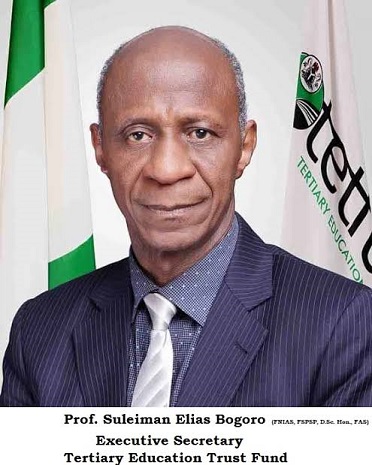
At the Tetfund at Ten event, its Executive Secretary, Prof. Suleiman Bogoro, was introduced as the apostle of research and development. A very apt description, narrating how he has turned the tide of the impact of Tetfund from infrastructure to research. The previous administration first appointed Bogoro, and barely two years after, the new administration of President Muhammadu Buhari (PMB) relieved him of his duties. Not long into the PMB administration, Bogoro was again re-appointed. This is a glaring testimony of the quality of stewardship he brings to the running of Tetfund. Tetfund staff rolled out the red carpets for him and welcomed him back to their fold amidst celebrations.

At Tetfund at 10, it was disclosed that 152838 infrastructural projects had been executed across the country. Thirty thousand lecturers have also been sponsored for Masters and PhD programmes. In addition, 68000 academic and non-academic staff of tertiary institutions have also been sponsored to attend local and international conferences. Tetfund has also supported 71263 lecturers under the Teacher’s Supervision Programme. Moreover, over two million books and 152000 E-resources have been procured by Tetfund.

The apostle of research and development came to improve funds for The National Research Fund, which had started with seed money of just 3 billion naira in 2011. Bogoro saw this fund’s growth by over 50 per cent, to an unprecedented 8.5 billion naira in 2021. So far, 9 billion has been accessed by lecturers to fund their research activities. Tetfund played a significant role in Covid-19 research. Tetfund approved four mega research clusters for Covid-19 vaccines and drug research and security and dairy research. The clusters had within the range of 250 million to 450 million to fund their research activities.

As the most pushful advocate for research in Nigeria’s tertiary institutions, Prof. Bogoro has achieved near-global fame among education sectors’ stakeholders. In recognition of his efforts, Afe Babalola University, Ado-Ekiti, named its research centre after him. This particular university is not even a beneficiary of Tetfund’s interventions and so cannot be accused of repaying him for any interventions in their school. Speakers at this event said Bogoro had earned for himself the appellation of Senior Advocate of Research, SAR. Bogoro emphasises advancing learning through research.

True to Bogoro’s advocacy for improved research and development, the Federal Government just received a draft executive bill for establishing the National Research and Development Foundation led by Tetfund. Bogoro, who received the bill on behalf of the Minister of Education, Mallam Adamu Adamu, thanked the Justice Ministry for drafting its staff to the exercise. This is a direct drive in turning Nigeria into a knowledge-driven economy. At the event, Bogoro stressed that Nigeria’s economy could not be competitive if it did not institutionalise Research and Development. He said that the most competitive nations placed innovation and creativity as the lead elements that drive society.

The Chairman of the drafting committee, Prof. Yadudu, commended Prof. Bogoro for putting the committee in place and his vision for the Research and Development Foundation. He also said that the country stands to reap bountifully when the bill is passed. “This is a bill which seeks to establish a National Research and Development Foundation to institutionalise, mainstream, and commercialise research and development; promote innovation and support enterprise development for job and wealth creation, for a knowledge-driven economy. This is the key thing,” Prof. Yadudu said.


Tahir is Talban Bauchi.

TETFund 2022: Research Grants targets N10bn

By Hussaina Sufyan Ahmad

The Tertiary Education Trust Fund (TETFund) has announced its target to raise the annual allocation to the National Research Fund (NRF) from N8.5 billion in 2021 to N10 billion in 2022, during a virtual meeting on the marking of the International Open Access Week October which holds October 25th – 31st, Nairobi, Kenya.

TETFund executive secretary, Professor Suleiman Bogoro, stated this for the theme “Democratisation of Higher Education in Nigeria through Open Access.” A meeting co-hosted by the Fund and the Training Centre in Communication, Nairobi.

According to the TETFund boss, following the agency’s proposal, the Board of Trustees’ had in 2019 graciously approved N5 billion for NRF, which was raised to N7.5 billion in 2020 and N8.5 billion in 2021.

“Over the last two and half years now, we have raised funds available for research. There are two categories; institution-based and National Research Fund.

“The institution based has a ceiling of N3,600 US dollars and it is mainly for basic research while the higher ceiling grant of about 92 – 93,000 US dollars is the National Research Fund aimed at promoting applied research. To this extent, in 2019 I made it a case to the Board of Trustees of TETFund to increase the threshold.”

“It used to be a kind of seed money. Seed money of N4 billion for eight years but from the year 2019 to last year and this year, 2021, we have increased it to N5 billion annually. Last year we increased it from N5 billion to N7.5 billion and this year it is N8.5 billion; and we are hoping in 2022 it will move to N 10 billion.”

Baffa Bichi donates food items to over 500 households in Kano State

By Abdurraman Muhammad

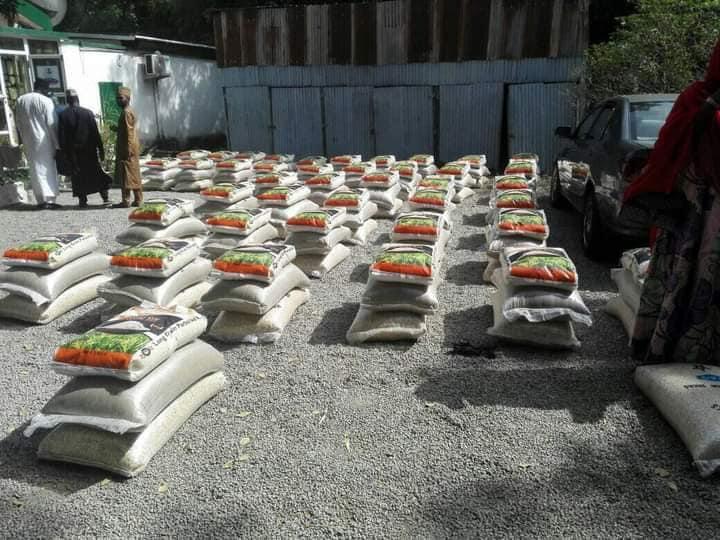
As many Muslims around the world are celebrating the birthday of Prophet Muhammad (Peace be unto him), the former Executive Secretary of Tertiary Education Trust Fund (TETFUND), Dr Abdullahi Baffa Bichi has distributed food items to over 500 households as a philanthropic gesture to commemorate the 1443 Maulud Celebration.

Speaking during the distribution exercise, that took place in his residence at Bayero University Kano, Old Campus, Dr Bichi said the essence was to put smile on the faces of people by cushioning the effect of harsh economic situation in the country.

He noted that many people are finding it difficult to feed their families and therefore, his action was to make them happy on this festive period.

The donated items included a bundle of cloth, bag of rice, millet and maize each and a portion of meet.

“As we are today celebrating the birth of our Noble Prophet SAW, we feel obliged to put smiles on the faces of our brothers who could not afford a good food for their families”.

Many people who benefitted from the gesture expressed their appreciations by describing him as the rising politician who has the interest of a common man at heart.

After collecting his items, Malam Abubakar Idris said, “the items came handy as he had no single grain in his house with a family of five.

Another woman busted into tears of joy, lamenting that it has been over a week since last they cooked a solid food in the house. They just rely on other difficult means.

“We were surviving on crunches for the last few weeks, as we have nothing in the house, my husband died last year during the Covid-19 pandemic, he left me with five children and no one to feed us. The selling of akra I was doing did not last long due to lack of capital. In addition to the food items, he equally supported us with a  by to take-off money to start a business. We really appreciate him and may Allah continue to guide him. Alhamdulillah.”

A director in the One 2 Tell 10 campaign organisation of Baffa Bichi, Honourable Ghali while explaining the concept of human empowerment, noted that the desire was to bail out the needy especially widows, orphans and other needy persons in the society.

Honourable Ghali disclosed that the only way out of the economic crunch is for all the wealthy and public sprites individuals to come up with program that would have a positive pact on the lives of the less privilege by providing them with capital money so as to be independent and self reliant.

“Our desire is to empower people to be self-reliant so that they can as well be productive to the society. No nation can grow and prosper if the teeming populace are in abject poverty and economic dependency. Ours is to teach a person how to fish so that he can be productive in the society,” he declared.

TETFund should abolish foreign scholarships

By Abdelghaffar Abdelmalik Amoka

The presence of ETF and later TETFund became more visible after the suspension of the 2009 ASUU strike in October 2009, thanks to the ASUU strike. You enter the campus of some universities, especially the state government-owned universities and it appears as if TETFund is the only funder of the infrastructures in the universities. No wonder Professor Mahmood Yakubu’s NEEDS Assessment committee referred to them as “TETFund universities”.

The intervention from TETFund did not end on infrastructures and other physical projects but also on training. Quite a number of University academic staff obtained their PhD abroad, thanks to the TETFund Academic Staff Training and Development Intervention and ASUU. That ASUU’s achievement has increased the number of quality PhDs across the departments in our universities. About 6 colleagues in my department are beneficiaries of the TETFund PhD grant.

It did not stop at that. TETFund has also established research grants. The TETFund Institutional Based Research (IBR) grant for basic research and the TETFund National Research Fund for developmental research.

When TETFund announced the call for the 2016 National Research Fund (NRF) grant proposal submission, I got it forwarded to me by several people that knew I was passionately looking for research grants to set up my lab since my return from Europe to ABU in September 2015. I was excited with the call for proposals and I prepared my proposal and submitted it with others. It was well coordinated by the university, thanks to the efforts of Prof. Husseina Makun and the Directorate of Academic Planning and Monitoring of my university.

Not long after then, there was a change in the leadership of the agency and I never get to hear anything about that submission to date. My guess was that the usual Nigerian factor may have played a role and you possibly need to know somebody that knows another body that knows someone that can help facilitate it.

The call for the submission of a “concept note” for the 2019 NRF grant after your return did not excite me. I was informed by several people but I ignored it. I was like this is a repeat of what I called the “2016 call for grant proposal scam”. But few days to the expiration of the call, I decided to make a submission, after all the application doesn’t cost anything. It will only cost my time and effort. I was actually not expecting a response like it happened in 2016, but a few weeks later, you “shocked” me as I received an email requesting to submit the full proposal. I did, and a few weeks later I got an invitation to Abuja to defend the proposal. In January 2020, the grant award letter was issued.

That was the first very transparent exercise I have participated in in Nigeria in recent times. No personal contact. All correspondence was through email and you don’t have to wet anybody’s palm. Unbelievable! That exercise gave me a renewed hope that with responsible leadership, we can make every unit work as it should and the sum will make Nigeria work. Sir, you renewed my hope that Nigeria is going to work and we can regain the lost glory in academia.

TETFund is making a lot of impact in public universities even though some universities may not get the true value of the allocated funds due to several reasons including the possible manipulation of the procurement process. TETFund is also doing a lot to build research capacity in our universities and over the last 10 years, the number of quality PhDs has increased. But my worry is that these researchers may end up being more frustrated if they get back without the necessary research facilities and incentives to give back to the system.

The TETFund PhD training scheme is a train-the-trainers program but there seems to be no preparation to utilize the knowledge acquired by these scholars on their return. We seem to be just training without any provision for their return. The scholars were sent for training as researchers but returned to meet little or no improvement on research facilities. So, how do we intend to utilize these well-trained scholars that have returned?

Their research work seems not to be well coordinated, unlike the NRF grants. They are mostly not towards the critical needs of the country. Some of the scholars who have got no idea of what to work on may sometimes end up using our fund to implement the supervisor’s idea. The idea may not be something that is of very importance to our country. Going abroad for quality research in that state-of-the-art laboratory but on research that does not tend towards our national need and without adequate provision for their return will make them more frustrated on their return.

Quite a number of PhDs in our universities, colleges of education, and polytechnics trained over the last 10 years are TETFund Scholars. Thanks to the overseas training scheme. The question then is; What is the strategic plan for the scheme? How long is the scheme meant to last? When is it going to end? What are the exit plans?

A lesson from other countries.

During my PhD, I met a number of Malaysians doing PhD at the University of Southampton. One of those Malaysians was on 3 months research visit to the lab I did my PhD. They were all on a Malaysian government scholarship. They have all returned to their respective universities in Malaysia with well-established laboratories and access to funds for research. Most of the funds for PhD training are in Malaysian universities.

Malaysia now earn foreign exchange from international students, especially Nigeria students. These my colleagues and contemporaries in the UK universities are among the researchers/Lecturers training my Nigerian university colleagues that have gone to Malaysia to study. What is the difference between us and them? They return to a functional lab but we returned to an empty space and we are struggling to build a lab. Our situations are different because their training and return were well planned out. What are the plans for our trained colleagues?

It is possibly time to re-channel the funds for overseas scholarships to funded PhDs in our universities.

South Africa has National Research Foundation (NRF) that gives grants for research PhD training in South African universities. NRF is so well established that they are collaborating with DAAD in Germany for a funded PhD in South Africa. There is also the TWAS-NRF funded PhD but in South African university. We can take a lesson from that

The Research Council of Norway usually contributes 50% of research project funds while the other 50% is from industrial partners, but the condition on the government 50% is to train a PhD or postdoc in Norwegian university. Norwegian universities are tuition-free like Nigerian universities. The grant covers living costs, travel, conference attendance anywhere in the world, etc.

There is the UK Research and Innovation (UKRI), Engineering and Physical Sciences Research Council (EPSRC), that provides UK universities with grants – awarded through a competitive process – to cover the fees and living costs of postgraduate students. Each place a university offers as a result of this funding is called a studentship. Application for the studentship is done through the university you want to study.

These countries would not have being able to comfortably execute research and training without capacity building. We surely need capacity building scheme and TETFund and PTDF have done great in that respect. But the scheme should have a well-defined timeline. At the expiration of the timeline, the overseas scholarship should be converted to full national scholarships for the trained scholars to train PhDs in funded laboratories in our universities. Forex is already becoming a big challenge. The funds are then domicile here rather than shipping the fund out.

TETFund may need to produce a database of their scholars in the various tertiary institutions in Nigeria and even the ones that have refused to return to the country. There should also be a database for successfully completed TETFund NRF projects and their Principal Investigators. The TETFund Academic staff training and development intervention can then be converted to Nigeria’s university-based training. Scholars are only sent abroad for subjects that we lack expertise in Nigeria.

So what do we do?

We can adopt the German model. To get a DAAD-funded PhD training in Germany, you must first get a supervisor in a German university that is willing to work with you. With the consent of the supervisor, you can then apply and the application is endorsed by the supervisor.

In our case, the prospective TETFund PhD scholar will first get a supervisor from TETFund recognized researchers/Professors. Application is then made through the university and endorsed by the prospective supervisor. If the scholarship grant is like 20 million naira, for example, up to 10 million naira can be mandated for laboratory equipment, the rest will be used for living expenses for the scholar, International conference participation, purchase of consumables, etc.

You can imagine the value Dr. Mansurah Abdulazeez will add to the existing facilities for Cancer research in their Biotech lab in BUK if they are awarded the 20 million naira by TETFund to train 1 TETFund scholar each year for the next 10 years. That will be another investment of about 200 million naira in our university that would have being taking out.

Just a little effort and we got the Materials Physics Research lab. Imagine getting 10 TETfund scholars to train over the next 10 years in high voltage materials engineering and 50% (about 100 million naira) of the PhD grant is approved for research facilities. Unlike the PhD done abroad, the facilities procured during the PhD will remain in the Nigerian university for others to use after the PhD. Just imagine how the lab will be in the next few years.

I was at the Biotech lab at IAR, ABU Zaria last year, I saw the IAEA-funded research facilities, and I was like wow! Just imagine the steady growth of the lab, research output, and visibility if Prof Husseina Makun for example, gets the funded PhD scholars to work with instead of taking the money to universities abroad. We have quite a number of serious-minded researchers among senior colleagues across our university and a large number of bright and exposed early career researchers.

We have trained enough PhDs abroad over the last 15 years through PTDF, TETFund, NITDA, etc that are back and capable. Some of them are not doing badly even with all the challenges as they have been able to publish quality papers in indexed journals. I want to believe that we can give quality training to PhD scholars in Nigeria.

We have several challenges in Nigeria that the universities can develop solutions for. But personally funded PhDs cannot give that quality PhD research to achieve that. I advertised 2 research topics on my Facebook page recently and I got responses from prospective research students. But the question they were asking was; is it funded? Some of the people that responded are students that received their MSc abroad.

A timeline should be rolled out on when to end the overseas scholarships and focus on using the fund meant for that to further develop the research capacity of our universities to make them attractive to foreign students. It is time to keep the money at home to develop our research and development capacity and use PhD programs to find solutions to our numerous problems.

Abdelghaffar Abdelmalik Amoka

We are all guilty of the state of the nation

By Abdelghaffar Amoka Abdelmalik

The trending news/video of the over 500 doctors that turned up in Abuja at the Saudi health ministry organised recruitment meeting to pick Nigerian doctors for work in Saudi Arabia reminded me of a comment by a Nigerian Professor in a university in the UK sometime in 2008 or so. There was a discussion on the management of PTDF oversee scholarship scheme, the scholars in the UK, their future, Nigeria, and capacity building. He said Nigeria is perhaps the only country in the world that spends a lot of money to train scholars and doesn’t care what becomes of the scholars after the training.

This scenario is common to all the scholars funded with government money. We send scholars to the UK and other countries under PTDF, TETFund,  NEEDS Assessment, NITTDA, etc., and we do not care if they return home or not. As a matter of fact, there is no provision at the home institutions to utilise the knowledge acquired by the scholars during the training on their return. It’s like you were trained for yourself and not for the system. Those who return are not better than they were before they left as no laboratory to train others. They most times become more frustrated.

Then, how do you expect a system that makes no provision for scholars sent abroad for training to make provision for those we managed to train at home? This is the case with our Medical Doctors moving to other countries to practice. Even though we do not have enough medical personnel, medical doctors sometimes find it challenging to get a job as Consultants after their residency. So, why they should not move to the UK, Canada, Dubai, Saudi Arabia, etc., to practice?

We need to deal with the lack of respect and value for our universities, professionals, and intellectuals. It worsened when our leaders abandoned our institutions while taking their families abroad for education and medical care. They are not even ashamed to post their graduation pictures on social media and shamelessly requesting us to celebrate with them. I thought COVID-19 and the lockdown would teach us lessons, especially our leaders, but it seems we have not learned any lesson from experience.

I read a comment sometime back that during the slave trade, our people were forced into slavery, but if it is now, Nigerians will give themselves up to be taken away. They believe that whatever the challenges are in those countries, it will still be better than Nigeria.

The gathering of over 500 professionals (Consultants and Resident Doctors), both Muslims and Christians, for a recruitment exercise to Saudi Arabia called for sober reflection and not throwing insults. These guys do not care about the Shariah law and the stories of racism in Saudi Arabia from those that have worked there. They just want to leave. So we need to sit down and reflect and ask ourselves questions. What future do we want to create for Nigeria and Nigerians?

Our leaders don’t believe in the country. They instead take our money to London, Dubai, and Saudi Arabia, etc., to secure the life of their family members. They patronise medical care in first-class state-of-the-art hospitals established by the leaders of those countries since they can’t make our health sector desirable. And they are not ashamed of that as leaders. On the contrary, they travel for medical tourism with pride and class.

You will not blame our doctors who were trained nearly for free in our “ASUU Strike” public universities by our “ill-equipped” professors to move to London, Canada, Dubai, Saudi Arabia, etc., to help those countries treat our politicians. But, of course, they want a better life too, and they will be paid better there. So, why should they be ashamed of running away when our leaders are not? Why should they endure and MILT (manage it like that) when our leaders aren’t prepared to MANAGE our hospitals and schools LIKE THAT for their kids?

It is unfair to expect the people to be patriotic when the leaders are not — and don’t even seem to believe that Nigeria can work. The president, Vice President, the Governor, the Senators, others that are supposed to make our schools work have their kids in schools in the UK. The president and other political leaders that are supposed to make our hospitals work receive medical care in the UK, Dubai, Saudi Arabia, etc. How will they make a system they don’t patronise to work? They will just think the system is OK for us as they are, and we can MILT.

Come to think of it. How can our doctors be on strike and hospitals shut for patients for over three weeks? It is not surprising. After all, they allowed the ASUU strike to last for nine months and public universities closed for that nine months. They would not have let that happen if they and their immediate families patronised the system that was and is on strike.

The leaders don’t believe that the country can be fixed, and the led also don’t believe the country can work. So let all of us just run away, even to Niger, Cotonou, Rwanda, etc., and let Nigeria fix itself before we return.  

While I am in solidarity with our Medical Doctors on strike, I only wish that the strike is not just about salaries and allowance but also on the proper funding of the healthcare sector so that we can have hospitals similar to the ones they patronise in the UK, Dubai, and Saudi Arabia.

The question now is: Do you want Nigeria to work? Just be the change that you desire—both the leaders and the led.

Meanwhile, the Punch newspaper has reported that the organisers have suspended Saudi Arabia recruitment as DSS disperses doctors, arrests journalists. Is that the way to fix the problem?

It is relieving that despite the ASUU strikes, the breaks, and all the insults on lecturers, our graduate doctors can still pass International examinations and are qualified to work in the UK, Canada, Dubai, and Saudi Arabia. To God be the Glory.

Kudos to our “ill-equipped” professors who have helped train this Nigerian workforce from 100 Level till graduation for the UK, Canada, Saudi Arabia, Dubai, etc.

Maybe I need to run too. Meanwhile, I am still thinking of the country to run to. 

Abdelghaffar Amoka Abdelmalik writes from zaria can be reached via aaabdelmalik@gmail.com.