Nigeria

Senate approves Tinubu’s N1.15tn domestic loan fill 2025 budget deficit

By Anwar Usman

The Senate on Wednesday, has approved President Bola Tinubu’s request to collect N1.15 trillion from the domestic debt market to cover part of the 2025 budget deficit.

The approval followed the adoption of a report by the Senate Committee on Local and Foreign Debt during plenary.

The committee noted that the 2025 Appropriation Act provides for a total expenditure of N59.99 trillion, an increase of N5.25 trillion over the initial N54.74 trillion proposed by the Executive.

This expansion created a total budget deficit of N14.10 trillion, of which N12.95 trillion had already been approved for borrowing, leaving an unfunded deficit of approximately N1.15 trillion.

Recall that, on November 4, Tinubu formally requested the fresh N1.15 trillion borrowing.

He stated that it would bridge the funding gap and ensure full implementation of government programs and projects under the 2025 fiscal plan.

In a related development, a motion by Senator Abdul Ningi was adopted, directing the Senate Committee on Appropriations to intensify oversight to ensure that the borrowed funds are properly implemented and used strictly for their intended purposes.

Security breach at Kano govt house as thief makes off with official vehicle

By Abdullahi Mukhtar Algasgaini

A brazen car thief infiltrated the Kano State Government House in the early hours of Monday, successfully stealing a Toyota Hilux from the deputy governor’s convoy.

According to security sources, the suspect entered the secure compound through Gate 4 and later exited unchallenged through the main gate.

The audacious theft went completely unnoticed by security personnel at the time.

Authorities have launched an investigation into the major security lapse.

It was confirmed that CCTV footage from the area is being scrutinized and the official driver assigned to the vehicle has been taken in for questioning.

Wike’s confrontation with soldier a threat to national security, demands apology—Buratai

By Abdullahi Mukhtar Algasgaini

Former Chief of Army Staff, Tukur Buratai, has condemned the Federal Capital Territory (FCT) Minister, Nyesom Wike, for his public confrontation with a soldier, calling it a threat to national security that requires an apology.

Buratai’s statement comes after videos circulated online showing Wike in a heated argument with military personnel over a disputed plot of land in Abuja on Tuesday.

He described the minister’s “verbal assault on a uniformed officer” as a profound act of indiscipline that undermines the nation’s command structure and disrespects the authority of President Bola Tinubu as Commander-in-Chief.

“The integrity of our Armed Forces demands nothing less,” Buratai stated, insisting Wike must immediately apologise to both the President and the officer involved.

A REPORTER’S DIARY: The day NYSC registration tested my will

By Rabi Ummi Umar

The 2025 Batch C1 National Youth Service Corps (NYSC) registration for prospective corps members was a real eye-opener for me. I finally understood why my friends and family had urged me to take a breather after my final exams. I was itching to do something—anything—after completing my university studies.

As humans, we are wired to anticipate the next phase, and for me, that next thing was NYSC. Yet I wrestled with how to keep myself busy before the time came.

As someone who is always on the go, I began to feel the weight of post-school reality just a few days after returning home. There was suddenly little or nothing to occupy me. Then came the thought of continuing my internship with Image Merchant Promotion Limited (IMPR), a firm where I had already gained considerable experience.

That decision helped tremendously in keeping me engaged until NYSC registration was announced. There were mixed emotions as I waited for the process to begin—excitement, nervousness, and a bit of anxiety all at once.

Finally, when the registration portal opened, I felt a huge weight lift off my shoulders. I whispered to myself, “Alhamdulillah, I’ve finally got something to do. The next phase is here.”

On the scheduled day, Tuesday, November 4th, 2025, I set my alarm for midnight, determined to register as soon as possible. However, the portal had its own plans. It wasn’t yet open for Batch C, so I had to wait until 4:00 a.m. to try again. Luckily, it worked—I put in my email and waited… and waited… and waited some more.

Restlessness set in. I thought my email had issues. I created a new Yahoo account, called friends and co-workers for help, and tried again and again. Nothing worked, even by 6 a.m. Eventually, I decided to head to the cybercafé.

Just as I left the house around 8 a.m., an email notification popped up—it was the long-awaited link to the registration portal. Overwhelmed with relief, I whispered “Alhamdulillah” and screamed in excitement without realising it.

When I arrived at the café, the network started misbehaving. The portal kept crashing and refreshing. Still, I managed to register and fill out the manual form provided. Everything necessary was done, and I finally left around 11 a.m. Reflecting on the experience, I thought, “What a stressful but fulfilling process.”

I was among the fortunate ones. Many of my friends and schoolmates faced serious challenges—some never received their registration links, while others couldn’t access the portal at all. Our group chat was flooded with frustration. By the second day, the site had begun to crash, and by the third, it was completely down.

Over a thousand prospective corps members were unable to register, a far cry from the seamless experience promised. The ordeal was overwhelming, and I couldn’t help but empathise with those who weren’t as lucky, wondering how they coped with the stress and disappointment.

The situation grew so dire that NYSC had to extend the registration deadline by two days—from Sunday, November 9th, to Tuesday, November 11th, midnight. Yet, problems persisted. The payment system for call-up numbers malfunctioned, leaving many stranded. While the extension was a relief, it also exposed the urgent need for improved infrastructure and coordination.

NYSC must do better. The registration process should be seamless, not frustrating. If this national scheme must endure, it must also evolve. People shouldn’t have to suffer this much—just to get started.

Rabi Ummi Umar is an intern at Image Merchant Promotion Limited (IMPR). She can be reached via: rabiumar058@gmail.com.

Wike: The deepening threat to Nigeria’s democratic landscape

By Abba Hikima

It is clear to even the most daft Nigerian that Nyesom Wike, a serving member of President Tinubu’s Federal Executive Council, is only in the PDP to sabotage it and clear the path for his benefactor, the President, come the 2027 elections. What may not, however, be clear is the extent to which Wike’s tactics and antics can undermine Nigeria’s democracy.

Whether you are APC, PDP, ADC or even politically indifferent, Wike’s actions should bother you, as long as you dream of a truly democratic Nigeria where institutions transcend whimsical meddling of the few.

From any angle, one sees a deliberate pattern that systematically seeks to dismantle the country’s main opposition party and tilts the political landscape dangerously toward one-party dominance.

The recent Federal High Court injunction, restraining the PDP from holding its planned November 15 National Convention, issued by Justice J. Omotosho, only reinforces this pattern. It aligns with a string of judicial outcomes and political manoeuvres that have consistently favoured Wike’s factional interests, all at the expense of Nigeria’s fragile democratic balance.

Between 2023 and 2025, Wike’s loyalists seized the PDP’s national secretariat at Wadata Plaza, installed their own acting chairman, and plunged the party into even deeper crisis. Earlier, he had been linked to moves to demolish the PDP headquarters in Port Harcourt and to lawsuits that derailed planned conventions.

These deliberate acts of sabotage are calculated to dismantle opposition structures and weaken the political alternatives that every democracy relies on. In Nigeria today, prominent political opposition actors are crosscarpeting from their political parties to the ruling APC, not because the APC is doing better, but to salvage their seats and realise their aspirations, which appear rather vivid with the APC.

In saner climes, inclusion of opposition figures within ruling governments is a laudable means of promoting national unity and bridging gaps. But in Nigeria’s case, Wike’s dual role, serving as a federal minister while wielding extraordinary control over an opposition party, is clearly a means of manipulation.

It blurs ethical boundaries and deprives citizens of genuine democratic alternatives.

Even more disturbing is Wike’s perceived closeness to certain segments of the judiciary- what Professor Chidi Anselm Odinkalu aptly described as a “pathological fixation.”

From 2019 to 2025, at least five major cases tied directly or indirectly to Wike’s interests have been heard before the same judge, fueling concerns of judicial clientelism —a scenario where powerful litigants can select their forums by proxy.

The danger goes far beyond politics.

If political elites can manipulate opposition parties while simultaneously bending judicial processes to their favour, then democracy becomes mere theatre. A performance that preserves power and erodes accountability.

Having said this, the National Judicial Council should randomise the assignment of politically sensitive cases and ensure that no single judge repeatedly handles matters involving the same litigants. A stronger ethical firewall must also be built between judicial officers and politically exposed persons.

Politically, Nigeria must introduce conflict-of-interest rules that bar sitting ministers or presidential appointees from exerting control over opposition parties. Democracy cannot thrive when the same hand both governs and manipulates its opposition.

Coming this far, we must accept that reform is not optional; it is existential.

Abba Hikima, Esq. wrote from Kano, Nigeria.

Terror groups plot regional takeover in west Africa, ex-official warns

By Abdullahi Mukhtar Algasgaini

A former Nigerian presidential aide has raised a stark alarm, claiming that terrorist groups are actively attempting to seize a vast swath of territory across four nations to establish a new global headquarters for terrorism.

Hakeem Baba Ahmed, who previously served as a Special Adviser to President Bola Tinubu, made the declaration in a televised interview.

He asserted that intelligence circles are aware of the threat to carve out a large territory encompassing parts of Nigeria, Chad, Cameroon, and Niger.

“There are attempts by interests to take over huge territory… and turn it into the global headquarters of terror,” Baba Ahmed stated.

“Those in intelligence circles know this. I’m saying this publicly now. A lot of people know this.”

He emphasized the dire consequences of such a takeover, stating, “We must never allow that kind of thing to happen. We don’t want to live under ISWAP. We don’t want to live under Boko Haram.”

While his warning included a critique of US policy, Baba Ahmed also stressed the importance of the Nigeria-US relationship.

He called for more constructive American support, suggesting targeted sanctions on corrupt leaders instead of broad policies that negatively impact citizens.

He described actions that sow division among Nigerians as the “worst possible approach” to tackling the nation’s challenges.

Troops free 86 abducted civilians, arrest 29 Boko Haram suppliers in Borno

By Uzair Adam

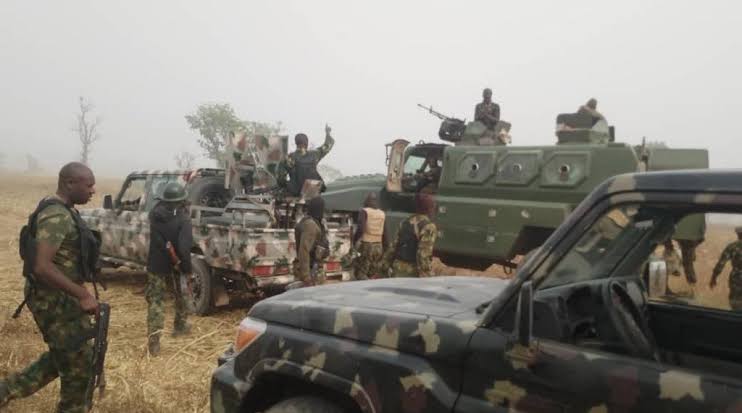
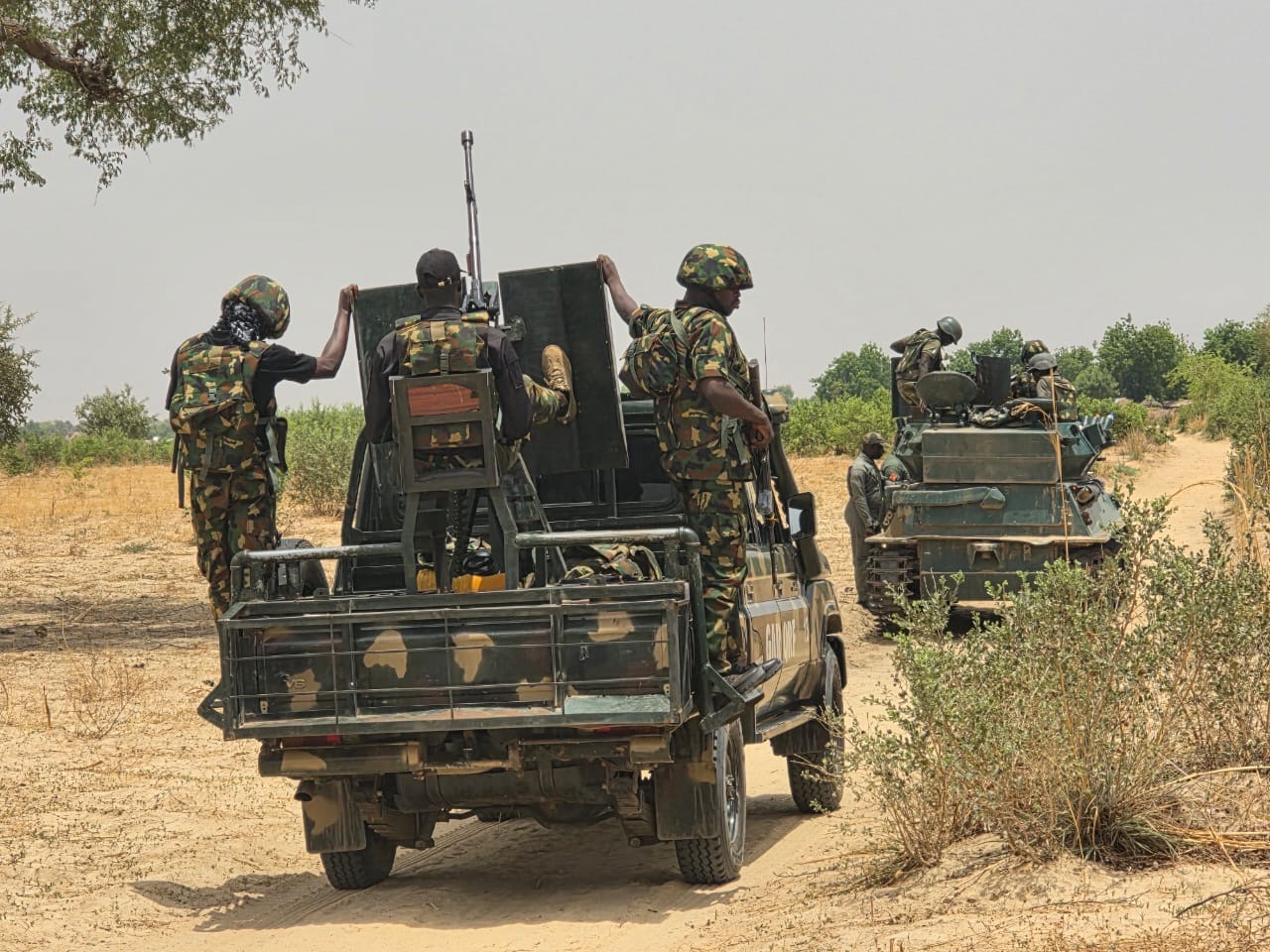
Troops of Operation HADIN KAI (OPHK), Joint Task Force North East, have rescued 86 civilians, mostly motorists and passengers, who were abducted by Boko Haram/ISWAP insurgents around Dutsen Kura along the Damaturu–Buratai–Biu road in Borno State.

According to a senior military officer who was not authorised to speak to the press, the incident occurred on Sunday, November 9, 2025.

The troops also destroyed 11 makeshift structures belonging to the terrorists during the operation.

The officer disclosed that troops of the 135 Special Forces Battalion under Sector 2, OPHK, encountered the insurgents after discovering they had abducted civilians and seized vehicles along the Buratai–Kamuya road.

“The troops immediately engaged the terrorists, pursued them towards Mangari, and overpowered them in a follow-up encounter near their camp, forcing them to flee in disarray,” the source said.

A thorough search of the area led to the rescue of 86 victims, including men, women, and children.

Items recovered from the scene include one AK-47 rifle, five magazines loaded with 73 rounds, four PKT ammunition belts, five civilian vehicles, five motorcycles, eight bicycles, and two logistics tricycles.

The camp was later destroyed after clearance operations.In a separate operation, troops deployed at Mangada arrested 29 individuals suspected to be logistics suppliers for Boko Haram while en route to Chilaria.

The suspects were found with two pickup vans and a tricycle loaded with over 1,000 litres of petrol, four gallons of engine oil, two new gun truck tyres, a cache of medical supplies, and large quantities of foodstuffs and provisions.

The source confirmed that all operations were conducted successfully without any casualties among the troops.

The Military High Command commended the soldiers for their gallantry and professionalism and urged them to sustain the momentum to deny terrorists any freedom of action in the North East.

Soludo secures second term as Anambra governor

By Abdullahi Mukhtar Algasgaini

Professor Charles Soludo has been re-elected as the Governor of Anambra State after a decisive victory in Saturday’s governorship election.

The Independent National Electoral Commission (INEC) declared Soludo, the candidate of the All Progressives Grand Alliance (APGA), the winner on Sunday.

The Returning Officer, Prof. Edoba Omoregie, Vice Chancellor of the University of Benin, announced that Soludo polled 422,664 votes.

The results placed Chief Nichols Ukachukwu of the All Progressives Congress (APC) in a distant second position with 99,445 votes.

Mr. Paul Chukwuma of the Young Progressives Party (YPP) followed in third place with 37,753 votes.

Notably, the Labour Party, which is associated with the party’s 2023 presidential candidate Peter Obi, finished in fourth place.

Its candidate, George Moghalu, received 10,576 votes. John Nwosu of the African Democratic Congress (ADC) trailed with 8,208 votes.

The declaration was made at the INEC state headquarters in Awka, solidifying Soludo’s continuation in office for a second term.

Colonial minds in Nigeria: The case of Igbos and Christians

By Sa’adatu Aliyu

“I was Igbo before the white man came” is a saying by Chimamanda Adichie through her character Odenigbo in her infamous book Half of a Yellow Sun, reinforcing pride in her African heritage before the white man’s incursion, which destabilised the otherwise peaceful coexistence of African communal states.

However, it seems to me that she has been afflicted by the Igbo superiority complex over other tribes in Nigeria, especially the Hausa-Fulani in the North. This pride in being traditionally Igbo and human doesn’t extend to her acknowledgement of the Hausa-Fulani Muslim humanity and identity—held with equal pride—just as the Hausa-Fulani were before the Whiteman.

Ethnic Pride and Selective Humanity

Moreover, the likes of Adichie and her Igbo fanatics would rather make baseless and false claims about the Igbos being suppressed and ethnically cleansed in letters to Washington than sit to resolve their differences internally with their brothers in the North, solely because they are Muslims whom the Igbos do not perceive as human equals.

Generally speaking, the problem with the Igbos is that they believe all the lands in Nigeria belong to them. Their illusion of grandiosity makes them feel entitled to all locations in Nigeria beyond their region as places they have the right to live, seek better economic opportunities, and build a stable, secure life. In contrast, the same right is not extended to other tribes in Nigeria, especially the Hausa man, who, until today, faces all sorts of harassment whenever he is in the Southeast, sometimes stopped and asked by unscrupulous elements to pay “matching ground” money.

This is a form of tax collected from non-indigenous individuals seeking better economic opportunities over there—a thing that doesn’t occur in the North. Unlike the South, even though Muslims predominantly inhabit the North, it has a significant presence of churches, whereas the presence of mosques is not tolerated in the Southeast except in a few exceptional cases. Moreover, if the North was so brutal towards the Christians as they depict, why do Southerners/Eastern Nigerians seek greener pastures in the North more than the North moves towards their region? If it was so unfriendly to the Igbos and Christians, why not the Igbos remain in their regions, and the North remain in theirs?

Power, Entitlement, and the North–East Tension

While all Nigerian citizens have the right to live and build a life devoid of fear in any part of Nigeria, the Igbos particularly think they should be the ones solely steering the affairs of Nigeria and should be the sole tribe entitled to managing the juiciest positions in government, merely for being Igbo, not necessarily based on superior qualification.

Understanding the mentality of the Igbos has led to what I’d like to refer to as a “personality clash” with the Hausa-Fulanis. Despite being perceived as backwards in an educated population, they are like poor men who would never sacrifice their dignity for money, nor bow to any force that may seek to demean them based on possessing more Western education.

This has led to the long-standing tension between the two ethnic groups. The case of the North and the East is akin to a couple in their early years of marriage experiencing a clash of personality—not necessarily due to lack of love or to cause deliberate harm, but because one happens to blow issues out of proportion by arguing that the other insists on hurting them deliberately.

Instead of checking in with their ego, they engage in score keeping, accusing, and incessantly crying out for help, even if it means seeking a third party in the cloak of a certified therapist—who may hiddenly be a psychopath and has no genuine interest in the wellbeing of the couple, but instead has its greedy eyes on the money to be extorted from them, further destroying their home.

The West as “Therapist”: Foreign Meddling and Naivety

This is precisely what the Christians in Nigeria are doing by seeking the intervention of so-called America, peering underneath African countries’ beds looking for genocide, when the very foundation of the U.S. was built on the vile killings of Indigenous Native Americans.

This scenario has been fueling some of the false accusations circulating in the media about genocide against Christians in the North. It is no doubt Nigeria has been plagued by indiscriminate killings and kidnappings in the past few years, but this has involved the loss of lives and livelihoods of citizens across all ethno-religious groups—mainly by Boko Haram militias and banditry—and not killings affecting Christian communities alone, as the naive Christians of Nigeria, who still put the U.S. on a saintly pedestal, have been framing it.

This is mere fabrication born out of a myopic desire to destabilise the fragile peace still holding the nation together, forgetting that foreign powers have never and will never look out genuinely for the Black race, but have repeatedly set their eyes on how to invade and plunder the resources of our dear land.

Be it the U.S., Russia, China, or other subordinate world powers, they couldn’t care less if Africa burned. All they would do is not find a way of quenching the fire but find a means to steal our resources, all the while supplying the weapons we’ll use to maim our brothers with whom we share the same African Black DNA.

It is sad that, in the eyes of Nigerian Christians, America remains a demigod they rush to whenever facing a “problem.” in this manner. But this doesn’t paint the image of a race free from the shackles of colonialism—it looks to me like a remix of the same song to which we can’t dance, should any foreign power invade as is being threatened by the U.S currently. 

Nigerians should never forget Libya, Iraq, Afghanistan, Sudan, and every other country the U.S. has invaded. It was never for goodwill or for the sake of the masses to have a better life; it was never about democracy but about the kleptomaniac instinct of foreign powers to pillage, to use the stolen resources of Africa to build their countries.

Colonial Mind enslavement and the Illusion of Freedom

When Chimamanda Adichie said she’s Igbo before the invention of the white man, I presume she was refuting the attempt of the white colonialist to redefine her ancestral root. She was rejecting the image of the indigenous people of Africa that the white man struggled to create to wipe out her identity.

I also want to believe the white man here is seen as foreign, intrusive, with no right to rewrite the history of the African people, nor to decide our destiny. But how come the same Nigerians, especially Igbos who pride themselves on being a fraction of the Black race, are quick to call for the intervention of the same white man to salvage them—to resolve a conflict with their African brothers on religious division, (the religions) on the basis which they’re stirring foment being a product nothing but a product of colonialism?

Yet they pick up their pens and still write saintly yet furiously about pride in Africa, Pan-Africanism, Negritude, and pride in the Black race they claim to represent. And one wonders with the level of hate projected towards Northern Muslims, whether they are not part of the black Africans. To me, this is nothing short of colonial mind slavery that still bedevils even our so-called intellectuals, blinded by religious fundamentalism and succumbing to it so effortlessly. Hence, one begins to question their education.

As Chuba Okadigbo once said:

 “If you are emotionally attached to your tribe, religion or political leaning to the point that truth and justice become secondary considerations, your education is useless.

If you cannot reason beyond petty sentiments, you are a liability to mankind.”

Mirroring a similar view, if the educated one cannot look beyond ethno-religious sentiment and live objectively, he has no business being called educated. However, this is a hat donned by several of Nigeria’s think tanks, sadly.

Similarly, Nelson Mandela reminds us:

 “It is not our diversity which divides us; it is not our ethnicity, or religion or culture that divides us…”

Can the African mind ever be decolonised? I doubt so. It might all look like we are free, but there’s no freedom without the freedom of the mind.

So, the quest of Ngũgĩ wa Thiong’o for Africans to free themselves from mental colonial slavery—which led to his abandonment of the English language and adoption of Kikuyu—doesn’t extend to this area for many Christian fanatics who happen to be influential writers from the Eastern part of Nigeria. And this is utterly disheartening.

In Conclusion

In the wake of all this commotion, I perceive the naivety of those spreading these lies to draw foreign intervention in Nigeria as an act of somnambolic foolishness—for which I am sure they will regret when they come face to face with the hypocrisy that lies in the heart of world powers, should they get what they are calling for.

I pray for peace, unity, religious understanding, and togetherness in Nigeria and the world at large. Let us always remember: a shred of peace is better than no peace at all.

Saadatu Aliyu is a writer and poet based in Zaria. Email @: saadatualiyu36@gmail.com 

Dangoro community raises alarm over land takeover for Kano market project

By Uzair Adam

Residents of Dangoro community in Kumbotso Local Government Area of Kano State on Saturday held a special prayer session, seeking divine intervention over what they described as the continuous takeover of their farmlands and plots by the state government.

The residents said they were thrown into panic following the government’s plan to relocate the Yan Lemo Fruit Market and Yankaba Vegetables Market to their area, an action they fear will lead to another round of land seizures and displacements.

Speaking during the prayer session, one of the affected landowners, Sadik Muhammad Abdullahi, expressed frustration over what he called repeated loss of property to government projects.

He stated that, “This is the fourth time such an incident is happening in Dangoro. I was a victim of the previous one. I had eight plots of farmland, but when the government came, it took them and gave me only one and a half plots as compensation. I later sold it and bought another land, which is now being targeted again.”

Abdullahi added that many residents could suffer the same fate if the plan goes ahead, saying the area consists of individually owned plots, which would make fair compensation extremely difficult.

“If what happened before happens again — where someone loses eight plots and gets one or one and a half plots — some people might collapse or even die of shock. The situation is becoming unbearable,” he lamented.

Another landowner, Comrade Nuraini Adabayo, said the community had been devastated since hearing of the government’s plan.

“I even encouraged others to buy land here, assuring them that the government would not carry out any further measurements since it had done that three times before.

“Now, we have over forty plots belonging to me and others who trusted me. Some people have even laid foundations for their buildings. I don’t know what to tell them,” Adabayo added.

He also complained that the government gave them very short notice, with the land measurement for compensation expected to start on Monday.

He added that many of the affected landowners do not live in Kano, making the process more complicated.

He appealed to Governor Abba Kabir Yusuf to consider relocating the markets to Kano Economic City, where, according to him, there is ample space to accommodate both the fruit and vegetable traders, similar to how the medicine sellers were relocated.

A respected community member, Alhaji Gambo Saminu Adamu, also urged the state government to urgently address the situation to prevent what he described as a looming humanitarian problem.

“I call on His Excellency, Governor Abba Kabir Yusuf, to personally visit this community and see the situation himself rather than relying on reports.There is enough space at the Economic City to accommodate all these traders without taking away people’s lands,” Alhaji Adamu added.

When contacted, the District Head of Dangoro, Ishaq Yusuf Ishaq, declined to comment, saying the issue did not originate from his office.

“As a traditional titleholder, we have our protocols. But you can contact the relevant government officials; they are aware of the development,” he said.

Similarly, when reached for comment, the Director of Public Enlightenment at the Kano State Ministry of Land, Murtala Shehu Umar, said he was not aware of the plan.

“Well, I am not aware of this ongoing plan. However, once I get any information, I will let you know. Maybe we can meet on Monday at the community during the exercise or before that time,” he stated.

The residents vowed to continue seeking divine intervention and called on the government to halt the planned relocation to prevent what they described as a threat to their livelihoods and ancestral heritage.