Islam

Saudi Arabia: Conservative versus Western values

By Salisu Yusuf

Since becoming the crown prince and de facto leader in 2017, Prince Mohammed bn Salman (known as MBS) is stirring controversies in Saudi Arabia and making the country a battleground between the conservative Sunni and trendy Western values.

Immediately after assuming power, MBS declared that the return of ‘moderate Islam’ was key to his plans. MBS’s declaration is an affront to Islam because his statement gives credit to Western media, which categorises Muslim adherents as either ‘moderate Muslim’ or ‘Islamic extremism.’ Such labels are derogatory and indictment; to label somebody as either moderate or extremist Muslim is to say that extremism is an extension of Islam. Moreover, MBS’s statement is a subtle backing to America retaining Guantanamo Bay Camp, where many innocent Muslims are being held without a trial and tortured. 

In 2018, MBS lifted a ban on women drivers. Saudi, being the last country in the world where such provision existed. Many, including Muslims, commanded the move as there’s no available Qur’anic injunction or Hadith that prohibits doing so. However, shortly before the ban was lifted, many women rights activists who campaigned against the ban were rounded up and imprisoned.

Bn Salman is seen by many as a power monger. For example, he was seen in 2017 shortly after becoming the crown prince with the former crown prince, Mohammed bn Nayef, the former pledging allegiance. Bn Nayef is King Salman’s nephew. He’s, therefore, MBS’s cousin. Bn Nayef was seen kneeling and kissing his older cousin’s hand, a gesture disapproved in Sunni Islam.

Saudi annual billion-dollar US arms deal is making Saudi Arabia a laughing stock. Former US President Trump supports Saudi because of the deal, and on the other hand, US moral and financial unconditional support to Israel is a source of concern.

The latest controversy is the mosque speaker restrictions. The Saudi government asks Imams and Muezzin to lower their speakers to a third of their maximum volumes during calls to prayer and during the prayer itself. 

Opponents criticise the restrictions, saying cafes and restaurants could be heard blaring loud music all over the country. Authorities had earlier said they placed the restrictions because parents complained that the speakers disrupt their children while asleep. Even though modern means of a call to prayer, the outrageous number of mosques and airing the prayer itself could be contestable if they’re brought under strict Islamic legal spotlight, some see MBS’s attempt to give some consolation measures to Western nationals living in the Kingdom.

Prince MBS has stepped up his opposition to freedom of expression, arresting and jailing many critics. Some have paid the heavy price with their lives, like the US-based journalist Jamal Khashoggi who was extrajudicially killed in the Saudi Consulate in Istanbul. Many members of the ruling family were also arrested and imprisoned. They could only be released after paying the state some huge amounts of money, which authorities claimed was payback for alleged corrupt practices. In the past, substantial freedom of expression was allowed, especially on issues of check and balance.

Brazenly, Saudi Arabia has recently signed a 10-year professional wrestling contest show with an American World Wrestling Entertainment Company (WWE). So today, you can go to a stadium in either Jeddah or Riyadh and watch wrestling contests; Royal Rumble, Super Showdown, etc., are a daily occurrence as is seen in Texas, New York, and other cities in America.

Moreover, Hajj has been suspended since last year. The first time a Hajj was suspended since the creation of the Saudi Kingdom in 1932. Many Muslims criticise the move after watching the mammoth crowd that graced the 2020 Euro final played this month (July) at Wembley stadium. Over 60,000 spectators watched the final. Prior to kickup, thousands of Italian and English fans were shown walking en route to Wembley, overlooking the so-called Covid-19 protocols. If Europe, the epicentre of the coronavirus, could gather such huge crowds, they asked, why the international Muslim community could not be allowed to go to Hajj?

As Prince Mohammed bn Salman consolidates power and his father gets older, only time will tell for how long and which of the two contrasting values will win the battle in Saudi Arabia’s mainly Sunni, conservative community.

Pakistan bans TikTok for “immoral content”

Pakistan Telecommunications Authority has, again, on Wednesday banned the popular video-sharing platform TikTok for the “continuous presence of inappropriate content on the platform and its failure to take such content down”.

Pakistan banned the platform for the same reason the first time in October 2020. However, TikTok assured the authorities that it would take measures to censor the contents deemed inappropriate. Days later, the ban was lifted.

Pakistan, an Islamic Republic and seen as conservative by many, blocked the app for the second and third time based on complaints from its citizens and under its Prevention of Electronic Crimes Act 2016. This current ban is reportedly the fourth. However, India blocked the app for reportedly political-cum-diplomatic reasons.

In Nigeria, a social commentator, Muhammad Ubale Kiru, recently criticised the app for promoting “immorality” among northern Nigerian youth. A post he wrote on Facebook went viral in the region’s cyberspace. In reaction to Kiru’s post, several people called on the Nigerian government to ban the Chinese-origin app.

Hajj 2021 sermon to be aired in Hausa, 9 other languages

By Muhammad Sabiu

The Kingdom of Saudi Arabia (KSA) has announced that the sermon for this year’s Hajj would be broadcast in 10 languages, including Hausa, one of the major languages in the West African region.

This was contained in a short social media update on a popular English page, Haramain Sharifain, which releases important information courtesy of the Two Holy Mosques in KSA.

The other languages are English, Malay, Urdu, Persian, French, Mandarin, Turkish, Russian, and Bengali.

This was not a new move as part of the effort to contain the spread of the COVID-19 and minimise the number of pilgrims. Like the previous year, the chairman of the General Affairs of the Grand Mosque and the Prophet’s Mosque, Sheikh Dr Abdul Rahman bin Abdulaziz Al Sudais, indicates that the decision was to do the same this year.

The inclusion of the Hausa language on the list may be connected with the increasing number of language speakers. In Ethnologue’s 2018 report, Hausa is the 11th most spoken language in the world. Therefore, this and the fact that most Hausa people are Muslims could be why Saudi authorities chose to include it on the list for the sermon to reach a broader audience.

Eid-ul-adha: July 20 and 21 declared public holidays

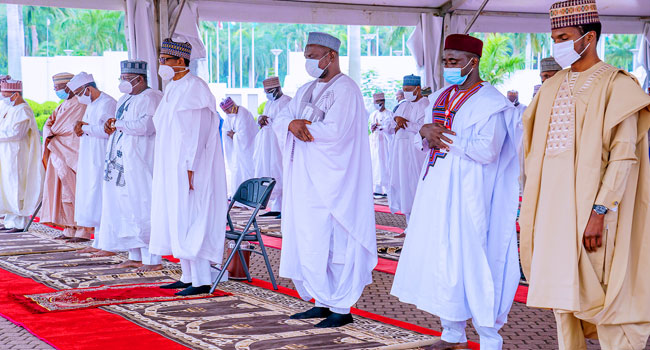
The Federal Government of Nigeria has declared Tuesday, July 20, and Wednesday, July 21, 2021 as public holidays.

The declaration was made by Interior Minister, Ogbeni Rauf Aregbesola. The minister congratulates all Muslim faithful home and abroad. He also advises them to “imbibe the spirit of love, peace, kindness, and sacrifice as exemplified by the holy prophet Muhammad (peace be upon him).”

The minister also implores the Muslim faithful to pray in the period for “peace, unity, prosperity, and the stability of the country, considering the challenges of insecurity we face at the moment.”

He gives assurance on the commitment of Muhammadu Buhari’s administration on security of lives and prosperity of Nigerians, empowerment, social investment programs, and adequate security for schools.

He also states the need for all Nigerians to keep on observing the COVID-19 protocols by wearing face masks, washing hands regularly, and keeping physical distance which can help in stemming the transmission of the dreaded pandemic in the country.

Significance of the ten days of Zhul-Hijja


By Tajuddeen Ahmad Tijjani

According to the highest body saddled with the responsibility of moon sighting in Nigeria (the sultanate council), Sunday the 11th of July 2021 was declared the first day of the month of Dhul-Hijjah in Nigeria.


The first ten days of Zhull Hijja (the last month on the Islamic calendar) are observed with reverence by Muslims worldwide. Prophet Muhammad, peace and blessings of Allah be upon him (PBUH), said: There are no days on which good deeds are more beloved to Allah than the days of Hajj.


Muslim faithful globally assemble in Meccah to perform one of Islam’s fundamental principles (Hajj). Unfortunately, due to the Covid-19 pandemic, only Saudi nationals are allowed to perform the Hajj this year. However, those who cannot visit the holy land are not left behind to accomplish good actions. Those at home are admonished to thank their Lord frequently, seek forgiveness, intensify prayers and fast throughout the nine pivotal days or at least fast on the Arafat day.  Muslims are enjoined to make sacrifices on the tenth day to seek Allah’s pleasure. 


According to Islamic teachings, remembering Allah wipes away sins, cures problems, and eliminates calamities no matter how burdensome they may be. Speaking about difficulties and calamities, indeed Nigeria is a country in a critical period; now is the perfect time for our Muslim brothers and sisters to intensify prayers and seek Allah’s intervention to free the country from the shackles of Boko Haram, banditry, kidnappings, armed robbery, violent secessionists, domestic violence, and other forms of terrorism.


Sallah is in a few days, but ordinary Nigerians can no longer afford the Salla ram, thanks to inflation. So while it’s part of Sunnah to make sacrifices by slaughtering an animal at the end of the ten days, it is strongly advised that the fortunate among us should give aid to the less privileged. Doing so will increase their wealth and will please Allah, adding more blessings to their wealth.

 
Tajuddeen Ahmad Tijjani writes from Galadima Mahmud street, kasuwar-kaji Azare, Bauchi State.

Why we need to empower women

By Salisu Yusuf

There’s an established cultural practice of female social exclusion in the Muslim North that’s partly patriarchal and partly a cultural construct fuelled by religious misinterpretation, especially on business transaction issues. 

Many people wrongly and unfairly assume that women must not participate in business dealings because men cater for their needs. However, instances from Islamic history and established ahadith corroborate women’s active role in market-oriented activities, especially during the caliphate of Sayyid Umar bn Khattab (RA). I have a story to tell which will convince you that our women should, or even must, be allowed to transact.

A close, affluent friend of mine died two years ago. He left behind four wives, children and millions of naira. Fortunately or not, the deceased’s male relatives could not handle the proceeds of the orphans properly. And even if they could handle the wealth well, most people nowadays are morally lax in handling trusts, especially inheritance. Only a few handle it sincerely, while many others betray the trust given to them. So, the widows became carers and guardians; in other words, the bulk of wealth is handed over to them.

Those who had never transacted (only two out of the four) became businesswomen in their life. They are both fathering and mothering the young orphans. Although single parenting is a difficult task, the women brace up, take care of the children efficiently, conduct business aspects, get profits, provide daily bread, support the children’s education, and other basics such as clothing. I am deeply impressed by the women’s resolve to forget their differences, shun their rivalries, burry their wounds, pick up the pieces and continue to survive in the absence of the best husband and father. 

Two years after their husband’s death, the entire house fares very well, managing to survive despite the harsh realities of the Nigerian socio-economic milieu. When last I visited the family, they told me of the difficulty in combining business dealings with parenting and guidance. One widow told me how lucky they were to learn to trade even before their husband’s death because he had numerously given them startups to learn to earn a living. She said if they had not been this fortunate – under a caring husband who had so much empathy and understanding, they would have been left in the cold, would have devoured the money and would have been left at the mercy of a hostile public as beggars.

Two years since their breadwinner’s death, the women turned men survive because they can hold their heads, transact, guard and guide the young orphans.

Salisu can be reached via salisuyusuf111@gmail.com.