Insecurity In Nigeria

Benue: The noise, the blood, and the silence that matter

By Oladoja M.O

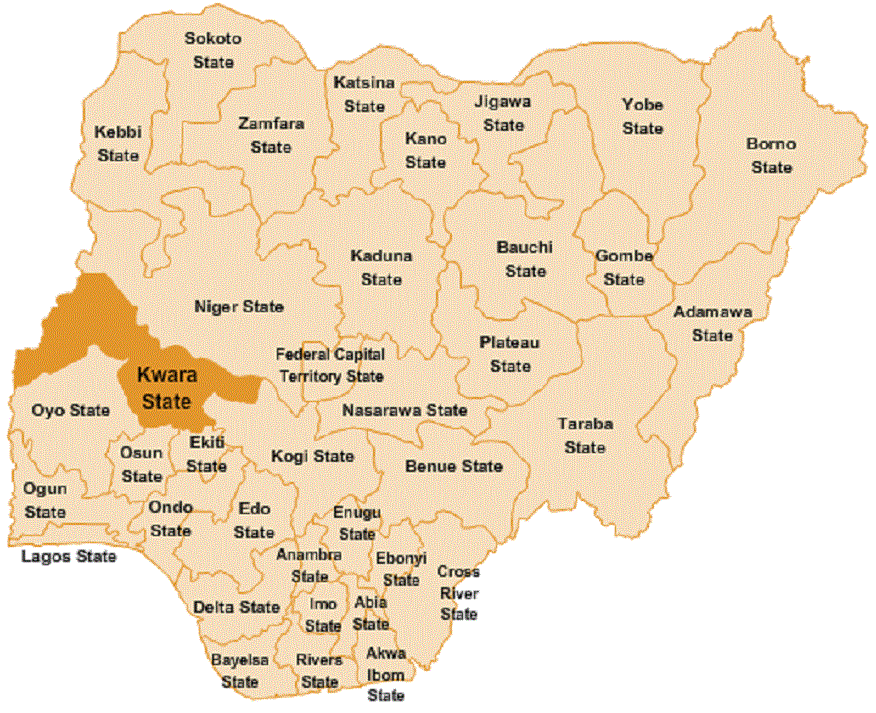
Benue bleeds again. A recent massacre in Yelewata village, where at least 100 to 150 lives were claimed, cast a shadow over headlines, but smothered the deeper truth of decades-long sorrow. As images flash across social media in real time, outrage erupts. But near-instant outrage often substitutes for understanding. And in Benue, where tragedy is almost normalised, such performative empathy does more harm than good.

A Land on Fire, not for the First Time. This is not a one-off disaster. The roots go deep:

The 2001 Zaki‑Biam, where Nigerian soldiers massacred hundreds of Tiv civilians, razing villages in a brutal military reprisal, the 2016 Agatu Massacre, where more than 300, possibly up to 500, villagers were slaughtered during herders‑farmers clashes, leaving thousands displaced, the Odugbeho 2021, where suspected Fulani herders killed at least 40 residents in Agatu LGA, part of a continued wave of violence. In April 2022, over 25 were murdered in coordinated herder attacks on farming communities in Goma, up till this latest carnage, where victims were shot and burned in their homes, echoing a tragic pattern.

Between 2015 and March 2023 alone, 5,138 lives were lost across Benue in herder‑farmer attacks. Under President Buhari’s term, Benue became a killing field; 6,000 killed, 2 million displaced. The Humanitarian Crisis has been ongoing under the surface of fleeting headline moments.

The tragedy is not fodder for political stunts. The moment a video goes online, hashtags spiral: blaming the President, vilifying the government, and stirring political gain. But very few pause to ask: who suffers most in these cycles of condemnation? The dead do not return. The displaced families do not reclaim their farms. The real loss is in our silence, our unwillingness to grasp the whole before pointing fingers. Yes, government leaders, state and federal, bear responsibility.

The 2017 anti‑open grazing law in Benue was well-meaning. However, it remains a paper tiger: characterised by uneven enforcement, a lack of ranches, and feeble federal support. President Tinubu’s speeches and increased defence budgets amount to little on the ground when arms still flow, and security forces remain under-resourced. And when political opponents oversimplify the conflict as mere religious persecution or ethnic cleansing, nuance is lost.

At the heart of all these disputes is a struggle over scarce resources, including land, water, and natural resources, as well as grazing routes, which is exacerbated by climate change. Historically, grazing corridors existed. However, escalating population growth, farmland encroachment, and desertification have reduced these spaces. Compounding this: centuries-old migration, religious and ethnic tensions, cattle rustling, and political exclusion of Fulani groups. Each side bears accumulated grievances; farmers over burnt crops, herders over stolen cattle.

This is fundamentally communal, not merely political. Solutions must be rooted in non‑kinetic, non‑violent engagement. Dialogue tables must sit Fulani herders alongside Tiv farmers and local officials. Traditional leaders, ranchers, security services, and federal authorities must all negotiate a win-win framework, including grazing reserves, clear land-use maps, property rights enforcement, and swift justice for perpetrators. Yes, bring the perpetrators to book. Those profiting from killing, whether herders or cartels supplying arms, must face speedy consequences. However, we cannot rely solely on force. We need intelligence systems, community policing, and legal reform. We need peaceful co-management of land and water.

It’s time for Nigerians to shift from hashtag empathy to hard-won solidarity. Unleashing threads of blame on social media while clicking “share” does little for grieving widows or orphaned children. 

Recording a burn-out home instead of rescuing a trapped neighbor is the hallmark of a self‑absorbed age. 

Public discourse must evolve from political opportunism to intellectual empathy. From performance to purpose. When presidents speak, let’s demand substance: “Where are the ranches? Where is land‑use reform? Who funds security at the village level?”

We demand action, but not at the cost of conscience. We must hold leaders accountable while still listening. Civil society must stop yelling into empty rooms, and start negotiating into full ones.

A practical roadmap might include;

Reviving grazing reserves with clear boundaries, monitored jointly by local farmers and herders, enforcement of anti-grazing laws, backed with ranching incentives and federal support, swift prosecution of killers, with community courts supported by federal justice, strengthening local security, with trained village vigilantes under lawful guidelines. Climate adaptation, planting trees, building dams, restoring soil to reduce migration pressure, and, more importantly, promoting inter‑communal peace‑building through youth exchanges, shared markets, and local councils.

If Nigeria continues to allow Benue’s blood to stain its conscience, we’ll face another generation hardened by loss, distrust, and rage. A country that waits for television headlines before honouring its fallen has already forgotten them. Benue’s suffering needs more than outrage; it needs us: grounded, knowledgeable, purposeful. We must reject hollow political theatre and demand real solutions. Because beneath the noise and the blood, lies an entire community crying for justice, and silence is not an option.

Oladoja M.O writes from Abuja and can be reached at: mayokunmark@gmail.com.

Feared bandit leader Yellow Danbokkolo dies from injuries after clash with security forces

By Muhammad Abubakar

Yellow Danbokkolo, the notorious bandit kingpin long feared across eastern Sokoto and parts of Zamfara State, has died from injuries sustained during a fierce confrontation with Nigerian security forces last week.

His death was confirmed by Abdulaziz Abdulaziz, Senior Special Assistant to President Bola Ahmed Tinubu on Print Media, via a post on his verified social media account. According to Abdulaziz, Danbokkolo succumbed to his wounds on Sunday.

Danbokkolo, widely considered even more dangerous than the infamous Bello Turji, was linked to numerous deadly attacks in the region. He was the mastermind of the gruesome December 2021 arson attack in Shinkafi, Zamfara State, where dozens of travellers were burned alive.

Security sources say the bandit leader’s reign of terror was sustained by a chronic addiction to pentazocine, a powerful opioid, which he reportedly abused in heavy doses.

Residents of the affected communities have expressed relief at the news, hoping it marks a turning point in the fight against rural banditry in Nigeria’s northwest.

The persecution of Hausa people in Nigeria must stop

By Salisu Uba Kofar Wambai

The safety and dignity of Hausa people in Nigeria are increasingly under threat. The recent spate of brutal killings targeting innocent Hausa travellers across various regions of the country is both alarming and unacceptable. 

Disturbingly, the North Central and Southern parts of Nigeria, in particular, are turning into graveyards for members of the Hausa community, despite the hospitality and freedom non-indigenes continue to enjoy in Hausa land—where people from across the country have settled peacefully, enjoying all rights guaranteed under the Nigerian Constitution, including freedom of movement and residence.

The recent killing of two Hausa tanker drivers in the South-East came as a shock. They were attacked and butchered while trying to repair their broken-down vehicle. Similarly, the horrific massacre of Hausa hunters in an incident that sent shockwaves across Nigeria and beyond speaks volumes about the rising hostility against the Hausa community.

Equally tragic was the killing of Hausa travellers in Plateau State who were on their way to honour a wedding invitation. Their brutal slaughter reflects the growing dehumanisation of Hausa people, treated like cockroaches in a country they call home. In Benue State, two sons of renowned Islamic scholar, Malam Ibrahim Khalil, were also gruesomely murdered, as though their lives meant nothing.

These atrocities raise serious questions: Are we to fold our arms while our people are slaughtered day after day? Where are our political leaders? Where are the Hausa individuals within the security and intelligence networks? Is silence the best they can offer? Or is the Hausa community being pushed to a point where it might be forced to retaliate?

This alarming trend must not be ignored. The examples highlighted are only a fraction of the broader pattern of persecution being endured by Hausa people across the country. Despite being one of the most accommodating and detribalized ethnic groups in Nigeria, the Hausa are being pushed to the wall—and if this continues, the unity of the Nigerian federation could be at serious risk.

Urgent action is required. These barbaric attacks must stop, and those responsible must be brought to justice. The time to act is now.

The killing of Zaria travellers: A wake-up call to our failing conscience

By Muhammad Umar Shehu 

I read with deep shock and sorrow about the gruesome murder of innocent travellers from Basawa in Zaria LGA of Kaduna State. It is heartbreaking and disturbing. 

What is happening to our society? When did we become so heartless that taking a human life no longer moves us? When did we start watching these tragedies unfold without reacting, without speaking, without demanding justice? This is not normal. We are clearly losing our sense of humanity and conscience.

The killing of these travellers is wicked, and it must be condemned in the strongest terms. No matter the excuse, mob action is mob action. Whether it happens in Plateau, Uromi, Kaduna, or anywhere else, it is lawlessness. It is cruel. And it has no place in any society that wants to grow, that wants peace, that wants justice. The moment we begin to justify the unjustifiable, we open the door to more bloodshed and deeper division.

The Federal Government, Plateau and Kaduna State Governments, security agencies, traditional rulers, religious leaders, and all other concerned stakeholders must rise to the occasion. This crime must not go unpunished. It is not enough to issue statements. Action must follow. Those behind this evil must be arrested, investigated properly, and brought to justice. That is the only way this act can serve as a warning to others. We cannot continue to act as if all is well when innocent lives are being wasted with no consequences.

It is painful to admit, but we have become a society where people record killings with their phones instead of stepping in to stop the madness. Where is our sense of community? Where is our compassion? The silence and indifference from many quarters are just as dangerous as the violence itself. We must speak up, we must act, and we must demand better from those who claim to lead and protect us.

The media, civil society, and the public must not let this incident be buried under the weight of the next trending story. These lives mattered, and these families deserve answers. We must keep the pressure on until justice is served. A society that fails to protect the innocent will one day be a danger to everyone, including those who look away.

May the Almighty Allah forgive the victims, grant them eternal peace, and give their families the strength to bear this painful loss. And may we, as a people, wake up before it is too late.

Muhammad Umar Shehu is a writer and social commentator from Gombe and can be reached via umarmuhammadshehu2@gmail.com.

NFSS commends Bauchi operatives, urges integration for improved security

By Uzair Adam 

The Nigerian Forest Security Service (NFSS) has called on state governments to integrate its command structures into existing security frameworks to strengthen the fight against crime across the country.

The call was made as the Deputy Commander-General (Intelligence), Dr. John Metchie, praised NFSS operatives in Bauchi for their bravery and dedication in curbing criminal activities in the state. 

He also appealed to Nigerians to refrain from stereotyping the Fulani community as inherently violent, pointing out that many of the security challenges are caused by foreign herders entering through Nigeria’s porous borders.

Also speaking, the Assistant Commander-General (Operations), Umar Aliu, revealed that the government has remained supportive of the service by consistently paying salaries to over 800 personnel. 

He added that there is an insurance policy in place, providing N5 million to the families of operatives who lose their lives in the line of duty.

Aliu further disclosed that the state governor has approved the recruitment of 2,000 new operatives and provided vehicles, motorcycles, and allowances to bolster their operations.

Wave of carnage in Plateau leaves 41 dead, many homes destroyed

By Muhammad Abubakar

A wave of violent attacks across Plateau State over the past week has claimed the lives of at least 41 people, with dozens more reportedly wounded, local sources and security officials have confirmed.

In what residents describe as a series of coordinated assaults, a total of 96 homes were set ablaze in several communities, displacing scores of families and raising fresh concerns over the escalating insecurity in the region.

The attacks, which spanned multiple local government areas, are believed to be part of ongoing communal clashes and reprisal violence that have plagued the state for years. Eyewitnesses recount harrowing scenes of gunfire, arson, and panic as armed assailants descended on their villages under the cover of darkness.

Authorities say security operatives have been deployed to the affected areas, but locals continue to express frustration over what they perceive as a slow or inadequate response to the violence.

While the Plateau State Government has condemned the attacks and promised to bring the perpetrators to justice, humanitarian agencies are calling for urgent relief efforts to support the growing number of displaced persons.

As of the time of this report, no group has officially claimed responsibility for the attacks. Investigations are ongoing.

We are ruled by commentators

By Oladoja M.O

A peculiar tragedy defines the Nigerian state—a complete surrender of responsibility by those elected to bear it, a full-blown case of irresponsibility institutionalised at the highest levels. It is as if we are not being led at all. It is as if we are simply being watched, pitied, and narrated to. Our so-called leaders behave like helpless spectators, not as those with the authority to fix the very problems they moan about.

Shamefully, Nigeria lacks leadership. Instead, it has men and women who love the microphone more than the mandate. We are not governed; we are narrated. Commentators rule us.

Just days ago, a State Governor resurfaced with yet another alarming statement: that Boko Haram has infiltrated the government. Again. This is not the first time he has said something like this. Several times, he has come out to decry the killings, to point fingers, to lament the destruction. And every single time, one question keeps hanging in the air. What exactly has he, as the Chief Security Officer of the state, done about it? What has he changed? What systems has he challenged? What heads have rolled under his watch? Where is the real action beyond the endless news appearances and emotional speeches? It is not enough to wear a bulletproof vest and take a stroll in a burned village. That is not leadership. That is performance.

I mean, this individual is not a social media activist. He is not a political analyst. Not a powerless citizen. He is not a sympathiser. He is a sitting governor, for goodness’ sake! He has the resources, influence, and intelligence at his disposal. If all he can do is complain, then he has failed. And that is the bitter truth. Or how did the weight of office shrink to the mere performance of sympathy and public outrage? Because, for all I know, leaders do not just point to problems. They solve them. They don’t weep when the house burns. They command the water. But what we see here is the opposite. 

It is as if holding public office in Nigeria has been reduced to a loud-speaking exercise. The governor speaks. The senators speak. The representatives hold press conferences. Everybody speaks. But nobody leads. They describe problems they were empowered to solve, like detached observers, rather than active change agents. It is nauseating. It is tragic. It is dangerous because this governor is just one symptom of a far deeper rot. 

Nigeria’s leadership structure is littered with voices that echo sorrow and rage without ever lifting a finger to stop the bleeding. The National Assembly, for instance, has become a festival of talkers. Lawmakers who go to the chambers not to legislate, but to lament. Some of them even act as if their job is to criticise the government when in fact, they are the government. You hear them talk on TV and wonder if they were mistakenly sworn into opposition. These are people elected to craft laws, drive policies, and oversee the executive. Instead, they pick microphones and begin to “express worry”, “condemn in strong terms”, and “call on the federal government”, as though they are not the federal government themselves. It is embarrassing. It is pathetic. It is a national disgrace that the loudest voices in power are often the most passive in a country so battered.

And the tragedy is even louder when we look at the so-called new breed. For instance, Peter Obi has earned some Nigerians’ admiration because they see in him a departure from the past. But in reality, he’s just the same recycled blaming and deflecting game-player. Recently, when asked about the internal crisis tearing through the Labour Party, a party he is seen as the head of, his response was a flat finger-pointing exercise. He explained who caused what and who did what. Zero sense of responsibility. No ownership, nor a plan to fix it. Is it hard to understand that leadership is not explaining the problem but solving it? What are we banking on if someone aspiring to govern 200 million people cannot manage internal party squabbles?

Being soft-spoken and throwing statistics around is not leadership. Nigerians need people who carry the weight of responsibility and act with urgency, not people who are always ready with talking points. 

This country is bleeding. Virtually every region, every sector, every institution is either hoping to set into recovery or picking up the pieces. From poverty to insecurity, from joblessness to healthcare collapse, from fuel inflation to decaying infrastructure, we are a nation gasping for air. And what do our leaders do? They gather at events and in press briefings to express sympathy. They talk. They hold conferences. They issue long tweets. And then they disappear. It is now a full-blown epidemic. Everyone in power wants to talk about the problem. No one wants to be responsible for the solution. They love the headlines. They love the interviews. But they vanish when it is time for hard decisions, bold reforms, and deep accountability.

This is not what leadership looks like. Leadership means bearing the burden of others. It means thinking, planning, executing, sweating, failing, trying again, and never passing the buck. But Nigerian leaders today see power as a shield from responsibility. To them, power is for glory, not for duty. It is for the title, not for toil. And we, the people, must also take some blame. Because time after time, we bring these same people back. We vote them in. We defend them. We hail them. We wash, rinse, and repackage them for another round of useless governance. It is insanity.

A time must come, and it should be now, when Nigerians wake up to the bitter reality that democracy today is mostly a circus—a time when we say it clearly and loudly: enough with all the empty noise. We do not want more commentators, glorified orators, or prophets of doom in positions of power.

We want leadership. Real, practical, accountable leadership.

If you are in the office, your job is not to narrate the problem. Your job is to change it. If you are the governor and your people are being killed, we expect action, not pity. If you are a senator and the economy is crashing, we expect reform, not press conferences. Don’t blame others if you are a party leader and your house is on fire. Fix it. Nigeria can no longer afford leaders who vanish when it matters most. We cannot survive another decade of commentators posing as commanders. The country is on the brink, and what we need now are not voices of complaint, but minds of action and hearts of steel.

Until that happens, let the records reflect it. We are not being led. We are being narrated to. And that is the greatest insult of all.

Oladoja M.O writes from Abuja and can be reached at: mayokunmark@gmail.com

April Fools? Not for Nigerians—A stark glimpse into security and anti-graft realities

By Haroon Aremu Abiodun

April is traditionally a month of pranks and laughter. But in Nigeria, the joke was on no one except, perhaps, on a nation whose security architecture is under siege from terrorists, bandits, and kidnappers.

Far from fearing our security operatives, criminal elements across the country displayed shocking audacity, reminding us that the battle for Nigeria’s soul remains bloody and unresolved.

In a horrific display of lawlessness, notorious bandit leader Bello Turji celebrated Eid in Sokoto by executing kidnapped victims, recording and broadcasting the gruesome act without fear of consequences. Across parts of Katsina, Kaduna, and Zamfara, bandits not only continued their reign of terror but have begun levying taxes and operating parallel governments in areas still supposedly under state control.

Compounding public anxiety, National Security Adviser Nuhu Ribadu made headlines when he advised families of kidnapped victims to “stop paying ransom.” While theoretically sound, the reality is far more brutal. Without swift and credible government intervention, desperate families have no option but to finance their tragedies. Until state forces can decisively rescue captives, this vicious cycle will continue.

In just one month, attacks escalated across Plateau, Kwara, and Benue States, leaving communities in mourning. Boko Haram and ISWAP insurgents resurfaced with deadly ambushes, signalling their continued relevance in Nigeria’s security equation.

April’s bloodshed has revealed operational lapses and a deep strategic and moral crisis. The Office of the National Security Adviser (ONSA) must urgently intensify efforts, especially by working discreetly with rescued victims to extract intelligence, boost surveillance systems, and dismantle criminal networks worldwide.

While commendable successes by security operatives, such as rescuing hostages and recovering illegal arms, were recorded, they were dwarfed by the scale of atrocities witnessed within just 30 days.

The Department of State Services (DSS), often criticised and even facing calls for disbandment, must seize this moment to redeem itself. Encouragingly, recent commendations from the Plateau State Government and Governor Uba Sani of Kaduna for the DSS’s contributions to curbing insecurity suggest a glimmer of institutional reliability. Their successful arrests of gunrunners and dismantling of kidnapping syndicates are steps in the right direction.

Notably, the DSS also intercepted a British Army Major in Delta State attempting to smuggle 50 AK-47 rifles and ammunition—a major bust, and a signal that the service can perform under pressure. Their ability to withstand calls for the suspect’s release further strengthens public confidence.

Going forward, DSS and ONSA must strengthen collaboration through real-time joint operations, intelligence sharing, and visible outcomes. The Nigerian Intelligence Agency (NIA) also must integrate its overseas capabilities with ONSA’s domestic strategies. Today’s criminals are sophisticated—our response must be smarter.

Beyond the battlefield, Nigeria’s fight against corruption also demands attention. The Economic and Financial Crimes Commission (EFCC) must intensify efforts with ongoing arrests of internet fraudsters and by pursuing justice in high-profile cases involving figures like Betta Edu and Sadiya Umar Farouq.

Regarding Aisha Achimugu’s case, the EFCC must adhere to due process and uphold its promise to act with diligence and integrity. Recent arrests, including that of Bauchi State Accountant General Sirajo Muhammad Jaja, show the commission is active, but visibility and transparency are critical.

Despite receiving accolades, such as the Government Spokesperson Award and the Courage in Justice and Transparency Award from the Nigerian Human Rights Community, EFCC must do more to recover funds stolen through schemes like CBEX. Collaborating with Interpol to dismantle international fraud networks and prevent future scams using forged EFCC certificates will reinforce the commission’s credibility locally and abroad.

Transparency is the only antidote to growing public cynicism about the Commission’s integrity.

The Independent Corrupt Practices and Other Related Offences Commission (ICPC), though laudably organising programs like its stakeholders’ meeting on accountability in local government, must now transition from talk to action. Corruption within Ministries, Departments, and Agencies (MDAs) remains rampant. A recent ICPC report showed that over 60% of corruption cases involved diverting healthcare funds—a scandal demanding decisive intervention.

April has ended, but the wounds it inflicted are still fresh. If we’ve learned anything, it is that the fear of the Nigerian state must be restored—not with hollow rhetoric, but through coordinated, courageous, and relentless action.

The enemies of Nigeria no longer fear our uniforms, our institutions, or the name “government.”

The time to act was yesterday. Today is already a dangerous gamble. Tomorrow may be too late.

Haroon Aremu Abiodun is a PRNigeria Fellow and author. He can be reached via exponentumera@gmail.com.

How I shook hands with a bandit leader and lived to spill the tea

By Abdulrahman Sani  

It started like any other routine assignment. A simple task in a place that, on paper, seemed no different from the others. I was sent to a remote village in the heart of the North West, tasked with completing an enumeration in a region that was increasingly known for its volatile security situation. But what I didn’t realise then was that this seemingly innocuous assignment would lead me straight into the heart of danger.

The village, Rugar Yashi, sat on the fringes of the wilderness, far from the usual path of most travellers. The journey had been long, but I arrived early enough to begin work without delay. The protocol for entering any enumeration area was clear. 

Before stepping foot into the village, I was to call my security contact to get a briefing, obtain clearance, and receive a pass that would ensure my safety. I dialled his number repeatedly, but there was no answer. I tried once more, but the line remained dead. Frustration rose within me, but it was quickly overshadowed by the realisation that I had no choice but to proceed.

I wasn’t new to the idea of security checks. Over time, I had come to view the process as a mere formality, a minor inconvenience in the grand scheme of things. Security clearance was just another uncomfortable routine, a small hurdle before getting to the heart of the work. The reality of how precarious the situation honestly was hadn’t fully sunk in. In my mind, it was just another remote village, no different from the countless others I had visited. Little did I know, I was about to step into the lion’s den.

The Village on the Edge of a Whisper

Rugar Yashi wasn’t on any tourist map. You wouldn’t stumble upon it unless you were sent there or running from something.

The place looked serene, almost cinematic. It was tucked neatly between rustling trees and the distant hum of wilderness. I walked in alone, unseen by the world, accompanied only by a curious blend of optimism and unawareness.

I didn’t meet him in the village.

I met him at a farm by accident.

He was tending to something near a stand of goruba trees. I greeted him and mentioned I needed a cutlass to slice through one of the fruits. Without hesitation, he handed me his.

It was only after I introduced myself, explaining why I had come and what I was doing, that he nodded and said simply,

“I’ll guide you.”

That was it.

No suspicion. No resistance. Just a quiet offer that, in hindsight, held far more weight than I realised.

And so we began.

He led. I followed.

At first, he was nothing more than a helpful local. His voice was calm, measured. He spoke sparingly, and when he did, it was often with a faint, unreadable smile. The villagers treated him with a mixture of casual reverence and respect. Nothing overt. Just the kind of nods, glances, and silences that said more than words ever could.

Of Questions and Rifles

As we walked through Rugar Yashi, I quickly noticed something odd. The men around us were armed. Their rifles glinted in the sun as they moved with deliberate ease. Their eyes darted around, scanning the horizon as if waiting for something—anything—out of the ordinary. Some of them offered brief nods of acknowledgement to my guide, a quiet understanding passing between them that I couldn’t quite place.

At first, I dismissed it. I assumed they were simply vigilantes, locals tasked with protecting their community. The village seemed peaceful. The people were humble. And my task was simple. What could go wrong?

We continued through the village, and I conducted my enumeration with the usual questions—family members, occupations, and living conditions. He knew exactly where to take me. At one point, I inquired about his family, which was part of the enumeration form. He smiled and said that his brother, Aliyu, was studying at ABU Zaria. I nodded and moved on.

It sounded plausible enough.

After the work was done, he walked me to the edge of the village where a group of armed men stood, exchanging hushed words and scanning the trees. As we passed, they gave us more than a passing glance. He shook my hand, gave me his contact information, and said casually,

“Call me next time before you come. It’s safer that way.”

I smiled, nodded, and walked away. The road back to the main track was quiet. Just a few goats, wind in the trees, and my own footsteps.

The Call

Then my phone rang.

It was the security contact I had been trying to reach all morning. His voice came through tense and unfiltered.

“Where are you?”

“Done. Just leaving Rugar Yashi.”

There was a pause, and then his voice dropped.

“Who did you work with?”

I gave a brief description. His voice turned sharp.

“That man you were with, Labbo Jauro? He’s one of the most notorious bandit leaders in the region. His brother isn’t at Zaria. He was killed months ago. Deep in the forests of Niger.”

Silence.

The kind that makes your spine go cold.

I had shared a blade with him and walked through the village under his protection. Sat beside him in quiet moments. All while unknowingly under the watchful eyes of armed men who could have changed the course of my story in an instant.

The glances. The nods. The stillness in the air. It all made sense now.

But at the time, I thought I was just doing my job.

Reflection on the Edge

Looking back, I wonder whether he knew what I didn’t. Whether he had already decided for me before I’d even finished cutting that goruba fruit. Or whether, by some strange twist of fate, I had walked straight into danger and was spared not by wisdom or caution, but by simple, Divine grace.

That day in Rugar, Yashi changed how I saw the work. It blurred the line between routine and risk. It reminded me that, sometimes, the man offering help in the fields may be more than just a friendly farmer.

Sometimes, he’s the one everyone else fears.

And sometimes, he’s the reason you make it back home alive.

Postscript: This story is based on a true account. The subject’s name has been omitted, and the narrative is told in the first person by the author. Specific details have been altered or excluded to protect privacy and ensure safety.

Abdulrahman Sani can be contacted via Twitter @philosopeace.

Security: The Nuhu Ribadu Formula

By Zayyad I. Muhammad 

Before the emergence of President Bola Ahmed Tinubu’s administration, Nigeria’s security architecture was grappling with deeply entrenched challenges, particularly in the Northwest and Southeast regions. The situation had deteriorated to alarming levels, with criminal elements and secessionist movements establishing a disturbing level of control in certain areas.

In the Northwest, banditry had evolved from sporadic attacks to the full-scale occupation of territories. Vast stretches of land, especially in states like Kaduna, Zamfara, and Niger, fell under the influence of heavily armed groups. The Abuja-Kaduna highway, which was once a vital economic and commuter route, became a perilous stretch, notorious for frequent kidnappings and ambushes. 

The Northwestern security threats extended further, with the Kaduna–Birnin Gwari–Lagos road effectively shut down due to sustained bandit activity. Even commercial life suffered significantly; the Birnin Gwari cattle market, a major hub for livestock trade, was forced to cease operations under the pressure of violence and extortion.

Meanwhile, in the Southeast, the situation was compounded by the secessionist agitation led by the Indigenous People of Biafra (IPOB). Through fear and coercion, IPOB succeeded in enforcing a weekly sit-at-home directive across several states in the region, paralysing economic activities every Monday. Businesses were shuttered, schools closed, and the freedom of movement was severely curtailed, undermining both governance and development efforts.

This was the grim reality that the Tinubu administration inherited. However, at the heart of the renewed fight against insecurity stands a strategic recalibration: what many now refer to as the “Nuhu Ribadu Formula.” As National Security Adviser, Ribadu brought a fresh, intelligence-driven approach to tackling Nigeria’s security woes. With an emphasis on coordination among security agencies, restoration of public confidence, and targeted offensives against criminal enclaves, his methods have begun yielding tangible results.

While challenges persist, especially in remote and hard-to-reach areas, the difference in tone and trajectory is becoming increasingly evident. The Ribadu-led security strategy has not only focused on reclaiming territory but also on addressing the root causes of unrest, be it poverty, weak governance, or community grievances. It is this multidimensional and proactive approach that may well define Nigeria’s path to lasting peace and stability.

Mallam Nuhu Ribadu, the National Security Adviser, has been pivotal in reshaping Nigeria’s national security framework through a clear and strategic vision built on three foundational pillars.

The first is the carrot-and-stick approach, which balances kinetic (military force) and non-kinetic (dialogue, reconciliation, and development) strategies. This dual-pronged approach acknowledges that not all security threats can be addressed solely through force. By combining targeted military operations with community engagement and deradicalisation efforts, the approach aims to neutralise threats while addressing the root causes of violence.

The second strategy is a shift from rhetoric to action, a deliberate move away from endless briefings and political grandstanding towards concrete, measurable outcomes. Under Ribadu’s watch, security interventions are now judged not by promises, but by performance. The focus is on restoring peace, reclaiming lost territories, and enabling displaced persons to return to their communities.

Third is the promotion of synergy and intelligence sharing among security agencies. Previously plagued by inter-agency rivalry and fragmented operations, Nigeria’s security forces are now operating with improved coordination. Through unified command structures and shared intelligence platforms, responses have become faster, more precise, and increasingly proactive.

These strategies have already begun to yield visible results. The recent resurgence of attacks in Plateau and Benue States, as well as isolated Boko Haram assaults on soft targets in Borno and Adamawa, were swiftly countered using the same framework. Rapid deployment of forces, community-based intelligence, and coordinated operations prevented escalation and restored calm.

Still, the road to full recovery is a gradual one. While the machinery of state security has been retooled, the average citizen may not immediately perceive these gains. Part of the challenge lies in the persistence of outdated or unverified reports in some sections of the media, which can paint a distorted picture of the current realities. Nevertheless, those on the ground, especially in previously hard-hit areas, are beginning to sense a shift.

The “Nuhu Ribadu Formula” is proving to be more than just a tactical adjustment; it is an evolving doctrine that prioritises effectiveness, accountability, and collaboration. With sustained implementation and public support, it could well become the blueprint for enduring peace in Nigeria.

Zayyad I. Muhammad writes from Abuja, zaymohd@yahoo.com.