Gbajabiamila, an exemplary leader
By Samson Kefas Galadima
Everyone can claim to be a leader, but not everyone is an effective leader. Therefore, it is time to separate the wheat from the chaff.
People who know me very well can attest that I rarely write for politicians or people who hold public office. This is because of the preconceived notions I have about Nigerian politicians. Before now, I believed Nigerian politicians were corrupt people who share the national cake at the centre and corner while they desert their constituents. My perception has been that way right from my childhood. The reason for that cannot be far-fetched from what I see every dawn of a new day where politicians make empty promises and never keep them. Instead, they fly to Dubai or the UK for recess while the people they govern face social unrest, poverty, and even religious divisions when the nation is facing problems of national concern.
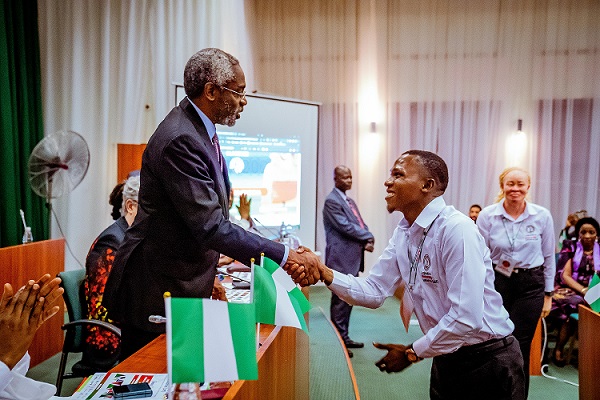
However, in the last five weeks, my generalization about some of the Nigerian politicians began to take a radical paradigm shift when I got selected to participate in the Legislative Mentorship Initiative (LMI), the brainchild of the Speaker of the 9th House of Representatives Rt. Hon. Femi Gbajabiamila. The Legislative Mentorship initiative is a special program that seeks to identify, train, and equip a younger generation of ethical public sector leaders. In addition, the program seeks to deliberately, intentionally, and consistently groom the successor generation of public sector leaders, especially legislators, to possess and demonstrate deep values of character, competence, and capacity, which would later or sooner improve governance efficiency in our country.
During the last five weeks, other 73 fellows from across the 36 States of the federation and the FCT and I had engaging moments with Mr Speaker during what we tagged as “The Mentor-Exchange (MentX)”, where the Speaker shared with us his 20 years of wealth of experience working as a Legislator, the story of his humble beginning, the challenges and how he was elected as the Speaker of the 9th House of Representatives, Federal Republic of Nigeria. It was indeed such a revealing and inspiring moment.
In addition to the awe-inspiring delivery of his speech which was graced with ease, his humility captured my heart, leaving me begging for more of his presence. When asked about effective leadership, he said, “Leadership is about sacrifice and sometimes the kind of sacrifice you would not imagine that you would want to make; it is the kind of sacrifice that hits you to the marrow.’’ Sometimes you would have to bury your interest to consider others, but above all, national interest should be what drives you at the end of the day, he added.
When speaking of humility, Rt. Hon. Femi said, “Being the Speaker of the 9th House of Representatives, I don’t see the 359 Honourable Members as subordinates. Instead, I see them as colleagues and myself as the first among equals.
Gbajabiamila is a visionary leader who sees beyond his nose. I can attest to this through the aides he is working with and the investments he is making in the lives of young people in his constituency. This is also true for Nigeria, by extension. For instance, the Legislative Mentorship Initiative (LMI), which he founded and I am proud and privileged to be part of the inaugural cohort, is doing a fantastic job of sharpening the minds and visions of young people. He believes nation-building is a joint task that cannot be completed without the youth, and so is the task of building tomorrow’s leaders. No wonder the LMI’s motto is ‘…building the next generation of Nigeria’s public sector leaders.’
Another quality I admire in Gbajabiamila’s life is his vulnerability as a leader. For instance, recall sometime in July this year, the Speaker on his verified Twitter page posted pictures of himself in a classroom at Harvard School of Government in the US at a time public universities in Nigeria had been shut down for about six months at that time, Mr Speaker after widespread backlash on social media apologized to Nigerians for the insensitive post.
In his words, he wrote, “Yesterday, I posted a picture of myself at the @Harvard@Kennedy_School undergoing a course. That post was not sensitive to the present feelings of fellow citizens, especially parents and students who are presently bearing the brunt of the ongoing closure of public universities owing to the unresolved issues between the Academic Staff Union of Universities and the Federal Government of Nigeria. I apologize for the post at this time, and I hope you will understand that it was not my intention to cause disaffection.’’ Mr Speaker’s ability to accept that he was wrong when being criticized made him an exceptional leader. Unfortunately, this quality is lacking in many of Nigeria’s politicians and public servants. A significant number of them see vulnerability as a sign of weakness and not strength.
With the contributions of Mr Speaker and other well-meaning Nigerians, a new Nigeria is possible. As I draw closer to a conclusion, I want to thank you, Mr Speaker, for never saying no to your responsibilities. In this way, Mr Speaker, you have won over another ardent supporter of accountability who will appreciate you where you deserve to be appreciated. I will provide constructive criticism and positive feedback where necessary as I share your core values of accountability, inclusivity, and effective governance. Thank you, Mr Speaker, for being an exemplary leader that makes a difference.
Samson Kefas Galadima is a writer from Gombe State and a Fellow of the Legislative Mentorship Initiative (LMI). He can be reached at kefsammy@gmail.com.