Hausa Films

Days of Future Past: Creativity, Technology and Challenges of Film Policy in Kano (II)

By Prof. Abdalla Uba Adamu

Being a keynote at the Kannywood Foundation film training workshop, on 2nd October 2022, Kano

Opportunities of Digital Technology

By 2012 the Hausa film industry has entered into the doldrums I have just described. There was a lot of head-scratching about the next moves. In the meantime, many individuals had formed YouTube channels and were uploading Hausa films with or without the knowledge and consent of the producers. Most of the films were old and were subscribed by internet newbies who had just acquired Smartphones and taking advantage of the cut-throat competition among Nigeria’s main service provers (MTN, 9Mobile, Airtel, Glo) were buying data and watching films on their phones. The DVD and CD players faded away, and although kids were still selling what were clearly outdated CDs at traffic junctions in the city of Kano, the process of watching free films on YouTube made the CD market non-viable. Then Arewa24 came along.

An initiative of the US Government, Arewa24 was part of the anti-terror and anti-radicalization program of the US State Department’s Bureau of Counterterrorism. The task was contracted to Equal Access International (EAI), which eventually established Arewa24, the first Hausa language satellite station rooted in peacebuilding and entertainment, in 2013. One of the ways the station revolutionized Hausa cinema – and thus succeeded beyond its expectations was the introduction of TV shows, hitherto a neglected entertainment segment in Hausa cinema. Broken into seasons and episodes, the first TV show on Arewa24 was Daɗin Kowa, a weekly drama about a melting pot city somewhere in the north of Nigeria containing a diversity of ethnicities, religions, languages and social classes. Of course, there are actual Daɗin Kowa settlements in Gombe and Kaduna State, but that did not deter the Series filmmakers. It was massively successful on multiple fronts.

First, it deconstructed the then-current Hausa cinema based on Hindi cinema with a lot of choreographed singing and dancing as well as romantic storylines, which was tiring to Hausa audiences. Second, it reconstructs Hausa TV shows of the 1970s, so beloved by cultural purists of Hausa storytelling. Third, as VOD (video on demand), Arewa24’s Daɗin Kowa blazed a new digital trail in film marketing for Hausa filmmakers. Being heavily subsidized, the producers can afford to load the entire series on an easily available platform of YouTube.

Yet, the second TV show on Arewa24, interestingly, was by an independent studio, Saira Movies, and the series was Labarina, made a year before Arewa24 took off in 2015. The novelty of Labarina as a series had a massive impact on online viewing of Hausa communities. Armed with Smartphones and cheap data from competing ISPs, millions tuned to Arewa24 to watch the series and later download it when it shifted to YouTube. It was the success of Labarina as a TV show that provided a backstory to the audience receptivity of Daɗin Kowa.

YouTube is an American online video sharing and social media platform headquartered in San Bruno, California. It was launched in 2005 and has become the main avenue for African cinema distribution. It is important to emphasize its American roots and origins to draw attention to the fact that the censorship regulations in any country do not apply to it. The Google-owned video service is also a major tool for self-distribution, as illustrated by the proliferation of web series in local languages in countries such as Ethiopia, Kenya, Rwanda, Senegal and Nigeria.

Kano filmmakers were quick to jump on the TV show bandwagon by cloning the success of Daɗin Kowa as a series broken up into episodes. Not only are the story arcs captivating, but they also provide a deeper script philosophy that is often critical analysis of the anthropology of contemporary Hausa societies. Although coming earlier than Labarina, Daɗin Kowa was more successful than Labarina, which was based on basically Bollywood soap operas. Daɗin Kowa was an authentic reflection of the contemporary realities of Hausa communities.

Other YouTube channels quickly followed. Table 1 shows a few of the channels and their overall viewership.

S/NSeriesChannelSubscribersDateChannel Views
 Izzar SoBakori TV969,0002014119,764,682
 Kwana Casa’inArewa24469,000201484,222,468
 LabarinaSaira Movies468,000201348,726,390
 AduniyaZinariya TV413,000201838,632,116

Bakori TV, which hosts Izzar So, has the highest number of channel views followed by Arewa24, then Saira Movies and Zinariya. These metrics, as indicated, reflect the overall channel views rather than the series – but provide an idea of the popularity of the series hosted by the channels.

Izzar So is a very popular TV show, judging by the audience metrics of each episode. Yet it was hard to determine its overall playlist metrics on YouTube. This was because the channel is so poorly organized that it does not even shift its individual episodes into an effective Playlist grouping. The channel has only two Izzar So playlists; Season 1 with 13 videos and Season 2 with 3. This, of course, is inaccurate since in the main listing of videos, the Channel listed episode 100 in the series at the end of September 2022, although it is unclear which season it was. The average views for the latter episodes are slightly over one million. Even their Facebook page does not promote the series in the light of providing information about the series, the stars or the stories.

Similarly, while Aduniya has a playlist, it only listed 33 videos in the list, whereas the list of videos with the episodes has the latest episode being number 73 with over half-million views. Labarina did not fare much better, with three playlists listing less than 30 episodes, when Season 5 EP1 was released in late September 2022.

While most of the TV shows streaming on either Hausa VOD or YouTube are romantic soap operas, Aduniya stood out because of its focus on the gritty urban life of a Kano city – exposing what I call ‘corruption from below’. It competes only with Daɗin Kowa but surpasses it in its presentation of the harsh, tough and ruthless social culture that operates below the radar of public spaces.

It is clear, therefore, that Hausa filmmakers are gradually favouring the TV show format, but their lack of digital skills to effectively present the contents limits their appeal. Further, with millions of views, the TV show filmmakers have not been able to provide adequate information on either the series or the synopsis of the episodes anywhere on a dedicated website (for which there is none, except Arewa24) or even Wikipedia entry.

Besides the challenges of poor digital marketing skills of the TV shows, filmmakers in Kano also faced the problems of censorship from the Kano State Censorship Board. In a bizarre revenue-driven focus, the Kano State Censorship Board demands that TV show series must be submitted to it for censoring before being uploaded to YouTube. Yet the servers are not based in Kano nor under Nigerian government control, so it is difficult to see how the Board will have authority over the contents on a server located in California.

Towards a Cultural Film Policy

The key objectives of film policy are to promote new artists, create new jobs, increase investments in film production, attract foreign producers and enhance the outward-looking character of Hausa cinema. So far, the only film policy available in the country is the policy of regulation from both the National Film and Video Censors Board (NFVCB) for the nation and the Kano State Censorship Board for Kano State.

The regulatory focus of these bodies was to ensure cultural specificity in film production in whatever language it is produced. The usual focus was on avoidance of foul language, nudity, and reproducible behaviour, especially for impressionable viewers and religious sensitivity. It would appear, therefore, that any policy would have to revolve around the cultural and religious frameworks of the audiences.

This issue had been a sore point with Hausa filmmakers right from the halcyon days of the industry from 1998 till its eclipse in 2007. Market-driven Hausa filmmakers are focused on commercial rather than an artistic success. Arthouse films like Kazar Sayan Baki, and Ibtila’i, did not sell because they had no commercial motifs of singing and dancing. And once the studio feels it is not selling enough to remain afloat, it simply closes shop and moves to selling essential commodities.

This is where the Kannywood Foundation comes in. A training program such as this will pave the way to the future after emerging from a cloudy and rocky past. I will not presume to give a policy here because it is a group effort. However, while thinking about the policy directions of Hausa cinema, the following might be points to ponder:

  1. Move away from commercialization to professionalization. Other professions include specific, targeted and focused entry points and exits. You don’t wake up one day and claim to be a doctor. One has to go through a rigorous process of certification. This should be the same with the film industry. It is not to say, ‘I am creative, and I have money’. You have to demonstrate competency since what you do is representation.
  2. Seeking storylines in community arcs. A policy should demote the idea of transnational copying of films that focus on blindly copying Indian or Western films. It should focus on the anthropology of our experiences – of which there are myriad ways of getting story arcs. A policy can, therefore, effectively reward those ethnographically based films, through additional funding, rather than ineffective ‘film awards’, most of which were bought by the filmmakers
  3. Any training program that would be part of a policy should include cultural studies. Scriptwriters, directors, actors and production designers must know what constitutes public culture – beyond what they experience. They need to be aware of it from the structural perspective of a research process. Production designs, therefore, must be not only accurate enough to the period being recorded but also aesthetic enough to convey a sense of elegance and pride in cultural tradition
  4. A greater focus of the policy and training should be on digital marketing. It is not enough to simply open a YouTube channel and upload films. Practitioners need to be aware of how to drive traffic to their channels and organize their content in a structured and easily accessible form.
  5. Reaching out to the larger world. While it is pleasing that many Hausa TV shows are now flooding YouTube, most have no subtitles in an international language that will communicate to international audiences. This is clearly a misuse of the social media platform – where although open to the world, Hausa TV shows are restricted to Hausa audiences. If there is anything to copy from Hindi cinema, it should be its marketing strategy. With their subtitles, their films are seen and accepted as cultural products worldwide – for language is the best representation of culture.
  6. Careful attention must be given to Hausa VOD services, particularly Northflix and Kallo. While still in their early stages, these VOD streaming services effectively show the way to the future.

Cultural commodities – whether tourism-related or popular culture – are marketed with the assumptions of their impact on the daily lives of their consumers. Marketing determines the success of especially media industries, often with a disregard for the content. The commodification of the Hausa popular cultural industries was premised on profitability motives, not art or aesthetics. Financiers are ready to continue investing in the industries as long as they can make effective profits. It is this profit motive that commoditizes art and elegance to common supermarket products with a short shelf life.

Prof. Abdalla Uba Adamu wrote from the Department of Information and Media Studies, Bayero University Kano, Nigeria. He is, among many other things, the former Vice-Chancellor of the National Open University of Nigeria (NOUN). He can be reached via auadamu@yahoo.com.

Days of Future Past: Creativity, technology and challenges of film policy in Kano (I)

By Prof. Abdalla Uba Adamu

Being a keynote at the Kannywood Foundation film training workshop, on 2nd October 2022, Kano

A Tale of Two Cinemas

In November 2007, I was privileged to participate at the African Film Conference held at the University of Illinois, Urbana-Champaign, United States. It was a stellar gathering of what I call the ‘Nollywood Mafia’. The outcome of the conference was reflected in the publishing of selected papers in Viewing African cinema in the twenty-first century: FESCAPO art films and the Nollywood video revolution, published by the Ohio University Press in 2007. At the tail-end of the conference, a session called The SIU Nollywood Project Brainstorming was held on Sunday, 11th November 2007. Containing well-known Nollywood scholars such as Jonathan Haynes and Onookome Okome, as well as Nollywood stars such as Joke Silver, Francis Onwochei and Madu Chikwendu, among others (including those who study Nollywood from the fringes such as Brian Larkin and Birgit Meyer), the session sought to determine funding for research on Nollywood from the US National Endowment for the Humanities. A critical point of discussion during the session was the name ‘Nollywood’.

While discussions were on course for the funding mechanism, there was a feeling from the participants that the term Nollywood should be used to reflect all films from Africa, regardless of region, to create a unified view of African cinema. As the only northern Nigerian with a focus (and paper earlier presented) on Hausa cinema, I objected and spent time arguing why the term Nollywood cannot be used as a blanket term for African cinema. Continentally, films from north Africa from Egypt, Tunisia, Morocco, Algeria and Mauritania are radically different from those produced by Nigerian Nollywood. Similarly, filmmakers from Chad, Burkina Faso, Senegal Cote d’Ivoire are more ethnographic to their cultures, which makes them required viewing for film and cultural studies across the world.

Even back in Nigeria, there is a radical difference between Hausa language cinema and the type of films produced and promoted by Nollywood. Labelling all African films as Nollywood is to cancel the identity of the portrayals of the films by different cultural groupings in the continent and project Nollywood as the only ‘African voice’. I am unsure whether the funding was obtained, but I know that the idea of labelling all African films as ‘Nollywood,’ regardless of cultural point of origin, was dropped.

***

By 2012 the Hausa film industry had literally crashed. The major marketers-cum-producers had all pulled out of the industry. Their shops in the major video markets in Kano were subsequently filled with clothing—particularly blouses and football jerseys; for these make more money than selling films. Others took to selling Smartphone accessories, while others returned to the farm and became serious farmers. The few Hausa megastar actors took to commercial advertising of noodles, milk and other household commodities – often moving from house to house with products’ marketers – relying on their faces and voices (making sure they introduce themselves in all the commercial jingles) to sell to increasingly hungry population caught in the vortex of economic depression. The frequency of releasing films drastically dropped because no one was buying. International Satellite channels like the Indian Zee World, especially their English-dubbed TV series, caught Hausa urban attention more than recycled Hindi film clones that were the hallmarks of Hausa video films. Consequently, many reasons combine to lead to the crash of the Hausa film industry towards the end of 2016. 

Market congestion

The popular cultural industries in Kano were marketed into market hubs. The Bata market at the edge of Sabon Gari controlled the predominantly foreign films and music sales and the main distribution centre to other parts of Nigeria and Africa, where a sizeable market existed in Niger, Burkina Faso, Ghana, Togo, Cameroon, Chad and Congos.

When the Hausa video film arrived in 1990, it found a ready template to attach itself. The other was Kasuwar Ƙofar Wambai, located at the edge of the walls of Kano city and near a cluster of old colonial cinemas. The Wambai market focuses mainly on leather, textile and plastics. However, it was also the hub of audio tape sales – with marketers doing brisk business pirating old EMI, Polydor and HMV tapes of traditional Hausa musicians recorded in the 1960s. Road construction work at Bata in about 2003 created unfavourable conditions for many of the stall owners, and some decided to shift to the Wambai market. By 2005 the video film market had moved entirely to Wambai, which now became the new Bata.

The Wambai market, hitherto occupied by cassette dealers who ignored the Hausa film industry, suddenly became a virgin territory for film marketers and producers, with each opening a stall. In less than five years, it had reached its ascendency and crashed due to the massive congestion of producers and marketers – all selling the same thing. When I visited the market in May 2017, I counted less than ten stalls selling either videos or audio; contrasted to some five years ago when it was bursting at the seams with these products. The stalls have now been taken over by stocks of cheap blouses, football jerseys and cloned Smartphone accessories.

Lack of new or captivating scripts

By 2005 the Hausa video film industry had become fully established, with over 1,600 officially censored releases. With an extremely few exceptions of less than 0.5%, they all revolve around a pastiche of Hindi films in one form or other aimed, as the video filmmakers themselves kept insisting, at urban Hausa children, youth and housewives. Yet, most Hindi films could be classified as musicals, especially due to their reliance on a strong dosage of song and dance sequences blended with a melodramatic storyline, which employs formulaic ingredients such as star-crossed lovers and angry parents, love triangles, corrupt politicians, kidnappers, conniving villains, courtesans with hearts of gold, long-lost relatives and siblings separated by fate, dramatic reversals of fortune, and convenient coincidences.

This stylistic technique provides a vehicle for echoing a fundamental Hausa emotional tapestry in three main creative motifs: auren dole (forced marriage, the love triangle, and the obligatory song and dance sequences—with an average of about six songs in a two-part video. With every producer trying to outwit everyone with more love triangles, song and dance routines, the market became saturated, and audiences got bored – and indicated this by refusing to buy the films.

Monopoly by Megastars

Those actors lucky enough to be accepted early enough in the film industry came to dominate the system. This was actually imposed by the marketers who insisted on a particular actor appearing in a film they would sponsor or market because such actors were more bankable and guaranteed quick sales of their films. With this economic force behind them, such few (perhaps less than five) came to dominate almost every ‘big’ budget Hausa film. By 2017 their stars had started fading; audiences became tired of seeing them in nearly the same film with different names, and marketers dropped them. While still making films, they diversified their faces and voices to commercial advertising for major telephone service providers and essential commodities such as chicken noodles and milk and soup seasoning.

The fading of the fortunes of the megastars became evident with the ascendency and popularity of relatively unknown stars of a TV series, Daɗin Kowa, shown on Arewa24 satellite TV that began on 21st January 2015. Daɗin Kowa (pleasant to everyone) is an imaginary town that serves as a melting pot, housing Nigerians of various ethnicities and religions and yet living peacefully. In 2016 it won Africa Magic Awards over Sarki Jatau, an expensive lavish, traditionally cultural Hausa period drama.

The coming of Arewa24, initially conceived and funded by the United States State Department’s Bureau of Counterterrorism to counteract insurgency in 2014, merely placed another nail in the coffin of the Hausa video film market. Transnational in its outlook, the Arewa24 TV series provide a level of script sophistication unheard of in the Hausa film industry. Other Satellite TV stations, such as StarTimes, and Hausa Channels on Africa Magic DStv, including GoTV, became increasingly affordable. Showing a massive amount of Hausa films, they eclipsed the purchase of CDs and DVDs of Hausa films. Audiences prefer to watch for free than to go through the hassle of purchasing DVDs that often do not work and requiring DVD players, mostly Chinese knock-offs of international brands that often turn out dodgy.

New Media, New Poverty

The Internet provided the biggest blow to the decline of Hausa video films. With telecommunication companies competing for customers and undercutting each other in offering data plans, Hausa youth have more access to social media sites such as Instagram and YouTube. The latter, in particular, provided them with opportunities to upload hundreds of Hausa films for all to see. While this has increased the visibility of Hausa films worldwide, such popularity does not translate to return on investment, as most of the films were illegally uploaded to YouTube.

Another dimension of the new media political economy was the proliferation of Download Centers in northern Nigeria, with the largest groups in Kano. Operators of these Centers rip the CD of DVDs of Hausa films and convert them into 3gp formats and make them available to customers at N50 per film—with discounts given for volume purchase. A 1GB microSD card can pack as many as 20 films. The 3gp format makes it possible for people to watch the films on their Smartphones, which readily and rapidly replaced DVD players, which require a TV and electricity – something not always guaranteed in Nigeria. Often the Downloaders ‘lease’ the films from street vendors – children hawking the CDs and DVDs at traffic lights – for N100 per film, rip them off, and return back to the hawker who simply puts them back into its pristine cellophane wrapper and eventually sells it – thus gaining double profit. Both the various Associations of Hausa filmmakers and the Kano State Government’s Censorship Board had tried to stamp out the Downloaders, but without success, as the latter had become so powerful and organized that they formed various Associations. The punitive steps were usually to arrest them, fine them, and order them to delete the illegal ripped-off films from their computers. These measures proved so ineffective that a deal was worked out in 2017 between the filmmakers and the Downloaders to ‘officially’ lease the films to the Downloaders for a fee in the form of a ‘legal license’. However, these measures did not work because the Downloaders prefer to obtain their films cheaply rather than being registered with the Government as licensing the films. On the other hand, the Kano State Censorship Board simply asks them to register their business and charge them fees, regardless of their downloading bootleg business.

Southern Indian Competition

A final factor in the decline of the Hausa film industry by 2012 was the massive popularity of ‘Indiya-Hausa’ films. These were Telugu and other southern Indian films dubbed into the Hausa language by, first, Algaita Studios in Kano. When the marketers at Wambai market noted the popularity of these dubs, they also moved in and commissioned their own dubbed translations.

The original Telugu films were brought to Kano by an Indian national with full license to translate into local African languages. The first film translated by Algaita Studios was the Bhojpuri film, Hukumat Ki Jung (dir. S.S. Rajamouli, 2008). It was translated as ‘Yaƙi da Rashin Adalci’ (Fighting Injustice). Others that followed included Dabangg (dir. Abhinav Kashyap, 2010), Racha (dir. Sampath Nandi, 2012) and Nayak: The Real Hero (dir. S. Shankar, 2001). In an interactive session in June 2016, Buzo Ɗanfillo, the CEO of Algaita Studios and whose voice is used in the translations, told me that the Algaita Studio had translated 93 films by 2016. They were paid ₦80,000 by the Indian licensee of the films.

The first few films that appeared from the Algaita Studio from 2012 were considered novelties, providing relief from watching complete remakes of Hindi films by Hausa filmmakers or even the originals themselves. What made them more attractive, however, was the translation of the titles of the films in a single powerfully expressed word, or a couple of words, that seems to take a life of their own and communicate either adventure, danger or defiance. For instance, Nayak: The Real Hero (dir. S. Shankar, 2001) was translated as ‘Namijin Duniya’ (lit. Brave); Indirajeet (dir. K.V. Raju, 1991) as ‘Fargaba’ (Fear), and Velayudham (dir. Mohan Raja, 2011) as ‘Mai Adda’ (Machete). Referred to as ‘India-Hausa’ (Hausa versions of Indian films), they quickly became the new form of transcultural expression in the Hausa entertainment industry.

The Indiya-Hausa translations were massively successful and attracted audiences not attuned to Indian films in the first place. This can be deduced from the numerous comments on the Facebook pages of the Algaita Dub Studio (https://www.facebook.com/algaitadub/).

Their success created a public debate, mainly online on social networks, about their cultural impact. In the first instance, there does not seem to be any attempt by the translators to mute some of the bawdier dialogues of the originals – translating the dialogue directly into Hausa. Kannywood filmmakers latch on to this as an indication of cultural impropriety of the translated films. Additionally, the often-romantic scenes revealing inter-gender sexuality were not edited out by the translators since their focus is not the visuals but the voices. This, again, was pointed out by Hausa filmmakers as a direct attack on Hausa cultural sensibilities. Kannywood filmmakers accept that they appropriate Hindi films but argue that they culturally adapt the stories to reflect Muslim Hausa sensibilities.

Prof. Abdalla Uba Adamu wrote from the Department of Information and Media Studies, Bayero University Kano, Nigeria. He is, among many other things, the former Vice-Chancellor of the National Open University of Nigeria (NOUN). He can be reached via auadamu@yahoo.com.

Kannywood Movie Review: Mutuwar Aure

By Franziskus Kazimierz (Casmil)

The Al-Mubarak International Film Production LTD movie Mutuwar Aure (Hausa: Death of the Marriage), produced in 2018, tells a story set in a modern-day Hausa community by and large dealing with the common, or perhaps a rather notorious topic of divorce in the Hausa cultural context. Thus, set exclusively within a family context, the film’s plot tells a narrative between a family drama – or what it may be for “Hausa eyes” – and a love-triangle story. It also heavily proselytizes Islam and defends its values and proscriptions – especially prayer – and against sorcery – a generally well-pronounced motive within Northern Nigeria’s Kannywood. It is, arguably, also against the oppression of women being pronounced by critics outside and within the community. 

But beyond the mentioned main themes in the film, Mutuwar Aure develops a pretty interesting plot structure on its own, awaiting the spectators with unexpected turnarounds and slightly mixing genres, thereby making the plot’s twist even more curious.

To give an overview of the film’s plot – which primarily involves but a few characters only, making the film more understandable but maybe giving it too much “soberness”. It will certainly not be a spoiler to cheat about its beginning, when Abbas hands over a divorce letter to his wife, Rahma, containing the emotionally charged words “Náà-sàkee-ki” – I divorce you. By that, Abbas, a young man maybe in his early thirties, cuts one of the three possible ropes (igiyoyi) – with three cut ropes making reunification of the couple almost impossible. The twist of gloom on Abbas’ face makes the story’s plot seem predetermined, making him the “bloody antagonist” within the film – and Rahma, his victim, to be defended.

It is in this pattern the plot seems to be starting, but it is also precisely from this moment on that the story takes the unconventional twists mentioned above. In defence of Rahma, her family – in whose house Abbas is living – with a strong accent on its women seems to be ready to do everything for her – pronouncing it in a very hostile manner. By avoiding showing the strength of reconciliation, Mutuwar Aure heavily resembles Fuska Biyu (dir. Yaseen Auwal, 2018), a well-known Hausa movie containing similar features of adult women’s aggressiveness in order to fight for the interest of their own family. Throwing Abbas’ possessions out of the house, he also has to leave – having tried himself to send Rahma and their children away before. What is unknown to the spectators at this time is that the house where Abbas and Rahma had lived was granted to him by Rahma’s dad out of generosity. Therefore, by working heavily with fading-in back plots and visualized daydreams, the viewers may get the impression of Abbas being more than an antagonist while also being shameless and ungrateful.

Still, the movie contains more secrets to reveal. The more Abbas comes to Rahma, her dad and her family, the more it also becomes clear that there is something more to the divorce. Rahma was rude to him when she suspected that Abbas was having an affair with his secretary, Zainab – in this regard, we can observe a reversed love triangle.  

Thus, shortly before Abbas can marry his secretary, Zainab, they can reunite by the strength of Rahma’s prayers – while Zainab is being rejected for using sorcerers to conquer Abbas’ heart – finally, the superiority of prayer over magic is demonstratively portrayed.

It can, therefore – also looking at the whole film – not be underlined enough in what grade the film proselytizes the traditional Islamic way of life. Rahma and her family, whom some might surely cheer in their fight for women’s rights initially, drop to be full of naivety and false morals, constantly humiliating a righteous man asking for their forgiveness. Rahma’s father finally admits that he had called him names for nothing.

Abbas, on the other side, a poor teacher at primary school who seems to be doing nothing but exploiting Rahma and her family until they don’t seem to be profitable anymore and moralistically reciting the Qur’an, changes to a mistakenly humiliated, righteous character. Rahma, herself, finally asks for his forgiveness.

While dealing with a fascinating plot, the way of making it a film probably could be better. The setting resembles Risala (dir. Abubakar S. Shehu, 2015) – as it is set in a different time – than other films being set in the modern day  – by being quite sterile. There are hardly any scenes beside the Abbas’ house, making it appear like filmed theatre – the exact production environment for many, especially early, Kannywood movies. Though constantly in the background, music doesn’t play any role like in vocal numbers. By the combination of these circumstances, the film looks pretty puristic. It might be, therefore – although there are significant differences, why not (?) – a counterpart of Risala set in modern times portraying Abbas to be an innocent man being persecuted. Interestingly, though – of course – the place where Mutuwar Aure is set in – does contain modern equipment, the modernity is not really to feel, probably by missing liveliness.   Also, in the end – and somehow similarly to Risala – the happiness is again relativized by new – though unreasonable – suspicions of Rahma.

Still, the plot is full of exciting and probably unconventional twists opening a broad horizon for this kind of movie. Though it could have been livelier and more trenchant in its actions, it still has a powerful message and is, by that, fitting to be talked about, if not purely for entertainment.

Casmil wrote from Cologne, Germany, via kafrakize@aol.com.

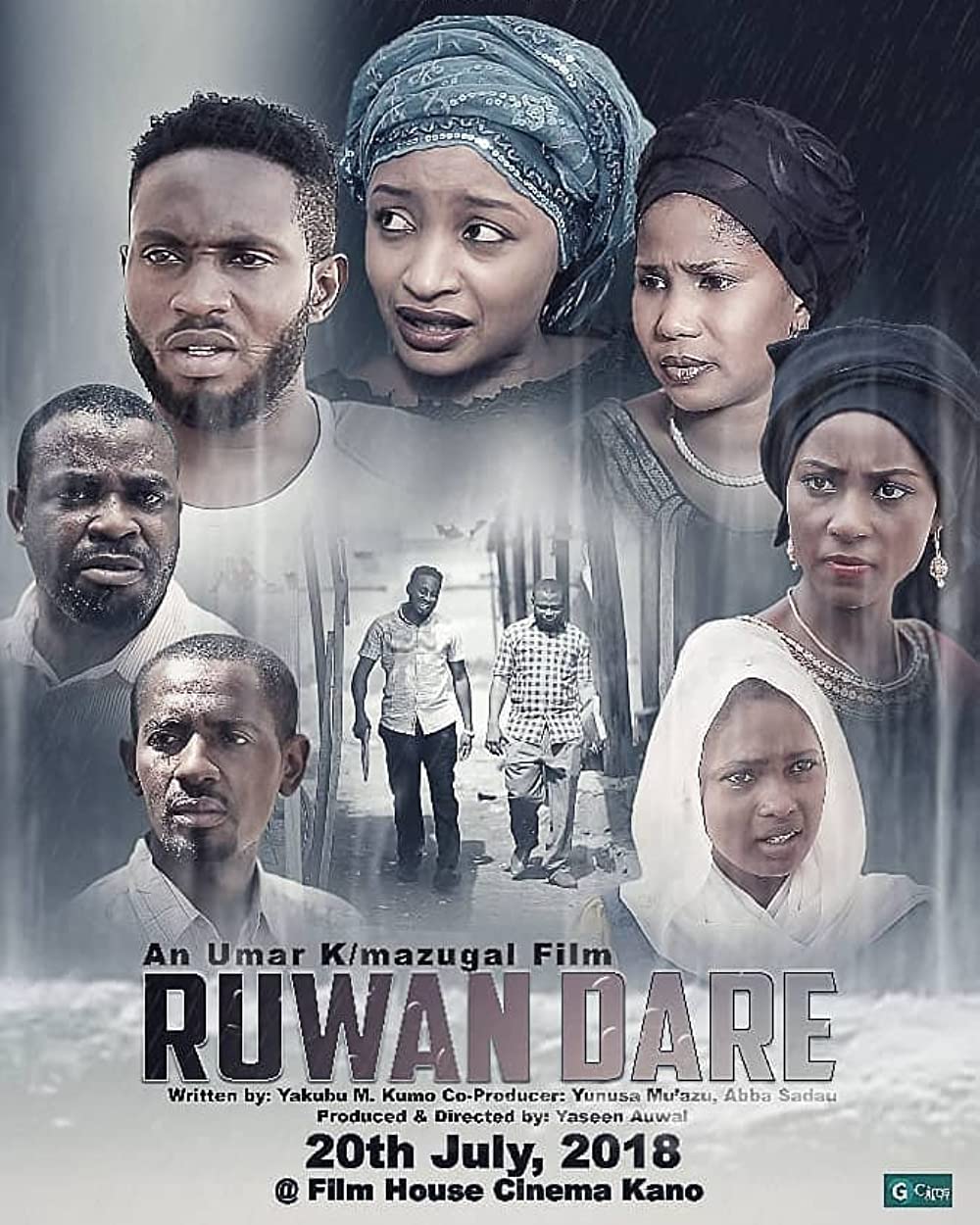
Kannywood movie review: Ruwan Dare

By Muhammad Abubakar

Having watched this movie and seeing its lessons, I decided to review it. Doing so will, by God‘s will, will wake up those graduates—who are unknowingly killing, or more correctly, misleading themselves into believing that it’s shameful for graduates to get themselves engaged in a low-income business, let alone being a labourer.

The movie was released in 2018. It‘s directed by a veteran Kannywood director, Yaseen Auwal. The film is about the situation and the kind of life our nowadays students, particularly graduates, live.

Kamalu (Sadiq Sani Sadiq), the son of the lowest-income businessman (Rabi’u Rikadawa), happened to be a close friend to Bashir (Aminu Sharif Momoh), a brother to the husband of Jamila Nagudu. Their respectable, reasonable, deep-thinking friend, Lawal (Baballe Hayatu), always tries his best to advise not only Kamalu and Lawal but anyone too ambitious not to rely on the government job entirely. At least they should find something to do to improve their lives.

However—unfortunately for them, they always don’t see his advice as something important. One fateful day, Kamalu and Bashir came to the cafe where they almost every day buy stuff without payment. They lie to the tea seller (Ahmad Aliyu Tage) that when they become billionaires in the future, they will pay back everything he now gives them and give him more.

Unfortunately, the tea seller, Ahmad Aliyu Tage, rejected their request, complaining that he was tired of their ‘when-we-become-billionaires’. Luckily for them, Lawal came to buy something at the same cafe too. Although they undermined his sense recently, he surprised them by assigning the tea seller, Ahmad Aliyu Tage, to cook one packet of noodles alongside a whole roasted chicken for each of them. Sadly, this has not served them as a lesson.

One thing that inspired me is: Lawan never worried himself about a government job. He, in the end, made it, leaving them still suffering from poverty as usual.

The film is fascinating, indeed. We see how Lawal and Bashir suffer due to their laziness in going and refusing to hustle. As a result, they end up pushing a truck and teaching at primary school. In addition, the movie passes the message that: Whoever is not content with what God gives him will end up missing a lot in life.

The camera work and sound are up to the mark. And the subtitler has perfectly played his role. Even though he mixed with Hausa in some scenes, this is not an issue. Since the message is precisely delivered – this film was purposely made to call on the attention of graduates like Kamalu and Bashir.

It’s a must-watch film.

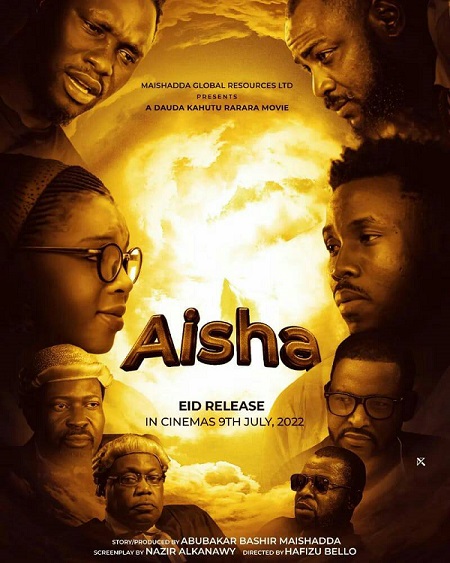
Kannywood movie review: AISHA

  • Director: Hafizu Bello
  • Producer: Abubakar Bashir Mai-Shadda
  • Screenplay: Naziru Alkanawiy
  • Language: Hausa
  • Company: Mai-Shadda Global Resources Limited
  • Release Date: 9/7/2022
  • Cast: Amal Umar, Nura Hussaini, Adam A. Zango, Sani Danja, Shamsu Dan Iya, Sani Mu’azu, Kanayo O. Kanayo, Sadiya Umar, Abdurrazak Sultan, etc.

You can hardly see a ‘thriller’ or a ‘crime mystery film’ in Kannywood’s archive. Recently, however, the trend has begun to change, as the rare genre is being explored by the veteran director Hafizu Bello. After presenting the murder mystery film HIKIMA in 2021, he came again with another one entitled AISHA. It revolves around the eponymous character, a rape victim who eventually dies, and her parents’ struggle for justice.

Aisha (Amal Umar) is a university student from a low-income family. Her father, Malam Balarabe (Nura Hussaini), tries his best to see her success. However, one fateful day, she is found lying, raped and wounded on campus. The police soon arrive and take her to the hospital. Meanwhile, the university management is more concerned about the school’s reputation. They, therefore, conspire with the police officer in charge of the case, SP Audu Makera (Adam A. Zango) and the doctor (Abba El- Mustapha) to hide the embarrassing incident.

Aisha’s parents are upset and anxious to know the cause of their daughter’s critical condition, but the doctor refuses to tell them. Therefore, her father questions the official report issued after she dies and files a petition to get justice. The audience is then taken to the courtroom, where everything is unmasked at the end.

Typical of mystery films, the plot is uncommonly twisted. Many sequences are cut before they end and later continued as flashbacks, particularly when the suspects are interrogated. There are more flashbacks as the defendants and witnesses talk during the court sessions. But all are flawlessly pieced together. The credit should go to the director, Hafizu Bello, who handles the film with the finesse of a devoted artist. Other crew members also did remarkably well. The cinematography is top-notch, and the locations are beautiful. There is also good use of costumes and props.

The film exposes the grim reality in some higher institutions where the students commit serious misconduct. It can also be a wake-up call for parents to be extra cautious about their female children. We see how Aisha duped her father into believing she would spend her night in the hostel but ended up in her boyfriend’s room, where the tragedy later befalls her. The film also highlights how the elite plot against the masses to protect their selfish interests.

Indeed, Aisha is a decent, well-crafted movie with a strong message and realistic narrative. However, the University setting and courtroom dramas make it somewhat formulaic, resembling the director’s previous film Hikima. It would’ve also been more intriguing if it had begun from the scene where Aisha is shown lying on the ground.

The film has an all-star cast, and the actors fit their respective roles. But some of them, like Yakubu Muhammad and Baballe Hayatu, are wasted as minor characters. The eponymous heroine (Amal Umar), the prime suspect (Shamsu Dan Iya) and the security personnel (Sani Danja and Adam A. Zango) all try to pull off good performances. However, it’s Nura Hussaini that steals every scene he features. The courage and anguish he communicates as Aisha’s hapless father seem extremely real. The lawyers (Sani Mu’azu and Sadiya Umar) and the judge (Kanayo O. Kanayo) also play their part with remarkable capacity.

Although Aisha is not a masterpiece, it’s better than the fluffs Kannywood churn out regularly. I, therefore, strongly recommend it—rating 3.5/5.

Reviewed by:

Habibu Maaruf Abdu

Kano, Nigeria

habibumaaruf11@gmail.com

Kannywood Film Review: ” There is a way”

By Anna Mohr

The movie, There is a way, directed by Falalu A. Dorayi and produced by Abba El-Mustapha, is a simple but effective feel-good movie retelling popular tropes and stories in a predictable but heartwarming way. Following the recipe of Shakespearean dramatics and clichéd Disney movies in the 2000s, such as Cinderella Story or High School Musical, it easily can stand on its own while also covering issues of the Hausa society and giving insights into its culture – an entertaining and so sweet movie you can taste the sugar on your lips.

Isham is a middle-class university student with a pure heart who wants to get his degree through hard work. He falls high over heels for Fadilla, the daughter of a wealthy businessman. The two desperately want to be together but must face several problems threatening to destroy their relationship.

There is a Way was the first Hausa movie I watched, and although the story has already been told a thousand times, I easily became invested with it. Even though I rarely watch romantic movies, I have a soft spot for them. The quality of the film is fitting to the story itself: simple but refreshing. Please, do not expect finesse camerawork or outstanding dialogues – you will surely be disappointed. But the blunt storytelling is made up of dramatics that can easily compete with those of the Bollywood film industry.

The movie itself is certainly no piece of art. It is amateurishly made: the camera is wiggling, and the lighter colours in the scenes are sometimes glaring and unnatural. At the same time, the movie uses effects such as slow-motion, certain scenes are muted to create tension and dramatic music is played in between.

The story itself is predictable as typical for a romantic movie and has similarities to our Western fairy tales and Elizabethan or ancient love stories: Man meets a woman and falls in love at first sight, but their love is doomed, and they have to face challenges before being together. Also, the poor protagonist and his rich-born love interest are no rarity in this genre. Another aspect I recognized in the film is the flat characters: We have a pure-hearted hero who cannot do wrong. But instead, tragedy happens to him, and his pureness is challenged. I found that quite wasted because characters are made to make mistakes. They can only grow when they do wrong and when they fail. There is a sense of relatedness that I miss.

The characters themselves are introduced in simplicity. When Fadilla’s parents appear on screen, they are introduced with “Hello Mum” and “Hello Dad”, which is blunt and unimaginative to share the family ties with the viewer. The dialogues are just as direct. The movie is in English, and there is no dubbing involved, meaning that Hausa people speak a language that is not their own. That includes that the dialogues are often wooden and lacking finesse. “I will tell you the secret of …” is just one example of the movie’s very direct way of communication, and I daresay that it would have been more natural if the characters had spoken in their own language. The English script has some sentences that are generally not used, leading to many exaggerated dialogues. For example, “you harbour a criminal” when Isham is accused of cheating in an exam.

So, why do I like this movie?

Easy: Because it has charm. It is charming how Isham and Fadilla are swooning about each other. How they tell each other Shakespearean confessions of undyeable love as if they just teleported into one of his sonnets; how they are the embodiment of a Greek tragedy, a Hausa variant of Romeo and Juliet; how the world is joined against them, but they are still standing side by side.

Viewing the Hausa society and culture in the movie is also fascinating. When watching it, you may recognize that male and female characters are never touching each other – not mother and son, not father and daughter, nor the lovers. In addition, women are wearing scarves – hijabs – around their heads, so you cannot see their hair.

Another interesting fact is the mention of Allah instead of God, which I needed some time to get used to the first time I watched the movie. Also, certain issues are discussed: For example, the gap between poor and rich, the importance of education and the problem of corruption and blackmailing at university. These aspects convey the information I would not find out otherwise and give more insights than any textbook in school.

To put it all together, the movie is a people pleaser. You can easily be invested in the plot and follow the relationship between Isham and Fadilla, although the story itself is simple and predictable. At the same time, there are interesting aspects of culture and society. So, I recommend watching it!

Anna Mohr studies at the University of Cologne, Germany. She can be reached via amohr9@smail.uni-koeln.de.

OBITUARY: Nura Mustapha Waye, the genius behind ‘Izzar So’

By Habibu Maaruf Abdu

On Sunday, July 3, 2022, Kannywood lost a colossus and a rare talent, Nura Mustapha Waye. Thousands of condolences started pouring from all angles as soon as the news of his death broke. Waye was the director of Izzar So and many other series and feature films. His sudden death came as a tremendous shock and left the Kannywood members and millions of their audience with tears in their eyes.

“Waye’s death is a significant loss to Kannywood, for he’s, I believe, the most prolific director today.” So says the Kannywood leading scholar-cum-critic, Dr Muhsin Ibrahim, in his short tribute to the late director.

Nura Waye, or Malam Nura, as he was respectfully called, proved unique among his peers in the Hausa film industry. He neglected its favourite musical love stories to make topical Islamic compliant productions. His dream of educating the audience prompted him to incorporate Qur’anic verses and prophetical sayings into the dialogues of his most of his films.

“In filmmaking, there are messages you could send and get a divine reward from the Almighty Allah… I take film as a medium for propagating a particular policy or ideology. This is what primarily inspired me to venture into it,” he once told VOA Hausa in an interview.

Waye began his Kannywood journey in the late 1990s. He was an actor throughout his first five years in the industry. He, afterwards, switched to director to realize his ambition of making films with a didactic tone. His early films left no mark, and he remained unnoticed for over a decade. Kuru-Kuru (2018) was, perhaps, his first movie to get critical attention.

The movie, which deals with the issue of ‘incest’, revolves around a new bride whose husband finds to be pregnant. After a lengthy investigation, it’s discovered that her uncle is responsible for the pregnancy. The movie received positive reviews and was generally praised for its theme and steady plot. But Waye would never rest there.

He reached the pinnacle of his career in 2020 after creating the YouTube series IZZAR SO. It was a sensational hit, and it went on to become the most-watched Kannywood series on YouTube. Its remarkable success dictated the migration of the Hausa film business to the online platform. Muhsin describes it as a ‘game-changer’ and opines thus:

“There might be a few YouTube series before Izzar So, but many more emerged following its unprecedented success. This has inspired many filmmakers, both struggling and established, to resort to making series, serials and feature films for YouTube.”

For Waye, however, Izzar So was not just a success but a fulfilment. This is because it catapulted him to the top of his career, which was his ultimate goal. “I want Allah to elevate me to its top,” he said when asked about his dream in the filmmaking business.

Nonetheless, Waye’s films are only one aspect of his legacy. He, on another side, had a reputation for being a very gentle, peaceful man. He was also so decent that he hardly features an actress wearing a tight-fitting dress in his movies. These, together with his vivid love for the Prophet (S.A.W), endeared him to the Hausa-Muslim populace despite their hostility towards Kannywood members.

Finally, as a Kannywood movie reviewer, I affirm Nura Mustapha Waye’s rare creativity. I believe he will always be remembered as a socioreligiously-committed filmmaker who led to Kannywood’s migration to online space and, above all, ‘the genius behind Izzar So’.

Habibu Maaruf Abdu wrote from Kano, Nigeria, via habibumaaruf11@gmail.com.

Kannywood/Nollywood film preview: Nanjala

The “Hausa films in English” have, since their debut, been as much praised as they have been criticised. However, while a large section of spectators welcomes the films, many others regard them as a threat to the development of the indigenous language. Others go further to describe them as “non-Kannywood” productions.

However, their initiator and promoter, Malam Kabiru Musa Jammaje, remains undaunted. He is all set to enthral the audience with another Kannywood film in English after the remarkable success of There is a way (2016), This is the way (2017), Light and darkness (2018) and In search of the king (2019).

The soon-to-be-released movie, entitled Nanjala, is the first of its kind in Kannywood. It features the industry’s heavyweights alongside top Nollywood actors like Enyinna Nwigwe, Nancy Isime, Segun Arinze, Sola Sabowale, among others. Moreover, it’s reportedly the most expensive Kannywood movie with a budget worth over N35 million.

The movie was directed by “whizkid” Ali Nuhu, co-produced by Abubakar Bashir Mai-Shadda and titled after its main character, Nanjala. I have only watched its two-minute-long teaser, but I could grasp that the eponymous heroine, Nanjala, is a journalist whose investigative reports would lead to the main conflicts. The film’s themes may include corruption, honesty, women empowerment, the menace of drug abuse, moral decadence, etc. The cinematography is terrific, and the cast seems to give an outstanding performance.

To be right is to describe the film as ‘pan-Nigerian’ due to its production quality, cast, English medium, and the resonance of its message in the country. It’s, of course, promising and will surely appeal to moviegoers from a wide range of backgrounds.

I, therefore, commend the trio of Jammaje, Ali Nuhu and Mai-Shadda for making a Kannywood film with the potential to catapult the overlooked film industry to the international stage. I do hope that it will not disappoint.

Habibu Maaruf Abdu

Kano, Nigeria

habibumaaruf11@gmail.com

27.5.2022

Kannywood movies review: NADEEYA

Director: Yaseen Auwal

Producer: Rahama Sadau and Abubakar Bashir Maishadda

Screenplay: Yakubu M. Kumo

Language: Hausa

Company: Sadau Pictures

Release Date: 18/02/2022

Cast: Rahama Sadau, Umar M. Shareef, Rab’u Rikadawa, Asma’u Sani etc.

After a brief hiatus in Kannywood, superstar Rahama Sadau is back with an eponymous movie NADEEYA. There have been high expectations of the film because of the good reputation of its director, Yaseen Auwal, and the female lead, Rahama Sadau, who also doubled as the producer. It, however, failed to open with a bang due to little publicity as it wasn’t initially made for the big screen.

The film is an issue-based drama about ‘upbringing’. It depicts how some parents spoil their kids, specifically daughters, and the practical difficulties such children face in life. The story revolves around a pampered daughter, Nadeeya (acted by Rahama Sadau), who faces similar challenges after her marriage.

Plot:

On their first day as newlyweds, Nadeeya’s husband (Umar M. Shareef) begins to discover mysterious things about her. She prays badly and can’t correctly perform even a simple ablution, not to speak of the ritual bath. The husband learns further that his bride doesn’t master domestic chores like cooking and housework. She once cooked a pretty heinous meal that nobody could eat. He is, thus, obliged to question her past. Viewers are then shown a series of flashbacks as she recounts her story.

Nadeeya is, since childhood, spoiled rotten by her father (Rabi’u Rikadawa). The father tried hard to get rid of anything that could cause discomfort to his favourite daughter. He had once fought an Islamic school teacher for punishing her and eventually pulled her out of the school. He also divorced her mum for disciplining her. Therefore, she was brought up single-handedly by the impious father with a maid doing everything for her. Nadeeya is now extremely remorseful and ready to change for the better. The story continues…

Critique:

The film is, indeed, hard-hitting and very meaningful. Through the eponymous character, it shows that children’s first learning begins at home, and their personality and morals depend largely on how they are raised. It also reminds of the responsibility of protecting one’s family from the hellfire, as contained in Qur’an (66:6). It reiterates that the responsibility is on both parents and husbands — this is seen in the portrayal of Nadeeya’s husband (Umar M. Shareef).

Nonetheless, despite some scenes being highly overdramatized, the director, Yaseen Auwal, succeeded in handling the serious theme with the utmost gravity. He deserves an accolade for making this topical movie that not only slams indulgent parents but also underlines the need for religious knowledge. Additionally, the film’s locales are beautiful, except for the bride’s room, where we see cracks in the painting. It was also well shot with an audible sound.

Again, the actors all did well. The lead, Rahama Sadau, is no slouch at acting. She melded every action with a fitting gesture, making a brilliant performance throughout the movie. M. Shareef tried to deliver his dialogue. He impressed in the scenes where he recites the Qur’an and where he teaches Nadeeya about Islam—although his chemistry with her didn’t take. However, Rabi’u Rikadawa did excellently as usual.

On the whole, Nadeeya is a well-made movie. I recommend it for those who are tired of Kannywood’s overblown romantic melodramas. Rating 3.5/5.

Habibu Maaruf Abdu wrote from Kano via habibumaaruf11@gmail.com.

Kannywood Movies Review: “Lamba”

  • Director: Ali Gumzak
  • Producer: Abubakar Bashir Maishadda
  • Screenplay: Jameel Nafseen
  • Language: Hausa
  • Company: Mai-Shadda Global Resources Limited
  • Release Date: 28/01/2022

Mai Shadda Global Resources Limited, a film production company that recently emerged as Kannywood’s powerhouse, has produced many blockbusting comedies with the veteran director, Ali Gumzak. Their last release, Kayi Nayi, was the biggest hit of the previous year. However, as the new year arrived, they came in with another comedy entitled LAMBA.

The film is a social satire set against the backdrop of ‘Audio money’ (a slang term for the fake display of wealth). It tells how some three young men (Adam A. Zango, Umar M. Sharif and Ado Gwanja) flaunt false riches to impress the classy girls they meet on social media. They look for the girls who post their filtered, stylishly snapped pictures on the platforms.

Quite incidentally, the girls, too, are living under false pretences. They rent all the trendy clothes and latest phones they use. They hire everything from a dubious merchant, Salo (Aminu Shareef Momo), at any price. The unveiling of their true identity and what transpired later is shown in brilliantly executed hilarious scenes that get the audience laughing throughout.

The film bears some striking similarities to Makaryaci and Kalen Dangi (both directed by Ali Gumzak in 2017), but this doesn’t make it a clichéd one. It’s, in fact, somewhat of an unconventional comedy for having up to three choreographed song and dance routines. The songs are pretty melodious and well shot. But Zango’s dance in the last one, which has thumping music, impresses the most.

Also, due to the film’s need for multiple actors, the producer (Mai Shadda) didn’t cast his favourites (M. Shareef and Maryam Yahaya) alone. He, this time, featured Adam Zango alongside many others. This is particularly interesting for, until this film, the star (Zango) has not appeared in any big production since Karamin Sani (Dir. Falalu Dorayi, 2020).

Moreover, Ado Gwanja, Aminu Sharif (momo), Maryam Booth, Amal Umar and Aisha Najamu acted in pivotal roles. Dubbing artist-cum-actor, Sultan Abdurrazak and rising starlet Ummi Rahab also play supporting roles along with many new faces.

All the leading cast show great comic timing. Zango is larger than life, and Gwanja amuses with great gusto. M. Shareef shows a vast improvement as an actor. Aisha Najamu shines with her signature look, and the new faces seem promising. The credit should go to the director (Ali Gumzak), who handles them effectively.

In sum, though LAMBA lacks an innovative script, it’s an excellent comedy that succeeds in tickling the funny bone. It will surely entrance you and leave a long-lasting smile on your face. Watch it!

Habibu Ma’aruf Abdu wrote from Kano via habibumaaruf11@gmail.com.