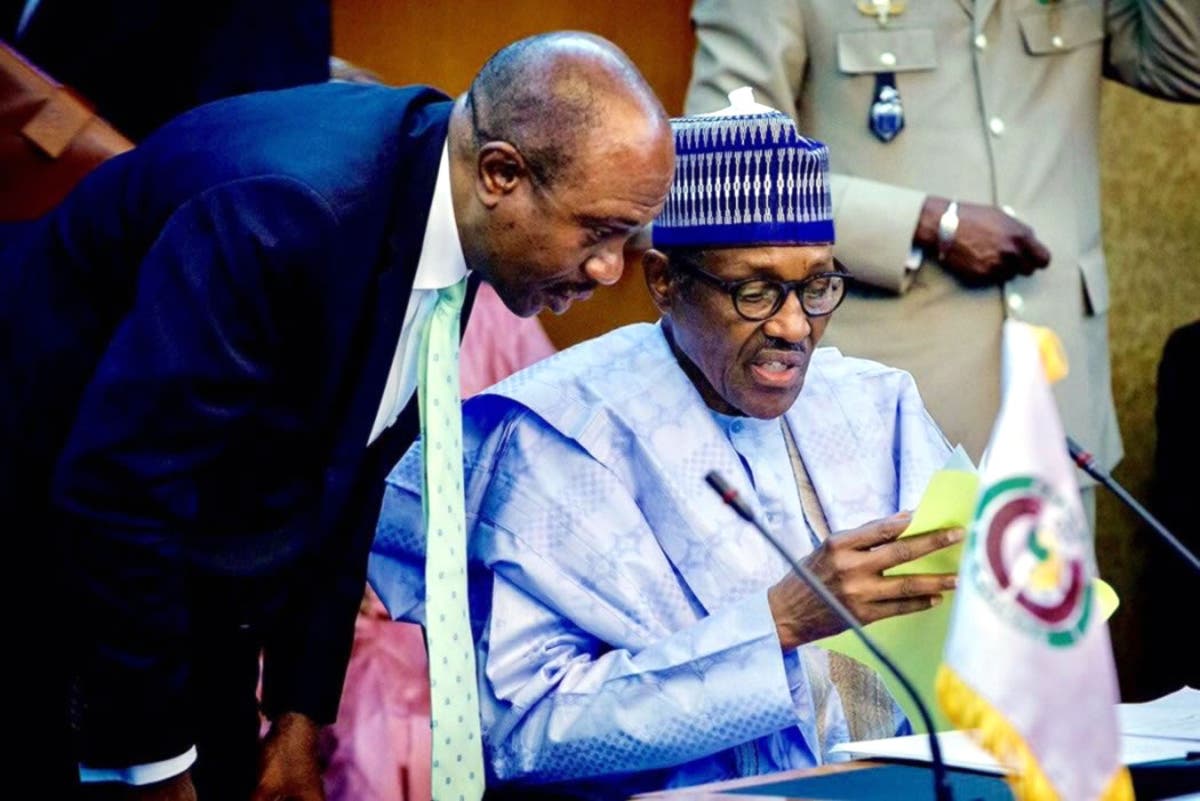
Godwin Emefiele

Buhari unveils eNaira Monday

By Muhammad Sabiu

President Muhammadu will tomorrow Monday unveil the Central Bank Digital Currency (CBD), also known as eNaira, at the State House in Abuja.

Nigeria’s apex bank, in a statement by its spokesperson, Osita Nwasinobi, said this is part of the efforts to ease financial transactions among Nigerians

“The launch of the eNaira is a culmination of several years of research work by the Central Bank of Nigeria in advancing the boundaries of [the] payments system in order to make financial transactions easier and seamless for every strata of the society.

“Following a series of engagements with relevant stakeholders including the banking community, fintech operators, merchants, and indeed, a cross-section of Nigerians, the CBN designed the digital currency, which shall be activated on Monday, October 25, 2021.

“The eNaira, therefore, marks a major step forward in the evolution of money and the CBN is committed to ensuring that the eNaira, like the physical Naira, is accessible by everyone.

“Given that the eNaira is a journey, the unveiling marks the first step in that journey, which will continue with a series of further modifications, capabilities, and enhancements to the platforms,” Mr Nwasinobi said in the statement.

Recall that the launch of the eNaira was early on announced to be held on October 1, but the bank later rescheduled it, citing events to be observed in the celebration of the country’s independence as the reason.

CBN/Aboki FX Saga: Currency Play and Lessons from Billions TV Show

By Abdulhaleem Ishaq Ringim


While explaining the reason behind the Central Bank of Nigeria’s clampdown on the parallel market exchange rate aggregation and publication website, AbokiFx, the CBN Governor submitted that the CBN’s preliminary findings suggested that AbokiFX was used for foreign exchange “manipulation and speculation”.

“They get Naira notes, use it to purchase dollars, take a position, change the rate over a given period, sell the dollars they purchase and make a profit. This is completely illegal and unacceptable and we will pursue them”, he said.

This remark sparked rage in the minds of many Nigerians, most of whom are oblivious of the technicalities of foreign exchange market operations. They outrightly dismissed the move by the CBN on AbokiFX as a mere attempt to shift the blame on the consistent crash of the Naira against the Dollar to AbokiFX. They considered it somewhat impossible that AbokiFX’s operations could have any impact on the exchange rates.
But currency play or currency manipulation is real, and even while it might indeed be an attempt by CBN to shift blame, the possibility of currency manipulation cannot be discounted. And to understand how it works, one needs to be conversant with some basic FOREX trading operations; the “long” and “short” positions.

A “long” position in FOREX trading signifies buying a particular currency at a certain rate by selling another currency while expecting the bought currency to appreciate against the sold currency. Let’s take NGN and USD for example, going long on this currency pair means buying Naira at a lower rate(by selling US Dollars) and selling it at a higher rate as it appreciates to buy back the Dollar sold initially. For example, one goes long if he buys NGN at the rate of let’s say N100(by selling $1) and sells the Naira as it appreciates perhaps to N50(for $1) to buy back $2 now instead of $1 thereby making a $1 profit. Meaning he bought N100 by selling $1 and now 1$ is N50, so N100 will now be worth $2 since N50 represents $1 now.

A “short” or “short-sell” position signifies borrowing a particular currency at a certain rate to sell and acquire another currency while expecting the borrowed currency to depreciate against the acquired currency so that you can buy it back at a lower rate. Let’s use the same example of NGN and USD, a short-sell would mean borrowing let’s say N50 and selling it to acquire $1, then wait until the Naira depreciates to N100 per $1, then sell your $1 dollar to buy back N100 now instead of the N50 it was before thereby realizing a profit of N50. Meaning one borrowed N50, sold it for $1, then waited until $1 equals N100, then sells his $1 which now represents N100.
Now, recall the CBN Governor’s statement of suspicion about how AbokiFX is being used for currency manipulation and compare it with the explanation of the “short-sell” above, you’d definitely find a correlation. But how does the manipulation happen?

I was able to find an answer to this question while watching “Billions” which is a TV show about the financial markets and their many intrigues. An episode titled “Currency”, which is the 5th episode in season 2 of the TV show was majorly about how Nigeria’s currency could be manipulated.

In the episode, a certain financial markets trader claimed that Nigeria’s CBN Governor told him that the Naira was going to be devalued due to the increasing weakness of the country’s oil industry and overvaluation of the country’s currency. However, the timing was ambiguous as nobody knew when the devaluation would happen.

However, he suggested that there was a way the timing could be determined and controlled, and that is if somebody takes a massive “Short” position against the Naira so as to pressurize the CBN to devalue immediately. The “short” he said would have to be massive. He was unveiling this to a hedge fund manager.

The hedge fund manager saw it as an opportunity to prop up his profits but knows clearly that a “short” position from only him would not do the work. So he sought the advice of a renowned banker and economist and he was counselled to assemble some other hedge fund managers(his competitors), pitch the idea to them so that they could work together to achieve a massive “short” against the Naira. And this he did.

He assembled them and offered them the glad tidings. Some of them raised concerns regarding the risks attached to this form of “currency play” because one has to enter the position at the right time for one can go too late and find nothing or enter too early and get wiped out due to increased interest rates. He convinced them that they could control the timing by taking monster “short” positions against the Naira. They all bought the idea and collectively agreed to “short” the Naira with a $5 Billion worth “short” position. And so they did.

Unfortunately, one of them had personal grievances with the hedge fund manager that brought the idea and he saw this as an opportunity to get back at him. So he leaked the information and CBN was alerted and they started raising interest rates which could bleed the hedge fund managers who took this massive “short” out of their trade positions.

Only one option remained for them to prevent losing their positions, and that was to get a renowned economist and banker to talk in a renowned international business television station about the Nigerian situation and conclude that the only option left for the country was devaluing their currency. So he reverted back to the economist that initially advised him about the situation and they finished the work together by granting an interview to a renowned international business television station concluding that Nigeria’s only remaining option was devaluing their currency. And so it happened and they profited massively from their “short” positions.

Even though this American TV Show is a work of fiction, it describes clearly and perfectly how a country’s currency can be manipulated by speculators hoping to benefit from the manipulation. And this is exactly what AbokiFX might have been doing with their platform as the value of a currency to a large extent is determined by people’s perception of and confidence in the currency. Hence, the CBN Governor’s alarm and subsequent measure. This is only but a possibility though, as the CBN has not yet offered substantial evidence to back this, the measure is still a product of “preliminary findings”.

Another possibility, however, is as described by the first-generation model of currency crisis as presented by Paul Krugman (and adapted from Stephen Salant and Dale Henderson’s model of speculative attacks in the gold market). Krugman explains that fixed exchange rate regimes are usually prone to attack by speculators especially when stakeholders perceive that the fixed regime is coming to an end due to certain fiscal and monetary signals.

And to tackle this,  I must end by concurring with Tope Fasua’s suggestion as presented in his article titled “As Nigerians joyfully gather to kill the naira”. He said, “The CBN must be very nuanced and professional in its pronouncements around the naira. Ignore the black market. Face your market. Know that there are speculators reading your lips and gauging your resolve. Most financial market players are shorting the naira already, constantly on the lookout for dollars. Shock them without saying a word. Be unpredictable. Ensure your information does not leak to the market until you take action. Subtly put out the word through proxies sometimes, but act independently.  Check your ranks. It is filled with non-believers in the Naira or even in the Nigerian project. What is going on presently is a speculative attack on the naira, through the black market.”

Abdulhaleem Ishaq Ringim is a political and public affairs analyst, he writes from Zaria and can be reached through haleemabdul1999@gmail.com.

CBN abandons non-interest loan facility for Nigerian Muslims

By Muhammad Abdurrahman

Despite millions of applications by Nigerian Muslims for the Central Bank of Nigeria’s interest-free interventions, the apex bank decides to discard this critical project.

A year ago, on July 24, 2020, the Central Bank of Nigeria (CBN) unveiled series of guidelines for the non-interest financial interventions under its Agri-Business, Small and Medium Enterprise Investment Scheme (AGSMEIS), Micro, Small and Medium Enterprises Development Fund (MSMEDF), the Accelerated Agricultural Development Scheme (AADS) and host of others. Millions of Nigerians, especially Muslims guided by the sermons of prominent clerics and the assistance of many Muslim IT specialists and academics, applied for these CBN’s interventions.

Nevertheless, more than a year later, there has not been any information or explanation from the CBN regarding these crucial programmes. As a result, Nigerians are now left only with speculations, which are gradually gaining ground.

Many people alleged that some interests within the bank and the country’s financial architecture sabotage the interventions, with all the consequences on the Federal Government’s acclaimed concern for integrated development.

In a statement signed by the National Secretary-General of the Da’awah Coordination Council of Nigeria (DCCN), Engr Ahmad M.Y. Jumba said, “It will be a great disservice for the Federal Government, which has been widely applauded for this milestone, to allow this intervention to end up in the dustbin of calculatingly sabotaged policies and programmes. If the CBN is serious, why then the delay in implementation even as it continues to implement other programmes?

“The Da’awah council calls on the authorities concerned to expedite action and make those interventions immediately available, accessible and affordable. At a time when many Nigerians are suffering from extreme poverty and hunger, when small businesses are crumbling due to lack of capital, when millions of youth are roaming the streets with no jobs and no access to start-ups; at this time of hyperinflation amidst dwindling incomes, we find it suicidal for the CBN to remain conspicuously silent about a programme that has all it takes to support Nigerians get out of poverty and put our dear nation on the path of inclusive growth and sustainable development,” Jumba lamented.

Some applicants contacted by The Daily Reality cried out that as is the norm for Muslim faithful, they had resorted to prayers and anticipation for God’s intervention. On this note, Jumba also added that:

“It is our hope that the Federal Government will fulfil its promise by directing the CBN to immediately release the modalities for accessing those interventions in the shortest possible time.

“We will call on all religious leaders, Imams, in particular, to use their pulpits and deliver QUNUT against any person who is deliberately engaged in sabotaging the interventions,” Jumba concluded.