Federal Government of Nigeria

How to make the month-long ASUU strike a win-win situation – Don

By Uzair Adam Imam

A senior lecturer with the Department of Mass Communication, Bayero University, Kano (BUK), Dr Ibrahim Siraj, has described the four-week strike of the Academic Staff Union of Universities (ASUU) as a necessary evil Nigerians must learn to live with.

Siraj said that as we could not stop the strike, we could do whatever we could to minimize the ‘losses’ that come with it while anticipating the benefit.

The academic who disclosed this on his social media platform stated that if only we could use some formulas, we are all winners – driving many benefits from the strike.

The writing he titled, “How to Make the Month-Long ASUU Strike a Win-Win Situation”, provided some formulas which he married them up with the benefits worth driving if put into practice.

Dr Siraj wrote, “Federal Government is given an ample opportunity to study ASUU demands, engage in serious and sincere negotiation and finally seal a deal. This will save the system from further disruption and damage.

“And with the countdown to 2023 general elections just starting and political activities expected to reach their peak later in the year, no better time than now to do it. They can resolve this one and concentrate on their politicking. Win.”

He added that “for lecturers, this is a time to sort out all issues relating to continuous assessment (CA), have some rest, finish writing that paper, gain some renewed energy and hope for the best from the struggle. In-sha-Allah it will usher into a better university system: better teaching and learning conditions, better remuneration, and more productive scholarship. Win.”

Moreover, Siraj stated that this is also an opportunity for the students to prepare for the coming exams “eat up the notes, ‘cram’ the handouts and do additional reading and consultation on the topics. This could translate into better performance and ultimately higher grades. Win”.

“Final year students could use the window to invest more time in writing their projects. So, in addition to aiding timely completion, it could also enhance the quality of the output. Win,” he stated.

The lecturer stated that the adjustment in the calendar means that BUK students will spend a better part of the blessed month of Ramadan at home. Thus, he said, “this means students and teachers will have more time to devote to seeking Allah’s pleasure in the holy month. Win.”

Dear Governor Bala Mohammed, listen to Jama’are people

By Y. Z. Yaú

In 2018, the Jamaare Local Government Area of Bauchi State suffered a devastating flood that destroyed farms and houses and the central market. There was a Government in Bauchi State, but it did not respond to the crisis. Those who died due to the flood ended up as mere flood statistics. The descendants of Dilara took it calmly and in their strides.  They consulted among themselves and prayed to God to answer their prayers. In his infinite mercies, God answered and wiped their tears: the federal government through the Ecological Fund responded with an intervention to mitigate the effect of the flood.

In a three-part initiative, the Ecological Fund financed a new drainage network in the town and promised to rebuild the market destroyed by the flood. The third aspect was the dredging of the river so that the flood could be reduced if not altogether eliminated. The state government was to contribute as counter funding. But, unfortunately, it did not, and the flood came back with more vengeance during the last raining season, and for the first time in over 50 years, the flood got into town, occupied and destroyed many houses. Several people, mainly farmers and their children, died while crops were damaged in the waves. The loss to the community was shuttering. Again, not a whimper of sympathy from the state government. 

Over five years ago, as part of the ecological intervention, the Federal Government decided to upgrade the power sub-station, which serves more than four local governments, to improve the electricity supply in the area. A significant new sub-station was to be built on the understanding that the State Government would do the civil works while the Federal Government does the engineering component. The Federal Government delivered its part, and to date, the State Government has not delivered its component, so the project remains uncompleted. 

What does the frequent flood tell? While flood in itself is destructive, it reveals that if the water can be controlled, agricultural production can be improved to raise the national food production capacity. After all, already along with the Hadejia wing of the Hadejia-Jamaare Rivers basin, this area is perhaps the largest rice production belt of the country. Stabilization of the flood plain of the Jama’are river is, therefore, a project not meant for the benefit of the Jamaare people only. It is to improve national food security and farming resilience in the country. It is thus in the national interest. 

The flood plain of the Jama’are river is a fertile agricultural area and a ready-made natural laboratory for agricultural research that will improve farming systems and practices across the country. This consideration led the Faculty of Agriculture of the Bauchi State University in Jama’are to leverage this natural laboratory for research, experimentation and teaching. In addition, Jama’are people will benefit from agricultural extension services, agricultural advice from experts, improved skills and knowledge for the farmers, and uptake of research outcomes to address agricultural, livestock, and horticultural issues.

It will also benefit from the usual town-gown interaction that a university made possible. But above all, however, the state and the country stand to gain in enhanced agricultural production, livestock production and development of horticulture. The foresight of the Committee that searched and selected the site of the Faculty of Agriculture must be commended for their deep sense of patriotism and adherence to professional ethics. 

The Faculty is already on the ground with hundreds of students and over 100 academic and non-academic staff engaged in academic activities in the college. Academic activities have stabilized, and a sense of synergy between the campus and the host community has taken shape. 

Suddenly, there are rumours making rounds that the state government is planning to relocate the Faculty to another place for the Federal College of Education takeoff that the federal government recently decided to establish in the town. This move to relocate the Faculty that was sited based on clear reasons of functionality and leverage not only smacks of the politics of blockage but also totally lacking in appreciation of the considerations for the setting up of both the Faculty of Agriculture and the Federal College of Education in Jamaare. It certainly does not show concern for the deep patriotic thinking of sitting the Faculty. But this apart, the argument of justice and fairness has led to the establishment of the Federal College of Education. 

Jama’are is one of the oldest local governments in the state, established in the country’s first wave of local government creation. Jamaáre Emirate is a foundational emirate, resulting from the Dan Fodio Jihad and not a recent political design of some politicians. Of the four emirates in the state, until 2014, it was the only one lacking in any institution of higher learning. Even when the Faculty of Agriculture was established, the Emirate was nowhere near the others in terms of the number of higher institutions. It was to promote equitable educational development and the spreading of educational opportunities across the state that reinforced the rationale for selecting the site of the Faculty of Agriculture and the establishment of the Federal College of Education in Jamaare. 

It is difficult for the people of Jamaáre not to read the purported attempt to remove the Faculty as one more instance of deliberate discrimination against people known for their peaceful disposition. For all the deprivations, they have never taken to a protest. Not that they value their rights nor that they cannot fight for their right. They believe that what you do not get in peace will not necessarily come in violence. They live in the humble Fulbe spirit of not giving to showing pains or pleasure. Therefore, when last Monday they met from all corners of the Emirate at the Jamaare central mosque and led by the leadership of the scions of the Dilara dynasty, the community has taken this attempt to disinherit them calmly and resorted to prayers, in the hope that as usual, Allah will ensure that justice is done. As a peace-loving community, we take solace in our patience and trust our density. 

It is still not late for the Bauchi State Governor, Bala Mohammed (Kauran Bauchi), to dispel these rumours and assure the people of Jamaáre, and indeed the whole country (which stands to lose from this move) that what is theirs shall remain theirs. They will embrace him with brotherly love and in that spirit. We hope that Kaura hears our humble request for his heart to take flight into the hearts of Jamaáre people who would warmly embrace him in eternal gratitude for acting as a true leader who treats all parts of his constituency equally. We are waiting and watching.

Ya’u is the executive director of the Center for Information Technology and Development.

ASUU to embark on a fresh strike soon

By Uzair Adam Imam


The Academic Staff Union of Universities (ASUU) has said that there is a possibility of going on a strike if the government does not address its demands.


The union said that the N52.5bn it received from the Federal Government would not be sufficient to deal with the challenges facing the university system in the country.


Prof Emmanuel Osodeke, the ASUU President, disclosed this in an interview with the journalists.


“There was a possibility that the union would still go on strike unless the government addressed its demands, including the 2009 agreement,” he said.


The Daily Reality gathered that the Federal Government had released N30bn Revitalisation Fund and N22.5bn Earned Academic Allowance totalling N52.5bn to the union.


Osodeke added that: “The Federal Government had said it paid lecturers N30bn Revitalisation Fund and N22.5bn Earned Academic Allowance.
“It noted that it had made some progress in implementing the Memorandum of Understanding the government reached with the union,” he stated.


However, Osodeke also described the fund released by the government as a token payment, reiterating that it was not enough for lecturers to change their minds on the suspended strike.

ASUU: FG impoverishes us, no going back on strike

By Uzair Adam Imam

The Academic Staff Union of Universities (ASUU) has threatened that there is no going back on its planned strike action as long as the government did not meet its demands.

The union also tackled members of the National Assembly for earning  ₦1.5 million or thereabout monthly to the detriment of professors with ₦416 000 monthly takehomes.

Mr Adelaja Odukoya, the Zonal Coordinator of ASUU, Lagos Zone, made the disclosure on Tuesday while addressing journalists at the end of the zonal meeting of the union held at the Federal University of Agriculture Abeokuta (FUNAAB), Ogun State.

Odukoya also criticized Senators and House of Representatives members over “jumbo pay”, adding that academic members “are being impoverished by the federal government.”

COVID-19: FG directs civil servants from level 12 and below to resume work

By Sumayyah Auwal Ishaq

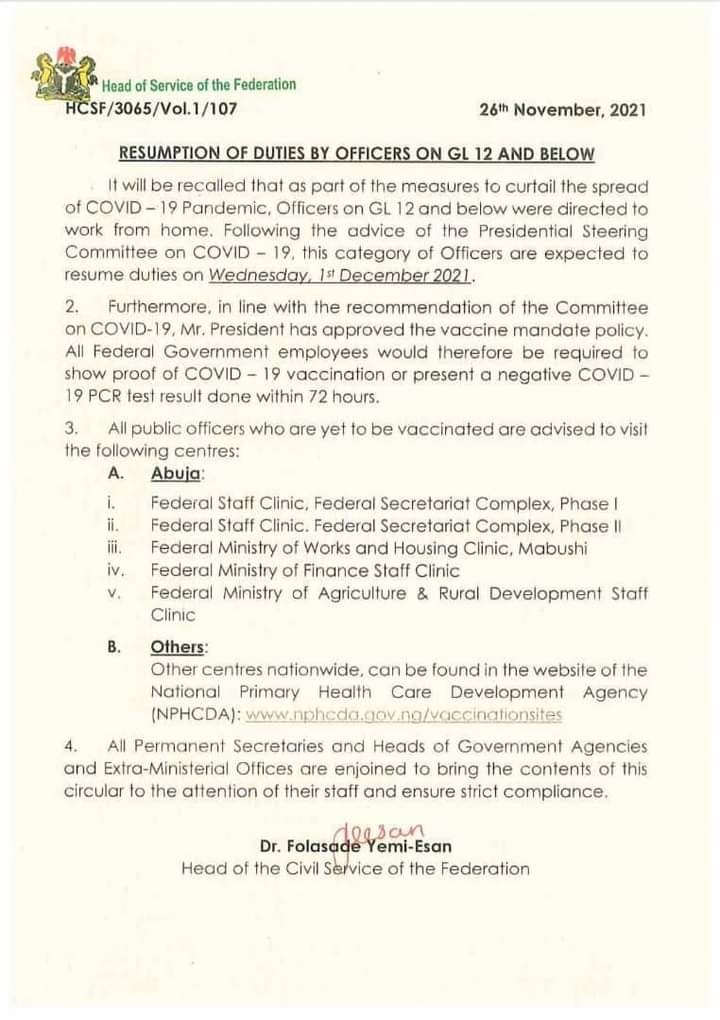
The Nigerian government has directed federal civil servants from Grade Level 12 and below to resume full duties on Wednesday December 1, 2021.

The Head of the Civil Service of the Federation, Dr. Folashade Yemi-Esan, gave the directive in a circular on Friday in Abuja. Dr. Yemi-Esan, further said that President Muhammadu Buhari has approved the vaccine mandate policy to all Federal Government employees.

The new development follows a recommendation by the Presidential Taskforce (PTF) on COVID-19, urging workers to resume full working hours and days.

Nigerian military neutralizes many ISWAP terrorists

By Muhammad Sabi’u

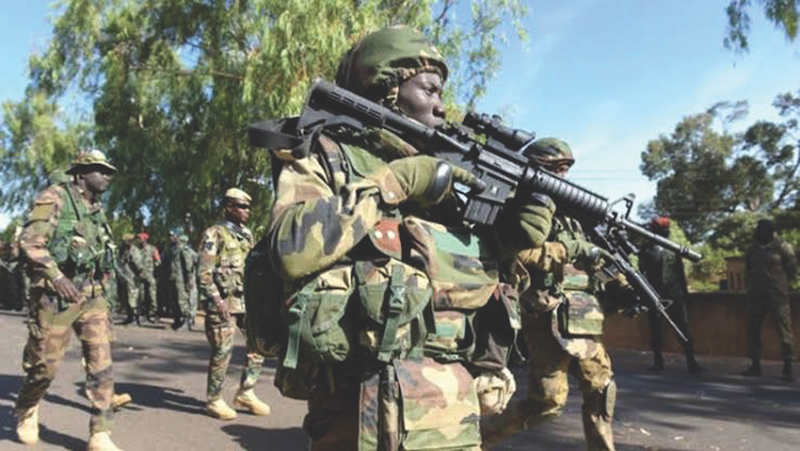
The Nigerian military on Saturday has an encounter with members of the deadly Islamic State of West African Province (ISWAP) in Askira Uba of Borno State.

A number of the terrorists were said to have been neutralized in the said encounter, which also led to the recovery of arms vehicles by the military.

This was disclosed in a statement released today via Nigerian Army’s official Facebook page and signed by Brigadier General Onyema Nwachukwu, who is the Director Army Public Relations.
However, four soldiers, unfortunately, lost their lives in the course of the encounter.
Read Nigerian Army’s full statement:
OPERATION HADIN KAI: TROOPS NEUTRALIZE SEVERAL ISWAP TERRORISTS DESTROY, EQUIPMENT IN ASKIRA UBA ENCOUNTER
 
Troops of Joint Task Force, North East Operation HADIN KAI have neutralized several Islamic State West Africa Province (ISWAP) terrorists during a recent encounter in Askira Uba Local Government Area of Borno State. In the fierce encounter which is still raging as at the time of filling this report, troops supported by the Air Component of OPHK have destroyed five A – Jet, two A-29, two Dragon combat vehicles and nine Gun Trucks.
 
Sadly, a gallant senior officer Brigadier General Dzarma Zirkusu and three soldiers paid the supreme sacrifice in a very rare display of gallantry as they provided reinforcement in a counter offensive against the terrorists, and successfully defended the location. The family of the senior officer and soldiers have been contacted.
 
The Chief of Army Staff Lt Gen Faruk Yahaya deeply commiserates with the families and relations of the fallen heroes. He has also directed that the troops continue in the ferocious counter offensive and hot pursuit to eliminate the remnant of the fleeing terrorists.
 
ONYEMA NWACHUKWU
 
Brigadier General Director Army Public Relations 13 November 2021

Nigeria’s Development: The Daunting Doom

By Lawi Auwal Yusuf

Leaders are preoccupied with self-centred political hustles, party meetings, extravagant banquets and flying their private or chartered jets over the country attending various lavish occasions. On the contrary, Nigerians turned wistful and sad about the terrible fate of the country and the gloomy future. As they get more concerned, their hope becomes less.

The country is endowed with efficacious potentials for its development to become a global power. It has a strategic location, sizable landmass, enormous young population, highly educated elites and abundant natural resources. In addition, favourable climate, fertile farmlands, and the shores that give it access to the Atlantic Ocean in the South are all added advantages.

In the last sixty-one years, Nigeria has reaped hundreds of billions of petrodollars in total revenues as one of the major producers and exporters of oil to the global market. It is the 12th largest producer of oil in the global ranking, 8th largest exporter and the 10th largest proven reserves. According to the Department of Petroleum Resources, it has about 159 oil fields and 1481 wells in production.

Apart from petroleum resources, Nigeria has multiple precious mineral resources in massive deposits. Moreover, cocoa is the largest foreign exchange earner to Nigeria besides oil and rubber, the second largest.

Similarly, as the most populous state in Africa and the 7th in the world with over 211 million people, Nigeria is a vast market. Its mixed economy is the largest on the continent. It is the 27th largest economy in the world by nominal GDP as of 2021 estimate. By GDP per capita, it is the 137th in the global ranking and the 25th largest by PPP.

However, these unique and extraordinary endowments are rare for a country to possess. These are the best opportunities and possibilities for its advancement. Unfortunately, poor leadership, endemic corruption and mismanagement have been the greatest obstacles in realising the potential. These precious endowments were not genuinely and diligently used. Hence, it has not made appreciable progress in those years. Had they been utilised at the best and maximum capacity, the sky would have been the limit.

More than 40% of Nigerians are living below the poverty benchmark in May 2020 estimates. They are destitute and cannot afford the three daily meals. Today, pervasive poverty depicts the lives of most Nigerians. The life expectancy is as low as 54.7 years on average. Infant mortality reached 74.2 deaths per 1,000 live births in 2019, and maternal mortality was 814 per 100,000 live births in 2015.

Moreover, the stagnant economy, inflation and the perpetual falling value of the naira have aggravated the plight of the masses, making life worse, more challenging and more miserable for ordinary Nigerians. There has been a swift rise in the cost of living and a concurrent decline in the living standard. Therefore, poverty, inequality, mass idleness, underemployment and wretchedness are at the highest pinnacle. This made Nigeria always emerge winner of the global rankings of the poorest nations.

It is appalling that the masses are becoming poorer while the nobles are getting more affluent. There has been a persistent widening inequality between the rich and the poor. Transparency International ranked Nigeria 136th out of 182 in the 2014 Corruption Perceptions Index. It was estimated that more than $400 billion were embezzled by corrupt leaders from independence to 1999. Nonetheless, President Muhammadu Buhari in 2015 said that corrupt officials had squandered more than $150 billion in the last decade. As a result, the country is synonymous with corruption. And the most astonishing is that it is among the wealthiest countries and also the poorest simultaneously. This is because the state wealth is enjoyed only by the aristocrats while the commoners are destitute.

Rule by theft known as ‘kleptocracy’ has deteriorated into kleptomania. They are strongly obsessed with stealing to the level that they don’t even have a material need for it. It degenerated into highly competitive accumulation syndrome. The monies that are ideal for the development of Nigeria are stashed at its detriment in Western countries and therefore become beneficial to their contented economies.

On the other hand, in the early 1960s, Nigeria was self-sufficient in food. But after the Civil War in 1970, the government failed to reinvigorate agriculture, resulting in failure to meet the acute population growth. It had to depend primarily on importation to fill up the supply gap. Sadly, in the 21st-century world, farmers are still tilling the ground with simple implements like hoes and cutlasses to feed a population of over 200 million. As of 2010, almost 30% of Nigerians are employed in agriculture and still have not met up the national demand.

The leaders had failed to provide the basic necessities of life to the citizens. As a result, after more than six decades of self-governance, there is no stable electricity supply, safe drinking water, standard healthcare, adequate and affordable food, qualitative education, social housing estates, infrastructures and social amenities. Nonetheless, the problems of the country in the1960s are yet to be resolved. Poverty, corruption, rule by theft, secessionism, tribal and religious antagonisms are lingering today. Regrettably, terrorism, kidnappings, cattle rustling, banditry and other current collective problems have deepened the crises.

Not being able to diversify the monocultural economy that largely depends on oil plays a significant role in the economy, accounting for 40% of GDP and 80% of the government earnings. Moreover, Nigeria does not adequately exploit the vast array of mineral resources in colossal deposits while the mining industry is still in its early stage of development. Moreover, other sectors of the economy that will help tremendously grow the economy and raise revenues are also underdeveloped. Contrarily, it has remained a perennial borrower of funds in the global capital market. Recently it emerged as the 5th most debt-ridden country in the world. The World Bank in August 2021 said that it had accumulated $11.7 billion in debt.

There has been deficient human development, especially the youths folk. In 2019, it ranked 161st in the world in the Human Development Index with a 0.539 score, which was very low. Millions of school-age children are out of school while some wander the streets freely with torn-out clothes and scavenging through rubbish looking for food. These miserable children are left on their own to live their entire unwholesome lives on the streets in search of a living. They have no qualifications or skills to make them employable in the labour market. Similarly, graduates searching for employment happened also to be idle many years after they had left school. Therefore, almost half of Nigerians are unemployed.

Furthermore, the emigration by professional Nigerian doctors to the diaspora known as the “brain drain” due to adverse working conditions in the country led to shortages of doctors in the healthcare system. It was estimated in 1995 that roughly 21,000 indigenous doctors were working in America alone, which was almost equal to those in the public health service then.

When you make a comparative analysis between Nigeria and its peers to assess its performance, you will realise that it had performed poorly. For example, look at the High Performing East Asian Economies (HPEAEs) that include Malaysia, Taiwan, Thailand, Singapore, Indonesia, South Korea and Japan. They are the fastest-growing economies in the world after the first world countries. Some had launched rockets into space. They manufacture aircraft, ships, automobiles, computers and smartphones while Nigeria still imports razor blades, pencils, toothpicks, including its most abundant petroleum products. Singapore and Japan developed from the less developed countries and joined the first world nations.

Look at other countries like UAE, India, Brazil and South Africa that recently established a consociational democracy in 1994. Nigeria played a significant role in fighting the apartheid regime and helped in establishing the multiracial democracy in the country. South Africa is now regarded as a highly developed state and has become a better haven for Nigerian youths who emigrated there in search of greener pasture.

Finally, Nigeria still has the chance to do better and start developing once more to realise its long-lost potential.

Lawi Auwal Yusuf wrote from Kano. He can be reached via laymaikanawa@gmail.com.
Of Professors in the Ivory Tower: Inner Rumblings

By A. A. Bukar

Let me preface this with the caveat and confession that part of the reason I recently slow down hobnobbing with professors is my increasing abhorrence of this culture of excessive bootlicking and kowtowing that is creeping into academia and eroding the ideals of independent thought, spirit of free inquiry and detachment that hitherto characterise intellectual discourse. The radical critique of issues and events for the betterment of humanity and irradiating the society is slowly taking a wing, supplanted with overt politicisation of minor issues (and even non-issues). Today, young academics, like myself, are becoming increasingly afraid to express even simple admiration of who they consider as the IDEAL TYPE among their teachers and mentors in academia because of “interpretations”. For this, you can even be reported to the enemy of such a scholar to possibly victimise you “sabida ai yaron wane ne! Ku kyale shi, ai zai zo defence, ai za’ a kawo papers dinsa for assessment”. And on and on. Such pettiness and vendetta. Hence, many – out there – see  Nigerian academics as the worst enemies of themselves and are happy with how FG is dealing with them.

Little wonder whether this culture is obtainable in other parts of the world. Departments are compartmentalised into cliques and camps a la political parties in the larger society. Professors are becoming like emirs fortified by sycophants, making them unnecessarily snobbish and covetous of flattery. PhDs are deliberately delayed or tactically killed because a candidate does not BELONG. A blind eye is turned to obvious wrongs, mediocrity, and crass injustice because “our oga” is INVOLVED. Entitlements and privileges (especially of the younger ones) are stampeded to settle SCORES.

A friend sent me a Jumaat goodwill message, a quotation from Rumi which reads: “Listen to silence; it has so much to say”. How many PhD/MSc candidates do you know writhing in silent pain of frustration? Prof sirs and mas: listen to our silences and that shy smile that says “ba komai sir”. When I was an undergrad, I once overheard my teacher, Dr Gausu, talking about one of his colleagues in Economics, Business or Accounting (I can’t remember exactly) who’d become agoraphobic and almost schizophrenic because of PhD manhandling from a senior colleague. Of course, then I was too inexperienced to understand the heck that was about. They sarcastically even refer to the initials as “Pull Him Down”.

Whether this augurs well for generation, production and dissemination of ideas and knowledge typical of the Ivory Tower, I leave it to your imagination.

For these and more, many ideal intellectuals are on the lookout for escape windows from the suffocating atmosphere of poverty and frustrations taking over academia like a thick cloud on the horizon. Many are “diversifying”, hence diverting their attention from the absolute commitment ideal scholarship demands. Others are increasingly becoming nonchalant – that I-don’t-care attitude of: “if the department or unit fuels the generator set, fine, otherwise I teach the SPSS or Word Processing on the whiteboard”. Elsewhere blackboard. So Nigerian hospitals are not alone; medical practitioners are just a cohort.

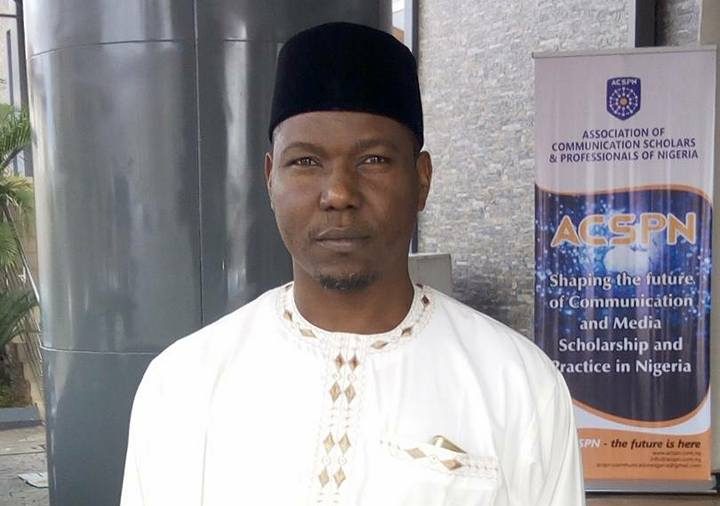
Despite all odds, I love being at the University. It is a place where I feel I naturally belong. And our campuses are still dotted with the IDEAL TYPE (just as there are IDLE TYPES who do not “profess” any knowledge) that constantly bring back to one’s memory my favourite: Edward Said. Critically engaging. Highly unassuming – like Mazrui. Passionate about nourishing the mind; concerned with the public good and Humanity as a whole. People who will unconsciously make you feel you are far from arriving without making you feel embarrassed. I have recently met and enormously admire one such intellectual is Professor Abubakar Mu’azu of the Mass Communication department, UNIMAID.

Interpret this one too the way you like. Report me anywhere. Land me into trouble. I no longer care. But Allah knows whether this is coming from the bottom of my heart or elsewhere. Such as an attempt to curry favour.

After all, what use is admiring people if you cannot tell them or others you do? Or should we hold on till they are no more? Wouldn’t that serve as a token of encouragement to maintain the course and tempo against all odds?

I have earmarked a few other similar intellectuals I will write about in due course on this space. I will unburden my heart about people I feel positively towards. Yes, I will specify those who fit my definition of the ideal intellectual. Part of this is, of course, honesty. Wallahi, no matter how engaging you are, you are out of the equation once it comes to the light you are dubious and too self-centred. If you’re extorting money or sex from your vulnerable students, you cannot be my model. But again, I am not looking out for an angel.

Back to the subject, I have met with Prof Muazu only a few times. One was when he came as an external examiner to my thesis in April 2018 and some months earlier as an accreditation team member for the college I taught in Yobe state. The last, some weeks back. Each, he left me with nothing but admiration and deep respect.

When I phoned my referee and supervisor at undergrad, late Prof Maikaba, to congratulate him on his last promotion, he typically enquired about the progress of my thesis. I told him then, “I was done with viva yesterday and effecting corrections now”. Curiously, he returned with a finder about the examiner. When I replied that it was Mu’azu, he said: “kace an sha aiki”. Toh Bukar. PhD beckons. You can’t wait, especially for one in this business. He admonished me as usual; I giggled, thanked and said my goodbye.

I don’t know whether it’s appropriate to reveal this too. Some hours before the viva voce, my supervisor, Dr Binta Kasim Mohammed, called alerting me “to prepare very well. Because the external examiner brought is extremely thorough and critical”. Sir, you are appreciated and held in high esteem not only by nonentities like us but also by your colleagues. But my assessment of you from afar is that: these things matter little to you (if at all) – out of humility.

From both you and the late Maikaba, I graduated with distinction. But each time we met, you left me feeling inadequate, making me wonder ‘when will I arrive?’. Parts of this are the books you recommend, which I never read, or know not exist. But somewhere in WHERE I STAND, Sheikh Gumi has opined along this line that knowledge is such enigmatic that the more you learn, the more you realise that you know very little. I wonder whether you feel something similar sometimes. Yes, despite the accomplishments. In just your last visit, you recommended, as the situation warranted, many texts. Among these are Peter Winch’s THE IDEA OF A SOCIAL SCIENCE AND ITS RELATION WITH PHILOSOPHY. Then the POSITIVIST DISPUTE IN GERMAN SOCIOLOGY. The latter is such a rare collection – in fact, my first time to meet Adorno, Habermas and Karl Popper in one place. Both books remind me of similar stuff I read from the staple of Claude Ake and Yusuf Bala Usman of blessed memory.

In this vein of characteristic modesty, you specifically asked me to read Ben Bagdikian’s MEDIA MONOPOLY after the viva voce in order to steel my argument on the influence of profit drive in media content production. A copy of my thesis still carries your adorable handwriting suggesting the title and other points. But little wonder you never drew my attention to the fact that you have written extensively on media in peacebuilding until my curiosity took me to the internet and a bookshop where I stumbled CONFLICT MANAGEMENT AND THE MEDIA IN NIGERIA  – a book coedited by you and Gani Yoroms. This was despite your awareness that my thesis is squarely about this matter of controversy. Quite recessive indeed.

With the crisis engulfing Nigerian Universities (the worst I have ever seen) and academics running helter-skelter for greener pasture, I equally wonder what becomes of the academia after the few of you that remain out of passion pass on to something else or the inevitable great beyond. And especially if this maddening ill-treatment continues from the federal government. Allah Ya kiyaye, amin.


Bukar teaches Mass Communication & Journalism at Ahmadu Bello University, Zaria.

Nigeria: In need of El-Rufa’ism

By Tahir Ibrahim Tahir (Talban Bauchi)

Do you remember when Governor Nasiru El-Rufai chased bandits into the bush along the Kaduna/Abuja expressway as he encountered a bandit attack along the highway? He practically trailed the assailants into the bush, chasing the gunmen, along with his entourage of armed escorts. He wouldn’t stand aside and watch the security men put their lives on the line alone. They had no choice but to cover him as they pursued the bandits. Some were shot, and a few escaped with injuries.

El-Rufai is a hands-on man and practically chases the reality of things to the letter. If you were a Chief of Air staff, with El-Rufai as your C-in-C, you would probably be called to a scenario where El-Rufai is in one of your bases, manning a drone attack himself. I bet you, he could even be in one of the Tucanos, spitting fire on terrorists; and you would end up answering yes sir to him, over the mic, from the fighter jet. No garrison commander or head of any of the counter-terrorism operations would ever allow himself to be caught flat-footed by his irrepressible commander in chief. You can’t be in a command guest house somewhere while your Commander In Chief is in an MWRAP elsewhere on the battlefield, charging your soldiers on to carry the battle to the terrorists.

El-Rufai would not waste time naming the bandits as terrorists, so he wouldn’t be handicapped in annihilating their terror! If all the North-Western states’ governors had co-operated with El-Rufai’s plans long ago, they would have proactively put in place all the crunching measures — that would have ended the banditry plaguing the region today.

Do you know that Kaduna’s IGR of 13.6 billion in 2019 has grown to a whopping 51 billion in 2020? Anticipating a 60 billion IGR in 2021? This could mean that our monthly federation allocation of an average of 600 billion could be well over 1.5 trillion, to a probable 2 trillion naira monthly! Elrufai would find all those nooks and crannies of our economy that are not yielding fruits to the federation account — and make sure they matter to our economy. The Kaduna IGR example is a classic case of economic diversification, which is what Nigeria desperately needs. The President Muhammadu Buhari-led administration has laid the template for this, and what remains is the right lieutenant to take it to the next level.

States would be mandated to replicate the Federal template on revenue generation, and there would be less pressure on the federal purse. More viable states would be the elixir to the economic emancipation of Nigerians. Governance would be made to impact the local level, as revenue generated would reflect in the development of the rural areas. Under El-Rufai, revenue generation would not be a problem at all!

Have you seen how El-Rufai is developing a new generation of technocrats, entrepreneurs, and public servants? We have a Chief Executive in Kaduna state who is just 29 years old! Most of his commissioners are under 40 years of age. New metropolitan authorities have been constituted and are charged with the development of their base areas. All these executives are young indigenes who are representing the younger generation well.

El-Rufai is giving the youths a hands-on advantage of learning and gaining experience. He is grooming a new age of leadership in the state, which would never be bereft of ideas, and the zeal to implement those fantastic developmental ideas. This is aside from making youths SAs or SSAs only, as the highest offices they can attain. This is profiting from the abundance of technical knowledge that the youths can offer. This is harvesting youth IT knowledge and potential away from the yahoo-yahoo industry.

Nigerians aren’t so law-abiding and are fond of cutting corners and profiting from the lapses of our laws, as well as law enforcement. To date, no FCT Minister is missed, the way El-Rufai is yearned for in Abuja. The disarray and chaos in Abuja are unbecoming. It would take an El-Rufai to reset the city and make it a befitting nation’s capital. I’m sure the income that the FCTA would generate will be unprecedented — enough to manage itself, with or without any Federal interventions.

Kaduna has become one magnificent project site as projects run rampage across the state. A before and after picture of the Kawo bridge area is breathtaking. ‘Kasuwan Bacci’ is now a ‘Kasuwan Farke’ (a transformed and brand new metropolitan market).

I can only imagine the Mambila hydro project in the hands of El-Rufai or the Abuja/ Kano/ Maiduguri highway. The North-Eastern road networks’ deplorable situation would become history. I’m sure the South West and South East would be filled with light rail networks.

The industrialisation of our agro-allied processes would be in full swing, just the way agro-processing industries are springing up in Kaduna. We would then be ably competing with countries like Holland, in the production of milk. We could compete with Mexico in the export of tomatoes, where they make over 2 billion dollars. El-Rufai would make sure that Federal laws are respected and adhered to and would make real scapegoats to deter other goats from grazing on the wrong side of the law.

Nigeria desperately needs Elrufaism. If Nigerians can target their own national infrastructure and bring it down to a halt, who better to handle us?

Tahir is Talban Bauchi and can be contacted via talbanbauchi@yahoo.com.

Maulud: Tuesday is public holiday—FG

By Muhammad Sabiu

Tuesday, October 19, has been declared by the Federal Government of Nigeria as a public holiday in commemoration of the Maulud celebration.

According to a statement signed by the Permanent Secretary, Ministry of Interior, Shuaib Belgore, on Friday, the Minister of Interior, Rauf Aregbesola, congratulated all Nigerian Muslims on the occasion of Eid-ul-Maulud.

Mr Aregbesola was quoted as saying, “As the indisputable leader of our race, we (Nigerians) must show responsible leadership in Africa.

“Irrespective of faith, ideology, social class and ethnicity, I urge you to cooperate with President Muhammadu Buhari’s administration in its effort to build a progressive and enviable nation that all citizens would be proud of.”