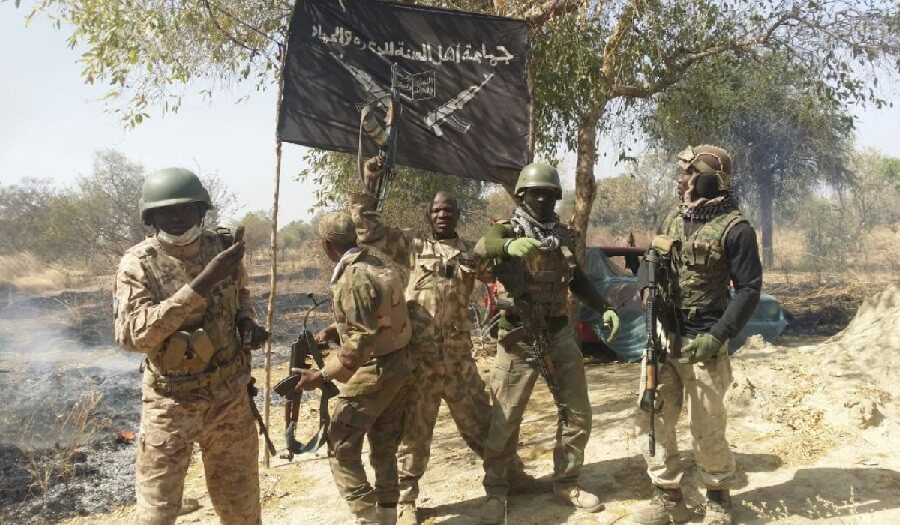
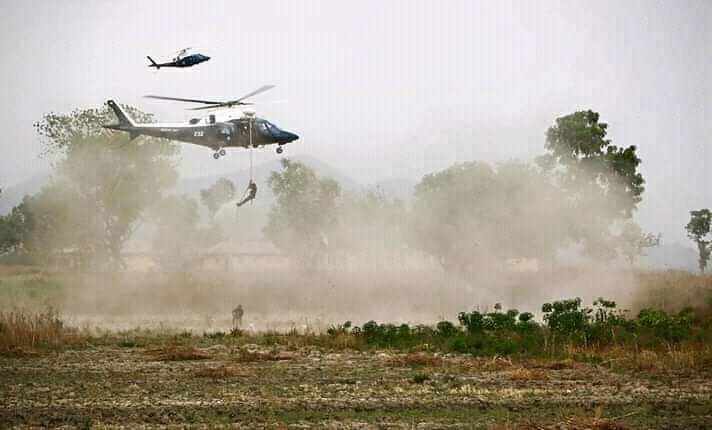
Again, Nigerian military engages ISWAP terrorists in Borno, kill 4
By Muhammad Sabiu
By Muhammad Sabiu
By Muhammad Sabiu
By Mukhtar Ya’u Madobi
Subject to its wider ramifications, the burden of maintaining security is too cumbersome to be single-handedly by a solitary institution in a heterogeneous country like Nigeria.
Thus, the multi-stakeholders’ approach is often more necessary where there is a rise in security challenges. Therefore, security should be a collective effort of the government plus other state and non-state actors, including the private sectors.
The word ‘security’ simply implies the protection of the lives and properties of people from various forms of threat. It occupies the highest level of priority in the hierarchy of responsibility by the government as one of the core values that the state cherishes as non-negotiable and that does not admit compromise.
The contribution of private sectors in ensuring security can be rendered through various channels, including the construction of security facilities, donations of logistics to security services and providing equipment at their disposal during emergency response situations such as fire outbreaks, accidents, building collapse and natural disasters such as flooding, earthquake, etc.
Other alternatives include community participation in securing their locality in collaboration with police, i.e. the neighbourhood watch or vigilante group, involvement of religious and traditional leaders in disputes resolution among their followers and services provided by the business enterprises to their host communities through corporate social responsibility (CSR) initiatives.
To that effect, the role being played by the famous Civilian Joint Task Forces (Civilian JTF), through collaboration with the security agencies in countering the violent extremism of Boko Haram terrorists in the North-East (Borno), is very commendable. Such volunteer groups provided invaluable intelligence that led to the uncovering of many deadly terrorist cells and their subsequent elimination.
Now that the terrorists are surrendering, community leaders, civil society groups and NGOs have a greater job to embark on sensitizing the mindsets of the public in de-radicalization, rehabilitation and reintegration of the repentant terrorists into society. This will go a long way in maintaining the security of lives and properties of people.
It is noteworthy that the CSR initiatives of the Aliko Dangote Foundation donated 150 operational vehicles to the Nigeria Police Force in 2018, which was described as the single most significant gift ever by a private sector operator to the police.
In the Niger Delta region, where the problem of insecurity is mainly attributed to the feeling of anger and frustration by host communities due to negligence of CSR initiatives, the oil companies have turned a good leaf by changing the narratives.
Multinational corporations are now actively involved in providing infrastructural facilities such as schools, hospitals, roads, and water supply to their host communities. In the long run, they also designed a special scholarship scheme for the indigenes. They are provided with tuition fees and reading and learning materials to further enhance their educational careers. This initiative has undoubtedly contributed immensely to reducing the militants’ activities and other security tensions in the oil-rich Niger Delta region.
Moreover, several societal figures and organizations were known for their efforts in constructing and rehabilitating security outfits across the country. Recall that, immediately after the #EndSARS protests in which several lives of both civilians and security personnel were lost, many properties were destroyed, police stations looted, their firearms carted away and subsequently destroyed.
The giant private sector-led Coalition Against COVID-19 (CACOVID) procured new equipment for police officers and pledged to rebuild the burnt police stations destroyed during the civil unrest to restore security to the affected locations across the country.
Even the traditional institutions were not left out as Oba (Alhaji) Dauda Ajolola Adebimpe Akinfolabi of Ayedade Local Government Area of Osun State built a divisional police headquarters and the office for the Nigeria Security and Civil Defence Corps (NSCDC) office. The monarch noted that the gesture was necessary to protect his people and ensure safety in his community, considering the rising insecurity in the country.
In addition, private security companies are also part and parcel of the security architecture of every country. The responsibility of a private security guard is ‘securing the lives and properties of the client’. The client may be an individual, organization, private institution, government, etc. However, experience has shown that guards can perform additional functions other than just protecting the lives and properties of the client.
Their large number and widespread presence make them a critical part of the security system of the nation. The NSCDC is the ultimate regulator of all private guard companies in Nigeria and has so far licensed over 1000 companies. Almost all residences, offices, schools, shopping malls, parks etc., especially in the city, are staffed by private guards securing their location. To that effect, their number has even exceeded that of the entire Police Force in the country.
Therefore, the government and the security agencies can take advantage of this opportunity to collaborate with private guard companies, especially in areas of intelligence gathering and sharing, training and joint task operations towards securing the country from the activities of criminal forces.
Sequel to that, Nigeria’s Policy Framework and National Action Plan for Prevention and Countering Violent Extremism, produced by the Office of the National Security Adviser (ONSA), retired Major General Babagana Monguno have succinctly acknowledged the role of the prominent private sector in national security.
As they say, Emergency Management is everyone’s business.
Mukhtar sent this piece from Kano. He can be contacted via ymukhtar944@gmail.com.
By Aminu Mohammed
“Aminu! I cannot travel to Afghanistan. I am afraid that the Taliban will kill me. I am not going anywhere and will rather die in Germany”.
These are the exact words by my friend and neighbour, Suroosh, who incidentally is from Afghanistan. According to him, going to Afghanistan is akin to signing his death warrant. Suroosh also narrated a gory tale about how a relative was hacked to death a few weeks ago by the Taliban just because he worked as a translator for the United States Embassy in Kabul.
This issue got me perplexed, and I became curious about why the Taliban wanted Surrosh dead. My neighbour revealed that he previously worked for an international non-governmental organisation in Kabul before moving to Germany for further studies. This alone puts him on target for elimination by the Taliban if he decides to visit Afghanistan.
I usually perform my Friday prayer at the Afghan mosque in my city here in Kiel. However, from my interaction with some Afghan nationals, I observed that feeling of hopelessness and agony. These people cannot go back to their country for fear of the unknown. Most of those I engaged in conversation with are afraid to go home for fear of being killed by religious zealots.
This article is not about the Taliban or Afghanistan; I want to draw our attention to the negative trend and how lack of proper understanding of Islamic tenets can lead to chaos and anarchy, resulting in mass suffering among the citizens. It should be noted that this discussion with my neighbour took place shortly after the Taliban took over the mantle of leadership in Afghanistan.
I have always refrained from engaging in any discussion about the myriad of challenges bedevilling Northern Nigeria. However, I realised that one could not continue to maintain silence when it comes to issues about one’s homeland. I am compelled to write this because I am worried about the current security situation in the North, especially kidnapping and banditry. The issue at home has become critical that we need to do whatever it takes in one way or the other to change the narrative.
I have observed with keen interest and dismay the incessant verbal attacks and altercation among our people, particularly our youths, over religious issues in various social media platforms and offline. We attack one another and show hatred and bitterness to our fellow Muslims just because of sectarian differences. This has degenerated to the extent that people within a particular sect will be tagging others who do not believe in their doctrine as infidels.
The Islamic scholars from various sects are not left out in this altercation and dangerous trend. Some make uncomplimentary remarks against other scholars and sects during their preaching and sermon, which always elicit amusement rather than condemnation from their audience. This has become constant and worrisome that we must try as much as possible to propagate against this; otherwise, it will not augur well for our society if we all keep quiet and refuse to act.
Let me, first of all, clarify some issues. First, I am not an Islamic scholar, and I do not claim to have a vast knowledge of Islam. However, having been taught by Sunni Islamic scholars from Pakistan, India, and Egypt at the College of Arabic and Islamic Studies, Afikpo, Ebonyi State, I can distinguish between right and wrong in Islam. Our teachers (at Markaz) never taught us to discriminate against other sects or abuse people that do not believe in our doctrine. I still don’t understand why our people dissipate energy on religious arguments and trivial issues to the extent of cursing one another.
Today, the North is no longer secure and safe. People are being hacked to death in large numbers. Religious intolerance has become a significant challenge in our society. We derive joy in casting aspersion on people and mocking those who do not believe in our ideology. This got me wondering whether there is something wrong with us. Why should we be fighting one another over different doctrines and sects? Is Islam in Nigeria different from the one being practised in other saner climes and countries?
Are we not concerned with the number of out-of-school children, illiteracy, industrial stagnation, high unemployment and the raging inflation in the North? Are the incessant killings of hapless villagers perpetrated by marauders and bandits in our rural communities not enough to wake us up from our slumber? I am afraid that if we continue on this trajectory, we will wake up one day and discover that we have no place to call home because of what we have done to ourselves.
Afghanistan is in chaos and ruins today because of this religious rascality, and I am afraid the North is heading in that direction. Prayer alone without action cannot stop the calamity that may happen if we fail to take action. Therefore, it behoves us as individuals and groups to start a conversation and see how we can live in unity and harmony with our fellow Muslim brothers irrespective of their sect and ideology.
We should learn to accommodate people in our midst irrespective of the sect they belong to or the religion they practice. We should endeavour to voice out against Islamic preachers who abuse other sects or do not share their ideology. Tolerance should be our watchword and the only key to our progress and prosperity as a people. We need peace and security for us to grow as a nation. Silence is no longer a virtue. We cannot remain silent and continue to watch as spectators while our region degenerates into anarchy.
Aminu Mohammed is at the School of Sustainability, Christian-Albrechts-Universität zu Kiel, Schleswig Holstein, Germany. He can be reached via gravity23n@gmail.com.
By Hussaina Sufyan Ahmad
There have been reports of attack by ISWAP fighters on a community hospital and telecommunication mast in the town of Mugumeri Local Government Area of Borno State on November 3, 2021.
It was gathered that the attackers stole some drugs and other medical consumables from the facility.
While the military exchanged gunfire with a group of the ISWAP fighters, the other group sneaked into the hospital to steal drugs, a refrigerator and some bedsheets, according to a source.
“They attacked the town from behind, burnt down Airtel mast and ransacked the hospital.
“They went away with drugs, a refrigerator and some bedsheets.”
Magumeri is about 40 kilometers away from Maiduguri, the state capital.
By Muhammad Sabiu
By Barrister Nura Sunusi
For some misguided individuals and those who consume everything online hook, line and sinker, David Hundeyin’s ‘Cornflakes for Jihad: The Origin of Boko Haram Story’, which he and his cohorts call ‘investigation’, would have been left to die a natural death like many before it. However, if allowed unchallenged, lies may be sold as truth, and the world will be blind. And those who know will not allow this. Besides, Hundeyin’s story is packed with journalistic chicanery of epic proportion.
Hundeyin’s sole aim was to push the lies he concocted down the throat of his readers/audiences. This is my concern. It is for this, I believe, such intellectual dishonesty has to be stamped out completely.
One cannot give what they do not have. Before I go far, Hundeyin deserves some quick bath; then let me stripe him naked first.
An Annang Christian ‘journalist’ from Akwa Ibom State in the South-South, Hundeyin is utterly ignorant of the vast northern region and its intentional predicates: background, history, language, culture, religion, etc. At this point, it is instructive to note that Hundeyin is not a lone walker in the use of this pure sophistry. There are some people in our midst toeing this path.
Izala, particularly Alhaji Shahru, Sheikh Yakubu Musa, Isa Pantami and other personalities belonging to the religious body, have been a target of a sustained campaign of calumny for its ability to bestride the earthly and heavenly with such ease. Of particular is a Nigerian ‘historian’, mind the quotation marks, who teaches at an American University.
This confused dude like Hundeyin has been at the forefront of this campaign for some time. Had he been allowed, he would have formed an empire, which modus operandi is to silence and blackmail the most peaceful, 40-year-old registered religious organization in Nigeria. About two years ago, perhaps long before that, the said ‘historian’ raised a finger in this corridor, and some intelligently educated youths called his bluff. He left mentally wounded.
I have learnt that Hundeyin’s hit-and-run piece has struck the ‘historian’, who has been mum all this while like a spent horse, as an energizer.
My perception of this saga is this: since those folks had test-flied this campaign severally and woefully failed, now Hundeyin is hired to try his luck and dead is his attempt on arrival.
That notwithstanding, to set the record straight, Hundeyin‘s piece deserves some response, which I give below, stitching facts and figures. Then let us take it one at a time.
Nomenclature of terrorism
First, the blurry line demarcating what terrorism is and what it is not, who is a terrorist and who is not is, is one of the factors breathing life into liars like David Hundeyin.
Although I intend to restrict this piece to Alhaji Shahru Haruna’s side of the argument, I will touch on some of the issues Hundeyin raised in his article to unravel the intricacies involved.
Hundeyin is overzealously blind in the sense that every passing picture of Islam or a Muslim forms in his mind a mental image of what he calls terrorism or terrorist. No wonder! Nigeria is full of academically certified but ignorant people. We will see this in the subsequent paragraphs.
Nigeria is not an opponent of GSPC
GSPC stands for “Groupe Salafiste pour la Prédication et le Combat” (Salafist Group for Preaching and Combat). According to Wikipedia, GSPC was an armed Islamic group UNTIL 2004!
The group had only one opponent, which was not Nigeria, but Algeria. Therefore, how did Alhaji Shahru Haruna or Sheikh Yakubu Musa become the GSPC’s agents?
Politics of origin
The moment he tried to conjecture up a triangular of Izala, terrorism, which he barely understands, and finance, Hundeyin shot himself in the foot. His is a weak argument full of lacunas, fabricated evidence, and disjointed analogies. Is there anything hatred cannot drive one to do?
From Sheikh Abubakar Gumi to Alhaji Shahru Haruna, Sheikh Yakubu Musa to Isa Aliyu Pantami, the current minister of Communications and digital economy and others, Hundeyin has failed to come up with even a single irrefutable proof linking any of them with terrorism. Instead, his submission heavily relied on hearsay, including social media posts.
First, Izala’s deeply established manifestoes/objectives to non-politically strive and promote the pure teaching of Islam and proselytizing, which is acknowledged even by non-Muslims in the West, is for anyone to see.
Second, Izala’s leading figure, Sheihk Abubakar Gumi, the Grand Khadi of the Northern region of Nigeria between 1962 and 1967, was a champion of democracy. He encouraged Islamic and Western educations; and associated with upright political figures like Aminu Kano, Sa’adu Zungur and Sardauna of Sokoto.
Moreover, Izala is a progressive organization. It has established schools, libraries, hospitals, Islamic centres, and satellite TV stations, and now Assalam Global University in Jigawa is in the pipeline. Unlike its nemesis, its members participate in political activities, and they vote and are voted for into political offices. In addition, they are into academia and civil service.
In contrast, Boko Haram, which is the opposite, is an insurgent group engaged in continued rebellion against the constituted authority. The insurgent group ideology is rooted in a gross misinterpretation of Sunni and Salafi Islam, and it primarily attracts poorly educated and overzealous youths that lack even basic Islamic knowledge.
Where is the link?
Consequently, that in 2011 bombs went up at St. Theresa Catholic Church, Madalla, a fringe of Abuja and Gadaka in Damaturu; and during the trial of one Kabiru Sokoto, a ‘masked’ witness testified that an Islamist group in Algeria provided funding and support worth N40,000,000 ($250,000 at the time) to carry out the attacks, is not enough reason to inculpate either Sheikh Abubakar Gumi, Shahru Haruna, Yakubu Musa or other Izala personalities, is it?
Let’s try this formula to see if it works this way: on October 1, 2010, bombs went off, killing 15 people during Nigeria’s fiftieth anniversary. An ex-MEND leader, Henry Okah and one Nwabueze were convicted of terrorism.
If Kabiru Sokoto or attacks by Boko Haram insurgents were to be linked to Izala and Alhaji Shahru for a simple reason that Izala is an Islamic organization and Shahru is a Muslim and a member, as Hundeyin would have us believe, who sponsored Henry Okah and his accomplice? Hundeyin, who is also an overzealous Christian and a southerner?
From the inception of Boko Haram to date, Izala, as against other violent religious movements, has never been on the same wavelength with any insurgent group.
Facts speak for themselves, they say. Had Izala clerics been complicit in the activities of the insurgents, Boko Haram leadership would never have called for the heads of Pantami, Sheikh Jaafar Mahmud Adam or Sheikh Muhammad Auwal Adam Albaniy Zaria.
It seems those who planted the piece have not briefed Hundeyin of the fate of the two fiercest critics of Boko Haram in the Izala cycle: Albaniy Zaria and Ja’afar. Boko Haram murdered both in an attempt to silence the persistent voice that had been voicing the irreligiosity of Boko Haram and insurgency of any type.
One does not need to strain himself. Videos showing Izala Ulama in a heated debate with the Boko Haram founder, Muhammad Yusuf, are on YouTube. An example is that of Sheikh Pantami.
Journalist or religious bigot
Nigeria’s media space is saturated with ethnic and religious bigots, and David Hundeyin happens to be one of them.
He quickly cited that ‘the scholar(s) states that Muslims should never accept a non-Muslim as ruler, which can be interpreted as a call for insurrection against a Christian Nigerian President’. However, he could not tell his readers how pastors ascended the pulpit of churches and made similar calls, which can also be interpreted as another call for insurrection against a Muslim Nigerian President as we see today?
Ideology of Finance
Who deceives who? If there is anything Hundeyin succeeded in linking Alhaji Shahru Haruna to is his tie with Izala and his being an owner of legitimate businesses – nothing more.
Citing CBN Governor Godwin Emefiele’s argument that BDC operators sell dollars to some people ‘to go and buy arms and ammunitions to come back to hurt us’ is no clear-cut evidence to implicate Alhaji Haruna.
A call to CBN
It is high time for CBN to furnish the public with the reason for its instruction to banks to block bank accounts of some entities such as Zahraddeen Shahru Haruna’s (Alhaji Shahru Haruna’s son).
I believe that the failure of the apex bank to provide the information is one of the chief reasons behind Hundeyin’s evil pen attempt to link the Zaharaddin’s account blockage to terrorism.
Shahru’s media trial
Shahru Haruna’s media trial began sometime in 2004. And to understand this better, I will refer the reader to a defunct Weekly Trust newspaper front cover story in 2004 titled ‘Detention Without Trial’.
The paper narrated a sympathetic story of how Alhaji Shahru Haruna was arrested and detained by DSS without trial for six consecutive months.
However, the interesting part of the story is how the secret police discharged him unconditionally. Since then, there has been no re-arrest by the DSS or any other relevant security agency. What does that imply?
My conclusive argument is that Hundeyin of Akwa Ibom’s piece is yet another failed smear campaign against Alhaji Shahru Haruna, Sheikh Yakubu Musa, Izala and some of its personalities. It is another mischief that has its sponsors.
Barrister Nura Sunusi writes from Kano. He can be reached via nurasunusi6@gmail.com.
By Hussaina Sufyan Ahmad
Reports of sporadic gunshots and explosions behind 777 Housing Estate at the outskirts of Maiduguri metropolis, the Borno State capital, late Saturday night have gone viral.
The incident was said to have started at about 10:15pm. The residents of Pompomari, 778 and 1000 housing estates confirmed the heavy blasts and gunshots as they were put on alert to be safe and secured for any eventuality.
According to Vanguard news, Nigeria Airforce helicopters hovered after deployed to the vicinity in order to repel the attack suspected to have been masterminded by terrorists group of ISWAP.
By Aminu Nuru
“The most dangerous untruths are truths moderately distorted”. – George Lichtenberg
It is not uncommon that some public commentators and analysts could be mischievously deceptive in their narratives and analyses of history to accomplish an end. They could quote historical facts, mix them with fiction, and frame narratives to promote a single story. In some cases, they deliberately relegate and ignore some significant events or points to suit the writer’s bias. Recent writings on the origin and rise of Boko Haram demonstrate how some writers distort facts to frame narrative and promote bigotry.
For instance, if one can closely study the framing of Boko Haram and how it is brazenly becoming one-sided, then one can say that the whole history is rewritten to massage and satisfy the ego of some group’s bigotry. It is not farfetched to say that some of these bigots will soon claim that the generality of the Muslim North endorsed and supported Boko Haram and Nigerian Christians were the only targets and victims of the group’s deadly attacks. Why would I make such a sweeping projection with every sense of finality? To respond to this question, let’s go back to 2013.
While speaking at the 14th meeting of the Honorary International Investor Council (HIIC) held at the Banquet Hall of the Presidential Villa on June 22, 2013, former Nigeria’s President, Goodluck Jonathan, a Christian, disclosed that the Boko Haram sect had killed more Muslims than Christians in Nigeria. This is not just hearsay but a verifiable fact that is naked in vision to people that are not be-clothed with hatred, ethnic and religious jingoism.
However, the Christian Association of Nigeria (CAN) couldn’t swallow this fact and, therefore, issued a statement to disagree with him vehemently. In a press statement credited to the Northern chapter spokesperson, Elder Sunday Oibe, CAN said that Jonathan’s assertion was “misleading and unacceptable”. They further stated that,
“We want to believe that the president was misquoted; we don’t want to believe that with the security apparatus and report from security intelligence network at his disposal, he made this assertion. If it is true that Mr President actually made this assertion, then, we are highly disappointed and sad at this veiled attempt to distort the fact as it concerns the activities of the Boko Haram sect. The purported statement by the President is highly disappointing considering the facts that Christians, churches and their businesses have been the major targets of Boko Haram” (Sahara Reporters, June 23, 2013. http://saharareporters.com/2013/06/23/northern-can-disagrees-jonathan-says-boko-haram-has-killed-more-christians-muslims)
For CAN, the Boko Haram crisis was/is “religious by nature” – the familiar we-versus-them religious clashes and conflicts in Nigeria, although in different outlooks and techniques; it is a plot by some Muslims to reduce the populations of Christians in Nigeria and crackdown their businesses. Since then, CAN sympathisers subsequently frame their narrative of Boko Haram from this angle. An article titled “Cornflakes for Jihad: The Boko Haram Origin Story” by David Hundeyin, widely shared on social media in the last few days, aimed to promote this kind of narrative. Unfortunately, the author skillfully filled the article with half-truths and a mixture of facts and fiction to push the CAN’s sentiment. Hundeyin is practically siding with his former religion.
Firstly, Hundeyin makes an effort to link Sheikh Abubakar Mahmoud Gumi with the origin of Boko Haram. Many people think that Hundeyin’s “Cornflakes for Jihad” is the first futile effort by an “investigative” journalist, analyst, historian or whatever to make this manipulative effort. However, Andrew Walker’s thesis, “Eat the Heart of the Infidels: The Harrowing of Nigeria and the Rise of Boko Haram” (Oxford University Press, 2016), preceded it in that exercise. Therefore, it is not likely to be a false accusation if it is argued that Hundeyin copied the idea of featuring Gumi in discussing Boko Haram, almost verbatim, from Walker. From the arguments of Sheikh Gumi’s “influence” in the “political” realm of Nigeria to his “friendship with Ahmadu Bello”, to pioneering the “propagation of Wahabism” in post-independent Nigeria, to his contribution in the creation of Izala and his “Saudi connection” are equally and loudly echoed in Walker’s thesis.

For both Walker and Hundeyin, Sheikh Abubakar Mahmoud Gumi championed the Sunni/Salafi/Izala movement in Nigeria. Therefore, any account of the origin and rise of Boko Haram – a so-called Sunni/Salafi-fundamentalist terrorist group – must be traced back to him. Albeit impliedly, their submissions suggest that there would be no Boko Haram if Gumi did not “disrupt” the Sufi order and influence of Qadiriyya and Tijjaniya in Northern Nigeria. They claim that Gumi’s campaign of a corrupt-free practice of Islam inevitably gave birth to the radical movements in Northern Nigeria. This is to say, although without explicitly stating it in their works, every Sunni/Salafi-based movement in Nigeria, whether moderate or violent, must have had their inspirational source from Gumi. On the link between Boko Haram founder, Muhammed Yusuf, and Sheikh Gumi, Walker writes: “The title of Yusuf’s book deliberately echoes the titles of similar treatises by Sunni preachers, like Sheikh Gumi’s “The Right Faith According to the Sharia”, perhaps in order to lend his ideas credence…the two clerics share a revulsion for secularism..” (Walker, 2016:144).
This line of argument is even less faulty in logic and spirit of “balanced story” than what Hundeyin further orchestrated in his article. According to Hundeyin, Sheikh Gumi admonished Muslims, particularly his Sunni/Salafi followers, to reject a non-Muslim as a leader and advocated “for insurrection against a Christian Nigerian President” and, of course, his Christian followers. In the successive paragraphs that supported this claim, Hundeyin apprises his readers on the “consequence” of Gumi’s propagation; he states that after Gumi’s death, a Sunni/Salafi-indoctrinated group, which bears the name “Boko Haram”, toed to the path of his admonishment to carry weapons against Nigerian Christians, killing and bombing them in their churches. He wittingly makes reference to the bomb blast at “St. Theresa Catholic Church”, Madalla that “killed 37 people”, and other subsequent “killings of Christians” in Jos and Damaturu.
The implication of this narrative on an outsider, who does not know the context of Boko Haram terrorism in Nigeria, is that s/he would begin to see Sheikh Gumi as “problematic” and a source of Boko Haram’s inspiration and violent extremism. Secondly, a non-pragmatic reader may also assume that the group only targets Nigerian Christians in their series of attacks in the country. Hundeyin’s article aims to peddle that twisted narrative for no reason other than the writer’s hatred for the Muslim North (Arewa) and their Islamic culture. In one of his previous tweets, he heedlessly says that: “The world will be a significantly better place when Arewa culture completely dies off and is replaced with something fit for human civilisation” (David Hundeyin/Twitter, November 29, 2020).
In the spirit of fair analysis, it is expected that an impartial analyst would compare the socio-religious ideas Gumi propagated in his lifetime and the ideologies of Boko Haram. But this would not sell out Hundeyin’s bigotry, and so he ignored that vital aspect. The core centre of Boko Haram dogmatic tenets is a war against “western-styled” education, democracy and civil service. On the other hand, Sheikh Gumi was both a product and proponent of western-styled education; he worked with the government as a civil servant and received salaries from the state resources. As he proudly opined in his autobiography, “among [his] children were army officers, civil servants, medical doctors, an engineer…lawyers, teachers and workers in finance houses and private businesses. There was hardly any profession in which [he] did not have representation from [his] family” (Gumi with Tsiga, 1991:202).
Gumi was also pro-democrat, as evidence from his recorded preaching suggested so. He is famously quoted to have said, “siyasa tafi sallah”, which could loosely mean “politics is more significant than prayers”. This was the extent Gumi had gone to support democracy in Nigeria, and believe me, Shekau would not hesitate to call him “taghut” – an idolatrous tyrant. He had also worked closely with the Christian Head of States. They had a cordial relationship and respect for each other: Ironsi invited him to lead a delegation to North Africa and the Middle East to carry goodwill messages of his new regime; Gowon appointed him Chairman of the Nigerian Pilgrims Board and gave him “all the necessary support, although he himself was a Christian”; with Obasanjo, he could “freely talk” and express his mind on relevant socio-political issues (Gumi with Tsiga, 1991:203). However, Hundeyin willfully refuses to draw this analogy to give a sense of what Achebe called “a balanced story”. Instead, he purposely portrays Sheikh Gumi on the wrong page in the book of terrorist origin in Nigeria.
Contrary to the insinuation of Hundeyin moreover, the truth of the story is that Boko Haram did/do not target Christians only. In fact. Nigerian Muslims suffer(ed) more causalities than Christians in the Boko Haram conflict. Hundeyin refuses to mention the main enclaves of Boko Haram activities and the population ratio of Muslims and Christians there. Stating this factual data will indeed not favour his intended, warped story. The reality is that Muslims have the predominant population in Borno, Yobe and Adamawa States. Arguably, the cumulative of all Boko Haram killings of innocent people would show nothing less than 70% of Muslim casualties.
On a specific, direct attack on religions, Hundeyin only mentions the bomb blast at St. Theresa Catholic Church, ignoring similar incidents on August 11, 2013, at a mosque in Konduga where 44 people were killed and on November 28, 2014, at the central mosque in Kano where 120 people were killed (BBC Hausa, 2013, 2014). It is understandable if Hundeyin re-echoes the bomb blast at St. Theresa Catholic Church in his article; it is a show of solidarity to his ex-religion. However, what is faulty and even worrisome is the selective exemplification of the direct attacks on religions by the Boko Haram insurgents. A reader who is unacquainted with the details of Boko Haram attacks on places of public worship would feel that churches and Christians were the only victims.

To further promote this half-truth, Hundeyin moves on to tell us how a Salafi/Sunni preacher was directly linked with the funding of Boko Haram. I will neither attempt to exonerate Sheikh Yakubu Musa nor believe those serious allegations in toto without reading or hearing the Sheikh’s version of the story. However, my problem here is with Hundeyin’s failure, which is intentional, to mention the Salafi/Sunni preachers that fought Boko Haram vehemently and even paid the ultimate price with their lives. It is on record that at the early stage of the Boko Haram crusade, Salafi scholars debated Mohammed Yusuf. In Bauchi, for instance, Ustaz Idris Abdulaziz Dutsen-Tanshi, a Salafist to the core, invited and challenged Muhammed Yusuf at his mosque and in the presence of his followers; so also a young Isa Ali Pantami – the then Imam of ATBU Juma’at mosque.


These Salafists continued to be critical of Muhammed Yusuf and his sect. They consistently delivered lectures to denounce his fatwa. Sheikh Ja’afar Mahmoud Adam, an unapologetic Salafist, was particularly vocal in his public censure and condemnation of Boko Haram. Unlike Hundeyin, Walker states this fact in his book:
“In 2007, Yusuf ’s former teacher, Sheikh Ja’afar Mahmud Adam, himself an ardent Salafist, had gone on record to denounce the group and warn that these ideologues were heading for a violent confrontation with the state” (Walker, 2016:148).
For many, Sheikh Ja’afar was the spiritual successor of Sheikh Abubakar Mahmoud Gumi. Some influential people requested and later attempted to transfer his annual Ramadan Tafseer to Gumi’s preaching base, Sultan Bello Mosque, Kaduna. He conducted his annual Ramadan Tafseer in Maiduguri, the early and central territory of Boko Haram terrorism. During his Tafseer sessions, Sheikh Ja’afar was not reluctant to criticise Yusuf and his new sect. On April 13, 2007, a day to general elections in Nigeria, and barely 48 hours after delivering a talk in Bauchi on Islamic views on thuggery, violence and widespread killing of innocent souls, Sheikh Ja’afar was murdered in Kano while observing Subh prayer and “it is thought to be members of Yusuf’s sect” (Walker, 2016:148).
Another prominent voice among Salafists in the fight against Boko Haram was Sheikh Muhammad Auwal Albani, Zaria. But, unfortunately, he was also killed in cold blood. In a video released to the public, Muhammed Yusuf successor, Abubakar Shekau, took responsibility for the assassination (Sahara Reporters, February 20, 2014, http://saharareporters.com/2014/02/20/bo-haram-leader-claims-responsibity-killing-kaduna-cleric-sheikh-albani-threatens).
Hundeyin has ignored all these facts about Salafi preachers in Northern Nigeria but brought a single dubious claim to frame a narrative that would deceive an uncritical, vulnerable audience. His motive is clear: he wants to rebrand the entire population of Salaaf and the Muslim North as pro-terrorist, supporting the killings of Christians in Nigeria. It is rather unfortunate that this is where the discussion is heading, and it is a wake-up call to those of us that witnessed and had a first-hand experience of the Boko Haram crisis to begin to write our counter-narrative. If we don’t write it, others will write for us. And before we retrieve our consciousness, we will be afloat in a sea of half-truths and stereotypes on Boko Haram, Islam and the North.
Aminu Nuru wrote from Bauchi. He can be contacted via aminuahmednuru@gmail.com.
By Muhammad Sabiu
David Hundeyin, a self-styled investigative journalist who has in recent months become popular on social media, has come under fire over his about-a-year-old tweet condemning “Arewa” and its culture.
According to Mr. Hundeyin, the world would be a better place to live in without the “uncivilised” Arewa culture because he has“[n]ever seen a culture that hates outsiders and somehow detests its own women worse than it hates [the] said outsiders.”

“The world will be a significantly better place when Arewa culture completely dies off and is replaced with something fit for human civilisation,” he added.
The digging up of the tweet could not be unconnected with a recent, viral, controversial article he wrote titled “Cornflakes for Jihad: The Boko Haram Origin Story”, in which he tried to give the history of Boko Haram in Nigeria and presented what many described as “conspiracy theories” and “hasty conclusions.”
Airing their grievances against Mr. Hundeyin’s derogatory tweet, many Facebook users from the North took the issue to their timelines.
For instance, Dr. Ahmad Shehu suggested that legal action should be taken against people making such negative stereotyping.
“The north should make an example of these idiots. I hate it when we seem passive against these kinds of bigots. I enjoin our legal activists to take these kinds of people to court for stereotyping,”Dr. Shehu wrote.
Similarly, another user, who goes by the name Abubakar Sulaiman, sees him as somebody with a dangerous mindset. “The question that crosses my mind is simply why do they hate us? This is the dangerous kind of mindset David Hundeyin and his ilks use to delve into archives.
“So what was made to look like an investigative journalistic endeavour by the likes of David Hundeyin was simply a pre-conceived idea supported by witty though foolish biased selection of data while ignoring a significant portion of related data that may contradict that pre-conceived idea. A clear case of cherry picking,” he said.
Also, according to Adam Baba Yamani, Hundeyin is nothing but a bigot and hater of anything that has to do with the North and Muslims.
He wrote,“Hello my people of the North (Arewa), if you think David Hundeyin is not a bigot and a hater of anything North and Muslims, take your time and glance at what he wrote on his Twitter handle, don’t be deceived by the cloak of journalism he is wearing, his intent is to replace you, your culture and Way of life with the one of his choice, for those among us that are applauding David Hundeyin for his “Conflakes..”, please read, research and cogitate.”