ASUU

Academic dream: My research, my citations, my h-index, and the “true impact”

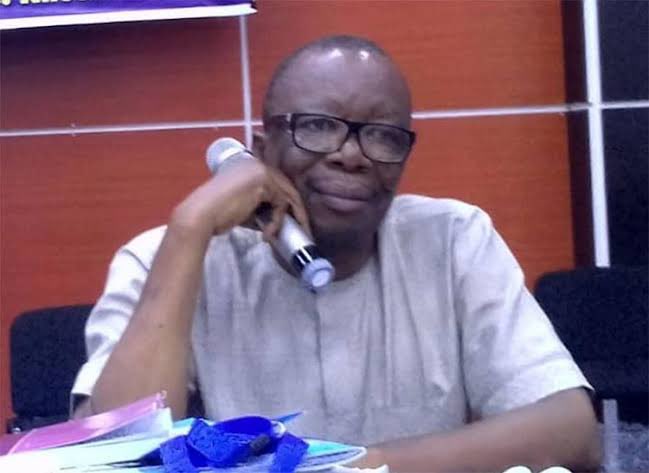
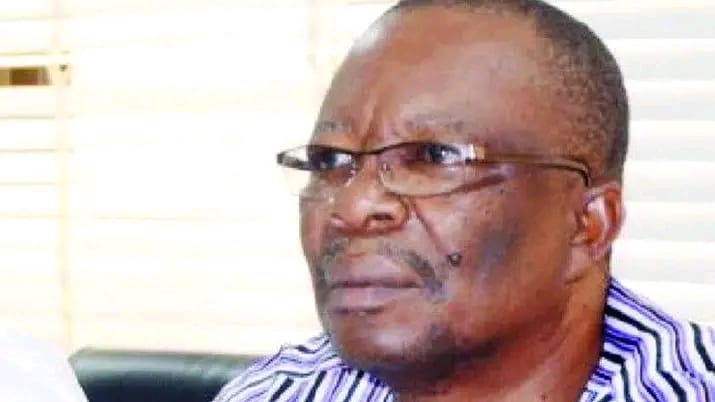
By Prof. Abdelghaffar Amoka

Colleagues have been sharing their experiences as academics in Nigerian universities with several reactions. The essence is not to discourage people from going into academia but to know what lies ahead of you if you want to go into academia. Like most colleagues, I had no idea of the challenges in Nigeria’s academia when I was so eager to join. For example, I never knew the job is for 24 hours, and that promotion is based on research output you will fund from your pocket.

After graduating in 1999, I looked forward to being part of the academia. During my youth service in Kano, I visited the HoD of Physics, ABU Zaria, Prof I. B. Osazuwa, to discuss my “academic dream”. He directed me to the late Prof. N. I. Hariharan. I met him, and he advised that I should enrol for MSc. So, in 2001 on my way from Kano, I stopped over in Zaria, purchased the PG form, and left for Lagos.

As we were job-hunting in Lagos, I remember my friend and Brother, Yusuf Osafore, saying it appears I was not taking the job hunting seriously but was more concerned with pursuing a Master’s degree. My looking forward to becoming an academic was so apparent to people around me. Then, I eventually got hired in March 2005. It was a dream come true. I have finally joined the group of intellectuals. The “most revered” group in the society. A group of knowledge generators. A group of reservoirs of knowledge.

After a few months in the university, they revealed the reality of Nigerian academia. The fact that I had no prior knowledge of. There are, of course, viable ideas, but they die within the university walls because the political class isn’t interested in them. The ideas are published, but it is just for promotion’s sake. I paid N7,000 or so to publish my first paper in a Nigerian university-based academic journal in preparation for the next promotion to Lecturer II. These made me begin to meditate on “my academic dream”.

In 2007, I had the opportunity to visit ICTP for a two weeks workshop, and my interaction there revived my academic dream. Then, in 2009, I got lucky and left the country for my PhD, strengthening my revived “academic dream”. My joy knew no bounds when I published my first research paper in an Elsevier-indexed Q1 journal in 2011. From then on, the papers kept coming.

There are two publication options. You either publish in close access journals where publishers are paid for access to your research work, or you pay between $1,500 to $3,500 to publish as open access for everyone to have access. I remember spending some dollars in 2014 to publish the last paper from my PhD work in Elsevier’s Sustainable Materials and Products journal as open access. That money came from my salary in Norway.

We were told that research impact is based on the number of citations one has. Something they called h-index was brought to classify our research impact. I began to monitor my citations and h-index on Scopus, ResearchGate, and Google Scholar. I usually wear a smile on my face whenever I receive citation alerts. As the promotion period approached, I counted my number of publications and was excited as my number of citations grew. We began to use Scopus h-index to rate academics. Unfortunately, we get carried away so much that if you talk too much, we ask, “What is your Scopus h-index?”

The irony is that you look for money (either grant or personal fund) to do research and get it published in a reputable journal after rigorous reviews (reviewers work for free) and are excited for an additional paper to your credit. Brag that you have so many articles in indexed journals and get promoted for a peanut added to your salary. In Nigeria, you become a Professor to earn about 440 USD (N325,000) per month. You proudly go around with the title (Prof). Meanwhile, a multi-billion dollars cooperation makes money from your sweat and the knowledge you have laboured to create. And all that we are happy with are citation alerts, a growing h-index, and promotions that come with peanuts.

The best publication time is during our young age. As we grow older, our students take over the writing. Then, the university will ask why you are the paper’s first, second, or last author. They have got no idea how it was funded. The academic dream can truly be defined as spending our entire youth creating knowledge and paying a billion-dollar corporation to take it from us in exchange for career capital that you can then use to buy meaningless promotions from other exploited individuals.

Sometime back, I logged into the university network, and the research output of a senior colleague on Google Scholar was highlighted on the university webpage with thousands of citations and a high h-index. So I decided to follow the link to check mine. Mine was very much below his, but it wasn’t that bad. So then, I sat down and began to question the true impact of my research work beyond what Google Scholar has evaluated.

Do a mere citation of our publications truly translate into research impact? Research is global, but you should see your work impact your immediate environment. We have Professors with thousands of citations that can’t present an inaugural lecture, faculty colloquium, or even a departmental seminar; so, what is the impact of our research on our immediate community?

I tried to reflect on our impact, especially as Professors and Farooq Kperogi came to mind. I remember checking on him on Scopus when he became a Professor in the US. However, when I later reflected on his writeups on Nigeria’s sociopolitical scene and the healthy discussions he had generated towards repositioning the country, I began to realise that Farooq has made much more impact on Nigeria than many of us with a better presence on Google Scholar, Researchgate, and Scopus.

Let me introduce myself properly—a Professor of Physics specialising in dielectrics and high-voltage electrical insulation. I have 33 research documents indexed in Scopus and an h-index of 11, 13, and 14 in Scopus, Reseachgate, and Google Scholar, respectively. In addition, I have about 585 citations on Google Scholar. My published research articles are on high-voltage insulation. Still, the articles and the citations, put together, have not impacted our electricity network in Nigeria, which is on a breakdown spree. So, what, then, is my impact?

Universities are identified as keys to innovation, from developing new ideas to providing state-of-the-art facilities. Industrialists and managers of the countries engage them in keeping the workflow full of new ideas. But in Nigeria, our university system has been made the most insignificant institution that has been reduced to lecture rooms. We only publish to avoid perishing.

Everywhere in the world, academics are respected and heard when they talk. But in Nigeria, especially during the Buhari government, they are tagged as enemies to crush. Our universities were once places where policies evolved. Academics generated ideas that shaped the country. Discussions in academia are used to shape the policy development of our nation. The golden time of Bala Usman can never be forgotten. What happened to those intellectual discussions? Who killed it? We now chase appointments within and outside the universities, especially after we become ‘Professors’.

Nigeria has been messy for the last eight years, and universities are in the worst state ever. But the government of Buhari used eight years to run away from education stakeholders’ engagement. The political class are educated people with no value for the education of the people. The best gift that Buhari gave to the people that so loved him was to strangulate the public universities for the people. Rather than having a public engagement on how to salvage the situation he was well aware of before his appointment, the outgoing Education Minister, Adamu Adamu, described the backwardness that they have imposed on us as “self-imposed backwardness” and their idea of the solution is by approving the establishment of more substandard private universities in the North.

The incoming government of Bola Ahmed Tinubu needs to come in with a clean and open mind to engage the academia with sincerity. They should look at ASUU as partners in progress rather than enemies to crush. The solutions to our problems are right in our hands if we are willing to engage each other. On the other hand, academia needs to start looking beyond publishing, not to perish. We need to start thinking beyond journal publication impact that has no impact on our immediate constituency, Nigeria. We need to wake up and revive the golden days of Bala Usman on our university campuses.

©Amoka
Aftermath of ASUU strike and the hike of university fees

By Safiyanu Ladan

The Academic Staff Union of the Universities (ASUU) embarked on an indefinite strike on the 14th February 2022, following years of unresolved issues with the federal government. During the period of the strike, the union had on several occasions met with the federal government representatives headed by the labor and employment minister Chris Ngige with a clear mandate to find a long and lasting solution to the lingering problems but to no avail as the meetings have always ended in deadlock.

Tired and frustrated with that, In September last year, the federal government through the ministry of labor and employment took the union to an industrial court, praying to the court among other things to order the varsity teachers to resume classes with immediate effect. The outcome of the court’s judgement favored the federal government. Paradoxically, the appellant court refused to entertain ASUU’s appeal, saying that until and unless they obey the lower court’s judgement of going back to classes.

The intervention of the speaker, house of representatives Right Hon. Femi Gbajabiamila has paved the way for the varsity workers to get a soft landing in what seems like an unending fracas with the Federal government.

Prolonged and incessant ASUU strikes were this time around followed by a heavy price as the federal government reiterated that, the no work no pay policy has been duly applied to the striking workers. The federal government decision to withhold their salary has generated heated debates and threats from ASUU, but the government remains adamant. Closing down of Universities is at the detriment of students because they are always at the receiving end.

Having been tried but failed to convince the FG to pay the arrears of the past eight months of ASUU members, the management of some universities have decided to compensate that with an increment of students’ school fees. It’s no longer news that some universities have deliberately increased their fees to more than 100%.

It’s now crystal clear that this increment will affect many students because their parents cannot afford to pay such whopping amount of money as school fees. In the meantime, the mass exodus of students dropping out of the universities most especially in the North is imminent. Leaders and everyone should know this. Many students have expressed their worries on the trend and their final resolve to quit.

Safiyanu Ladan wrote from Zariya City and can be reached via uncledoctor24@gmail.com.

FG is trying very hard to destroy Nigeria’s educational sector – ASUU KUST

By Ibrahim Mukhtar

The members of Academic Staff Union of Universities, Kano State University of Science of Technology (KUST) Wudil have issued a strong warning to Nigerians that the current happenstance in the Nigeria’s educational sector may be a deliberate attempt to destroy the country’s higher education.

In a press statement signed by the duo of Comrade Muhammad Sani Gaya, the Chairperson ASUU KUST and Comrade Murtala Muhammad, Secretary ASUU KUST, they maintained that, despite such evil intents, Nigerian academics have powerful excellent records all over the world.

Part of the release says:

“Members of Academic Staff Union of Universities (ASUU) suspended its eight-month strike action in compliance with Court directives as a Union of intellectuals and law-abiding citizens. It is however, quite disheartening that the Federal Government under the present administration of Major General Muhammad Buhari (rtd) resolved to withhold seven months salaries of our members and payment of pro-rated salary for the month of October 2022. This decision is ill-informed and a clear demonstration of either government’s ignorance on the responsibilities of academic staff or a flagrant abuse of office. The duties are clearly spelt out in the laws establishing the universities, which are easily verifiable.

As at today, Nigeria ranked third (3rd) in Africa with highest number of documents in Scopus database as indicated in Scimago (https://www.scimagojr.com) due to volumes of research outputs. Equally, in other reputable international databases, the Nigerian academics are making the country proud despite the precarious working condition and deliberate underfunding.”

It was also reported in the release that members of ASUU KUST sensed that all these kind of ill-treatment that is meted upon the Nigerian academics is done in order to frustrate the lecturers to abandon their duties, as the current rulers of Nigeria have nothing to lose.

“The ill-intent of this administration to deprive teeming Nigerian youths from quality university education and destroy the public universities was clear from the ugly utterances of Ministers of Education and that of Labour and Employment. Furthermore, the act of withholding the seven (7) month salaries and payment of October salary on pro-rata basis is another testimony. The Federal Government may wish to be reminded that academics in the Nigeria Universities are not casual staff.

ASUU-KUST therefore condemned in strong terms, this singular action and call on Federal Government to immediately address the issues for industrial harmony to be sustained. Mischievously, the Federal Government deliberately refused to implement all the agreements freely/duly signed in 2017, 2019 and 2020. This is not unconnected with the fact that the wards of ruling elites are either schooling abroad or in private universities in Nigeria. For the records, we want the public to note that the union will never be distracted from salvaging Nigerian University system.” the statement further says.

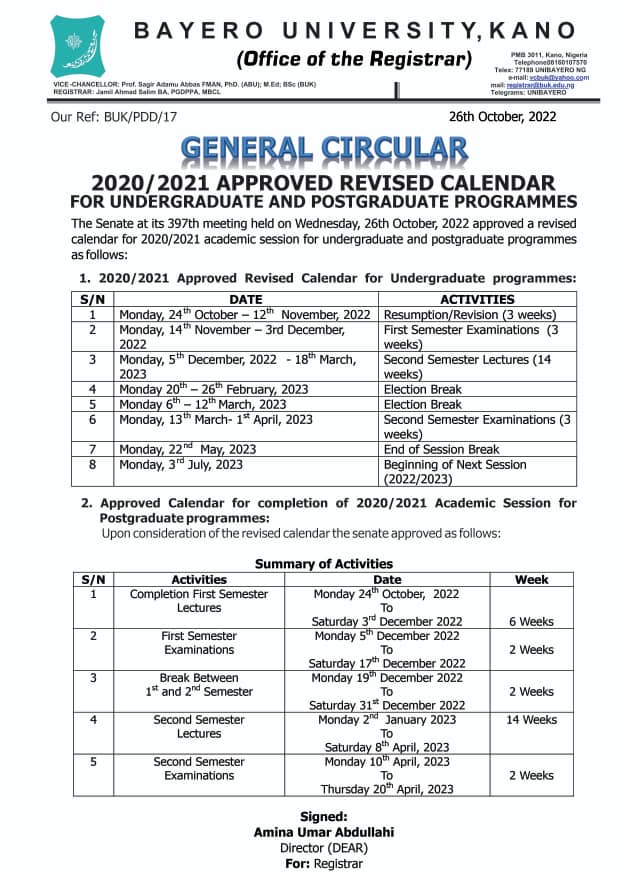
BUK revises calendar, gives students 3 weeks for revision

By Uzair Adam Imam

Following its resumption on Monday, the Management of Bayero University, Kano (BUK), revised its academic calendar, giving the students three weeks to revisit their previous lectures before exams.

The decision by the management was a result of a Senate Meeting held today, Monday, October 26, 2022, at the university’s Convocation Arena.

The university was about to start its first-semester examination on February 16 when the Academic Staff Union of Universities (ASUU) embarked on a strike.

The industrial action by the union, which lasted for eight consecutive months, started on February 14, 2022.

The university lecturers embarked on the total shutdown of the universities to press their demands home, which they said the Federal Government failed to fulfil.

However, after several disputes between the Federal Government and the ASUU, the union ended its strike just recently. Still, many students, parents and even most lecturers are not enthusiastic about the resumption. This is simply because the lecturers are still left stranded by the FG without payment of their salaries. If the salaries are paid, it will surely and greatly serve as a motivating factor for a vibrant return of the lecturers to their classes.

We suspended the strike despite our demands not met – ASUU

By Ahmad Deedat Zakari

The Academic Staff Union of Universities, ASUU, has suspended its eight-months-old strike.

The union disclosed this in a press statement signed by its president, Emmanuel Osodeke, on Friday.

Speaking on the reasons for the strike suspension, ASUU said the intervention of President Muhammadu Buhari and the Speaker of the House of Representatives, Femi Gbajabiamila were imperative for the suspension of the strike action. The union argues that their demands were not satisfactorily addressed .

The statement partly reads: “While appreciating the commendable efforts of the leadership of the House of Representatives and other patriotic Nigerians who waded into the matter, NEC noted with regrets that the issues in dispute are yet to be satisfactorily addressed.

However, as a law-abiding Union and in deference to appeals by the President and Commander in Chief of the Armed Forces of Nigeria. His Excellency, President Muhammadu Buhari, and in recognition of the efforts of the Speaker of the House of Representatives, Rt. Hon. Femi Gbajabiamila, and other well-meaning Nigerians, ASUU NEC resolved to suspend the strike action embarked upon on 14th February 2022.

Consequently, all members of ASUU are hereby directed to resume all services hitherto withdrawn with effect from 12:01 on Friday, 14th October 2022.”

ASUU to call off strike in few days

By Uzair Adam Imam

The Academic Staff Union of Universities (ASUU) promised to end its strike after meeting the Speaker of the House of Representatives, Femi Gbanjabiamila.

The union, which has been on strike since February 14, disclosed this yesterday after meeting with Gbanjabiamila and some ASUU members.

The lecturers down tools to press their demand home which include the Federal Government’s failure to meeting the agreements reached with the union.

The meeting was a last-minute move to persuade the striking union and came after the Court of Appeal, Abuja, on Friday intructed the union to call off its incessant strike.

Gbanjabiamila said, “This is a recap to seal the deal on what has been a long-fought battle; a long hard road for everybody – for ASUU, the students and the government.

“As you would recall, some weeks ago the House got involved in this crisis and we had long, tough, intense meetings with ASUU.

“We had meetings with those on the government side and we are happy to report that as the result of the consultation and intervention of the House, very significant progress has been made and we are more or less at the end of the road save for dotting some “I”s and crossing some “T”s.

“I believe we have covered ground, covered most of the thorny issues and it is basically, what we have agreed with ASUU is basically to put everything on paper and sign off. I believe if we had met yesterday and the papers had been drawn up, ASUU, I am sure, would have called off the strike today.

“But we only just met behind closed doors now and so we have to draw up the agreement as I have stated to you, and hopefully in the next couple of days, of course, ASUU has to get back to its bases as well. Once that is agreed, I am very hopeful and very excited about the possibility or probability the strike would be called off in a matter of days.”

“We did this for the sake of our students and children and I hope it would be a thing of the past. I thank you very much, ASUU. I also thank Nigerians for their patience, and the students, having endured these many months. But I believe that this has hopefully come to an end in a matter of days.”

The ASUU President, Professor Emmanuel Osodeke, commended the House leadership for its intervention.

He said, “If the way the National Assembly has intervened; if you have done that long ago from the beginning, or those who are in charge of labour and education have done exactly this, we will not be where we are today.”

ASUU Strike: FG will not sign any agreement it cannot implement

By Uzair Adam Imam

President Muhammadu Buhari Friday told the Academic Staff Union of Universities (ASUU) and other tertiary institution-based unions that the Federal Government would not sign an agreement it can not implement.

The President disclosed this on Friday, September 7, 2022, during his last budget presentation in Abuja.

Buhari said his administration alone could not provide the resources required for funding tertiary education.

The Daily Reality reported that the Court of Appeal in Abuja ordered members of ASUU to resume work with immediate effect.

He added that, rather, the government remained committed to the implementation of agreements reached with staff unions within available resources.

He was also quoted to have said: “The government notes with dismay the crisis that has paralyzed activities in the public universities in the country. We expect the staff of these institutions to show a better appreciation of the current state of affairs in the country.

“In the determined effort to resolve the issue, we have provided a total of 470.0 billion in the 2023 budget from our constrained resources, for revitalization and salary enhancements in the tertiary institutions.

“Distinguished Senators and Honourable members, it is instructive to note that today Government alone cannot provide the resources required for funding tertiary education.

“In most countries, the cost of education is jointly shared between the government and the people, especially at the tertiary level. It is imperative therefore that we introduce a more sustainable model of funding tertiary education.

“The government remains committed to the implementation of agreements reached with staff unions within available resources. This is why we have remained resolute that we will not sign any agreement that we would be unable to implement. Individual institutions would be encouraged to keep faith with any agreement reached in due course to ensure stability in the educational sector.

“Government is equally committed to improving the quality of education at other levels. Recently, we implemented various incentives aimed at motivating and enhancing teachers’ development in our schools. In the health sector, the government intends to focus attention on equipping existing hospitals and rehabilitating infrastructure. Emphasis will also be on local production of basic medicines/vaccines.

“As human capital is the most critical resource for national development, our overall policy thrust is to expand our investment in education, health and social protection,” he added.

ASUU to sue FG for registering bodies to checkmate its activities

By Uzair Adam Imam

The Academic Staff Union of Universities (ASUU) Thursday vowed to sue the Federal Government for registering bodies to checkmate its activities.

Recently, the federal government has officially registered two new academic unions in Nigerian Universities as trade unions.

The bodies are the Congress of Nigerian Universities Academics (CONUA) and the National Association of Medical and Dental Academics (NAMDA.

The counsel to ASUU, Femi Falana, disclosed this on Thursday when he was featured on Channels Television’s Sunrise Daily.

Falana said the registrations of the two unions as illegal, saying; “ASUU is going to court. It is going to be the National Industrial (NIC).”

Nigerian gov’t reverses directive for reopening universities

By Muhammad Sabiu

The National Universities Commission, on behalf of the Federal Government, today rescinded the circular that earlier instructed vice-chancellors, pro chancellors, and governing councils to reopen federal universities.

Recall that it was early on reported that all vice-chancellors, pro chancellors, and chairmen of governing councils of federal universities received a circular with the subject line NUC/ES/138/Vol.64/135, directing them to reopen their institutions.

However, the commission reverses the directive few hours later, in a subsequent circular with the reference number NUC/ES/138/Vol.64/136, which was also signed by Sam Onazi, the NUC’s director of finance and accounts.

Without categorically stating the reason behind the U-turn, the letter tagged, “withdrawal of circular NUC/ES/138/Vol.64/135 dated September 23, 2022” noted, “I have been directed to withdraw the NUC Circular Ref: NUC/ES/138/Vol.64/135, and dated September 23, 2022, on the above subject.

“Consequently, the said circular stands withdrawn. All pro-chancellors and chairmen of governing councils, as well as vice-chancellors of federal universities, are to please note. Further development and information would be communicated to all relevant stakeholders.

“Please accept the assurances of the Executive Secretary’s warmest regards”

NANS describes ruling against ASUU as ‘black market judgment’

By Uzair Adam Imam

The National Association of Nigerian Students (NANS) has described the ruling against the striking Academic Staff Union of Universities (ASUU) by the Industrial Court as black ‘market judgement’.

NANS said the ruling betrayed equity because the Federal Government, at the first place, ought not to drag the academic union before the court.

The court Wednesday has ordered ASUU to suspend its ongoing strike immediately, saying the strike was a breach of the Section 18(1)(2) of the Trade Disputes Act, which prohibits their action.

The students’ union disclosed this in a statement by its National Public Relations Officer, Giwa Yisa Temitope, who described the ruling as a “black market judgment.”

The statement read in part, “Our attention has been drawn to a news of a court judgment mandating the Academic Staff Union of Universities (ASUU) to call of its 7 month strike. As an association, we feel disturbed to read the news of the judgment because we believe that it betrays equity.

“Ordinarily, the Federal Government is not meant to have dragged ASUU to court. But, the fact that they had to drag ASUU to court is a signal that this government cannot handle crisis. And, we want to state categorically that the court cannot force members of ASUU back to lecture theatres.

“And, as it stands today, with that court judgment, we maintain that the court has not resolved the problem and we reject the judgment in strong terms.

“The court could have said that the Federal Government should go and pay rather than say that lecturers who are on strike should go back to classrooms. We were expecting the court to have understood that lecturers are on contract of personal service hence, they cannot be compelled to render a service they don’t want to render.

“The only remedy to this strike action is for the Federal Government to accede to the demands of ASUU which the government willingly entered into with them and properly fund education.”