Arewa

Of rotational presidency and whatnots

By Abu Haneef 

It is true that the North and South have rotated the presidency from the inception of the Fourth Republic in 1999 until Jonathan truncated it in 2011 after the demise of Umaru Musa Yar’adua. Many have argued that it was practically challenging to stop an acting president from contesting just because of an unconstitutional gentleman agreement, which was put in place by not-so-gentle politicians to rotate the presidency between the North and the South. Although not a valid justification to scrap that agreement, the argument is not entirely incorrect; who could have stopped Jonathan if he wasn’t patriotic enough to put the country ahead of himself? No one.


All that is now history. But what isn’t history is how all the proponents of the rotational presidency during Jonathan are now speaking against rotation; in the very same manner, those that argued against the rotational presidency during Jonathan are now suddenly making a case for rotation. The way both sides exchanged arguments with the change of personalities proves that those arguments were never in favour of the reasons given in the first place. 


While there are some good arguments for and against the rotational presidency in Nigeria, there will never be a good argument for scrapping it when that benefits you, only to turn around and demand rotation when it does not. This double double-standard is against fair play. 


Now let us analyse the case. While the argument for the rotational presidency is valid on the grounds of national security and stability, there are many things wrong about how we are understanding and approaching the rotation—from its premises to our assumptions thereof and many things in between. 


Anyone who understands Nigeria’s politics knows that religion, rather than ethnogeography, is the biggest faultline, albeit with a bit of ethnogeographic connotations here and there. This explains why since 1999, almost all Northern Christians voted for Southern Christians (except where both contenders were Muslims, and even then, they preferred PDP simply for being “more Christian”), despite sharing the same geopolitical threats and opportunities with the Northern Muslims they rejected. Yet, notwithstanding this apparent reality, we chose to premise our rotation on ethnogeographical consideration rather than religion (I’m not making a case for religion here, I’m only analysing our presidential rotation). 


Now let us ask ourselves, what happens if we rotate the presidency to the South and a Muslim, backed by Northern voters, emerges as the president? He would have been a Southern president who would not give the South a sense of belonging. The same will have been the case if a Northern Christian emerges as president. So our current premise for rotation is faulty, and those responsible for it know this; they are only ashamed to premise our rotational presidency on religion because of the global stigma religion faces today. 


Another critical question we haven’t convincingly answered in Nigeria is population spread across Nigeria’s ethnogeographical constituents and religions. Doing this would have removed the heat generated on the polity by the many unrealistic demands currently put forward by all sections of the country. However, we have so many issues to solve, and the best way to start is to answer all the critical demographical questions we haven’t. Only then will every section understand its proper place in the scheme of things, as there are currently huge delusions by many country sections. 


Another problem with this rotation is our constitution, which does not recognise it. This is problematic because people at the opposite faultline can only surrender power based on trust. There is no guarantee that the other region will yield power according to agreed terms. We had seen that in 2011 when Jonathan contested against PDP’s zoning arrangement. Therefore, the question of constitutionality in rotating the presidency must be answered to address the current distrust in the polity. 


Another valid question to answer on presidential rotation is that of fairness, particularly with the way and manner we have seen many agitations for resource control, which led to the creation of 13% Derivation, Ministry of Niger Delta and Niger Delta Development Commission (NDDC). Suppose we agree that they deserve more resources only because God planted those resources in their land. In that case, the North can also argue that they deserve to retain political power because the same God that chose to bless Niger Delta with hydrocarbon decided to bless the North with a larger population. Suppose it is fair for Niger Delta to demand resource control. In that case, it is certainly reasonable for the North to require strict adherence to the democratic principle of majority retaining power at all times. That is one consistency of truth we must not skip in our national discourse. 


Conclusively, I submit that the only thing correct about the rotational presidency we argue for or against is the idea of having or not having it, but everything else has either been misunderstood, refused to be understood or deliberately misrepresented. And in these tiny details and questions we repeatedly miss lies most of the solutions we seek elsewhere. 


Abu Haneef can be reached via imabuhaneef@gmail.com.

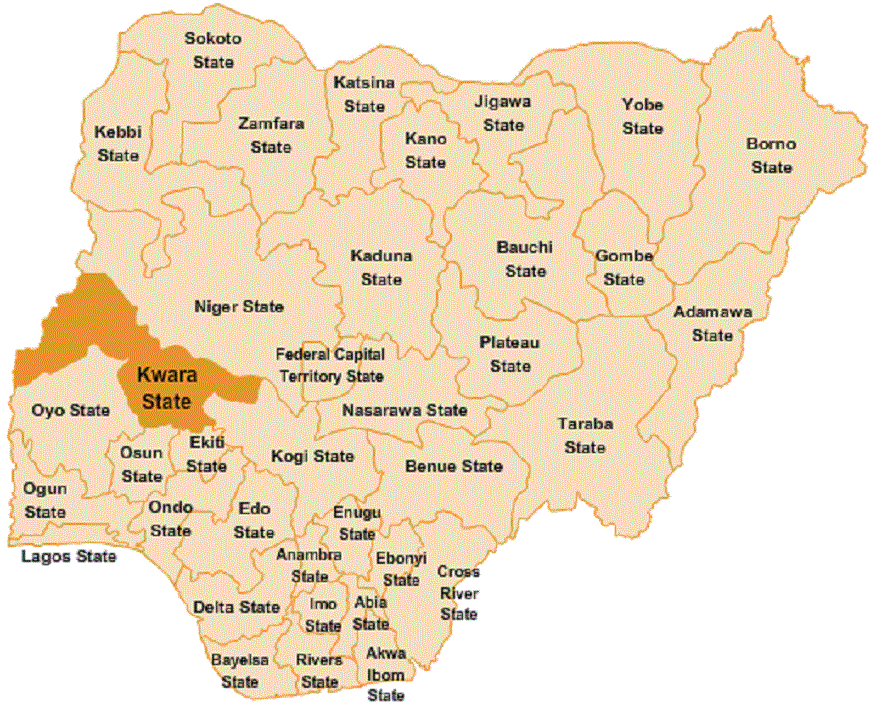
Kwara State: Arewa, Middlebelt or Oduduwa Republic?

By Ahmed Zakaria

With the recent agitations for “Yoruba Nation” and “Middlebelt”, it is pertinent for Kwara State indigenes to review their relationships with other groups, narrate their stories by themselves and resist all efforts at manipulations of the narratives.

Some raucous voices have always taken it upon themselves to categorise Kwara State where it suits their tribal, political, religious and sentimental inclinations without considering the choice of the state’s indigenes.

Just because the Yoruba language is the Lingua Franca in Kwara doesn’t separate Kwara from the northern states. But, that does not also mean only Yorubas reside in Kwara, or only they “own” Kwara, as there are many other tribes, like Nupes, Barubas, Kanuri, Fulani,

Some people wrongfully assume the scale to be a Northern State is being above River Niger, which is absurd and wholly superficial and unwarranted.

Others use Hausa or Fulfulde language as a yardstick for grouping northern and southern states, which is also fallacious. A lot of people in northern Nigeria do not speak Hausa or Fulfulde.

Others use religion as a criterion, which is also untrue. For example, many communities in northern Nigeria have large populations of Muslims, Christians, and worshippers of traditional religions. Most recently, agitators of the “Middlebelt” have used religion as a basis for dividing northern Nigeria. 

With the recent agitations in the South West for “Oduduwa Republic”, many people encourage Kwara Yorubas and even Kogi Yorubas to join the struggle. They claim they will regret being part of the North or be oppressed by the “Northerners” or that they won’t gain anything from the North. Many other things they enjoy saying without knowing the repercussions of what they are saying or putting into consideration the emotions of others while saying it.

It is all due to utter historical ignorance. It is highly offensive to assume Kwarans are Northerners by chance or are “Northerners” for the benefit of what they “gain” from the “North”. 

Kwarans are unfortunately projected as “power-hungry” folks, making them seem all their decisions are guided by the love of money, power or recognition, which is wrong, untrue, and humiliating. 

Adding more salt to injury is to assume that other “Northerners” will “oppress” Kwarans or take away their “rights” or “resources”. It is more painful and mischievous. Nothing as such exists in the dictionary of the good people of Kwara State. It is a lack of understanding of the historical relevance of the current nomenclature of Kwara State that leads to all these unfortunate and insincere utterances and views.

No one can take away the “rights” of Kwarans or “resources”. We are focused on what “we” can sincerely offer this nation and region and not what this nation or the North can offer us. We do not discuss our “rights” when we haven’t discharged the “obligations” upon us.

The people in Kwara State have a strong ideological and religious association with  Northern Nigeria, which is stronger than mere tribal and geographical relationships.

Those who wish to project Kwarans as unclear of where they belong or are lost, looking for an identity, or seeking acceptance are deceiving themselves, not Kwarans. They deny the obvious. 

Many Kwarans welcomed the news of the raid on Sunday Igboho’s house and the arrest of his criminal associates for their effrontery towards Kwara State heroes and monuments.

They employed their propaganda machines to tarnish the good image of Kwara as well as to portray them in a negative light. They rubbished our traditional institutions and had the audacity to instruct their foot soldiers to be insulting Our Royal Father, the Emir of Ilorin.  

He thought the hooliganism and thuggish behaviour he exhibited in Oyo State could be condoned and replicated in Kwara State. He does not know the bonds that bind the people of Kwara are more robust than what people like him could ever break. Many sacrifices were made to build, foster, and develop these bonds and brotherhood, but his followers kept praising him till he met his Waterloo.

No true son of Kwara will support the criminal attitudes of Igboho. That is why some people believe that most people causing trouble and tribalism today in Kwara State are not true sons of Kwara. No true son of Kwara will support the disrespect meted on the state by Igboho and his propaganda machines.

It is harrowing and highly disappointing to paint Kwarans as people without an identity, just like it is a blatant lie to assume Kwarans don’t know their identity; that was what Igboho worked extremely hard at achieving.

It is unfortunate to assume Kwarans don’t know where they belong to or are looking for love and affection from any people or group of people. But, on the contrary, Kwarans respect everybody and bear no grudge towards anyone.

The mere thought of what Igboho represents is distasteful, extremely humiliating, and deeply heartbreaking. Kwarans are not troublesome; they are warm-blooded, unlike their counterparts in other parts of the country. 

That is the opportunity Igboho seized and the reason he dared to insult, belittle, humiliate, and threaten Kwarans. Yet, he dared not threaten Kano, Sokoto, or Borno in the same fashion he threatened Kwara.

Those supporting Igboho’s antics, methods, styles, and methodology do not and will never represent Kwarans. The attacks on our Emir and traditional institutions even made us more united behind our Emir despite all our differences.

Igboho consistently portrays hatred for those he terms the “Fulanis”, but we all in Kwara State fall under that category. He has been blinded by deep-seated tribalism and hatred that he views all of us in Kwara State as Fulanis and “Eru Fulanis” to the extent that it is absolutely impossible to convince his myopic mind that not all people in Kwara are Fulani and that Yorubas, Nupes, Barubas, and Fulanis live side by side, peacefully since the time of Shehu Alimi, that’s two centuries ago.

We thank the swift intervention of the DSS in tackling the menace and criminal activities of Igboho and his cohorts, for if the government hadn’t intervened, other non-state actors would definitely spring into action to counter his illegal activities and unguarded utterances against Kwara State. He and tribalists like him are not welcome in Kwara State. 

May ALLAH bless Kwara State and the whole of Nigeria, amin.

Ahmad Zakariyah writes from Kwara State. He can be reached via ahmadzakariyah@gmail.com.
Why we need to empower women

By Salisu Yusuf

There’s an established cultural practice of female social exclusion in the Muslim North that’s partly patriarchal and partly a cultural construct fuelled by religious misinterpretation, especially on business transaction issues. 

Many people wrongly and unfairly assume that women must not participate in business dealings because men cater for their needs. However, instances from Islamic history and established ahadith corroborate women’s active role in market-oriented activities, especially during the caliphate of Sayyid Umar bn Khattab (RA). I have a story to tell which will convince you that our women should, or even must, be allowed to transact.

A close, affluent friend of mine died two years ago. He left behind four wives, children and millions of naira. Fortunately or not, the deceased’s male relatives could not handle the proceeds of the orphans properly. And even if they could handle the wealth well, most people nowadays are morally lax in handling trusts, especially inheritance. Only a few handle it sincerely, while many others betray the trust given to them. So, the widows became carers and guardians; in other words, the bulk of wealth is handed over to them.

Those who had never transacted (only two out of the four) became businesswomen in their life. They are both fathering and mothering the young orphans. Although single parenting is a difficult task, the women brace up, take care of the children efficiently, conduct business aspects, get profits, provide daily bread, support the children’s education, and other basics such as clothing. I am deeply impressed by the women’s resolve to forget their differences, shun their rivalries, burry their wounds, pick up the pieces and continue to survive in the absence of the best husband and father. 

Two years after their husband’s death, the entire house fares very well, managing to survive despite the harsh realities of the Nigerian socio-economic milieu. When last I visited the family, they told me of the difficulty in combining business dealings with parenting and guidance. One widow told me how lucky they were to learn to trade even before their husband’s death because he had numerously given them startups to learn to earn a living. She said if they had not been this fortunate – under a caring husband who had so much empathy and understanding, they would have been left in the cold, would have devoured the money and would have been left at the mercy of a hostile public as beggars.

Two years since their breadwinner’s death, the women turned men survive because they can hold their heads, transact, guard and guide the young orphans.

Salisu can be reached via salisuyusuf111@gmail.com.

A case for technical colleges in Nigeria

By Adamu Tilde, PhD.

For a while now, Nigeria has been witnessing exponential growth in the rise of certificate-awarding institutions and massive production of holders of certificates of all kinds: diplomas, NCEs, degrees, masters, PGDs, etc. Ordinarily, this should be a welcome development. But, unfortunately, this phenomenon comes at the expense of acquiring quality skills, thus resulting in the production of certificate holders with no skills at all or with some skills that are not in demand and/or have no economic value whatsoever.

One comes to realise the effects of this phenomenon when one does a simple close-proximity analysis—for example, over sixty registered and unregistered colleges of education award NCE certificates in Bauchi state alone. Most of the courses offered in these colleges are combinations of English/Hausa, Social Studies/English, Arabic/Fulfulde, etc. The questions to ask are: what are the specific skills that an average NCE holder acquires in the three years they spend in college? Do these skills, if any, have any economic value? If yes, how many NCE holders, for example, does Bauchi state need at any given time?

Again, in Toro, one out of the twenty local government areas of Bauchi state, there are six colleges of health technology and counting. Most of the courses offered in these colleges are diplomas in Medical Records, Environmental Health, Community Health, Laboratory Technology, etc. I may sound so dismissive of these courses, but don’t get me wrong. These are significant courses and, perhaps, with valuable skills to offer, but we already have enough to go around. And, trust economics, its laws are no respecters of irrational decisions: the higher the supply, the lower the demand and invariably the price. So the need to rethink why we do certain things instead of other things could not be more urgent.

Way Forward

To be very clear, I am not presenting anything novel. Our pioneer leaders had envisaged the inevitable need for technical skills for economic growth and development, and that’s why they established monotechnics, polytechnics, and technical colleges across the country. No thanks to unimaginative leadership and penchant for mass production of certificates-wielding graduates that had led to having polytechnics with more students studying mass communication, theatre arts than engineering, computer science, statistics, etc. Nothing can be more ironic.

In the following subheadings, I will argue on why we should pay more attention to technical skills and invest more in establishing technical colleges:

Guaranteed employment

Rest assured that employers lined up waiting for you once you possess skills like plumbing, welding, woodwork, carpentry, masonry, tiling, electric wiring, programming, website and apps development, etc. With an increase in population comes corresponding demands for housing, food, and services. So these skills will forever be in need, so long as we breathe. And in the event you don’t want to be on the payroll of anybody, you can monetise the skills by employing yourself. For example, a diploma holder in animal health and production can engage in the private practice of visiting farms and local markets to provide first aid treatment. There are too many farms to go around. We can say the same about a plumber, tiler, painter, etc.

Less time than conventional schooling

Most technical skills can be acquired in a record time, probably in a year or two, and then you are good to go. The most interesting thing about a given skill is that the more you practice it, the more you master it. Moreover, it is more difficult for a person to forget a set of skills than the paper-based theories learned in school. Very unlike typical schooling (a diploma or a degree), where you would spend 2 or 4 years with no specific skills to show and then sooner you would forget the little theoretical knowledge you have acquired since you are not practising.

High return on investment

Compared to the money spent to acquire NCE certificates, diplomas in health-related courses, and some instances, degree courses, you are better off having any of the aforementioned technical skills. NCE holders and, in some cases, degree holders hardly make up to ₦30,000 per month in many private schools. In fact, even in public service, NCE holders fetch ₦36,000 per month in Bauchi state. When you analyse the time, money and energy expended to acquire the certificate and the monetary reward after that, you will struggle to make economic sense of the decision. So many Keke Napep guys make more than that amount in a month. So much for a heap of certificates!

Again, as a private investor, you are better off establishing a technical college, especially if you would engage in vertical integration by employing your products (graduates). For example, you can set a company that specialises in finishing and look for contracts. Trust me; we have a paucity of skilled workforce in the building industry. We do import tilers, plumbers, welders from outside. That’s how bad things are, and that’s how vast the opportunities are.

And for those who want to ‘japa‘ (to go abroad), your chance of securing a visa and employment abroad is greatly enhanced if you have any technical skills. This is for non-medical professionals and exceptionally brilliant computer wizards.

Note

The argument here is not whether an NCE certificate or health technology diploma or even degree certificate, for that matter, is good or not. No! The idea here is that we should go to colleges and universities to acquire skills that we can use to improve our financial situation. If the so-called certificate(s) you have obtained cannot fetch you a job or equip you with skills that people can pay for, you need to rethink why you were in school in the first place. We have tonnes of graduates and varying certificate-holders roaming the street for jobs that are not there and crying for lack of employment; meanwhile, they have no skills worth employing. We are massively producing what we do not need and under-producing what we urgently need. Something is wrong.

We have to appreciate the dynamics of time. Long ago, all it takes to climb the mythical social ladder and join the much-vaunted middle-class is a certificate of any kind. Whatever or not you studied in the university is immaterial; public jobs were waiting for you. But that was then. Those years of yore have passed for good. There are no more public jobs for everyone. Internalise this and know peace. As for private companies, well, first of all, they are not charity organisations. Secondly, they are profit-driven, so they don’t employ people to fill any underrepresented state’s quota. Thirdly, they reward value— what you have to offer is what counts. You need much more than a certificate to survive. You need skills, not just any skills, but skills that have economic value.

You need to wake up and smell the coffee. Hello!

Dr Tilde can be reached via adamtilde@gmail.com.