Abdalla Uba Adamu

A visit to an ace Hausa ethnomusicologist – Muhammad Kalarawi

By Prof. Abdalla Uba Adamu

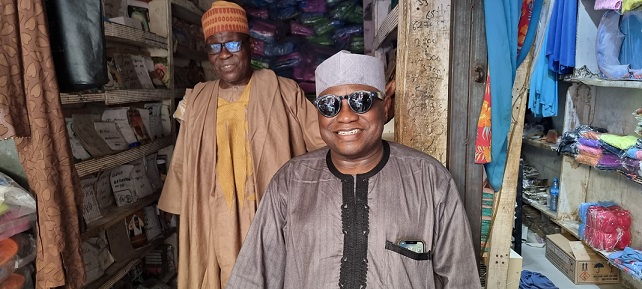
In an attempt to gauge the current popular culture market in Kano, I visited my old haunt at Kasuwar Ƙofar Wambai today, 2nd August 2023. It was the place where virtually all Hausa popular culture media products were distributed in the late 1990s to 2000s. It was simply the best in West Africa, as media products from this market – which took over from the Bata market – were distributed to other parts of Hausaphone West Africa.

I was shocked at the fact that there were only three shops selling CDs/DVDs and cassette tapes. The market had been taken over by plastic household items and blouses/football jerseys! It was so sad to see such a vibrant market – the best in West Africa – down on its luck. Discussions with three forlorn merchants reveal two main reasons for this sorry state of affairs of consumptive popular culture media in Kano.

The first was the proliferation of Download Centres. In these places, films were ripped off DVDs or CDs and with a reduced resolution to fit a Smartphone screen – and dozens were packed on a microSD card and sold for peanuts. This denies the content providers of profit from their hard labour. A licensing compromise was agreed between filmmakers and Downloaders to everyone’s satisfaction. Thus, no more CD purchases that require both a CD player, a TV and electricity to play. Downloaders often get their primary source directly from the producers – thus eliminating the media production processes.

Second was the rise of TV series, popularised massively by Arewa24’s Dadin Kowa (although it was not the first). Now almost every producer has jumped on the TV series bandwagon and using YouTube to distribute their programs. With data getting cheaper, it means viewership has migrated to YouTube series dramas – where more money is made with AdSense clicks. Rarely does a producer bother now with a feature film.

Sad as I was with these developments, I perked up when I visited the shop of Alhaji Muhammad Kalarawi. He is quite simply the best ethnomusicologist in the market. His nearest rival, Musa Nasale, passed away some time ago (and no one knows what has happed to his catalogue of unique and rare music field recordings).

Alhaji Muhammad Kalarawi got his name from being the recordist of the late Kano-based Islamic cleric, Alhaji Lawan Kalarawi (d. 1999). The term, “ƙala rawi” means ‘the narrator said’. Kalarawi established himself as a fearless, acerbic preacher in Kano – earning him numerous jail sentences. He was really telling it like it was – bringing his incredible interpretations on leaders (both modern and traditional) and commoners alike. Thanks to modern media technologies, there are hundreds of Lawan Kalarawi’s archival recordings on YouTube and MP3 trawler/caching sites.

Kalarawi’s popularity was enhanced by his street speech mode with jovial, often bawdy commentaries, which made him immensely popular. I personally count three Islamic preachers in Kano as those I avidly listen to: Lawan Kalarawi, Ibrahim Khalil and Aminu Daurawa. All down to earth. Just as it is, without any excess baggage or appendices.

The current Muhammad Kalarawi has almost every incidence of the late preacher’s recordings. That is a huge treasure trove. In addition, he still has stacks of tapes and CDs of traditional Hausa griots, which are simply not found anywhere. I was so elated to know he is still in the game, despite the suffocating pervasive influx of Hausa Afropop in Kano (which studiously avoided the Wambai market). I wish research institutes such as the History and Culture Bureau in Kano, or Arewa House in Kaduna, would license Kalarawi’s priceless catalogue and digitise them for posterity. Once they are lost, they will be gone with the wind.

Revisiting a Classic: M.U. Adamu’s notes on North African traders in Kano

By Prof. Abdalla Uba Adamu 

In 1968 I was a twelve-year-old whippersnapper and found solace in my father’s library (hate football and games anyway!). A journal, Kano Studies of the year, caught my attention because of the way my Dad held on to it. I fixed my sights on it, eventually opening it and trying to read it. Oh, I did, quite all right, but I did not understand half of what was written! However, I did not give up and continued perusing the journal. 

Eventually, during high school years, a couple of years down the road, I discovered what glued my late father, Muhammadu Uba Adamu, alias Kantoma, to that specific issue – his article. The article was titled “Some Notes on the Influence of North African Traders in Kano”. This time when I read it, it made sense. I found it fascinating, and I can genuinely say it planted the roots of historical interest in me. However, I was keener on race, culture and identity, and in particular, how new racial identities emerge as a result of what Kantoma himself later referred to as ‘confluence and influences.’

“Some Notes on the Influence of North African Traders in Kano”, as I was to discover later, was based on the methodology of what Victor Turner referred to as “the anthropology of experience”. Kantoma embedded himself in the Arab community (a bit easy to do, with an Agadesian grandmother) in the Alfindiki community in the heart of the city and close to his traditional family homestead at Daneji. It was through extremely loose focus group discussions that he was able to gather as much data as he could. And he was then a student of Political History at Ahmadu Bello University Kano (via Abdullahi Bayero College). 

Years later, I had the chance to befriend one of Kantoma’s teachers, John Lavers. He glowingly told me how excited he was with Kantoma’s initial paper and how he made a series of suggestions that eventually turned the paper into a classic. John Lavers was one of the founders and editors of Kano Studies. 

The paper was extensively revised by Kantoma as “Further notes on the influence of North African traders in Kano”. It was presented at the International Conference on Cultural Interaction and Integration Between North and Sub-Saharan Africa, Bayero University Kano, 4th–6th March 1998 – some thirty years after the original. Unfortunately, despite being the person who typed it up for him, I could not locate a copy (remember, we were using floppy drive storage in those ancient days!).

Some notes planted in me an interest in race, culture and identity and the interrogation of the specific gravity of racial identity in Africa. For instance, take a community of Tripolitanian Arabs who settled in Dandalin Turawa, Kano, right on the edge of the Kurmi market. Years later, they were no longer ‘Turawa’ but African – at least in colour and language, as most have also lost the Arabic language of their forebears. So, what exactly are they? Arabs? Hausa? Or do they create a crazy hyphenated identity – Hausa Arabs (like the ridiculous ‘Hausa Fulani’)?

So, I started my own anthropological trajectory by writing a proposal for a Stanford University (US) residency on Race, Culture and Identity. I wanted to map the six groups of Arab residents in Kano to determine how they self-identify – language or genes. These are Shuwa, Sudanese, Tripolitanians, Syrians, Lebanese, and the Yemeni. Again, Kantoma had much data on especially the Yemeni, in addition to his earlier Tripolitanian engagements.

For a few years, I worked with him to flesh out the project and even got some of the Yemeni elders interested in proper documentation of their community (as was done by S.U. Albasu in “The Lebanese in Kano”). I did not get the Stanford residency, and other things about the daily grind kept me away from the project, so I put it on hold! I can’t even locate the original proposal now. But who knows? Once I have a free year or so, I might rummage through some forgotten hard drives and see what lurks there and, if possible, get back into the race (pun intended!). 

Here, for your archival pleasure, is a gift from Kantoma pending a full-blown site that will have all his writings much later in the year (hopefully by Fall). Download from here:  https://bit.ly/3p2LeOx.

The Origins of the Onomatopoeic Intertextuality of Hausa Popular Culture

By Prof. Abdalla Uba Adamu

His name was Tijjani, and nicknamed Ma’aslam. He mainly lived in the Sabon Sara ward, Kano city, but was a common sight along the Mandawari junction to Kasuwar Kurmi corridor in the 1960s.

Everyone considered him nuts. Apparently, he built a single-storey building without stairs to access the upper floor. He did not think a door was necessary for any structure either, so the building had no doors. He simply jumped up to the upper floor at night and jumped down in the morning. It was enough for the ward head to report him to the Jakara magistrate for him to be locked up on insanity charges.

During the hearing, he was given a basket to fetch water. He simply laughed at the judge, informing him that only a madman would attempt to fetch water in a basket. The judge threw the case out, declaring him perfectly rational. He may be nuts – although eccentric was more apt to describe his behaviour. But then, it takes a certain amount of nuttiness to be an innovator. And he was an innovator.

As children – and I am talking 1960s inner city Kano – we simply referred to him as Ma’aslam. He, I would argue, planted the seeds of onomatopoeic intertextuality in Hausa popular culture, at least in Kano. This was the process of picking up an element of popular culture, say, a song, converting it side-by-side into a different language (intertextual), using ‘sound-alike’ of the original (which is onomatopoeia) into a new one. A quick example was the Bob Marley hook:

Get up, stand up,

Stand up for your rights

Sadi Sidi Sharifai, a Kano onomatopoeic superstar, converted this to:

Jallof, Jallof,

Jallop, sai da rice

Try singing both the original and Sadi’s interpretation, and you have become an onomatopoeic star yourself!

In 1967, the American super soul star James Brown & the Famous Flames recorded the stunning live double album of their concert at the Apollo Theatre in New York. It was, perhaps unimaginatively enough, titled, ‘Live at Apollo.’ A standout track on the album was ‘I Feel Alright’. Its choral hook was:

‘Hey, hey, I feel alright

One time, uh!’

The album of the concert was released on 16th August 1968. I was 12 years old then, and still now, totally wired in music, complete with a Ukulele guitar, given to me by David Hofstad (author of Tabarmar Kunya play). My Dad, an avid music lover, noting my attachment to the song which was played on the radio, simply bought the double album for me at Musa Zamani Record store in Fagge (are there any old codgers who remember this record store?). I played it to death on the old Grundig music player we had then.

Back to Tijjani Ma’aslam. With his eccentric behaviour categorising him as loony, Ma’aslam started reciting the ‘Dalailul Khairat’, a celebrated manual of salutations upon the Prophet Muhammad (SAW), written by Muhammad ibn Sulayman al-Jazuli in 15th century Morocco. What was unique about Ma’aslam’s open-air recitation, however, was that he adopted the James Brown meter in the song, ‘I Feel Alright’, as his chorus. His rendition of the hook for his recitation of the Dalai’lu was:

Mujibun, Mujabun,

Afiyan, Afuyan,

Rasulillahi

Ahlan wa Sahlan

Rasulillahi

This was accompanied by James Brown’s dance moves (shown on Television’s Soul Train, which was available in a few houses that he might have access to). Maybe he was not reciting the salutations in their structured order, but at least his verses were discernible, as the Dalai’lu itself was recited in a song form by many reciters in Kano. What he did, and did it differently, was using a foreign music meter to make it more accessible. This formula was to be adopted by the Ushaqu Indiya group of devotional singers in the city of Kano (actually along the same neighbourhood as Tijjani Ma’aslam). More of this in subsequent articles/posts.

Tijjani Ma’aslam’s delivery mode was intertextually onomatopoeic to ‘Hey, hey, I feel alright’. The chorus was ‘Rasulillahi’. Ma’aslam was usually followed by a gaggle of kids echoing the chorus while he merrily led the way, clapping his hands, dancing and reciting the names of the Prophet from the Dalai’lu. Elders were bemused at the spectacle and simply labelled Ma’aslam crazy. He might have been. He certainly was not following the sequencing of the Salawat from the book. But his performances opened a door.

Up the road from his haunt and covering the same zone was the Palace cinema. This was built and completed in 1951 and opened in 1952. Palace cinema became an instant hit with the youth, closeted in the city and without any visible means of night-time entertainment. Before its opening, and still a carryover from the World War II years (1939 to 1945), a curfew used to be imposed on city residents at 8.00 p.m. With the relaxation of the curfew, the few neighbourhood plazas (dandali) that offer games for youth (both boys and girls) were no match for the sheer spectacle of a massive screen accompanied by loud music. The predominant films shown in the cinema were cowboy or mainstream European films. However, after independence in October 1960, Indian films started to be shown from November 1960 in Kano cinemas. Early films screened included Cenghiz Khan, Jaal, Sangeeta, Raaste Ka Patthar, Waqt, Amar Deep, Rani Rupmati, Dharmatama, Dost, Nagin and thousands of others. The one that caught massive imagination in Kano’s inner city, however, was Rani Rupmati, originally released in India in 1957 but only found its way to Kano cinemas in the 1960s.

Like all Indian films, at least from what the industry refers to as Bollywood, Rani Rupmati had a lot of songs – in fact, its overall screenplay is based on two people united by their love of music. However, two songs from the film caught Kano’s inner city imagination, ‘Itihaas Agar Likhna Chaho’ and ‘Phool Bagiya Mein Bulbul Bole.’ Interestingly, there was no choreographic dancing in these two songs, unusual for general Bollywood films but typical of earlier, more historical and artistic ones.

The first, ‘Itihaas’, sung by Lata Mangeshkar, has a great hook that, thanks to Tijjani Ma’aslam, became domesticated by kids along his sphere of influence and Palace cinema zone. It goes something like this:

Itihaas agar likhana chaho /

Itihaas agar likhana chaho /

Azaadi ke mazmoon se /

To seencho apni dharti ko /

Veeroon tum upne khoon se /

Har har har Mahadev /

Allaho Akubar /

Har har har Mahadev /

Allaho Akubar /

Sung within the backdrop of a band of warriors getting ready to go into a battle, led by a woman (the titular Rani Rupmati), it certainly gave the picture of a woman more enlightening than what was both the Hausa and Indians are used to. The film itself endeared itself to Hausa through the modesty of the women – shy drooping kohl-enhanced eyes with long blinking lashes, fully clothed (even the swimming scene shows the singers fully clothed in the river), with sari that resembles Hausa wrapper (zani), lots of jewellery, and stunning beauty. A Hausa common saying of the period was, ‘Allah, kai ni Indiya ko a buhun barkono’/God, let me visit India even in a sack of pepper. That was how besotted Hausa youth were to the beautiful Indian women seen on the screen, giving a false impression that every single Indian woman is beautiful.

Hausa youth, inspired by Tijani Ma’aslam, quickly domesticated the chorus of the song as:

Ina su cibayyo ina sarki / where are the warriors, where the is king?

Ina su waziri abin banza / And the useless vizier?

Mun je yaƙi mun dawo / we have return from the war

Mun samo sandan girma / and we were victorious

Har har har Mahadi / hail, hail the reformer

Allahu Akbar / Allah is the Greatest

Har har har Mahadi / hail, hail the reformer

Allahu Akbar / Allah is the Greatest

In an interesting case of lyrical substitution, the Hausa intertextual transcription captured the scene of the song as shown in the film, if not the actual meaning of the words. Loosely translated, the original verse was urging warriors to defend their land with their lives and become part of history. The chorus translates as ‘Let each of us sacrifice ourselves to Mahadev’.

While Mahadev was a reference to the Indian deity, Shiva, this pantheistic line was followed by a monotheistic reference to Allah, the Supreme Being in Islam. Thus, two contrasting religious sentiments were expressed in the song. It was likely that S. N. Tripathi, who directed the film and composed the music, introduced the chorus to attract both Hindu and Muslim audiences. After all, while Rani was a Hindu, her love interest in the film, Baaz Bahadur, was a Muslim. The expression, however, has since then been used as a slogan of communal harmony between often warring Hindu and Muslim communities in India.

But more stunningly, the Hausa version substituted the word ‘Mahadev’ with ‘Mahadi’. The Hausa heard ‘Mahadi’ (guided one), not ‘’Mahadev’, which worked perfectly well. Substituting Mahadev for Mahadi Islamized the song, as it were. In Islamic eschatology, Mahdi is a messianic deliverer who will fill the earth with justice and equity, restore true religion, and usher in a short golden age lasting seven, eight, or nine years before the end of the world.

The second song from the film, ‘Phool Bagiya Mein Bulbul Bole’ (also sung by Lata Mangeshkar, with Mohammed Rafi), also inspired onomatopoeic intertextually but further afield from Kano and bizarrely entered into Hausa urban legend of the 1960s. Its first verse goes something like this:

Phul bagiya me bulbul bole /

Daal pe bole koyaliya

Pyaar karo /

Pyaar karo rut pyaar ki aayi re /

Bhanwaro se kahati hain kaliya /

Ho ji ho ho ji ho ho ji ho /

Ho ji ho /

What Hausa youth heard in the choral refrain was ‘Hotiho’, not ‘Hojiho’, and in the film Rani Rupmati, the lady (played by Nirupa Roy) came to be referred to as Hotiho. The Hausa griot, Mamman Shata (d. 1999) popularised the word (which has no particular meaning) in his song, Mallam Sidi, ‘Mijin Hotiho’/Mallam Sidi, Hotiho’s husband.

In the film, there was no marriage between Rani and Baaz Bahadur because she said she was ‘married to her music’, despite living with him after running away from home to avoid death from a chalice of poison given to her by her father to avoid the shame of her rejecting a chosen husband. In all their dialogues, Rupmati and Baaz Bahadur stress their shared love for music, not their love for each other. So, Shata did not accurately describe the relationship in the film. However, such deep film analysis is not important to the transnational interpretation of Shata of Baaz Bahadur as a signature tune for a hen-pecked husband. Shata’s interpretation of the actor who played Rani’s lover was certainly in order as he was effeminate and obsessed with music rather than empire building, despite being heir to a throne. It was even Rani who led their army into war. He was wounded in the battle and ran away.

Another Hausa griot, Ali Makaho (d. 1984), known famously for his anti-drug song, ‘Mandula’, briefly referenced Rani Rupmati in another of his songs.

Za ni Kano / I’m going to Kano

Za ni Kaduna / I’m going to Kaduna

Mu je Katsina lau za ni Ilori / Let’s go to Katsina and Ilorin

Na je Anacha / I will go Onitsha

Ni ban san kin zo ba / I didn’t know you had arrived

Da na san kin zo ne / If I had known you have arrived

Da na saya miki farfesu / I ‘d have bought you [pot of] pepper soup

Hitoho hotiho /

Hotiho hotiho /

With a comedy skit thrown in, Ali Makaho’s rendering uses Phoolbagiya’s meter to narrate a series of anticipated travels over northern Nigeria. As an intertextual comedy, it worked and remained of his most memorable skits.

A third Hausa griot to adapt a song from Rani Rupmati was Abdu Yaron Goge, who played the goge (a large fiddle played with a bow). Abdu picked ‘Raat Suhani’ from the film for his adaptation. Since, unlike the other griots who used the elements of the songs from the film, Abdul was a musician, he used two approaches – first was rendering the symphonic structure of the opening bars of the actual composition, Raat and playing it on his fiddle, then secondly, he onomatopoeically appropriated Mangeshkar’s lyrics as Hausa version. The original lyrics were as follows:

Raati Suhani /

djoome javani /

Dil hai deevana hai /

Tereliye /

Tereliye /

These lines were pure expressions of love the protagonist has for her lover, especially ‘in the beauty of the night’ [raati Suhani]. Abdu Yaron Goge’s rendition was as follows:

Mu gode Allah, Taro / We should thank Allah, people

Mu gode Allah, Taro / We should thank Allah, people

[These lines vocalized the opening bars of Raat]

Duniya da daɗi /This world is nice

Lahira da daɗi / The hereafter is nice

In da gaskiyar ka / If you are truthful

Lahira da daɗi / The hereafter remains nice

In babu gaskiyar ka / If you are untruthful

Lahira da zafi / The hereafter is blazing

Thus, in a single verse (which he kept repeating over and over till the end of the performance), Abdul Yaron Goge borrowed a popular musical motif from another culture and domesticated it to Hausa entertainment. At the same time, he delivered a message totally different from the original meaning.

There were, of course, many other onomatopoeic intertextual interpretations of Indian film songs, but the three songs from Rani Rupmati, predated by Tijjani Ma’aslam’s innovative use of foreign motifs, were the definitive pioneers in music. In Literature, look towards Abubakar Imam and Magana Jari Ce. The intertextual origins of Hausa arts, of course, started in the 1930s; but its migration to music was certainly in the 1960s. It spawned a Hausa Cinema industry which was labeled ‘Kanywood’ in 1999, a few years before the term ‘Nollywood’ to refer to the Nigerian English language cinema, was created.

On a final note, Nazeer Abdullahi Magoga, a Kano ‘Indian’ (who speaks the language fluently, to the shock of BBC Delhi, who sent a crew to interview him in Kano, in Hindi) composed a song for the Centre for Hausa Cultural Studies, Kano which I was heading, but which I had to pause due to lack of funding. He used the Raat Suhani meter and used both Hausa and Hindi lyrics in his wonderfully beautiful tribute to the Centre. A link to the song on YouTube is given below. To really appreciate Nazeeru’s performance, listen to the original Raat Suhani from the film Rani Rupmati, also provided in a link.

Cibiyar Nazarin Al’adun Hausa by Nazeer Magoga [Raat Suhani template]

https://bit.ly/3LXTrMK

Raat Suhani, from the film, Rani Rupmati (1957)

https://bit.ly/42eTuJF

Rarara’s Invective Barbs: innuendoes, body shaming, and Kano politics

By Prof. Abdalla Uba Adamu

For the past 43 years that I have been a researcher, there were two areas I stay clear of: politics and religion. If you see my hand in any of these two, then the entry point is popular or media culture. For instance, I have recorded a lot of Kano Qadiriyya’s Anfasu zikr, not as a devotee, but as an ethnomusicologist – focusing on the body percussion and movements (after studying the wonderful works of Margaret Kartomi on body percussion while in Morocco). Similarly – and to balance things somewhat – I recorded Tijjaniyya zikr sessions at Chiranci in the city of Kano as part of a larger study on religious performances. All my recordings were uploaded to a dedicated YouTube public channel. I was, therefore, amused when people try to pigeonhole me either as Qadri or Tijjani. I am neither.

Politically, I am apolitical, meaning I really don’t care who rules the country. I don’t even vote, having done once a long time ago (at the insistence of a dear friend), and promised never to do it again. But performance arts brought my attention to protest songs and the prosecution of singers in Kano. The end product was a paper, “Poetic Barbs: Invective Political Poetry in Kano Popular Culture” which I am sure is floating somewhere in a modified form. And I thought that was it.

In 2014 I came across a song that I found amusing. I was playing it on my laptop when someone exhibited surprised that I was listening to the songs of Dauda Adamu Abdullahi Kahutu, with a stage name of Rarara. That was the first time I even heard the name. The song was “Zuwan Maimalafa Kano.” It attracted my attention in two ways. First, its lyrical construction, as well as its delivery, was just amazing. Rapid fire. He should have been a rapper, a genre of music I am totally besotted on (old school DMX, 2Pac, Snoop Dogg, Ice Cube, Queen “The Equalizer” Latifah, y’all). It was clear Rarara was singing off the cuff, not reading from a setlist or lyrical sheet. Second, it was the most detailed invective song I have heard in the Hausa Afropop music genre. I started digging and latched on to him and his songs. So, for the last seven years or so, I have been following every song he released using the invective matrix.

So, what is an invective song? Invective is the literary device in which one attacks or insults a person or thing through the use of abusive language and tone. If you like, “zambo/shaguɓe”. Invective is often accompanied by negative emotion. Invective can be divided into two types: high and low invective. High invective requires the use of formal and creative language, while Low invective, on the other hand, makes use of rude and offensive images. From 2010, Rarara became a master of popular Hausa invective oral poetry. He used his skills to abuse, insult and body shame anyone he was paid to insult. Including former masters and associates.

A pattern evolved. His switchbacks. Chronologically, his earliest non-invective song was “Saraki Sai Allah” (in honour of then Governor Ibrahim Shekarau’s turbaning as Sardaunan Kano in 2010 by the late Emir of Kano, Alhaji Ado Bayero). In 2011 – barely a year later – when Shekarau failed to anoint Rarara’s ‘master’, Deputy Governor Abdullahi T. Gwarzo, to succeed him, Rarara became ballistically invective – and established a career in body shaming, abuses and innuendoes against various previous masters. Shekarau bore the blunt of colorist abuses – often a case of the kettle calling the pot black. No one was spared his invective barbs. Deeply cut. Insulting. Spread over 39 songs, from 2014’s “Malam Ya Yi Rawa Da Alkyabba”, to 2023’s “Tangal-Tangal.”

I have seen social media calling Rarara out on his not being a Kano indigene, getting rich in Kano through his songs, and yet insulting Kano’s leaders. This is all true. However, ‘da ɗan gari a kan ci gari’ (enemy within). Only about three songs in my analytical corpus by Rarara were free-standing (i.e., unsponsored). All the others were commissioned and paid for – by politicians from Kano, to abuse other politicians from Kano. Rarara always acknowledges his sponsors in the opening doxology of his performances.

Rarara was a highly unprincipled and unethical businessman. Show him the money, and he will praise his closest friend and abuse the friend’s enemy. Show him more money, and he will insult the same friend he praised, and heap praises on the enemy he insulted. Does anyone remember that the glorified “Ɗan Ƙaramin Sauro” (irritating mote) was part of the demeaned “Banza Bakwai” (Bastard Seven)? The bromance did not end well, did it? Business unusual.

In any event, Rarara’s invective braggadocio came back to hit him hard on 5th April 2023 when his opponents used his mother’s picture in unflattering terms and splattered it all over social media and gave her a feminine variation of an insulting name he used against one of his targets. Apparently when the shoe is on the other foot, it pinches.

Thus, instead of focusing on political ideology and promises of creating a better life for the electorate, often politicians in Kano (and I think Kano, as usual, is the only state that uniquely does this) would pay more attention to denigrating, shaming, and condemning opposing candidates, creating an unfavorable imagery of the politician to prevent his being voted. Rarara was a perfect malleable puppet in this process. He has the same emotional value to Kano politicians as an alien from Saturn. Despite his lyrical brilliance and acerbic wit, he was expendable. How many singers from Kano can you recall doing the same invective insults as Rarara to Kano politicians? Two? Three? Their corpus is not as extensive as that of Rarara. Conversely, how many politicians from Katsina pay Rarara money to insult other Katsina politicians? I can only remember one.

Wary of possible legal action against direct defamatory speeches, politicians often find it easier to engage what I call ‘political drones’ to communicate their defamatory messages through the popular medium of singing. In this way, when push comes to shove, it is the singer who would face legal – or in some cases, physical – wrath in one way or other. Unethical singers like Rarara – who was arrested, but not charged in 2014 over “Zuwan Maimalafa Kano” – were willing to pay the price in exchange for the stupendous amount of money they will receive. At least they will have enough for medical care when their houses were wrecked, assaulted and incapacitated to continue singing.

And the politician who caused it all? He can’t even remember the song that made him popular, having moved on to greener political pastures. Until the next election cycle when he will latch on another expendable drone to help him heat up the polity through more invective songs using campaign words he does not have the guts to utter himself.

Rarara’s defense of not uttering specific names in his invective taunts and body shaming do not stand up to scrutiny under Nigeria’s defamation laws, and demonstrates that while he was a brilliant lyricist, he needs to understand the law. This is because his invective defamation in the form of his songs is publicly available (indeed, he made them so), created a narrative about individuals that are easily identifiable either by their physical appearance or public behavior, created a negative impression on the person being so targeted, and was not misquoted as Rarara’s utterances (from his songs) were publicly available and subject to an only interpretation as intended. A clever prosecutor would have enough to jail Rarara on listening to any of his invective songs, if someone complained hard enough.

Invective songs can often have their positive sides in the sense of making politicians – or their targets – aware of public perception of their misdemeanors, or at most, errant behaviors. Rarara’s invective narrative in the selected songs I analyzed, however, do not demonstrate their oversight functions in public accountability for politicians. Regardless of whether explicit names were uttered or not, their narrative was focused on kicking them when they are down, and subjecting them to public ridicule. This questions the artistry of Rarara as a purveyor of aesthetic values of the Hausa oral arts.

Academicians ignore Rarara and his art – and I think that’s a mistake. True, some would argue that his songs have no aesthetic, intellectual or ideological value. On the contrary, they do. In their own way. They are beautiful as lyrical discourses. His delivery is truly artistic, even if the content is inelegant. Unlike other songs in the repertoire of political communication, his are not protest songs, and thus lack ideological focus. They neither educate, illuminate or illustrate any aspect of political culture. They only entertain – at the expense of the dignity of the people he attacks. His songs synthesize Hausa rural lexicon overlayered with abusive, often self-constructed urban jargon to enhance general appeal – and act as rabble rousers for politicians who think like him. It is a unique, if unadmirable business model in the performing arts.

Subsequently, Rarara’s songs cannot be compared, by any stretch of imagination, with the classical Hausa protest poets such as Sa’adu Zungur, Mudi Sipikin, Aƙilu Aliyu, Abba Maiƙwaru and Aminu Kano, whose artforms were fueled by educative political ideology, certainly not profit. Mudi Sipikin, for instance. used his poetry to attack the system of colonial rule. Aƙilu Aliyu wrote poems directly attacking the NPC. Abba Maiƙwaru wrote a 10-line NEPU poem for which he and Aminu Kano were arrested in the mid-1950s.

Zungur used his poetry originally to warn the emirs of the north of the necessity for reform, as illustrated in his central work, Jumhuriya ko Mulukiya [Republic or Monarchy]. In this work, he called for political and social problems to be solved on the basis of the existing Islamic institutions, rejecting alien political concepts. He later used his poetry to appeal directly to the common people. In a similar vein, one of the earliest poems written for a northern political party was by Aminu Kano, and called ‘Waƙar Ƴancin NEPU-Sawaba’ [Freedom poem for NEPU-Sawaba], and published in 1953 and put in the final form by Isa Wali. It was one of the earliest statements of Nigerian nationalism.

Despite all these, I argue that as researchers we can’t afford to ignore a current of knowledge flowing right at our feet. But the cold shoulder given to Rarara by our community, opposed to Aminu Ladan Abubakar (ALAN Waƙa) who is a toast to the academic and intellectual community, merely emphasizes the expendable and ephemeral nature of Rarara’s art. Ten years after the release of any ALA song, it will still have relevance. The relevance of Rarara’s songs rarely last to the next song release. Instantly forgettable.

Nevertheless, just as we struggled for the recognition and documentation (if not acceptance) of the Kano Market Literature in the 1990s when everyone was denigrating it, we need also to document the stream of popular culture, including Rarara – warts and all – flowing around us at all times. As far as I can see, only Maikuɗi Zukogi has focused attention on two of Rarara’s songs. More needs to be done.

As soon as I tell myself that I will wrap up the research, he will release a song insulting a former master or associate. Subsequently, I delayed publishing the research until he insulted two people, and true to expectations, he did. These were President Muhammadu Buhari (Matsalar Tsaro) and Governor Abdullahi Umar Ganduje (Lema ta sha ƙwaya). With the ‘Hankaka’ barb against Ganduje in the Lema song, my fieldwork became almost complete. His destruction of “ɗan ƙaramin sauro” leaves only the references to be completed. As I argued, based on his corpus, Rarara sells to the highest bidder with neither conscience nor ideology. The huge profit he makes serves as insurance against future loss of earnings when Kano politicians become mature enough to stop patronizing him to insult each other (and themselves) and utilize his skills in more constructive ways.

My thanks to a team of eager research assistants, headed by my ever-faithful and close companion, Hassan Auwalu Muhammad – a former songwriter and lyricist himself. He was the one who mainly, patiently, transcribed the songs, which I wove into a narrative going to almost 40 pages! I plan to upload the lot during my Summer break when the children are all here on holiday! By then, the threatened wobbling ‘Tangal-Tangal’ had stopped and probably settled for a four-year legal battle.

Professor Abdalla Uba Adamu can be contacted via auadamu@yahoo.com.

Hausa names as ethnographic identifiers

By Prof. Abdalla Uba Adamu

It happened 40 years ago. A friend’s wife in Kano had delivered a bouncing baby boy. My friend chose Maikuɗi as the name for the baby. The families on both sides were having none of this. Maikuɗi was not a name, they argued. But he saw nothing wrong with it – a nice traditional Hausa name. He was adamant. They were adamant. Cue in A Mexican Standoff.

Three days before the naming ceremony, he blinked first and apparently gave up. With a glint in his eyes, he decided to name the child Ibrahim. A beautiful Hebrew name but cognately shared by both Muslims and Christians (from Abraham, the father of all). Everyone was happy – until it dawned on everyone that Ibrahim was the name of my friend’s father-in-law. Tricky. In Hausa societies, the names of parents are never uttered. In the end, everyone ended up calling the boy Maikuɗi! Right now, the boy is a successful international businessman living in the Middle East. Earning serious cash and living up to his name – which means one born on a lucky day. Or Tuesday.

A few years later, the same friend’s wife gave birth to a beautiful baby girl. He decided to name her Tabawa. Objections reloaded. Cue in Dog Day Afternoon. As previously, my friend blinked first. He decided to name her Hajara, another cognate of Hagar, the wife of Abraham. It also happened to be the name of his eldest sister. His mother could not utter it – both the Hausa and Fulani system of cultural relations prohibit mothers from calling the names of their first series of children. In the end, everyone ended up calling the child Tabawa. She is currently a university lecturer and a doctoral student in Nigeria. Living up to her name – which means Mother luck, or the name given to one born on Wednesday (in Kano; in Katsina, it is Tuesday) is considered a lucky day. Two children, both lucky in their lives. Their traditional Hausa names became their mascots as they glided successfully through life.

So, why the aversion to Hausa ‘traditional’ names? You can’t name your child Maikuɗi, but everyone will applaud Yasar (wealthy – mai kuɗi?). Or Kamal (perfection). Or Fahad (panther). Or Anwar (bright). Or Fawaz (winner). You can’t name your daughter Tabawa, but it is more acceptable to call her Mahjuba (covered). Or Samira (night conversationist –TikToker?). Name your daughter ‘Dare’, and you are in trouble. Change it to Leila, and you out of it, even though this is an Arabic for ‘dare’ (night).

A lot of the names the Muslim Hausa currently use have nothing to do with Islam. Bearers of such names rarely know their actual meaning or context. They were Arabic and forced on us by the Cancel Culture that attaches a derogatory ‘Haɓe’ coefficient to anything traditional to the Hausa.

Therefore, my friend, whose family story I just related, another friend and I decided to get together and be Wokish about traditional Hausa names. Paradoxically, none of us is genetically Hausa (whatever that might mean) – one had roots in north Africa, another had Kanuri heritage, and one had Agadesian and Torodbe roots – but all of us self-identified, with absolute honour and tenacity, as Hausa. None of this ‘Hausa-Fulani’ aberrational nonsense.

‘Hausa-Fulani’ appellation, in my view, is a Nigerian Cancel Culture device to suppress the Fulani culture. The Fulani may have conquered the ruling of the Hausa (except in one or two places) and imposed their rule. The Hausa, on the other hand, have linguistically conquered the Fulani. In Kano, claiming Fulani heritage is considered anthropological purity – without knowing a single word of Fulfulde (the Fulani language). Substituting rulers does not get rid of the general populace who remain what they are.

The third friend then took the task with gusto. He spent over ten years compiling authentic traditional Hausa names that have absolutely nothing to do with ‘Maguzanci’ (the label gleefully and contemptuously attached to any Hausa who is not a Muslim by the Hausa themselves) before Islam in about 1349, at least in Kano). He also collected names that had only a tinge connection to Islam. The end product was a hitherto unpublished list of 1001 authentic, genuine, traditional Hausa names that reflect the cosmology of the Hausa.

Hausa’s anthropological cosmology reflects the worldview and belief system of the Hausa community based upon their understanding of order in the universe. It is reflected in their naming system – just like any other culture. The Yoruba Muslims, for the most part, have retained this attachment to their traditional cosmology. Farooq Kperogi has done wonderful work on Yoruba naming, although with a focus on their adaptation of Muslim names. The failure of the Hausa to do so was, of course, due to the suffocating blanket of Cancel Culture that the Hausa had been suffering for almost 229 years.

Now, let’s look at the names and their categories. The first category I created from the 1001 Names, which I edited, revolved around Being, Sickness and Death. As noted earlier, the traditional Hausa centre their naming conventions on ecological and cosmological observations—using time, space and seasons to mark their births. Based on this, the first naming convention uses circumstances of birth. This category of names refers to the arrival of a child after another child’s death, the death of a parent, the sickness of the child immediately after being born or a simple structure of the child that seems out of the ordinary. Examples include:

Abarshi. This is derived from the expression, ‘Allah Ya bar shi’[May Allah make him survive]. A male child was born after a series of miscarriages. A female child is named Abarta. A protectionist naming strategy is where the child is not given full loving attention after birth until even evil spirits note this and ignore it and thus let him be. Variants include Mantau, Ajefas, Barmani, Ajuji, and Barau. Now you know the meaning of Hajiya Sa’adatu ‘Barmani’ Choge’s name – the late famous Hausa griotte from Katsina (1948-2013).

Then there is Shekarau, derived from ‘shekara’, a year. A male child is born after an unusually long period of gestation in the mother’s womb. A variant of this name is Ɓoyi [hide/hidden]. A female child is named Shekara. Now you know the meaning of the surname of Distinguished Senator Malam Ibrahim Shekarau from Kano.

A third example is Tanko. This is a child born after three female children. Variants include Gudaji, Tankari, Yuguda/Iguda/Guda. I am sure you know the famous Muhammed Gudaji Kazaure, a Member of the House of Representatives of Nigeria and his media presence in late 2022.

Each of these sampled names reflects a philosophical worldview, reflecting spiritual resignation or slight humour. They, therefore, encode the traditional Hausa perspective of living and dying as inscribed in the way they name their children.

Names that even the contemporary Hausa avoid because of bad collective memory are those linked to wealth and being owned or slavery.

Slaves have prominently featured in the political and social structure of the traditional Hausa societies, especially in the old commercial emirates of Kano, Zaria, Daura and Katsina. Their roles are clearly defined along socially accepted norms, and they are expected to perform given assignments demanded by their masters.

Slaves in Kano are divided into two: domestic and farm-collective. Trusted and, therefore, domesticated slaves are mainly found in ruling houses and are prized because of their loyalty to the title holder. Farmyard slaves were often captured during raids or wars and were not trusted because of the possibility of escape. They were usually owned by wealthy merchants or farmers and were put to work mainly on farms

Although the institution of slavery as then practised has been eliminated in traditional Hausa societies, the main emirate ruling houses still retain vestiges of inherited slave ownership, reflected even in the categorisation of the slaves. For instance, in Kano, royal slaves were distinguished between first-generation slaves (bayi) and those born into slavery (cucanawa).

At the height of slave raids and ownership, particularly when owning a slave was an indication of wealth, the names of the slaves often reflected the status of the owner. Examples of these names include Nasamu (given to the first slave owned by a young man determined to become a wealthy man), Arziki (first female slave owned by a man), Nagode (female slave given away to a person as a gift), Baba da Rai (first gift of a male slave to a son by his father), Dangana (male slave of a latter-day successful farmer or trader, although later given also to a child whose elder siblings all died in infancy. The female slave variant is Nadogara), and Baubawa (slaves with a different faith from the owner), amongst others.

The changing political economy of Hausa societies since the coming of colonialism has created new social dynamics, which included the outward banning of slavery. Thus, many of the names associated with slaves and ‘being-owned’ in traditional Hausa societies became disused, unfashionable, or, which is more probable, to be used without any idea of their original meaning. It is thought that some records of them may be of value. An example is ‘Anini’, usually a slave name but later used to refer to a child born with tiny limbs. The ‘smallness’ is also reflected in the fact that ‘anini’ was a coin in the Nigerian economy, usually 1/10th of a penny—a bit like the small Indian copper coin, ‘dam’ (from which the English language got ‘damn’, as in ‘I don’t give a damn’).

Further, with the coming of Islam, slave names were eased out and replaced by conventional Muslim names as dictated by Islam, Retained, however, are slave names that also served as descriptors of the functions of the slave, even in contemporary ruling houses. Examples of these slave titles, which are rarely used outside of the places, include:

Shamaki (looks after the king’s horses and serves as an overseer of the slaves), Ɗan Rimi (King’s top slave official and looks after all weapons), Sallama (King’s bosom friend [usually a eunuch], same role as Abin Faɗa), Kasheka shares the household supplies to king’s wives [usually a eunuch], Babban Zagi (a runner in front of the king), Jarmai (the head of an army), Kilishi (prepares sitting place for the king), amongst others. These names are almost exclusively restricted to the palace and rarely used outside its confines. Cases of nicknames of individuals bearing these names remain just that but had no official connotation outside of the palace.

The coming of Islam to Hausaland in about the 13th century altered the way traditional Hausa named their children and created the second category of Hausa beside the first ‘traditional’ ones. This second category became the Muslim Hausa, which abandoned all cultural activities associated with the traditional Hausa beliefs. This was not an overnight process. However, taking it as it does, centuries. Even then, a significant portion of Muslim Hausa material culture remains the same as for traditional Hausa. The point of departure is in religious or community practices, which for the Muslim Hausa, are guided by tenets of Islam.

Affected at this point of departure is naming conventions. This is more so because Islam encourages adherents to give their children good meaningful names. These names must, therefore, not reflect anything that counters the fundamental faith of the bearer or reflect a revert to a pre-Islamic period in the lives of the individuals.

However, while predominantly accepting Muslim names, traditional Hausa parents have domesticated some of the names to the contours of their language. For instance, Guruza (Ahmad), Da’u (Dawud), Gagare (Abubakar), Auwa (Hauwa), Daso (Maryam), Babuga (Umar), Ilu (Isma’il), amongst others.

So, here you are. If you are looking for an authentic, ‘clean’ traditional Hausa name or trying to understand your friend’s traditional Hausa name (or even yours), you are welcome to 1001 Traditional Hausa names.

The list is divided into two. The first contains 869 authentic traditional Hausa names. The second contains 132 Arabic/Islamic that the Hausa have somehow domesticated to their linguistic anthropology.

The file is available at https://bit.ly/42HJl97.

“I Will Sell My Cows For You To Become a Pilot”: The Incidence of Babar Mai Fura, Hausa Women and International Women’s Day

By Prof. Abdalla Uba Adamu

His name was Sadik. Perhaps about 11 years old. He walked into my newly allocated office in the old Mass Communications building of Bayero University Kano (Nigeria) in 2013. I was startled. He was a tiny boy with deep dark skin, a beautiful face with intense eyes and a dolphin smile. He asked if I wanted to buy Fura (steamed millet balls blended in cow milk, often used as dessert, although it could stand on its own as a nutritious meal). He did not look like any of the usual urchins who thronged the corridors of the building look for odd jobs – run errands, empty trash, sweep office when those officially charged – and paid – to do so did not. Intrigued, I ordered one. He disappeared and returned some twenty minutes later with the Fura in a transparent plastic bag. I paid him, and that was that.

He returned the following day. When I declined to buy it because I didn’t feel like drinking the Fura, he insisted I buy it for others. When I asked why, he simply retorted that I appeared richer than other staff because, first, I was a professor, and second my office was larger. I was amused by his evaluation of my finances based on my position. And true, my office was the largest for staff, but I was a new bride in the Department – having been wedded to Mass Communication after an amicable transfer from the Department of Science and Technology (thus the ‘double’ professor tag), and all stops were pulled to make me welcome. Based on his logic of having a larger office, if not a deeper pocket, I bought about ten and asked him to distribute them to colleagues.

Sadik was to become a regular fixture in the corridor. Always after 2.00 p.m. One day he came with a blue checkered school uniform. Mentally, I thanked the boy who gave him the ‘hand me down’. The uniform was from Musa Iliyasu College, located along Gwarzo Road, a few kilometres from the New Campus of Bayero University Kano. This was a private and prestigious high school in Kano, attended by the children of the well-to-do.

I was told, however, that the uniform was his own and that he was indeed a student at the famous prestigious college. Curious about the human aspect of this development, I decided to delve further. What I found was what I want to share with you regarding the world of Hausa women.

Sadik did not come from an elite home. He was from a large Fulani family living in a ruga (a Fulani cattle encampment) near Janguza Army Barracks in Kano – itself a few kilometres from Bayero University Kano, New Campus, along Gwarzo freeway. The unit was a father, three wives and eighteen children. Sadik was the eldest in his mother’s room. They were herders. Indeed, Sadik was born near Tamburawa along Zaria Road in Kano when the family was on the move in 2002. They camped near Janguza Barracks, where they located their ‘hometree’.

The mother was the one selling the Fura at Bayero University Kano New Campus that Sadiq marketed. She had a ‘stand’ near the Faculty of Engineering. She had a lot of customers in all categories of the university community. After all, even professors love Fura. Her interaction with the university community enabled her to develop an interest in education, and she wanted to get Sadiq to attend a school and eventually a university. She did not want Sadik to follow the family herd. His father, however, wanted the child to join the family herding tradition. The mother then engaged one of her customers, a professor, to drive to the ruga and convince the father to allow the child to attend school, to which he reluctantly agreed. The mother then took over the process of educating the child.

She enrolled him in a local private primary school inside the Janguza Barracks. After he finished, she inquired which was the best high school around, and Musa Iliyasu came highly recommended. She enrolled him there. An exclusive private school. Paid for from the proceeds of her Fura business. She bought a bike for Sadik to make it easy for him to attend the school, some five kilometres from their tent. His legs could barely reach the pedals, but he was enthusiastic about learning. After school, he would go to her Fura stand, park the bike and then trample all over the BUK mega building advertising his mother’s Fura (even boldly entering the Vice-Chancellor’s office to market the Fura), all the way till 6.00 p.m. when they close ‘office’.

I interacted with Sadik for three years. He was so curious, bold, confident and always lifting books on my desk, trying to read them, asking endless questions, his eyes always darting and roving all other office. He was truly an inquisitive and intelligent child.

In 2016 I temporarily relocated my place of work to Abuja, and that was the last I saw of Sadiq. I did not fully return to Bayero University till 2022. In the intervening period, I had wistfully thought of Sadik and finally decided to find out what had happened to him when I returned. It was a massive success story of doggedness by a traditional woman.

When Sadik finished Musa Iliyasu College, he told his mother he wanted to be a pilot. She asked him to find out how much it would cost. Off he went to the Nigerian College of Aviation Technology (NCAT), Zaria, where he learned the fees could be as much as ₦7.5 million. He informed his mother, who immediately asked him to continue the process of getting admitted. She would pay the entire sum – after all, she was already a millionaire with the large herd she had. She earmarked the number of cows to sell to raise the pilot school fees. Sadik did the entrance exams but did not scale the final test. So, he was not admitted.

He then applied to BUK with his JAMB score of 201 for Computer Science but did not meet the Post-UTME requirements for the program. Again, he faced rejection. His mother initiated the process of getting him alternative university admission and was advised to take him to Al-Qalam University, a non-profit Islamic university in Katsina. He went there and inquired about the admission process and the fees. With his results, he was admitted. His mother sold two of her cows for ₦450,000 and gave him the money to pay for the school fees in Computer Science and his accommodation in Katsina. He enrolled and started his program.

When he relocated to Katsina, she sent him money every day. She eventually gave him ₦200,000, with which he started a Fura packaging business, employing his co-tenants in the house he was renting. Soon, he established a small business employing other students. Eventually, he vied for and succeeded in becoming the Vice-President of the Computer Science Students Association of the Al-Qalam branch.

Sadik became a dedicated student with a consistently high CGPA, which could eventually lead to either a good second upper or a first in Computer Science. He was eventually elected the President of the Computer Science Students of his university chapter. One day, the officers of the Association came to Kano for a function during a school break and decided to see his house, especially after he told them he lived in a ruga. They were astonished to discover he was telling the truth – their respect for his modesty raised higher.

In January 2023, I was in my office at the Faculty of Communication BUK when someone walked in. I was bent on my laptop but did notice the guest removing his shoes and coming and standing in front of my desk, waiting for a pause in my typing.

I looked up at a tall well-built young man. I immediately knew it was Sadik. At 21 years, everything about him has changed, of course, but not his dolphin smile. He told me he learnt I was asking of him and decided to come and greet me. I was so happy to see him, and it was he who related to me what I had written so far. I immediately connected him to Sunusi Ahmad Baffa Dawakin Tofa, Chairman of the Kano State chapter of the Fulfulde Development Association of Nigeria (FULDAN), of which I was a patron. They promised to come together and see how Sadik could be part of community mobilisation awareness and a role model, especially for youth. Sadiq owes his success so far to his mother.

Professor Abdalla Uba Adamu and Sadik

***

Sadik’s mother, Hajiya Hauwa Suleiman Dikko, was not an educated, entitled, privileged woman. She did not go to school. Her class was the hard knock of life. As a young girl, she missed going to school with lunchboxes and rucksacks festooned with stickers from the Marvel Cinematic Universe – Spiderman, Hulk, X-Men, and Fantastic Four. She did not attend a privileged landscaped school with paintings of Micky Mouse and Donald Duck on their walls. She had no driver to chauffer her to school in an airconditioned SUV. No TV to return to after school hours in a nice airconditioned living room. No iPads to play with. No Netflix to relax her hard stressful day. No extra lesson teacher (Uncle John or Auntie Funmi) to ensure she passed those horrible subjects such as Mathematics.

Her contemporaries who lived such life finished successfully from their expensive private schools (of course, no private school would allow mass failure, especially from children of the privileged) and had gatekeepers to ensure they got admission into the juiciest disciplines in the university of their choice. If at all in Nigeria – otherwise, it would be off to Ukraine (before it became too hot), some obscure countries in Eastern Europe, India, Cyprus, the UK or preferably, Malaysia.

When such contemporaries returned, they had cushy jobs waiting for them and a relatively easy path to the top. Eventually, they are celebrated as women of substance – given awards (which they don’t need) and celebrated in academic papers and opinion pieces as role models of female achievement and doggedness in a patriarchal society. I don’t mind their high-profile visibility. I just believe the accolades are wrongly placed, or at the very least, the Point of View (POV) should sweep around.

My female heroes? Those I will be celebrating today, the 2023 International Women’s Day? Let’s start with Sadik’s mother. And hundreds of others like her. I am sure you know one or two in your locality. They are women, often widowed, left alone, with little or no inheritance, and who, with the little they have, were able to provide much-appreciated services in their communities and keep a tight hold on their families. They don’t engage in endless and fruitless debates about gender identity or reproductive rights nor women’s representation in political representation and their share of hegemony. Rhetoric. Talking loud and saying nothing. As my main Man sang, “Like a dull knife / Just ain’t cutting / Just talking loud / Then saying nothing”. (James Brown, 1970).

Mainly, restauranteurs, these local women build people and impact their communities. With their business – restaurant (ƙosai, koko, tuwo, ɗanwake, wake da shinkafa, alkubus, gurasa, ƙashin rago, etc.), public transport (Keke NAPEP, buses, Acaba/Okada, Ƙurƙura), estate (properties, rental apartments, plots of land) – they are the role models who should be celebrated. They don’t feel entitled and are privileged in the peace of mind they have and the mentoring they do in their communities. They have no PAs, SAs, fierce dogs at the gates of their solar-powered villas and mansions, no frowning ‘maigad’ to intimidate and scare away panhandlers.

They have no SUVs as the cost of one could serve as capital for a whole year for their business. They don’t even have cars, despite some owning a transport business or so. They do not take their holidays in London or Dubai – they have no time for holidays as they are busy serving their communities. They marry off their daughters, not in grand style, with furniture imported from IKEA in China but from local makers – thus contributing to local economies.

So, what should be the concerns of women on International Women’s Day? For me, with a focus on Muslim Hausa women living in traditional communities, how about integrating them into the modern sector digital economy? Instead of empty rhetoric about gender representation, why don’t we focus on enabling them to acquire skills such as mobile phone repairs and POS services – in the comfort and safety of their homes? Many women are now engaged with mobile phones and online trading and payments. Muslim Hausa women feel unsafe in approaching service centres where clusters of men provide these services. Empowering them to be skilled in digital knowledge in the lungu and saƙo (alleyways) of our communities works better than hot-air rhetoric and genuinely can make a difference.

On this day, I, therefore, award accolades to Sadik’s mother, Hajiya Mai Ƙashin Rago Fagge (with a whole street named after her), and countless others whom I am sure Jaafar Jaafar knows more. They are truly women of substance.

Today, being International Women’s Day, please locate any in your community, go right up to her and appreciate her. Celebrate her achievements and her silent but visible impact in the community as the REAL woman of substance.

PS: Some have asked about Sadik’s whereabouts. He is in his final year at Al-Qalam, Katsina, Computer Science, and from his results so far, he is heading towards either a First Class or a very good Second Upper.

Professor Abdalla Uba Adamu can be contacted via auadamu@yahoo.com.

Ƙoƙi and ethnographic slice of Hausa history

By Prof. Abdalla Uba Adamu

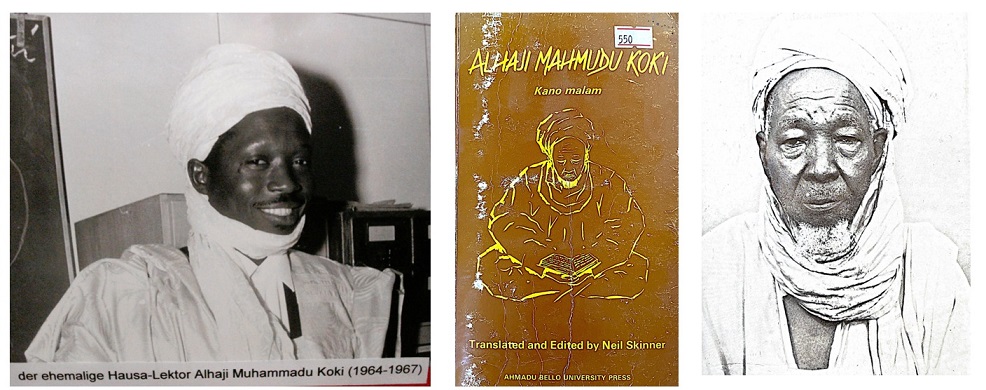
I was rummaging through my travel pictures when I came across a picture that I am sure has not been published anywhere. I saw it in a glass case at a ‘corridor museum’ at Universität Hamburg, Germany, on 2nd December 2008. I was excited because of its rarity. It was the picture that I am sure has not seen the light of day almost anywhere. I had vaguely heard about the man from my father, a writer, but did not pay attention then. Now he was there, smiling in all glory and right before me. I decided I would take the picture to show it to my father.

Edit: The man was Muhammad Ƙoƙi, the son of Alhaji Mahmud Ƙoƙi, the Kano Malam. His picture triggered my excitement about his father, Malam Mahmudu Ƙoƙi.

Malam Mahmudu was perhaps one of the most unsung and unknown critical literary figures in Hausa history. You can Google all you can. You won’t find him or his picture. Instead, you will be taken to Neil Skinner’s book, “Alhaji Mahmudu Ƙoƙi: Kano Malam” (ABU Press, 1977). I very much doubt if ABU Press itself has a copy. My copy is in excellent condition (except for a slightly scratched cover) since it was printed on shiny bond paper – and can therefore scan very well. I hesitate to do this for fear of copyright violation. I do wish ABU Press would consider retrieving a copy somewhere and reprinting it.

On return from Hamburg, I started looking for the book – and I was lucky to grab a copy at then ₦550 in January 2009. Now, some 14 years later, you can get a second-hand copy from the online store Abe Books for just $99 (cheap at ₦74,000 in 2023). At the moment, I don’t have any ‘kebura’ around me (since the ASUU strike was suspended!). Otherwise, I would offer mine for ₦50,000 for my copy!

Quite simply, it is a brilliant slice of Hausa history. Most significantly, it detailed the fieldwork done in the collection of data for Bargery’s Hausa Dictionary, whose full title is “A Hausa-English dictionary and English-Hausa vocabulary”.

Although mainly attributed to Rev. George Percy Bargery (1876-1966), an English missionary and linguist, the dictionary had significant input from Diedrich Hermann Westermann (1875-1956), a German missionary, Africanist, and linguist. The dictionary was published in 1934. The printed copy used to be available at ABU Bookshop, where a colleague of mine gifted me one he bought at the huge sum of ₦2,000 in ancient days, almost breaking his bank account!

The book was written/edited by Neil Skinner (1921-2015) at the request of Bargery’s son, Kenneth, to collect recollections of the elder Bargery while in northern Nigeria. Alhaji Mahmudu Ƙoƙi (1894–1976) was Bargery’s Chief Assistant in the preparation of the Dictionary and was the first choice to ask in 1967. As Skinner recollected, “I began recording some of his memories of Bargery. Listening to his vivid accounts of Kano in the first of the century, I formed the idea of putting together from Mahmudu’s lips some account of his own life.”

And what a fascinating life it was. Skinner continued, “As a son of the largest city of northern Nigeria, who had been born into the civil war of Aliyu and Tukur, M. Mahmudu saw the coming of the British, knew Waziri Giɗaɗo and Resident Temple, lived to see the end of the British rule and the Nigerian Civil War and, above all, had close contact with rulers and innovators, both Nigerian and British. He, therefore, seemed likely to have a tale worth recording for younger generation of Nigerians and those with an interest in Nigeria as it was and is. Mahmudu was a spectator of many great events and participant in not a few.”

And what a whirlwind tour of northern Nigeria it was in the early 20th century. Reading the book is like going back in a time machine. Everything was covered: economy, society, governance, culture, everything. As Neil Skinner stated, the book was told by Mahmudu himself – Skinner just edited it. It contained both fascinating and often disturbing details of days gone by. For me, for instance, I was traumatized by his account of the slave trade in Kano. As Mahmudu recalled,

“I used to see slaves being sold – with my own eyes! At Ƴan Bai, on the west of the [Kurmi] market. That was where they used to line them up and sit them down, with their feet sticking out, like this. Then it would be, ‘You there! Get up!’ And he would get up, and we would look him over well from top to bottom and say, ‘Walk a little!’ then he would do so until we told him to come back. He would do so, and we would say, ‘Right, go and sit down’ and put hand to pocket and take out a little money, perhaps a score of cowries or fifteen and give them to him. You would do this, whether you bought him or not. Then, if he saw someone selling groundnuts, he would call her over to get some saying he had been given the price for getting up to be inspected. That is how we have a proverb which says, ‘Tashi in gan ka ma na da ladanta’.”

Based on this disturbing account – in the heart of Africa – I wonder how many of our other proverbs have such creepy and dark origins? If you go to Ƴan Bai in Kurmi market in Kano, now you will only see mats, books and assorted goods.

Alhaji Mahmudu Ƙoƙi provides a rich tapestry of ethnographic details about how the Dictionary was compiled and the fact that the team of Bargery and his assistants insisted on seeing actual objects and their names before recording them. One wished they had an artist with them to sketch out many of the cultural artefacts that have all but disappeared now. It is good that the Bargery dictionary has been digitized and is available free online, thanks to the efforts of Hirokazu Nakamura of the Faculty of Human Science, Department of Human Sciences, Bunkyo University, Japan.

“Alhaji Mahmudu Ƙoƙi: Kano Malam” is comparable to “Baba of Karo” by Mary F Smith (wife of M.G. Smith, author of “Government in Kano, 1350 to 1950” amongst others, and which is available FREE online!). Published in 1954, “Baba of Kano” is an anthropological record of the Hausa people, partly compiled from an oral account given by Baba (1877-1951), the daughter of a Hausa farmer and a Koranic teacher. Baba’s reports were translated by Smith.

Books like these encourage us to seek out our own cultural history – visit those places mentioned, savour their historical aroma and note them as centres of excellence in discovering our past. By the way, Ƙoƙi is a ward in the city of Kano and right on the edge of the Kurmi market. If you are from the area, perhaps you may have heard of Alhaji Mahmudu from his grandchildren.

Don’t forget; this is not a review of the book but a memory jog on the old man, Alhaji Mahmudu Ƙoƙi, whose picture was honoured at a foreign university.

There is a composite collage of the picture I snapped in the Hamburg university museum of the son, the book and the father! as the latter appeared in the book.

Prof. Abdalla Uba Adamu can be reached via auadamu@yahoo.com.

Gender and the Disappearing Hausa Intangible Heritage: A Study of Shantu Music

By Prof. Abdalla Uba Adamu

Hausa Intangible Heritage Revival – Overture to the Symphony

When Gillian Belben, the British Council’s new Director in 2004, wanted to introduce a truly unique project in enhancing the cultural relations between Britain and Nigeria, a series of initiatives were proposed. One of them was Connecting Futures – a project that linked youth in Britain and Nigeria through music, films, debates, social advocacy and the arts.

I was involved in the film and music projects. In the music domain, we wanted to create a music ensemble that would revolutionize traditional Hausa music – an endangered performing art. The reason for its endangerment was its griot-based nature. Traditional Hausa musicians were seen basically as praise singers – singing the praises of rich, famous, infamous patrons who pay them a lot of money. The changing Hausa society in the 21st century saw the disappearance of such griot musicians – as no one had the money (or the gullibility) to pay to hear their praises, except politicians – thus making such performances short-lived and, fundamentally, non-artistic. I was the Chairman of the defunct Center for Hausa Cultural Studies, based in Kano. The Center and the British Council liaised to develop a project to create a sustainable focus for Hausa traditional performing arts, at least for as long as the Connecting Futures project lasted. There was no government input in this – we did not seek any, nor do we expect any, despite the existence of the History and Culture Bureau (HCB) in Kano.

Gillian and I were interested in contemporary European music of multiple-instrument ensembles and decided to recreate an ensemble of Hausa musicians playing different instruments. This was unheard of in Hausa ethnomusicology since, traditionally, Hausa griot musicians tended to stick to only one instrument (stringed or percussion). However, with the advent of ‘modernity’ in traditional performing arts, some Hausa club musicians started combining string instruments (kukuma mainly) with percussion – drums and calabashes. Examples include Garba Supa and Hassan Wayam. For more on this, see Jacqueline Cogdell DjeDje’s brilliant Fiddling in West Africa.

We were not interested in modern synthesizer music with its sampled sequencers of sounds that modern Hausa ‘nanaye’ singers arrange to form melodies and then transposed lyrics over the beat, often with female autotuned voices – all mimicking Indian film soundtrack singers. This production mode earned their genre the name of ‘nanaye’ – girlish (not female, incidentally!) music.

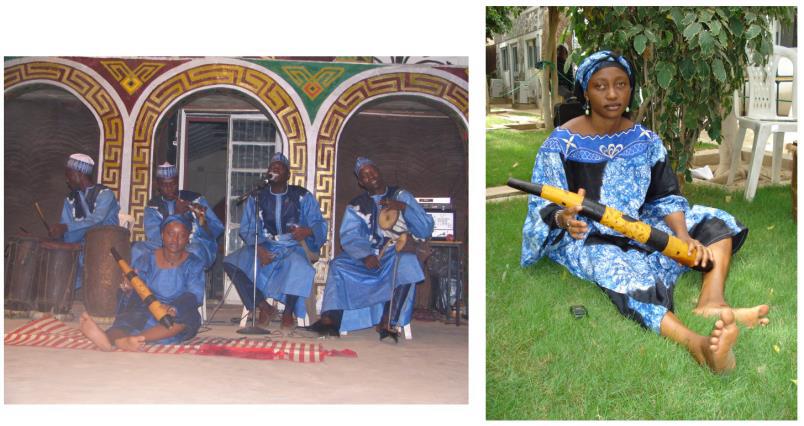
In our project, we envisaged four different instruments working in harmony to produce at least an acceptable ‘post-modernist’ Hausa traditional griot music – without the praise singing. We sent out notices requesting expressions of interest from interested musicians, mainly griot. Many ‘nanaye’ singers came, and we turned them away – we wanted musicians, not singers –none of the nanaye singers could play any traditional instrument. Auditions were held with those who can play a specific traditional instrument, and we first chose three: sarewa (flute), kukuma (fiddle), and kalangu (drums). Because there were many varieties of drums, we added duman girke ‘conga’ drums. All were to be played by males, as was traditional in Hausa traditional performing arts. That was when Gillian decided to up the ante by insisting on a female musician join the four young men.

This was a tall order for many reasons. Hausa women are not accustomed to playing musical instruments, especially in public. There were, of course, exceptions. The late Hajiya Sa’adatu Barmani Choge and Hajiya Uwaliya Mai Amada both had ‘calabash orchestras’ and performed in public. You can find further readings on her life and performance at the end of this. Currently, in 2022, Choge’s children and former bandmates have continued the tradition of performing in public – mainly at weddings and naming ceremonies. They used to perform during political campaigns, but the bad publicity and accusations of improper behaviours put paid to that.

Both Uwaliya and Barmani were in advanced age and could get away with pretty much everything. Getting a young Muslim Hausa woman to join young males and perform in public was genuinely challenging. However, Gillian was determined to do it, so we focused on the instrument the female band member could play. The only viable one was shantu – an aerophone. This was a female musical instrument, which, together with the bambaro (mouth harp), has all but disappeared.

Eventually, we found Fati Ladan, a lady living in Kano but originally from Niger State, who was one of the ƙoroso dancers attached to the History and Culture Bureau (HCB), Kano. The HCB already have a shantu ensemble, made up of much older women who perform during opening ceremonies at government events – adding a bit of classic flavour to the settings before the long speeches start.

Fati could not play the shantu herself but was willing to learn, especially from the existing shantu ensemble at the HCB. She eventually became adept at it. In the next stage of our project, we added her to the earlier group of four male musicians and called the group Arewa. But since the fronts man of the band was Nasiru Garba Supa, the son of the legendary kukuma player, Alhaji Garba Supa, we later referred to the band as Nasiru Garba Supa and Arewa. You can watch Fati’s solo performance, which I recorded and edited in 2014 in Kano, at https://bit.ly/3DF1Hfk.

The shantu, a percussion tube used by Hausa women, found its way to North Africa due to the trade in enslaved women (for more, see Ames and King, Mercedes). The Kanuri ganga (double-headed cylindrical drum) and the Hausa and Songhai instruments of the same name are North African borrowings from West Africa. An extremely large variant of the shantu, called languru (sharing a name with a language learning and dictionary app) and also referred to as shantu, is played by male Fulɓe.

Interestingly, the languru is similar to the alphorn, a wind instrument that is a national symbol of Switzerland. It has been used by Alpine farmers for hundreds of years as a form of communication in mountainous regions, although now it is simply a musical instrument. During the 18th centuries it was regarded as a beggar’s horn, since it was most often played by impoverished shepherds in the cities, obviously using smaller versions. The Fulɓe languru is also a wind instrument and played during festivities in gatherings of the Fulbe in the evenings after the cattle has been squared away either in corrals or designated areas. The smaller shantu used by women is a tubular shell of a long, narrow gourd, open at both ends; often decorated with patterns burned on, or cut into, the outside shell. It is held in the right hand and beaten in a variety of ways by the seated player, including the following:

  • Stamped with its lower end against the inside of the right thigh, or against the calf of the right leg.
  • Stamped with its upper end against the open palm of the left hand
  • Tapped with its outer shell against the shin bone of the right leg
  • Tapped with the lip of its lower end against the ground
  • Tapped on its outer shell with rings on the fingers of the right or left hand
  • Used singly or with one or more other shantuna in the statement of zambo (innuendo), as in waƙar kishiya (song of co-wife), karin magana (proverbial sayings), etc., through the imitation of speech tone and quantity; used solo or with one or more other shantuna in the accompaniment of song
  • Used by women for social comment (e.g., by a co-wife in criticism of her partners) or for informal music-making.

Nasiru Garba Supa’s Arewa and Fati performed many concerts for the British Council over a period of two years, generating a lot of interest and accolades due to Fati’s often solo slot given during any performance. Since the concerts were family affairs – involving the whole family to attend – many young people were fascinated by Fati’s shantu playing.

Gender Rebellion and Shantu music – The QAC Troupe in Historical Perspective

Generally restricted mainly to elderly women playing it to amuse themselves, the shantu was made a choice of musical performance in all-female secondary schools in northern Nigeria in the 1970s. For the most part, they performed during school activities – graduation, cultural days, national events, etc. Once the students graduate from the secondary schools, they simply retire the shantu to what would pass for attic. However, perhaps remembered by people in their sixties, the prominence of shantu as an instrument in public performance was catapulted into legitimate public entertainment in the early 1980s by students of Queen Amina College (QAC), located in Kakuri, Kaduna, northern Nigeria, especially the 1984 graduating class. They were encouraged to use it as part of the then cultural revival in secondary schools. The main reason for their popularity was rehearsed perfection. Perhaps not surprisingly, they were more frequently featured on NTA Kaduna cultural variety shows.

However, soon enough they started drawing criticisms due to their increasingly bold, and what was seen as anti-cultural, performances. Perhaps carried away by their popularity, they became more experimental in their choreography. One of the performances on their setlist was Gantsare Gaye. Accompanied by the deep bass-like hollow sound of about 10 shantus, the dancers energetically move their derrières in an obscene movement of sexualized dance routine (mainly referred to as ‘gwatso’/thrust). Although the 1980s was a liberal decade (and almost twenty years before Sharia was launched in Islamicate northern Nigeria), the sight of teen girls performing such obscene dance routines on public Television drew critical reaction and condemnation in newspapers and from Muslim clerics in Kaduna and Kano. The QAC girls were undaunted, however, knowing fully well that they had the full protection of their powerful parents, the girls themselves eventually marrying into equally powerful influential homes, with quite a few of them becoming powerful themselves. QAC was an elitist school and thus created a cultural disjuncture in the performance of the girls. Interestingly, it evolved from a Catholic missionary educational tradition – thus giving multiple readings to the girls’ performances. The college was established as the Queen of Apostles College Kaduna by Catholic Missionaries in 1940, becoming Queen Amina College when it was taken over by the Kaduna State government in 1970s following government takeover of missionary schools.

Their defining creative moment was at the International Market for Film and Television Programmes, organized by the Nigerian Television Authority, held at Durbar Hotel, Kaduna, from 27th to 31st March 1983 (NTA IMPT ’83). Part of the festival included performances by various artists – and the QAC girls were requested to perform on stage for 15 minutes. Their troupe consisted of 22 performers – 12 call-and-response vocalists and dancers, and 10 shantu players who also called the chorus. There were no percussion instruments, with the bass sound of the shantu being sufficient enough.

Through trawling various Facebook postings, I have been able to identify some of the performers – now all grandmothers and in their mid-50s! They included Fatima Umar Wali, Halima Waziri Digma, Maryam Tinau, Maryam Adamu, Hauwa Suleiman, Aishatu B Musa, Rabi Tinau, Binta Tukur, Binta I Kaita, Fatima Musa, Fatima Usman, Mairo Mu’azu, Amina Musa, Zuwaira Abubakar, and of course, others, actually mentioned in some of the verses.

Their setlist for that festival was made up of five songs, plus intro and outro skits. The main songs were Karyamaye, QAC, Alhaji Lawal Kalabayye, Ko da Rabo, Gantsare Gaye. The song structure of their performance did not fall into the classic intro, verse, pre-chorus, chorus and bridge, associated with modern, basically English songs. They adopted the framework of chorus, verse, chorus – in a call-and-response pattern, typical of traditional songs in northern Nigeria. The chorus was also the song’s hook. Only one song had an opening doxology of one line (Karyamaye). Sleuthing on Facebook comments about the uploaded videos of the performances reveal that Alhaji Lawal Kalabayye was named after their food contractor! He apparently did a good job to warrant having a whole song devoted to him!

The opening song of the performance, after a few seconds of the intro skit, was their masterpiece: Karyamaye (a made-up word to provide vocal harmony). This was an invective song targeted at their public culture critics. The first (and actually, the main) verse is transcribed below:

To bismillah, jama’are, Arrahmani/People, we start in the name of Allah

Mu ƴan Hausa, da mu ƴan Shantu/We, the Hausa and Shantu club

Da ba ruwan mu da kowa/ Those who are not bothered

Ba ruwan mu da kowa/We are not bothered

Sai dai a gan mu a bar mu/See us, and leave us alone

Sai ko hararar  nesa/Your dirty looks only at distance

A cikin duniyar nan, Wallahi/ In this world, by Allah

Muna da masoya, kana muna da maƙiya/We have fans and we have haters

An ƙi jinin mu, kamar a sa mana kananzir/They hate us, wishing to pour kerosene on us

A ƙyatta ashana a jefa/And lit [the fire to burn us]

Ba’a san mu kamar a kashe mu/The haters want to see dead

Ga rijiya a saka mu /Or throw us in deep wells

Ko a samu warin gwano/Or make us stink like black stink-ant

Daga hange sai leƙe sai ko harar nesa/Watching afar, hating with dirty looks

Wataran sai labari/It’d be all over one day

…       

Ku san mai san ku/ Kana kusan mai ƙin ku/Know your fans/ Know your haters

Koda dare ko rana/ koda cikin ƙabari ne/Night or day, even in the grave

Koda ruwa ko iska/ koda cikin duhu ne/Through storms, even in the deepest darkness

Karyamaye, with full booming sound of 10 shantuna (pl.) with outside air energetically sucked down the aerophone provided a perfect percussion to their voices, and really demonstrated the power of the shantu in well-skilled hands. It is this rehearsed, almost flawless perfection that stood them better than other girl troupes in their immediate vicinity (e.g., Kurmin Mashi girls shantu troupe, also in Kaduna). Their verse was full of insouciance, defiance and pride in their art and identity; for instance:

Mu ƴan Hausa, da mu ƴan shantu/We, Hausa and shantu players

Perhaps, even aware of their delectable beauty, they cocked a snook at their unapproving but silent admirers:

Sai dai a gan mu a bar mu/ Sai ko hararar  nesa/

The line is basically saying, look, but we are untouchable – you can only hate from afar. As I indicated earlier, the second performance, Alhaji Lawal Kalabayye, was named after the school’s food contractor, as confirmed by a former Home Economics teacher at the College, Mrs Lasfir Tasalla Andow, in 2019. The song, however, did not mention Alhaji Lawal himself, although the first lines of the song salute farmers – an obvious reference to food, and tangentially, to Alhaji Lawal!

Ina jin hausin mutumin ba ya zuwa gona/I am annoyed at a person who detests farming

Sai ya zauna a tsakar gida sai ka ce turmi/Always at home like some fixture

The song, however, further reaffirms the Hausa identity of the performers because they went through a cycle of profiling various ethnic groups – essentially pointing out the bad character traits of the groups, justifying their unwillingness to allow their daughters to marry them because of the profiled reasons they gave. For instance:

Ina da ƴata ni baza na bai wa Zagezagi ba/I will not marry off my daughter to Zaria people

Fate da safe, fate da yamma, kamar mayu/Yam porridge all day, like hexers

Ina da ƴata ni baza na bai wa Fulani ba/I will not marry off my daughter to the Fulani

Uwa a daji, uba a daji kamar kura/Both mother and father in wilderness, like hyenas

Ina da ƴata ni baza na bai wa Beriberi ba/I will not marry off my daughter to the Kanuri

Uwa da tsagu, uba da tsagu kamar ƙwarya/Both mother and father with facial marks, like calabashes

Ina da ƴata ni baza na bai wa Yoruba ba/I will not marry off my daughter to the Yoruba

Suna da kuɗi, amma a kwano suke kashi/They are wealthy, but they poop in their dishes

Ina da ƴata ni baza na bai wa Katsinawa ba/I will not marry off my daughter to Katsina people

Uwa masifa, uba masifa kamar sauro /Both the mother and father are too fiery, like mosquitoes

Ina da ƴata ni baza na bai wa malamin bana ba/I will not marry off my daughter to modern Malams

Yana wazifa, hannunsa na shafa ƴan mata/While being devotional, they also fondle little girls

These stereotypes, of course, fall within the purview of joking relationships in forms of playful taunts between citizens of various cities that made up the old kingdoms of northern Nigeria. Such relationships are often based on ancestral pacts forbidding conflict or war between specific communities, and imply that the members must love one another and provide assistance where needed. The lyrics were therefore not meant to condemn or belittle any community or groups.  

It was surprising that Kano, with its almost manic commercialism, escaped this stereotyping – even though most of the girls were not from Kano, but perhaps their songwriters (most likely their Hausa subject teachers) were from, or affiliated with Kano! Whatever the case, their trenchant, non-politically correct lyrics cast them with an independent and spirited veneer that demands either acquiescence or indifference from the public. The ethnic groups of Yoruba, Kanuri and Fulɓe each came under their taunts. The Yoruba came into the picture because of Ilorin, considered one of the ‘bastard seven’ Hausa city-states (banza bakwai), although the historical narrative used Yoruba as a generic term; but it was only that Ilorin had a historical connection to the core Hausa states. Even respected Islamic teachers did not escape their barbs – – being accused of alleged sexual abuse of children under their care. This created a picture of betrayal of trust by those in charge of child care. Perhaps due to the constant radio criticisms of the girls by the cleric establishment in especially Kaduna and Kaduna, the performers felt obliged to point out that everyone has a bad spot, no matter how morally upright.

Alhaji Lawal Kalabayye ended with an acknowledgement of the support of their establishments in their art:

Teachers ku lura ku gane/Our teachers, be wary

Ƴan gulma suna nan/Gossipers abound

Yan baƙin ciki na nan/Haters are present

Gasunan dan su rabamu/Wanting to divide us

Wallahi baza su iya ba/By God, they will not succeed

They closed their performance with the song – and dance – that drew the ire of the public culture in northern Nigeria: Gantsare Gaye. The refrain was:

Gantsare gaye, gaye never go straight/

The sexual innuendo was clear in the ‘straight’ part of the chorus, and performing it in public took their art to a new level. The performance is available at https://bit.ly/3Eh0dYJ, with the ‘gantsarewa’ starting at tc1.01. ‘Gaye’ referred to what might be called ‘the dude’ – urban, transnational, metrosexual and sophisticated young man. Influenced by African American superstars such as Michael Jackson, young men in the north of Nigeria took to Jackson’s fashion and street cool. The Hausa ‘gaye’ (stylized from guy) was immortalized by the griot, Ɗan Maraya Jos in his song, ‘Ɗan Gaye Mugun Bawa’/The Badass.

Each of the girls was called out in the chorus to come and do the obscene gwatso dance – something that would probably make them blush later in their middle age years! Indeed, an unverified anecdote I once heard in Lagos decades after the event, was that one of the participating ladies phoned NTA requesting the TV station to stop repeated showing of the clip (which was part of archival cultural entertainment) because she said it was embarrassing.

The stage performance of Gantsare during the festival was more energetic than in the muted TV studio versions and an additional defiance to their critics – with total approval of their school.

Overall, regardless of the judgement on their performance, they did reflect an authentic female, and what I may even refer to as proto-teen feminist defiance. Certainly, the QAC girls had lent flair and elegance to a tradition of gendered performing art which counts as an intangible cultural heritage. Their granddaughters, by 2022, were the Gen Z cohort, and armed with TikTok, Snapchat and Instagram, rather than the shantu, carried the self-expression and defiance to a whole new level as petulant, entitled generation, and certainly without the cultural authenticity their grandmothers had.

Shantu Jazz Fusion and the Mezcal Jazz Unit

The Kano State History and Culture Bureau (HCB) subsequently established its own shantu troupe, made up of more mature ladies and keeping the spirit of intangible heritage alive. I had the opportunity to watch them perform live at the Emirates Palace Hotel, Abu Dhabi, UAE, on 1st October 2009 as part of the preparations to the conference on preservation of musical heritage of various cultures, Hausa being one of those chosen. I was with them in the dressing rooms backstage where I interviewed them, and later recorded their performance. A little bit of it is at https://bit.ly/3GBaSQG. A second Hausa act at the concert was Nasiru Garba Supa, who also performed, although without Fati and her shantu because by then Fati had left the band after getting married, although HCB retained her in some capacity.

Earlier in February 2009, the French Cultural Centre in collaboration with Alliance Française, Kano, organized a Kano Music Festival, Kamfest 2009. This was to bring French and Nigerian artists together for a three-day music festival. One of the French bands was Mezcal Jazz Unit, a jazz band formed in Montpellier, France. The band had established a reputation as being a fine jazz band and creating crossover fusion recordings with artists from various cultures worldwide.

The HCB shantu troupe was also featured at Kamfest 2009. While each band performed separately, a segment was created where a jam session was performed fusing MZU’s jazz improvisations with the HCB shantu sounds and vocals from the players. This creation must be seen as a real bridge between the two cultures via both authentic and peaceful exchanges, through music. Two cultures, two countries, one music!

Mezcal Jazz Unit, whose identity is maintained by regular confrontation with musical groups from all horizons, was one of the rare groups capable of engaging in smooth and fluid artistic collaborations that appear spontaneous. Their quartet was based on the clearly established principle of openness, allowing for a continuous invitation of “jazz” and “non-jazz” artists. This spirit inspired Mezcal Jazz Unit to formally record with the shantu ensemble in February 2009, just before the KAMFEST festival. The result was a CD, recorded in Kano, but mastered, pressed and marketed in Paris. The CD was simply titled Shantu. Released in 2010, it is available at https://apple.co/3zEMdGR, although some videos of the performance are also available at https://bit.ly/3DBDLcm.

Recently, the shantu has started coming back as part of female entertainment, especially during wedding ceremonies, as reflected in quite a few TikTok uploads of various shantu performances during ceremonies. Perhaps tired of the synthesizer love songs typical of modern Hausa singers (not musicians, since the singers rarely create the music accompanying their song) a revival of Hausa intangible cultural heritage is probably happening.

Preservation of the Hausa Intangible Cultural Heritage in Performing Arts

According to UNESCO, intangible cultural heritage includes the practices, representations, expressions, knowledge, skills – as well as the instruments, objects, artefacts and cultural spaces associated therewith – that communities, groups, in some cases, individuals recognize as part of their cultural heritage. Hausa female musical performance certainly are part of this heritage and is fast disappearing. There quite a few reasons for this.

First, music generally is frowned in Hausa societies. It is widely considered a low-class occupation (Smith has a good thought on this) – despite the immense popularity of both traditional griot and modern electronic (synthesizer) performing artists. This has the unpleasant outcome of relegating music and musicians to the background of any debate on social development.

Secondly, the subject matter of most musical performances also creates a distaste in the genre. With extremely few exceptions, Hausa performers are basically praise singers – singing the praises of politicians who pay them millions to praise them or denigrate their political opponents. This has contributed to lowering the image of musicians in the society. Rarely do musicians approach the art as an aesthetic process independent of client or patronage status.

Third, and mainly for women, public performance in predominantly Muslim communities is frowned upon because the audiences are not her muharrams – i.e., males with whom there is no possibility of any marriage. Salamatu Mai Gurmi, a female gurmi player, found a way around this by taking her husband along to her performances with his full permission. After all, the performances do put food on the table, as it were.

Fourth, the preservation of musical heritage requires a sustainable input in terms of concert dates, tours, record deals, publicity, distribution and marketing, etc., processes with not only required expertise that is absent among local, especially female, performers but also exposure – with attendant security risks – that will not make it possible for women to participate, no matter how talented. Currently, Barmani Choge’s female grandchildren have sustained their grandmother’s musical heritage in Funtua, Katsina State, but living in penury and lack of both individual and government support. I have instituted a project to get one of them to a studio and record her songs – which will be uploaded to YouTube for all to hear. Salamatu Mai Gurmi, from Bauchi, plays the gurmi on invitation to naming and wedding ceremonies, accompanied by her husband and playing to mainly female audience. She performed solely for the camera at https://bit.ly/3gkPKDS

Five, private female-only performances do take place in various places – for instance, the Sakaina (broken calabash as instruments) performance in the Kano Emir’s Palace in the past. However, such performances are not public, even though they are part of the intangible heritage to be preserved. There is a need to create public equivalents, even if restricted to private female audiences, of these performances, especially among older women.

As we focus on the preservation of the Intangible Cultural Heritage in the performing arts domain of the Muslim Hausa female, the main thrust of such preservation falls on the National Institute of Cultural Orientation (NICO), a UNESCO country partner representing the Federal Ministry of Information and Culture.

Thus, NICO can sustain its revival movements as a form of cultural activism that uses elements from the past to legitimate change—change comprising not only a reversion to past practices but innovation. Therefore, a series of initiatives are needed to preserve the intangible heritage of the shantu performance.

The Institute could initiate a policy dialogue involving public culture representatives – clerics, youth organizations, community leaders – that will fashion out an acceptable re-insertion of shantu music as accepted public performance. This is because the issue of the public visibility of the female within Islam has to be balanced out. Of course, there are many young women in Hausa societies who are currently performing as singers (though not as musicians) in the public domain. Yet, traditional instruments, in the hands of women and in public arena does tend to rub some people in the Islamicate culture of northern Nigeria the wrong way. Dialogue is critical to everyone being on the same page.  

At the same time, NICO could institute a competition among girls and young women and clustered by age for shantu playing, with prizes for the best three within each group. The songs needed not be on relationships – they could over all spectrum of human behavior, with prizes awarded for the best performance in each category – and such rewards to include marketing and promotion of the output.

Finally, the success of the crossover genre embarked by the Mezcal Jazz Unit and shantu clearly points to the future of such crossover improvisations. For instance, amada performers can be integrated with both shantu and gurmi players for a series of fusion concerts. This will create new innovations in Hausa female music and certainly provide a welcome alternative and exposure to a performance genre that is fast being smothered by synthesized sounds.

Select Bibliography

Adamu, Abdalla Uba. “Tribute to Hajiya Sa’adatu Ahmad Barmani Choge, Griotte, northern Nigeria, 1948-2013.” The Annual Review of Islam in Africa, University of Cape Town, South Africa, Issue No. 12/13, pp. 166-172, 2016.

Adamu, Abdalla Uba. “Womanist ethos and Hausa domestic ecology: A structuralist analysis of Barmani Choge’s operetta, Sakarai ba ta da wayo (Useless woman).” In S. Abdu (Ed.). Poetry and Poetics: Proceedings of the 5th Conference on Literature in Northern Nigeria. Bayero University Kano: Department of English and French, pp. 93-120, 2008. 

Almajir, Tijjani Shehu. 2022. Sigogin Waƙoƙin Shantu da Tasirinsu a Rayuwar Hausawa. Bayero University Kano. Kadarkon Adabin Hausa: A Festschrift in Honour of Professor Sa’idu Muhammad Gusau. Forthcoming, 2023.

‌Ames David Wason and King, Anthony V. Glossary of Hausa Music and Its Social Contexts. Northwestern University Press, 1971.

Ames, David Wason. “Professionals and Amateurs: The Musicians of Zaria and Obimo.”  African Arts, vol. 1, no. 2, pp. 40-45+80+82-84, 1968.

‌DjeDje, Jacqueline Cogdell. “West Africa: An Introduction.” In Ruth Stone (Ed.). The Garland Handbook of African Music. New York: Routledge, pp. 166-197, 2000.

DjeDje, Jacqueline Cogdell. Fiddling in West Africa: Touching the Spirit in Fulɓe, Hausa, and Dagbamba Cultures. Bloomington: Indiana University Press, 2008.

Erlmann, Veit. “Notes on Musical Instruments among the Fulani of Diamare (North Cameroon).” African Music: Journal of the International Library of African Music, vol. 6, no. 3, pp. 16-41, 1983. https://doi.org/10.21504/amj.v6i3.1166.

Jatau, Phoebe. “Shantu Songs: An Example of the Oral Heritage of Hausa Women in Kaduna State.”  In Saleh Abdu and Muhammad Badmus (eds.), Writing, Performance and Literature in Northern Nigeria. 2nd ed. Kano: Bayero University Press, pp.166-182, 2006.

Kassam, Margaret Hauwa. “Some Aspects of Women’s Voices from Northern Nigeria.” African Languages and Cultures, vol. 9, no. 2, Gender and Popular Culture, pp. 111-125, 1996.

Kofoworola, Ziky and Yusef Lateef. Hausa Performing Arts and Music. Lagos, Nigeria: Department of Culture Federal Ministry of Information and Culture, 1987.

‌Mack, Beverly Blow. Muslim Women Sing. Bloomington: Indiana University Press, 2004.

MacKay, Mercedes. “The Shantu Music of the Harims of Nigeria.” African Music: Journal of the African Music Society, vol. 1, no. 2, pp. 56–57, 1955. https://doi.org/10.21504/amj.v1i2.255.  

Musa, Umma Aliyu. “Promoting women empowerment through songs: Barmani Choge and her performances.” Journal of African Languages and Literatures, vol.1, 2020, pp.89-109, https://doi.org/10.6092/jalalit.v1i1.6735.  

Smith, Michael Garfield. “The Hausa System of Social Status.” Africa, vol. 29, no. 3, pp. 239–252, 1959.
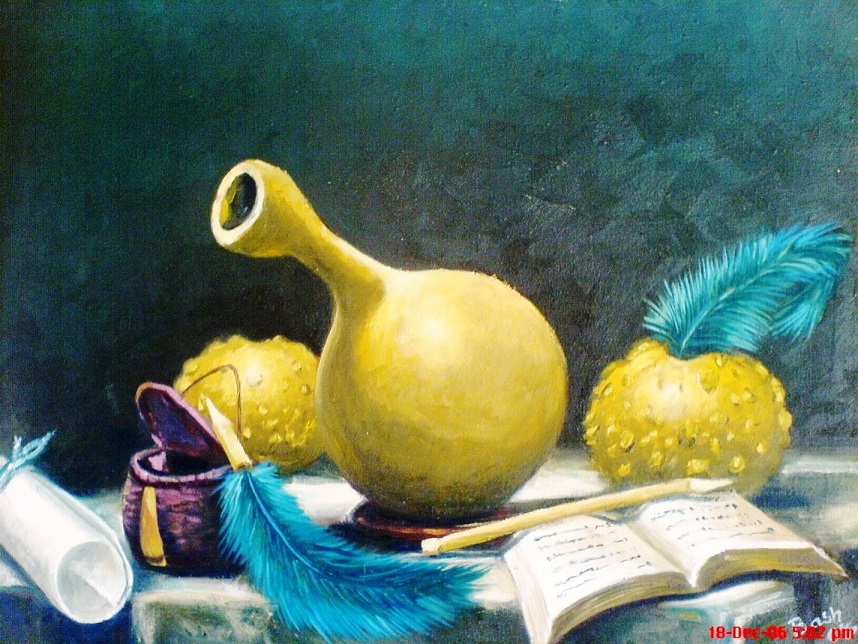
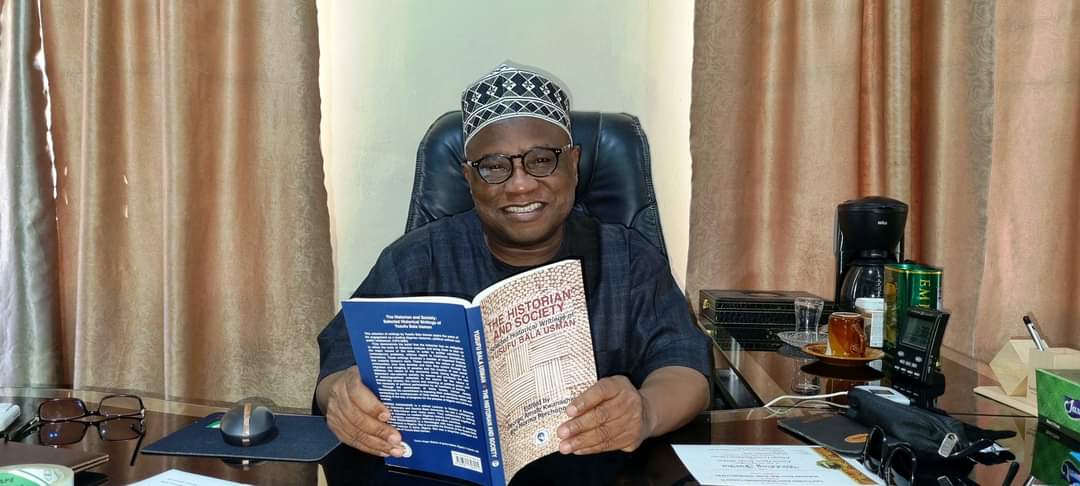
Paradigmatic Shift in Literary Ignorance: Ajami on Naira Reloaded

By Prof. Abdalla Uba Adamu

As we enter into the ‘will they, will they not’ mode of uncertainty typical of Nigerian public culture about the change of Nigerian higher currency denominations announced by the Central Bank of Nigeria (CBN) on 25th October 2022, my mind went back to an article I wrote on 16th April 2007. This was in the wake of the removal of “Arabic inscriptions” on the Nigerian currency (the Naira) on 28th February 2007 in the new currency notes that removed the Ajami (Hausa written in Arabic script) writing that indicated the denomination of the respective currency note and replaced with the Latin alphabet. This is a ‘remix’ of that posting on the then-popular platforms of Blogspot. Mine was called Nishadin Hululu (Hausa Popular Culture).

The full historical overview of how the Arabic “script” came to become part of the essentially northern Nigerian Muslim Hausa educational package is given in Manuscript Learnability and Indigenous Knowledge for Development – Hausa Ajami in Historical Context. A version is available at https://bit.ly/3zoi7XN.

I rarely bother to visit Nigerian “Naija” websites on the web or any other group of politically motivated Nigerians. I know what I will find – the usual vituperative tirade against northern Nigerians, Muslims, Hausa, ad nauseum. Southern Nigerians have three fundamental articles in their crusade against northern Nigeria: Islamic fanaticism, conservative feudalism and their weird perception of the “born to rule” syndrome held by the ‘northerners’. No matter how many groups of Nigerians you interact with, these three form the main focus of the divide in Nigeria. They are the main reasons why Nigerian “unity” is virtually impossible.

I doubt if there is any other group of Africans who hang out their dirty ethnic laundry like Nigerians. Although, I accept, for the most part, such ranting is probably not personal; they are basically religious – the Christian versus Muslim divide, rather than any feeling of superiority of one ethnic group over the other. Any such feelings of superiority are part of a religious template that sees the acquisition of education as the central criteria for judging the value of a whole people. Thus education, not religion, is the central fulcrum around which the Nigerian nation wobbles.

Southern Nigerians acquired education through Christian Missionary activities from about 1849. Such education became the mainstay of acquiring Westernized modernity. Inevitably Western education brought by Christian missionaries to Nigeria became equated with Western Christian values. For the most part, Christian southern Nigerians are happy with this because it makes them “civilised” – in the absence of any cherished antecedent cultural values. Thus, any other worldview is considered barbaric.

Northern Nigerians, specifically the Hausa and the Kanuri, acquired education through conversion to Islam since 1250 and even earlier in the Kanuri kingdom. The constant eddy of scholars from north African learning centres throughout the 14th to 17th centuries ensured a sustained scholastic tradition in Muslim northern Nigeria. Muslim northern Nigerians, therefore, had a longer exposure to the concept of formalised learning and literacy than southern Nigerians. Universal basic education was indeed introduced around 1464 in the city of Kano when new methods of indigenising the Arabic script to Hausa phonology were created. This led to the creation of a novel way of writing out the Hausa language in a script that young scholars will understand. This method of indigenising Arabic script to the Hausa language became “Ajami”. It became one of the main ways of educating young pupils in northern Nigeria. Do you remember all those “Almajirai” you see in northern Nigerian cities? Well, most are fluent in Ajami writing. Currently, the most prominent modern Hausa political singer (though not the most talented or likeable), Dauda “Rarara” Adamu Kahutu, has an extensive catalogue of his songs, all written in Ajami which he reads as he records in the studio.

Ajami, therefore, is any literacy strategy in which any language is written in Arabic. Over 50 languages are currently written in the script. First, let us look at the parallel sphere. If any African language is written in Latin characters, it can be called Ajami. Ajami is not Islamic; any more than the Latin alphabet is Christian.

However, in a new era of reform, CBN decided to remove the “Arabic” script from the Nigerian currency in new currency notes launched on 28th February 2007. The removal of the Ajami script on the Nigerian currency reflected Nigeria’s deep-rooted religious divide because the Arabic script was seen as religious – and Nigeria is considered a secular country. This equates Arabic with Islam – ignoring the vast number of Arab Christians throughout the Middle East.

The logic of the removal of what the Nigerian economic establishment calls “Arabic inscription” on the Nigerian currency given by the Nigerian Government was premised on using a Latin inscription that is available to all Nigerians (even if in mutually exclusive languages), rather than an exclusive script tied down to a particular religious culture. According to the then Governor of CBN, Professor Chukwuma Soludo, during a sensitisation visit to the Sultan of Sokoto,

“I will also like to inform you that the removal of the Arabic inscription on the notes is not targeted at any group or religion but rather to promote our language and cultural heritage…As you can see, Naira is the symbol of our nationalism and our pride. It is pertinent to let you understand that Arabic is not one of our national languages, and it was inscribed on the notes forty years ago because the majority of people then could read it in the northern part of the country to the detriment of their counterparts in the South (ThisDay, 16th February 2007, posted to the web 19th February 2007 at https://bit.ly/3TQ4FEw.

Similarly, the CBN issued a rebuttal to the controversies by stating that the “de-ajamization” was to “conform (to) Section 55 of the 1999 Constitution, which recognises four languages, English, Hausa, Ibo and Yoruba as medium of conducting government businesses.” After all, as they claimed, after forty years of Western education, most people in Nigeria should be able to recognise Roman inscriptions. This, we believe, can strengthen our unity by ensuring equity and fairness. Indeed, the replacement was done in national interest and the desire to comply with the Constitution of the country.”

But how can national unity be attained when a large proportion of the country is still marginalised? To prevent this marginalisation, the British colonial administration introduced the Ajami letters on the first Nigerian modernised currencies, well aware of the large education gap – and therefore, the ability to read and understand Latin characters on the country’s currency notes. An example was the £1 note.

Fam daya” was prominently written to enable those literate in Ajami, but not the Latin alphabet, to identify the currency.

Interestingly, the main argument was that the presence of Ajami on Nigerian currency was seen to the “detrimental” to southern Nigerians (who presumably do not understand it) – yet the inclusion of the Latin alphabet is not seen as detrimental to non-Roman literate northern Nigerians (mainly Muslim Hausa, who presumably do not understand it). In this warped logic, it is, therefore, easier to alienate Muslim Hausa northern Nigerians than southern Nigerians, especially since a Christian was the President of the country (and a Christian Governor of the Central Bank facilitated the alienation). Of course, when a Muslim becomes the President, the arguments might be revisited – and reversed, which another subsequent Christian president will also revisit, and so on endlessly. Farooq Kperogi actually imagined a nightmare scenario that might come out of this in 2022 at https://bit.ly/3TOt2T1.

The inclusion of the script on the Nigerian currency by the British colonial administration was an acknowledgement of the rich literary heritage of a vast number of people in Nigeria who could not read the Latin script– and not a strategy to impose Islam on anyone in Nigeria. Indeed, the British colonial administration had no reason to propagate Islam. Yet on the currencies circulated by the same administration, the “Arabic inscription” was conspicuously present. This was maintained until 2007 when the despised Arabic inscription was removed and replaced with the much-loved Latin ‘inscription’. An example with ₦50 illustrates this.

The ₦50 with the ‘Arabic inscription’ of Ajami merely indicates that it is fifty naira in Hausa. In the redesigned ₦50, the Roman name for the Hausa was ‘naira hamsin’ instead of the Ajamized ‘hamsin’ in the old note. Yet, ‘hamsin’ means fifty in Arabic! So, like it or not, Arabic remains on the naira. To get rid of it, you have to get rid of the Hausa language entirely since about almost 45% of Hausa words are based on the Arabic language.

Further, other multicultural countries pay such homage to multiple literacies in their currency notes. The Indian currency, for instance, has 15 language scripts, including Urdu (Ajami) – despite Arabic not being part of its national languages.

And while not explicitly stated, the links made by the Nigerian economic establishment with Arabic to Islam seem to be part of a move to “de-Islamize” Nigeria – scoring a cheap point, particularly in the way most northern Nigerian states re-introduced Islamic Shari’a in their governance from 1999 led by Zamfara State, and the earlier issue of Nigeria’s membership of the Organization of Islamic Countries (OIC) in January 1986, which the Nigerian Christian (as well as Marxist Muslim) groups were against.

We look forward to the new currency notes in December 2022.

Prof. Abdalla Uba Adamu wrote from the Department of Information and Media Studies, Bayero University Kano, Nigeria. He is, among many other things, the former Vice-Chancellor of the National Open University of Nigeria (NOUN). He can be reached via auadamu@yahoo.com.

Days of Future Past: Creativity, technology and challenges of film policy in Kano (I)

By Prof. Abdalla Uba Adamu

Being a keynote at the Kannywood Foundation film training workshop, on 2nd October 2022, Kano

A Tale of Two Cinemas

In November 2007, I was privileged to participate at the African Film Conference held at the University of Illinois, Urbana-Champaign, United States. It was a stellar gathering of what I call the ‘Nollywood Mafia’. The outcome of the conference was reflected in the publishing of selected papers in Viewing African cinema in the twenty-first century: FESCAPO art films and the Nollywood video revolution, published by the Ohio University Press in 2007. At the tail-end of the conference, a session called The SIU Nollywood Project Brainstorming was held on Sunday, 11th November 2007. Containing well-known Nollywood scholars such as Jonathan Haynes and Onookome Okome, as well as Nollywood stars such as Joke Silver, Francis Onwochei and Madu Chikwendu, among others (including those who study Nollywood from the fringes such as Brian Larkin and Birgit Meyer), the session sought to determine funding for research on Nollywood from the US National Endowment for the Humanities. A critical point of discussion during the session was the name ‘Nollywood’.

While discussions were on course for the funding mechanism, there was a feeling from the participants that the term Nollywood should be used to reflect all films from Africa, regardless of region, to create a unified view of African cinema. As the only northern Nigerian with a focus (and paper earlier presented) on Hausa cinema, I objected and spent time arguing why the term Nollywood cannot be used as a blanket term for African cinema. Continentally, films from north Africa from Egypt, Tunisia, Morocco, Algeria and Mauritania are radically different from those produced by Nigerian Nollywood. Similarly, filmmakers from Chad, Burkina Faso, Senegal Cote d’Ivoire are more ethnographic to their cultures, which makes them required viewing for film and cultural studies across the world.

Even back in Nigeria, there is a radical difference between Hausa language cinema and the type of films produced and promoted by Nollywood. Labelling all African films as Nollywood is to cancel the identity of the portrayals of the films by different cultural groupings in the continent and project Nollywood as the only ‘African voice’. I am unsure whether the funding was obtained, but I know that the idea of labelling all African films as ‘Nollywood,’ regardless of cultural point of origin, was dropped.

***

By 2012 the Hausa film industry had literally crashed. The major marketers-cum-producers had all pulled out of the industry. Their shops in the major video markets in Kano were subsequently filled with clothing—particularly blouses and football jerseys; for these make more money than selling films. Others took to selling Smartphone accessories, while others returned to the farm and became serious farmers. The few Hausa megastar actors took to commercial advertising of noodles, milk and other household commodities – often moving from house to house with products’ marketers – relying on their faces and voices (making sure they introduce themselves in all the commercial jingles) to sell to increasingly hungry population caught in the vortex of economic depression. The frequency of releasing films drastically dropped because no one was buying. International Satellite channels like the Indian Zee World, especially their English-dubbed TV series, caught Hausa urban attention more than recycled Hindi film clones that were the hallmarks of Hausa video films. Consequently, many reasons combine to lead to the crash of the Hausa film industry towards the end of 2016. 

Market congestion

The popular cultural industries in Kano were marketed into market hubs. The Bata market at the edge of Sabon Gari controlled the predominantly foreign films and music sales and the main distribution centre to other parts of Nigeria and Africa, where a sizeable market existed in Niger, Burkina Faso, Ghana, Togo, Cameroon, Chad and Congos.

When the Hausa video film arrived in 1990, it found a ready template to attach itself. The other was Kasuwar Ƙofar Wambai, located at the edge of the walls of Kano city and near a cluster of old colonial cinemas. The Wambai market focuses mainly on leather, textile and plastics. However, it was also the hub of audio tape sales – with marketers doing brisk business pirating old EMI, Polydor and HMV tapes of traditional Hausa musicians recorded in the 1960s. Road construction work at Bata in about 2003 created unfavourable conditions for many of the stall owners, and some decided to shift to the Wambai market. By 2005 the video film market had moved entirely to Wambai, which now became the new Bata.

The Wambai market, hitherto occupied by cassette dealers who ignored the Hausa film industry, suddenly became a virgin territory for film marketers and producers, with each opening a stall. In less than five years, it had reached its ascendency and crashed due to the massive congestion of producers and marketers – all selling the same thing. When I visited the market in May 2017, I counted less than ten stalls selling either videos or audio; contrasted to some five years ago when it was bursting at the seams with these products. The stalls have now been taken over by stocks of cheap blouses, football jerseys and cloned Smartphone accessories.

Lack of new or captivating scripts

By 2005 the Hausa video film industry had become fully established, with over 1,600 officially censored releases. With an extremely few exceptions of less than 0.5%, they all revolve around a pastiche of Hindi films in one form or other aimed, as the video filmmakers themselves kept insisting, at urban Hausa children, youth and housewives. Yet, most Hindi films could be classified as musicals, especially due to their reliance on a strong dosage of song and dance sequences blended with a melodramatic storyline, which employs formulaic ingredients such as star-crossed lovers and angry parents, love triangles, corrupt politicians, kidnappers, conniving villains, courtesans with hearts of gold, long-lost relatives and siblings separated by fate, dramatic reversals of fortune, and convenient coincidences.

This stylistic technique provides a vehicle for echoing a fundamental Hausa emotional tapestry in three main creative motifs: auren dole (forced marriage, the love triangle, and the obligatory song and dance sequences—with an average of about six songs in a two-part video. With every producer trying to outwit everyone with more love triangles, song and dance routines, the market became saturated, and audiences got bored – and indicated this by refusing to buy the films.

Monopoly by Megastars

Those actors lucky enough to be accepted early enough in the film industry came to dominate the system. This was actually imposed by the marketers who insisted on a particular actor appearing in a film they would sponsor or market because such actors were more bankable and guaranteed quick sales of their films. With this economic force behind them, such few (perhaps less than five) came to dominate almost every ‘big’ budget Hausa film. By 2017 their stars had started fading; audiences became tired of seeing them in nearly the same film with different names, and marketers dropped them. While still making films, they diversified their faces and voices to commercial advertising for major telephone service providers and essential commodities such as chicken noodles and milk and soup seasoning.

The fading of the fortunes of the megastars became evident with the ascendency and popularity of relatively unknown stars of a TV series, Daɗin Kowa, shown on Arewa24 satellite TV that began on 21st January 2015. Daɗin Kowa (pleasant to everyone) is an imaginary town that serves as a melting pot, housing Nigerians of various ethnicities and religions and yet living peacefully. In 2016 it won Africa Magic Awards over Sarki Jatau, an expensive lavish, traditionally cultural Hausa period drama.

The coming of Arewa24, initially conceived and funded by the United States State Department’s Bureau of Counterterrorism to counteract insurgency in 2014, merely placed another nail in the coffin of the Hausa video film market. Transnational in its outlook, the Arewa24 TV series provide a level of script sophistication unheard of in the Hausa film industry. Other Satellite TV stations, such as StarTimes, and Hausa Channels on Africa Magic DStv, including GoTV, became increasingly affordable. Showing a massive amount of Hausa films, they eclipsed the purchase of CDs and DVDs of Hausa films. Audiences prefer to watch for free than to go through the hassle of purchasing DVDs that often do not work and requiring DVD players, mostly Chinese knock-offs of international brands that often turn out dodgy.

New Media, New Poverty

The Internet provided the biggest blow to the decline of Hausa video films. With telecommunication companies competing for customers and undercutting each other in offering data plans, Hausa youth have more access to social media sites such as Instagram and YouTube. The latter, in particular, provided them with opportunities to upload hundreds of Hausa films for all to see. While this has increased the visibility of Hausa films worldwide, such popularity does not translate to return on investment, as most of the films were illegally uploaded to YouTube.

Another dimension of the new media political economy was the proliferation of Download Centers in northern Nigeria, with the largest groups in Kano. Operators of these Centers rip the CD of DVDs of Hausa films and convert them into 3gp formats and make them available to customers at N50 per film—with discounts given for volume purchase. A 1GB microSD card can pack as many as 20 films. The 3gp format makes it possible for people to watch the films on their Smartphones, which readily and rapidly replaced DVD players, which require a TV and electricity – something not always guaranteed in Nigeria. Often the Downloaders ‘lease’ the films from street vendors – children hawking the CDs and DVDs at traffic lights – for N100 per film, rip them off, and return back to the hawker who simply puts them back into its pristine cellophane wrapper and eventually sells it – thus gaining double profit. Both the various Associations of Hausa filmmakers and the Kano State Government’s Censorship Board had tried to stamp out the Downloaders, but without success, as the latter had become so powerful and organized that they formed various Associations. The punitive steps were usually to arrest them, fine them, and order them to delete the illegal ripped-off films from their computers. These measures proved so ineffective that a deal was worked out in 2017 between the filmmakers and the Downloaders to ‘officially’ lease the films to the Downloaders for a fee in the form of a ‘legal license’. However, these measures did not work because the Downloaders prefer to obtain their films cheaply rather than being registered with the Government as licensing the films. On the other hand, the Kano State Censorship Board simply asks them to register their business and charge them fees, regardless of their downloading bootleg business.

Southern Indian Competition

A final factor in the decline of the Hausa film industry by 2012 was the massive popularity of ‘Indiya-Hausa’ films. These were Telugu and other southern Indian films dubbed into the Hausa language by, first, Algaita Studios in Kano. When the marketers at Wambai market noted the popularity of these dubs, they also moved in and commissioned their own dubbed translations.

The original Telugu films were brought to Kano by an Indian national with full license to translate into local African languages. The first film translated by Algaita Studios was the Bhojpuri film, Hukumat Ki Jung (dir. S.S. Rajamouli, 2008). It was translated as ‘Yaƙi da Rashin Adalci’ (Fighting Injustice). Others that followed included Dabangg (dir. Abhinav Kashyap, 2010), Racha (dir. Sampath Nandi, 2012) and Nayak: The Real Hero (dir. S. Shankar, 2001). In an interactive session in June 2016, Buzo Ɗanfillo, the CEO of Algaita Studios and whose voice is used in the translations, told me that the Algaita Studio had translated 93 films by 2016. They were paid ₦80,000 by the Indian licensee of the films.

The first few films that appeared from the Algaita Studio from 2012 were considered novelties, providing relief from watching complete remakes of Hindi films by Hausa filmmakers or even the originals themselves. What made them more attractive, however, was the translation of the titles of the films in a single powerfully expressed word, or a couple of words, that seems to take a life of their own and communicate either adventure, danger or defiance. For instance, Nayak: The Real Hero (dir. S. Shankar, 2001) was translated as ‘Namijin Duniya’ (lit. Brave); Indirajeet (dir. K.V. Raju, 1991) as ‘Fargaba’ (Fear), and Velayudham (dir. Mohan Raja, 2011) as ‘Mai Adda’ (Machete). Referred to as ‘India-Hausa’ (Hausa versions of Indian films), they quickly became the new form of transcultural expression in the Hausa entertainment industry.

The Indiya-Hausa translations were massively successful and attracted audiences not attuned to Indian films in the first place. This can be deduced from the numerous comments on the Facebook pages of the Algaita Dub Studio (https://www.facebook.com/algaitadub/).

Their success created a public debate, mainly online on social networks, about their cultural impact. In the first instance, there does not seem to be any attempt by the translators to mute some of the bawdier dialogues of the originals – translating the dialogue directly into Hausa. Kannywood filmmakers latch on to this as an indication of cultural impropriety of the translated films. Additionally, the often-romantic scenes revealing inter-gender sexuality were not edited out by the translators since their focus is not the visuals but the voices. This, again, was pointed out by Hausa filmmakers as a direct attack on Hausa cultural sensibilities. Kannywood filmmakers accept that they appropriate Hindi films but argue that they culturally adapt the stories to reflect Muslim Hausa sensibilities.

Prof. Abdalla Uba Adamu wrote from the Department of Information and Media Studies, Bayero University Kano, Nigeria. He is, among many other things, the former Vice-Chancellor of the National Open University of Nigeria (NOUN). He can be reached via auadamu@yahoo.com.