By Sabiu Abdullahi
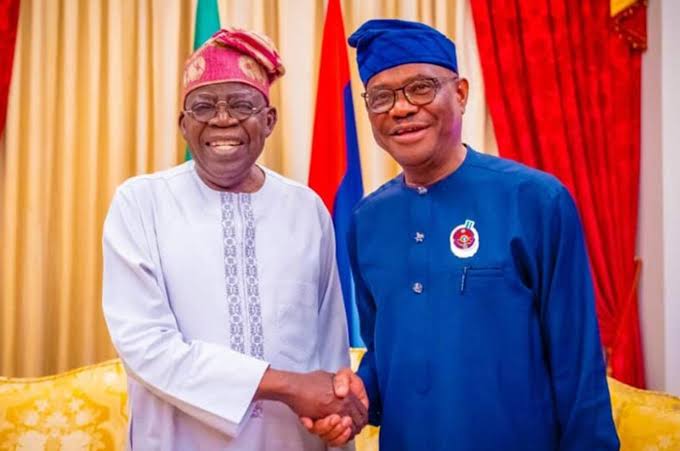
A fresh disagreement has emerged between Federal Capital Territory Minister Nyesom Wike and governors elected on the platform of the All Progressives Congress over the Rainbow Coalition ahead of the 2027 general elections.
The dispute centres on Wike’s support for President Bola Tinubu’s re-election while he remains associated with the Peoples Democratic Party and continues to back PDP candidates in other electoral contests.
The APC Governors’ Forum, led by its chairman and Imo State Governor, Hope Uzodimma, said its members would not support any political arrangement that could weaken the APC or affect its candidates.
Uzodimma made the position known after the governors met in Abuja on Monday night. He said the forum had not entered into any agreement with an individual or opposition party ahead of the elections.
He stated, “The APC Governors Forum unanimously resolved that its members will not participate in, support or endorse any alliance or political arrangement capable of undermining the re-election of Mr President, weakening the APC or adversely affecting any candidate of the party at all levels.
“In other words, the forum has no intention to support any candidate at any level that is not an APC candidate because our candidates who are contesting the election are being sponsored by our party.
“The governors’ campaign commitment is exclusively to all APC candidates. All levels of the party campaign architecture will align with the expectations of Mr President and the strategic objectives of the party.”
Wike, however, has maintained that his support is specifically for Tinubu’s presidential bid and does not amount to support for APC candidates in state and legislative elections.
Through his Senior Special Assistant on Public Communications and Social Media, Lere Olayinka, the minister said the Rainbow Coalition was not an APC structure. He described it as a platform for politicians from different parties who support Tinubu’s re-election.
The minister noted that “politics is local and those having problems in their states should resolve them instead of using the reelection of the President to whip up sentiments.”
Wike also said he never promised that the PDP would refrain from fielding candidates for governorship, National Assembly and state assembly elections.
“What I said and stand for is that I will mobilise support for the reelection of the President. I never promised anyone that PDP will not field candidates to contest governorship, National Assembly and state Houses of Assembly elections.
“Most importantly, the Rainbow Coalition has nothing to do with the APC. Rather, it is our own way of mobilising support accross political parties for Mr President, who has done well to deserve a second term,” he said.
In an interview on Arise TV’s Prime Time on Tuesday night, Wike also dismissed the concerns raised by the APC governors and defended his continued political activities within the PDP.
“They (APC governors) are politically lazy. When you have your local problems, don’t use Mr President as your excuse,” Wike said.
He said the disagreements surrounding his political activities were not new and recalled similar opposition during his time as Rivers State governor and later as FCT minister.
“This thing did not start today. It started at ministerial position. They were not happy that I was Minister of FCT. Also, they were unhappy when I was governor,” he said.
Wike added, “If they know what I know, they would not come out to shout.”
He also questioned why his support for Tinubu should affect his relationship with the PDP.
“I have said I will support the President and I am still supporting him. What has that got to do with my party?” Wike asked.
The FCT minister cited the political situations involving Anambra State Governor Chukwuma Soludo, Osun State Governor Ademola Adeleke and Abia State Governor Alex Otti to argue that backing a presidential candidate does not necessarily prevent political parties from contesting other positions.
“Take Soludo, Adeleke and Otti. Does it mean that their parties will not present other candidates? This thing they are saying does not have any basis,” he said.
Wike also criticised Kwara State Governor AbdulRahman AbdulRazaq over the political disagreement.
“The governor of Kwara, so unforunate. Anytime he sees a snake, it’s Wike. Any day he doesn’t eat, it’s Wike. I never see people who will give time to gossip more than the work they have been given. He has three serving senators, he changed all of them. He has House Reps, he changeed all of them.”
The disagreement has also drawn reactions from different factions of the PDP.
The PDP Publicity Secretary, Jungudo Mohammed, said Wike’s decision to support Tinubu should not be interpreted as an endorsement of the APC. He maintained that the PDP would continue to field candidates for the 2027 elections.
Mohammed stated, “I think the issue, or rather the position of the minister to support Tinubu, has been mistaken to mean absolute support for the APC. The minister never said he was going to support the APC. Rather, he said his support is for Tinubu as his President and the person who appointed him to the present position he occupies. So, the feeling that the minister’s gesture of support will be extended to all of them across their states was where they got it wrong. It is important for the APC governors to know that Wike is a force to reckon with, not a force to be rejected.
“It is a complete political misnomer and miscalculation for these governors to assume that the PDP, and indeed the minister, will not field candidates, will not contest against the APC, and will not be able to win against the APC.
“The issue is not even about Wike as a person. It is about how comfortable Nigerians are, particularly with the governors. I am not trying to speak for the President, neither am I trying to speak for the minister. But, in all honesty, the President has given these governors all that is required for them to provide infrastructure and human capital development for the good of the people in their respective states.
“There has been an increase in federal allocations and the issue of financial autonomy for local governments. Yet these governors have muzzled the local government chairmen and refused to allocate or account for the billions of naira accruing to them in their respective states. They have failed to provide good governance and failed to deliver the dividends of democracy.”
Mohammed further alleged that the APC governors were concerned about the PDP’s participation in the 2027 elections.
“Now that it is time for elections, they are afraid. The PDP has fielded credible and popular candidates with the capacity and credibility to defeat these APC governors. That is why they are crying wolf where there is none. That is why they are jittery.
“But I can tell you, if truly they are lovers of President Bola Ahmed Tinubu and are concerned about the success and victory of their presidential candidate, then I do not see any reason why they would be pushing away a strong political phenomenon like Minister Wike.
“For us, if there is a way we can make the minister rescind his decision not to support our presidential candidate, we would be glad to do that. But we are only respecting his constitutional right to choose whoever he wants to support as a citizen of this country, particularly as an appointee of the President.
“When you compare the records of the minister when he was governor and now that he is a minister, his record is something that cannot be matched by any of these governors. So why are they scared? I will call on them to go back to their respective states, deliver the dividends of democracy, keep the people and account for their stewardship. That is when they can begin to say Wike is not going with us or not.”
Meanwhile, the National Publicity Secretary of the PDP Interim National Working Committee led by Tanimu Turaki, Ini Ememobong, criticised the political arrangement that has seen Wike serve in the APC-led Federal Government while retaining his PDP identity.
Ememobong stated, “They created a monster, that monster ended up in their belly. And so, the APC governors and the President, who were enjoying the anomaly that Wike constituted, working for an APC government while claiming to be PDP and, obviously, working against the interests of the PDP.
“At some point, they were excited about it, and today it is their turn to play in the belly of the monster. If the President does not intervene and bring this to a stop, he will also end up in the belly of the monster. It is only a matter of time.
“Politics is not just a practice; it is also a field of study. Therefore, practice must follow theory, and there is no theory that can support what is being presented as political practice in Nigeria.”
The dispute has also prompted speculation from unnamed APC sources about the political interests behind the disagreement.
One source alleged that Wike and Uzodimma were positioning themselves and their allies ahead of the 2031 political cycle.
He stated, “Wike, Uzodimma and some of them are strategising for the vice-presidential position. People have very tall ambitions. We are trying to go into the 2027 election, but people are positioning themselves for 2031 in 2026.
“The first problem was with regard to the position of each of them in relation to the President. Wike and Uzodimma have been at daggers drawn over their closeness to President Tinubu. Initially, all of them were angling for the position of Director-General of the campaign. At the end, none of them got it.
“Both men are seriously competing, and they are recruiting the President’s friends, supporters and party chieftains into their respective camps. You will recall what played out in Rivers State, where Uzodimma was supporting (Sim) Fubara and others working against Wike’s interests. In Imo State, Wike is supporting the likes of (Samuel) Anyanwu and others against Uzodimma’s interests.
“At the national level, the rivalry has also played out several times. For instance, Uzodimma and some other governors approached the President with proposals on how to raise funds for his re-election campaign. Wike subsequently went to the President and alleged that the governors were not to be trusted and could divert the funds, urging him to be cautious.”
Another source said the disagreement also involved control of the National Assembly and political influence across various states.
The source stated, “Ultimately, it is about political ambition. It is about 2031 and, of course, control of the next National Assembly. They are all trying to expand their influence beyond their respective states to their geopolitical zones and even beyond.
“You also have to understand that the APC governors have candidates to protect. Some of them are also senatorial candidates, while their parties have governorship candidates and other candidates contesting elective positions in their respective states. But Wike’s faction of the PDP is also fielding candidates, many of whom are perceived political opponents of these APC governors. Some of these politicians moved to Wike’s faction of the PDP, and the governors feel aggrieved by it.
“If you look at what is happening in Kwara State, for instance, the Saraki political dynasty is being emboldened and empowered, which could make the Kwara State governor feel threatened. The same situation is playing out in Imo, Gombe and several other states. The APC governors, under the leadership of Uzodimma, are therefore unhappy about the development.
“So, the dirty dealings are many. One person is hitting another, and the other is hitting back. Now, they are going to team up against Hope through Wike’s Rainbow Alliance. Yesterday, Hope met with the governors and they opposed the Rainbow Alliance because the alliance is principally aimed at tthwarting their interests. The whole thing is actually a fight for political positions. Hope wants to be Vice-President in 2031, and Wike also wants to be Vice-President in 2031. That is what is driving much of this rivalry.
“This infighting is also considered a threat to President Tinubu’s re-election unless he does something urgently to resolve it. If allowed to continue into the campaign period, it may affect the party and some of its candidates.”
A second APC source said the disagreement was also connected to Wike’s continued political activities despite his membership of the PDP.
The source stated, “Of course, the infighting is about their political interests. Most APC governors are unhappy that Wike, a PDP member serving in an APC-led Federal Government, has been empowered by the President and is using the influence and resources available to him to mobilise politicians to contest for the State Houses of Assembly, Senate, House of Representatives and governorship positions in their respective states, mostly under the PDP, against the governors’ political interests.
“This is visible in many states, with Wike’s faction of the PDP accommodating APC members seeking to challenge serving governors. All these are part of the problem.
“Again, it is also about 2027 and 2031. Politicians plan early, and both Tinubu and Wike are positioning themselves strategically ahead of these elections so that discussions about the presidency will involve them and they can play a major role in key political decisions. It is also about the National Assembly leadership and who gets what in the next cabinet. That is probably the source of the problem.
“But we hope the President quickly swings into action and uses his influence to resolve the differences and bring them together in the interest of himself and his party. If not, it may affect everyone, including the party.”
The disagreement between Wike and the APC Governors’ Forum has thus centred on whether support for Tinubu at the presidential level should extend to APC candidates in other elections. Wike says his support is limited to the President, while the APC governors have declared that their campaign commitment covers APC candidates at all levels.