Opinion

Ƙoƙi and ethnographic slice of Hausa history

By Prof. Abdalla Uba Adamu

I was rummaging through my travel pictures when I came across a picture that I am sure has not been published anywhere. I saw it in a glass case at a ‘corridor museum’ at Universität Hamburg, Germany, on 2nd December 2008. I was excited because of its rarity. It was the picture that I am sure has not seen the light of day almost anywhere. I had vaguely heard about the man from my father, a writer, but did not pay attention then. Now he was there, smiling in all glory and right before me. I decided I would take the picture to show it to my father.

Edit: The man was Muhammad Ƙoƙi, the son of Alhaji Mahmud Ƙoƙi, the Kano Malam. His picture triggered my excitement about his father, Malam Mahmudu Ƙoƙi.

Malam Mahmudu was perhaps one of the most unsung and unknown critical literary figures in Hausa history. You can Google all you can. You won’t find him or his picture. Instead, you will be taken to Neil Skinner’s book, “Alhaji Mahmudu Ƙoƙi: Kano Malam” (ABU Press, 1977). I very much doubt if ABU Press itself has a copy. My copy is in excellent condition (except for a slightly scratched cover) since it was printed on shiny bond paper – and can therefore scan very well. I hesitate to do this for fear of copyright violation. I do wish ABU Press would consider retrieving a copy somewhere and reprinting it.

On return from Hamburg, I started looking for the book – and I was lucky to grab a copy at then ₦550 in January 2009. Now, some 14 years later, you can get a second-hand copy from the online store Abe Books for just $99 (cheap at ₦74,000 in 2023). At the moment, I don’t have any ‘kebura’ around me (since the ASUU strike was suspended!). Otherwise, I would offer mine for ₦50,000 for my copy!

Quite simply, it is a brilliant slice of Hausa history. Most significantly, it detailed the fieldwork done in the collection of data for Bargery’s Hausa Dictionary, whose full title is “A Hausa-English dictionary and English-Hausa vocabulary”.

Although mainly attributed to Rev. George Percy Bargery (1876-1966), an English missionary and linguist, the dictionary had significant input from Diedrich Hermann Westermann (1875-1956), a German missionary, Africanist, and linguist. The dictionary was published in 1934. The printed copy used to be available at ABU Bookshop, where a colleague of mine gifted me one he bought at the huge sum of ₦2,000 in ancient days, almost breaking his bank account!

The book was written/edited by Neil Skinner (1921-2015) at the request of Bargery’s son, Kenneth, to collect recollections of the elder Bargery while in northern Nigeria. Alhaji Mahmudu Ƙoƙi (1894–1976) was Bargery’s Chief Assistant in the preparation of the Dictionary and was the first choice to ask in 1967. As Skinner recollected, “I began recording some of his memories of Bargery. Listening to his vivid accounts of Kano in the first of the century, I formed the idea of putting together from Mahmudu’s lips some account of his own life.”

And what a fascinating life it was. Skinner continued, “As a son of the largest city of northern Nigeria, who had been born into the civil war of Aliyu and Tukur, M. Mahmudu saw the coming of the British, knew Waziri Giɗaɗo and Resident Temple, lived to see the end of the British rule and the Nigerian Civil War and, above all, had close contact with rulers and innovators, both Nigerian and British. He, therefore, seemed likely to have a tale worth recording for younger generation of Nigerians and those with an interest in Nigeria as it was and is. Mahmudu was a spectator of many great events and participant in not a few.”

And what a whirlwind tour of northern Nigeria it was in the early 20th century. Reading the book is like going back in a time machine. Everything was covered: economy, society, governance, culture, everything. As Neil Skinner stated, the book was told by Mahmudu himself – Skinner just edited it. It contained both fascinating and often disturbing details of days gone by. For me, for instance, I was traumatized by his account of the slave trade in Kano. As Mahmudu recalled,

“I used to see slaves being sold – with my own eyes! At Ƴan Bai, on the west of the [Kurmi] market. That was where they used to line them up and sit them down, with their feet sticking out, like this. Then it would be, ‘You there! Get up!’ And he would get up, and we would look him over well from top to bottom and say, ‘Walk a little!’ then he would do so until we told him to come back. He would do so, and we would say, ‘Right, go and sit down’ and put hand to pocket and take out a little money, perhaps a score of cowries or fifteen and give them to him. You would do this, whether you bought him or not. Then, if he saw someone selling groundnuts, he would call her over to get some saying he had been given the price for getting up to be inspected. That is how we have a proverb which says, ‘Tashi in gan ka ma na da ladanta’.”

Based on this disturbing account – in the heart of Africa – I wonder how many of our other proverbs have such creepy and dark origins? If you go to Ƴan Bai in Kurmi market in Kano, now you will only see mats, books and assorted goods.

Alhaji Mahmudu Ƙoƙi provides a rich tapestry of ethnographic details about how the Dictionary was compiled and the fact that the team of Bargery and his assistants insisted on seeing actual objects and their names before recording them. One wished they had an artist with them to sketch out many of the cultural artefacts that have all but disappeared now. It is good that the Bargery dictionary has been digitized and is available free online, thanks to the efforts of Hirokazu Nakamura of the Faculty of Human Science, Department of Human Sciences, Bunkyo University, Japan.

“Alhaji Mahmudu Ƙoƙi: Kano Malam” is comparable to “Baba of Karo” by Mary F Smith (wife of M.G. Smith, author of “Government in Kano, 1350 to 1950” amongst others, and which is available FREE online!). Published in 1954, “Baba of Kano” is an anthropological record of the Hausa people, partly compiled from an oral account given by Baba (1877-1951), the daughter of a Hausa farmer and a Koranic teacher. Baba’s reports were translated by Smith.

Books like these encourage us to seek out our own cultural history – visit those places mentioned, savour their historical aroma and note them as centres of excellence in discovering our past. By the way, Ƙoƙi is a ward in the city of Kano and right on the edge of the Kurmi market. If you are from the area, perhaps you may have heard of Alhaji Mahmudu from his grandchildren.

Don’t forget; this is not a review of the book but a memory jog on the old man, Alhaji Mahmudu Ƙoƙi, whose picture was honoured at a foreign university.

There is a composite collage of the picture I snapped in the Hamburg university museum of the son, the book and the father! as the latter appeared in the book.

Prof. Abdalla Uba Adamu can be reached via auadamu@yahoo.com.

Quick takeaways from the premiere of Manyan Mata!

By Mahmud A. Zukogi

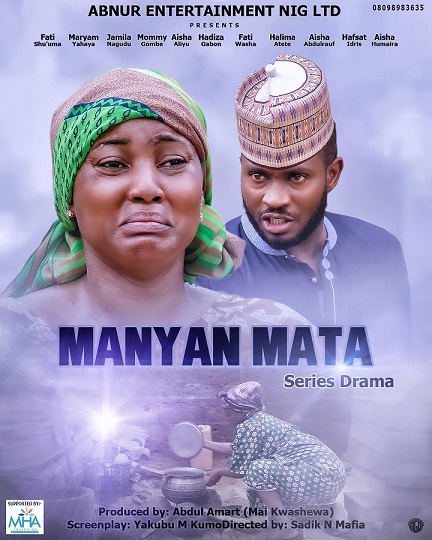
This much-awaited, much-talked-about and star-studded film series, which incidentally will hit your screens today, Saturday, February 11, 2023, at nine o’clock this evening on Arewa 24, was premiered on February 4 at the Film House, Ado Bayero Mall, Kano.

The event, which was graced by the invited guests and Kannywood’s veteran, reigning and emerging stars, was full of the usual fanfare, excitement and expectations associated with the premiere of any new film. The red carpet was lit with beautiful lighting and stars, and guests took turns to pose to the beauty and demand of the evening.

The industry is gradually exploiting the opportunities that film serialisation provides, no thanks to the exciting marketing platform made available by the leading entertainment television, Arewa 24. It is to the eternal credit of the television that such films as Dadin Kowa, Gidan Badamasi, Labarina, Kwana Casa’in, Gidan Danger, etc., have become popular and a must-watch by the teeming audience of the industry. It is obvious, therefore, that the art of film serialisation has gained currency in the industry, and Manyan Mata is coming to compete for space and attention. How it is able to do this will depend largely on the techniques and the staying power of the crew, especially the producer and the director.

Manyan Mata is produced and directed by two of the industry’s iconic duo, Abdul Amart (Maikwashewa) and Sadiq Mafia. What the film brings to the table can be summarised into three: innovation, diversity and topicality of motif. Abnur Entertainment is known in the industry for innovations that have opened a window of opportunities to the core stakeholders, from the producer down to the end of the ladder in the entertainment chain.

The film is highly diverse because of the array of stars it could gather under one roof. As far as the Kannywood industry is concerned, it takes great power, confidence and directing abilities to handle these stars, each with his/her ideals and idiosyncrasies. Thus, if any outstanding star is left out of the film, it could be a result of unavoidable oversight or a logistical glitch. But getting Ali Nuhu and Adam Zango, the northern and the southern poles of the industry, in one set is no doubt speaks of the commendable effort of the producers. Talk of the leading female stars of the industry; name them, and they are all there.

What, then, are the central motifs of the film and which has made it outstanding and a must-watch? The Almajirci question, the girl-child abuse/prostitution and the male overload of the women under the guise of marriage have been juxtaposed to educate, entertain and, most of all, draw public empathy to the raging social issues putting us down as a people.

The premiere opens with electrifying scenes of these social motifs, and this drew great excitement from the audience, who expressed individual understanding and appreciation of the representations in the film and its many expectations.

Veterans of the industry were well represented, ranging from Kabiru Maikaba, Shehu Hassan Kano, Hajiya Saratu Gidado Daso and the like. No less represented were the leading directors in the industry who came to support one of their own. There were expressions of appreciation and critique of the film, which was well received by the directing crew.

Overall, the premiere evening was full of life, excitement, and encomiums for the head of Abnur Entertainment, Abdul Amart, for his creativity and vision.

The greatest oversight is the industry’s inability to tap into the opportunities provided by the university which is next door. As far as the industry is concerned, there has not been a concerted effort to establish the needed relationship between and gown, a beneficial relationship that would help to grow the industry and take it to a whole new level of growth and worldwide visibility.

Strong institutional linkage is desperately needed to grow the art and economy of this under-tapped multibillion-dollar industry. I’m aware that scholars such as the respected Professor have invested so much energy in intellectual research that would have propelled the industry to the worldwide heights it ought to be. Same for Professor Yusuf Adamu, Ibrahim Malumfashi and, lately, Dr Muhsin Ibrahim, who has published widely and recently completed his PhD on a topic related to the industry at the University of Cologne.

Yours sincerely and his colleagues were only there in their individual capacity and not on institutional representation, which shouldn’t be the case.

It is thus necessary and about time that this costly oversight is remedied. The industry needs to open up and embrace change, and the best way to do this is to key into the opportunities they stand to gain by establishing a solid relationship with the university to improve its art and human capacity. I also believe this should be a two-way process, so the university should take the industry into confidence and dispel its image of unapproachability.

Mahmud Zukogi can be reached via mabuzukogi78@gmail.com.

Lee Kuan Yew and African leaders: A comparative note

By Muhammad Muzdaleefa

Founding leaders of nations matter. A country’s founding moment is often a make-or-mar moment in the life of the country. The trajectory on which the founding leadership sets the country, as well the power of their founding example, often defines and determines the future course of events way past the founding generation. Founding precedents tend to have an exceptional degree of endurance, because founding leaders command a kind and degree of legitimacy and license that is exceptional and which gives them and their example and precedents a special status and the propelling force of path dependency in their country’s history.

George Washington’s founding example, of not offering himself up for election again after serving two terms as (first) president of the new republic, even though nothing in the US constitution at the time imposed term limits on an incumbent president, initiated a tradition of American presidents not going beyond two terms; a tradition that remained in place until Franklin Delano Roosevelt breached it in the 1930s/40s, causing it to be restored by constitutional amendment. Additionally, the contemporary trajectory of American federalism, including the enduring fault lines in its politics, can be traced back to the Federalist/anti-Federalist split in the founding generation; between the Hamiltonian (strong federal/center) and the Jeffersonian/Madisonian (strong states) visions.

The death of Lee Kuan Yew, the founder of modern Singapore and its prime minister from 1959 to 1990 (then senior minister after that), has brought the usual apologists of autocratic rule in Africa out of their holes, doing what they do best: making all manner of inapt comparisons and prophecies of “what would have been” had one or the other favorite African autocrat been allowed to rule for as long as Lee Kuan Yew did. There is the implicit suggestion that similar longevity in office would have turned Lee’s African contemporaries into a Lee Kuan Yew or transformed their African states from Third World to First. It is a fanciful thought, one not borne out by the record.

First of all, Africa’s first generation of autocrats did, in fact, stay in power for very long periods. Nyerere, Kaunda, Banda, Houphouet Biogny, Mobutu, Bongo, Senghor, all were in power continuously for nearly three decades. And many current ones, including Mugabe, Museveni, and Biya have equaled or broken the record. None has managed any transformation of the Lee Kuan Yew kind, except in the opposite direction. So, the difference between Lee Kuan Yew and his African contemporaries was not just a matter of longevity in power, it was far more than that. Time itself is a value-neutral resource. It is what you do with the time you have that determines the future course of events. Africa’s autocrats did very different things with their time in power than Lee Kuan Yew did with his. They were bound to reap different results.

Second, while Lee Kuan Yew was an authoritarian leader, he was not an autocrat. It is an important distinction. Lee built and worked through institutions. He did not destroy the rule of law. Lee’s government passed and enforced draconian laws, but arbitrary and personal rule did not displace government through institutions, rules, and procedures. Lee also assembled and worked with a solid team (the first group of which is featured in the book “Lee’s Lieutenants”). His was not a one-man project; he was captain of a team. Lee’s Lieutenants brought to the table a complement of talents and abilities that Lee, as leader, effectively harnessed and synthesised into a shared vision. There was no “Lee Kuan Yewism” to which all were obliged to swear allegiance or else. And while Lee Kuan Yew did not like or think much of his opposition, he never declared a one-party state. His party contested elections and won those elections repeatedly. The franchise was not aborted. Nor were opposition parties. Absence of electoral turnover is inconsistent with competitive parliamentary politics. The Liberal Party’s overwhelming hold on power in postwar Japan is a case in point.

Lee Kuan Yew ruled for as long as he did, in part because he did not replace Singapore’s Westminster parliamentary system with a presidential system. The title “President” apparently had no particular allure for the supremely self-confident Lee. He was happy to be a “mere” prime minister, which meant that, as long as his party continued to win a majority in parliamentary elections and he retained his own seat and leadership of the party, he was free to remain prime minister. Term limits have been traditionally associated with presidential systems, not parliamentary systems. Today, his party remains in power, even if its electoral strength has diminished over time.

Lee’s contemporaries in Africa, on the other hand, moved quickly to replace their parliamentary systems with presidential rule. It was one step on the road to autocracy. It freed them from accountability to their party, to cabinet, and to parliament. From that foundation, other blocks in the autocratic project fell into place.

There are many other ways in which Lee Kuan Yew and his African contemporaries were fundamentally different. They, like Lee, did not care much for human rights, free speech, free press, and the like. Lee Kuan Yew believed in “Asian values”, not “Western democracy”. And his African contemporaries too defended their own idiosyncratic versions of African exceptionalism. But that’s pretty much where the similarities end.

Instructively, Lee Kuan Yew recalls telling himself, after a 1964 visit to Africa that took him to 17 countries, “I was not optimistic about Africa”. Lee said. And while in Lagos in January 1966 for the Commonwealth Heads of State conference, Lee again recalls, after observing the Nigerian government at work: “I went to bed that night convinced that they were a different people playing to a different set of rules.”

Nothing is gained, except more of the same escapism and revisionism that keeps us stuck in the counter-developmental past, by trying to cast one or the other African autocrat in the mold of a Lee Kuan Yew. We have had no Lee Kuan Yews. Not that we need or must have one. But, well, just saying!

Lessons from Adam A. Zango’s life

Muhammad Ubale Kiru

Adam A. Zango, for those of you who don’t know him, is a Kannywood Film actor who is popularly known as Adamu Usher for his spectacular dance steps. He appeared in more than 100 Hausa films over the years.

While lamenting why his marriage is in chaos, Adam identified that his wife committed a number of mistakes that may probably lead to their divorce. One of the mistakes mentioned was that she posted a video of herself taken at a beauty parlour while having henna (kunshi) done on her and at the same time dancing.

He indicated that such action was something he prohibited all his wives from doing, and he was devastated by the action. Hence, he stated it as one of the things she did. Now, the irony is this – these people have no shame in picking young girls to act in their movies. They have no shame in displaying these young girls on TV dancing and sometimes even touching them. However, they know quite well that it is wrong, yet they lure young girls into it.

Adam felt so bad that he is thinking about divorcing her because of what he himself is doing with other women and yet posting on the internet.

Dear ladies: You see, most of you are not smart. Men can do things and run away with it, but can you? Adam can spend 50-60 years of his life acting, but for you, the maximum is 40-45. This means what you are doing is not really a good business because, in the end, they will use you and then dump you. They know so well that it is not right, yet, they get you involved because they don’t care about your life or future.

In an interview with Hadiza Gabon, she was asked about when she would be getting married or if she had a fiancee. In her response, she said, “yes, I have a fiancee. As for when I will marry, that I don’t know because I can’t marry off myself”. They have plenty of suitors, but will they be ready to commit to marriage? The answer is NO. because Film is a bad business for women. It doesn’t matter whether it is Kannywood or Hollywood. The majority of them spend their lives pursuing lusty men and, in the end, commit suicide or die in nursing homes helplessly and full of regrets.

Success is not attained in the comfort zone

By Abdurrazak Mukhtar

Comfort is often seen as a golden ticket to happiness – where we can bask in the serenity and put our feet up. But what if I told you that staying in your comfort zone for too long could be the very thing holding you back from success? This saying suggests that to thrive genuinely; one must be willing to trade comfort for discomfort.

Imagine a world where you never challenge yourself and always stick to the tried and true. Chances are, your life would remain much the same, devoid of growth and new experiences. But that’s not the kind of life anyone of us wants, right? The key to unlocking our full potential is embracing discomfort.

Risks are the building blocks of progress. By stepping outside our comfort zones, we open ourselves to a world of possibilities. Only by testing our limits can we discover what we’re truly capable of. Every time we push ourselves to be uncomfortable, we grow, and our comfort zones expand.

Being uncomfortable doesn’t mean feeling miserable and stressed. It’s about embracing a new challenge and putting ourselves in a position to learn, grow, and succeed. And as we progress, we’ll find that the things that once made us anxious and nervous become second nature.

So, my friend, next time you are cosily nestled in your comfort zone, take a moment to reflect on this saying. Embrace the uncomfortable and watch as you attain new success and comfort levels in your life. The journey may be challenging, but the reward is worth it.

Abdurrazak Mukhtar  sent this article via prof4true1@gmail.com.

2023: Presidential elections and the battle between two categories of Northern elders

By Ibraheem A.Waziri

Every election season in Nigeria comes with its provoking premises and issues! This time around, apart from the usual North and South, Muslim and Christian divides that are often most prominent than party affiliations; a new dynamic which has not yet caught public attention has been added up to the mix. The struggle to maintain relevance between two different categories of Northern eldership or leadership. These two categories, in the realm, are separated primarily by order of generational cohort (GC) in age!

Falling back to the scholars in anthropology, we learn that a GC is usually pegged at 15-20 years. All persons born within such intervals are regarded to, more or less, belong to the same groupings defined by the same circumstances; social, economic, and cultural events and would likely share some core elements in perspectives, tastes and life preferences.

Since the completion of the taking over of Northern Nigeria by the British in 1903, a generation who will eventually become Nigerians from the territory began to be given birth to that same year. Therefore the first generational cohorts (GC) of Northern Nigerians can be said to be those born between 1903 and 1919. That is if the mode at which boys usually reach puberty is considered as the norm to be 16 years!

The second GC came between 1919-35. The third was between 1936-51. This GC is the one that did the 1967 military counter-coup and prosecuted the then Nigerian civil war from the Northern Nigerian side led by 2nd GC member, General Yakubu Gowon, as Head of the Nigerian state.

One can be right to say that the 3rd GC of Northern Nigerians has been influencing politics and government policy not only in the North but in Nigeria from that time until now! The politicians among them, intellectuals and business owners, have been holding the region at its nape!

After the 2019 elections, some pundits among us have been harping about the fate of the North come 2023, as it was obvious that the 3rd GC are threatened by senesces and, therefore, very weak. The assumption is that they will reach a consensus among themselves to identify an able group of successors to hand over the affairs of the North and fade themselves into retirement, having put in their best for about 57 years now! The longest any GC have been there and probably will ever be.

None of us thought that the successor cohort, the 4th GC, born between 1952-67, would need to necessarily put up a fight to dislodge the 3rd GC from the power circle and forcefully take over like what is happening now in the ruling party.

However, since the statement made in Abeokuta on the 25th of January, 2023, in a campaign rally, by Asiwàju Bola Ahmed Tinubu, the All Progressive Congress (APC) party presidential candidate; to the effect that there are saboteurs in the Presidency – which ironically is occupied by his party – who are against his emergence as winner of the 2023 presidential Elections slated to hold 25th of February, 2023.

Bola Ahmed Tinubu, though a Southerner, enjoys the support of 14 of the 19 Northern Governors, who are from the ruling party. 11 of them also belong to the 4th GC. 1 belongs (Borno State) to the 5th GC. 

Kaduna State Governor, an outspoken element among them, has granted a series of interviews on the 1st and 2nd of February 2023. To a number of media Houses, including BBC and TVC, in both Hausa and English, implying that some 3rd GC Northern influencers around President Muhammadu Buhari (who is himself a member of the same cohort) are plotting to work against their candidate! By following other means, they do that to ensure a member of the 3rd GC, Atiku Abubakar of the opposition People Democratic Party (PDP), and a Northerner emerge as the winner of the 2023 presidential Elections!

The ultimate question now, apparently, is whether the people in the North will agree to prolong the tenure of leadership and eldership of the 3rd GC Northerners, adding another eight years to their 57 years, making it 65 long years. Or, in the alternative, they want to hand over the realms of their leadership and eldership to the 4th GC Northerners; to bring their own uniqueness to the table early enough.

It is obvious that the 4th GC Northerners, born during the years building up to the civil war to its end, have different perspectives and arguments about how Northerners should see themselves and live with their neighbours in Nigeria. They don’t view Southerners with the kind of suspicion the 3rd GC Northerners think of them. It is why in the first place, they would resolve to fulfil the unwritten agreement of power shift to the South in 2023.

Some members of the 5th GC of Northerners, either those born between 1968-83, would appreciate seeing a new perspective taking control of the space and atmosphere of Northern Nigeria come 25th February 2023. It will guarantee an experiment with fresher perspectives that are sure catalysts to positive change and comprehensive progress, not the same old perspective that has dominated the space for 57 years. 

Also, it is only when the 4th GC Northerners move a little higher on the ladder that the 5th GC Northerners, the post-civil war generation, will enjoy a certain degree of influence at some social plane. The same thing with the 6th GC Northerners, born between 1984-1998, the military rule generation. Also, the 7th GC Northerners, born between 1999 – 2015, Fourth Republic, Peoples Democratic Party (PDP) rule generation. Each movement on the ladder creates opportunities for growth and stability for others to play their role and display their God-given talent for the benefit of all.

These can be among the reasons why most Northern Nigerians would consider lending their support to the 4th GC Northern leaders in their bid to take control now. Politicians and bureaucrats like Nasir El-Rufai, intellectuals and opinion leaders like Dr Aliyu Tilde, Mahmud Jega; Abdulaziz Abdulaziz of the 5th GC and a host of other businessmen and religious leaders deserve this chance to move us to another level of life-changing perspective with Asiwàju Bola Ahmed Tinubu Nigerian leadership come 25th February 2023!

Ibraheem A. Waziri wrote from Zaria, Kaduna State. He can be reached via iawaziri@gmail.com.

How Naira redesign, cashless policy, affect prices of farm produce in Katsina

By Aliyu Ya’u Baraje

I have consistently written against the greediness of Nigerian agricultural produce suppliers since the implementation of the cashless policy. I am now fully convinced that a typical Nigerian is potentially greedy and corrupt, especially when presented with the opportunity.

There is no doubt about the scarcity of Naira, which economics has taught is a characteristic of money. This scarcity has created hardships for Nigerians, particularly for rural dwellers whose voices are hardly heard. This is partly due to a lack of modern education, IT literacy, and little or complete absence of media coverage. When visited, rural areas now seem like mourning grounds, faces barely smile, just silence, and black faces.

As a farmer and rural dweller, I feel it’s my duty to bring to light the ongoing exploitation of local farmers by produce suppliers. These suppliers are taking advantage of the cashless policy to profit at the expense of farmers whose main source of income is selling produce or livestock.

The prices of produce and livestock have plummeted dramatically. For example, the price of maize per 100kg has fallen from 22,000 to 13,000, rice from 26,000 to 15,000, beans from 42,000 to 25,000, and soybeans from 32,000 to 18,000. This trend is also seen in other produce such as millet, groundnuts, sesame, sugarcane, yams and cassava.

Farmers are offered two prices, one for a cash-and-carry deal and another for bank transfers. Those who need cash are given the lowest price, while those who require a transfer receive an increase of about 3,000 to 4,000.

This exploitation is unacceptable, especially since prices of other commodities have skyrocketed. I stand against this mistreatment of farmers and the erosion of their livelihoods.

I am from the southern part of Katsina State, which includes the local government areas of Sabuwa, Dandume, Funtua, Faskari, Danja, Qafur, and Malumfashi. This region is renowned as an agricultural hub not only in Katsina State but throughout northern Nigeria. This is due to the fertile land and extensive use of industrial

fertilizers and manure. The local government areas are rivaled only by the Saminaka, and neighboring local government areas.

Those who are familiar with this region will attest to the fact that its inhabitants are engaged in farming activities, not just subsistence farming but also what could be described as mechanized farming. In this region, farmers producing hundreds of tons or thousands of bags of the listed produce can easily be found. If one is a resident of this region, he is either a farmer or from a farming family. Even those who have switched to other businesses or occupations, most of their extended families are still farmers.

Given this, it should not be surprising that the exploitation of farmers by suppliers is a source of concern for those in the region.

2) In today’s Nigeria, the prices of processed and refined commodities have risen dramatically, with some even doubling, tripling, or quadrupling. The price increase for some commodities is so significant that it’s difficult to describe. So, why are farmers the only target for this exploitation?

3) In southern Katsina State, farming is done on a large scale, making it more of a business. This leads to the excessive use of agricultural chemicals, the prices of which have skyrocketed multiple times. For example, NPK fertilizer is sold for 32,000 Naira, Urea is sold for 22,000 to 23,000 Naira, Moroccan OCP (mixed fertilizer) is sold for 15,000 to 17,000 Naira, and the locally made Dan-Buhari fertilizer made from Kankara Local Government is sold for 10,000 to 15,000 Naira. Given these high prices, it’s understandable why a farmer would not be happy with selling their produce for less than 15,000 Naira.

Moreover, the use of tractors and other heavy engines for farming activities such as harrowing, tilling, harvesting, and transportation requires diesel, which now costs over 900 Naira per liter. The use of small equipment for dry-season farming, mobilization, pesticides, and herbicide spraying also requires petroleum, which now costs between 350 and 400 Naira. The prices of other chemicals such as pesticides, herbicides, and preservatives have not only doubled but have tripled or even worse.

This means that when a farmer who needs cash takes their produce or livestock to local markets, they feel like they are being shortchanged or receiving only a fraction of what they spent months or years nurturing. As a result, many farmers go home feeling like they have been robbed and have nowhere to turn for help

4) I seek to draw public attention to the exploitation of farmers in Southern Katsina state. The rise in prices of agricultural chemicals and equipment, along with the exploitation of farmers by produce suppliers, have led to a situation where farmers are not able to make a fair profit from their hard work. I categorizes those who are happy with the situation into two groups: those who are exploiting the farmers for their own gain (like suppliers) and those who are not involved in farming and only care about purchasing cheaper produce for domestic consumption (the consumers).

5) It is unfortunate that the farmers who work hard to produce the commodities are being exploited by the suppliers, hoarders, and processing industries. The lack of government price control mechanisms, excessive taxes and restrictions on foreign goods, and competitors. The selling of finished products at high prices, even higher than those imported from other countries has shown that farmers are intentionally targeted. This creates a situation where the farmers receive low prices for their produce while the final products are sold at high prices, leaving the farmers with little profit and often feeling exploited. It is important to address this issue and find ways to support and protect the livelihoods of local farmers

6) The exploitation of farmers in Nigeria has become a major concern as they are being targeted by suppliers, hoarders, and companies. The prices of agricultural chemicals and equipment used in farming have skyrocketed, making it difficult for farmers to make a profit from their produce. The lack of government price control and foreign competition, as well as excessive tax charges, have added to the farmers’ burden. Despite the high prices of commodities, the owners of processing, refining and packaging factories have not reduced their prices (per kg from suppliers), and instead sell the finished products at exorbitant prices. This has made life in rural areas even tougher, as the local farmers are unable to compete with foreign imports and are being forced to sell their produce at low prices. The suppliers have also adopted a cashless policy, which has made it difficult for farmers in rural areas to receive payment for their produce. The lack of recognition of wired transfers and poor network and electricity coverage in rural areas has further complicated the situation.

It’s important for the government to consider all factors and individuals, including rural settlers, when making decisions on the cashless policy. The government should strive to ensure that all citizens have equal access to financial services, regardless of their location.

Aliyu Yau Baraje, Dandume Local government area Katsina. He can be reached via: aliyuyau900@gmail.com fb: Aliyu Baraje

The Harvard University Professor who worked as a bus ‘conductor’ in Lagos

By Muhammad Jameel Yusha’u, PhD

At 2:45 am every day, the first email at HKS comes to your inbox. HKS Daily is a catalogue of information about activities at Harvard Kennedy School. If you miss it for a day, you could miss countless opportunities about conferences, breakfast with guests, working groups, and lectures by presidents, governors, mayors and other leading policymakers from different parts of the world.

When I checked this morning, I saw an event posted by the Building State Capability Project. It was a book talk entitled “They eat our sweat: Transport labour, corruption and survival in urban Nigeria.” The theme was from the title of a book by Daniel Agbiboa, an Assistant Professor of African and African American Studies at Harvard University Center for African Studies. I registered immediately.

I love original research. Daniel’s work is an excellent example of that. The book, which I look forward to reading, was based on his research work at the University of Oxford, where he worked with the late pan-African scholar, Professor Abdulra’uf Mustapha. It was a research project that used participant observation to study the informal transport sector in #Lagos. As a student of public policy, this attracted my attention even more. Many policies are designed without an in-depth understanding of the social, cultural and even political implications of such policies.

A governor or minister might see the informal transport sector as a nuisance to a modern city. He might bring consultants to hurriedly analyse the problem and come up with a solution. Every person would like to see his city looking like San Francisco, Paris or Dubai. What we tend to forget is that there are thousands of lives that could suffer in our attempt to look modern. Where do we put those people who work as drivers and ‘conductors’ if we don’t have an alternative industry that will absorb them?

To understand this, Professor Daniel went to the field. He became a bus ‘conductor’ for two months, working with a driver, starting early in the morning and absorbing the difficulty that comes with such endeavour. He used his research to understand the difficulty of survival within the informal transportation sector.

He provided a critique to those who use CPI to evaluate countries as corrupt when ordinary people in those countries have completely different realities. “Informal transport not only provides a sector for examining corruption, but also a prism through which to interrogate the binary framing of formality/informality and understandings of the borders (or lack thereof) between the two.” Says Daniela Schofield in a review of the book published on the blog of The London School of Economics and Political Science (LSE).

Takeaway: Developing public policy needs in-depth thinking and proper planning. Building infrastructure is only one part of the story. Managing the effect of policies on people is a much harder task.

Muhammad Jameel Yusha’u, PhD, is a candidate for a Mid-Career Master’s in Public Administration at Harvard University, John F Kennedy School of Government. He can be reached via mjyushau@yahoo.com.

Language and the specific gravity of identity

By Prof. Abdalla Uba Adamu

Muhsin Ibrahim had started a very interesting thread on his Facebook wall about language usage in northern Nigeria. Basically, the argument is about whether predominantly Hausa (his publics) should intensify their use of English in public discourse, especially now that things are getting more virtual. There has been a lot of resistance in using English among the Hausa because of the belief that using English (or other languages, except Arabic) leads to the erosion of identity. Muhsin urges the Hausa to embrace or at least immerse themselves as much as they can in the English language to gain a competitive advantage. I agree with him.

The arguments against the use of English are predicated upon language and identity. Generally, language symbolizes our identity and conveys identities to those who speak them. But how true is this in an interconnected world? I have a friend whose children were born in Hong Kong. They are adults now. They hardly speak Hausa. Does that make them Chinese? Imagine an Urdu-speaking Pakistani immigrant whose children were born in Wales and do not speak Urdu. Does that make the children Welsh?

In South Africa, the apartheid regime used language as one of the yardsticks, besides skin colour, to develop its divide-and-rule ideology against the black population. If a Black South African somehow was able to speak fluent Afrikaans, does that shifts his identity and make him White? I have encountered Hausa merchants in the Deira section of Dubai’s textile market speaking fluent Hindi – are they then Indians?

I once encountered a Yoruba mechanic in Gusau – born and bred there, but could only speak the Sokoto dialect of Hausa, not my absolutely wonderful Kano dialect, and informed me that although his parents were Yoruba, he does not speak the language. So, what was he? Bayarabe or Bazamfare? The Kano Hausa even created sociolinguistic categories for his situation: ‘Ɗan Kasa’ (‘son of the soil’), ‘Muna Kano’ (immigrant non-Hausa, Hausa-speaking), ‘Muna Hausa’ (immigrant, non-Hausa, retaining immigrant language identity). The two ‘outsider’ categories are easily recognized by Kanawa, who describe their Hausa as ‘wata iri’/strange. Oh, they will interact freely with you – until you come to marry one of their daughters!

So, does merely speaking a particular language confer on the speaker the identity of the originators of the language? We learn English and Arabic. Become fluent in them. Does that make us English or Arabs? Thus, if we speak other languages besides our mother tongue, does that shift the specific gravity of our identity? I have three adult children (an oxymoron, I know, but there you are!). We always address each other in Hausa, but we always write to each other in English! Does that alter our identity?

Then the big one. Any DNA test on me will reveal that I am genetically Fulbe (Silsilɓe/Torodbe mix). I don’t speak Pulaar. I tried to convince myself that I should speak Pulaar as a form of anchor to an identity. When I asked Aliyu U. Tilde about the easiest way to learn the language of my genetic ancestors, he suggested marrying a Fulɓe woman! Not on the cards – I am a single-wife person for life.

So, I moved into the anthropology of cultural preservation. At one stage, I was even the Grand Patron of the Fulani Development Association of Nigeria (FULDAN) Kano Branch. During one or two erratic meetings, I was the only one who could not speak Pulaar – and I was the Chairman! We set up an evening class school at Gidan Makama school in Kano to teach Pulaar. Not many people came – despite the usual posturing of many Kanawa that they are Fulɓe.

Next, with some funding from Maison des Cultures du Monde in Paris, I produced two CDs of Pulaar children’s songs (Surbajo, Short Round Crew), and with the help of the British Council in Kano, held a Pulaar music festival, Voices from the Desert, and included a Pulaar rap song (Wazobia Waru). I have no clue what the artists were singing! I next personally sponsored a series of video lessons on how to speak the language and paid lots to make the finished product sleek and professional. I planned to upload the lot on YouTube. That was four years ago. I never got around to it. If I could, somehow, learn Pulaar, what, exactly, would I do with it – none of my publics speaks it; so, with whom will I converse this new form of lost-and-found language identity?

I stopped all that and quit deceiving myself on the issue. Not even my great-grandparents from both sides of the genetic pool spoke it. At all. Only lovely, glorious, wonderful Hausa. In this, I stand with The Nigerian Bahaushe, where I belong. Gregor Mendel, the father of the modern study of Genetics, rest in peace.

So where do I find the intersection of my identity – at the junction of Hausa and Pulaar languages? And please, don’t say ‘Hausa Fulani’. There is absolutely nothing like that. The fact that the ‘Hausa’ was written before the ‘Fulani’ suggests a linguistic dominance, at the very least, not a genetic chiasma.

Yes, there is often a particularly strong link between language and a sense of belonging to a national group, a sense of national identity. Further, although fears are voiced in some countries about the loss of national identity caused by learning foreign languages, especially English, there is little, if any, research evidence to justify this fear. Studies of language and identity have traditionally focused on how individuals or groups maintain, construct, project or negotiate their social identities in and through linguistic practices. Speaking English, however, does not make you English (not to talk of being Welsh, Irish, or Scottish), even if you are British.

It is believed that languages become endangered when they are not passed on to children or when a metropolitan language dominates over others. The tenacity of the Hausa language and its speakers will only endanger those who come in contact with Hausa, not the other way around. No matter how much immersion in English the Hausa have, I doubt if they are in danger of losing their language and identity. After all, what is identity?

Broken down to the interpersonal level, identity is a person’s sense of self, established by their unique characteristics, affiliations, and social roles. We must therefore see identity as a shifting focus on multiple planes – cultural identity, professional identity, ethnic and national identity, religious identity, gender identity, etc. Language can bind but not suppress them.

Thus, acquiring the English language gives the Hausa a competitive advantage in any international communication while, at the same time, tenaciously retaining their identity. I know. I am one of them!

Prof. Adamu can be contacted via auadamu@yahoo.com.

Why men flirt with waitresses in hotels?

By Hamid Al-hassan Hamid

I read a post this morning by one of our sisters, where she was asking if it is a “written rule” that men would flirt with waitresses at hotels and restaurants.

Well… the main reason why hotels and restaurants employ females as waitresses is for the undeniable fact that we all know, which is to attract and hook men’s attention. PERIOD!!!

And if you are a woman, with such kind of job, put it at the back of your mind that your qualification is likely the last thing that was considered. Your ability to attract men to the business and enchant them to spend more money is top on the list. The only exception where your qualification will be put into consideration is in the educational and health sector. Other than that, almost all banks, hotels, restaurants, law firms, offices, and businesses employ women to attract men.

It is a wise business strategy too, because men are the top earners in societies, and women hate women. Only men love women. This is one of the reasons why female patients prefer male gynaecologists to female gynaecologists. The female patients in various literatures made it clear that female gynaecologists are usually rude and roughly handle their boxes during examinations, unlike the men who are more caring. And why wouldn’t a man be so, there!

I always tell women to never get comfortable with any man, including myself. I had to protect myself, I do not even chat with women unless it is totally necessary because if I chat with you for at least two days in a row, I am going to start preaching the gospel before I even know it and speaking in tongues. This is what we are built for and why we exist.

I also don’t attend functions, or even so-called tech and business meetups, I do not show up in public unless it is totally necessary. Ask anyone in Sudan if they know my girlfriend. Even the Nigerian community in Sudan have approached and begged me to at least date one girl.

Anyways, at functions, or so-called tech meetups, even when I attend, I try to mind my business, ignore women and just do my things. But the thing is that ignoring women attracts women. Yes. I have had women in Niqaab approaching me and asking why I am not talking and moving around like the rest of the people around me. Let alone women wearing jeans and skirts, those ones will straight up come over, close my laptop and ask why I am being too serious.

Women are very funny. Stay at home, they will not stay at home, they go out and they complain that men are looking at them. Before nko, who or wetin you wan make dem look?

Lowering your gaze will only work for a few seconds in public, especially if you meetup frequently, she will eventually approach you and ask if you have a pencil that needs sharpening.

Some of us go to school, but we find it difficult to research basic human behaviour. I mention research at least to those of us stupid to not understand reality but would at least respect scientific research.