Opinion

NANSU: Past, present and future

By Salihi Adamu Takai

This will take us on a nostalgic – National Association of Nigerian Students in Uganda – NANSU’s heyday that exited in the time when Nigerian Students studied in Uganda, enjoying the value of the Naira currency from 2013 to present.

National Association of Nigerian Students in Uganda (NANSU) was a strong association that showcased its values, with the Ugandan Shilling being significantly weak compared to Naira currency. This has led to the braggadocio in the association, attracting other nationalities to the financial value of the Naira.

Yesterday, I was listening to a brother, who was a student at IUEA from 2013 to 2015, discussing about how Naira’s value was in those days; “I was recieving 60 thousands Naira monthly from home, and that amount was equivalent to 1.5 Million Shillings”, said by him. He added that “I used to deliberately go to shop, buy foodstuff, and I don’t collect my balance regardless of the amount”.

Some of the Nigerian students don’t sleep at night, frequenting clubs, lavishly flowing money for show-off. They were like British men in Uganda, when going to some places, people used to be around in order to get their shares. Someone was reminiscing about his life then, unveiling how he was attractive to Ugandan ladies; “I used to receive calls of around 20 different ladies in a day”, he said.

He added that also, “I didn’t cook myself. I used to buy from the first class restaurants in Kampala”. They used to withdraw money with their MasterCard from Ugandan Banks, and, they were being paid in official rates. One thousand Naira (₦1000) was equivalent to 15 thousand Ugandan Shillings (15,000).

As time kept going, it reached to a time when the then President, Godluck, was defeated, and Buhari came in, and, upon his swearing in, different policies were made, affecting the value of Naira.

The first policy, was the directive to block the use of MasterCard overseas. This led certain difficulties, which started facing Nigerian Students. In just a year, Naira dipped woefully, and Shillings started bouncing. Towards the end of Buhari’s tenure, the rate was so shocking.

Tinubu was sworn in last year. Upon the swearing in, he made a statement over the fuel supsidy removal, and this was the first recipe for the first hardship in Nigeria. Fuel prices increased by more than 200 percent compared to how it was prior to the statement. Tinubu didn’t stop there, he also directed for the removal of the Dollar subsidy. This was the first time when Dollar lost control in Nigeria, Naira keeps devaluing against Dollar.

International Nigerian students have been stranded, waiting for a time when Naira will bounce back to its value. This has led to the deferral for studies by many Nigerian students studying abroad. They can’t afford it with the current rate. They have been used to it when it was affordable to them, but now, the rate is very bad. Those who can live hand to mouth are very few as hundreds can’t afford simple meal twice in a day while staying overseas.

As few are managing to cope with the situation smoothly despite the skyrocketing of exchange rates, which is, of course, determining the comfortability of the students. Whenever the exchange rate goes down, students afford many things, and if it goes up, it messes up everything. Students are now pessimistic about their studies. Many of them are now admitting that, if things keep going like this, they will definitely lose their ways here.

Northern Nollywood, Southern distorted mirrors: Nollywood and the rest of us

By Prof. Abdalla Uba Adamu

Recently, an extremely prestigious academic journal requested that I review a film made by a Nigerian. I was surprised, as that is Muhsin Ibrahim’s forte. Further, I really don’t watch Nigerian films, aka Nollywood, personally preferring African Francophone directors. Nevertheless, I agreed to do the review. 

However, the link they sent for the film was password-protected. I informed them, and they requested the filmmaker to send the password. Being a request from a highly prestigious journal, he sent the code, and I was able to get on the site and watch the film online. I was surprised at what I saw and decided to delve further into these issues. Before doing that, I wrote my review and sent it off. The film, however, set me thinking. 

Like a creeping malaise, Nollywood directors are rearing their cameras into the northern Nigerian cultural spaces. Again. The film I reviewed for the journal was “A Delivery Boy” (dir. Adekunle Adejuyigbe, 2018). It was in the Hausa language. None of the actors, however, was Hausa, although the lead actor seems to be a northerner (at least from his name since an online search failed to reveal any personal details about him). 

Nothing wrong with that. Some of the best films about a particular culture were made by those outside the culture. Being ‘outliers’, it often gave them an opportunity to provide a more or less balanced and objective ‘outsider’s perspective’ of the culture. Alfonso Cuarón, a Mexican, successfully directed “Harry Potter and the Prisoner of Azkaban” (2004), while Taiwanese director Ang Lee did the same with “ Brokeback Mountain” (2005), even earning him an Oscar. 

In 2006 Clint Eastwood, an American, directed “Letters From Iwo Jima.” The cast was almost entirely Japanese, and almost all of the dialogue was in Japanese. It was very well-received in Japan, and in fact, some critics in Japan wondered why a non-Japanese director was able to make one of the best war movies about World War II from the Japanese perspective. Abbas Kiarostami, an Iranian filmmaker, directed his film, “Certified Copy” (2020) in Italy, which contained French, Italian, and English dialogue starring French and British actors. 

British director Richard Attenborough successfully directed Ben Kingsley in the Indian biopic Gandhi (1982). The film was praised for providing a historically accurate portrayal of the life of Gandhi, the Indian independence movement and the deleterious results of British colonization of India. It took away eight Oscars. American director Steven Spielberg’s “Schindler’s List” (1993) on a German, Oskar Schindler, was equally a powerful portrayal of an auteur genius by a “non-native”. The film won seven Oscars. 

In each of these examples, the directors approached their subject matter with a clean, fresh and open mind that acknowledges the cultural sensitivities of the subject matter. My point is that a person, outside of a particular cultural context, can make sensitive films that portray the culture to his own culture as well as other cultures. That is not, however, how Nollywood plays when it focuses its cameras on northern Nigerian social culture. Specifically Muslims. 

I just can’t understand why they are so fixated on Muslims and the North. If the purpose of the ‘crossover’ films (as they are labelled) they make is to create an understanding of the North for their predominantly Southern audiences, they need not bother. Social media alone is awash with all the information one needs about Nigeria—the good, the bad and the ugly. You don’t need a big-budget film for that. Or actors trying and failing to convey ‘Aboki’ accents in stilted dialogues that lack grammatical context. 

Yet, they insist on producing films about Muslim northern Nigeria from a jaundiced, bigoted perspective, often couched with pseudo-intellectual veneer. To sweeten the bad taste of such distasteful films, they pick up one or two northern actors (who genuinely speak the Hausa language, even if not mainstream ethnic Hausa) and add them to the mix, believing that this will buy them salvation. For southern Nigerians, anyone above the River Niger is ‘Hausa’. 

They started in the early 2000s, and people just ignored them. The directors then included Oskar Baker (Ɗan Adamu Butulu, Abdulmalik), Yemi Laniyan (Makiyi, Uwar Gida), Tunji Agesin (Halin Kishiya), Matt Dadzie (Zuwaira), I. Nwankwo (Macijiya) and many others. These came on the heels of the massive success of “Sangaya” (dir. Aminu Muhammad Sabo, 1999) when this particular film opened up the northern Nigerian film market. 

Those Nollywood producers jumped into cash on the popularity of Hausa films and made their own for northern markets. For the most part, these early ‘crossover’ films that I refer to as ‘Northern Nollywood’ were fairly mild and evoked no reaction. They were still rejected, as the Hausa can be the most discriminatory people you can come across. If you are outside their cultural universe, you remain there. Forever. 

The few Kannywood actors eager to be seen on the ‘national stage’ allowed themselves to be used to deconstruct Islam and Muslims on the altar of filmmaking in subsequent Northern Nollywood films. Let’s not even talk about character misrepresentation, which Muhsin Ibrahim has written extensively about. In these scenarios, the usual tropes for northerners in Nollywood films is that of ‘Aboki’ (a term southern Nigerians believe is an insult to northerners, without knowing what it means), ‘maigad’ (security), generally a beggar. If they value an actor, they assign them an instantly forgettable role rather than a lead. Granted, this might be more astute and realistic marketing than ethnicity because it would be risky to give an unknown Hausa actor a significant role in a film aimed at southern Nigerians. 

A few of these types of portrayals in Nollywood included Hausa-speaking actors in films such as The Senator, The Stubborn Grasshopper, The World is Mine, Osama Bin La, Across the Border and The Police Officer. 

When Shari’a was relaunched from 1999 in many northern Nigerian States, it became an instant filmic focus for Nollywood. A film, “Holy Law: Shari’a” (dir. Ejike Asiegbu, 2001) drew such a barrage of criticism among Hausa Muslims due to its portrayal of Shari’a laws then being implemented in northern Nigeria that it caused credibility problems for the few Hausa actors that appeared in it. With neither understanding of Islam nor its context, the director ploughed on in his own distorted interpretation of the Shari’a as only a punitive justice system of chopping hands, floggings, and killings through foul-mouthed dialogue. As Nasiru Wada Khalil noted in his brilliant essay on the film (“Perception and Reaction: The Representation of the Shari’a in Nollywood and Kanywood Films”, SSRN, 2016) “the whole story of Holy Law is in itself flogged, amputated and killed right from the storyline.”

“Osama bin La” (dir. MacCollins Chidebe, 2001) was supposed to be a comedy. No one found it funny in Kano. Despite not featuring any northern actor, it was banned in Kano due to its portrayal of Osama bn Ladan, then considered a folk hero. The film was banned to avoid a reaction against Igbo merchants marketing the film. I was actually present in the congregation at a Friday sermon at Kundila Friday mosque in Kano when a ‘fatwa’ was issued on the film. Even a similar comedy, “Ibro Usama” (dir. Auwalu Dare, 2002), a chamama genre Hausa film, was banned in Kano, showing sensitivity to the subject matter. 

The reactions against crossover films seemed to have discouraged Nollywood producers from forging ahead. They returned in the 2010s. By then, northern Nigeria had entered a new phase of social disruption, and Nollywood took every opportunity to film its understanding of the issues—sometimes couched in simpering distorted narrative masquerading as social commentary—on society and culture it has absolutely no understanding of. 

In “Dry” (dir. Stephanie Linus, 2014), the director developed a sudden concern about ‘child marriage’ and its consequences. Naturally, the culprits of such marriage, as depicted in the film, are sixty-year-old men who marry girls young enough to be their granddaughters. The director’s qualification to talk about the issue (which was already being framed by child marriage controversy in the north) was that she has ‘visited the north’ a couple of times. With the film, if she could get at least “one girl free and open the minds of the people, and also instruct different bodies and individuals to take action, then the movie would have served its purpose.” The ‘north’ was living in darkness, and it required Stephanie Linus to shed light on ‘civilization’. 

 “A Delivery Boy” (dir. Adekunle Adejuyigbe, 2018) that I reviewed was about an ‘almajiri’ in an Islamic school who was kidnapped from the school, to begin with and repeatedly raped by his ‘Alamaramma’ (teacher). The almajiri somehow acquired sticks of dynamite to create a suicide vest and vowed to blow himself up—together with the teacher. The Alaramma in the film lives in an opulent mansion, far away from the ‘almajirai’. In this narrative universe, the ‘almajiri’ do not learn anything and are unwilling rape victims of their teaches who actually kidnapped them and forced them into the schools. 

“The Milkmaid” (dir. Desmond Ovbiagele, 2020) evokes the idealistic picture of a Fulani milkmaid and became a basis for a Nollywood film. Instead of focusing on the political economy of the Fulani milk trade, the film focused on the trope of terrorism. “The Black Book” (dir. Editi Effiong, 2023), touted as ‘Nigeria’s John Wick’ shoots a significant portion in ‘the north’ – with ‘Islamist’ hijab-wearing females touting assault rifles hidden underneath their hijab. “Jalil” (dir. Leslie Dapwatda, 2020) visits the recurrent theme of kidnapping for ransom. In the north, of course. 

Then came the latest, “Almajiri” (dir. Toka McBaror, 2022). Claimed to be a true-life story (although it is not clear whether it happened to specific people or based on what the director believed to be a common event), it featured muscle-bound badass types of thugs with guns and dreadlocks as Almajirai. The film reinforces the southern Nigerian trope of any beggar in the north being an Almajiri. Such ‘almajiris’ are kidnapped and sold into virtual slavery and horribly abused. The idea is to blame the parental irresponsibility of northerners. 

For southern Nigerians, especially the Nollywood crowd, an ‘Almajiri’ is a beggar, a product of a failed education system, a terrorist, a bandit, and an ‘aboki’. They use concocted figures bandied about by alphabet soup agencies to proclaim ‘over 10 million almajiri are out of school’ and, therefore, twigs of the terrorism inferno. How can someone who has been part of a system of education for over half a century be considered out of school? But for Nollywood, if it is not ABCD, then it is not education. 

“Northern Nollywood” films are the precise reasons why there will ALWAYS be different film cultures in Nigeria. Kannywood talks to its publics, happily churning out now TV shows that address issues it deems relevant—in its own way. Both the northern and southern parts of the country (covering the three major languages) were actively engaged. However, they were mutually non-legible to each other. This was essential because they operate on virtually opposing cultural mindsets – making the emergence of a truly “Nigerian cultural film” impossible. 

Quite a few writers seem to suggest that Kannywood is a ‘subset of Nollywood’, and indeed, many would prefer for the term Kannywood (created in 1999 by a Hausa writer) to be dispensed with and replaced with Nollywood (created in 2002 by a Japanese Canadian writer). It is to protect our cultural representation in films that I stand as a lone voice in advocating for a ‘Hausa Cinema’ to reflect the cultural universe of the Hausa.

Professor Abdalla Uba Adamu can be reached via auadamu@yahoo.com.

Reinstatement of Emir Muhammadu Sanusi II and the resurgence of thuggery in Kano

By Aliyu Dalhatu Adamu

Kano people are known as peace-loving, as inculcated by the longest-serving Emir of the kingdom, Alhaji Ado Bayero,who led for over 50 years. His charisma and love for his people made him unique among all African traditional rulers. 

Kano people were traumatised by His Highness Alhaji Ado Bayero’s demise in June 2014, and the loss remained irreplaceable until 2020 when His Highness Alhaji Aminu Ado Bayero became the Emir of Kano. His emergence renewed the hope of the Kano people because he exhibited the same characteristics as his father. This makes him earn the love that people have for his father, which no one has in Kano.

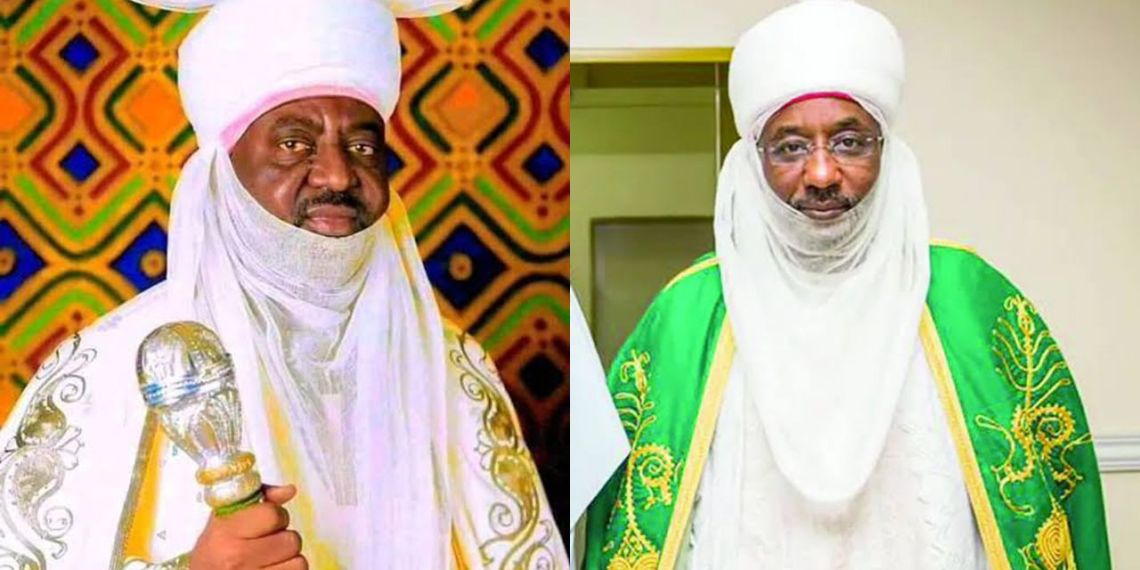
The recent development of the Emir and reinstatement of the deposed Emir Sunusi Lamido Sunusi have seriously disrupted peace and stability in the state. This has opened doors for hooligans and thugs to widen their operations in the state.

It is a known fact that hooliganism and thuggery threaten the security of lives and property in every society. Hence, leaders are saddled with the responsibility of maintaining law and order to prevent potential offenders from engaging in such acts. 

It is unfortunate to say that the current administration of Governor Abba Kabir Yusuf has begun to do the other way around, as hoodlums and thugs are allowed to take over the Kano palace in the name of protecting the selfish and politically motivated interest of his political godfather. This has become a serious threat to the peace and safety of people in Kano as the hoodlums are harassing and intimidating people at will within the vicinity of the Kano Emir’s palace, all in the name of imposing Sunusi on the throne, which is facing outright absolute rejection by the good people of Kano.

This unbecoming attitude is becoming an eye-opener for young children who are now growing to witness this evil as a condoned behaviour. This may contribute to making hooliganism a wider phenomenon, a useful symbol, and a social obsession in the future tradition of the Kano Emirate traditional system.

Since the reinstatement of Sunusi Lamido Sunusi to Gidan Dabo, the palace and areas such as Kofar Kudu, Kano Municipal, Gwale, Dala, and the surrounding areas become the headquarters of thugs. Even medical workers at Hasiya Bayero Paediatric Hospital were attacked on the 27th of May, 2024. The Nigerian Medical Association (NMA) issued a statement condemning the barbaric development. Many other people living in the neighbourhood are not spared either.

This situation arose when the city’s public spaces were “swarming” with thousands of newly armed groups mandated to “protect” and pay allegiance to Emir Sunusi. These groups were recruited by the Kano state government only to praise their political master at the detriment of public safety.

Indeed, Gov Yusuf’s incompetence, ineptness, and clueless leadership style are undoubtedly taking Kano back to square zero. The pickle of the Kano emirship brawl is a cessation of Kano peace and stability as a courtesy to Senator Rabi’u Musa Kwankwaso, former Governor of the state Kwankwaso, by Governor Yusuf and the former Emir Sunusi Lamido Sunusi, in a bid to drag Kano to the state of anarchy. 

Hooligans also came to represent the dangers inherent in loosening constraints on society. Even when hooligans victimised people far from their concerns, the increase in their numbers, the apparent pettiness of their motives, and the savagery of their actions within Gidan Dabo suggested that certain members of the lower classes were either very beastly or very angry and that the mechanisms of state’s control were no longer in place to checkmate this.

Now, what we ask is, does the state government prioritise praising its political godfather over protecting the blood of theKano people?

Ironically, hooliganism and thuggery that previous administrations fought have now been revived by the present administration as the number 2IC in the government triggered the infiltration and indoctrination of youth into hooliganism and thuggery.

On this note, we are calling on the federal government, security agencies, intelligence communities, Nigerian Bar Association (NBA),  northern traditional rulers, religious leaders and all other relevant authorities to intervene. They should also advise the Kano state government to obey the court order restraining them from reinstating the deposed Emir Sunusi Lamido Sunusi and dissolving the remaining four Emirates in the interest of the good people of Kano. This will bring an end to hooliganism, public disrespect, defiance, chaos, and violence that are capable of destabilising the peace and security of Kano State.

Aliyu Dalhatu Adamu wrote from the Federal University, Dutsinma, Katsina State, via

aliyudalhatuadamu@gmail.com.

Unlocking career opportunities with a fisheries degree 

By MD Aminu, PhD 

Yesterday, I met a young lady who graduated with a degree in fisheries from the University of Port Harcourt. She was hesitant to tell me about her field of study because she often encountered scepticism about its prospects. Initially, she had wanted to pursue engineering but was assigned to fisheries. Many of her classmates transferred to other departments after their first year, driven by the belief that fisheries lacked career opportunities. 

The lady shared her concerns that people often looked down on her course of study, assuming it had no potential for a sustainable livelihood or a great career. However, I assured her that a fisheries degree holds significant promise and began to outline various opportunities, although our conversation was cut short. 

If I had pursued a degree in fisheries, here is the approach I would take to maximize its potential. With a good first degree in fisheries, I would utilize my national service year to study diligently for the GRE, preparing for graduate school in the United States or Canada. Prior to graduation, I would research the top researchers in fisheries globally and identify the institutions they belong to. By examining their research trends over the years, particularly focusing on the last five years, I would gain insights into the latest advancements and focal areas in the field. 

I would then reach out to these researchers, discussing my plans for graduate school and exploring potential funding opportunities within their departments. This proactive approach would demonstrate my interest and alignment with their work. 

Additionally, I would investigate the practical applications of these research trends beyond academia, specifically looking at what employers of fisheries graduates, such as FAO, IFAD, and the World Fish Centre, are currently focused on. Understanding that these organizations emphasize sustainability in their programs, I would delve into the major issues concerning sustainable livelihoods and fisheries management. 

As an African, I would pay particular attention to sustainability challenges relevant to African fisheries. This would ensure that my studies and future research remain pertinent and impactful within my regional context. Additionally, I would explore what researchers in sustainable fisheries in the tropics are identifying as future problems, aiming to stay ahead by addressing medium- and long-term challenges. 

Securing admission to a reputable university under leading fisheries researchers would be a significant milestone. My goal would be to produce a doctoral thesis that is futuristic, globally relevant, and applicable to Africa. I would aim to publish at least three research papers in leading fisheries journals, establishing my expertise and credibility in the field. Throughout my graduate studies, attending leading conferences where fisheries experts convene would be essential. Presenting my research at these events would enhance my visibility and allow me to network with professionals from both industry and academia.

 As I near the completion of my research, I will actively seek positions at global organizations like FAO, IFAD, and the World Fish Centre. Additionally, I would monitor the activities of institutions like the African Development Bank and other UN organizations involved in fisheries and food security in Africa, aiming to identify relevant vacancies. 

Securing a position in a global organization would provide not only an exciting career opportunity but also a platform to make a significant impact. My work would contribute to global initiatives in fisheries management and sustainability, and my expertise would be recognized internationally. 

By strategically planning my education and career path, networking with top researchers, understanding industry trends, and focusing on sustainability, I would be able to carve out a successful and impactful career in fisheries. By leveraging available resources, staying informed about industry trends, and aligning my studies with global and regional sustainability challenges, I would ensure that my fisheries degree opens doors to a fulfilling and globally influential profession. 

The young lady I met need not worry about the perceived limitations of her degree. With determination and strategic planning, she can transform her fisheries education into a thriving career with significant impact.

MD Aminu can be reached via mohd.aminu@gmail.com.

The return of Emir Sanusi II and Shaykh Ja’far’s polemics:  What many critics of Emir Sanusi don’t know

Isma’il Hashim Abubakar, PhD

Being one of the followers and now among proponents (perhaps pioneers) of Jafarology, an ongoing hypothetical intellectual formulation of a school of thought that seeks to document, survey and study the scholarly legacies of Shaykh Ja’far Mahmud Adam from multiple angles and diverse approaches, I ought to blindly oppose, like many fellows, anything favourable connected to Sanusi Lamido Sanusi. The reason for this is apparent: Shaykh Ja’far, my favourite scholar, had a bitter polemical engagement with Sanusi, and the duo exchanged hot tirades that escalated to the use of deregulatory labels and scathing monikers to attack each other. 

As someone who always aspires to operate objectively and dispassionately, in addition to having conducted a broad investigation on the pros and cons of the dispute between the two prominent figures, I feel it a duty-bound and personal responsibility to reveal what many people are oblivious of, mainly as thousands of people rely on the recorded and widely circulated sermons of the late Shaykh Ja’far against Sanusi to not only point to the latter’s lack of competence to rule the Islamic society of Kano but to go to the extent of excommunicating him.  

My decision to join issues with Sanusi’s critics on this saga, most of whom I believe are sincere, was informed by the desire to clear many misconceptions and set the record straight. Perhaps it will sound shocking if I boldly suggest that were Shaykh Ja’far alive today, having witnessed the many transformations in Sanusi’s career and the onerous memorable developments witnessed as a result of his adventurous capacity in the various roles he served, including as the 14th Emir of Kano, the late prominent cleric would have hailed and applauded Emir Sanusi in the same degree, if not higher than, he praised a few traditional figures. 

During his reign before the government of the day’s interruption, Emir Sanusi presided over a lively empire that revived, to a greater degree, the culture of intellectual debate and involvement of scholars and luminaries in various fields in the decision-making exercise. Sanusi’s leadership in prayer, his daily free-feeding scheme for the poor and regular comments on the goings-on, which were sometimes controversial, were all rendered dormant by his dethronement. Therefore, in as much an admirer of Shaykh Ja’far criticises Sanusi relying on the positions of Shaykh Ja’far on the former in some respects, one cannot help but align with Sanusi for epitomising what Shaykh Ja’far had been preaching, perhaps more than many of his peers who served similar roles as his. 

Having conducted my PhD research and written the thesis on the career, thoughts and ideas of Shaykh Ja’far and awarded a doctoral degree in July 2023 by Mohammed V University, Rabat, I present below a section in which I examine the engagement between the cleric and Sanusi, a social analyst by then. Enjoy.

Ja‘far had a bitter engagement with Sanusi Lamido Sanusi for the latter‘s critical view of the Shari‘ah project and other issues associated with Islam and Muslims in Nigeria. In one Friday sermon, the content of which was partly reflected in a newspaper interview by the Weekly Trust with the late Shaykh, Ja‘far depicted Sanusi as (a nominal) Muslim who imbibed some features of hypocrisy, which then informed his criticism of Islamic values and Shari‘ah, while attacking Muslim governors who were committed to the return and implementation of Shari‘ah. Ja‘far argued that Sanusi, who was then residing in Lagos, did not, conversely, pen a single essay to condemn the massacres of Muslims by the OPC in the Southwest. Ja‘far further expressed disappointment over what he regarded as a brazen act of Sanusi, who paraded himself as a social critic and intellectual, only to rubbish northern Muslim leaders who, in their effort to resist the marginalisation of Muslims by President Obasanjo, held meetings in Kaduna on the issue.

Ja‘far‘s dismay over Sanusi‘s rubbishing of Muslim leaders who complained of marginalisation of Muslims by the Obasanjo administration was a reference to Sanusi‘s article in which he argued that having fewer Muslims in the executive arm of the federal government was nothing scary, as scholars like Ja‘far and the northern leaders were ―needlessly – crying out. In the words of Sanusi, to reduce Obasanjo‘s crime to the number of members of the Muslim elite he has appointed-or rather not appointed – to key positions and to pretend that if we had more Muslim appointees,then Muslims would be better off automatically, to say this, is to speak from an ethically blind perspective (https://www.gamji.com/sanusi/sanusi48.htm).

Sanusi‘s concern that there was virtually no difference between Muslims and non-Muslims in terms of performance and citizen-concerned leadership was, to a large extent, correct. Ja‘far himself mostly criticised Muslim politicians who, in some regimes, dominated the echelons of power but failed to solve the myriad problems of their people, while in some occasions, he indirectly upheld the records of some non-Muslims who did better than their Muslim counterparts in some capacities. Nevertheless, equitable representation and centralisation of power are important ingredients of democratic dispensation, the absence of which has the potential of throwing political entities into chaos. Sanusi‘s criticism came at a time when sentiments among Muslims over marginalisation were heightening. Not only that, but it came at a time.

Obasanjo was convening a national constitutional review conference, which was seen as a robust chance to further shut out Muslims in the scheme of things. After all, despite being in the minority, Christians were given slots for delegation,which outnumbered Muslim delegates, hence the too much anxiety from the Muslim quarters.

When he took a swipe at Sanusi about Shari‘ah, Ja‘far was obviously referring to Sanusi‘s arguments in some of his writings where he portrayed the Shari‘ah as a tool for politicians to promote their popularity, while in essence, not applying the Shari‘ah to themselves but limiting it to the poor. Similarly, Sanusi had intensely criticised some rulings of Shari‘ah courts, which passed hudud verdicts over convicted criminal cases like flogging in the case of fornication, stoning for adultery and amputation for thievery. This had, at the time, led many Muslims in the country to conclude that Sanusi was a secularist Muslim or even a Marxist pursuing an anti-Shari‘ah agenda. But at the same time, he earned accolades and commendations from the Southern press and intellectuals who hailed him as an enlightened, progressive, reformist, modernist Muslim, etc. 

Ja‘far‘s Friday sermon and newspaper interview were greeted with Sanusi‘s ripostes in which he challenged Ja‘far‘s view of him and descended on the Kano-based scholar‘s personality. Sanusi dismissed Ja‘far as “an unknown quantity that rides on the back of religious fundamentalism to gain social relevancy” but also described him as “a Nigerian who was educated on the charity of Saudi Arabia and whose mosque and school – his source of livelihood – are funded by Arabs (http://www.gamji.com/sanusi/sanusi49.htm). 

This attack opened floodgates of defensive rejoinders from supporters of both Ja‘far and Sanusi, with some accusing the latter of pontificating about his “privileged background” and someone who “can tangle with the Karl Marx‘s of this world but not Qur‘an and Sunnah”, hence he “could not contribute to his society and religion as Sheikh Ja‘far does”. Although he admitted that Sanusi‘s response was too offensive for a respected scholar like Shaykh Ja‘far, one defender of the then-Kano prince observed that Sanusi‘s arguments were “not entirely bereft of its merit and sound judgment”, particularly his call for the adoption of “national identity”, rather than clinging onto ethnic and geographic proclivities.

Whatever the case, Sanusi seems to have developed an ambivalent position toward the Shari‘ah project in Nigeria, either because of the persons involved in the project or due to some personal interpretations of his on the Shari‘ah codes which might differ from the mainstream conception of Shari‘ah. As an independent thinker and intellectual, a quasi-Islam scholar, Sanusi is sometimes a complex person who is too difficult to predict. As opposed to Ja‘far‘s allegation that there was not a single instance in which Sanusi mounted a public discourse in defence of Islam, some other developments showcased Sanusi siding with Shari‘ah and championing the cause of some 

fundamental aspects related to it. In one conference held in London in 2005, Sanusi not only defended the Shari‘ah but also juxtaposed it against Western legal values, pointing out the defects and hypocrisy in the normalisation of free sexual relationships with multiple women while ridiculing polygamy, the myopic legal protection of a murderer by not subjecting him to the same death process, etc (http://www.gamji.com/sanusi/sanusi51.htm).

Similarly, in one other article, Sanusi countered the growing sentiments from Christian quarters about the potential of Shari‘ah controversy to plunge Nigeria into crisis, arguing that it was the portrayal of Shari‘ah in a bad light, that was an “attribute of injustice, this tendency to give a dog a bad name in order to hang it that will destabilise Nigeria, and not introduction of sharia”. Exonerating the Zamfara State government from some unfounded stories related to Shari‘ah implementation, Sanusi accused Christian leaders of threatening peace in the country by convening conferences to propagate anti-Shari‘ah rumours, calling on Christians to “judge Shari‘ah by what the Shari‘ah is” while arguing that “the historical church is no yardstick for measuring Islam”. Sanusi boldly declared that if “Christians fear intolerance from Shari‘ah, or accuse Islamic law of being barbaric, therefore, it is because their knowledge of Shari‘ah is limited to the bible and their experience under catholic popes which led to rebellion and secularism” (http://www.gamji.com/sanusi/sanusi8.htm).

 Therefore, Sanusi advised one Christian-owned newspaper, the Guardian, to listen to the Zamfara state government. It is time to know that the Qur’an and Sunnah enjoin creating a just and honest society and protecting freedom of religion and conscience. It is time to ask those who feel there are legal problems to go to a court of competent jurisdiction. Alhaji Ahmed Sani has repeatedly said his priorities are good government, education, poverty alleviation, and moral rebirth. He has assured non-Muslims of the full protection of their rights. He has never declared Zamfara an Islamic state (see http://www.gamji.com/sanusi/sanusi8.htm).

Above all this, as detailed in chapter two, it was when Sanusi served as the governor of the Central Bank of Nigeria that Muslims finally got the approval for non-interest banking and financial transactions, otherwise known as the Islamic banking system, to operate despite the vehement rejection by Nigerian Christians. Sanusi, who was once hailed by Christians and upheld as “progressive” in the Southern press, had quickly transformed into an agent of Islamization of Nigeria and was labelled with different dismissive names. Sanusi was subsequently promoted in the Muslim milieus as a hero and champion for Muslims and Islam, particularly as Christians united against him, calling for his removal from his post as CBN governor.

Interestingly, although this development was realised in 2012, five years after Ja‘far‘s assassination, Ja‘far‘s public discourses were full of advocacy and agitation as early as the late 1990s for the introduction of interest-free, Islamic-compliant banking and financial transactions.

Furthermore, when Sanusi became the emir of Kano in 2014, he transformed into a religious scholar who not only closely related with scholars, some of whom were members of Ja‘far‘s circle, but he uniquely led religious functions like serving as an imam and giving a weekly sermon, addressing the topic of public concern, much tallying with the way Ja‘far had been advocating for Muslims rulers. Sanusi built a reputation as one of the few traditional chiefs who used to boldly challenge the policies of governments, a move that largely contributed to his deposition in 2020 by the Kano State Government. As shown elsewhere in this chapter, Ja‘far gave special emphasis on the role he envisaged Muslim rulers to play in defending the interests of their subjects and uplifting them in multidimensional spheres of life, and this seemed to be one of Sanusi‘s priorities as the emir of Kano. It is safe, therefore, to trace some fundamental areas of convergences between the two fearless figures, born nearly the same year and at some point both went to Sudan and studied at the OIC-funded International University of Africa, Khartoum. 

If Ja‘far were alive when Sanusi navigated the later developments that catapulted his prestige among religious leaders and ordinary Nigerian Muslims, Ja‘far would have been most outspoken in celebrating the achievements recorded by Muslims through Sanusi. Interestingly, as two informants have revealed to me and later confirmed to me by Sanusi himself, before Ja‘far died, a meeting was arranged by Sanusi‘s mother where the duo had reconciled, understood each other and sheathed their swords.

Isma’il writes from Rabat and is reachable via ismailiiit18@gmail.com.

Pantami’s three faces

By Zayyad I. Muhammad 

Isa Ali Ibrahim Pantami, former Honourable Minister of Communication and Digital Economy, an Islamic sheikh, and a UK-trained Ph.D. holder, has found himself in a triangular situation: an Islamic sheikh, a politician, and an academic. This revered status means any issue that affects his personality will always be a hot topic and attract public scrutiny.

Pantami’s full transformation into a politician who is eyeing the ‘ballot box’ was noticed during this year’s Ramadan Tafsir; his style of delivery and the content of his messages were noticeably altered. Traditionally known for his sticking to religious contents during tafsirs, this time, the sheikh took every opportunity to showcase his extensive knowledge of the economy, geography, and global politics. This shift did not go unnoticed by the audience and observers.

Pantami’s discussions were peppered with references to economic policies, geographic strategies, and the intricacies of international relations, signalling a significant change in his focus and priorities. Pantami continues to align himself more closely with political aspirations, and his body language has also evolved to reflect this new ambition. 

Recently, controversies, debates, and discussions have emerged about Pantami’s books, Skills, Rather than Just a Degree and A Scholar’s Journey: Navigating the Academia. These books trended for a while and reignited old controversies about how he obtained his professorship. This situation has also awakened Pantami’s political adversaries, who view his behind-the-scenes early efforts to enter the Gombe state governorship race as an encroachment on their territory.

Many politicians, especially in his home state of Gombe, are upset with Pantami because they view him as an outsider who seized opportunities to occupy their ‘slots,’ first as the Director-General of NITDA and later as a federal minister representing Gombe State. However, after eight years of working independently, he now seeks their support to establish himself in their domain.

Conversely, the majority of Pantami’s critics regarding his appointment as a professor are academics. In contrast, most of those who backed the critics were Pantami’s political opponents and their supporters.

One of Pantami’s critics was reported to have penned this: 

“Mr. Pantami was only for the most part a Lecturer 1 or 2 where he first served and didn’t spend a whole working career in the university system or in a university’s employment,” he was “made” a Professor by a university where he never worked, taught, sat in its Senate, worked in its committees, never examined or marked UG or PG exam scripts, and his whole promotion papers were never processed at the departmental and faculty levels, and, indeed, he never had a payroll number… Mr. Pantami was thus never a scholar in the classical or academic sense of that word. I wonder whether he’s now teaching or giving classes or seminar papers at any university after his leaving office in May 2023.”

On the other hand, supporters of Pantami’s professorship encompass academics with a fondness for him, members of religious groups, his students, and his political associates. 

In fairness to Pantami, having held a ministerial position, he is already entrenched in politics. Moreover, the criticisms in his books predominantly consist of one-off comments rather than comprehensive analyses or academic discourse. Furthermore, Pantami’s challenge for a debate on his book is yet to take place. 

The debate about Isa Pantami’s books, professorship, and foray into politics has three divides: his adherents, his opponents, and those sitting on the fence. The views of his followers and critics are well known and are often based on their perspectives. However, those sitting on the fence have, on many occasions, provided valid points both for and against Pantami.

Isa Ali Pantami’s transition from an Islamic scholar to a politician and professor has sparked both controversy and applause. His political opponents view his entry into politics as an intrusion into their territory, while his academic critics regard his professorship as ‘unearned.’ On the other hand, his supporters perceive his multifaceted identity—as a sheikh, a politician, and a professor—as exceptional among his peers.

Zayyad I. Muhammad writes from Abuja via zaymohd@yahoo.com.

Kano Emirship Crisis: It always helps to live in the real world

By Dr Raji Bello

Following encouragement from some friends, let me say what I’ve been a bit reluctant to say. It is based on my conviction as a dispassionate and non-partisan observer and of course, as a non-indigene of Kano State.

The root cause of the emirship imbroglio in Kano, in my view, was the inability of Muhammadu Sanusi II to subordinate himself and his office to the Ganduje administration as required by the terms of his appointment. This is essentially what triggered every other thing that has happened and which has led us to where we are today. To correct any problem permanently, we need to examine its root cause.

I am not saying that Sanusi is not an emir of high intellect who is enormously popular among the people. This assessment of mine is based on only one criterion — his willingness or ability to comply with the terms of his appointment — and it is made without prejudice to his qualities, endowments and accomplishments as an individual, technocrat and emir. Like other human beings, the emir is not perfect. He might have excelled in 9 out of 10 criteria but his failure in the 10th is the cause of the emirship crisis because it happened to be a very important criterion.

All post-colonial emirs and traditional rulers have been obligated to demonstrate loyalty and due courtesy to government be it colonial, democratic or military. History is replete with examples of the huge price that was exacted each time an emir fell short on loyalty towards government.

As an intellectual of high standing, the emir must have been aware of that history. When he set out to be emir, he should have been conscious of the terms of appointment and should have fully reflected on whether it was the appropriate platform for someone of his disposition or not. The emir seems to want the Kano emirship in its pristine 19th century form when it didn’t answer to a non-traditional authority. This betrays a lack of situational awareness and good judgement because the reality is that the 19th century is long gone and can never be brought back. So if anyone is interested in becoming emir in the 21st century, it has to be under 21st century terms.

The Ganduje administration had accused the emir of multiple infractions from political partisanship, insurbordination and failure to demonstrate courtesy towards it. Some of these infractions had played out in public for all to see and hear which means that they were not false accusations. I do not fully endorse the former government’s actions (which bore traces of the usual Nigerian impunity) but it is clear that it was provoked into taking actions against the emir. I believe that all state governments are inclined by default to respect the traditional institutions within their states and hostilities only break out when there is a breach of the terms of appointment (usually, but not always) on the part of the traditional rulers.

There is no individual who is so important or popular that they would enjoy exemptions from complying with the terms of their appointment. This is an incontrovertible fact. A friend told me that the emirship style of Aminu Ado Bayero is a bit bland compared to that of Muhammadu Sanusi II. I replied that this is true but the Aminu style is actually the correct one.

Post-colonial emirship is not a radical or revolutionary platform and, after the 1976 Local Government Reforms, the traditional institutions in northern Nigeria lost all the vestiges of authority that were previously delegated to them under the Native Authority system. The post of traditional ruler is now just a custodianship of heritage whose essential features are loyalty, co-operation and circumspection.

Yes, Sanusi is wildly popular, has a deeper intellect, a gifted oratory and displays a higher sartorial elegance but it was Aminu Bayero who was doing the emirship correctly under its current terms. Those who cheered Sanusi as he breached the terms of his appointment were not helping him or the Kano emirship institution.

Reorganizing NOUN for excellence under new neadership

By Mukhtar Jarmajo

The recent appointment of Mallam Isa Yuguda as the Chairman of the Governing Council of the National Open University of Nigeria (NOUN) has sparked hope for a new era of growth and excellence at the institution.

As a former minister and governor, Yuguda brings a wealth of experience to the table, which will be crucial in shaping the future of NOUN.

However, the new leadership faces significant challenges. NOUN has struggled with issues of funding, infrastructure and quality of education, which have hindered its ability to reach its full potential.

One of the primary challenges is the need to improve the university’s infrastructure, including its virtual learning platform, to enhance the learning experience for students.

Another challenge is addressing the issue of funding, which has been a perennial problem for NOUN. The new leadership must explore innovative ways to secure sustainable funding to support the university’s programs and initiatives.

The quality of education is also a critical area that requires attention. NOUN must ensure that its programs meet the highest standards of academic excellence, and that its graduates are competitive in the job market.

Despite these challenges, the prospects for NOUN are bright. With the right leadership and support, the university has the potential to become a center of academic excellence, providing access to quality education for millions of Nigerians. The new leadership must also focus on building strategic partnerships with local and international organizations to enhance the university’s research and innovation capabilities.

Furthermore, NOUN must leverage technology to expand its reach and improve its services, including online learning platforms and digital resources. It has the potential to play a critical role in addressing Nigeria’s development challenges, including poverty, inequality, and unemployment. By providing access to quality education, NOUN can help build a more skilled and competitive workforce, which is essential for driving economic growth and development.

The new leadership at NOUN faces significant challenges, but the prospects for growth and excellence are bright. With the right vision, leadership, and support, NOUN can become a beacon of hope for millions of Nigerians, providing access to quality education and driving national development.

Jarmajo wrote from Lobito Crescent, Wuse 2, Abuja.

Dear FG, why has there not been Udoji since 1974?

By Bilyamin Abdulmumin

To commemorate Workers’ Day on May 1st, FG announced the long-awaited salary increase from 25% to 35 %. However, hours later, the NLC president, Joe Ajaero, kicked against the increase and instead stuck to the 615,000 they proposed as minimum wage.

Although this total figure looks astronomical, it suddenly looks normal, putting the breakdown that Ajaero gave into perspective, especially with the current high inflation. At least that amount should reflect the salary of anyone receiving 100k or more before Tinubu came to power. In other words, the breakdown might be exaggerated to the bottom-line salary earners but not the middle ones.

When several pundits shared their analysis on National Assembly wages, the Ajaero recommendation suddenly became realistic again. The National Assembly’s daily take-home is more than the recommended minimum monthly take-home. So, the argument is that if NA daily wages are so high, the minimum monthly salary asked by NLC should not be too much. This is quite plausible.

But from the interview Abdulaziz Abdulaziz gave, it could be discerned that the highest minimum wage the government is ready to pay is double the current minimum. Abdulaziz first clarified that the current salary increase is temporary, pending when the tripartite committee under the former head of service concluded their assignment. However, as a committee member, he said unlike the 25 to 35% increase, the minimum wage may go up to 50 to 60k. He also emphasised that the federal government is bidding for the highest among the three parties: federal, state, and private.

An argument accompanying the discussion of salary increases is the plight of non-governmental citizens. The argument is that if FG increases government workers’ salaries, what about the rest of the citizens? To buttress this point, government workers are said to be just about 10% of the total population. This argument appears to carry substance, but it is misleading by flipping the coin because the more money on the government workers, the more money on every one.

The people who should be rather pitied are the state and LG workers. Because some of these tiers of government still receive the 1999 salaries benchmark. A friend who works with the local government health sector summarises their predicament. He said a decade ago, when he married, a mudu of foreign rice was 450 naira, and they only used half of it. Now the mudu costs five times, and because their family has increased, they need the whole mudu, but the pathetic part is that the salary hasn’t only increased since, but several bogus deductions have eaten deep into it.

At this time when the FG and labour are arguing about high salary increases to meet public expectations due to high inflation, there is no better time to remind ourselves of the famous “Udoji award” than now.

As a fan of Dan Anache, I heard one of his songs mention “Udoji.” I understood that he was mocking someone, but I didn’t know what it meant, so I took it at face value and enjoyed the song. The lyrics read: “Kai baka soja, kai baka dan sanda, kattsaya jiran Udoji. To Udoji in dai sadaka ce muma araba abamu.” It wasn’t until I came across Mahmud Juga’s article titled “UPE, WAI and Udoji” that I realised what it meant. 

In the article, Jega concluded, “Why has there been no Adebo and no Udoji in this country since 1974? Any young person who does not know what that means should please ask the elders.” So, with the right name in hand, I did what everyone does when faced with a burning question—I turned to search engines.

The Middle East, the world’s oil bank, is known for conflicts and unrest, so anytime one arises, just like the current one is on the card, the global oil price experiences a meteorological rise. One of the most popular oil price rises occurred during the Arab-Israeli War and the Iranian revolution in the 1970s. This was when Nigeria had had an oil boom, and there appeared to be no idea what to do with excess money, so the Udoji Award was. 

Jerome Udoji chaired the committee focused on the effectiveness of public service. One of the committee’s recommendations was to increase the salary twofold, which was implemented by the military head of state, Yakubu Gowon. The salary increase was so popular that it became known after Udoji. Please, someone should tag the current chairman of the minimum wage committee, Bukar Goni Aji.

There is no oil boom now, but there is a subsidy removal boom. So, to paraphrase Jega, Please FG, why has there not been a Udoji Award since 1974?

The alliance of history and the “Good Old Days” phrase

By Sharif Ishaq Abubakar

Introduction

Man envisages hope and secures confidence. In the course towards thriving to make a better positive arrival to the future, emanating from a past and rolling to a thoughtful destination, though I’m not quite sure, I set goals to beat what has to spell the past. There is a joint alliance with history as a discipline and what a layman could call the “Good old days”. 

The good old days, as the essay subscribes to them, are precision in explaining what is commonly attested to when there is a flashback in a human being’s life, portraying the rosy and more easygoing way of life or the simple life of the past. This is usually not welcome in the language of academic historians, as what is more vividly visible is the past in response to the doctrine of history. 

The good old days in question are what I find and regard as a commonly digested utterance by those who find their past life more pleasing. They are not necessarily shouldered with success in a weighted rate, but a sense of appeasing and touching unforgettable times that the present has swallowed but left tangible emotions for the utterer to describe. It is not elusive. It happened, occurred, took place, and was quite eventful. 

With this periodic relevance, I sensed a spectacular alliance between the history known as a Study and the phrase candid by mostly good explainers of events and happenings, adhering and recalling their past days as the good old days. I see the two working relatedly, but I saw them separating as the latter could not get a fixed spot as shallow as a topic.  This essay, therefore, will highlight the alliance of History and the phrase” Good old days”.

The Past and the Emotion of the Old Days

This piece does not set itself in the medicinal or health advocative stance, guided by medication or clinical hypothesis. In this context, the past and the emotion of the old days patronise a common fact that should be well acknowledged by every human being, which posits that the past was not that less patchy or lacked bruises in the lane that gave birth to the present. There were struggles, but the man still thrived like the men of the stone age. The measures and methods might not constitute similar skills and advancement, but what ascertained the inbuilt tradition of man is to uncover the path for survival, which further comes with attached conditions and risk-taking that also spells more of man’s ways. 

If this is how the generational pattern of man’s life was and will continue to be, how did man develop emotion for the past and even refer to the past with an emotional remembrance phrase, the Good old days?

I found the worthiness of my response to these questions in stages of human being growth. 

In the study of history, those before us paved the way for the advancement we enjoy today, and we are responsible for what will become of future advancement. It is a stage, and it is periodical. Man, stages of growth come with several definitive developments and mistakes, which transform into lessons. Historically, our forefathers have been down to us, and we shall be forefathers to another set. 

Man grows up leaning on his parents, forming a bond and several events transpiring in his life; in several clicks of time, one can no longer go back to those days, but the days stay in the heart, brain and the whole body system, despite the natural heritage from the parents which of course speaks clearly of who you took after, one still look back at the gone days and smile, blushing out some event that occurred not because there were meant to make a joke of, but because there are several notable notations attached to that scenarios. The past is lovely because it makes you remember who you are and what you are supposed to strive for. The mind works in a mysterious way that flashes back in a second to events that take you out of your present, honouring the past and handing over the juridical capability to make your choice forward. It is emotional, but the phrase “good old days” weighs a lot.

The Alliance of History and the Phrase the “Good Old Days”.

Standing from within, inspecting the past, observing the turning points of events, and profoundly judging the historical stages that led to the current development, one would apparently love the past because it is historical; it takes you back to the meaning of the present. This sets a distinct correlation between the term history as a study and the above phrase.

What will become of the understanding of democracy or the modern pattern of international relations when one thinks of imperialism and how it transpired, where it became economically and practically legal to show nation strength and capability by annexing and conquering more land, these territories and lands have settlers and indigents inhabited in them. Still, the wake-up of the clamour of securing your land by defending and raising quite a courageous military to secure land proves the days to be readymade for wars. 

Territories prepare and anticipate war. Some nation-states have made a fortune and are where they are today because conquest was practicable before today, and there is no favour history can bring about their success without pointing at those days. Today, national flags speak volumes of reasons why they appear with specific colours, not because the past covers the unscratched step to their current capability, but because it was worth passing through the past and having the present as a representative of the past.

Aside from the above example, why would a layman refer to the past as the good days, and how is it related to history?

Indeed, they have been developed, but glaring at the present harbours inflation and population growth as resources tend to be fewer than in the past. Looking back to the past and scoring those days as good days defines the long way the past determines the future and how related they are. It breaks an alarming projection when the hope of the future is always cherished to be better. It hence gives birth to a predicament when the future of the past becomes less provident than it was judged to be. 

Man is hence left with a single option: turn to the better days, which is why history deals with everything. History is used to judge the progress of a certain goal; it tracks the impact and provides facts that place the past and the present on a scale for one to choose between whether the past had a more promising trajectory, or the present thwarted those policies initiated to befit the future (Now Present). Either way, I will cite Nigeria as a critical reference.

Nigeria gained independence in the year 1960. The individuals who worked through the path of success in attaining Nigeria’s freedom from colonialism were highly respected and celebrated with greater hope for the country’s future. All reflection points to leadership, health care, education, youths, democracy, infrastructure, and other aspects that require reliable leaders’ consent. That was hope, and it started on a good platter, but the future led to crises and other predicaments, resulting in a civil war within six years of attaining a positive foot in the country’s history. 

The future rolled on, leading to several phases of military leadership, and the country bounced back to democracy in 1999. Why, then, will one refer to the days of the leaders of the first republic as the good old days? There is a response to the question when one depicts the days of the previous leaders who died not owning or amassing the wealth of the public or citizens of the country despite being labelled as corrupt. 

One of the reasons the First Republic’s political settings crumbled was corruption. Still, till today, the pattern of corruption has only taken a glorifying approach that seems more degrading than that of the leaders of the First Republic. That is to assert that in a situation where the past seemed to be more politically sound than the future (now present), the past must be seen as the good days, not because it was hoped for to be that way, but because it proves better than the worsening present/ future.

 Conclusion 

 This essay captured the relevance of the past, thereby mirroring the fact that not all events that happened in the past historically can be beaten by the future or present. Some might indeed wish the past should fade, but growth seems to make one attached to his past so much that the yearning for past memories leads to a label known as the “Good Old Days.”

Sharif Ishaq Abubakar wrote via Sharifishaq55@gmail.com. He is a PhD Student at the University of Abuja, Department of History and Diplomatic Studies.