Terrorism

Security: The Nuhu Ribadu Formula

By Zayyad I. Muhammad 

Before the emergence of President Bola Ahmed Tinubu’s administration, Nigeria’s security architecture was grappling with deeply entrenched challenges, particularly in the Northwest and Southeast regions. The situation had deteriorated to alarming levels, with criminal elements and secessionist movements establishing a disturbing level of control in certain areas.

In the Northwest, banditry had evolved from sporadic attacks to the full-scale occupation of territories. Vast stretches of land, especially in states like Kaduna, Zamfara, and Niger, fell under the influence of heavily armed groups. The Abuja-Kaduna highway, which was once a vital economic and commuter route, became a perilous stretch, notorious for frequent kidnappings and ambushes. 

The Northwestern security threats extended further, with the Kaduna–Birnin Gwari–Lagos road effectively shut down due to sustained bandit activity. Even commercial life suffered significantly; the Birnin Gwari cattle market, a major hub for livestock trade, was forced to cease operations under the pressure of violence and extortion.

Meanwhile, in the Southeast, the situation was compounded by the secessionist agitation led by the Indigenous People of Biafra (IPOB). Through fear and coercion, IPOB succeeded in enforcing a weekly sit-at-home directive across several states in the region, paralysing economic activities every Monday. Businesses were shuttered, schools closed, and the freedom of movement was severely curtailed, undermining both governance and development efforts.

This was the grim reality that the Tinubu administration inherited. However, at the heart of the renewed fight against insecurity stands a strategic recalibration: what many now refer to as the “Nuhu Ribadu Formula.” As National Security Adviser, Ribadu brought a fresh, intelligence-driven approach to tackling Nigeria’s security woes. With an emphasis on coordination among security agencies, restoration of public confidence, and targeted offensives against criminal enclaves, his methods have begun yielding tangible results.

While challenges persist, especially in remote and hard-to-reach areas, the difference in tone and trajectory is becoming increasingly evident. The Ribadu-led security strategy has not only focused on reclaiming territory but also on addressing the root causes of unrest, be it poverty, weak governance, or community grievances. It is this multidimensional and proactive approach that may well define Nigeria’s path to lasting peace and stability.

Mallam Nuhu Ribadu, the National Security Adviser, has been pivotal in reshaping Nigeria’s national security framework through a clear and strategic vision built on three foundational pillars.

The first is the carrot-and-stick approach, which balances kinetic (military force) and non-kinetic (dialogue, reconciliation, and development) strategies. This dual-pronged approach acknowledges that not all security threats can be addressed solely through force. By combining targeted military operations with community engagement and deradicalisation efforts, the approach aims to neutralise threats while addressing the root causes of violence.

The second strategy is a shift from rhetoric to action, a deliberate move away from endless briefings and political grandstanding towards concrete, measurable outcomes. Under Ribadu’s watch, security interventions are now judged not by promises, but by performance. The focus is on restoring peace, reclaiming lost territories, and enabling displaced persons to return to their communities.

Third is the promotion of synergy and intelligence sharing among security agencies. Previously plagued by inter-agency rivalry and fragmented operations, Nigeria’s security forces are now operating with improved coordination. Through unified command structures and shared intelligence platforms, responses have become faster, more precise, and increasingly proactive.

These strategies have already begun to yield visible results. The recent resurgence of attacks in Plateau and Benue States, as well as isolated Boko Haram assaults on soft targets in Borno and Adamawa, were swiftly countered using the same framework. Rapid deployment of forces, community-based intelligence, and coordinated operations prevented escalation and restored calm.

Still, the road to full recovery is a gradual one. While the machinery of state security has been retooled, the average citizen may not immediately perceive these gains. Part of the challenge lies in the persistence of outdated or unverified reports in some sections of the media, which can paint a distorted picture of the current realities. Nevertheless, those on the ground, especially in previously hard-hit areas, are beginning to sense a shift.

The “Nuhu Ribadu Formula” is proving to be more than just a tactical adjustment; it is an evolving doctrine that prioritises effectiveness, accountability, and collaboration. With sustained implementation and public support, it could well become the blueprint for enduring peace in Nigeria.

Zayyad I. Muhammad writes from Abuja, zaymohd@yahoo.com.

India launches missile strikes on Pakistan, tensions escalate

By Muhammad Abubakar

India has launched missile strikes on nine locations across Pakistan and Pakistan-administered Kashmir, targeting what it described as “terrorist infrastructure.” The strikes come amid heightened tensions between the two nuclear-armed neighbours following a deadly militant attack in Indian-administered Kashmir last month that claimed 26 lives.

Pakistan reported that at least eight people were killed and 35 injured in the strikes. Authorities in Islamabad condemned the assault as an “unprovoked, blatant act of war,” accusing India of deliberately targeting civilian areas.

In response, Pakistan claimed to have shot down five Indian fighter jets, though Indian officials have yet to confirm any such losses.

The incident marks a dangerous escalation in a region with a long and volatile history, raising fresh concerns about stability and the risk of broader conflict.

President Tinubu vows to crush terrorism, boosts military welfare 

By Abdullahi Mukhtar Algasgaini

President Bola Ahmed Tinubu has issued a strong charge to the Nigerian military, urging them to intensify efforts in ending terrorism and banditry while promising improved welfare for troops.  

Speaking to soldiers of the 17 Brigade in Katsina on Friday, Tinubu described the security crisis as a pivotal moment in Nigeria’s history. He called for unwavering resolve in defending the nation’s sovereignty and restoring peace.  

“This is a defining moment,” Tinubu declared. “Nigerians are counting on you to reclaim every inch of our territory. Let the enemies of Nigeria know—their time is up.”  

The President assured troops of better housing, healthcare, timely allowances, and family support. He praised their bravery in combating banditry in Katsina and beyond, stating, “You are the shields of Nigeria, standing between our people and terror.”  

Tinubu’s visit included inaugurating a 24km dual-carriage road and an agricultural mechanisation centre. His message was clear: Nigeria will not surrender to terrorists, and the military will receive full backing to end insecurity.  

“To those who seek to destabilise us,” he warned, “Nigeria will not bow.”

Jihadist resurgence in Northeastern Nigeria raises alarms

By Muhammad Abubakar

A recent surge in jihadist attacks in northeastern Nigeria has sparked concerns over a potential comeback of extremist groups in the region. Over the weekend, at least 48 individuals lost their lives in coordinated assaults across Adamawa and Borno states, marking one of the deadliest periods in recent months.

Security analysts attribute this uptick in violence to a reduction in infighting between Boko Haram and its splinter group, the Islamic State West Africa Province (ISWAP). The groups have reportedly adopted advanced tactics, including the use of armed drones and roadside explosives, indicating increased tactical support and funding from the Islamic State.

In Borno State, Governor Babagana Zulum has warned of militant regrouping in the Lake Chad and Sambisa Forest regions, noting a lack of strong military response. The Nigerian military has yet to comment on the situation.

The resurgence of these extremist groups poses a significant threat to the stability of northeastern Nigeria, a region that has endured over 15 years of insurgency.

Analysts caution that without a robust and coordinated response, the region may witness a return to the heightened levels of violence experienced in previous years.

United States reviews past aid to Nigeria, condemns Boko Haram atrocities 

By Muhammad Sulaiman

The U.S. government has announced plans to investigate past foreign aid allocated to Nigeria and other countries, following President Donald Trump’s 90-day suspension of foreign assistance. 

The decision comes amid concerns about global destabilization and whether aid aligns with American interests.

The U.S. Mission to Nigeria confirmed ongoing efforts to track past assistance provided by the U.S. government. 

The Mission also condemned the violence and loss of life caused by Boko Haram, the extremist group designated as a Foreign Terrorist Organization by the U.S. Secretary of State in November 2013.

The review aims to ensure transparency and accountability in aid distribution while addressing security challenges in affected regions.

Immigration reinvigorates border patrol over Lakurawa

By Anwar Usman

The Nigerian Immigration Service, Sokoto State Command, has reaffirmed its commitment to strengthening border security as part of its efforts to tackle the security problems posed by the emergence of the Lakurawa sect.

On Monday in Sokoto, the state Comptroller of the NIS, Mr Yusuf Bage, announced this during a courtesy visit from the leadership of the state Council of the Nigeria Union of Journalists.

Bage said the security problem posed by the Lakurawa sect is a new and evolving threat, especially in the state.

According to him, the Lakurawa sect members often enter the country through illegal routes.

”However, I want to assure the public that security agencies are ahead of them, and their activities will soon be curbed.”

He explained that one of the significant constitutional mandates of the NIS was to ensure effective border management, including oversight at airports and seaports.

To achieve this mandate, the NIS ensures proper identification of foreigners entering the country and closely monitors their movements and activities within communities.

He explains that the NIS had expanded its offices across the 23 local government areas to maintain visibility in all the state’s nooks and crannies.

He also highlighted the collaboration between the NIS, the Army, and other state security agencies to ensure the safety of citizens.

The comptroller also emphasized the importance of the media in supporting security efforts and pledged a mutual relationship between the NIS and journalists in the state.

The NUJ state Chairman, Mr Usman Binji, said the visit was to formally introduce the new leadership of the state council.

Binji reiterated the role of journalists in fostering collaboration with security agencies, stressing that the visit would reinvigorate the collaboration between the NIS and the NUJ to make Sokoto State safer.

He further stated that, “Our members are fully committed to supporting the security agencies in ensuring the safety of Nigeria’s territory.”

Shocked by ISWAP attack, Tinubu calls for enhanced military measures

By Abdullahi Mukhtar Algasgaini

President Bola Tinubu expressed his condolences to the soldiers who lost their lives in an attack on a military base in Sabon Gida, Damboa, Borno State.

Members of the ISWAP (Islamic State West Africa Province) group launched the attack at dawn on Saturday, using heavy military vehicles and motorcycles. The attack targeted the military base in Sabon Gari, located in Damboa Local Government Area, Borno State. They set the base on fire, including military vehicles, as confirmed by several military sources who requested anonymity due to restrictions on speaking about the matter.

Fighter jets dispatched from Maiduguri, located 100 kilometres (62 miles) away, retaliated against the attackers as they tried to flee.

In a statement released by the President’s spokesperson, Bayo Onanuga, Tinubu expressed deep sorrow for the loss of six brave soldiers who died in the terrorist attack on January 4th. The President has ordered a full investigation to determine the cause of the incident and ensure that it serves as a lesson to prevent future occurrences.

“The actions taken by the military demonstrate our strength and readiness to confront threats and eliminate them for the safety of our country. This operation highlights our commitment to fighting terrorism and banditry and working towards a peaceful and secure future for all Nigerians,” the President stated.

Tinubu further expressed his gratitude and sympathy to the soldiers and other security personnel on behalf of the grateful nation. “Your dedication and sacrifice will not be in vain. We stand with you 100% in this fight against these threats,” he affirmed.

The Chief of Army Staff also commended the military’s swift and decisive response, particularly the air support, which successfully struck many of the terrorists and destroyed their equipment as they attempted to escape.

According to Tinubu, the airstrike resulted in the killing of several terrorists and the destruction of their resources. The President urged the military to take further steps to launch direct assaults on bandits and terrorist camps.

He emphasized that special attention should be given to the North-Western region, where these criminal groups continue to pose a threat to the lives and property of innocent rural communities.

Tinubu also called on Nigerians and the media to support the military’s efforts to restore peace and security in the country.

Video of Nigerian, French troops unloading supplies debunked as old footage

By Uzair Adam 

A video depicting Nigerian and French troops unloading supplies in a coordinated manner has garnered significant attention on social media.

The Daily Reality reports that the footage has sparked controversies surrounding France’s alleged intentions in Nigeria.  

The controversy intensified after Mohammed Idris, Nigeria’s Minister of Information and National Orientation, dismissed claims that the country had ceded any part of its territory to France. 

Idris issued a statement on Thursday addressing allegations that Nigeria was conspiring with France to destabilize the Niger Republic through terrorism.  

Mahdi Shehu, a public affairs commentator, had previously alleged plans to establish a French military base in northeastern Nigeria. 

He claimed the plans gained traction after Femi Oluyede, Chief of Army Staff (COAS), reportedly hosted French soldiers.  

In a video accompanying Shehu’s since-deleted social media post, Nigerian troops were seen offloading supplies, including bags of rice, from trucks while French soldiers unloaded a cargo plane. 

The scene included vehicles, personnel in uniform, and a bus displaying a French flag. In the video, a Nigerian soldier stated that the troops had recently left a counterterrorism training centre.  

However, investigations by TheCable revealed that the video has been online since January 2013. 

According to a report by the Associated Press (AP), the footage shows ECOWAS troops, including 156 Nigerians, arriving at Senou International Airport in Bamako, Mali. 

The mission was part of a regional peacekeeping effort to stabilize Mali during a crisis.  

Reacting to Idris’ statement, Shehu urged the government to halt its denials. 

Meanwhile, Nigeria’s defence headquarters dismissed the allegations as “baseless.”  

The resurfaced video highlights the challenges of misinformation in public discourse, underscoring the need for careful verification before making conclusions or spreading claims.

Nationwide Operations: Military neutralizes 135 terrorists, arrests 185 suspects

By Uzair Adam

Nigerian military troops have intensified their nationwide operations, eliminating 135 terrorists, apprehending 185 suspects, and rescuing 129 kidnapped victims within the past week.

The Director of Defence Media Operations, Maj.-Gen. Edward Buba, provided the update during a briefing at the Defence Headquarters in Abuja on Saturday.

He disclosed that in the North Central region, some terrorists have begun surrendering due to sustained military offensives and collaborative non-kinetic engagements with community stakeholders.

Among those who surrendered are notable figures such as Yellow Jambros, Alhaji Mallam, Ardo Idi (Alhaji Lawal), Lawal Kwalba, Salkado, Yellow Ibrahim, Gana’e, and Babangida.

Buba emphasized that the military would maintain its operational momentum to dismantle terrorist networks and encourage further surrenders.

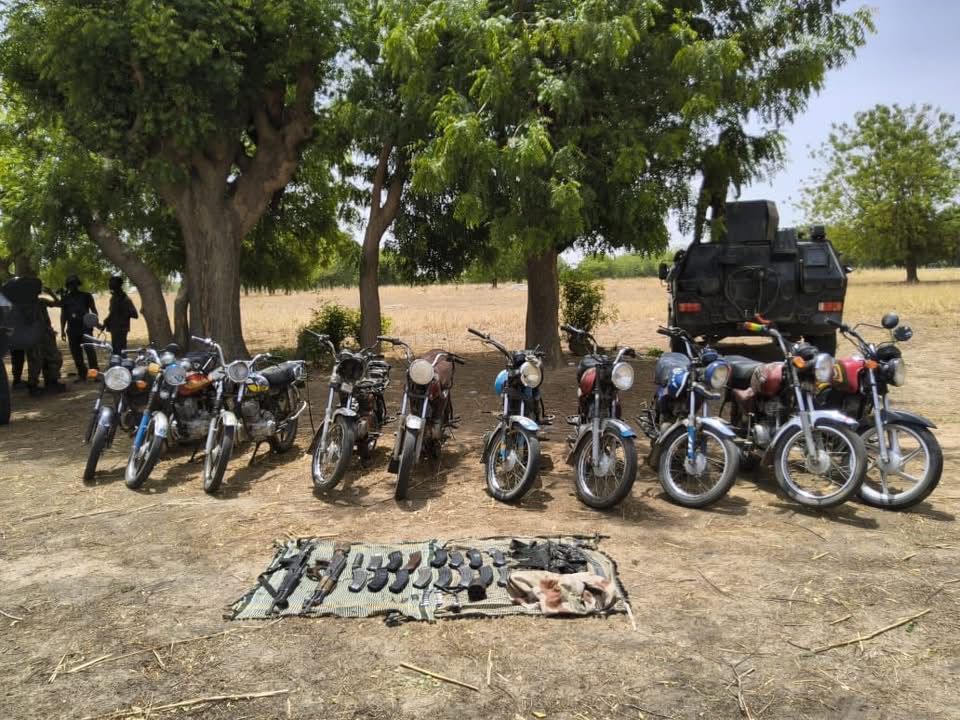
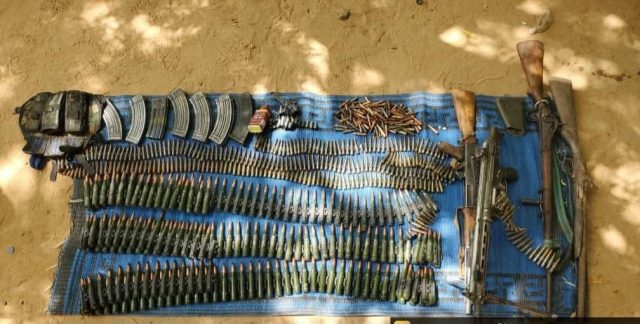
During the operations, troops recovered 113 weapons and 2,415 rounds of ammunition, including 72 AK-47 rifles, 11 fabricated guns, 15 Dane guns, eight pump-action shotguns, and four hand grenades. They also seized 46 motorcycles, 15 vehicles, 28 mobile phones, and various communication devices.

In the Niger Delta, troops destroyed 93 crude oil cooking ovens, 12 dugout pits, 37 boats, and 82 illegal refining sites.

They also recovered 909,800 litres of stolen crude oil, 71,060 litres of illegally refined diesel, and 13,580 litres of petrol.

Maj.-Gen. Buba reiterated the military’s commitment to addressing Nigeria’s security challenges, stating, “We remain in a winning position in this war and will continue to innovate in our approach.”

Borno police recover 8 unexploded devices, reassure public of safety

By Uzair Adam 

The Borno State Police Command has successfully recovered eight unexploded devices from the Dala and Gwange areas of Maiduguri, the state capital. 

This discovery was made on Friday following distress calls about unidentified objects suspected to be explosive ordnance.

According to ASP Grace Michael, the command’s Deputy Public Relations Officer, the police received a distress call about unidentified objects clustered near an uncompleted building in the Dala-Abuja Talakawa Area, Maiduguri. 

The police swiftly moved to the scene and recovered six projectiles and one unexploded mortar bomb.

Later that day, the police received another distress call from the Gwange Area about an unidentified object washed ashore on the Gwange river bank. 

The police quickly recovered one unexploded Hand Grenade (UXO).

Preliminary investigations revealed that the ordnance was washed ashore due to the recent devastating flood incident in the state. 

The Borno State Commissioner of Police, CP Yusufu Lawal, reassured residents of the command’s commitment to ensuring public safety and security.