Southern Nigeria

Should the Northern youth “Japa” too?

By Hassan Ahmad

The term “Japa” is slang used by Nigerians to refer to the continuous exodus of young Nigerians to the developed countries in search of greener pastures with the intent of not returning home. Japa is widely accepted in southern Nigeria, with many youths leaving Nigeria in the last decade. The justification for this mass departure is not farfetched. They include unemployment, insecurities, incessant strike actions by university teachers enabled by the government and other social problems cumulatively, among others. But on the other hand, the direct opposites of these push factors are the pull factors that also encourage it.  

The southern region of Nigeria housed the larger percentage of industries available in this country, with a better literacy rate and a better standard of living. 

However, in the North, the story is by far worse. Topping the list is insecurities from the Boko Haram ravaged northeast to the bandits’ taking over of northwestern villages and the ethno-religious conflicts in the north-central states. Don’t forget farmer-herders’ conflicts, too. 

Aside from insecurity, the poverty rate in the North is alarming – constituting 86 per cent as of 2021. In addition, illiteracy is prevalent, and there is high existence of unemployment as well as under-employment.  

From the above, we’ll understand that northern youths have more reasons to Japa and never look back, but that has not been the case. This can be understood to play out this way for obvious reasons: deep kinship relationship, lack of understanding of the evolving nature of the 21st century, fear of the unknown, ill contentment and others. 

The underlying issue is that it’ll no longer take long before the northern youths follow the footsteps of their southern counterparts and get fed up with Nigeria, and look beyond the seas and deserts to better their lives. Oh!  It has started already. Thousands of youths are already risking their lives through the Sahara desert with the hope of reaching Europe or the Middle East. Many others who were chanced to have acquired scholarships overseas ended up staying in those countries to pursue a living. This creates two scenarios.

While the educated northern youths get out of the country legally through scholarships and fellowship, the less educated and uneducated look for their ways illegally and, in most cases, lose their lives or ending as sex slaves. We lose our best brains to the developed world while losing our uneducated ones who can alternatively be a source of labour to the graves.  This means that the youths who are supposed to carry the northern and Nigerian dream (if there is any) are giving up already.

Where is the Northern Governors Forum? Have they provided a roadmap for the development of the North, how to tackle insecurity, unemployment, poverty or even improve education? 

Or the Forum is meant for negotiating power between the ruling elites? So why must it be far away Lagos that’ll have the foresight to partner with Kebbi in producing Lake-rice? Why not Kaduna, Kano or Nasarawa?  

Why is the same Forum quiet while their young people are out of school for an avoidable strike?  North is the most hit by the ASUU strike because 90% or more of her students depend on public universities for their education. Is this too hard for the governors to understand? Have they ever intervened? 

Northern leaders should rise to their responsibilities before it’s too late. The outside world is open to all but cannot afford to embrace us all. So it is either they make the North a home for the younger ones, or we look for another home. There is no sense in sticking to the parents that humiliate you all your life. 

As things are, if there is an opportunity, let’s Japa too, legally. 

Hassan Ahmad Usman writes from Lafia, Nasarawa State, Nigeria. He can be reached via basree177@gmail.com.

OBIDIENTS: A thinly veiled ethnic entrepreneurs

By Mubarak Shu’aib

Ask most people why countries break apart, and many will say that different groups sharing a single country naturally dislike and distrust one another. For example, Yugoslavia fragmented because the Serbs and Croats and then the Bosnian Muslims started to fight each other after the collapse of the Soviet Union. Ethiopia recently descended into civil war because its various ethnic groups – the Tigrayans, Amharans, and those from the Sidama region- each wanted government control. So fundamental ethnic and religious differences must be the cause of all these conflicts.

Nigerians have a lot at stake in answer to this question. Our country has become increasingly divided, with ethnicity now playing a central role in debates over where the presidency should go come 2023. Could the country travail through these adversaries and polarisations?

It turns out that the differences themselves do not lead to violence. This is the finding of political scientists who have studied hundreds of ethnic conflicts worldwide. Almost all countries are multi-ethnic and religious, yet few experience crises.

For a society to fracture along identity lines, you need mouthpieces – influential people willing to make discriminatory appeals and pursue discriminatory policies in the name of a particular group. They provoke and harness feelings of fear as a way to lock in an ethnic constituency that will support their scramble power. These mouthpieces are often politicians seeking to gain or maintain control. Still, they can also include business elites (seeking brand loyalty), religious leaders (seeking to expand their followers), and media figures (seeking to grow their audience). 

Separate and hostile ethnic identities don’t exist in a vacuum; they need to be crafted, and these individuals rise to do just that. They’re often at a high risk of losing power or have recently lost it. Seeing another route to securing their futures, they cynically exploit divisions to try to reassert control. We see such figures on our social media platforms (Twitter, Facebook etc.). And they’re more dangerous than what we’ve been led to believe.  Experts have a term for these instigators of conflict: ethnic entrepreneurs.

The term was first used in the 1990s in Yugoslavia, but ethnic entrepreneurs have emerged many times over in all parts of the world. Though the catalyst for conflict is often ostensibly something else – the economy, freedom of religion – ethnic entrepreneurs make the fight expressly about their position and status in society. Harnessing the power of media, they work to convince citizens that they are under threat from an out-group and must band together under the entrepreneur to counter the threat. They also try to persuade those in their group, often with incendiary language, that they are superior and “deserve” to dominate. They (ethnic entrepreneurs), at rallies, symposia, places of worship and town hall meetings, cast aspersions on some ethnic and religious groups.

So why do average Nigerians let themselves be swept along this rhetoric? Perhaps surprisingly, they are often clear-eyed about ethnic entrepreneurs. They know these individuals have their agenda and are not telling the whole truth. Many Igbos did not trust, let alone love, Peter Obi, who was a running mate to Atiku Abubakar a few years earlier (2019). But they’re now willing to show support after a mounting threat to their lives, livelihoods, families, or futures. Over time, the OBidients’ rhetorics and increasing ethnic biases steadily sowed doubts. After silencing the disloyal journalists and media outlets, they plied their audiences with unrelenting messages of fear and suspicion.

These ethnic entrepreneurs are now thriving. But they emerged out of nowhere. In fact,  from the #EndSARS protesters, some of these ethnic entrepreneurs have metamorphosis into #OBIdients. Unfortunately, Mr Obi is relying on their appeals to win the presidency. Albeit with a coded language.

Religion is next. To secure the support of Evangelical leaders and their increasingly mobilised voters, the ObIdients stake more and more pro-life positions. Moral imperatives and cultural identities are now, more than ever, driving voting patterns. 

From appealing to core policy concerns and stoking anxiety where it’s not required, these ethnic entrepreneurs are using different tools to upset the country’s political atmosphere. 

They rightly do so by exacerbating issues on social media. Deborah’s murder is a case study. Twitter exploded, Facebook went mainstream, and social media became an ever-present part of our lives.

Critically, a network of these gleeful ethnic entrepreneurs realised that they could gain ratings and influence by emphasising online tension. As a result, media titans such as SAHARA Reporters, who rely on ratings and clicks, feed us increasingly polarised content.

Into this political morass stepped in Peter Obi. In his bid for power, he realised that appeals to identity could galvanise his political base.  So now, he embraced identity politics explicitly and with gusto.

Obi intuitively understood that the deep feeling of alienation among many Igbo voters could carry him to power.  Although he’s too clever to factor much into the division like other ethnic entrepreneurs, he resorted to radicalising the previous administrations he’s part of as a two-time governor of Anambra State.

Although he remained an underdog in the race, his movement is a future incentive for other ethnic entrepreneurs who are now studying his playbook and will, without a doubt, use it to try to catapult themselves into the Villa in the nearest future. They will build on the momentum, and they will do so by manufacturing threats, fomenting even more ethnic fear, and convincing Igbos that they genuinely are in the midst of an existential fight. How far will these ethnic entrepreneurs go? How far will we let them?

Mubarak Shu’aib writes from Hardawa, Misau LGA, Bauchi State, via naisabur83@gmail.com.

Muslim-Muslim ticket in APC: North, ethno-religious manipulations and the way forward

By Abdulhaleem Ishaq Ringim

It is the realization that Nigeria’s presidency cannot be won by the sole or combined agencies of personal fame, resources or regional influence that informed the ideation of a merger of political parties that eventually birthed the APC. 

And the essence of this merger, as it were, was the pursuit of a formidable confluence between Nigeria’s most politically active blocs – northern and south-western regional voting blocs. This resulted in the officiation of an alliance through the instrumentality of a transnational political platform capable of displacing the political hegemony of the PDP. And the central representative figures of the two voting blocs were unarguably Muhammadu Buhari and Bola Ahmed Tinubu. 

Evidently, the merger would not have been successful without the uncompromising commitment and consensus of these central figures. Lack of such a consensus was the sole reason why attempts at the merger failed in 2011. And the eventual consensus was what translated into a successful merger that ousted PDP in 2015. One could say both of them are indispensable for as far as the merger is concerned. 

In both instances, the dynamics of running mate selection constituted a major challenge; one that stalled the entire merger process in 2011 and almost jeopardized the efforts again in 2015 if not for last minute compromises. And for the purpose of this article, our referential premise would be the events that characterized the selection of a running mate for Buhari in 2015. 

The resumption of merger talks was principally premised on the assurances of improved mutual understanding and primacy of deliberation and mutual agreement on all issues before implementation. Resultantly, the issue of VP selection was agreeably deferred to the ACN side of the merger. And being the leader of the ACN and a southerner, Bola Tinubu was the first point of call. 

However, such a supposition was put to test by the concern of certain stakeholders largely from the non-ACN merging parties over the feasibility of flying a Muslim-Muslim ticket to victory against the PDP. And based on this singularity of a justification defined strictly on the bases of religious [in]compatibility questions, Tinubu was dropped for Osinbajo whose credentialed affiliation to the leadership of Nigeria’s Christian establishment was seen as a suitable match to Buhari’s perceived religious fanaticism. 

7 years later, the same political platform faces same dilemma. Tinubu, the initial choice of Buhari’s running mate in 2015 and flag-bearer of the APC for 2023 presidential elections is faced with the daunting task of choosing a running mate. The dynamics that defined his emergence was largely characterized by ethnic considerations and the process of choosing his running mate seems to be greatly saturated by the influence of the overbearing conflict of ethno-religious interests. 

Ironically, the hypocritical ultimacy of political convenience as against principle has never been this blatant. Scores of politicians who vehemently opposed the idea of a Muslim-Muslim ticket in 2015 are seen today to be championing the cause. Even more perplexing is the dismissal by some of these supporters of issues of religious affiliation(of the running mate) as irrelevant. This group’s advocacy centers around the supposed primacy of merit and capacity to deliver without deference to ethno-religious considerations. The contradiction here is that same group agitated for a Tinubu presidency in fulfillment of a zoning agreement strictly based on an ethno-regional arrangement. 

As the elite slug it out, they keep deliberately torrenting the conflict down to the level of the masses whose minds have over time fallen victim of manipulative conditioning by the elite. As a result, the Christian establishment and followership, especially in the North demand uncompromisingly that the VP be picked amongst their brethren. While the Northern Muslim establishment and followership in the usual feeling of mutual insecurity and distrust have threatened to actively oppose a ticket with a Northern Christian as VP. 

It sadly almost seems as though whoever clinches the VP slot officially and institutionally enhances the presence and validity of the religion he belongs to. But is that accurate? How is a peasant Muslim farmer going to be better off with a Muslim as VP? And how’s the Christian peasant farmer in the opposite situation? What of security? Buhari is president yet the North suffer from insecurity the most. What of Justice? 

This conflict is largely an in-house Northern conflict. And we’ve consistently been falling victim to these manipulative tendencies because we’ve failed to understand certain political and social realities. But the most important among such realities is the glaring yet often forgotten fact that the allegiance of almost every elite in Nigeria is more to the power superstructure than it is to religion.

“This game of masks!”, as Yusufu Bala Usman, of blessed memory, described it only adopts religion as a manipulative enabler and agency for continued relevance within the power cycle. That is all! Religion should not be a manipulative tool. And it is high time we understand that it is never about religion but about power and the spoils that accompany its acquisition. The Muslim community should also be able to distinguish between manipulation and genuine allegiance to religious interest. 

In his seminal work ‘Leadership and Governance in Nigeria: The Relevance of Values’ whose content is drilled in philosophical and ethical theorization of Sokoto Caliphate’s breed of leadership and public policy with an exposition of the imperative of pillaring contemporary political and social value systems on the pristine belief systems and culture of our people; Mahmud Tukur, of blessed memory, explained that affiliation and allegiance to the Islamic belief system and values formed the foundational basis of community identity during the caliphal era. He puts “working hard in co-operation with fellow members to achieve the higher values of society or service in the interest of the community’s raison d’etre” as the archetypal basis of communal belonging. 

Muhammadu Sanusi II in his review of Tukur’s work deduced Islam – as a corpus of teachings(and values) rather than of actions of persons – to be the definitive basis for identity of the Northern Muslims. To quote his deconstruction of this principle, “… the fact that a “northerner” or a “Muslim” or a “Fulani” is the subject of a political issue is not sufficient to make that issue a “northern”, “Islamic” or “Fulani” one. The bottom line is how consistent is the issue at stake with the teachings of Islam as incorporated in the value-systems underlying the caliphate. In effect, every other identity is subsumed under our Islamic identity, and the Islamic values are the ones worthy of defending. These are not to be sacrificed in the name of “nationalism” or “northern politics” or even “Muslims”.

I find these delineations very instructive for it exposes religious manipulative systems and presents us with the philosophical framework for subjecting our political actions as Northern Muslims to intellectual scrutiny. It provides the basis for validation(or not) and examination of the consistency of our collective actions with the pristine Islamic value-systems. In the context of this article, it affords us the opportunity of examining the consistency of our agitation for VP slot(supposedly in the interest of religion) to our foundational Islamic values; is having a Northern Muslim Vice President fundamentally an Islamic interest? And are the Muslim northerners considered for the slot worthy of supporting strictly based on Islamic affiliations and considerations? Will fielding them in anyway lead to achieving the higher values of the Islamic community? 

These are the fundamental questions that require our dispassionate attention. By answering them, we’d be able to realize whether or not we are yet again falling for religious manipulative machinations. It will also reveal to us those social and political realities of ours that render us susceptible to this manipulative tendencies. However, one thing is clear, that the divarication and fragmentation of the formerly United North (into Muslim and Christian North) is our greatest source of susceptibility to manipulation and even marginalization. Even as the Union was not devoid of internal skirmishes, we were presentable as a United, influential front externally. This dichotomization only weakens our influence and negotiating position of advantage. 

Our collective problems as the North do not respect such bifurcations same way the results of incompetence of both Muslim and Christian political leaders of Northern extraction do not too. And good and ethical leadership are not exclusive preserves of any of the two religions. In fact, there’s a strong convergence of both religions on issues of political values, leadership ethics and principles of good governance. Insecurity; poverty; economic underdevelopment; inefficient educational and healthcare systems; infrastructural inadequacies; etc are our collective challenges and our collective resolve should be of getting competent leaders to reverse the situation. Ours should be geared towards sustaining and consolidating the unmatched northern political negotiating base and influence and leverage that to ensure we force the leadership to stick to their side of the social contract. 

To these manipulative elites, religion is only but an agency for the sustenance of relevance and power for self-aggrandizement. We must rise above such manipulative machinations and focus on building a formidable consensus capable of enforcing on the leadership a Northern agenda for development regardless of who becomes VP. 

Abdulhaleem Ishaq Ringim is a political/public affairs analyst, he writes from Zaria and can be reached via haleemabdul1999@gmail.com.

Corps member empowers widows with sewing machines, donates books to school in Yobe

By Tijani Hassan

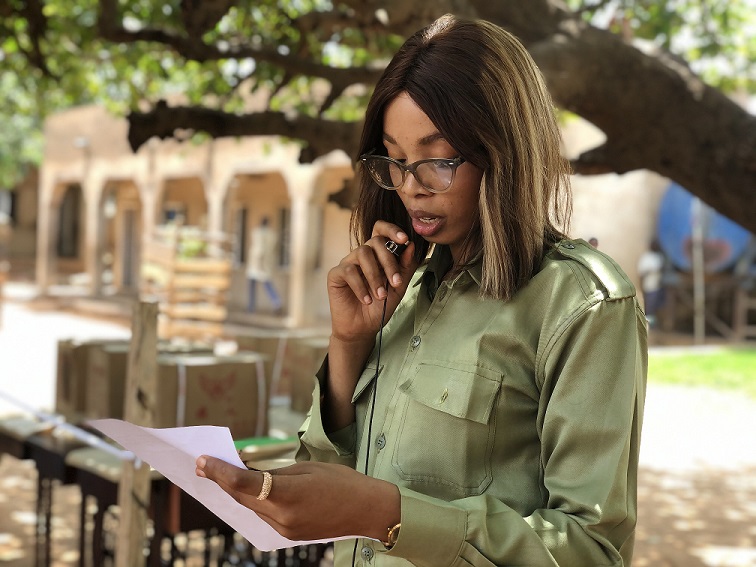
A corps member serving at Al-Furqan Learners’ Academy, Potiskum, Yobe State, has trained and empowered twenty widows on fashion design and tailoring skills in an effort to eliminate poverty and unemployment amongst women in the society.

The corps member, Chidimma Atuchukwu Obiageliaku, who hails from Anambra State, said the gesture was born out of her passion and desire to assist the vulnerable and less privileged in society.

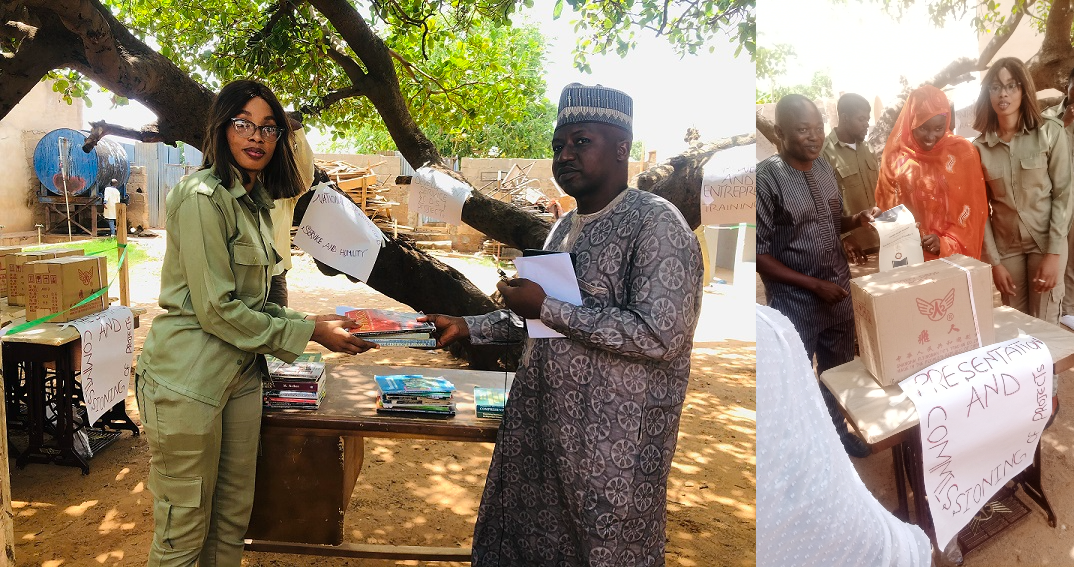
The Commissioning and Presentation Ceremony held on Thursday, 30 June 2022, at the school premises,  witnessed the presentation of certificates, wrappers, sewing materials and seven new sewing machines to the trainee widows. This came after 6 six weeks of intensive dress-making training and other entrepreneurial skills.

Other projects initiated by the Corps member included renovating and stocking a 40-seater school library to boost students’ learning capacity. She said, “whenever you read a book, it equips you with the knowledge and power to become whoever you aspire to be”, hence, donating the library to the school to equip the students to become great in the future.

In his welcome address, the School Director, Alhaji Ibrahim Mohammed, represented by Alhaji Suleiman Dauda, commended all the Corps members serving under his watch and specifically the project initiator Chidimma. He added that she was the first of her kind to execute a project of this considerable repute.

The state Coordinator of NYSC Yobe State, Hajiya Hafsat Yerima, represented by the Head of Community Development Service, CDS, Mr Abimbola Akin, expressed her satisfaction with the project carried out by the Corps member and hinted that the state would never forget her in a hurry while urging other Corp members to emulate her good gesture.

In his contribution, the Provost, Federal College of Education (Technical), Potiskum, represented by the Head of Digital and Visual Library of the College, Mallam Abubakar Hassan, explained that education is the bedrock of every meaningful society which deserves the contribution of all stakeholders.

Hassan, on behalf of FCE (T), Potiskum donated a reasonable number of textbooks to the school as part of their contribution to the project.

The benefiting widows, who were highly pleased, thanked the Corps member for the humanitarian support. The leader of the widows, Mrs Ladi, said the training is a lifetime investment that has transformed their lives beyond imagination. She prayed to Almighty God to grant their benefactor success in her future endeavours.

Other attendees included the Commissioner, Basic and Secondary Education, Yobe State, Dr Muhammad Sani Idris, representative of the Emir of Fika, His Royal Highness (Dr.) Muhammadu Idrissa Ibn Abbali, Humanitarian organisations, parents and students.

In his closing remarks, the School Director thanked the initiator of the projects and the sponsors and offered her automatic and pensionable employment with accommodation and other benefits after her National Service.

The Community Development Service is one of the key components of the NYSC, designed to have a beneficial influence on the lives of the host community.

2023 elections and religio-regional struggle

By Ali Tijjani Hassan

One would be amazed while looking at the similarities between the words “Religion and Region.” One will be even more amazed by how these twin factors play an unimaginable role in Nigerian politics.

Nigeria is divided into six geopolitical zones; North-central, Northwest, Northeast, Southeast, Southwest and South-South. In a nutshell, South and North. In terms of Religious diversity, we have only two major religions: Christianity and Islam. Subsequently, Christianity and Islam dominate South and North, respectively.

As the main opposition party, the People’s Democratic Party, PDP, elected Alhaji Atiku Abubakar as its flag-bearer in the forthcoming polls of 2023. On the other hand, the ruling party, the All Progressive Congress, has yet to choose their flag-bearer capable of winning the election against Atiku.

The APC has zoned their presidential quota to the South-West and Vice President to the Northeast. Their front-line aspirants (Tinubu, Osinbajo) are already from the Southwest. Alhaji Ahmad Bola Tinubu was a former governor of Lagos state. Prof. Yemi Osinbajo is currently on the echelon of his second-cum-two terms as Vice President of Nigeria.

Religion is another factor we have seen since the birth of Democracy in Nigeria in 1999. How religion plays a role in who would be President or Vice President, the candle of Muslim-Christian or Christian-Muslim tickets is still flaming. We witnessed Obasanjo/Atiku, Yar Adu’a/Jonathan, Jonathan/Namadi, and Buhari/Osinbajo.

The nightmare to the APC is how to relate their zoned system with the emergence of their candidates. Both Tinubu and Osinbajo are competent, but Tinubu, like his counterpart of PDP, is a gigantic gorilla that wouldn’t allow any candidate to win over them.

If Tinubu emerges as a flag-bearer, he has no option but to pick the former speaker of the house of representatives, Rt. Hon. Yakubu Dogara, since he is the only influential Christian of the party from the Northeast. Sequel of this, both North and South wouldn’t produce a candidate that is not condign to their religious interest.

Professor Yemi Osinbajo

Prof. Yemi Osinbajo is an influential Christian Southerner that was once seen as ready to serve in the eyes of Nigerians. Still, the disregard of the present Buhari-led administration tarnishes his striking image with red.

If Osinbajo gets the ticket, he must pick his running-mate from Northeast. Then Osinbajo’s running-mate must be an influential Muslim and northerner with integrity, accountability and competency. The qualities mentioned above would win the hearts of Northerners to revive the fallen hope that they put into the APC earlier.

It has been in the tradition of Northern politics since 2003, when president Muhammad Buhari stepped his foot into the presidential race arena. There is a constant twelve million votes that were captives in his favour. Therefore, whosoever would be Osinbajo’s running-mate must have the passkeys to open or conquer the twelve million vote bank.

Who will be Osinbajo’s running-mate?

Here in the Northeast, we have only two politically influential actors capable of running with Osinbajo and likely to conquer: The first is Prof. Babagana Umara Zulum, the governor of Borno State.

Prof. Zulum was a legend of fortune. Although he became the governor of Borno when the state was in the sorrow of insurgency, his braveness, doggedness, and justice with fairness made him the messiah of the Borno people then. That fortunate promotion paved Zulum’s way to be loved by many Nigerians.

The second influential Muslim northeasterner that could win the hearts of northerners and retain or succeed the Buhari’s twelve million votes is the minister of communication and digital economy, Prof. Isa Ali Ibrahim Pantami. Due to his Islamic religious sacerdotalism, the Sunnis sect fanatic would vote for him. Mainly, northern Muslims are Sunni. Therefore, a Pastor/Sheikh ticket is also possible.

Ipso-facto, we should say that the upcoming 2023 will be a “religion and region” war.

Ali Tijjani Hassan writes from Potiskum, Yobe state.

Northern APC governors support power shift to Southern Nigeria

By Ahmad Deedat Zakari

Northern governors of the All Progressives Congress, APC, have backed the transfer of power to Southern Nigeria.

The governors made this known in Abuja on Saturday, June 4, 2022, after a meeting.

The eleven governors who voted in favour of the decision include: Aminu Bello Masari of Katsina, Abubakar Sani Bello of Niger, Abdullahi A. Sule of Nasarawa, Prof B.G Umara Zulum of Borno, Mal. Nasir Elrufai of Kaduna, Muhammad Inuwa Yahya of Gombe, Bello B. Matawalle of Zamfara State, Simon Bako Lalong of Plateau, Dr A.U Ganduje of Kano, Senator Abubakar Atiku Baguda of Kebi State and the former Sokoto State Governor, Senator Aliyu Wammako.

The governors believed the decision was taken in the best interest of the country.

“APC governors and political leaders from the northern states of Nigeria today met to review the political situation and to further support our party in providing progressive leadership amidst our national challenges.

“During our discussions, we welcomed President Muhammadu Buhari’s invitation to governors and other stakeholders to contribute to the emergence of a strong presidential candidate for the APC.

“After careful deliberation, we wish to state our firm conviction that after eight years in office of President Muhammadu Buhari, the presidential candidate of the APC for the 2023 elections should be one of our teeming members from the southern states of Nigeria.

“It is a question of honour for the APC, an obligation that is not in anyway affected by the decisions taken by another political party. We affirm that upholding this principle is in the best interest of building a stronger, more united and more progressive country,” the communique reads in part.

They also urged presidential aspirants from North to withdraw from the race on the ruling party’s platform. Consequent of their decision, Jigawa State Governor, Abubakar Badaru has withdrawn from the race.

2023: Who is pushing for Jonathan’s presidency?

By Ibrahim Mustapha Pambegua

After an initial denial of rumours that he would join the ruling party, the former Nigerian president, Goodluck Jonathan, has finally ditched his party. However, after long speculations, his defection to APC has continued to elicit mixed reactions in the country.

Before his defection, many signals emerged that the former president had stopped attending activities organised by his former party. The Bayelsa state’s gubernatorial election conducted in 2020, whose former party lost to APC before a court ruled in its favour, suggested Jonathan’s indifference to PDP affairs. Does Jonathan’s defection have to do with how the party treats him during and after the 2015 general elections?

While the former president might have lost the 2015 election due to the zoning arrangements of PDP, which he disregarded and refused to abide by, the betrayal and backstabbing that ensued among trusted party loyalists led to his resounding defeat remains fresh in his mind.

The emergence of a new PDP split group led by Atiku Abubakar, Bukola Saraki, Aminu Waziri Tambuwal and other heavy party juggernauts who abandoned him at the tail end of the party’s convention had wreaked great havoc on his re-election bid. With these politicians who deserted him returning to PDP, Jonathan would not feel comfortable staying with them.

As a former president, Jonathan should be the party’s leader. However, Nelson Wike, Rivers State governor, has hijacked the party and has since been calling the shot. Wike and his surrogates have firmly controlled the party and failed to consult or engage the former president on the party’s decisions.

The inability of PDP to respect or recognise Jonathan as their leader must have dampened his morale and forced him to change his mind. One imagined how the former president, who was a governor, a vice president and president under PDP, could suddenly ditch his benefactor.

The former APC national chairman, extraordinary convention committee, Mai-Mala Buni, must take credit for Jonathan’s defection. The Yobe state governor, during his stint as chairman, visited and subsequently wooed him to APC. Do Malam Buni and his co-travellers sign a pact that they would throw their weight behind his presidential ambition if he joins the party? Jonathan did not only join the ruling party but also bought nomination form through the northern youth group.

Goodluck Jonathan’s presidential ambition has raised some critical questions. First, is the ruling party toeing the dangerous path of PDP by jettisoning its zoning arrangement? With Buhari completing his tenure, one will advise for equity and justice. There is a need for power to be shifted to the South.

Also, during its recent convention, APC opted for Abdullahi Adamu, a northerner, as the National chairman. This development has further buttressed that the South will produce the next president. Moreover, with Jonathan joining the presidential race, what will be the future of southwest politicians, especially Bola Ahmed Tinubu, who sees his contest as a lifetime ambition. It is no understatement to say that President Muhammadu Buhari’s victories in 2015 and 2019 are to the credit of Tinubu and other southwest politicians.

If APC fields Jonathan, the southwest politicians will unite and reject the party. To them, having played second fiddle in the previous elections, the 2023 ticket should be exclusively reserved for them. But, on the other hand, if the ticket is not given to them, there is every tendency of anti-party, as these politicians will ally with either PDP or Kwankwaso’s NNPP to ensure APC loses the election in the region.

Second, who and who are dragging or promoting Jonathan’s presidency and their motives? It was reported that Jonathan’s presidency had two northern governors’ tacit support. One from the northwest and the other one from the northeast. If their plan works as scheduled, Jonathan promised to pick one of them as running mate.

The legal technicalities that may await the former president will unarguably discourage APC from giving him its ticket. Jonathan took an oath of office twice.  If he is allowed to contest and luckily wins the poll, Jonathan will take his third oath of office, which is unconstitutional. This will open up serious court litigations.

What will happen if the opposition PDP finally settles for Atiku Abubakar as their candidate? Will APC stick to Jonathan’s presidency? The former president had received accolades globally for conducting a free and fair election in 2015. Jonathan was the first African president who conceded defeat and called and congratulated the winner even before the result was announced.

Since he left office, his diplomacy performances have endeared him to many Nigerians. However, the former president should have kept a low profile, continued his diplomacy engagement, and advised the country where necessary. With the former president throwing his hat in the ring, what will be his fate during and after the 2023 general elections?

Ibrahim Mustapha Pambegua wrote from Kaduna state via imustapha650@gmail.com.

The political calculations of 2023

By Muhammad Sagir Bauchi

As the political atmosphere in the country started to get momentum, top political actors are back on the strategy board to put down action and execution plans for successful campaigns and elections victory. Overnight, some controversial politicians are now running away from their once arrogant and nonchalant attitudes to a born-again one, thereby looking away from whatever may dent their newly ‘customised integrity’. As a result, the usual campaign promises of provision of security, creating job opportunities, fighting against corruption, etc., now appears unsaleable talking points to the electorates as they once were.

News of the inter-party crossover from some prominent politicians like former Speaker Hon. Yakubu Dogara (PDP-APC), Matawalle of Zamfara (PDP-APC), Kwankwaso (PDP-NNPP), etc., are making headlines.

Hon. Yakubu Dogara is one of the major political figures in Bauchi State politics. His role in ousting the previous governor of the state would never be neglected or underestimated. He played a vital role in his constituency and other spheres of the system.

When he decamped from PDP, the party that brought the present administration of Governor Bala Muhammad, several opinions were expressed in respect to that. To some, he joined the ruling party in anticipation of giving him the party leadership (i.e National Chairman of the party). While, to others, he was craving for the seat of Vice-President, in case the party ticket is won by a Southern Muslim. In present Nigeria, a Muslim-Muslim or Christian-Christian ticket at the presidential ticket is a non-starter, as it will polarise the country, create chaos and mistrust.

Of the two opinions surrounding the decamping of Dogara, none could totally be disregarded as they contain some elements of truth. For instance, If APC assigns Bola Ahmed Tinubu as its flag bearer, the party must pick a Northern Christian politician with popularity, high political experienced and wide acceptance among the regional religious, political and traditional leaders/institutions. The aim is to convince the electorates to go out and vote for the party on the election day. Dogara is one of those Northern Christians with broad appeal and political experience. But, can he win the confidence of his Northern block to vote for their ticket?

For that answer, we have to examine the current political doings and his image in his home state, Bauchi, to answer that question.

The present political situation in the state is a bit complicated. We all witnessed how his doings in his constituency influenced the emergence of the current governor of the state during the last gubernatorial elections. Still, events have overtaken the once-political comrades’ romance between him and the governor. His popularity has significantly dropped in 2/3 of the constituency he’s representing. And that could affect his future career in the state and beyond. Therefore, the Dogara factor alone cannot influence Northerners to vote for his party.

Now, away from Dogara to the party at large. Months ago, APC Governor’s Forum paid an unexpected visit to the former President, Dr Goodluck Ebele Jonathan. Of course, we did not know what was discussed during the visit. Still, looking at how the party is desperate to retain the president’s seat, it’ll be hard to disconnect it from what the Hausa people termed as “gaisuwa da ro’kon iri”. So they visited him, likely to ask for his blessing, sympathy and support to use his influence in the South-South to canvass support for their party flag bearer during elections. Or maybe, to lure him into accepting to contest for the presidency on the party ticket. 

If we take the party entirely and put it on a scale, we can see that the party is in a dilemma of who to be entrusted with the party ticket to retain the presidential seat. But looking at how the party zoned the national party executives, now it is clear that the flag of the party would come from the South.

Among the top Southern candidates that expressed interest in the presidency are Vice President Yemi Osibanjo and the party leader, Bola Tinubu. One of these two have every chance to win the party primaries. But, who among them can be an easy sale to all the regions of the country? Would the old rivalry between Igbos and Yorubas resurrect and allow Igbos to support anyone of them? Only time would tell.

But in the North, despite the significant drop in trust and popularity of President Muhammadu Buhari, there still exist those supporters that will go for whoever PMB anointed to succeed him at the polls. But many will be in a dilemma of choosing between one of their own, an outsider or may even decide not to vote.

After the country’s return to Democratic rule, PMB was among those with a desperate ambition to rule the country again. He contested three times but lost at general elections. Fortunately for him, he won at his fourth outing. Unfortunately, during his failed bids, his body language was that he only relied on the votes of his fellow Northerners.

By 2010, Buhari realised that that illusion wouldn’t give him the presidency. So, he aligned/merges his one-man party, CPC, with an umbrella forum of some rebellious and highly influential mainstream politicians from the ruling party, nPDP, ANPP and the Southwest’s AC to form the APC. This conglomeration of parties (merger) is what solely got him the presidency.

With all honesty, looking back at the significant contribution of the Southwest politicians, this is the right time for him to pay back those that helped him actualise his presidential ambition with the party ticket on a platter of gold, especially to a Southwestern candidate.

There’s not much tension within the PDP due to their discipline and expertise in handling intra-party conflict. However, the party must be careful with an emerging conflict from Wazirin Adamawa and governors’ overzealous ambitions. In addition, they must learn from their 2015 avoidable mistake that cost them the elections and government.

Sagir Ibrahim is a graduate of Economics from the Department of Economics, Bauchi State University Gadau. He can be reached via ibrahimsagir1227@gmail.com.

Unification of Nigeria: Incidental blessing

By Habib Korede

Restructuring has been a topic on Nigeria’s news headlines for decades, and as the 2023 general election approaches, ‘restructuring’ is one optics for political campaigns. However, the unification of Nigeria, which has continually stirred this debate, results from the colonials’ avarice but has fortunately been a blessing.

Before the colonials, Nigeria was home to over 300 ethnic groups, with Hausa in the North, Igbo in the South-East, and Yoruba in the South-West, as the three dominant ethnic groups. These ethnic groups operate under various separate entities such as ethno-religious, geo-regional, and political nationalities under caliphate, kingdoms, and empires,

The colonials amalgamated these entities through divide and rule policy on 1 January 1914, following Frederick Lugard’s recommendation. The colonials take full advantage of their exploration of the country by sternly concentrating power at the centre to favour their political and imperial interests instead of laying a good foundation for nation-building. This has become a puzzle for Nigeria in the post-colonial era. 

Struggles for inclusion at the centre and resource allocation have resulted in many heated controversies, distrust, compromise, and violent conflicts. These include the crisis that emanated in the 1959 and 1964 federal elections, the January and July 1966 coups, the three years civil war of 1967–1970 when the Igbo region wanted to secede into Biafra, followed by several bloody coups and counter-coups.

The unity of Nigeria has also been threatened by various ethno-religious conflicts resulting from bad governance, such as the Kaduna State Zangon-Kataf crisis in 1987, 12 June 1993, Moshood Abiola’s presidential election annulment crisis, and return to the military junta in November 1993.

The return to the democratic system of government under the leadership of Gen. Abdulsalami Abubakar, which gave birth to the presidency of Obasanjo in May 1999, led to a rapid paradigm shift in Nigerian political history.

Deterioration in the governance of the country sparked several protests. Protests like the 2012 fuel subsidy removal and the 2020 #EndSARS that resulted in the death of protesters are only a few examples.

From 1999 to date, every region of the country has shown dissatisfaction with the status quo. This dissatisfaction has led to several agitations and overheating of the country’s polity, which metamorphosed to ethno-religious and inter-communal crises, such as the year 2000 Kaduna crisis, the 7–13 Sep. 2001 Jos crisis, and so on.

These crises triggered the formation of several ethno-militia groups such as the Oodua Peoples Congress, Indigenous People of Biafra, Movement for the Emancipation of the Niger Delta, Niger Delta Avengers, the Boko Haram insurgency, banditry and the coordinated Fulani/Herdsmen-Farmers conflict. These militias are agent provocateurs that simultaneously unleash terror in the country to disrupt governance, leading to several national conversations, such as restructuring, decentralisation, creation of state police, and separation. 

The rising agitation for a restructured Nigeria results from perceived marginalisation, discouraging national leadership, identity crisis, ethno-religious intolerance, the concentration of power at the centre, and lack of patriotism.

However, different scholars have interpreted the word ‘restructuring’ differently, and both the antagonists and protagonists for a restructured Nigeria dissent on its meaning. Though, I see restructuring as ‘using an efficient medium to restore a collapsing building to save everyone in the building.’  

From 1914 to 2014, eleven constitutional conferences were held to strategise the most favourable federal system and resource sharing policy to keep the regions satisfied and united. However, the 2014 national conference confirmed inequality in the demand of all the country’s parts. Each region demands a policy for their vested interest even when it disfavours the unity and progress of the country. 

The Southern region suggests the country should revert to the regionalism of the 1963 constitution. Still, this suggestion was frayed by the fear of dominance and marginalisation of the minorities from future governance of the majority in these regions. 

Besides, the founding fathers of Nigeria were more selfless and patriotic than the current group of leaders, and the country’s population is higher than it was; these will make regional governance in contemporary Nigeria impracticable. 

Decentralisation of power and the emergence of state police, as suggested by many, will aid in the production of a pool of authoritarian state governors whose misuse of power will decline the country’s democracy. But, as mentioned by the former president of Nigeria, Goodluck Jonathan, ‘the stronger the boat of (democracy), the more it is able to meet the challenges of its voyage and deliver on its promise to citizens.’

Notwithstanding, the Northern region focused on creating additional states and power rotation among the six geo-political zones. Obviously, creating more states will further deteriorate the already weak economy because of the unnecessary administration cost. 

It is noteworthy that the clamour for creating a new state is not for developmental reasons but political purposes. This will abet the emergence of unproductive parasitic state elites, lead to the agitation for creating additional states, and eventually actuate the aggressive Balkanisation of Nigeria. Like Yugoslavia, East Timor, the former Union of Soviet Socialist Republics, and South Sudan. 

The systemic restructure of Nigeria will be insurmountable. The 1999 constitution stands as a considerable constraint to the systemic and resource restructuring because of the intricate processes involved in amending the constitution. This is one of the reasons the 2014 national conference ended in a stalemate; Nigerian leaders benefit from the current state of affairs in the country. They manipulate the system for their selfish interests. These leaders capitalise on the gullibility of the average Nigerian by using ‘restructuring’ as a campaign strategy to divide Nigerians, to amass votes at the polls after every four years. 

Because Nigeria has remained an indivisible entity for over 100 years shows the unity of the country. The many challenges Nigeria is facing arises from the selfishness of the leaders and the mindset of the citizens. It is eminent that Nigerians should recognise the power in population and diversity before it is too late. Thomas Malthus explains that: ‘The power of population is indefinitely greater than the power on the Earth to produce subsistence for man’.

Nigerians yearn for a prosperous Nigeria, and Nigerians need to know that prosperity comes with unity, sacrifices, and patience. ‘The cost of disintegration (of Nigeria) is higher than the cost of being together. We have everything to gain by being united than disunited,’ as stated by the former President of Nigeria, Olusegun Obasanjo.

The perennial agitation for restructuring and separation ensues from bad governance, corruption, insecurity, nepotism, and ethnic intolerance.

Achieving two concurrent goals will solve these problems: the first will be to intensify the country’s social structure, which will aid in reconciling Nigerians and redefine the perception Nigerians perceive Nigeria. The second will be strengthening the central government by building robust institutions where no one is above the law and where meritocracy always supersedes mediocrity.

Social restructuring of Nigeria is achievable under different progressions: by prioritising civic education and history at the basic education level; refurbishment of unity primary and secondary school across the country; the national youth service corps should continue to aid the youths of the country to explore the diverse cultures and enhance pragmatic multicultural solutions to the country’s problem; there should be an effective orientation agency that will be responsible for sufficient enlightenment of the masses, particularly on peace and unity of the country; and investing in intercultural dialogue.

When there is an unarguable socially restructured Nigeria, patriotism will augment, and every other thing will fall into place.

Most of the 36 states governors are doing a lot of things wrong. Still, the centre always receives the blame because of the rising weakness in the capacity of the central government to sanction the misappropriation of resources and bad governance by the state government adequately. Building powerful autonomous institutions will strengthen the central government.

Powerful institutions will enhance check and balance in the activities of the other arm of the government, which will help filter the best candidate for the leadership position in the public sector, and will unquestionably prosecute the guilty ones.

Powerful institutions will promote democracy and credible leaders. In the words of Chinua Achebe, ‘Nigeria is what it is because its leaders are not what they should be.’

Nigeria, a country with the fastest growing economy in Africa, the highest GDP on the continent, and the sixth most populous country globally, has all the potential required to become the world superpower. Good governance will enhance an excellent economy, peace, stability, and prosperity.

According to Ibrahim Index of African Governance, good governance is ‘the provision of the political, social and economic goods that any citizen has the right to expect from his or her state, and that any state has the responsibility to deliver to its citizens’.

Therefore, when the citizens are getting all the social and economic values they are expecting from the government, no region will have the urge to clamour for restructuring or separation of the country. However, there cannot be good governance when there is no equity, equality, transparency, inclusiveness, accountability, justice and responsiveness in the country’s activities

Habib Korede is a BEng (Hons) Civil Engineering graduate and a writer. He authored Propelling Success, and The Kalahari Review has featured his work. He can be reached via habibkorede247@gmail.com.
Don’t stereotype people for their kinsmen’s ‘fault’

By Muhammad Isyaku Malumfashi 

People nowadays cease to understand that everything in this life is ‘do me, I do you’. Nonetheless, very few people have the discretion of paying good for the bad input. 

On several occasions, I have heard people complaining about why others don’t treat them as they had treated them or relate with them politely. But, unfortunately, even my humble self is not an escaped or sacred being to that temptation, to be honest. 

People want to be treated more kindly than they treat others. But we often forget that life is “reciprocal”. We don’t get in return more than what we do give. However, the clean-minded people would always do good even if otherwise was done to them and vice-versa. 

I recently witnessed fascinating neighbourly scenarios, which will be the foundation of this piece.

An elder brother from a distancing place narrated a heart-touching story between him and the community members in one of the states in the West. He lived there for a while as a civil servant. He left on transfer to another workplace.

That brother is a northerner who was lucky to have come from parents who nurtured good parental upbringing to their children so that they could live with others even when the parents are no more, and the children might still be young. 

His transfer announcement threw the entire mosque to sombre as if life was about to be lost. Now, come to think of it. This man was transferred from North to West for public service. Still, he understands that despite the seeming differences in culture and religion to some extent. We’re all humans and citizens of this beloved country, so we can still live in peace and harmony. And that was the secret behind his love by those people.

Similarly, a female Christian neighbour in our school’s postgraduate hostel was robbed on her way back home to  South-South from school for Christmas and New Year season. The news shocked us. We were all disturbed for not reaching out to her to sympathize because the phones were confiscated during the robbery, plus other valuables.

As a mature woman, she always takes precautions while interacting with us to maintain the opposite sex. You know North is very sensitive about religion. However, her friendly attitude made us so open to her. We once had a total blackout at the hostel for three weeks due to the theft of some expensive fuse from the transformer. This woman collected our laptops and phones down to the school’s clinic to charge. She still did that though their law didn’t allow anybody outside the clinic to charge there. Then, sometimes unknown to us, she would cook and take it to our rooms and plead with us to bless the food. 

Another case study was a female Christian corp member serving in our school. The corp member hails from West, but she’s that kind of person one could describe as snobbish. She stays in the PG hostel with us too, but you hardly see her talking or greeting people. Her case was not a familiarity issue as many females in the hostels socialize far better than many males.

Her fate came during Christmas and New Year seasons. I’m a living witness because I didn’t travel earlier for that break until I submitted my chapter three to my supervisor. One day, when coming from the town, I overheard her complaining to someone on the phone that she’s tired of this Katsina, adding that the people are not as hospitable and accommodating as being alleged. Nobody wished her Merry Christmas except those calling on the phone from distant places. She added that some people even frowned at her when they met as if they wanted to fight her. The submission came to me as a shock!

More so, a respected former corp member and brother from North Central who served in my local government area recently unfolded his ordeal on how some of our people maltreated him during his national service. Even though he deserved to be retained but nepotism didn’t allow it. 

Furthermore, I witness many such scenarios where in one way or the other, someone falls victim to “not being our tribe person or just for me been a Muslim and Hausa in the South”, but I never used that to stereotype the southerners. Because if some hurt me, I was accommodated and loved by others of the same tribe. Thus, every society has the good, the bad, and the ugly. 

May we be the reason why others will anticipate our race.

Muhammad Isyaku Malumfashi sent this via muhammadisyakumalumfashi@gmail.com.