Sociology

Award-winning essayist Maimuna Abubakar graduated with a first-class from ABU Zaria

By Idris Hassan

A student of Ahmadu Bello University (ABU) Zaria, Maimuna Abubakar, who beat other contestants across the world last time to emerge 3rd in an International Essay Competition organised in the United States of America, has graduated with a first-class degree in Sociology (the third person in the department’s history to graduate with a first-class), after Muminah Musa Agaka, who first broke the 38-year record. 

Maimuna Abubakar is someone I have been mentoring since my time at ABU, Zaria. She’s from Niger State and has always been eager to listen and learn. She lost her mother a few years ago, which was a difficult period for her. 

I recall the last time she asked me if there was anything she could work on, as she often does. I mentioned an essay competition in the US that I wanted her to apply for. She responded, “Sir, that’s for people like you. I don’t think I am a good fit since I know so little.” I laughed and encouraged her to submit her entry. We discussed her ideas critically, and she wrote something she sent me for proofreading. After reviewing it, she submitted her essay and won third place.

Maimuna is a writer, poet, and much more. She graduated as the best student at her level in the Department. Maimuna is also a trained teacher with over five years of experience. During school breaks, she makes dresses, loves writing, and especially enjoys reading. 

She was Amira of the Muslim Students Society of Nigeria (MSSN) ABU, Chairperson of the NSASA Academic Committee, and Secretary of the NSASA Editorial Committee in Zaria. Maimuna aspires to be a Public Health Professional or a Social Psychologist. Given her dedication and achievements, I believe the Niger State government needs to acknowledge and reward her efforts.

Applied Worldwide is a project founded by Stephanie Wilson and Luke Hanna in the United States. It believes in a dynamic sociology in which sociological knowledge is produced and applied to enact positive changes in communities worldwide. 

Applied Worldwide organises an international essay writing competition to inspire students in the field and help foster change through a sociological lens that Applied Worldwide aims to bring. You can also try your luck.

A socio-religious analysis of Davido’s protege, Logos Olori ‘Jaye Lo’ video

By Hassan Idris

Discussing trending and contentious topics has never been my preferred inclination, not because of a lack of opinions or the ability to articulate them but rather due to the potential conflicts it may engender with those who hold me in high esteem. Nonetheless, today, I shall delve into the trending and contentious subject matter that has generated a whirlwind of discourse on social media, polarising individuals along sectarian, regional, and religious lines and culminating in mutual vilification.

Specifically, I aim to scrutinise the 45-second video released by the Nigerian music sensation David Adeleke, famously known as Davido. In this video, men donned in white jalabia and caps dance boisterously in front of a mosque immediately after partaking in prayers. Adding further intrigue, Logos Olori, Davido’s protege, occupies a prominent spot atop the building’s roof.

Notably, even though the singer makes mention of the phrase ‘Alhamdulillah’ (praise be to God), the video and the accompanying song have been met with severe disapproval from many Nigerians and fans, particularly among the Muslim community, who perceive it as an affront to Islam. They vehemently demand an apology, accusing Davido of disrespecting their religious practices by intermingling sacred rituals with song and dance.

Despite the mounting pressure, Davido finally relents and takes down the video after two days of receiving criticism, opting for a predominantly silent stance and refraining from issuing formal apologies. Notably, Professor Wole Soyinka, in a surprising twist, urges Davido not to apologise for releasing the ‘Jaye Lo’ video, asserting that dancing in front of the mosque does not possess the provocative connotation purported by some.

Among the voices calling for an apology from Davido are prominent Muslim faithful such as Ahmad Ganga, Ali Nuhu, Ashraf Yaman, Ayaat Saeed, Basira Ugochi, and numerous others. Conversely, some Muslims have countered this demand, contending that the singer’s lyrics and actions did not overtly denigrate the Islamic faith. Furthermore, they argue that the video was not intended to ridicule Islam but reflected a cultural norm in Yoruba society.

Additionally, they highlight the existence of Islamic sects, such as the Tijjaniya and Shi’ite, in the northern region, who employ the Mandiri drums as part of their worship practices, thus, indicating that some Muslims themselves engage in similar expressions of religious celebration, with no objections from the community. Before delving into the sociological perspective of religion, it is imperative to recognise the profound significance of religion, particularly in Africa. For many Muslims, it is not merely the song or the jalabiya donned in the video that raises concern, but rather the potential mockery of prayer, a cornerstone of Islam, considered sacred and inviolable. It stands in stark contrast to profanity and warrants utmost respect.

Comparatively, other musicians like Naira Marley may espouse diverse perspectives, yet their words do not evoke similar anxieties. For instance, Naira Marley’s song proclaims, ‘God is the driver, while the Prophet (SAW) is the conductor,’ which, despite its unconventional nature, does not overtly trivialise prayer. Indeed, if Naira Marley had ventured into such territory, he would likely have faced a similar backlash. In response to the contention that some Islamic sects might engage in activities akin to the video’s content, it is essential to discern that while various expressions of worship exist, dancing during prayers remains absent from any Islamic sect. Moreover, the significance of the mosque, as elucidated in the Qur’an, holds paramount importance for Muslims, who regard it as the most sacred and cherished space in their lives. Thus, actions that appear to contradict the mosque’s sanctity are naturally met with vehement objection.

As for Professor Wole Soyinka’s intervention, his failure to fully grasp Nigeria’s religious and multicultural fabric, coupled with his atheistic beliefs, may have influenced his hasty entry into this contentious issue without considering the multifaceted perspectives. Thus, there seems to be an underlying layer of ethnocentrism at play, though it is crucial to clarify that this observation is not intended to belittle Soyinka in any manner.

Turning our attention to Durkheim’s Elementary Forms of Religious Life, the philosopher Charles Taylor’s elucidation of religion as a comprehensive system of beliefs and practices encompassing human existence and its relation to the ultimate conditions of being and other human beings presents a multifaceted framework for analysis.

Durkheim’s seminal work contends that religion is not confined to individual beliefs and practices but rather constitutes a sociological phenomenon that both shapes and is shaped by society. Central to his argument is the concept of ‘collective representations,’ which denotes shared symbols and ideas that foster cohesion among individuals, binding them together in a collective community. Collective effervescence, a cornerstone of religious experience according to Durkheim, entails the shared emotions and sense of unity that emerges when people unite for a common purpose, often manifested in rituals and communal activities.

Furthermore, Durkheim’s delineation of the ‘sacred’ and the ‘profane’ elucidates the fundamental distinction between holy or special elements (the sacred) and the mundane aspects of everyday life (the profane). The video in question seemingly breaches this sacred-profane dichotomy, incorporating elements considered sacred within a context that may trivialise their significance. To elucidate the connection between Durkheim’s ideas of the sacred and the profane, the concept of totemism emerges as an essential component of his thesis.

Totemism encompasses groups of individuals coalescing around a common totem, an emblematic object or animal that symbolises the collective community. The totem, imbued with sacredness, serves as a focal point in rituals and ceremonies, forging a shared sense of identity and unity within the group. By drawing this parallel, the video can be perceived as appropriating religious attire and symbols, potentially attenuating their original sacred import.

Moreover, Durkheim’s concept of ‘mana’ merits consideration of the video’s content. Mana constitutes a spiritual force or energy believed to inhabit sacred objects or spaces. Often linked to animism, the notion that objects and locations possess spirits or souls, ‘mana’ illustrates how the sacred imbue objects and places with special significance. Here, the video’s portrayal of dancing immediately after prayers may be construed as desecrating the sacredness associated with the mosque. As Durkheim transitioned his focus to modern societies, the idea of ‘mechanical solidarity’ comes into play, wherein traditional societies cohere through shared values and beliefs among relatively homogeneous groups.

Comparatively, ‘organic solidarity’ characterises contemporary societies, wherein specialised social bonds form through the division of labour, with various individuals and groups performing distinct functions. The video, juxtaposing modern entertainment (the dance) within the context of a sacred religious space, potentially mirrors the fragmentation and diminished shared values observed in present-day society, evoking notions of anomie.

As a sociologist and poet, I believe some may perceive the Muslim community’s response to Davido’s music video as an overreaction. While concerns are warranted, approaching the issue with knowledge and wisdom, as instructed in the Qur’an, would have been more constructive. Addressing Davido’s actions maturely and knowledgeably could have fostered a more amicable resolution. However, amidst the controversy surrounding the video, it is crucial not to lose sight of the pressing issues in the North, such as kidnapping, terrorism, and poverty, which demand urgent attention and resolution. Calling for uniformity in addressing these challenges alongside the concerns over the music video could have a more significant impact in addressing social issues and fostering a sense of collective responsibility.

Furthermore, it is essential for everyone, regardless of their religious background, to respect and understand the beliefs and cultures of others. Ethnocentrism and a lack of cultural relativity can perpetuate societal misunderstandings and divisions. Respect for all religions, and their sacred practices, should be upheld, emphasising the need for mutual understanding and harmony among diverse communities.

In conclusion, when scrutinising Davido’s music video from a Durkheimian sociological perspective, many potential issues concerning the sacred and the profane in religion emerge. The video’s portrayal of dance immediately after prayers and its use of religious symbols may be perceived as disrespectful and culturally insensitive by some Muslim community members. Moreover, its potential impact on social cohesion and integration in Nigeria’s diverse and multicultural society warrants introspection. Both sociologists and individuals must remain cognizant of religious sensitivities while striving for a profound understanding of different religious practices, fostering mutual respect and harmony within society.

While the controversy surrounding Davido’s music video persists, individuals and communities must engage in constructive dialogue, foster mutual respect, and address societal challenges with collective responsibility. Religion is paramount. It should be treated with reverence, regardless of the particular faith. Let us strive to uphold the principles of knowledge, wisdom, and cultural relativity in our interactions, aiming for a more cohesive and harmonious society. May we all be guided right in our actions and decisions.

Hassan Idris is a Sociologist & Poet and can be contacted via idrishassan25@yahoo.com.

The criminogenic environment

By Lawi Auwal Yusuf

The nexus between our social environment and human behaviour is relevant in explaining Nigeria’s formidable crime rates. First, it is essential to understand the significance of socialisation in behaviour development.

Human interactions on both micro and macro levels provide a flawless context for learning behaviour from others. This learning occurs through these interactions that directly shape the socialisation process through observation of one’s environment, imitation, role modelling and expectation development.

So, human behaviour reflects what is learned in daily interactions with others. This socialisation process is influenced by individuals’ intimate groups and role models who similarly clout those close to them and serve as others’ source of learning.

Thus, deviation from society’s consensual values is not considered an innate human character predetermined by biological, psychological and or other natural factors, as argued by most social learning theories. Instead, it is a product of socialisation that determines the development of human behaviour through our perpetual interactions.

Given the foregoing, criminousness is like all other human behaviour spawned by social interaction. To wit, criminalness isn’t spontaneous. Untainted persons acquire their “knowledge” from external sources as they observe the tainted ones carrying out criminal behaviours. They learn and, subsequently, effectuate them.

Parents keep an eye on those your wards reach out to and teach them to avoid the toxic ones. Perhaps more importantly, don’t let those you are cynical of be their buddies. Be their pal yourself.

Lawi Auwal Yusuf wrote from Kano and is contactable via laymaikanawa@gmail.com.

Changing the poor as a strategic paradigm against poverty

By Lawi Lawal Yusuf

The early solutions to poverty were based on the premise that poverty is an aspect of inequality and could only be solved by restructuring society. As a result, most of the policies explicitly aimed at its reduction were developed from the stratification theories. But quite the contrary, from the late 1960s, many social scientists felt that the war on poverty had failed.

Despite governments’ energy and resolve, the poor remained stubbornly poor. As a result, some sociologists of welfare increasingly predicated that poverty is merely a problem of the poor, and solutions must be crafted on the assumption that the issue of poverty lies with the poor themselves and need cultural reorientation.   

Radical sociologists object to the welfare state by taking a more radical right-wing view than the left-wing socialists and social democrats as they argue for a freer, more open and more competitive economy and minimal state intervention. They were critical of much state intervention in welfare. They saw it as having a negative impact by discouraging self-reliance, creativity and entrepreneurship and promoting the dependency culture as people rely too heavily on state hand-outs.

Also, they further argued that as social problems progressively increase, the welfare state would become more and more expensive, leading to an excessive tax burden on private enterprises which prevents reinvestment. Hence, undermining economic growth and development.

Alternatively, they provided new impetus to changing welfare along neoliberal lines by defining poverty as a way of life and therefore developed solutions from the culture of poverty theories.

These three trends – the progressive increase of state financial burden coinciding with the stupendous rising cost of welfare administration, which had not equally extrapolate poverty. The emerging dependency culture on the welfare state results in what we might call a poverty trap, where the poor feel contented with the benefits available than taking low-paid work, giving them less incentive to work, which undermines their self-supporting abilities – have led to a pro-capitalist line of critique of the welfare and an alternative policy approach.

Arising in both the academic and policy fields, this critique and alternative approach pursue more explicitly a cause that prioritises individual initiative, economic competitiveness, encouraging responsibility and rewarding effort. But indeed, not isolated from a context where social justice and general fairness are being institutionalised.

The philosophical underpinning of this perspective is that even though all members of society are entitled to a reasonable minimum living standard regardless of their ability to work, welfare involves the moral expectation that people must take responsibility for their behaviour and the jobless must look for a job tirelessly and must accept any suitable one. Furthermore, individuals must be empowered to seize control of their future by being competitive, industrious and entrepreneurial, while the state is obligated to open up equal opportunities.

In context, these ideologues see poverty as a result of cultural influences on poor’s behaviour. They can be tackled by counteracting such behavioural dysfunction by changing faulty attitudes with universal moralities such as achievement orientation.

Thus, policies designed on this strand of thinking aim to undo the presumed effect of the culture of poverty by fostering ambition, hard work, initiative and motivation. Programmes are designed explicitly to change the social, psychological and vocational shortfalls of those bred to a life of poverty and are socialised to become more responsible and to remove such presumed deficiencies and bad attitudes by instilling work habits, character building and determination.

In the same vein, policies of job creation and encouraging people back to work and other measures that make work more attractive are introduced so that idleness could be significantly reduced to cut unemployment and increase the number of people working. Similarly, persons with defects are assessed to determine whether they are fit enough to do some work and in a position to help themselves, allowing them to fend for themselves.

It is gratifying to note that under this spectrum, measures coordinated to fight poverty are not formulated to displace it from society by providing more generous universal services (such as transport and social housing) or providing the poor with sufficient income to raise them above the poverty threshold, as direct aid is the least popular approach. Such brunt of benefits only cushion the misery produced by poverty but couldn’t dissipate it altogether. Contrarily, it was hoped that changing the poor would make them upwardly mobile on the social strata. To perfect this idea, the poor need a hand-up, not a hand-out to always depend on.

They needed the support and opportunities to help themselves rather than simply count on the state. And they must be willing to take these vantages once they have the education, training and work experience, while some have to be compelled to take advantage of the opportunities. In almost all circumstances, as experience has shown, significant benefits to the poor discourage many from taking a paid job.

 Efforts are made to move away from universal benefits and services by reducing the huge government expenditure on welfare to a minimum for only those with genuine needs to avoid fraud. At the same time, resources are redirected towards training and development of the poor and other extreme societal needs. This helps the poor turn enterprising and therefore take care of themselves.

The solution to poverty rests on a broader range of coordinated measures. Therefore, it’s more efficacious to have an effective welfare state that cushions the harsher edges blunted by capitalism while rewarding individualistic efforts, encouraging responsibility and ensuring equal opportunities.

Lawi Auwal Yusuf wrote from Kano via laymaikanawa@gmail.com.

Social Control: The Nigerian police and the criminal justice system

By Hassan Idris 

As students of sociology and criminal justice, we can’t debunk the fact that social control is a compelling discussion subject in the criminal justice system.  There has not been any society that exists without a social control mechanism to oversee the behaviours of its members. The Nigerian police, my discussion subject, is regarded as the ‘gatekeeper’ of the criminal justice system because it’s the nearest social control mechanism to the people. However, social control is unarguably the most preponderant static aspect of every human society. It’s the prerequisite for maintaining decorum, orderliness, and stability, which becomes a vital thing for every human society to develop a social control mechanism, be it formal or informal, to oversee the behaviour of the members of the society and bring about development and stability.

Marshall, in 1996 defined Social control as “the process of keeping individuals in check, moderating their behaviours, and maintaining social order”. Social controls tend to encompass the strategies and mechanisms put in place to oversee the behaviours of the members of human society. Social control is the birth of human social relationships which may be informal (comprising written norms, values, or customs) or formal (typically practised by the personnel of constitutionally acknowledged agencies. But we cannot discredit that formal and informal social control mechanisms are derived from the habituation and rationalization that arises from repeated interaction. 

Okoye, in 2011 posited that the word” Police” comes from the Latin word politic, which means” civil administration”.  However, the first Professor of Criminology in Nigeria from the Prestigious Ahmadu Bello University, Zaria-Nigeria, Professor Odekunle, in 2010,  defined the police as “the government officials most proximate to crime, temporally and procedurally, and the leading figures in crime prevention, control and law enforcement processes”. The fundamental objectives of policing in society are to provide security, or at least a social and psychological feeling of security, for a majority of citizens, in a majority of places, and for most of the time. The police, the “gatekeeper” of the criminal justice system in all contemporary societies, is the most apparent agent of formal social control. This is why Bittner, in 1990, asserted that “social control and reactions to deviance are intimately bound up with the functions of the police because they all address the central problem posed by events or behaviour which ought not to be happening”. 

However, the fact remains that the police assist other social control agencies through many of their actions. The paramount role the police play in ensuring societal laws, norms and values are kept and regulated made it one of the cogent institutions of the criminal justice system. Most Nigerians would not refute that the police institution is the nearest institution with regular contact with the people, making it distinctive amongst other criminal justice institutions. The uniqueness of the police clenches the evidence that its decision and action on the street or in society is vital to the existence of the criminal justice system. The police are the “gatekeeper” of the criminal justice system, and it decides who moves into the system and who comes out. Therefore, every action or activity carried out by the police have myriad and huge implications for the criminal justice system and other institutions.

Furthermore, to understand the contemporary Nigerian police and the anti-people administration they portend, it’s paramount to trace back to the history of policing and the colonial policies that influenced the current bureaucratic policing we have today. The history of policing predates the modification of the police as a permanent occupational group within bureaucratic institutions providing the primary state response to crime and disorder.  In the past, before the emergence of the contemporary police we have today, it was traditionally the duty of all adults in the community, especially male adults, to prevent, control, and guide people from internal and external inversion and aversion. However, the emergence of the state with its wide bureaucracies brought about centralization, hierarchical authority, power structure and professionalism and the traditional strategies of policing were transformed from everyone’s business to the state business.

The historical emergence of the conventional police over the globe occurred independently; nevertheless, the historical emergence of policing in Nigeria is categorized into three. The first category is the pre-colonial category which policing then includes the use of cults, messengers, secret societies and palace guards. Crime surveillance and curtailing then in Nigeria were executed by indigenous institutions which are regionally based.  The Northern and Southern Districts of the country’s system of policing were established on centralization and formalization. In the Northern parts of Nigeria, monopolized by the Hausa-speaking ethnic group, the Dogarai was employed as the bodyguards of the Sark( Emir or King). They refine full-time policing in the community. Under the leadership of the Dogarai, the Sarkin Dogarai was charged with capturing and disciplining offenders and protecting the town from internal and external invasions. Similarly, in the Yoruba-speaking ethnic group of Western Nigeria, the Ilari, Emese, or even the Aguven was responsible for apprehending or arresting criminals.

In the secondary category, which is the colonial period, the system and principles of policing changed and became anti-people. The vitality of establishing the formal police by the colonial masters was essentially to serve and protect their commercial interests and not the people. It’s a reason we have brutal and anti-people policing in Nigeria today. I’ll justify that in the next paragraph when I’m discussing the post-colonial category of policing. The third category, which is the post-colonial category, the leftover system in the pre-colonial category, which is anti-people policing, was still carried to this period, even when the colonial masters left, and this is evidence of why the style of law enforcement used by the Nigerian police today is not for the masses. 

The Nigerian police, without a doubt, have lost confidence in the hearts of the people, and there have been accused of unnecessary arrest and even breach of law. But we can’t deny that the Nigerian police from inception was built upon the wrong foundation because the British established a predatory police administration for Nigeria for the fundamental purpose and strategy of sustaining, promoting, and ensuring the socio-economic and political orientations and occupations of the colonial masters. 

In conclusion, the current pervasive feelings of insecurity and the near-total breakdown of law and order as a result of the upsurge in different criminal activities, like terrorism, kidnapping, armed robbery, political assassinations, and ritual killings, in Nigeria is an indictment of the failure of the Nigeria police force as the most visible agent of formal social control and the gatekeeper of the criminal justice system in the country. However, despite these shortcomings, the Nigerian police force remains a vital pillar through which conformity and maintenance of order are installed.

Hassan Idris is a sociologist and poet and sent this article via idrishassan035@gmail.com.

The sociology of Eid festivals in Nigeria 

By Hassan Idris

It’s quite important to demystify the fact that in the festivity of the Eid festival, which is a religious celebration amongst Muslims all over the world, there is quite a lot of sociologically significant display, which demands sociological explanations and outlooks. Religious festivals such as Eid hold greater importance to sociologists like Emile Durkheim (1858-1917). He developed a widely used theory for explaining what holds society and social groups together through his study of religion. He identified core aspects of religious structure and participation that sociologists today apply to the study of society in its entirety.

This includes the role of religious festivals and rituals in bringing about social cohesion, social solidarity and people together around shared practices and values. It also comprises ways that participation in religious festivals and rituals reaffirms shared values and thus reaffirms and strengthens the social bonds between people and the experience of “collective effervescence,” in which people tend to share in feelings of excitement and are unified in the experience of participating in religious festivals and rituals together. The Eid festival, an Islamic holiday celebrated by many Muslims as a religious holiday with religious rituals, values, and relationships, is one of them.

Thus, Durkheim defined religion as a“unified system of beliefs and practices relative to sacred things. Sacred to him meant extraordinary—something that inspired wonder and that seemed connected to the concept of “the divine.” He argued that“religion happens” in society when there is a separation between the profane (ordinary life) and the sacred. A rock, for example, isn’t sacred or profane as it exists. But if someone makes it into a headstone, or another person uses it for landscaping, it takes on different meanings—one sacred, one profane. Durkheim, who’s generally considered the first sociologist to have analyzed religion regarding its societal impact, believed that religion is about community. It binds people together (social cohesion), promotes behaviour consistency (social control), and offers strength during life’s transitions and tragedies (meaning and purpose).

With the applicability of the methodology of natural science to the study of society, Durkheim held that the source of religion and morality is the collective mindset of society and that the cohesive bonds of social order result from common values in a society. He contended that these values need to be maintained to maintain social stability, to which explanations of Durkheim on the importance and functionality of religion would be used to explain and understand the religious Eid festivals celebrated by all the Muslims in the world.

However, the word “Eid” means festival or feast. Therefore, it depicts the event that is being celebrated. Muslims celebrate two types of Eid yearly following two significant acts of worship. The first is called “Eid Al-Fitr”, which means “the fast-breaking Festival” celebrated after fasting the entire month of Ramadan. The second, known as “Eid-ul-Adha,” meaning “the festival of sacrifice which is celebrated immediately upon the completion of Hajj, the annual pilgrimage to Mecca. The Eid Al-Adha entails going for a pilgrimage to Mecca performed by millions of Muslims simultaneously once a year. Through Eid Al-Adha, the sacrifice Abraham was willing to make to God and the mercy God had upon him becomes celebrated and manifested.

Muslims celebrate the day by sacrificing a sheep or so and sharing it not just with family and friends but also with the less privileged. This celebration lasts four days, beginning the day after the completion of Hajj. The celebration of Eid Al-Fitr lasts one day, starting with the sighting of the new moon, which marks the end of the Islamic month of Ramadan and the beginning of the following month. During Ramadan, Muslims fast to purify themselves and get closer to God. Ramadan is like a retreat, a time to step aside worldly worries, focus on spirituality, and improve connections with the one who gave them life and blessings.

After going through a long spiritual retreat for a maximum of 29 to 30 days, it is only logical that a feast is held to mark the end of the month. This is what Eid Al-Fitr is all about. Like Ramadan, Eid Al-Fitr begins with the first sighting of the new moon, so most of the time, Muslims have to wait until the night before Eid to verify its date. If the new moon is not visible, the month lasts 30 days. The date changes annually on the Gregorian calendar and varies from country to country, depending on geographical location.

Though, in declaring the start of Eid, Muslim-majority countries depend on the testimonies of local moon sighters. The Judicial High Court then decides if Eid has arrived. When the sighting has been verified, Eid is declared on television, radio stations and mosques. The celebration of Eid Al-Fitr lasts one day, starting with the sighting of the new moon, which marks the end of the Islamic month of Ramadan and the beginning of the following month.

The first Eid Al-Fitr was celebrated in 624 CE by the Prophet Muhammad (PBUH) and his companions after their victory in the battle of Badar, a turning point in the prophets’ struggle with his opponents among the Quraish in Mecca during the early days of Islam. Inasmuch as all Muslims celebrate the festival, there are many doctrines and ways of celebrating it which are sociological and are of paramount interest and importance to sociologists and Anthropologists. However, the traditions of Eid Al-Fitr entail ‘Sawm’ ( fast), which is the practice of fasting during the holy month of Ramadan and is one of the five pillars of Islam.

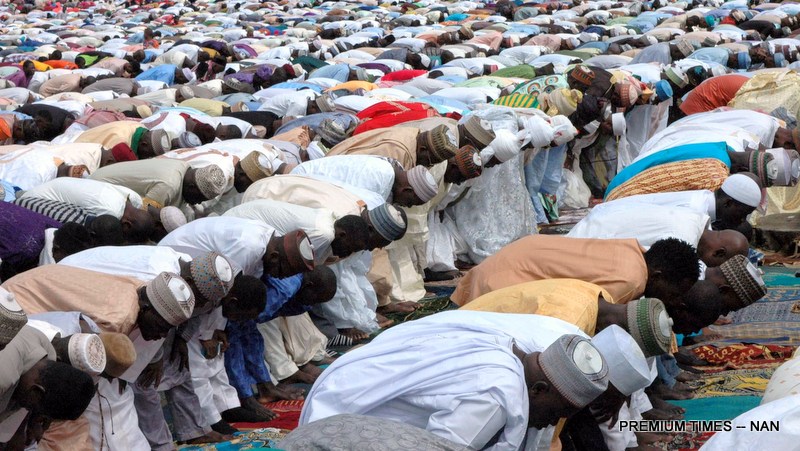
Muslims believe that during Ramadan, the Qur’an text was revealed to the Prophet Muhammad (S.A.W). Muslims celebrate Eid Al-Fitr with “Salat Al Eid” (Eid prayers). There is no audible call to prayer for the Eid prayers. Muslims will gather in mosques or open spaces and offer two units of prayer–called “Rakat”. The prayers are followed by a sermon, in which the Imam asks for forgiveness, mercy, and peace for every being worldwide.

To further bolster the sociological social solidarity and love in Islam, which clarifies Durkheim’s postulation, the other key element of the Eid festival is giving money to the poor alias ‘Zakat al-Fitr’, sending Eid greetings and feasting with families. For many Muslims, Eid al-Fitr is a festival to show gratitude to Allah for the help and strength he gave them throughout the month of Ramadan to help them practice self-control. The phrase commonly used by Muslims as a greeting on this day is “Eid Mubarak”, which is Arabic for ‘blessed festival’.

Muslims begin Eid with the observance of the Eid congregational prayer, sometimes in the mosque but usually in an outdoor location. Before going for the Eid prayer, it’s encouraged to take a bath, wear the most befitting clothes, and look dignified for the celebration. On the way to the Eid Prayer, Muslims recite the words: Allah is great, Allah is great, Allah is great. There is no other God but Allah. Allah is great; Allah is great. To him belongs all praise. And after the Eid prayer, people gather to feast with their families and friends, where they get to savour the taste of various dishes.

Some even travel to their hometowns or home countries to celebrate with their extended families and rekindle the bond of kinship. There is a rich tradition of gift exchange during Eid. For example, it is customary to gift new clothes and shoes to children in Nigeria. Sometimes, the children receive money to buy sweets and snacks to enjoy with their friends and cousins. In western countries, however, children receive gifts instead of cash, and parents decorate their homes to create a mood of excitement for the family.

Finally, Eid is meant to celebrate the completion of spiritual duty and a time to bond and exchange hugs, kisses, and laughter with family, friends and the community. Each country has traditional foods, and sweets prepared ahead of Eid or on the morning of the first day. These foods range from special biscuits and bread to cakes and puddings. On the first day of Eid al-Fitr, voluntary fasting is not allowed as Muslims are encouraged to feast and celebrate the completion of a month of worship and abstinence from food.

Greetings for Eid also vary depending on the country and language. For instance, in Indonesia, Eid is called Lebaran, so Indonesians would say, “Selamat Lebaran”, which means Happy Eid. Other variations of Happy Eid are “Barka da Sallah” in Hausa, a Nigerian language. In addendum, with clothes being an essential marker of Eid, some people wear traditional clothes from their culture, while others pick out something new to wear. Eid is a time for every Muslim to share and express love, peace, and friendship worldwide and extend hands to their non-Muslim neighbours and friends during this festival.

Hassan Idris wrote from Kogi State via idrishassan035@gmail.com.