The passing of Sheikh Dahiru Usman Bauchi shook the nation in a way words can barely hold. Bauchi witnessed a scene history will struggle to forget, millions gathered, from ordinary citizens to scholars, traditional rulers, state governors, former Vice President Atiku Abubakar, and even the Vice President of the Federal Republic of Nigeria, Kashim Shettima, leading the State’s delegation. It wasn’t a crowd built by influence. It wasn’t politics. It wasn’t power.
It was a divine honour given only by Allah to His chosen servants.
One elderly man at the funeral said, “What I saw today with my eyes… if Allah does not honour you, you cannot receive the kind of favour Maulana Sheikh received. This matter is beyond politics or chieftaincy. It is purely from Allah.” And truly, the atmosphere testified to that.
For decades, Sheikh Dahiru Bauchi stood as a bridge between generations. The number of people who embraced Islam through him is known only to Allah. The number of students who memorised the Qur’an under his guidance defies calculation. This, more than titles, wealth or recognition, is the legacy of a life well spent.
Yes, we feel the sting of his departure. But even in our grief, gratitude rises. Alhamdulillah for a man whose end came with honour, whose journey was marked by service, and whose impact will continue to shape hearts long after today.
He lived well. He left well.
May Allah widen his resting place.
May his light continue to guide those he left behind.
And may we live in ways that make our own children proud
Millions were proud to call him their teacher, leader and father.
Usman Muhammad Salihu writes from Jos, Nigeria, via muhammadu5363@gmail.com.
In the long and complex story of Islam in Nigeria, the tension between Salafi reformists and Sufi traditionalists has never been merely a clash of doctrines. It is, more often than we care to admit, a clash of tempers—of the tone one uses, the suspicion one bears, and the verdict one passes on those who practice religion a bit differently. What should have remained a quiet intellectual disagreement has, over time, metamorphosed into an extremism that thrives not on knowledge but on rhetoric.
When Dr Idris Abdulaziz Dutsen Tanshi passed on, the reaction from certain Salafi circles betrayed this peculiar tendency. His admirers saw his death as the painful exit of a righteous man who had lived his life fighting against innovation in religion and straightening the Umma along the path of Tawhid. On the other side, some Sufi-leaning critics responded not with mercy but with long-stored resentment—reminding the public of his “harshness,” his “excessive criticisms,” and his uncompromising, even combative sermons. The atmosphere felt less like the departure of a scholar and more like the settling of old, bitter scores.
And when Shaikh Dahiru Bauchi passed a few days ago, the pattern repeated itself, but this time in reverse. Sufi adherents elevated him beyond scholarship—into sainthood, into miracle, into myth. The outpouring was understandable, but in some corners it crossed into something else: a triumphalism that painted all those who disagreed with his spiritual path as misguided, cold, or spiritually weak. Some Salafi commentators, instead of exercising solemnity, used the moment to revisit old doctrinal disputes—reminding audiences of “bid’ah,” “ghuluw,” and “un-Islamic practices.” Even in death, the walls between both camps seemed eager to echo old hostilities.
What is common to both episodes is that the extremists on either side were saying the same thing without even realising it: that Allah’s mercy is exclusive to their camp; that the Ummah is too big to be shared, but too small to contain disagreement. And this, in its essence, is the extremism of our time—not the extremism of bombs and guns, but the extremism of the tongue.
The Salafi hardliner tends to imagine himself as the last defender of pristine Islam, wielding a vocabulary of denunciation: shirk, bid’ah, dalala, and ghaflah ad infinitum. Every disagreement becomes a deviation, every deviation a threat, and every Sufi becomes a suspect. Meanwhile, the Sufi extremist believes himself to be the custodian of spiritual truth, seeing the Salafi as spiritually blind, stone-hearted literalist, deprived of the inner sweetness of faith and to stretch it even further, an enemy of the beloved prophet SAW himself. Each side constructs a convenient caricature of the other —and then fights that caricature as if it were real.
The danger, however, is that rhetorical extremism does not remain rhetorical over the long run. It shapes communities. It hardens hearts. It turns mosques into enclaves, scholars into partisans and differences into hostilities. What begins as doctrinal rigidity becomes social fragmentation. And what should have been an Ummah becomes a map of feuding camps.
Yet, there is something instructive about how both Dr Idris Abdulaziz and Shaikh Dahiru Bauchi were remembered by their true students—not those who fight for them online, but those who actually sat with them. I mean, their real students, across divides, spoke about their scholarship, humility, discipline, and service. They remembered their knowledge—not their polemics. They recalled their character—not their controversies. This is a reminder that the extremists on both sides, loud as they are, do not represent the whole story.
Nigeria’s Muslim community must now decide what it wishes to inherit from its scholars: the softness of their manners or the sharpness of their debates; their mercy or their anger; their wisdom or their polemics.
To insist that disagreement must lead to division is itself an extremist position. To insist that every scholar must resemble one’s preferred tradition is another. And to pretend that Islam is too fragile to survive multiple approaches is perhaps the greatest of all.
In the end, the Ummah does not collapse because its members disagree. It collapses when disagreement becomes hatred, and hatred finds a pulpit.
May Nigeria’s Muslims learn to argue with knowledge, to differ with dignity, and to remember that Allah, in His infinite mercy, did not create only one path to Him—and certainly not only one temperament.
President Bola Tinubu has expressed profound sadness over the death of the revered Islamic leader, Sheikh Dahiru Usman Bauchi, who passed away on Thursday at the age of 101.
In a statement released on Thursday, the President described the late leader of the Tijjaniyya Muslim Brotherhood as a “moral compass” who dedicated his life to teaching and preaching.
President Tinubu stated that Sheikh Bauchi’s loss is monumental not only to his family and followers but also to the entire nation. He recalled the blessings and moral support he received from the cleric during the 2023 presidential election campaign.
“Sheikh Dahiru Bauchi was a teacher, a father and a voice of moderation and reason. As both a preacher and a notable exegete of the Holy Quran, he was an advocate of peace and piety. His death has created a huge void,” the President was quoted as saying.
The President extended his condolences to the Sheikh’s multitude of followers across Nigeria and beyond, urging them to immortalise the late cleric by holding on to his teachings of peaceful coexistence, strengthening their relationship with God, and being kind to humanity.
Al-Azhar was commissioned on the 9th of Ramadan 361H/ 972AD by the Fatimids in Cairo, Egypt. The name is derived from the holy Prophet’s (PBUH) daughter’s name, Fatimah al-Zahrā alayha al-Salam. The institution is one of the most prominent centers of Sunni Islam in the Muslim world. It serves as both a mosque and a university, and it is recognized as the world’s first university operating initially inside the grand mosque of al-Azhar.
The institution is a beacon of our enduring legacy and tradition, showcasing our continuous connection and shared heritage. Its services extend not only to educational, spiritual, and theosophical but also humanitarian services to mankind around the globe. It is followed by Zaytuna in Tunisia and Qarawiyin in Morocco.
As we celebrate the 1085th anniversary of Al-Azhar’s establishment, this article recognizes the significant contributions of Nigerians in the past and Al-Azhar’s contributions to our educational system in contemporary northern Nigeria. Finally, it highlights Al-Azhar alumni who have been instrumental in providing valuable services and whose excellence has made our nation proud.
1. Royal Contributions to Al-Azhar in the Past
Classical Azhar constituted several Ruwaq or Arwiqah Corridors/Hostels. These Corridors were named to symbolize the strong ties to some nations worldwide. A few of these names were dedicated to West African communities, such as “Ruwāq al-Barnāwī,” “Ruwaq Dakarinah Darfur,” “Ruwaq al-Barābirah,” and “Ruwaq al-Dakārinah Salih.” These names primarily related to precolonial Saharan and Sub-Saharan empire states, currently representing West African nation states. The closest to Nigeria is Ruwāq al-Barnawi, honoring Black African students from the Kanem Borno subregion in modern-day Northern Nigeria. This medieval hostel now serves as a lecture hall. This recognition stemmed from the strong relationships between Al-Azhar’s leadership and the Kanem Borno royal family.
Mai Idris b. ‘Alī (1564-1596) spent tons of gold in Cairo, some of which went to endowing the Al-Azhar institution alongside other expenses such as hostels for Borno students and lodges for Kanem-Borno pilgrims to Hajj. This gesture echoes the famous history of Mansa Musa, who made gold depreciate by 25% in Cairo during his famous Hajj travel and stayover.
Another substantial endowment was the Ibn al-Rashiq School, founded with support from Kanem Borno during the Ayyubi regime in 567-648/around the 12th AD. The institution served as a school and provided services to Hajj travelers from the Kanem-Borno area. In the 18th century, Muhammad bn Muhammad al-Fullānī Al-Kashnāwī’s impactful visit and teaching at Al-Azhar Mosque showcased the enduring influence he had on the institution and its scholars. He was so esteemed that they pursued him to stay until the end of his life, and he was buried in the Graveyard called Bustān al-Ulamā.
2. Al-Azhar’s Global Services
Since its inception, Al-Azhar has connected with the world, including our locality, in many ways. Al-Azhar sends teachers to the United States of America, Europe, Asian nations, African countries, and remote rural places. They were sent to the elementary and high schools worldwide, including Nigeria, to teach Islamic studies, the Arabic language, Basic Sciences, and Technology. Nigeria received more than a hundred teachers before, but the number recently decreased to less than 40 teachers due to insurgencies, as I inquired through the Embassy last year.
However, in May 2016, the Grand Imam of Al-Azhar, Shaykh Ahmad al-Tayyib, visited Nigeria. During his visit, he announced increased scholarships for Nigerian students to Al-Azhar University, covering not only Islamic sciences and humanities but also natural sciences, technology, engineering, and medical schools.
3. Celebrating Excellent Nigerian Alumni in the Past and the Present
I cannot celebrate this milestone without acknowledging some Azhar alumni who have made Nigerians proud. This section highlights the achievements of selected Nigerian students, both past and present, who have excelled there, showcasing their academic prowess and impact on Nigerian society, especially those in prominent national positions.
Among the notable contemporary alums, Ambassador Abdullahi Yalleman and Dr. Hadi Sheikh Tahir graduated at the top of their classes. The former had the honor of receiving his award from former Egyptian President Hosni Mubarak, while the latter was accepted as a Ph.D. student directly from Al-Azhar to the University of Glasgow in Scotland.
I apologize for not listing more excellent names here, as many deserving individuals come to mind among the outstanding alums I know personally. I will briefly mention a few sectors where Azhar alumni contribute to our society. For instance, most university lecturers, especially in the linguistics and Islamic studies departments, and leaders of colleges of education, are Azhar graduates. The leading Imam of the National Mosque and the founder of the first female-only university in Nigeria is also an Al-Azhar alumnus. Indeed, in the late 1940s, Nigerians celebrated the first female student admitted to the University of Ibadan, and now look at where we are with the contributions of Azharis.
The leadership of the Sheikh Tahir Bauchi Islamic Center for Quranic Memorization and Islamic Studies consists of Azharis, including the Chairman, Vice Chairman, Secretary, and several directors, all of whom are graduates of al-Azhar. In fact, the Director of Education and School Services for this foundation oversees over 1,500 schools across West African countries and is also an Azhari. The world’s wealthiest Black person is Nigerian and among the alums of al-Azhar. Additionally, the former world champion of Arabic poetry in Abu Dhabi in 2022 is a Nigerian Azhari from Kano. You can also find them in mosques, performing well and serving local communities everywhere. The list can go on and on.
This brief exploration has inspired me to write in detail in the future to celebrate our local leaders who are Azhar alumni and provide services to our beloved nation through various mediums.
Today, I extend my congratulations to our Grand Imam, the alumni, and the wider Muslim community on this anniversary. As I reflect on my graduation from Al-Azhar 15 years ago, I appreciate the significance of 1,085 years of intellectual pursuit, the creation of a lasting legacy, engagement with global intellectual institutions, and the dissemination of knowledge throughout the world.
I join the parents of our children in these urban and rural communities, along with Nigerian students in Azhar receiving full scholarships with free accommodations, in expressing our gratitude to the leadership and administration of Azhar and those Azhar teachers. The Egyptian embassies process the teachers’ paperwork, manage their placements, and report to the leadership above them—our dear Grand Imam.
Thank you, Azhar, with our spirits before our tongues, and may God preserve you for the Ummah of Islam!
Umar Sheikh Tahir is a PhD Candidate at Columbia University, New York, USA. He can be reached via ust2102@columbia.edu.
“And another time – you shall see something wondrous.” “And I thank my Lord that my secret is not sterile or barren.” – Sheikh Ibrahim Niasse
By Umar Sheikh Tahir
Harvard University is renowned for its academic excellence and intellectual vibrancy. Visitors often expect encounters with great minds and engaging discussions with professors, students, and highly enlightened individuals. However, my recent visit transcended mere intellectual exchange; it was a holistic experience that seamlessly intertwined intellectual discourse with spiritual enrichment, specifically with my fellow Tijjāniyah Faydah community, where I shared my day with them, which was superb and was a Friday full of activities.
On March 29, 2024, the day commenced with an eagerly anticipated lecture under the Islam in Africa initiative Lecture Series, co-organized by Prince Bin Al-Waleed Bin Talal Islamic Studies Program, Hutchins Center for African and African American Research, Harvard Faculty of Arts and Sciences, and Harvard Divinity School, and also the program convened by Professor Ousmane Kane al-Waleed Bin Talal, Professor of Contemporary Islamic Religion and Society.
My friend and interlocutor, a fellow Tijjānī disciple Amadu Kunateh, is a PhD candidate who works on Islamic Intellectual Traditions in Sub-Saharan Africa and their philosophical currents. He presented a lecture on the reception of theology (Kalam) and philosophy (Falsafa) in Modern Sub-saharan Africa. He utilised Sheikh Ibrahim Niasse as a case study of African ulemas’ engagement with the subjects. In keeping with the form of the subject matter, Amadu summarised his work in syllogistic form:
Premise 1: In Islam in Sub-Saharan Africa, Kalam and Falsafa were present but held limited valorisation.
Premise 2: Sheikh Ibrahim Niasse denounced Kalam and Falsafa as ‘evil innovations’.
Premise 3: Kalam’s aim of providing certain knowledge was refuted by Niasse, who argued that it cannot offer certainty.
Premise 4: Ma’rifa and tarbiya, offering certain knowledge, negate the necessity of Kalam.
Premise 5: Critics suggest that Ma’rifa is exclusive, leaving Kalam and speculative reasoning as alternatives for the populace.
Premise 6: In the Islamic context of West Africa, under Sheikh Ibrahim Niasse’s guidance, Ma’rifa is universally attainable.
Conclusion: Thus, in this milieu of the `Ārifeen in Subsaharan Africa, Kalam and Falsafa become redundant.
Notwithstanding, Amadu suggested that despite the privileging of ma’rifa and tarbiya as alternative cognitive modes, he showcased the continued presence of profound intellectual contributions to the issues pertinent questions of Kalam and Philosophy found in Sheikh Ibrahim’s Fi Riyād al-Tafseer.
The Q&A session allowed for more in-depth engagement with particular issues ranging from questions on Sheikh Ibrahim’s conception of Time, God’s Attributes (Sifat) & Dhat (Essence), the limits of the Intellect (‘aql), and more. The lecture ended with a hot meal, which was enjoyed by non-Muslims who are not observing Ramadan fasting, and takeaway containers for Muslim fasters.
Since it was Friday, we went to the Masjid for Friday prayer, where I found myself spiritually immersed, complementing the intellectual discourse seamlessly. Serendipitously, the Friday sermon (khutbah) was delivered by Dr. Ousmane Kane, who reminded congregants of the importance of God-consciousness (taqwa) and how taqwa results in God teaching you knowledge directly. This was a poignant reminder for an audience of academics and students in the pursuit of knowledge.
The sermon echoed Amadu’s earlier presentation on the alternative epistemologies and limits of the intellect. How remarkable to have heard a presentation on Sheikh Ibrahim Niasse only to follow it up with a khutbah at Harvard by his grandson, Dr. Kane, the son of his daughter Seyda Maryam Niasse. It was evident that the Flood (Fayda) had indeed travelled westward, and its wonders reverberated through the Harvard walls.
Dr Ousmane Kane
Following the Juma’ah prayer, the day continued to unfold its tapestry of spiritual and philosophical threads, culminating in two extraordinary meetings: one a private meeting with Dr. Kane in his office. During my meeting, I updated him on my project and the progress I am making at Columbia University. He gave me some valuable academic tips and then prayed for us with my friends.
My doctoral dissertation is about the tradition of Arabic Islamic logic in Subsaharan and North Africa. As such, it was suggested that I meet Āqil, an undergraduate student at Harvard College majoring in Math and philosophy, with a particular focus on modern logic. He is well-versed in Islamic tradition, having had madrasa training in Malaysia before arriving at Harvard.
Our conversation explored the relationship between Modal Logic, Classical Logic, and Arabic logic. The discussion focused on the metaphysical assumptions that ground modern logic and go unnoticed by modern logicians like Frege, Russel, and Wittgenstein. However, precise and comprehensive due to its extensive utilisation of symbols, it can be used for contemporary Usul al-Fiqh (Principles of Jurisprudence) as classical Arabic logic was traditionally espoused as an ‘instrumental’ tool for Usul and Theology. We were not convinced of the utility of modern logic for the Islamic sciences, but this issue requires further exploration.
Since it was Friday, and as Tijjānī adherents, we headed out to the Zawiyah located at Shaykh Ousmane Kane’s home to engage in more remembrance (dhikr), Qur’an recitation, poetry recitals community before the Maghrib prayer. In the midst of rigorous intellectual engagement, moments of spiritual reflection provided a refreshing pause. A moment of tranquillity presented itself during the Haylala at the Zawiyah. The evening culminated with the Quranic khatm, which is done every week following a complete recital of the Quran by members of this community.
We broke our fast together, which fostered a sense of community and companionship. It was amazing to experience a day of intellectual fasting at Harvard – with each conversation serving as a reminder of Allah.
The Path to Paradise is the prayer and the fast. And the Path to Allah is abandoning everything apart from Allah.
– Sheikh Ibrahim Niasse
As we partook in the communal meal, it became evident that such gatherings not only nourish the body but also nurture the soul, and the healing food is exclusively cooked with the heart before the hand. Thanks to Kane’s family.
By the way, not surprisingly again, Shaykh Ousmane Kane presented the annual Ramadan Lecture (Durūs al-Hasaniyah)hosted by His Majesty the King of Morocco in front of Muslim global ‘ulema on Western Academia and Islamic Intellectual Tradition in Sub-saharan Africa and his efforts at Harvard to unravel that history. It’s astonishing and unprecedented that Shaykh, who lectured in front of the world’s Islamic scholars in Morocco, was a Harvard professor, khatib, and spiritual leader (muqaddam). It is a testament to Dr Kane (complex of two oceans of mind and spirit, as I named him in lines of my poetry last year,) the grandson of Shaykh al-Islam and Harvard professor. Indeed, the Fayda has flooded over from Africa to Harvard and its nurturing hearts and minds.
Reflecting on the day’s experiences, it’s evident that intellectual and spiritual pursuits need not exist in isolation; rather, they can complement and enrich one another, as is currently occurring at Harvard. Within Harvard’s diverse intellectual community, there exists a small group of people championing a holistic approach to learning.
Umar Sheikh Tahir, PhD Candidate at Columbia University. He can be contacted via ust2102@columbia.edu.
Barrister Lawal Ishaq is a resident of the area where Irigwe militias massacred scores of Muslim travellers. The Daily Reality (TDR) newspaper had an interview with him, thus:
TDR: Nigerian newspapers, blogs and so on have reported different figures as numbers of Muslim travellers massacre while passing through Jos, Plateau State. Can you tell us how many people were actually killed?
Barrister: So far, the actual number is 26, and security operatives and good Samaritans rescued about 34 people.
TDR: Jos is known as a volatile state where religious crises have become a norm. Was this a sort of reprisal attack or what?
Barrister: Recently, there had been some misunderstanding and skirmishes between Fulani and Miyango tribe in Bassa Local Government. There have been attacks and counter-attacks between them for ages. Recently, it was said that four people were killed, and their corpses were deposited at Plateau Special Hospital. They planned their funerals on Saturday. After they picked the bodies from the hospital, instead of conveying their corpses in the vehicle, they opted to come in large numbers and carried them on foot and were heard chanting war songs in their language. They were over two thousand. They trekked from Plateau hospital, passing “Operation Safe Haven” headquarter, but nobody said anything to them. Their large number was a warning signal, but fortunately, nobody cares.
As they were passing through Rukba Road, unfortunately, their victims were coming back from their annual Zikr event in Bauchi under the leadership of Sheikh Dahiru Usman Bauchi. The event takes place on the first Friday of every new year of the Islamic calendar. So, most of the people killed came from Ondo State. Most of them are Fulani, but they speak Yoruba more than even Fulfulde, and they were followers of the Tijjaniyya sect. They spent a night in Bauchi and left Bauchi early morning. The typical road for them to follow through Jos. They were in five buses, each containing eighteen passengers. So imagine the number.
TDR: You mean they attacked all those five buses?
Yes. All buses were attacked, killing 25 people instantly. One died later in the hospital.
TDR: How did they identify them?
Barrister: Unfortunately, their buses were all carrying the pictures of Sheikh Ibrahim Inyas to indicate that they were on a religious trip. And some of them were chanting Zikr. But there was nothing suspicious about them. It was apparent that they were only passing through Jos. And according to what they have told us, ordinarily, they would have passed Inuwa Nsunde (name of the street) peacefully. But because of the traffic gridlock caused by those people, that was how they met their death.
TDR How long did the attack last?
Barrister: It didn’t last long because already there was tension in that area. So the security operatives are always on high alert. And in this social media era, before you know it, some people were able to record and share images and videos on Facebook and WhatsApp groups.
TDR: Was there any gunshot in their bodies?
Barrister: No! No, any gunshot at all. They used machetes, knives and anything that can kill.
TDR: Any action from the state government?
Barrister: The State Government had reacted promptly. The secretary to the state government came to the place immediately. The police commissioner was there, the director department of security service was there, and the Commandant of the Nigeria Security and Civil Defence Corps was also there. So we were together when they dispatched the security personnel team to the area. They retrieved the dead bodies and the injured, who were soon conveyed to the general hospital.
TDR: Was there any arrest?
Barrister: We stayed at the hospital until we were told to go and bury the bodies at 04:30 pm or thereabout. The burial took us more than an hour because we had to put them into a mass grave. We, later on, received information from the police command that about seven people were arrested. But the most important thing is that the resident of that area did not carry out the killing. Those people from Miyango village did this massacre.
TDR: What is the name of their tribe?
Barrister: Irigwe Tribe. They are predominantly Christians. That gives the whole thing a religious colouration because their victims were all Muslims. It took us a great deal to control the situation because some people were so agitated. That is why instead of burying them at the central burial ground, we took them to Dadin Kowa cemetery. That is about fifty kilometres from Jos.
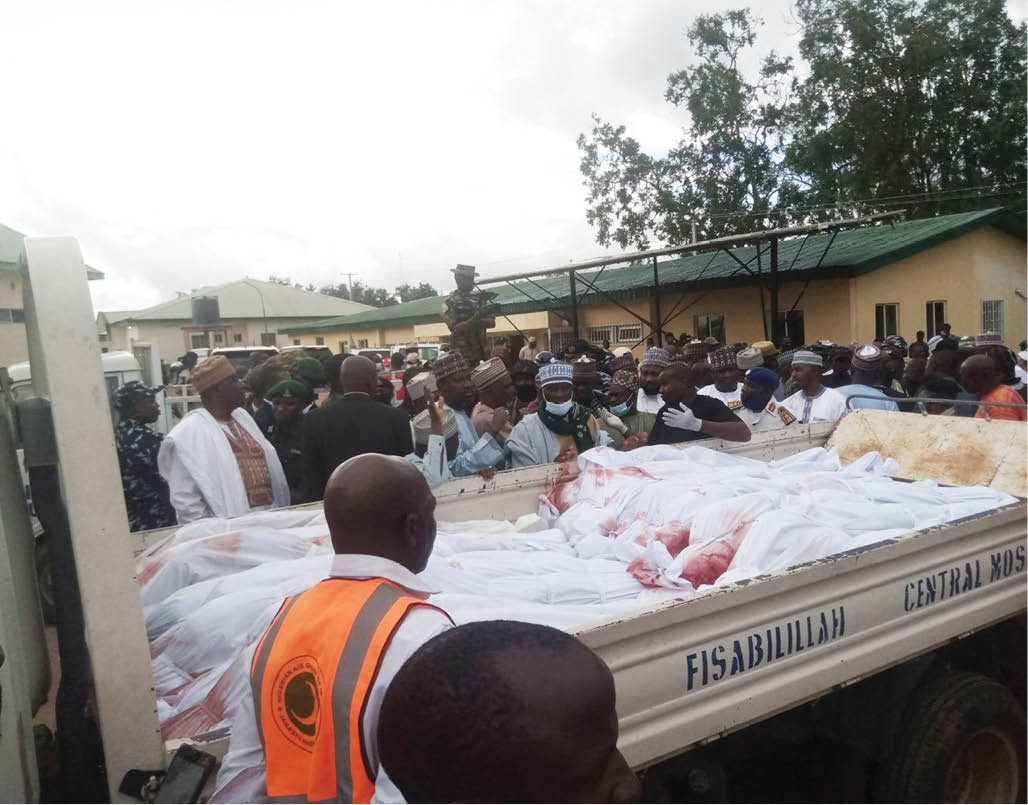
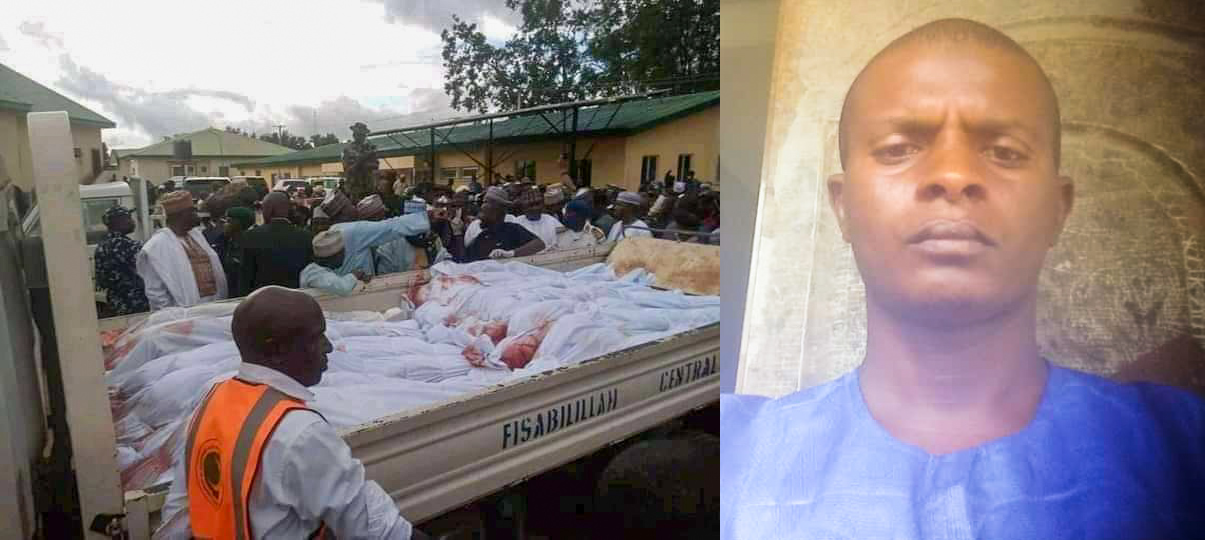
When I was listening to the Annual Muhammadu Sanusi II Colloquium online at around noon on Saturday, a call from a Jos-based friend interrupted my network. His heart was panting as he told me about an attack on travellers in Jos. However, he said he had no additional information; he only added that corpses, drenched in blood, had been brought to the Jos Central Mosque.
I immediately began to make calls, hoping I could speak directly with some survivors if there were any. But, unfortunately, I could not get any until the early hours of Sunday when I received an SMS from my source in Jos with the phone number of one survivor named Haruna Muhammad.
Haruna, 36, was the only man from Ogun state who joined other 53 Ondo and Kogi states based Muslims to travel to Shaikh Dahiru Usman Bauchi, a renowned Islamic scholar of the Tijjaniya Sufi Order in his home in Bauchi state. The 54 Muslim faithful travelled in a convoy of 5 hummer busses from Ondo state through Jos and arrived at Bauchi in the early hours of Friday “for a Friday litany with the Shaikh,” said Haruna.
“We left Bauchi for Ondo at around 7 am through Jos.” The journey was peaceful until around 10 am when “we arrived at a place blocked by some youths searching every car passing by. And when it came to our turn, we were asked to all step down of the cars.”
The youths began asking the drivers questions about where the convoy was coming from and where they were heading. “It was obvious they didn’t trust us,” Haruna said, but above all, the youths were angry. Before Haruna or any of his brothers speaks, the youth began shouting, hitting them with sticks, and suddenly, all the convoy dispersed into the nooks of Rukuba for their lives. “None of us has any idea where he’s running to, but we had to try and save our lives,” Haruna recounted.
While in hiding, Haruna watched in dread how the youth used sticks and stones to massacre some of his co-travellers. A viral video shared online by an unknown perpetrator shows how they used to smash and shatter the victims’ heads on the road. Haruna also heard a gunshot but could not identify who was shot at the moment. Twenty-five people were butchered at the spot before the military came to rescue those in hiding, like Haruna and 25 others. One other sustained severe injuries and died later at Plateau Hospital, according to Haruna.
The State Director, Fityanul Islam of Nigeria, Mallam Adam Hamza, who supervised the preparation and burial of the deceased, confirmed that they buried 26 bodies at Dadin Kowa Cemetery of Jos South. The graveyard is a 19-minute drive from the Jos North Central Mosque. The other injured victims are still at the hospital receiving treatment.
I asked Haruna why they chose to follow Rukuba Road since that wasn’t the road they followed to Bauchi. “One of us proposed that Rukuba Road would be better,” he said, “and then one of the drivers said he too knows the road. So, he led the convoy.” None of the five drivers, however, sustained an injury. All 5 were non-Muslim Yorubas from Ondo state. Before the military arrived at the scene, Haruna confirmed that one of the cars was set on fire, and another driver luckily drove off his car to safety. As of this morning, that driver set off for Ondo. Haruna and other survivors are still in Plateau State, kept at a hotel under the protection of the state government. He assured me they are well taken care of under the supervision of Fityanul Islam of Nigeria.
All this appeared to come to the authorities with shock, according to Mallam Adam. Some government officials who attended the burial include Secretary to the state government, who was said to have represented the state governor, Simon Bako Lalong. Others include the state police commissioner, CP Edward Egbuka, and General Officer Commanding (GOC) of the Jos 3-Division, General Ibrahim Ali. The CP and GOC also visited the scene of the massacre on Saturday.
All efforts to speak with one of the government officials were not successful. However, in a press statement, the Plateau State Government, in response to the massacre and avoidance of counter-reprisal, imposed dusk-to-dawn (6 pm – 6 am) curfew in Bassa, Jos South and Jos North local governments at 3 am on Sunday. But unconfirmed reports coming from Jos North this morning indicate that the atmosphere is intense.
It’s no wonder that through its Director of Press, Dr Makut Simon Machan, the state government released another statement at exactly 11:02 am today that imposing a 24-hour curfew in Jos North “to contain further security threats”.
It could be recalled that on Wednesday, August 4, 2021, an attack on travellers was recorded where a truck full of animals was set ablaze at Gada Biyu, a trekking distance from Rukuba Road. That attack was said to be a reprisal as Fulanis were said to have attacked Irigwe houses and destroyed farms in other state villages.
Yesterday’s attack could also be a continuation of the previous reprisal. Survivors and locals call on the Plateau state government to look into the root cause of these killings as a matter of urgency and ensure justice is served. Any delay could return Jos North to its dark days when people get killed sporadically if they (mistakenly) entered territory belonging to another ethnicity or religion other than theirs.
Haruna Muhammad further urged the Federal and State government to ensure the arrest of all who were responsible for the merciless killings of his innocent brothers on August 14 2021. He said whatever misunderstanding is going on between the tribes in Plateau state, his brothers know nothing about it, and their killings shouldn’t be unchecked. The massacre yesterday left 26 people dead and 33 survivors, including the drivers.