Qatar

The 2022 Qatar FIFA World Cup: Triumph of cultural tolerance and setback to clash of civilisations

By Babayo Sule, PhD

The 2022 Qatar FIFA World Cup is no doubt a beginning of a fresh era in intercultural relationships globally because of the indelible marks of perception, dynamism, fresh vigours, advancement of a new model and, most importantly, the introduction of a new style of reception, fanfare and farewell from the host to the world. Hosting a gargantuan event like FIFA World Cup is certainly a herculean task that financial muscles and political influence alone cannot earn. It takes beyond the lobby, indefatigable consultations, display of economic prowess, commitment, smart strategies that will outsmart competitors and, above that, a clandestine promise of delivery and reliability. Of course, Qatar surmounted all these obstacles and won the hosting. Beyond that, the World Cup was successfully organised, hosted, done and dusted most sublimely and fashionably way to some groups, perhaps.

Not long ago, some Western scholars, including Fukuyama (1996), Huntington (1996) and Lewis (1992), struggled hard to convince the world that the Western ideology, civilisation and system are forever the best and can never be competed with or matched in any circumstances. But for the critical counterattacks of the likes of Sa’id (2005), Harun Yahaya, Nefeily (2002) and some others, the Fukuyama-led cultural clash nearly succeeded in defeating the world to surrender to the almighty West and despair from any form of competition. Fortunately, the Sa’id-led counterattacks made us believe that cultural clash or advancing it is an act of ignorance that can be suppressed with dialogue and better understanding built on tolerance and respect. The approach of Qatar to the 2022 FIFA World Cup practically convinced us to discard the former school and hold firm on the latter.

When I learnt that the small country of Qatar, with just a population of 3 million, spent a breath-taking $200 billion, I cautioned myself to wait patiently and see what the country is after because my inner ego told me that the country is definitely up to something otherwise it will be crazy enough to believe this embezzlement amidst the myriads of squalor, deprivation, abject penury, natural disasters and other sufferings emanating from armed conflicts in the Muslim-dominated states. Qatar should have diverted this huge amount of money for humanitarian intervention in the most affected states, but my curiosity continues to deter me from concluding without seeing the actual intention. At last, it is revealed glowingly most passionately and soothingly to the global Ummah that Qatar invested in a modern and strategic Jihad.

Football is arguably the most unifying festival or even phenomenon globally, more than anything. Even religion today is not hypnotising like football, especially among youth. Take Nigeria, for example. Divisions are sharp and threatening to national unity in virtually all matters, even that of critical national importance like security, except for football. In an employment to strategic parastatals or apportion of a political position, no section of the country will tolerate the composition and the outlook of the national team, the darling Super Eagles. But in football, Ahmed Musa can score against Argentina in the World Cup, celebrate by prostrating before Allah (SWT), one of the major pillars of five congregational daily prayers and a major point of bringing one closer to his Creator, the Hausa/Fulani, Igbos, Yorubas, all the more than 400 ethnic groups, the Muslims, Christians, ritualists, animists and the North and South will unanimously celebrate the goal without minding exactly the mode and pattern of the celebration of the player. The same thing is applicable if a Christian player scores and celebrates using his religious signals and symbols. But for football, what can be tolerated that way in our mother country? Should a Minister prostrate in front of a national broadcast to celebrate the country and the achievement of his Ministry, trending impending insults among divided Nigerians will take weeks actively?

For Qatar, the small country lured the globe to its culture and way of using football as a tool. The country satisfactorily met all the requirements and fulfilled all the datelines, resources, infrastructures, provisions and all that is needed to host a successful World Cup. On several visits, the FIFA team always expressed its satisfaction with the level of preparations and provisions made by Qatar. However, some days before the commencement, Qatar boldly rose its head before the world and declared that it is a country of faith, culture, values and a system that must be respected without any compromise. Alcoholism in the stadiums, gay and other amoral attitudes are banned throughout the event, and any violation will surely attract a sanction according to the laws of Qatar governed by the Shari’ah system. Instantly, the belief that the West has in cultural clashes and the arrogant display of the ethnocentric chauvinism of superiority surfaced.

The Western media pounced on Qatar, and some even threatened to either boycott the event or Qatar must be forced to rescind its decision and guidelines for attending the event. Qatar stood firm and pledged never to compromise its stand on the ground that Qatar respects all cultures, and anywhere the citizens of the country visit, they respect and adhere to the guidelines, principles and laws of the land; then, why should her own be different? In what ways is any culture superior or advanced or super enough to bulldoze and overshadow the host culture? Fortunately, the FIFA President, being honest, frank and fair, supported Qatar fully and chided the West for, according to him, ‘its hypocrisy, intolerance, arrogance and immorality. Instead of the West apologising to the world for its more than 300 years of plunder and arrogance, it is parading tits trademark again’. The Western media, unrelenting, resorted to blackmail that the FIFA officials were bribed to grant Qatar the hosting, and the FIFA is bribed to approve the preparations and accept the conditions of Qatar without any protest.

The West, which mesmerised and dazzled the world with its modern scientific and technological advancement, effervescent skyscrapers, efficient system, and continuous innovation, failed the simple test of tolerance, respect and morality. The moral bankruptcy appears disappointing. Sayyid Qutb earlier berated the West for its handicap in a moral view. He expressed his wonders in seeing the miraculous feat achieved by the West in technology and development but rebuked them for moral emptiness, cultural intolerance, intellectual fallacies of distorting Islamic culture and values to him and bestiality exhibited by humankind in their societies. The FIFA President himself chastised the West for its sheepish behaviour and the display of immorality to the level of bestial nuptiality. The West arrogantly believed that it had the monopoly of setting the agenda for even cultural perception. The long-term monopoly in the political and economic control of the world intoxicated the West to believe that it must always determine the standard for anything, and it must have its way. But Qatar, a small but mighty country, challenged this view and put a sudden stop to it in style.

Qatar designed a Jihad model and unveiled it where all the attentions are. They say, ‘hit them where it hurts’, and Qatar hit where it hurts, but it soothes many. The opening ceremony sent waves of meticulous fantasy and a display of a fabulous enigma of people that aspired to differ in all ramifications from the acclaimed normal norm. Instead of the noisy fanfare, thunderous jamboree and a competition to display nudity and craziness of masquerades, the environment of the opening ceremony was ensconced in a serene clime with the melodious recitations of the Glorious Quran and a lullaby of the romantic Arab scents and marvellous dressing. The spectators silently listened and were hypnotised by the beauty and eloquence of the Qur’anic recitation.  

Instantly, the campaign of calumny, blackmail and propaganda swung into action in the West. The BBC declined to air the opening ceremony. The major Western media embarked on futile and baseless negative reporting. For instance, the Independent of November 21st 2022, wrote a piece mocking Qatar, the host, titled ‘Qatar World Cup defeat proves there are some things in sport you can’t pay for’. Another article in the Independent in the date titled ‘Qatar’s opening World Cup impression slips into disaster on and off the pitch’.

In another propaganda, CNN reports in an article on 20th November 2022, ‘Qatar makes World Cup in a debut controversial tournament of firsts’. The 24th November 2022 article by the Independent titled ‘What on earth is Morgan Freeman doing in Qatar? Queried why Morgan Freeman should be in Qatar. In the assumption of the Western media, Qatar spent lavishly to win. When and where World Cup opening match is won by the host? Morgan Freeman is seen either as too civilised to be in Qatar to attend a Qur’anic opening ceremony or irrelevant. The motive of Qatar is entirely a different ball game. Qatar has won the World Cup in the eyes of the fair-minded, culturally-tolerant but specifically, the Muslim world. The Jihad exhibited a moderate contemporary approach, and the resistance against the imposition of alien cultures to then host succeeded in opening the eyes of the imperialised and the international relations and international system will, of course, never be the same again.

Other resistance to neo-colonialism and new imperialism are unfolding courtesy of what Qatar did. Peacefully but assertively, Qatar altered the shape of the global political economy for keen observers. Even Huntington must revisit his clash of civilisations and rethink the remaking of world order beyond his only perceived clash.

The damages that the West self-inflicted in the effort to spoil the World Cup show in Qatar can take many decades or centuries to restore. For example, they are enlightening the world to resist any culture that it is not comfortable with, starting with their forceful imposition. They may continue to lure and influence the world using economic leverage and threats, but countries that are self-conscious, like Qatar, which internally recycled its economic buoyancy, will resist and counter. African states may take a lesson or continue to be humiliated by the world at will. The West, in its intolerance, informed the world that the crusade for human rights, democratisation and other dangerous exports (Blum, 2013) might be resisted, and it is a setback to its agenda of ruling the world using institutions and agreements.

Another lesson the world learnt from the weird attitude exhibited by the West in Qatar is to draw back and resist any attempt to denigrate or demean any culture, value, faith or nation. It is a scientific gateway for many global policymakers and key players to justify when pushing an agenda or tackling it. The worse of the scenarios is the moral emptiness and sheepish attitude of some countries and their football teams. The sport, as if it were a living organism, showed them an early exit to save the world from their embarrassment and allowed the serious-minded ones to battle it out.

One fascinating scenario in Qatar that will outlive the tournament and qualify the event to be extraordinary is that the vulgarity of Qatar is not leaving any stone unturned in its newly discovered Jihadism. The likes of Dr Zakir Naik were offered the opportunity to display their prowess in Da’awah, and the accommodation was designed to introduce the Islamic process of cleansing from impurity, a discovery that leaves many visitors dazzled and interested in Islamic teaching. The calls to prayer, display of Qur’anic verses from all angles of the city and Prophetic golden words all revealed exactly what Qatar spent its money for and not what the Independent article misperceived or tried to push deliberately. The final or closing ceremony after Argentina won the Cup was exotic. African musicians, including the Nigerian Davido, were invited but were confined to the World Cup tune prepared by a Qatari singer. The best player, Lionel Messi, was decorated in the regalia of the most valuable Arabian dress instead of the obscured juju and the usual spray of liquor and other madness that have no place in most civilisations but are being pushed down the throats of the communities by the imperial powers.

The World Cup has come and gone, but its memory will forever relish our minds and in what Qatar did, ‘Verily, in this is a Sign: but most of them do not believe’ (Q26:8). Qatar has opened a gateway for other world countries to liberate themselves from the encumbrances of new imperialism and neo-colonialism that is used to push the imperialism (Nkrumah, 1965). The small country has presented a fashionable and peaceful model of Da’awah that will strategically counter propaganda and a model of Jihad devoid of terrorism. It is a kind of Jihad that is difficult to provide a vacuum for conspiracy or damaging insults. Qatar may face stereotyping and a campaign of blackmail, and other Arabs and Islamic states may not smell the opportunity of hosting the World Cup for the next century or more, provided the West continues to control the world, but world countries can now develop the effrontery to counter abuse and disrespect of their faiths and cultures and may advance to ward off imperialism. African continent may restore its umbilical cord with Latin America and the Caribbean to re-establish a strong, surviving and successful Pan-Africanism. Qatar, in our eyes, is a blessed land of the righteous that present a model of liberation. God bless the country and the tournament!

Babayo Sule (PhD) wrote from the Department of Political Science, Faculty of Humanities Management and Social Sciences, Federal University Kashere Gombe, Nigeria. He can be reached via babayosule@gmail.com.

For my friends who don’t know the Bisht

By Dr Sarah Marzouk

There has been quite a bit of online commentary, some of it quite derogatory, regarding the black robe that Lionel Messi wore prior to accepting the World Cup. For context, I wanted to explain its significance.

The garment is called a ‘bisht’, and it is an outer garment worn in predominantly Arab countries. The name is derived from the Akkadian word ‘bishtu’, which means ‘nobility’ or ‘prestige’.

This garment is considered a symbol of great honour. It’s a status symbol amongst royalty, the wealthy and those with high social rank, much like a cross between ceremonial graduation robes or, in Western terms, wearing a black tuxedo on a special occasion.

When it’s the Emir of a country literally gifting you the bisht, putting it on you with his own hands, it’s the highest honour that can be bestowed upon that civilian. It has nothing to do with religion at all.

Messi may not have understood what it meant when he graciously wore it, but it was the Qatari way of recognising him for the GOAT that he is.

World Cup: Nigeria Embassy in Qatar advises Nigerians to be law-abiding

By Ahmad Deedat Zakari

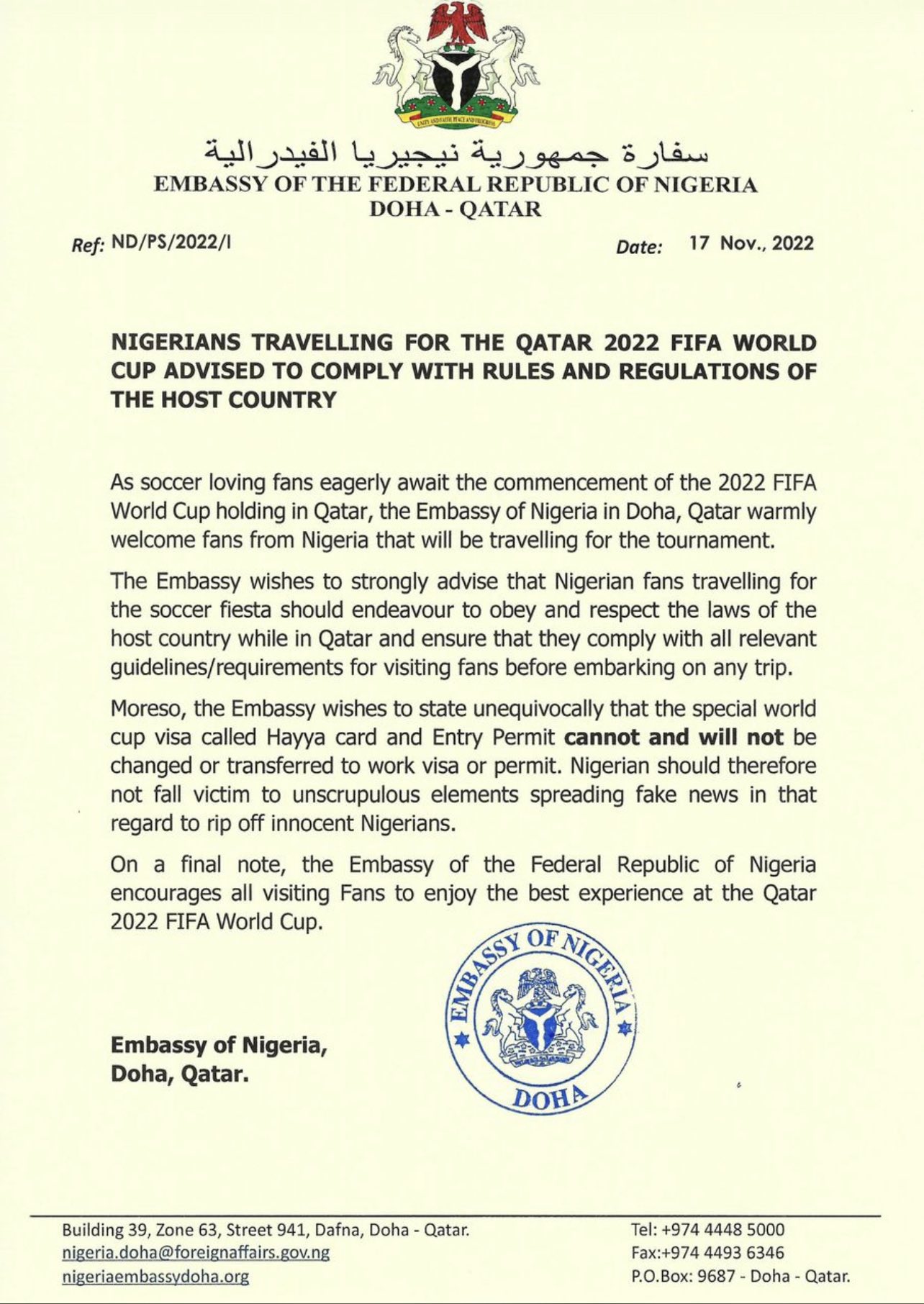
The Embassy of Nigeria in Qatar has advised Nigerians traveling for the World Cup to obey the rules and regulations of the host country.

The advice was contained in a statement signed by the embassy in Doha on Thursday.

“The Embassy wishes to strongly advise that Nigerians traveling for the soccer fiesta should endeavour to obey and respect the laws of the host country while in Qatar and ensure that they comply with all relevant guidelines/requirements for visiting fans before embarking on any trip” The statement read.

The statement further disabused the minds of Nigerians from any attempt to change the special world cup visa and entry permit to work visa. The embassy argued that it is not possible and Nigerians should not fall victims to unscrupulous elements.

“Moreso, the Embassy wishes to state unequivocally that the special world cup visa called Haya card and Entry permit cannot and will not be changed or transferred to work visa or permit. Nigerian should therefore not fall victim to unscrupulous elements spreading fake news in that regard to rip off innocent Nigerians” The statement further stated.

Nigeria did not qualify for the 2022 World Cup and will not be participating in the tournament.

Qatar 2022: Alcohol won’t be sold at World Cup stadiums

By Muhammadu Sabiu

Due to a policy change made by Fifa two days before the tournament’s commencement, alcohol will not be sold at any of the eight World Cup stadiums in Qatar.

Even though alcohol sales are legally prohibited in the Muslim nation, it was planned to be served in select places within stadiums.

Alcohol will still be available for purchase in the corporate sections of the stadiums during the competition.

When Qatar plays Ecuador on Sunday, the World Cup officially begins.

Beer manufacturer AB InBev owns Budweiser, a significant sponsor of Fifa, and it had exclusive rights to sell beer at the World Cup.

A statement from world football’s governing association states, “Following discussions between host country authorities and Fifa, a decision has been made to focus the sale of alcoholic beverages on the Fifa fan festival, other fan destinations and licensed venues, removing sales points of beer from Qatar’s Fifa World Cup 2022 stadium perimeters.”

Qatar: The veiled bride of emigrants

By Abubakar Aminu Ibrahim

Qatar is a peninsular Arab country whose terrain comprises an arid desert, and a long Persian (Arab) submerse shoreline of tantalising sceneries. It is also an industrial country with ultramodern architecture, dawning from its ancient Islamic infrastructure.

Doha, Qatar’s capital city, is well known for its elfin skyscrapers and alluring shores. It is a world-class capital city, home to the limestone Museum of Islamic Art. Thanks to the World Cup tournament, the oil-producing country is ready to spread its dominance by hosting the global spectacle this year.

However, this write-up is not purposely to eulogise Qatar or its capital city, nor attempt to lay statistical predictions of the World Cup tournament. No! But if you are an intending immigrant, if you have started giving a deposit to an agent that will take you to Qatar as a worker, if your dream is to get to Qatar and share all the pictures on WhatsApp, Facebook and Instagram, then fasten your seat belt. The ride is yours.

First of all, let me clarify one thing for you, my friend. Having a dream is not wrong at all; it is, in fact, something inherent in all of us. On the contrary, having the vision of migrating to any country is not wrong. So, chase your dream and work for it. However, you must be careful enough not to be fooled, enslaved and handcuffed by projections and assumptions. If you go anywhere, ensure you hold yourself tied to your honour and integrity. Make sure that your personality as a human is assured.

I write this piece to enlighten some of my people who intend to migrate, especially to Qatar. Qatar is a veiled bride if you are a third-class groom! This write-up shall unveil the bride.

This is an output of research that dip into the plight of migrants in Qatar. Perhaps, emigrants suffer in different places worldwide for specific reasons, but Qatar is uniquely infamous for its treatment of migrants.

 I watched a series of documentaries that taped agonising stories of how blacks and Asians are maltreated in Qatar. Usually, our people cooperate with agents and pay a lot of money to process their migration to countries like Qatar. Contracts are signed with promises, such as shelter, food and a monthly salary. Such deals are always mouth-watering to suffering Nigerians and others across developing countries. But they always come with unbearable prices.

 If you refer to how this write-up described Qatar in the opening lines, the least you should expect from such a country is having almost zero judicial systems that will handle civil charges in courts. But not until 2018 did the city of Doha get a labour court parlour with only six judges to address complaints of its migrant workers. It is even more baffling to hear that the labour court in Doha admitted that out of over two thousand complaints, only sixty-nine were processed (wow!).

These complaints are, in most cases, against host companies of these migrant workers whose salaries are withheld for months. Ibrahim (a Kenyan migrant in Qatar) laments in a France 24 documentary that he and his co-workers received no pay for over three months, and this practice is regular. He added that they were promised good living conditions, food and timely salaries in the contract they signed, but none of these was ever honoured. Worse still, their passports were seized, meaning they could not return home at will.

In another interview with some Philippinos working under a Qatari lady, they said that day was their first day off in their three years of work. Another one cried that he would not want his people to see his condition, and he sometimes goes out at night to snap some happy pictures, even though the police sometimes chase him!

It is disheartening that even in airports, Qatari security agents embarrass travellers and deny them basic provisions, especially if their visitor holds passports from an African country, especially a Nigerian one.

An undersecretary for the Minister of Labour admitted that despite having a tribunal now, some business leaders are opposed to them. Therefore some of the policies are purely and only theoretical. Some migrants taped in court waiting rooms appear visibly hopeless and helpless.

All these are only some of the realities in Qatar, only the victims of this ancient way of thinking can tell you how it feels to be denied your fundamental rights as a human just because of your skin colour or social status. The Doha News proclaimed how migrants build almost all the infrastructures in the country. Yet, when workers die at construction sites, the only tribute they get is having their pictures pasted on a wall. Thanks to the mobile stadium constructed for the World Cup, hundreds of people sacrificed their lives to win bread for their families.

In the final analysis, I aim to make you pause and pose a question for yourself: in what capacity are you migrating? Who are you going to work for? What type of job are you looking for? How are you planning to return home if things do not work out? But, on the other hand, what is your reward at the end if things are working?

Think twice. It is said in Hausa, “tsalle daya a ke a fada rijiya, amma sai an yi dubu ba a fito ba“, which means it takes a single jump into a well, but one will jump a thousand times without getting out.

Abubakar Aminu Ibrahim wrote from Katsina via matazu247@gmail.com.

Qatar introduces Islam to World Cup fans through murals

By Ahmad Deedat Zakari

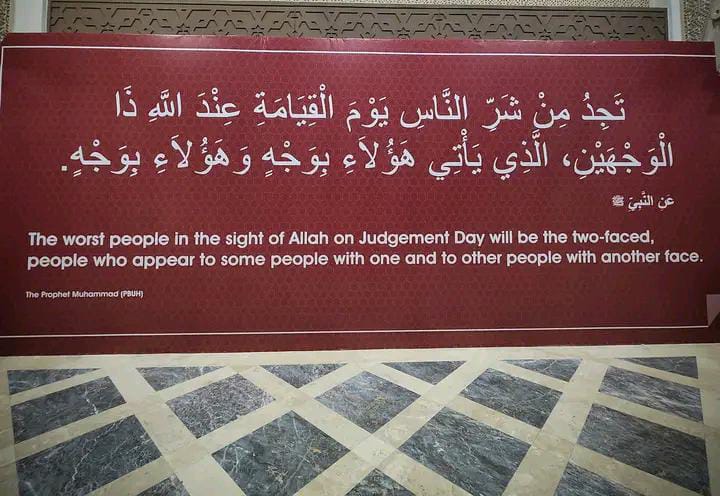
The Qatari government is preaching and introducing Islam to World Cup fans through murals placed in public places.

TRT World reported on Saturday that as Qatar prepares to host the 2022 FIFA World Cup, it has placed several murals in public places bearing Prophet Muhammad’s (PBUH) sayings and traditions written in Arabic and English.

According to the report, the murals feature various sayings on mercy, charity and good deeds. They are situated across the Pearl District, a popular tourist attraction in the Qatari capital, Doha.

The initiative of Qatar’s government has been applauded by many Arab journalists and Muslims worldwide.

Qatar’s government has been unpretentious about not compromising Islamic values because of the 2022 World Cup. However, their stance on homosexuality and the LGBTQ community has been critical; the government deems it unacceptable to their country’s values and norms.

The Head of Security for the 2022 Qatar World Cup, Major General Abdulaziz Abdullah Al Ansari, in a statement, said the country does not want LGBTQ flags in the venues of the World Cup, and LGBTQ is not acceptable to the country.

He said: You want to demonstrate your view about the LGBTQ situation, do it in a society where it will be accepted. Don’t insult the whole society because of this. You cannot change the religion for 28 days”.

Qatar is the first country in the Middle East to host the World Cup, the biggest tournament in the football world.

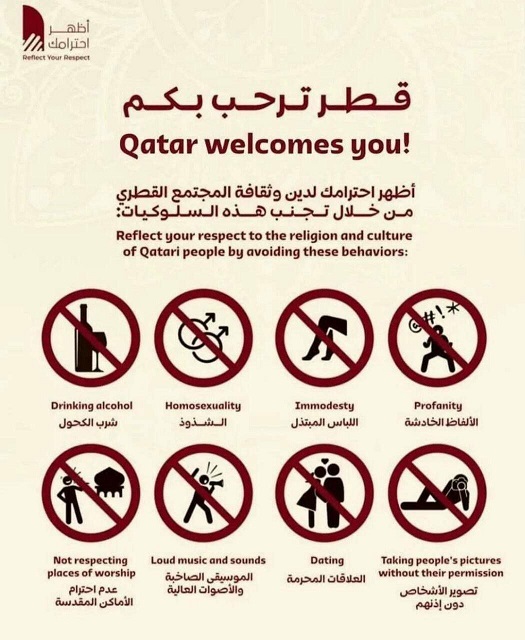
2022 World Cup: Qatar bans alcohol, LGBT, dating, others for fans

By Muhammadu Sabiu

Ahead of the 2022 World Cup, which begins on November 20, the tournament host, Qatar, has released a list of dos and don’ts, especially for fans from other countries.

The wealthy Gulf nation has disclosed that spectators coming should note the bans that have been in place on alcohol, the LGBT community, exposing parts of the female body, and swearing are still in effect.

The host added that disrespect for mosques, loud music and sounds, dating, and taking pictures of people without their consent, are also banned.

Apart from the moral rules, there are also regulations concerning COVID-19 and its vaccine.

The Supreme Committee for Delivery & Legacy mandated that all visitors six years of age and older show proof of a negative PCR test result obtained within 48 hours of their departure or a positive rapid antigen test result obtained within 24 hours of arrival.

Rapid antigen test results from legitimate medical facilities that are not self-administered only will be accepted. If visitors do not exhibit COVID-19 symptoms, no additional testing will be necessary in Qatar.

Additionally, everybody above 18-year-old must download the Ehteraz contact tracing phone app, which the government manages.

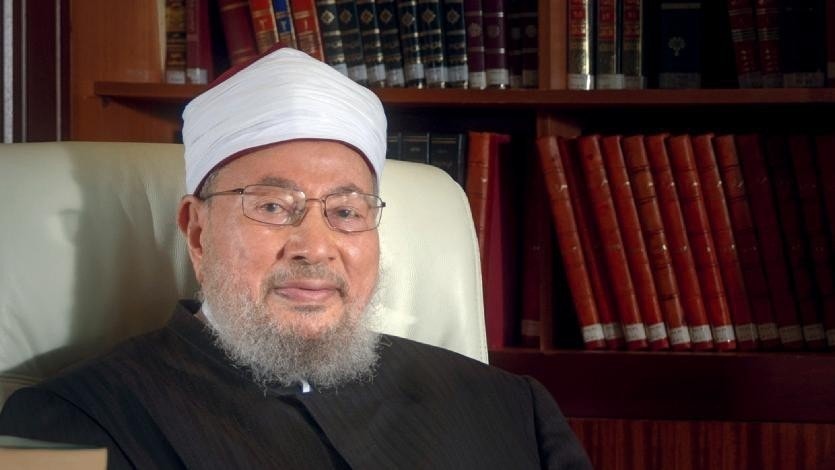
A tribute to Sheikh Dr Youssef Al-Qardawiy (Rahimahullah)


By Dr. Isa Muhammad Inuwa

We woke up to the maddening, stunning macabre and grim sorrow of the demise of Sheikh Dr Youssef Al-Qardawi, renowned scholar and jihadist of international repute. As we weep profusely, both internally and outwardly, over this irreparable loss, his death indicates that the sun has set down for yet another era of Islam, as yet another chapter is closed.

Late Al-Qardawi can go down in history as a titanic whale in the fathomless ocean of Islamic knowledge and jurisprudence. He authored many valuable compendia and an estimated 120 to 200 books, famous among which is Al-Halal Wal Haram, that addressed and gave solutions to vital lawful and unlawful issues in Islam.

He was a contemporary of scholars and jihadists of like minds such as Sheikh Hasanul Bannah, Sayyid Qutub, Sa’eed Hawaah, Kishk and the rest. The personalities mentioned above formed the nucleus of the Islamic Brotherhood movement’ ‘Ikhwanul Muslimuuna’ in Egypt around the 1950s to 1960s.

Ikhwan’s formidable movement under the late Hassan Al-Banna’s leadership served as an alternative political group that brokered power in Egypt by participating in the democratic process and contesting political posts. Former president Muhammad Morsi was a testimony to Ikhwan’s influence in the mainstream politics of Egypt.

More so, the hitherto Islamic movement in Egypt, administered by vibrant and agile youths, had impacted and triggered similar gestures in many countries and Muslim communities worldwide.

While some Ikhwan eggheads, such as Hassan Al-Bannah, were martyred amidst the struggle, others, like the late Youssef Al-Qardawi, survived, lived longer and contributed to humanity on many fronts.

May The Almighty Allah accept the late Sheikh Qardawi and uplift his status in the highest and exalted Jannah, amen!

Dr Isa Muhammad Inuwa writes from Bayero University, Kano, Nigeria, via ismi2000ng@yahoo.com.

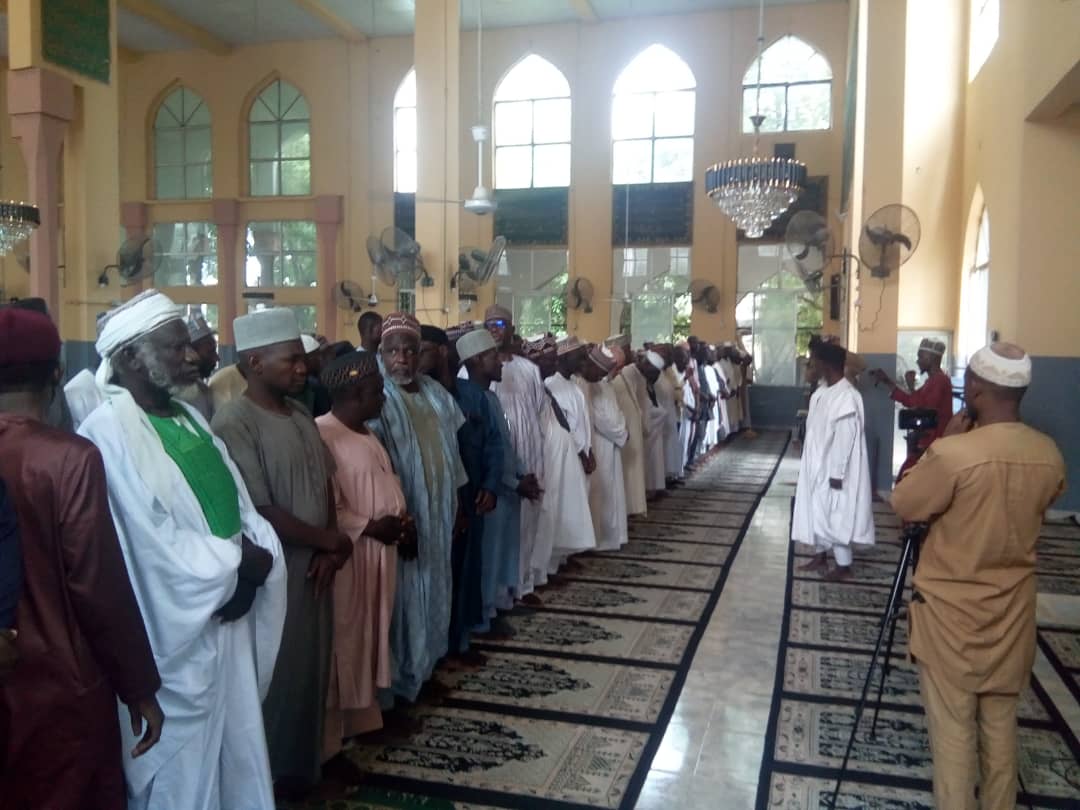
Kano: Muslims observe distant funeral prayer (Salatul Gha’ib) for Late Sheikh Yusuf Al-Qardawi

By Isa Muhammad Inuwa


Thousands of Muslims in Kano, Nigeria, had Thursday converged at the Umar Bin Al-Khattab mosque, where they offered funeral prayer in absentia for the repose of the soul of the deceased Sheikh Youssef Al-Qardawi, who passed on in Doha, Qatar, recently.

Leading the congregation, Imam Sheikh Yahaya Tanko delivered the prayer interluded with four Takbirs (Allahu Akbar! chants) and supplications.

Addressing the crowd shortly after, Sheikh Tanko recalled that the distant funeral prayer was first conducted by the Prophet Muhammad (SAW), in Medina, for the soul of Al-Najjashi, the then late Emperor of Abyssinia (present Ethiopia). Al-Najjashi was deemed to have converted from Christianity to Islam before his death.

Also speaking to the gathering, Professor Muhammad Babangida of Bayero University, Kano, announced that the late Sheikh Al-Qardawi was “a famous Islamic scholar of international standing, who spent the largest part of his life contributing to Islamic knowledge, through his teachings, writings and extracting solutions to religious matters (Fatwa)”.

He added that the late Al-Qardawi authored no less than 170 books, some of which consisted of several volumes. He said he was head of numerous Islamic bodies and that he migrated from his home country Egypt to Qatar because of threats to his life by anti-Islamic forces.

He described the deceased as a moderate jurist who maintained a middle course in proposing solutions on matters of Islamic jurisprudence. “He neither swerved to the extreme nor tilted to the most lenient side”, adding that he was very apt in addressing current issues arising in modern life in his publications and jurisdictions.

The scholar also described Al-Qardawi’s death as a significant loss to the entire Muslim World, whose replacement is difficult to find. He then asked God to forgive the deceased and rest his soul in the highest abode of Paradise.